Market Snapshot
Middle bar: base-year value × (1 + CAGR), rounded to two decimals. This is a calculated illustration, not a separately researched annual estimate.
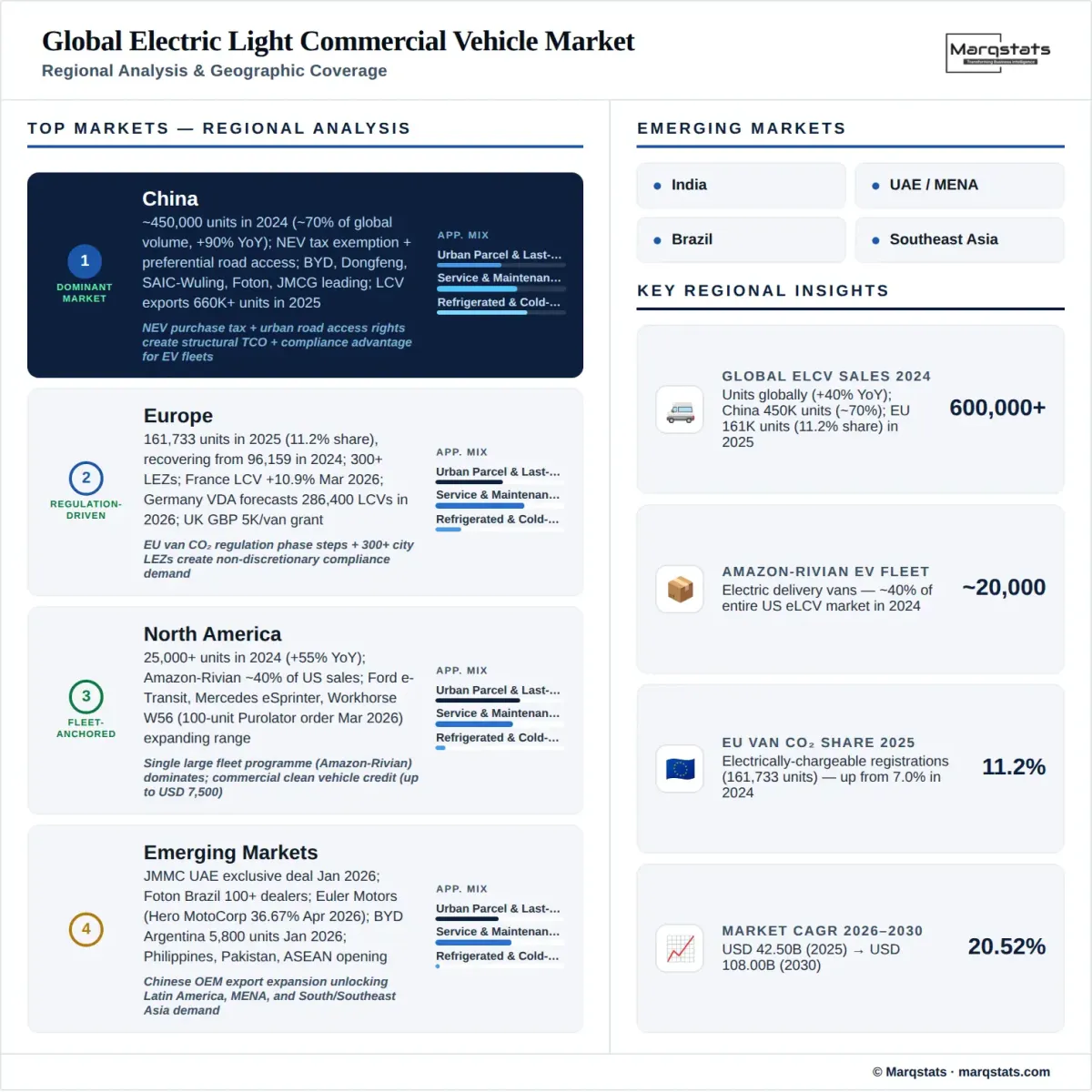
The global electric light commercial vehicle (LCV) market was valued at USD 42.50 billion in 2025 and is projected to reach USD 108.00 billion by 2030, expanding at a CAGR of 20.52% during the forecast period 2026–2030. Electric LCV sales exceeded 600,000 units globally in 2024, growing more than 40% year-on-year with a global sales share of approximately 7%, up from 5% in 2023. Electric LCVs are now the volume leader among all commercial EV segments, surpassing both electric buses and electric trucks in annual unit sales. China dominated with approximately 450,000 units (roughly 70% of global sales, growing approximately 90% year-on-year), while Europe recorded fewer than 120,000 units and the United States sold over 25,000 units (growing 55% year-on-year).
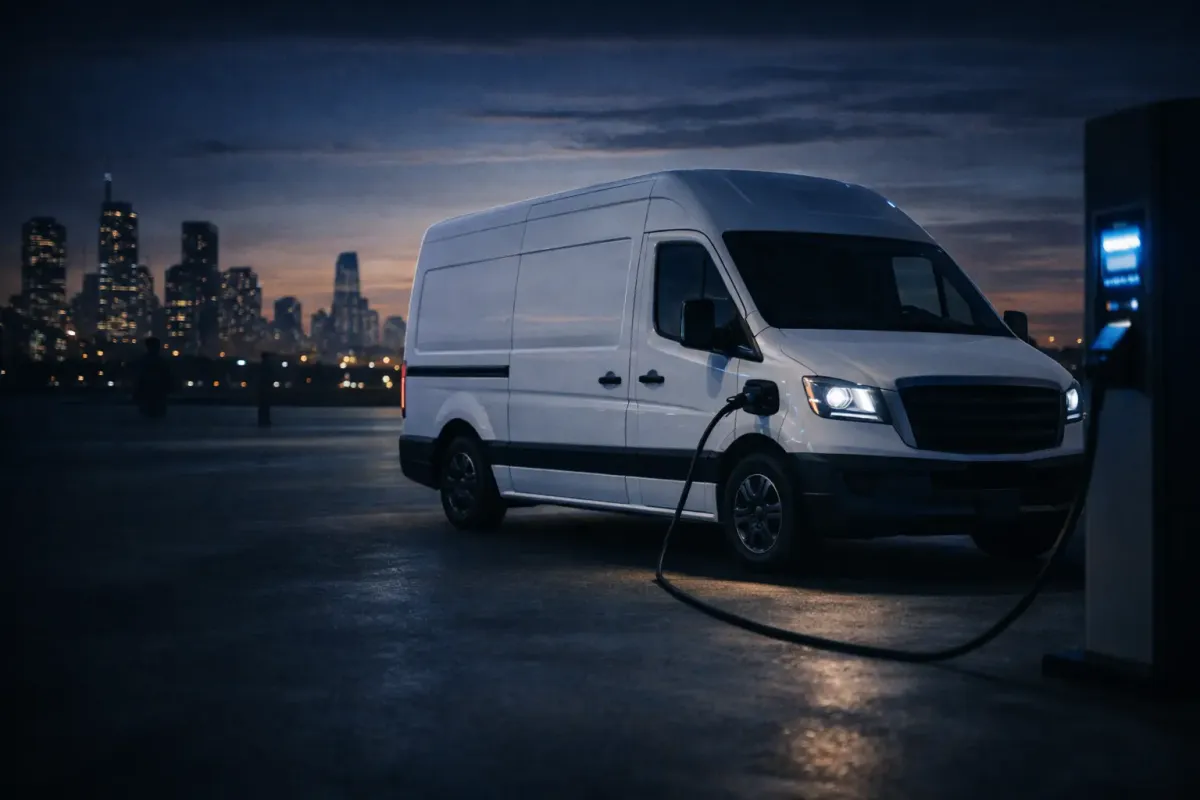
This is fundamentally a fleet logistics and urban delivery market, not a smaller version of the passenger EV market. Electric vans are central to demand because their operating patterns—predictable urban routes, return-to-base depot charging, high daily stop density, and route-level cost sensitivity—create the strongest economic case for electrification in commercial transport. The market is driven by e-commerce parcel delivery growth, fleet operating economics approaching and often achieving parity with diesel in energy and maintenance costs, city access restrictions through low-emission zones (LEZs) and zero-emission zones, and corporate sustainability commitments that compel fleet electrification independent of pure TCO calculations. In the EU, electrically-chargeable van registrations surged to 161,733 units in 2025 (11.2% market share), recovering sharply from a 2024 dip of 96,159 units that reflected incentive changes and regulatory phase timing effects.
The market is moving beyond first deployments toward operational optimisation: right-sizing battery packs to match route energy requirements, managing charging through dispatch and fleet scheduling software, standardising maintenance workflows, and addressing specialty applications such as refrigerated delivery where auxiliary loads fundamentally change energy and charging needs. Large fleet procurement programmes are materially shaping market scale—Amazon operates approximately 20,000 electric delivery vehicles through its agreement with Rivian, and Rivian represented roughly 40% of US electric LCV sales in 2024. Approximately ten new electric LCV models were introduced across Europe, Korea, and the United States in 2024, expanding the addressable market from small urban vans through large panel vans and chassis cabs. The competitive landscape is being reshaped by purpose-built electric van platforms, fleet software integration, and Chinese OEM export expansion.
Key Takeaways
Market Overview & Analysis
Report Summary
The electric LCV market encompasses battery-electric vans, plug-in hybrid vans, electric pickup-based LCVs, and purpose-built electric delivery vehicles up to 3.5 tonnes gross vehicle weight deployed in urban parcel delivery, grocery and food logistics, postal services, service and maintenance fleets, municipal light operations, refrigerated delivery, and field service applications. The market covers the full operating system: vehicles, depot charging infrastructure (AC overnight and mixed AC/DC for multi-shift), managed charging and fleet energy management software, body conversion and upfitting ecosystems (refrigeration, shelving, racking), and the procurement and financing structures that govern fleet transition.
Electric LCVs achieve early TCO competitiveness because energy cost per kilometre is relatively low (typically 0.15–0.25 kWh/km for a standard panel van), maintenance is simplified versus internal combustion engines, and vehicles return to base enabling lower-cost overnight depot charging at commercial electricity rates. The IEA notes that in some European segments, electric LCV total cost of ownership already equals or underperforms conventional alternatives for certain applications, while policy and incentives materially affect harder-to-electrify LCV applications. However, China’s 2024 growth of approximately 90% contrasted sharply with Europe’s approximately 10% decline, demonstrating how incentive structures, regulatory phase timing, and NEV tax policy eligibility can create divergent regional trajectories even as the underlying technology matures.
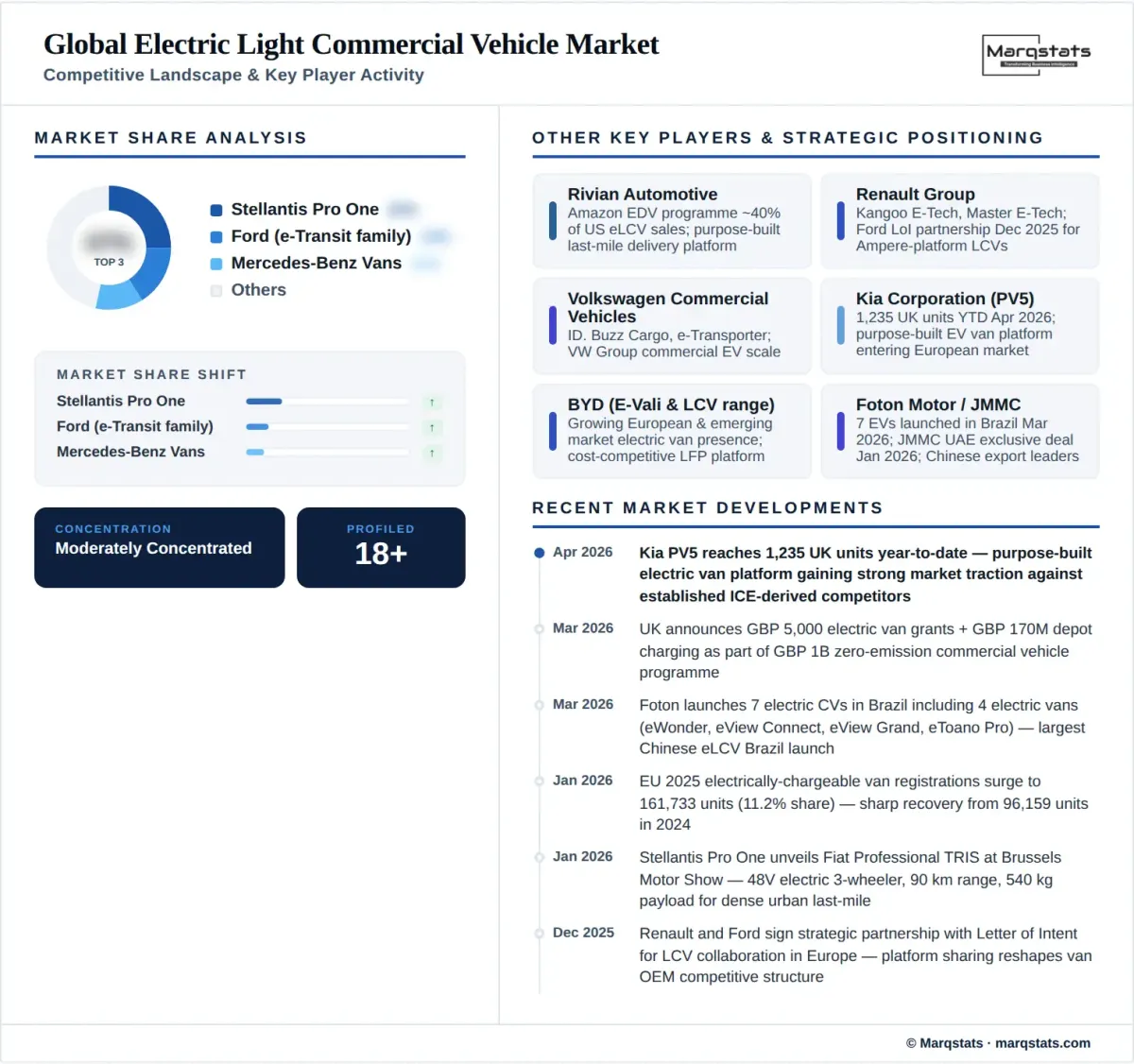
The competitive landscape is shaped by three intersecting forces: OEM product breadth across small, medium, and large van segments; fleet relationship depth including upfit ecosystems for refrigeration, shelving, and specialised bodies; and charging plus energy management integration. Ford’s e-Transit line expansion, BYD’s E-Vali introduction, Mercedes-Benz’s eSprinter US launch, Kia’s PV5 entering the UK market (1,235 units year-to-date by April 2026), and Stellantis Pro One’s Fiat Professional TRIS electric three-wheeler for last-mile delivery illustrate the broadening product range. Renault and Ford signed a strategic partnership in December 2025 including a Letter of Intent to explore collaboration on light commercial vehicles in Europe, potentially combining Renault’s Ampere platform expertise with Ford’s commercial vehicle distribution strength.
Market Dynamics
Key Drivers
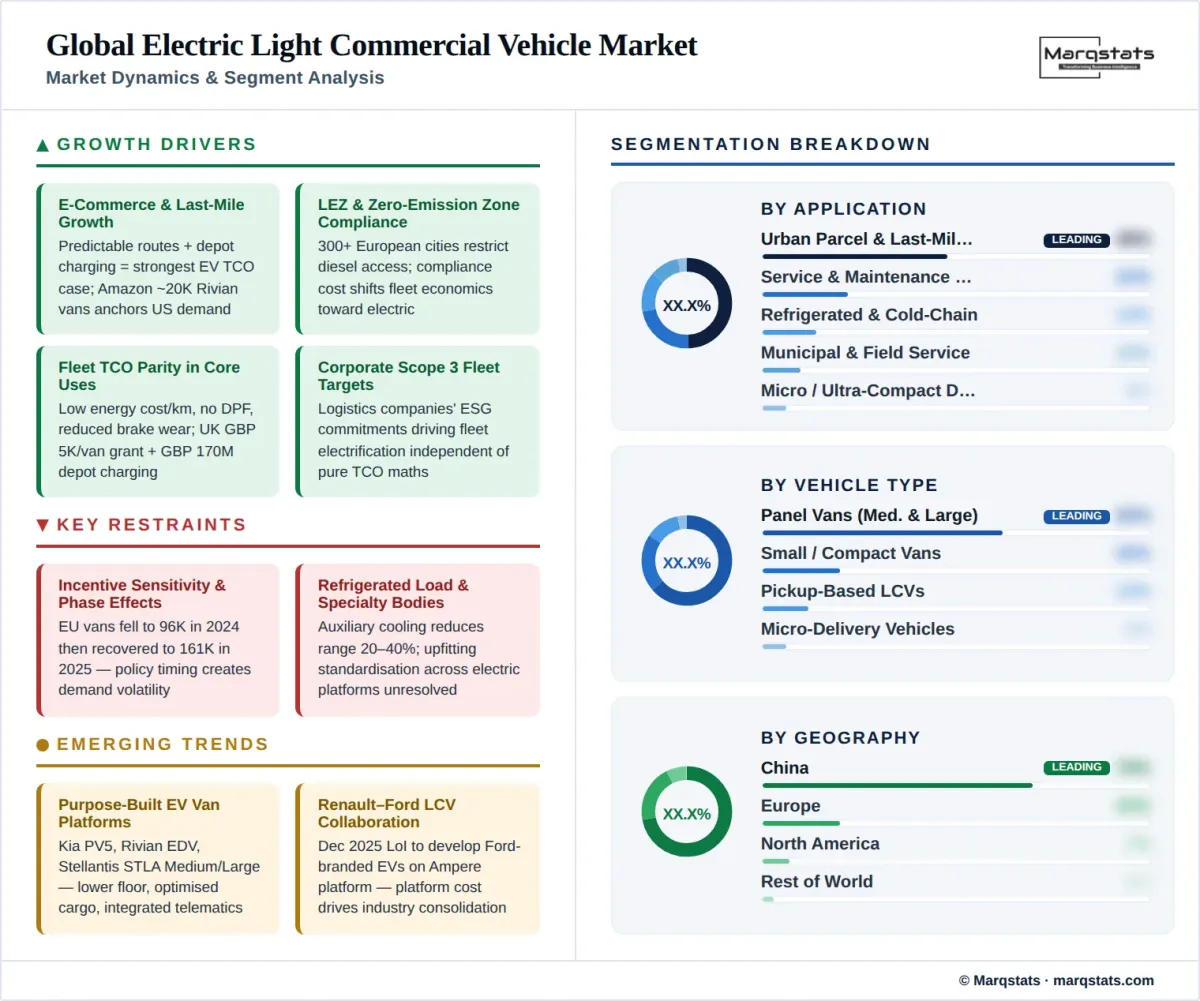
- E-commerce and last-mile delivery growth creating structural demand: The exponential growth of online retail, quick commerce, and same-day grocery delivery is driving demand for urban delivery vans that operate on predictable routes with high stop density. Parcel and logistics fleets are the primary adopters because their operating patterns—fixed daily routes, return-to-base charging, known payload requirements—create the strongest economic case for electric vans. Amazon’s approximately 20,000 electric delivery vehicles through Rivian demonstrate how a single fleet programme can anchor national-scale demand.
- Low-emission zones and city access restrictions compelling fleet transition: Over 300 European cities operate some form of low-emission or zero-emission zone, restricting diesel and older vehicle access to urban centres. London’s ULEZ, Paris’s ZFE, Amsterdam’s planned zero-emission logistics zone, and Berlin’s environmental zone directly affect fleet operators’ ability to serve urban customers. These access restrictions shift fleet economics by creating a compliance cost for diesel operation that makes electric vans economically necessary, not merely advantageous.
- Fleet operating economics reaching parity in core applications: Electric vans achieve TCO competitiveness in urban delivery because energy cost per kilometre is low, maintenance is simplified (no oil changes, reduced brake wear through regenerative braking, no diesel particulate filters), and depot charging at overnight commercial rates is the lowest-cost refuelling method available. The UK’s March 2026 announcement of continued electric van grants (up to GBP 5,000 per van) and GBP 170 million for depot charging directly addresses residual capex gaps.
- Corporate procurement targets and Scope 3 commitments: Major logistics companies, postal services, and retail corporations are setting fleet electrification targets driven by Scope 3 emissions reporting, ESG investor pressure, and customer sustainability demands. These corporate procurement commitments can be as decisive as government policy because large fleet players can underwrite charging infrastructure buildout and guarantee volume for OEMs. The IEA notes corporate procurement targets as a material demand driver independent of government subsidies.
- Chinese NEV policy and preferential road rights supporting commercial adoption: China’s NEV purchase tax policy provides continued support under a 2024–2027 structure, with full exemption through 2025 and reduced tax for 2026–2027. Preferential road access rights for NEVs in Chinese cities—including exemption from license plate restrictions and urban delivery time windows—directly improve utilisation and operating economics for electric LCV operators, contributing to China’s 90% year-on-year growth in 2024.
Key Restraints
- Incentive sensitivity and regulatory phase effects: Europe’s 2024 electric van sales decline of approximately 10% illustrates how changes in purchase incentives and the timing of EU CO₂ regulation phase steps can create year-to-year volatility. When subsidies expire or tighten before regulatory mandates fully bind, a demand gap emerges. Korea’s stricter subsidy performance requirements effectively restricted subsidies for LFP-battery models (often Chinese-manufactured), demonstrating how policy design shapes the competitive set.
- Upfront cost premium versus diesel equivalents: Electric vans typically carry a 30–50% purchase price premium over equivalent diesel models, though this gap is narrowing as battery costs decline. For smaller fleet operators without access to fleet financing, green bonds, or government grants, the upfront cost remains the primary adoption barrier even when lifecycle TCO favours electric.
- Limited depot charging access in dense urban environments: In dense urban markets, limited private parking and depot space can restrict fleet operators’ ability to install overnight charging infrastructure. Operators without dedicated depots must rely on public or workplace charging, which increases cost uncertainty and scheduling complexity. Multi-tenanted logistics facilities face additional challenges in allocating electrical capacity across operators.
- Refrigerated and specialty body requirements increasing complexity: Refrigerated delivery vans require auxiliary power for temperature-controlled cargo, fundamentally changing energy consumption, range, and charging requirements. Auxiliary refrigeration loads can reduce effective range by 20–40% depending on ambient temperature and cargo requirements. Standardising body conversion and upfitting workflows across electric platforms remains a challenge, particularly for temperature-controlled pharmaceutical and food logistics.
Key Trends
- Purpose-built electric van platforms replacing converted ICE architectures: The market is shifting from ICE-derived electric conversions toward purpose-built electric van platforms optimised for commercial use. Kia’s PV5 (1,235 UK units year-to-date), Rivian’s Amazon delivery van, and Stellantis’s STLA Medium and STLA Large commercial platforms represent this shift. Purpose-built platforms offer lower floor height, optimised cargo volume, integrated telematics, and packaging advantages that converted platforms cannot match.
- Fleet software and managed charging as competitive differentiators: Fleet scheduling, route optimisation, and managed charging software are becoming integral to the electric LCV value proposition. Managed charging reduces peak power demand charges by 20–40%, integrates with dispatch scheduling to ensure vehicles are charged for their specific daily routes, and provides fleet managers with real-time state-of-charge visibility. OEMs and fleet management companies offering integrated vehicle-charging-software solutions capture higher share than those selling standalone vehicles.
- Renault-Ford LCV collaboration signalling industry consolidation: Renault and Ford signed a strategic partnership in December 2025 to develop Ford-branded EVs on Renault’s Ampere platform, including a Letter of Intent for light commercial vehicle collaboration. This signals that LCV platform development costs are driving industry consolidation, with OEMs sharing electric architectures while differentiating through brand, service, and fleet relationships. Changan Auto is also considering selling light commercial vehicles in Europe as part of its eight-country expansion strategy.
- Micro and ultra-compact electric delivery vehicles for last-mile: Stellantis Pro One launched the Fiat Professional TRIS, a three-wheeled 100% electric pickup for last-mile delivery at the 2026 Brussels Motor Show. At 3.17 metres long with a 3.05-metre turning radius, 540 kg payload, and 90 km range, TRIS targets dense urban environments where standard vans cannot access narrow streets. This micro-delivery segment addresses the growing demand for pedal-assist cargo bike alternatives with weather protection and higher payload.
Market Segmentation
Urban parcel delivery is the highest-readiness segment and the primary volume driver for electric LCV adoption. These vans operate on predictable daily routes of 80–200 km with high stop density, return to base nightly for depot charging, and carry payloads of 500–1,500 kg. Amazon’s approximately 20,000 Rivian delivery vans, DHL’s StreetScooter programme, and major European postal operators’ electric van fleets demonstrate the segment’s maturity. Battery capacities of 40–80 kWh are typically sufficient for daily operational requirements.
Utility companies, telecoms, building maintenance, and field service operators represent a growing adoption segment. These fleets operate on semi-predictable urban routes, carry specialised tool loads rather than parcels, and return to depot for overnight charging. The segment values reliability, uptime, and integrated shelving and racking systems. Electric vans reduce operating noise for residential service calls and eliminate idle emissions during extended on-site work periods.
Refrigerated delivery is the key frontier segment where auxiliary cooling loads fundamentally change energy consumption, range, and charging economics. Auxiliary refrigeration can reduce effective range by 20–40% and requires careful thermal management integration. The growth of grocery delivery, pharmaceutical cold-chain logistics, and meal kit distribution is driving demand for electric refrigerated vans. Solutions include battery-powered auxiliary cooling units (eliminating diesel-powered TRUs), integrated thermal management systems, and purpose-built insulated cargo bodies.
Electric pickups represent a market- and policy-dependent segment with definitions varying by region. In North America, electric pickups (Ford F-150 Lightning, Rivian R1T, Chevrolet Silverado EV) serve both personal and commercial markets. In emerging markets, compact electric pickups target urban utility and light commercial applications. Isuzu launched the D-Max EV in Thailand in March 2026 for local sale and European export. The segment’s commercial relevance depends on payload capacity, towing capability, and depot charging compatibility.
Micro-delivery vehicles address dense urban environments where standard vans face access, parking, and manoeuvrability constraints. Stellantis’s Fiat TRIS (3.17 m length, 540 kg payload, 90 km range, 48V electric motor) targets this niche. These vehicles bridge the gap between cargo bikes and standard vans, offering weather protection, higher payload capacity, and regulatory compliance as motor vehicles rather than bicycles.
By Geography
China
China is the dominant global electric LCV market with approximately 450,000 units sold in 2024, representing roughly 70% of global sales and growing approximately 90% year-on-year. Adoption is driven by NEV purchase tax exemption (continuing through 2025 with reduced rates in 2026–2027), preferential road access rights exempting NEVs from license plate restrictions and urban delivery time windows, and the domestic manufacturing cost advantage. BYD, Dongfeng, SAIC-GM-Wuling, Changan, Foton, and JMCG are leading manufacturers. China’s LCV exports exceeded 660,000 units in 2025 (including ICE), with electric models comprising a growing share. JMMC (JMCG) signed an exclusive UAE distribution agreement with AW Rostamani in January 2026 for electric vans and buses.
Europe
Europe is the second-largest electric LCV market but experienced a notable 2024 dip (EU electrically-chargeable vans declining to 96,159 units) before recovering sharply to 161,733 units in 2025 (11.2% share). The recovery reflects the tightening impact of EU van CO₂ regulation phase steps and growing low-emission zone enforcement across 300+ cities. Key markets include France (LCV sales +10.9% in March 2026), Germany (VDA forecasts LCV market growth of 3% to 286,400 units in 2026), and the UK (Kia PV5 achieving 1,235 units year-to-date, UK government announcing continued GBP 5,000 electric van grants). Renault-Ford’s December 2025 LCV collaboration LoI and Stellantis Pro One’s expanding portfolio (including TRIS micro-delivery vehicle) signal intensifying competition. Approximately ten new electric LCV models were introduced in Europe in 2024.
North America
The US electric LCV market sold over 25,000 units in 2024 (+55% year-on-year), with adoption concentrated in large fleet programmes. Amazon’s approximately 20,000 Rivian delivery vans represented roughly 40% of US electric LCV sales. The commercial clean vehicle credit (up to USD 7,500 for qualifying LCVs) supports adoption, though the market remains fleet-led rather than broad-based. Ford’s e-Transit line expansion, Mercedes-Benz’s eSprinter US launch, and Workhorse’s W56 electric step van (100-unit Purolator order in March 2026) are expanding the product range. BYD arrived in Argentina with 5,800 hybrid and EV units in January 2026, and Foton launched electric vans in Brazil, signalling Latin American market development.
Emerging Markets
Emerging markets are opening through Chinese OEM export and local distribution partnerships. JMMC signed an exclusive UAE distribution agreement for electric vans and buses in January 2026. Foton launched four electric van models in Brazil (eWonder, eView Connect, eView Grand, eToano Pro) with dealer network surpassing 100 locations. The Philippines, Pakistan, and ASEAN markets are seeing initial electric LCV introductions through brands including BYD, Foton, and DFSK. India’s electric LCV market is developing through companies such as Euler Motors (36.67% acquired by Hero MotoCorp in April 2026) and Tata Motors’ commercial vehicle division.
How Competition Is Evolving
The electric LCV competitive landscape is structured around three tiers. The first tier comprises global van OEMs with full electric product ranges: Stellantis Pro One (Peugeot e-Expert, Citroën ë-Dispatch, Fiat e-Ducato, Opel Vivaro Electric, RAM ProMaster EV, Fiat TRIS), Ford (e-Transit, e-Transit Custom, e-Transit Courier), Mercedes-Benz (eSprinter, eVito, eCitan), Renault (Kangoo E-Tech, Master E-Tech), and Volkswagen Commercial Vehicles (ID. Buzz Cargo, e-Transporter). These OEMs compete on product breadth, dealer and service network density, and fleet leasing partnerships.
The second tier includes purpose-built electric van manufacturers and new entrants: Rivian (Amazon delivery van, representing approximately 40% of US eLCV sales), Kia (PV5, 1,235 UK units year-to-date), BYD (E-Vali and broader electric LCV range), Arrival/Canoo (restructured), Workhorse (W56 step van), and emerging Chinese manufacturers (JMMC, Dongfeng, Changan, DFSK). Rivian’s Amazon relationship demonstrates how a single fleet partnership can create market-leading volume in a purpose-built segment.
The third tier encompasses the enabling ecosystem: body builders and upfitters (refrigeration units, shelving, racking systems), charging infrastructure providers (depot AC/DC solutions, managed charging software), fleet management and telematics platforms, and leasing/financing companies offering electric van-specific products. Competitive advantage increasingly belongs to players who integrate vehicle, charging, software, and upfitting into a complete fleet solution rather than selling standalone vehicles.
Companies Covered
Companies covered in the report include:
Recent Market Activity
Table of Contents
Coverage & Segmentation
This report provides a comprehensive analysis of the global electric light commercial vehicle market covering the historical period 2021–2025 and forecast period 2026–2030, with 2025 as the base year. The study examines market size in value (USD billion) and volume (units), segmented by vehicle type (panel vans, chassis cabs, pickups, micro-delivery), application (parcel delivery, service fleets, refrigerated, municipal, field service), propulsion (BEV, PHEV), and geography (China, Europe, North America, emerging markets). The competitive landscape profiles 18 leading OEMs, purpose-built platform manufacturers, and enabling ecosystem players.
Primary research includes structured interviews with 40+ industry stakeholders spanning van OEMs, fleet logistics operators, parcel delivery companies, body builders and upfitters, depot charging providers, fleet management software companies, and government policy teams. Secondary research draws from IEA Global EV Outlook 2025, ACEA registration data, CAAM statistics, company disclosures, and fleet operator procurement records. All market estimates represent Marqstats Intelligence proprietary calculations.