Statistics & Highlights

Market Snapshot

Market size in USD Billion
$5.20B
2025
Base year
$5.75B
2026
Estimated
  
$8.35B
2030
Forecast
Largest market
United Kingdom (~50K Converted LCVs/Year, Tipper/Luton/Dropside Leader)
Fastest growing
Electric Van Body Conversion (EU e-LCV Share 11.2% in 2025, Up from 6.1%)
Dominant segment
Tipper, Dropside, and Box Van Conversion (Cargo/Construction Anchor Segments)
Concentration
Moderately Fragmented (OEM Programmes + Regional Bodybuilders)
CAGR
10.65%
2026 – 2030
GROWTH
+$3.15B
Absolute
STUDY PARAMETERS
Base year2025
Historical period2021 – 2025
Forecast period2026 – 2030
Units consideredValue (USD BN)
REPORT COVERAGE
Segments covered8 segments
Regions covered7 regions
Companies profiled15+
Report pages280+
DeliverablesPDF, Excel, PPT
Executive Summary

Key Takeaways

Market valued at USD 5.20 billion in 2025, projected to reach USD 8.35 billion by 2030 at a CAGR of 10.65% (2026–2030) — EU van registrations of 1,447,273 in 2025 and UK LCV registrations of 315,422 provide the addressable chassis-cab and panel-van conversion base, with conversion penetration rates varying from 15–25% of van registrations in cargo/box segments to 60–80% of chassis-cab registrations across tipper, dropside, Luton, and curtainsider bodywork.
Stellantis CustomFit programme — 550+ certified partners, 50% of Pro One CV production converted, 35% growth in converted-vehicle sales in 2024 — is the clearest indicator that the European van body conversion market has shifted from fragmented aftermarket activity toward integrated OEM-orchestrated upfit ecosystems, compressing conversion lead times and expanding warranty coverage across both base vehicle and bodywork.
Electric van body conversion is the market's fastest-growing and structurally most disruptive sub-segment — EU electrically chargeable van registrations at 11.2% in 2025 (up from 6.1% in 2024) and UK BEV van registrations growing 36.2% are forcing van bodybuilders to redesign tipper, box body, refrigerated, and service-van builds around battery floor layouts, revised payload budgets, and e-LCV-specific multi-stage type-approval requirements.
Renault's Goelette E-Tech (revealed April 2025) — purpose-built electric conversion chassis with up to 1.4-tonne payload, 450 km WLTP range, 800V fast charging, and Vehicle-to-Load capability in chassis cab, box body, and extended-cab variants — is the market's most advanced factory-integrated electric van conversion platform and defines the competitive benchmark for OEM-supported electric upfit programmes.
Tipper van conversion, dropside, Luton body, and curtainsider van conversion collectively represent the highest-volume segments of the UK and northern European body conversion market, anchored by construction, agricultural, and logistics demand — with SMMT tracking approximately 50,000 converted LCVs annually in the UK market alone, and the combined EU four largest markets (France 358,299 vans, Germany 265,801, Italy 188,373, Spain 185,559) providing the continental volume base.
Euro 7 adoption (Council adoption April 2024) combined with EU 2019/631 CO2 fleet targets of 153.9 g CO2/km for 2025–2029 and 0 g CO2/km from 2035 for new vans are making base-vehicle compliance architecture critical to converter programme planning, as bodybuilders must ensure their multi-stage builds do not compromise OEM type-approval validity under the ECWVTA and EU 2018/858 regulatory frameworks.
Market Insights

Market Overview & Analysis

Report Summary

The Europe LCV body conversion market is the commercial vehicle sector's primary mechanism for translating mass-produced panel vans and chassis cabs into professionally mission-specific working tools. The market operates through three distinct conversion pathways: OEM factory conversions (completed vehicles produced on the same line or within OEM-controlled facilities, with full warranty coverage on both base vehicle and bodywork), certified partner conversions (conversions carried out by bodybuilders formally accredited under OEM programmes such as Ford Pro Convertor, Stellantis CustomFit, or Mercedes-Benz VanSolution, with OEM-backed warranty overlay), and independent aftermarket conversions (third-party van bodybuilder activity operating under the multi-stage type-approval framework of Regulation (EU) 2018/858 and the equivalent UK ECWVTA scheme, without OEM programme backing but fully legally compliant under whole vehicle type approval rules).

The legal architecture governing Europe's van body conversion market is Regulation (EU) 2018/858 on the approval and market surveillance of motor vehicles, which explicitly allows multi-stage type approval for incomplete or completed vehicles — the regulatory foundation for virtually all commercial LCV conversions in Europe. Under this framework, a base-vehicle OEM produces a step-one type-approved chassis cab or incomplete vehicle; a converter adds bodywork or equipment to produce a step-two or step-three completed vehicle with its own multi-stage type approval. This formal approval structure means the European van bodybuilder industry is not an informal modification sector but a regulated multi-stage manufacturing industry subject to emissions compliance, safety standards, Euro 7 requirements, and CO2 accounting obligations. IVECO's official Body Builder portal — providing technical information, second-stage homologation documents, and normative documentation for its entire Daily and commercial range — exemplifies how the market's regulatory formality has become a competitive infrastructure asset rather than a bureaucratic burden.

The market's addressable volume is most reliably estimated through chassis-cab sales data and conversion-penetration inference. Of the 1,447,273 EU van registrations in 2025, approximately 200,000–250,000 are estimated to be chassis-cab variants sold specifically for body conversion, while an additional 150,000–200,000 panel van and box-body completions undergo factory or certified conversions. In the UK, SMMT's LCV data tracks approximately 50,000 converted LCVs annually across tipper, dropside, Luton, box, and specialist body types. Combined, the EU plus UK addressable pool for body conversions is approximately 450,000–600,000 vehicles per year, with average conversion value-add ranging from EUR 2,500–5,000 for basic shelving and service-van upfits to EUR 15,000–50,000 for refrigerated, ambulance, accessible vehicle, and specialist technical-service builds.

Market Dynamics

Key Drivers

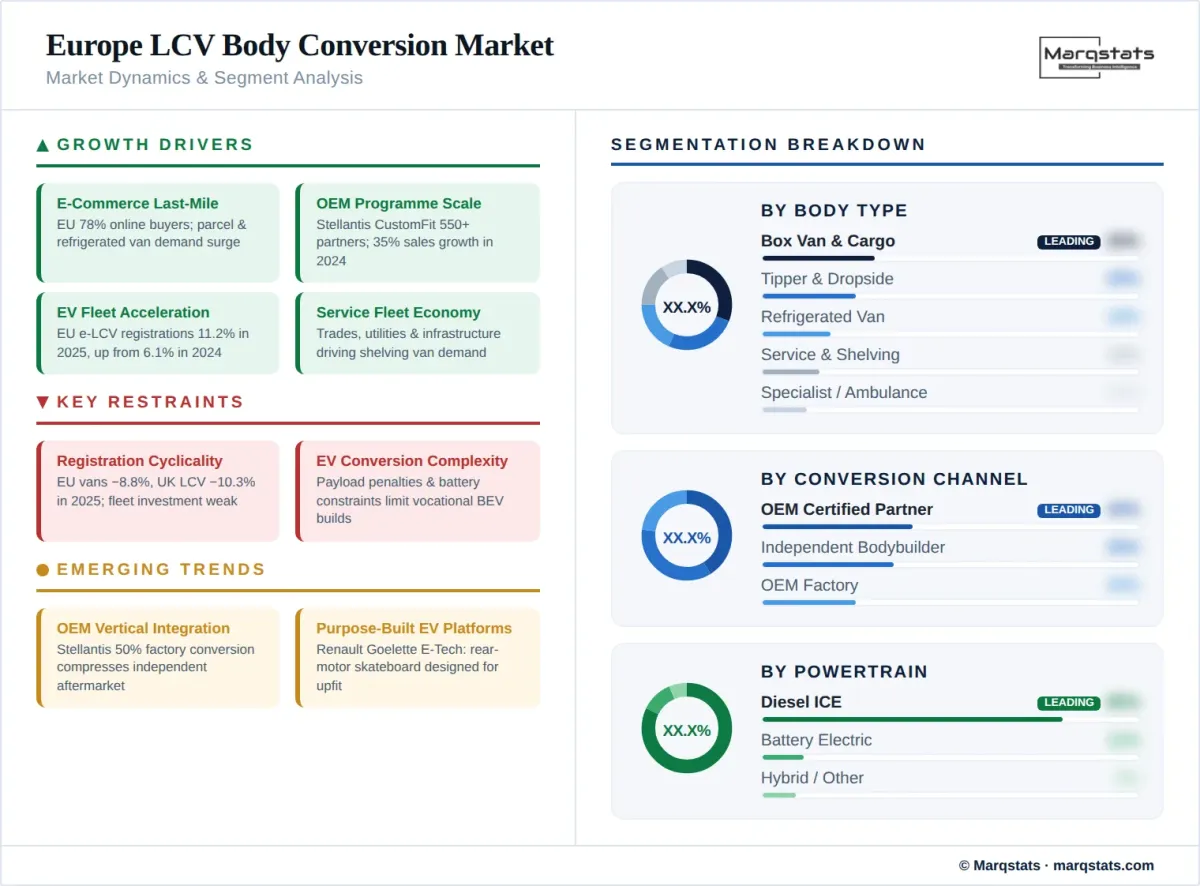
  • Urban logistics and last-mile delivery growth sustaining high box van, refrigerated van, and cargo conversion demand: ACEA identifies vans as key players in logistics chains facilitating efficient last-mile delivery. Eurostat reports EU enterprises generated 19.49% of turnover from e-commerce in 2024 and 78% of EU internet users bought online in 2025 — a demand base that directly drives fleet investment in purpose-built parcel-delivery box vans, refrigerated last-mile vehicles, and cargo-volume-optimised conversions. The box van conversion market, the Luton van market in the UK (where Luton bodies maximise load-floor volume with characteristic overhanging rear loading platform), and curtainsider van conversions are all structurally supported by e-commerce logistics demand.
  • Service-fleet economy driving shelving van, crew van, and mobile-workshop conversion demand: ACEA's position paper explicitly emphasises that vans serve not only parcel delivery but also service operations, construction trades, utilities, and other forms of commercial traffic. The service-fleet economy — plumbers, electricians, engineers, inspectors, broadband installers — drives demand for racking and shelving van conversions, crew vans with combined passenger-and-cargo layouts, and specialist mobile-workshop builds. This segment's demand is less cyclically sensitive than pure freight delivery because service-sector vans are replaced on fixed maintenance cycles rather than fleet-expansion decisions.
  • OEM-orchestrated conversion programmes creating structured commercial demand channels: Stellantis's 550+ certified CustomFit partner network recording 35% growth in converted-vehicle sales in 2024, Ford Pro Convertor's European recognition programme requiring alignment with Ford's body and equipment mounting rules and warranty overlay, and Mercedes-Benz's VanSolution concept demonstrate that major OEM programmes are actively consolidating conversion demand through formal certification channels. This OEM orchestration creates predictable, programme-driven conversion volumes rather than purely market-cyclical aftermarket activity, insulating certified-partner van bodybuilders from the full impact of registration-cycle volatility.
  • Electric van body conversion creating a structural new product category within the van upfit market: EU electrically chargeable van registrations reaching 11.2% in 2025 (up from 6.1% in 2024) and UK BEV van registrations growing 36.2% means the electric LCV body conversion market is now commercially significant. Ford's March 2025 statement that it offers electrified variants of every van in the Transit family in Europe, Stellantis's July 2025 launch of a factory-built Cargo Box BEV with 18.3 m³ cargo volume and 110 kWh battery at Atessa, and Renault's Goelette E-Tech with 450 km WLTP range, V2L capability, and OEM-designed conversion variants all confirm that electric van body conversion is becoming a mainstream market segment rather than a specialist niche.
  • EU CO2 and Euro 7 regulations creating bodybuilder compliance investment demand: Regulation (EU) 2019/631's 2025–2029 fleet CO2 target of 153.9 g CO2/km for vans and the 0 g CO2/km target from 2035 are generating active compliance-architecture investment by OEMs and their converter partners. Euro 7 rules adopted by the Council in April 2024 add battery-durability obligations and updated emission limits. These regulatory pressures require van bodybuilders to ensure their multi-stage builds preserve OEM type-approval validity, do not exceed authorised axle loads after body installation, and do not compromise OEM battery or powertrain warranty on EV base vehicles — creating a compliance-service revenue stream alongside hardware fabrication.

Key Restraints

  • Cyclical weakness — EU van registrations down 8.8% and UK LCV registrations down 10.3% in 2025: The 2025 registration decline in both the EU and UK reflects weak SME and fleet investment conditions, elevated interest rates affecting fleet financing, and post-pandemic fleet normalisation. Because body conversion demand is downstream of base-vehicle registration volumes, any sustained registration weakness directly suppresses conversion market volumes. The 2025 market entered the forecast period from a cyclical low, which makes the CAGR recovery assumption sensitive to fleet-investment conditions in 2026–2027.
  • Electrification complexity adding technical and financial friction for traditional van bodybuilders: Converting an electric van to tipper, dropside, refrigerated, or specialist body formats requires addressing battery floor penetration constraints (where subframe mounting must avoid battery enclosures), revised payload budgets (where battery weight reduces available payload for bodywork and cargo), auxiliary power sourcing from V2L capability rather than PTO taps, and EV-specific multi-stage homologation under EU 2018/858. Many established van bodybuilders — particularly SME fabricators serving agricultural and construction tipper markets — lack the engineering capability and homologation infrastructure to serve this emerging e-LCV conversion demand without significant investment.
  • Payload and range penalties on e-LCV conversions limiting adoption in demanding vocational applications: ACEA explicitly highlights that operators can only replace conventional vans with zero-emission alternatives if they are cost-effective and supported by suitable charging networks, particularly in urban and peri-urban areas. For heavy-duty vocational conversions — loaded tipper and dropside vans, refrigerated units with compressor loads, multi-person crew vans — battery-electric vans' reduced payloads (versus equivalent diesel chassis) and range reduction under payload can make the business case for electrified vocational conversion difficult to justify without subsidy or fleet-consolidation benefits.

Key Trends

  • OEM-factory and certified-partner conversions displacing independent aftermarket converters for standard body types: Stellantis's 50% conversion rate through its CustomFit programme means half of all Atessa large-van production exits the factory as a converted vehicle, not a standard panel van. Ford's skeletal chassis cab — specifically designed with a 100 mm lower chassis height and 200 kg weight saving for body conversions — and the Ford Pro Convertor network represent a systematic OEM effort to capture conversion value in its own commercial channel. This trend is compressing the addressable market for independent van bodybuilders operating outside OEM programmes, pushing them toward higher-value specialist segments (refrigerated, medical, accessibility) where factory-line conversion is commercially less viable.
  • Electric van platforms designed from the ground up for conversion versatility: Renault's April 2025 reveal of the Goelette E-Tech — purpose-built on the Flexis all-electric skateboard platform with a rear-mounted powertrain specifically to free the load floor for bodywork, available as chassis cab, box body, and extended cab with up to 1.4 tonnes payload, 450 km WLTP range, 800V fast charging, and Vehicle-to-Load capability — is the most advanced example of an OEM designing an e-LCV specifically to be a superior conversion base rather than adapting an existing ICE van for electrification. The Estafette E-Tech's 2.60 m internal height optimised for urban logistics and the Trafic E-Tech's 5.1–5.8 m³ cargo variants complete a Flexis portfolio that is explicitly designed as a van bodybuilder platform rather than a retail consumer product.
  • Renault-Ford van cooperation and platform alliances reshaping the conversion base landscape: Reuters reported in December 2025 that Renault and Ford announced cooperation on commercial vans in Europe, following Reuters' February 2026 report that Renault would take full control of Flexis with Trafic Van E-Tech production beginning in 2026 at Sandouville. Stellantis's March 2025 agreement to supply IVECO with two fully electric vans for Europe (sales expected from mid-2026) further illustrates how platform sharing between major OEMs is creating new conversion-base options — and potentially consolidating the chassis-cab variety that van bodybuilders must engineer their products around.
  • INEOS and specialist platform entrants expanding the chassis-cab conversion addressable pool: INEOS Automotive's November 2023 start of production for the Grenadier Quartermaster double-cab pickup at Hambach, France — with a separate chassis-cab variant going into production in 2024 specifically aimed at conversion specialists and commercial bodybuilders — and WEVC's eCV1 electric chassis cab prototype (with central driving position, 3.5-tonne cab-and-chassis, and purpose-designed conversion-ready body) illustrate how specialist and startup manufacturers are identifying the chassis-cab conversion market as a commercially viable entry point to the European LCV commercial vehicle ecosystem.
Europe LCV Body Conversion Market Dynamics Segment Analysis Infographic
Segment Analysis

Market Segmentation

Tipper and Dropside Van Conversion
Leading

Tipper van conversion and dropside van conversion are the highest-volume body conversion segments in the UK and represent a major category across Germany, France, and the Benelux region, anchored by construction, landscaping, agricultural, and waste-removal fleet demand. Tipper conversions involve hydraulic tipping mechanisms, steel or aluminium tipping bodies, and body-mounting subframes that must be engineered within the OEM-specified body mounting instructions and homologation rules. Dropside van conversion adds removable or hinged side and rear panels on a flatbed body, serving the agricultural transport, garden and building supplies, and light materials handling markets. The SMMT's tracking of converted LCV registrations in the UK shows tippers and dropsides as the two highest-volume body categories. The electric tipper van market remains nascent — the payload and hydraulic-power implications of battery weight and alternative V2L-powered hydraulic systems are the primary engineering challenges — but is an active development area for OEM and independent converter programmes.

Luton Van Conversion

The Luton van is the UK market's signature high-volume body conversion format, extending the load floor over the cab to maximise cubic capacity in a box-body format uniquely suited to removal firms, parcel delivery operators, and courier fleets requiring maximum load volume within the N1 3.5-tonne weight limit. The Luton van conversion market is almost exclusively a UK phenomenon (the term and format have limited direct equivalents on the continent) but represents one of the highest-volume single body types in the UK LCV conversion industry. Load volumes typically range from 18 to 24 m³ depending on cab overhang extension. Luton box conversions face the same electrification challenge as tippers — the battery weight of electric van base vehicles reduces payload headroom — but several van bodybuilders are actively developing Luton conversions on Renault Master, Ford Transit, and VW Crafter BEV base vehicles.

Box Van and Curtainsider Conversion

Box van conversion — panel van or chassis cab converted to a rigid box body with insulated or non-insulated aluminium or fibreglass panels — is the dominant continental European body conversion segment by volume, driven by parcel delivery, dry-goods logistics, and urban freight operators. The box van body is the natural conversion base for e-commerce logistics fleet expansion, with Stellantis's factory-built Cargo Box BEV (18.3 m³, 110 kWh battery, produced at Atessa) and Renault's Goelette E-Tech box body variant representing the OEM-factory approach to this segment. Curtainsider van conversion — with PVC tarpaulin sides on an aluminium frame for forklift or side-loading pallet access — serves palletised goods distribution, food and beverage logistics, and cross-docking operators across the Netherlands, Belgium, Germany, and France, where pallet-compatible loading is a procurement requirement.

Refrigerated and Insulated Van Conversion

Refrigerated van conversion — installing refrigeration units, insulated panels, vapour barriers, and temperature-management systems on chassis-cab or panel-van bases — is the highest-value-per-unit segment of the commercial van body conversion market, combining vehicle fabrication, refrigeration engineering, food-safety compliance, ATP certification, and multi-stage type approval in a single complex product. Temperature-controlled last-mile delivery for grocery and food-service e-commerce, pharmaceutical distribution, and meal-kit delivery is driving strong demand growth for refrigerated city vans and refrigerated light vans in the 3.5-tonne category. Mercedes-Benz and IVECO both specifically highlight refrigerated transport solutions in their van conversion programme communications, and the electric refrigerated van conversion segment — where heat pump or direct electric compressor systems replace diesel-powered refrigeration units — is one of the most actively engineered electric conversion sub-segments in the European market.

Service, Shelving, and Mobile-Workshop Van Conversion

Service and shelving van conversions — installing racking systems, tool storage, storage drawers, and work-surface fittings inside panel vans for trade, utility, and service-sector operators — are the highest-volume segment by number of individual van upfit projects, though individual conversion values are lower than body fabrication segments. Opel's conversion catalogue explicitly features shelving and service van configurations alongside box bodies and tippers, reflecting how central this segment is to the core commercial conversion market. Ford Pro Convertor programme partners cover this segment extensively through cargo management, storage, and van organisation solutions. The service-van shelving and upfit market is also the least electrification-sensitive segment — shelving and racking installations have minimal interaction with electric drivetrain architecture — making it a stable growth segment as BEV van penetration increases.

Ambulance, Emergency, and Specialist Mobility Conversions

Ambulance, emergency vehicle, and specialist accessibility and people-mobility conversions represent the highest regulatory-complexity and highest-value-per-vehicle end of the European LCV body conversion market. Ambulance and first-responder conversions must meet EN 1789 medical-vehicle standards, national procurement specifications, crash-test requirements, and multi-stage type approval under EU 2018/858. Wheelchair-accessible vehicles (WAVs) and people-mover adaptations must satisfy European accessibility regulations and national transport-system procurement standards. These segments are served by a small number of specialist van bodybuilders with dedicated homologation credentials, and demand is substantially driven by public procurement cycles in health services and local authority transport contracts.

Regional Analysis

By Geography

France

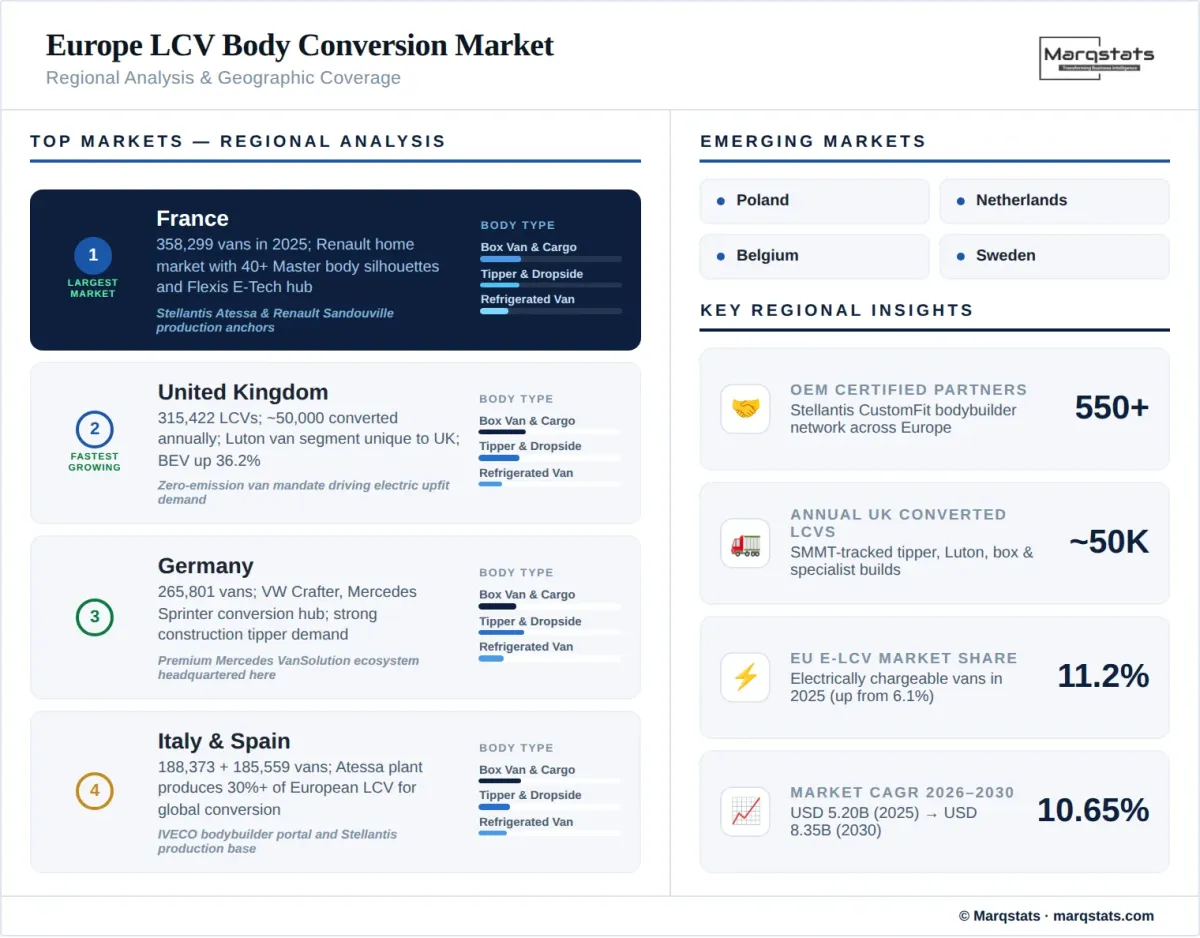
France is Europe's largest national van registration market in 2025, with ACEA reporting 358,299 new van registrations — placing it ahead of Germany for the year. France is also the home market for Renault, which with the new Master platform (over 40 body silhouettes, payload up to 2 tonnes, load volumes from 11 to 22 m³) and the Flexis Goelette/Trafic/Estafette E-Tech electric platform represents the most conversion-programme-intensive OEM in the European van market. Renault's Trafic Van E-Tech production beginning in 2026 at Sandouville, and Renault's December 2025 cooperation announcement with Ford on commercial vans, both reinforce France's position as a conversion-market policy and production hub. Stellantis's Atessa plant producing Peugeot, Citroën, Opel/Vauxhall, and Fiat large vans with integrated CustomFit conversion capability further anchors France's role in the pan-European conversion supply chain.

Germany

Germany is Europe's second-largest van market in 2025 with 265,801 registrations and the continent's primary market for Volkswagen Crafter and MAN TGE conversions, Mercedes-Benz Sprinter and Vito conversions, and industrial-service-sector van upfit demand. Volkswagen Commercial Vehicles' Hanover plant — producing the ID. Buzz Cargo alongside T6.1 and Multivan, with the VWCV conversion infrastructure built around the Crafter and T-series platforms — is a structurally important German conversion base. Mercedes-Benz's Conversion World and VanSolution/VanPartner ecosystem is headquartered in Germany and represents the most formally structured OEM conversion programme in the European premium-van segment. Germany's strong construction and trades sector makes it the largest continental market for tipper van conversion and dropside van conversion activity alongside the UK. The van conversion market in Germany is expected to recover from the 2025 cyclical weakness as construction investment resumes and fleet replacement cycles normalise.

United Kingdom

The UK remains one of Europe's most important and distinctively structured van body conversion markets, with SMMT reporting 315,422 LCV registrations in 2025 and tracking approximately 50,000 converted LCV registrations annually across tipper, dropside, Luton, box, curtainsider, and specialist conversion categories. The Luton van conversion market is a UK-specific high-volume category with no direct continental equivalent, reflecting the UK parcel and removal-sector demand for maximum cubic-capacity in the 3.5-tonne class. UK commercial van conversion market regulation operates under the UK's post-Brexit ECWVTA (Enhanced Certificate of Conformity) framework administered by the Vehicle Certification Agency (VCA), maintaining broadly EU-equivalent multi-stage type approval requirements while allowing independent UK regulatory updates. Ford Transit remains the single most converted van platform in the UK market, with the Ford Pro Convertor network of accredited UK bodybuilders among the most comprehensive OEM converter programme ecosystems in Europe. Battery-electric van body conversion is growing rapidly in the UK, with BEV van registrations up 36.2% in 2025 — the UK's zero-emission van mandate creating strong policy pull for electric-ready conversion platforms.

Italy and Spain

Italy (188,373 van registrations in 2025) is the location of Stellantis's Atessa plant — the European large-van production hub for Fiat Ducato, Peugeot Boxer, Citroën Jumper, Opel Movano, and their electric variants. The Atessa plant's 30%+ share of the European LCV market and 50% CustomFit conversion integration rate makes Italy an extraordinary production-side anchor for the European conversion market even though Italy's domestic demand profile is skewed toward lighter service-van conversions. IVECO, headquartered in Italy, operates the continent's most formally documented body builder portal and is particularly important in the commercial-body and specialist-conversion segments. Spain (185,559 van registrations in 2025) is the Renault Master's second-largest European market and hosts significant agricultural, construction, and logistics-sector conversion demand, with a growing electric van upfit market driven by Spain's ambitious clean-mobility policy targets.
Europe LCV Body Conversion Market Regional Analysis Infographic
Competitive Landscape

How Competition Is Evolving

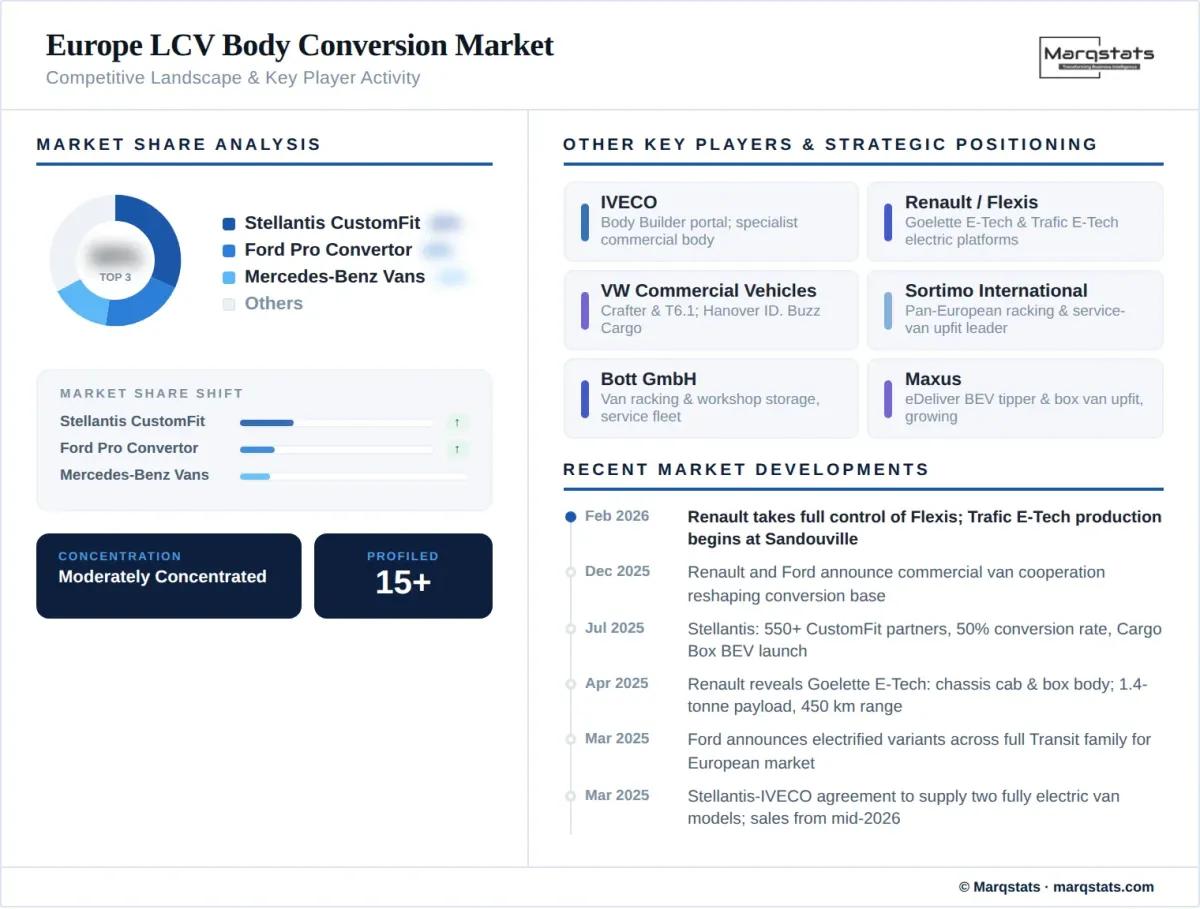
The European LCV body conversion market is moderately concentrated at the OEM-programme tier and moderately fragmented at the independent van bodybuilder tier. OEM conversion programmes — Stellantis CustomFit (550+ certified partners), Ford Pro Convertor (European network), Mercedes-Benz VanSolution, IVECO Body Builder portal, and Renault's conversion partner network — are the primary demand-aggregation and quality-control mechanisms, creating tiered market access for bodybuilders that directly shapes competitive dynamics. ACEA explicitly acknowledges that vans are often custom-built professional tools involving multi-stage production processes, which means the competitive advantage of European van bodybuilders is not price alone but homologation expertise, OEM-programme certification, and segment-specific engineering depth.

The electric van body conversion market is introducing a new competitive dynamic: traditional van bodybuilders with deep ICE-conversion expertise are being challenged by specialist EV upfit companies with electrical-systems and battery-integration knowledge. WEVC's eCV1 electric chassis-cab prototype (April 2023, central driving position, 3.5-tonne cab and chassis purpose-designed for body conversions) and IAV GmbH's partnership with Tassima and Ziehl-Abegg for electric bus conversion (plug-and-play electric drive axle conversion kits) both illustrate how the electric conversion sub-market is attracting technology-first entrants with different capability profiles from established bodybuilding companies. The convergence of EV engineering and traditional body fabrication skill is defining the next-generation competitive profile for the European van conversion industry.
Europe LCV Body Conversion Market Competitive Landscape Infographic
Major Players

Companies Covered

The report profiles 15+ companies with full strategy and financials analysis, including:

Stellantis Pro One / CustomFit Programme (Atessa Plant — Fiat Ducato, Peugeot Boxer, Citroën Jumper, Opel Movano; 550+ Certified Partners; 50% of CV Production Converted)
Ford Pro Convertor Network (Transit, Transit Custom, Transit Courier; Skeletal Chassis Cab; European Conversion Centre Network)
Mercedes-Benz Vans — Conversion World (Sprinter, Vito; VanSolution/VanPartner Programme; Specialist Vocational and Refrigerated)
IVECO (Daily — Body Builder Portal; Technical Documentation and Second-Stage Homologation Support; Commercial Body Specialists)
Renault / Flexis (Master — 40+ Body Silhouettes; Goelette E-Tech and Trafic E-Tech Electric Conversion Platforms; Sandouville Production)
Volkswagen Commercial Vehicles (Crafter, T6.1; Hanover Plant ID. Buzz Cargo; MAN TGE Platform)
Opel / Vauxhall (Movano; Certified Conversion Programme — Box Body, Crew Van, People Mover, Fridge, Shelving, Tipper/Dropside)
Maxus (eDeliver Series — Growing EV Van and Body Conversion Brand; UK and European Electric Tipper and Box Van Upfit)
INEOS Automotive (Grenadier Quartermaster Chassis Cab — Conversion Specialists Target Market; Hambach France Production)
WEVC — Watt Electric Vehicle Company (eCV1 Electric Chassis Cab Prototype — Central Driving Position; 3.5-Tonne Conversion Platform)
Sortimo International (Racking and Van Shelving Upfit; Service Van Storage Systems — Pan-European Market Leader)
Bott GmbH & Co. KG (Van Racking, Workshop, and Storage Systems — Service Fleet Upfit Specialist)
Whelan Bodies (UK Tipper, Dropside, and Luton Van Body Manufacturing — SMMT-Registered UK Converter)
Woodford Trailers (UK Dropside, Tipper, and Flatbed Van Conversion)
IAV GmbH / Tassima / Ziehl-Abegg (Electric Commercial Vehicle Conversion Partnership — Plug-and-Play Drive Axle Conversion Kits)
Note: Full company profiles include revenue analysis, product portfolio, SWOT, and recent strategic developments.
Latest Developments

Recent Market Activity

Apr 2025
Renault reveals Flexis electric commercial vehicle platform: Trafic E-Tech, Goelette E-Tech, and Estafette E-Tech — all based on a rear-mounted all-electric skateboard with 450 km WLTP (NMC) or 350 km (LFP) range, 800V fast charging in under 20 minutes, V2L and V2G capability, and SDV architecture. Goelette E-Tech specifically designed for custom conversions: available as chassis cab, box body, and extended cab with up to 1.4-tonne payload — the market's most advanced factory-built electric van conversion platform.
Jul 2025
Stellantis reports 30%+ European LCV market share at Atessa, 50% CustomFit conversion rate, 35% growth in converted-vehicle sales in 2024, and 25% growth in conversions with certified partners — with 550+ certified partners across the Fiat Ducato, Peugeot Boxer, Citroën Jumper, and Opel Movano conversion ecosystem. Separately launches factory-built Cargo Box BEV with 18.3 m³ cargo volume and 110 kWh battery.
Mar 2025
Ford announces electrified variants of every van in the Transit family in Europe — all Transit product lines now offered in battery-electric format, establishing Ford Pro as an all-electrification-capable conversion base programme for the Ford Pro Convertor network.
Mar 2025
Stellantis agrees to supply IVECO with two fully electric vans for Europe, with sales expected from mid-2026 — demonstrating platform sharing between major OEMs on EV van architectures and expanding IVECO's electric conversion base options.
Feb 2026
Renault takes full control of Flexis with Trafic Van E-Tech production scheduled to begin in 2026 at Sandouville — confirming the Flexis electric platform's commercial production timeline and Renault's commitment to factory-scale electric van conversion production.
Dec 2025
Renault and Ford announce cooperation on commercial vans in Europe — platform and supply-chain collaboration that may reshape the conversion base available to van bodybuilders across the Transit and Master ecosystems.
Nov 2023
INEOS Automotive starts production of Grenadier Quartermaster double-cab pickup at Hambach, France — with a separate chassis-cab variant for conversion specialists going into production in 2024, adding a premium off-road-capable chassis cab to Europe's conversion addressable pool.
Apr 2023
WEVC reveals eCV1 electric commercial vehicle prototype — 3.5-tonne cab-and-chassis purpose-designed for body conversions with central driving position, at the Commercial Vehicle Show in Birmingham, in partnership with ETRUX electric vehicle conversion specialists.
Report Structure

Table of Contents

1. Introduction
1.1 Study Objectives and Scope
1.2 Market Definition — LCV Body Conversion, Van Upfit, Van Bodybuilder Industry
1.3 What Is and Is Not Included — Commercial Conversion vs Leisure/Motorhome
1.4 Key Assumptions and Study Period (2026–2030)
1.5 Abbreviations — LCV, N1, ECWVTA, WVTA, VCA, OEM, IVMS, ATP, WAV, V2L, e-LCV
1.6 Currency and Weight Conventions (USD, EUR, GVW, GCW, kg, Tonnes)
2. Executive Summary
2.1 Market Snapshot 2025–2030
2.2 Market Size: 2025 (USD 5.20Bn) and 2026 (USD 5.57Bn); CAGR 2026–2030: 10.65%
2.3 Regulatory Architecture — EU 2018/858, ECWVTA, Euro 7, EU 2019/631 CO2 Vans
2.4 Critical Findings by Body Type, OEM Programme, and Country
3. Market Insights
3.1 Report Summary
3.2 Market Size and Historical Trend (2021–2025)
3.3 Market Forecast (2026–2030)
3.3.1 2026 Market Size — USD 5.57 Billion
3.3.2 2030 Market Size — USD 8.35 Billion (CAGR 10.65% from 2026)
3.3.3 2030 Market Size — USD 9.24 Billion
3.4 Addressable LCV Conversion Pool
3.4.1 ACEA EU Van Registrations — 1,447,273 in 2025 (Down 8.8% YoY)
3.4.2 SMMT UK LCV Registrations — 315,422 in 2025 (Down 10.3%)
3.4.3 Chassis-Cab Share and Conversion Penetration by Segment
3.4.4 Electrically Chargeable Van Share — 11.2% EU 2025; UK BEV +36.2%
3.5 Market Dynamics
3.5.1 Key Drivers
3.5.1.1 Urban Logistics and E-Commerce Driving Box Van, Refrigerated, Curtainsider
3.5.1.2 Service-Fleet Economy — Shelving, Crew Van, Mobile-Workshop Demand
3.5.1.3 OEM Certified-Partner Programmes Creating Structured Volume Channels
3.5.1.4 Electric Van Body Conversion as Emerging High-Growth Sub-Segment
3.5.1.5 EU CO2 and Euro 7 Compliance Driving Bodybuilder Programme Investment
3.5.2 Key Restraints
3.5.2.1 Cyclical Weakness — EU -8.8%, UK -10.3% Van Registrations in 2025
3.5.2.2 e-LCV Conversion Technical Complexity — Payload, Battery Floor, Homologation
3.5.2.3 Payload and Range Penalties Limiting e-LCV Vocational Adoption
3.5.3 Key Trends
3.5.3.1 OEM Factory and Certified-Partner Conversions Displacing Aftermarket Converters
3.5.3.2 Electric Van Platforms Designed as Conversion-First Architecture
3.5.3.3 Renault-Ford and Stellantis-IVECO OEM Alliances Reshaping Conversion Bases
3.5.3.4 Specialist Platform Entrants — INEOS Quartermaster Chassis Cab; WEVC eCV1
3.5.4 Key Opportunities
3.5.4.1 Electric Van Body Conversion — Tipper, Box, Refrigerated e-LCV Builds
3.5.4.2 Refrigerated Last-Mile e-LCV Conversion — Pharma, Grocery, Meal-Kit
3.5.4.3 Certified Bodybuilder Programme Accreditation — OEM Conversion Ecosystem
3.5.4.4 Eastern European and Emerging EU Market Conversion Demand
4. Regulatory and Homologation Framework
4.1 Regulation (EU) 2018/858 — Multi-Stage Type Approval (ECWVTA)
4.1.1 Incomplete Vehicle / Chassis Cab Step-One Approval
4.1.2 Step-Two and Step-Three Converter Approval Requirements
4.1.3 Whole Vehicle Type Approval and Whole Vehicle Type Approval Small Series
4.2 UK ECWVTA Post-Brexit — Vehicle Certification Agency (VCA)
4.2.1 GB Type Approval vs UKNI Market Status
4.2.2 VCA Approved Van Converter Programme Requirements
4.3 EU Regulation 2019/631 — Van CO2 Fleet Targets
4.3.1 2025–2029 Target: 153.9 g CO2/km
4.3.2 2030 Target: 25% Reduction; 2035: Zero Emissions (New Vans)
4.3.3 Temporary 2025–2027 Compliance Flexibility (Commission 2025)
4.4 Euro 7 — Council Adoption April 2024
4.4.1 Emission Limits and Battery Durability Rules for Vans
4.4.2 Impact on Diesel Base-Vehicle Availability for Converters
4.5 ATP Agreement — Refrigerated Van Compliance Framework
4.6 EN 1789 — Ambulance and Emergency Vehicle Conversion Standards
4.7 IVECO Body Builder Portal — Model for OEM Homologation Support
4.8 N1 Vehicle Classification and 3.5-Tonne GVW Market Boundary
5. Technology and Product Architecture
5.1 Chassis-Cab Platform Architecture for Body Conversion
5.1.1 Body Mounting Instruction (BMI) Compliance Requirements
5.1.2 Ford Transit Skeletal Chassis Cab — 100mm Lower, 200kg Lighter
5.1.3 INEOS Grenadier Quartermaster Chassis Cab (Hambach, 2024)
5.2 Electric Van Conversion Architecture
5.2.1 Battery Floor Integration and Subframe Clearance Requirements
5.2.2 Payload Budget Management — Battery Weight Impact
5.2.3 Auxiliary Power via V2L for Refrigeration, Tail-Lifts, and Equipment
5.2.4 Renault Goelette E-Tech — Rear Powertrain Design for Conversion Floor Clearance
5.3 Tipper Hydraulic Systems on Electric Van Bases
5.4 Refrigeration System Architecture — Direct Electric vs Heat Pump
5.5 Insulated Panel Systems for Refrigerated and Temperature-Controlled Builds
5.6 Racking, Shelving, and Storage System Integration
5.7 Vehicle-to-Load (V2L) and Auxiliary Power Integration for Conversions
5.8 WEVC eCV1 Electric Chassis-Cab Prototype — Central Driving Position Design
6. Market Segmentation — By Body Type
6.1 Body-Type Segmentation Overview
6.2 Tipper Van Conversion
6.2.1 Construction, Landscaping, and Agricultural Demand Base
6.2.2 Electric Tipper Van Conversion — Engineering Challenges
6.2.3 UK Market — SMMT-Registered Tipper Volume; Key Manufacturers
6.2.4 Revenue Forecast (2026–2030)
6.3 Dropside and Flatbed Van Conversion
6.3.1 Agricultural Transport and Building Materials Segment
6.3.2 Germany, Netherlands, Belgium — High Dropside Market Density
6.3.3 Revenue Forecast (2026–2030)
6.4 Luton Van Conversion
6.4.1 UK-Specific High-Volume Format — Removal, Parcel, and Courier
6.4.2 18–24 m³ Load Volume; Base Vehicles — Transit, Master, Crafter
6.4.3 Electric Luton Van Market Development
6.4.4 UK Luton Van Market Size and Forecast (2026–2030)
6.5 Box Van and Curtainsider Conversion
6.5.1 E-Commerce Last-Mile Demand — Pan-European Volume Anchor
6.5.2 Stellantis Cargo Box BEV — 18.3 m³, 110 kWh (Atessa)
6.5.3 Renault Goelette E-Tech Box Body Variant
6.5.4 Curtainsider — Netherlands, Belgium, Germany Pallet-Distribution Market
6.5.5 Revenue Forecast (2026–2030)
6.6 Refrigerated and Insulated Van Conversion
6.6.1 Temperature-Controlled Last-Mile — Grocery, Pharma, Meal-Kit
6.6.2 ATP-Certified Refrigerated Build Requirements
6.6.3 Electric Refrigerated Van — Direct Electric Compressor vs Heat Pump
6.6.4 Revenue Forecast (2026–2030)
6.7 Service, Shelving, and Mobile-Workshop Van Conversion (Van Upfit)
6.7.1 Trade and Service Sector — Electricians, Plumbers, Engineers
6.7.2 Sortimo, Bott, and Racking-System Competitive Landscape
6.7.3 EV Compatibility — Least Technically Complex Conversion Type
6.7.4 Revenue Forecast (2026–2030)
6.8 Ambulance, Emergency, and Specialist Mobility Conversions
6.8.1 EN 1789 Ambulance Standard and National Procurement Frameworks
6.8.2 Wheelchair Accessible Vehicle (WAV) and People Mover Conversions
6.8.3 Revenue Forecast (2026–2030)
6.9 Electric Van Body Conversion — Cross-Segment Analysis
6.9.1 EU e-LCV Market Trajectory — 11.2% Share 2025; Forecast to 2030
6.9.2 Bodybuilder Programme Readiness for e-LCV Conversion
6.9.3 E-LCV Body Conversion Revenue Forecast (2026–2030)
7. Market Segmentation — By Conversion Pathway
7.1 OEM Factory Conversions
7.1.1 Stellantis Atessa — 50% of Pro One Production via CustomFit
7.1.2 Renault Goelette E-Tech Factory Box Body and Chassis Cab Variants
7.1.3 VW Commercial Vehicles ID. Buzz Cargo Factory Build
7.2 OEM Certified-Partner Conversions
7.2.1 Stellantis CustomFit — 550+ Partners; 35% Growth in Converted Sales 2024
7.2.2 Ford Pro Convertor European Network
7.2.3 Mercedes-Benz VanSolution / VanPartner
7.2.4 IVECO Body Builder Portal — Documentation and Homologation Support
7.3 Independent Aftermarket Van Bodybuilder Conversions
7.3.1 ECWVTA Multi-Stage Type Approval Independent Route
7.3.2 Competitive Position vs OEM-Programme Converters
7.3.3 Specialist Segments Retained by Independents — High-Value Niche Builds
7.4 Conversion Pathway Revenue Forecast (2026–2030)
8. Country and Regional Analysis
8.1 Regional Market Overview
8.2 France
8.2.1 358,299 Van Registrations 2025 — Europe's Largest National Market
8.2.2 Renault Master and Flexis Electric Platform Home Market
8.2.3 Stellantis Pro One CustomFit in French Market
8.3 Germany
8.3.1 265,801 Van Registrations 2025 — Largest EU Market for Crafter/Sprinter Conversions
8.3.2 Mercedes-Benz VanSolution — VanPartner Ecosystem HQ
8.3.3 VW Commercial Vehicles Hanover Plant — Crafter and ID. Buzz Cargo
8.3.4 Tipper and Dropside Van Conversion Demand — Construction Sector
8.4 United Kingdom
8.4.1 315,422 LCV Registrations 2025 — SMMT ~50K Converted LCV Registrations
8.4.2 Luton Van Market — UK-Specific High-Volume Format
8.4.3 Tipper Van Conversion Market UK — Highest Single Volume Segment
8.4.4 VCA ECWVTA and Ford Pro Convertor UK Network
8.4.5 UK BEV Van Registrations +36.2% — Electric Tipper and Box Van Development
8.5 Italy
8.5.1 188,373 Van Registrations 2025 — Atessa Plant Location
8.5.2 IVECO Daily — 2/3 Sold as Chassis Cabs for Body Conversion
8.5.3 Stellantis Cargo Box BEV Launch — Atessa Production
8.6 Spain
8.6.1 185,559 Van Registrations 2025 — Renault Master Second-Largest EU Market
8.6.2 Agricultural and Construction Conversion Demand
8.7 Netherlands, Belgium, and Nordic Markets
8.7.1 Netherlands — Curtainsider and Refrigerated Pallet Distribution Market
8.7.2 Belgium — High Leasing and Conversion Fleet Activity
8.7.3 Nordics — Early EV Adoption; Electric Van Conversion Market Development
8.8 Poland and Central/Eastern Europe
8.8.1 Emerging Manufacturing Hub for Bodybuilding — Lower-Cost Body Fabrication
8.8.2 Growing Domestic LCV Conversion Demand
8.9 Country Revenue Forecast (2026–2030)
9. OEM Conversion Programme Analysis
9.1 Stellantis Pro One CustomFit
9.1.1 Programme Scale — 550+ Partners, 50% Production, 35% Sales Growth 2024
9.1.2 Cargo Box BEV Launch — 18.3 m³, 110 kWh Battery
9.1.3 Fiat Ducato, Peugeot Boxer, Citroën Jumper, Opel Movano — Multi-Brand Scope
9.2 Ford Pro Convertor Network
9.2.1 Transit Skeletal Chassis Cab — 100mm Lower, 200kg Lighter
9.2.2 Electrified Transit for Every Van Type — March 2025 Announcement
9.2.3 Ford-Renault Commercial Van Cooperation — December 2025
9.3 Mercedes-Benz Conversion World / VanSolution
9.3.1 VanPartner and VanSolution Tier Structure
9.3.2 Sprinter and Vito Specialist Conversion Market (Refrigerated, Ambulance)
9.4 IVECO Body Builder Portal
9.4.1 Daily Chassis Cab — 2/3 of IVECO Daily Sales as Conversion Base
9.4.2 Technical Documentation, Second-Stage Homologation, Normative Documents
9.5 Renault / Flexis
9.5.1 Master — 40+ Body Silhouettes, Payload 2T, 11–22 m³
9.5.2 Goelette E-Tech — Conversion-First Electric Chassis Cab
9.5.3 Flexis Trafic, Goelette, Estafette — April 2025 Full Platform Reveal
9.6 Volkswagen Commercial Vehicles (Crafter, T6.1, ID. Buzz Cargo)
9.7 Opel Conversion Programme (Movano)
10. Competitive Landscape
10.1 Market Concentration and Structure
10.2 OEM-Programme Tier vs Independent Bodybuilder Tier
10.3 Key Competitive Strategies
10.3.1 Certified-Partner Programme Accreditation as Market Access Control
10.3.2 Electric Van Body Conversion Capability as Differentiation
10.3.3 Specialist Segment Focus (Refrigerated, Ambulance, WAV)
10.3.4 Racking and Storage Integration — Van Upfit Services Market
10.4 Electric Van Body Conversion Competitive Entrants
10.4.1 WEVC eCV1 — Electric Chassis-Cab Conversion Platform Startup
10.4.2 Maxus eDeliver — EV Van + Body Conversion Growing in UK and Europe
10.4.3 IAV-Tassima-Ziehl-Abegg — Electric Drive-Axle Conversion Partnership
11. Company Profiles
11.1 Stellantis Pro One / CustomFit (Fiat, Peugeot, Citroën, Opel Movano)
11.2 Ford Pro Convertor Network
11.3 Mercedes-Benz Vans Conversion World
11.4 IVECO Body Builder Programme
11.5 Renault / Flexis (Master, Goelette E-Tech, Trafic E-Tech)
11.6 Volkswagen Commercial Vehicles (Crafter, ID. Buzz Cargo)
11.7 Opel / Vauxhall Conversion Programme
11.8 Maxus (eDeliver — Electric Van Body Conversion)
11.9 INEOS Automotive (Grenadier Quartermaster Chassis Cab)
11.10 WEVC — Watt Electric Vehicle Company (eCV1)
11.11 Sortimo International (Van Racking and Shelving Upfit)
11.12 Bott GmbH & Co. KG (Van Workshop and Storage Systems)
11.13 Whelan Bodies (UK Tipper, Dropside, Luton Bodybuilder)
11.14 Woodford Trailers (UK Dropside, Tipper, Flatbed)
11.15 IAV GmbH / Tassima / Ziehl-Abegg (Electric Bus and CV Conversion)
12. Value Chain and Ecosystem Analysis
12.1 Value Chain Overview — OEM to Fleet Operator
12.2 Chassis-Cab and Incomplete Vehicle Production — OEM Factories
12.3 Tier 1 Body Fabricators and Converters — Steel, Aluminium, Composite
12.4 Racking and Equipment Upfit Specialists
12.5 Refrigeration and Temperature-Control Equipment Integrators
12.6 Ambulance and Medical Vehicle Conversion Specialists
12.7 OEM Homologation and Certification Support
12.8 Fleet Operators and Corporate Procurement
13. Investment and Programme Activity
13.1 Stellantis Atessa Cargo Box BEV — Factory Electric Conversion Investment
13.2 Renault Flexis Sandouville Production Ramp-Up (2026)
13.3 VW Commercial Vehicles Hanover Modernisation for ID. Buzz Cargo
13.4 INEOS Grenadier Quartermaster Production — Hambach Investment
13.5 SSAB Fossil-Free Steel for Mercedes-Benz — Sustainable Materials Pipeline
14. Use Case Deep Dives
14.1 Stellantis CustomFit — From Factory to Fleet: 550-Partner Conversion Ecosystem
14.2 Renault Goelette E-Tech — Purpose-Built Electric Conversion Chassis
14.3 Ford Transit Skeletal Chassis Cab — Lightweight Conversion Base Engineering
14.4 IVECO Daily Body Builder — Formalised OEM Homologation Support Model
14.5 UK Luton Van Market — High-Volume Format in Parcel and Removal Sector
15. Market Forecast and Scenario Analysis
15.1 Base Case Forecast 2026–2030
15.2 Market Size by Year: 2026 (USD 5.57Bn) — 2030 (USD 8.35Bn) — 2030 (USD 9.24Bn)
15.3 Bull Case — Accelerated EV Van Adoption and OEM Programme Scale-Up
15.4 Bear Case — Prolonged Cyclical Weakness and EV Conversion Friction
15.5 Forecast by Body Type
15.6 Forecast by Conversion Pathway (Factory / Certified / Independent)
15.7 Forecast by Country
15.8 Electric vs ICE Van Conversion Revenue Split (2026–2030)
16. Strategic Recommendations
16.1 For Van Bodybuilders — OEM-Programme Accreditation as Growth Priority
16.2 For Independent Converters — Specialist Segment Focus (Refrigerated, Medical, WAV)
16.3 For OEMs — Electric Conversion Platform Design as Competitive Infrastructure
16.4 For Fleet Operators — Total Cost of Upfit vs EV Range Trade-Off Framework
16.5 For Investors — Certified Bodybuilder Platform vs Independent Fabricator
17. Study Scope and Methodology
17.1 Research Design and Approach
17.2 Primary Research — 40+ Interview Coverage
17.3 Secondary Research and Data Sources
17.4 Market Sizing Methodology — Chassis-Cab × Penetration × Value-Add
17.5 Forecast Assumptions and Sensitivity (CAGR 2026–2030)
18. Appendix
18.1 EU Van Registration Data by Country and Fuel Type (ACEA 2025)
18.2 UK LCV Registration Data (SMMT 2025) and Converted LCV Volume
18.3 Regulation (EU) 2018/858 Multi-Stage Type Approval Summary
18.4 EU Van CO2 Targets — 2025 to 2035 Timeline
18.5 Euro 7 Van Provisions — Council Adoption Summary
18.6 OEM Conversion Programme Comparison Matrix
18.7 Abbreviations and Acronyms
18.8 List of Exhibits and Tables
18.9 Bibliography and References
18.10 About Marqstats Intelligence
Study Scope & Focus

Coverage & Segmentation

This report provides a comprehensive analysis of the Europe LCV body conversion market covering the 2021–2030 period, with 2025 as the base year, 2021–2025 as the historical window, and 2026–2030 as the forecast horizon (CAGR computed over 2026–2030). The study covers OEM factory conversions, OEM certified-partner conversion programmes, and independent van bodybuilder activity for N1 light commercial vehicles up to 3.5 tonnes across tipper van conversion, dropside van conversion, Luton van conversion, box van and curtainsider conversion, refrigerated and insulated van conversion, service and shelving van upfit, crew van and people-mover conversion, ambulance and emergency vehicle conversion, and accessible mobility vehicle conversion. Regulatory coverage spans Regulation (EU) 2018/858 (multi-stage type approval / ECWVTA), Regulation (EU) 2019/631 (van CO2 fleet targets), Euro 7 rules (Council adoption April 2024), and the UK VCA ECWVTA framework. Geographic coverage includes France, Germany, United Kingdom, Italy, Spain, Netherlands, Belgium, Poland, Sweden, and Rest of Europe. Electric van body conversion is covered as a dedicated chapter tracking BEV base-vehicle growth, e-LCV conversion architecture challenges, and OEM electric conversion programme development.

Primary research included 40+ interviews with van bodybuilder operations directors, OEM conversion programme managers, fleet procurement managers in logistics and construction, homologation consultants, trade association representatives (ACEA, SMMT, SIMI, and national bodybuilder associations), and specialist e-LCV conversion engineers. Secondary research drew from ACEA van registration and production statistics (2024–2025), SMMT LCV data (2025), OEM conversion programme communications (Stellantis CustomFit, Ford Pro Convertor, IVECO Body Builder portal, Mercedes-Benz VanSolution, Renault/Flexis), EU Regulation 2018/858 and 2019/631 official texts, and company press releases.

Frequently Asked Questions

FAQs About the Europe LCV Body Conversion Market

The Europe light commercial vehicle (LCV) body conversion market was valued at approximately USD 5.20 billion in 2025, growing to USD 5.57 billion in 2026. The market encompasses OEM factory and certified-partner conversions, independent van bodybuilder activity, and the full range of N1 vehicle body conversion types including tipper van conversion, dropside, Luton van, box van, curtainsider, refrigerated van, service/shelving van, crew van, and specialist ambulance and accessibility conversions across the EU and UK.
The market is projected to grow at a CAGR of 10.65% from 2026 to 2030, reaching USD 8.35 billion by 2030 and USD 9.24 billion by the end of the 2026–2030 forecast period. Key growth drivers include the recovery from the 2025 cyclical decline (EU van registrations down 8.8%, UK LCV down 10.3%), the emergence of electric van body conversion as a high-growth sub-segment, and continued OEM programme expansion through Stellantis CustomFit, Ford Pro Convertor, and Renault Flexis electric platform launch.
The main commercial LCV body conversion segments in Europe are: tipper van conversion and dropside van conversion (highest volume in UK and Germany, construction/agricultural demand), Luton van conversion (UK-specific high-volume format for removal and parcel sectors with 18–24 m³ load capacity), box van and curtainsider conversion (e-commerce last-mile logistics), refrigerated and insulated van conversion (temperature-controlled delivery, ATP-certified), service and shelving van upfit (trade and service-sector operators), and specialist conversions (ambulances, WAVs, emergency vehicles). The SMMT tracks approximately 50,000 converted LCV registrations annually in the UK alone.
EU electrically chargeable van registrations reached 11.2% of new van registrations in 2025 (up from 6.1% in 2024), and UK BEV van registrations grew 36.2% in 2025. Renault's April 2025 reveal of the Goelette E-Tech — an all-electric chassis cab specifically designed for body conversions with rear-mounted powertrain to free the floor, 450 km WLTP range, 800V fast charging, V2L capability, and available as chassis cab, box body, or extended cab — is the clearest OEM response. Stellantis launched a factory Cargo Box BEV with 18.3 m³ and 110 kWh battery at Atessa. Van bodybuilders must now address battery floor clearance, reduced payload budgets, auxiliary power from V2L rather than PTO, and EV-specific ECWVTA homologation.
Europe's LCV body conversion market operates under Regulation (EU) 2018/858 on motor vehicle type approval, which provides the multi-stage type approval (ECWVTA) framework allowing incomplete vehicles to be progressively completed by certified converters. In the UK, the equivalent ECWVTA framework is administered by the Vehicle Certification Agency (VCA). OEM factory conversions and certified-partner programme conversions also operate under Regulation (EU) 2019/631 CO2 fleet targets (153.9 g CO2/km for 2025–2029; 0 g CO2/km from 2035) and Euro 7 rules (Council adoption April 2024), which govern base-vehicle emissions compliance that multi-stage conversions must preserve.
Stellantis is the single most important OEM in the European van body conversion market. In July 2025, Stellantis reported that its large vans manufactured at Atessa (Fiat Ducato, Peugeot Boxer, Citroën Jumper, Opel Movano) hold over 30% of the European LCV market share, 50% of Stellantis Pro One commercial vehicle production now involves the CustomFit conversion programme, certified partner conversions grew 25% in 2024, converted-vehicle sales grew 35% in 2024, and the certified partner network exceeds 550 bodybuilders across Europe. Stellantis also launched a factory-built Cargo Box BEV with 18.3 m³ cargo volume and 110 kWh battery in 2025.
The Luton van is a UK-specific high-volume body conversion format extending the load floor over the cab to maximise cubic capacity — typically 18 to 24 m³ — within the N1 3.5-tonne weight limit. It is the most distinctive UK-only category in the European LCV conversion market, widely used by removal firms, parcel delivery operators, and courier fleets. The SMMT tracks Luton van conversions as one of the UK's highest-volume single body-conversion types. Continental Europe does not use the term 'Luton van' in the same way, though equivalent long-wheelbase box-body builds serve similar logistics applications under different commercial nomenclature.
OEM certified-partner programmes — Stellantis CustomFit (550+ partners), Ford Pro Convertor (European network), Mercedes-Benz VanSolution, and IVECO Body Builder portal — are systematically consolidating conversion volume through certified channels, compressing the independently accessible aftermarket for standard body types. Bodybuilders that achieve OEM programme certification gain access to OEM warranty overlay, customer-facing programme visibility, and standard body-type conversion volume; those outside programmes are being displaced from standard segments and pushed toward higher-value specialist niches such as refrigerated, ambulance, accessibility, and bespoke technical-service builds where factory-line or programme-standard conversion is commercially less viable.
Yes. Marqstats offers custom editions tailored to specific body segments (tipper/dropside market UK and Germany, refrigerated van market Europe, electric van body conversion), countries (UK Luton and tipper market, France/Renault ecosystem, Germany/Crafter/Sprinter market), OEM programme analysis (Stellantis CustomFit, Ford Pro, IVECO), or competitive intelligence on specific van bodybuilder companies. Contact sales@marqstats.com for customisation options.