Market Snapshot
Key Takeaways
Market Overview & Analysis
Report Summary
This report sizes the North America electric turf equipment market — battery-electric mowers, handheld crew tools and utility vehicles sold into commercial, municipal and golf channels across the United States and Canada. Turf equipment is the least-examined electrification market of consequence in North America, and the most policy-driven: a commercial landscape crew's gas equipment produces emissions per operating hour far out of proportion to its size, which is precisely why regulators reached it before they reached most road vehicles.
California is the market's origin and its stress test. From 1 January 2024, newly manufactured small off-road engine equipment sold in the state has had to be zero-emission — a full sales ban on new gas mowers, blowers, trimmers and edgers, the first of its kind anywhere. The mandate converted California's commercial channel almost overnight, and the state now accounts for roughly a third of North American electric turf volume. But the accompanying USD 30 million assistance package works out near fifteen dollars per machine, which means the conversion has been financed by contractors, not by the state that required it.
The rest of the continent divides three ways. Twenty-seven states and the District of Columbia have adopted gas lawn equipment policies of some form, and more than a hundred cities restrict gas leaf blowers — Washington banned them in 2022, Montgomery County in Maryland bans their sale, Fairfax in California bans their use, and Lower Merion in Pennsylvania begins a seasonal restriction on 1 June 2026. Against that, Georgia and Texas have passed preemption laws prohibiting their own municipalities from restricting gas equipment. And in the middle sits the largest bloc of all: states with no policy either way, where electric turf equipment sells on running cost, noise and crew retention alone.
Market Dynamics
Key Drivers
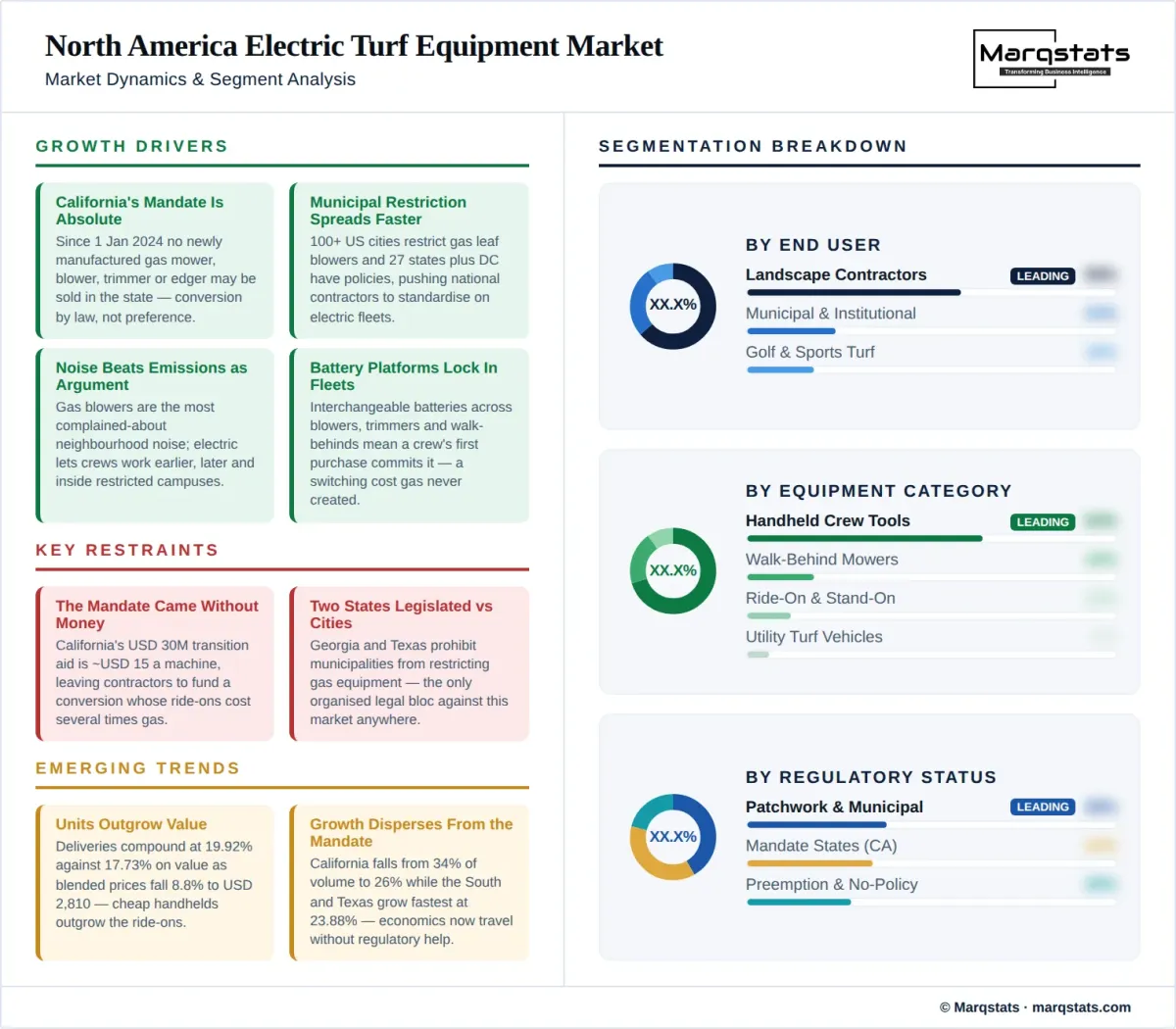
California's sales mandate is absolute and already in force. Since 1 January 2024 no newly manufactured gas mower, blower, trimmer or edger may be sold in the state, converting the largest single commercial turf market in North America by legal requirement rather than by preference.
Municipal restriction is spreading faster than state law. More than a hundred US cities now restrict gas leaf blowers and 27 states plus the District of Columbia have policies of some kind, creating a patchwork that pushes national contractors toward standardising on electric fleets rather than managing equipment by jurisdiction.
Noise is a stronger commercial argument than emissions. Gas blowers are the single most complained-about noise source in residential neighbourhoods, and electric equipment lets crews work earlier, later and inside noise-restricted campuses, hospitals and gated communities — expanding billable hours rather than merely satisfying rules.
Running costs favour electric on commercial duty cycles. A commercial crew runs its equipment hundreds of hours a season, and the fuel, oil, filter, plug and carburettor maintenance that gas equipment demands compounds against battery systems that need charging and little else.
Battery platform standardisation locks in fleets. Manufacturers now sell interchangeable battery systems across blowers, trimmers, edgers and walk-behinds, so a contractor's first purchase commits the crew to a platform — a switching cost gas equipment never created.
Key Restraints
The mandate came without the money. California's USD 30 million transition assistance amounts to roughly fifteen dollars per machine, leaving contractors to fund a fleet conversion whose ride-on equipment costs several times its gas equivalent.
Two states have legislated against their own cities. Georgia and Texas prohibit municipalities from restricting or discouraging gas equipment, creating the only organised legal bloc against this market's growth anywhere in the series and capping the regulatory channel across a large share of the continent.
Ride-on duty cycles still strain batteries. A commercial zero-turn mower cutting eight hours a day in summer heat remains the hardest case for battery equipment, and the ride-on category — which carries the market's revenue — converts slower than the handheld tools that carry its volume.
Charging logistics fall on the truck, not the depot. Landscape crews work from trailers across a dozen sites a day, so the practical constraint is on-board battery inventory and overnight depot charging capacity rather than public infrastructure — a cost most contractors discover after their first purchase.
Key Trends
The market grows in units faster than in value: deliveries compound at 19.92% against 17.73% on value, as blended prices fall 8.8% to USD 2,810 and cheap handheld tools outgrow the expensive ride-ons.
Ride-on conversion is accelerating from a low base at 23.82%, rising from 11.5% of units to 13.5% as battery capacity and swap systems finally reach commercial mowing duty cycles.
Growth is dispersing away from the mandate state. California falls from 34% of volume to 26% by 2030 while the South and Texas grow fastest at 23.88% — evidence that running-cost economics now travel without regulatory help.
Golf and sports turf is the fastest-growing end user at 21.22%, as course operators convert greens and fairway equipment for early-morning noise compliance and to remove hydraulic and fuel spill risk from managed turf.
Market Segmentation
The revenue category and the fastest-growing at 23.82%, rising from 11.5% of units to 13.5% by 2030. Commercial zero-turn and stand-on mowers cost several times their gas equivalents and face the hardest duty cycles, which is why they converted last — but battery capacity has now reached full-shift commercial mowing, and this category carries a disproportionate share of market value against its unit share.
Walk-behinds hold 18.5% of units easing to 17%, growing at 17.90% — the slowest category. They occupy an awkward middle: heavy enough to strain batteries, cheap enough that the gas alternative remains attractive where no mandate applies. Their volume is concentrated in municipal grounds crews and smaller contractors.
The volume engine at 64% of units, growing at 19.54%. Blowers, string trimmers, edgers and hedge trimmers are where regulation bites hardest — leaf blowers are the equipment most cities restrict — and where electric alternatives are closest to price parity. At a few hundred dollars each they dominate unit counts while contributing a modest share of value.
Small utility vehicles for grounds and golf operations hold 6% of units rising to 6.5% at 21.85%. This category was substantially electric before the mandates arrived — golf carts and course utility vehicles have run on batteries for decades — and its growth now comes from municipal grounds and campus operations adopting the same platforms.
The largest buyer at 58% of units, easing to 56% by 2030 while growing at 19.08% — the slowest end-user line. Contractors carry the conversion cost themselves and work across jurisdictions with different rules, which makes them simultaneously the market's biggest customer and its most reluctant one.
Cities, school districts, universities and hospital campuses hold 24% of units rising to 25% at 20.90%. Public buyers convert for reasons contractors do not share: they set the noise rules they must live with, they answer to residents, and their procurement can absorb higher capital costs against multi-year budgets.
The fastest-growing end user at 21.22%, from 18% of units to 19%. Golf courses run equipment before dawn beside residential property lines, which makes noise the decisive argument, and removing hydraulic fluid and fuel from greens equipment eliminates a turf-damage risk superintendents have managed for decades.
By Geography
California
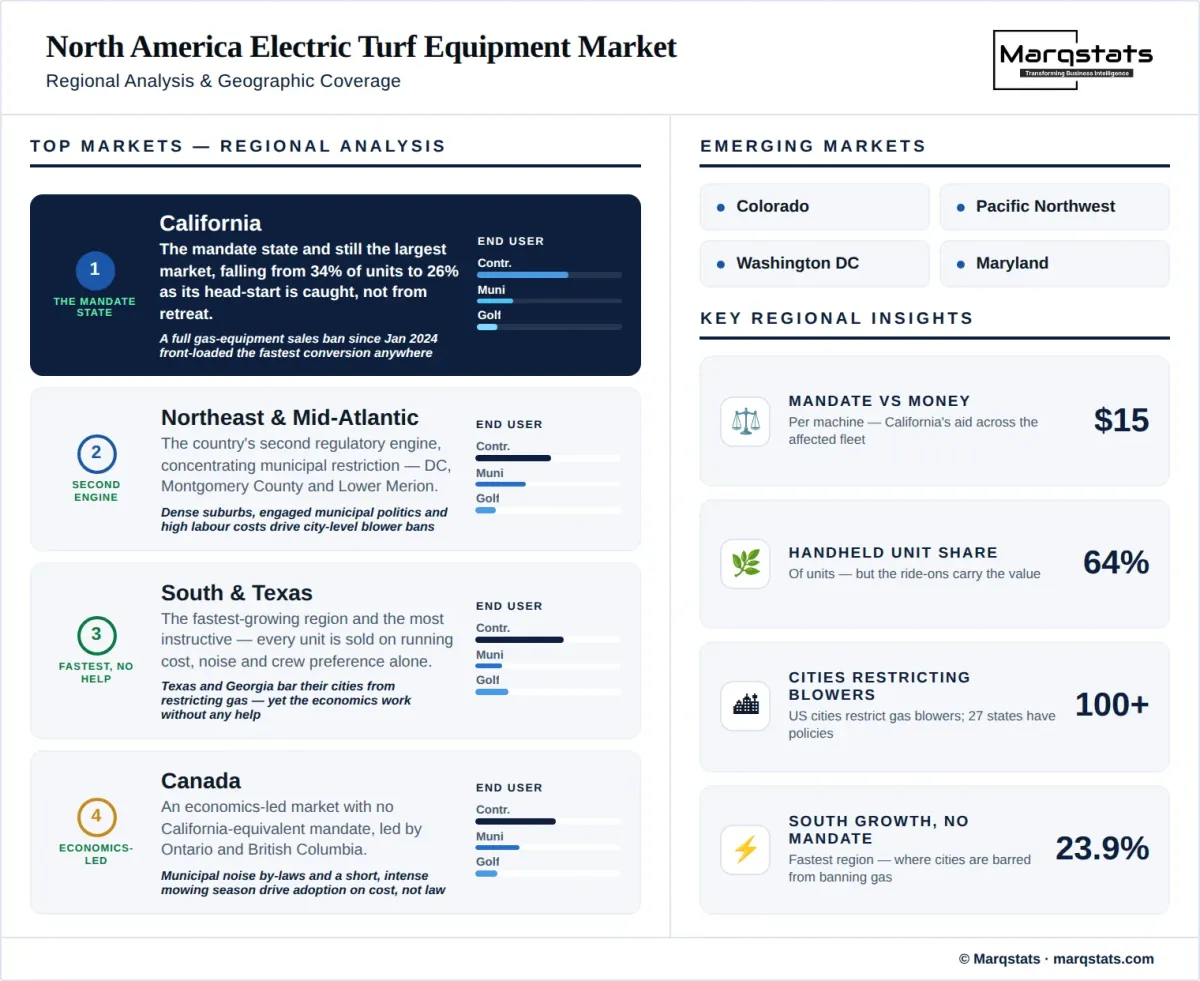
The mandate state and still the largest market at 34% of 2025 units, falling to 26% by 2030 at 13.65% — the slowest regional line. Since 1 January 2024 no newly manufactured gas turf equipment may be sold in the state, which front-loaded California's conversion; its declining share reflects that head start being caught rather than any retreat.
Northeast and Mid-Atlantic
Rising from 22% of units to 24% at 22.02%. The region concentrates municipal restriction: Washington banned gas leaf blowers in 2022, Montgomery County in Maryland bans their sale, Baltimore restricts them and Lower Merion in Pennsylvania phases in a seasonal ban from 1 June 2026. Dense suburbs, engaged municipal politics and high labour costs make this the country's second regulatory engine.
Pacific Northwest and Mountain West
Growing at 21.71% from 13% of units to 14%. Washington, Oregon and Colorado combine air-quality programmes — Colorado's regional air quality council runs an equipment exchange — with utility rebate schemes, and the region's environmental procurement norms carry municipal buyers ahead of state law.
South and Texas
The fastest-growing region at 23.88%, from 17% of units to 20% by 2030 — and the most instructive. Texas and Georgia have passed laws prohibiting their municipalities from restricting gas equipment, so every unit sold here is sold on running cost, noise and crew preference. Long mowing seasons and large commercial contractors make the economics work without any regulatory help.
Canada
Growing at 23.16% from 14% of units to 16%. Canadian municipal noise by-laws, provincial procurement policies and a shorter but intense mowing season drive adoption, with Ontario and British Columbia leading. Canadian buyers follow US product cycles closely, and the absence of a Canadian equivalent to California's mandate makes this an economics-led market.
How Competition Is Evolving
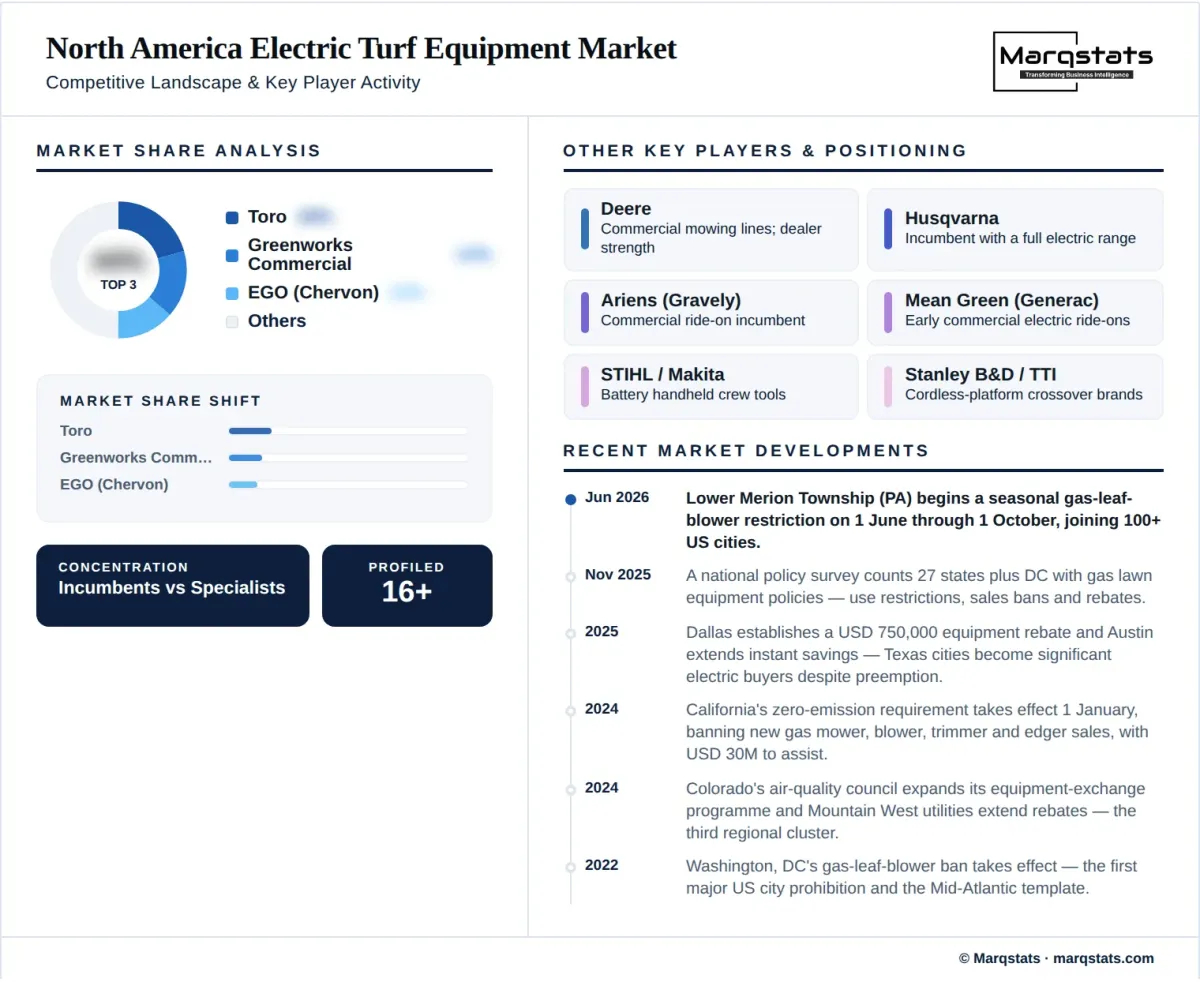
The competitive structure splits between incumbents defending installed bases and specialists that arrived electric. The traditional commercial turf majors — Toro, Deere through its commercial mowing lines, Ariens with its Gravely brand, Exmark and Husqvarna — own the dealer networks, the contractor relationships and the service infrastructure that commercial buyers depend on, and each has built electric lines rather than cede the mandate states. Their advantage is distribution; their difficulty is that a contractor converting to electric is, for the first time in decades, genuinely open to switching brands.
The specialists exploit exactly that opening. Mean Green Mowers, acquired by Generac, built commercial electric ride-ons before the majors took the category seriously; Greenworks Commercial and EGO Power Plus came from battery platforms rather than from engines and lead the handheld crew segment where volume concentrates. Their platform strategy is the competitive weapon: interchangeable batteries across blowers, trimmers and mowers create a switching cost that gas equipment never imposed, and the first sale to a crew increasingly determines the next decade of that crew's purchases.
Concentration is moderate and the market's structure is unsettled in a way the gas equipment market never was. No manufacturer holds a dominant position across both the handheld volume segment and the ride-on value segment, battery and motor supply arrives from outside the traditional turf supply chain, and the mandate patchwork means a manufacturer's California position tells you little about its position in Texas. For the forecast period the decisive competitive question is not product quality but whether the incumbents' dealer networks or the specialists' battery platforms prove the stronger lock on the commercial contractor.
Companies Covered
The report profiles 16+ companies with full strategy and financials analysis, including:
Recent Market Activity
Table of Contents
Coverage & Segmentation
This study covers new battery-electric commercial and professional turf maintenance equipment sold in the United States and Canada across 2021 to 2030, measured at equipment value in US dollars. Segmentation runs across four equipment categories, three end-user groups and five regional markets. Homeowner and residential equipment is excluded throughout, as are robotic and autonomous mowers, which constitute a separate market with distinct buyers, price points and duty cycles. Corded-electric equipment is excluded; only battery-powered machines are counted.
Two caliber distinctions govern every figure. First, units and value diverge sharply: handheld crew equipment is 64% of units but a minority of value, while ride-on mowers are 11.5% of units and a disproportionate share of revenue — a unit-share statement and a value-share statement about the same category will differ by a factor of several, and this report labels which is being used. Second, the commercial channel is not the whole market: residential electric turf equipment sells in far larger unit volumes at far lower prices, and mixing the two overstates this market severalfold.
Prices are stated at equipment value in US dollars and the blended figure moves with mix rather than with any single product's price. A commercial electric zero-turn mower runs from roughly twelve to twenty thousand dollars against a gas equivalent at a fraction of that; a handheld blower or trimmer sits between three and seven hundred. The blended average of USD 3,080 in 2025 therefore describes the basket, not a machine, and its 8.8% decline to 2030 reflects handheld tools outgrowing ride-ons rather than any product becoming cheaper. Readers modelling contractor conversion cost should work from category prices, not from the blend.