Market Snapshot
Key Takeaways
Market Overview & Analysis
Report Summary
This report sizes the Australia electric mining equipment market — battery-electric and cable-tethered electric mobile machines supplied to Australian mine sites, plus the charging and site electrical infrastructure serving them. Coverage spans surface haul trucks, hydraulic excavators and shovels, blasthole and production drills, dozers, underground loaders and trucks, and underground light and utility vehicles. Diesel-electric drivetrains are excluded on the grounds that they consume diesel; the legacy grid-powered dragline and rope shovel fleet is excluded as a mature installed base with no meaningful new supply, though its existence is the reason Australia has run electric mining machines for fifty years without anyone counting them as an equipment market.
The market is small, concentrated and mis-described. Its 2025 value of A$0.19 billion sits against Australian mining capital expenditure of roughly A$54.8 billion — a figure covering structures and exploration as well as plant, so not an equipment denominator, but one that sets the order of magnitude. Growth to USD 1.67 billion by 2030 depends almost entirely on whether one company takes delivery of one order on schedule, and that order has already slipped twice: from operational trucks by 2025, to validation in early 2026, to phased deliveries across 2028 to 2030. The forecast models the current schedule without assuming either a third slip or that this one holds.
Two structural facts govern everything else. The first is that Australian policy pays miners to burn diesel at roughly 45 times the rate at which it charges them for the carbon, which defers every investment decision that would otherwise be marginal. The second is that electrified haulage is not an equipment purchase with a charging accessory; it is a generation and transmission project with vehicles attached. Marqstats derives an average draw of 0.9 to 1.3 megawatts per 240-tonne battery haul truck — a range rather than a point, because published per-truck figures differ by a factor of nearly three between graded and flat haul profiles and Pilbara iron ore sits at the flat end. That puts one fully electrified Pilbara fleet at 300 to 430 megawatts continuous, or between roughly 58% and 83% of the average output of the renewable system being built to serve it, depending on which of the operator's two generation targets — published six weeks apart and never reconciled — is used.
Market Dynamics
Key Drivers
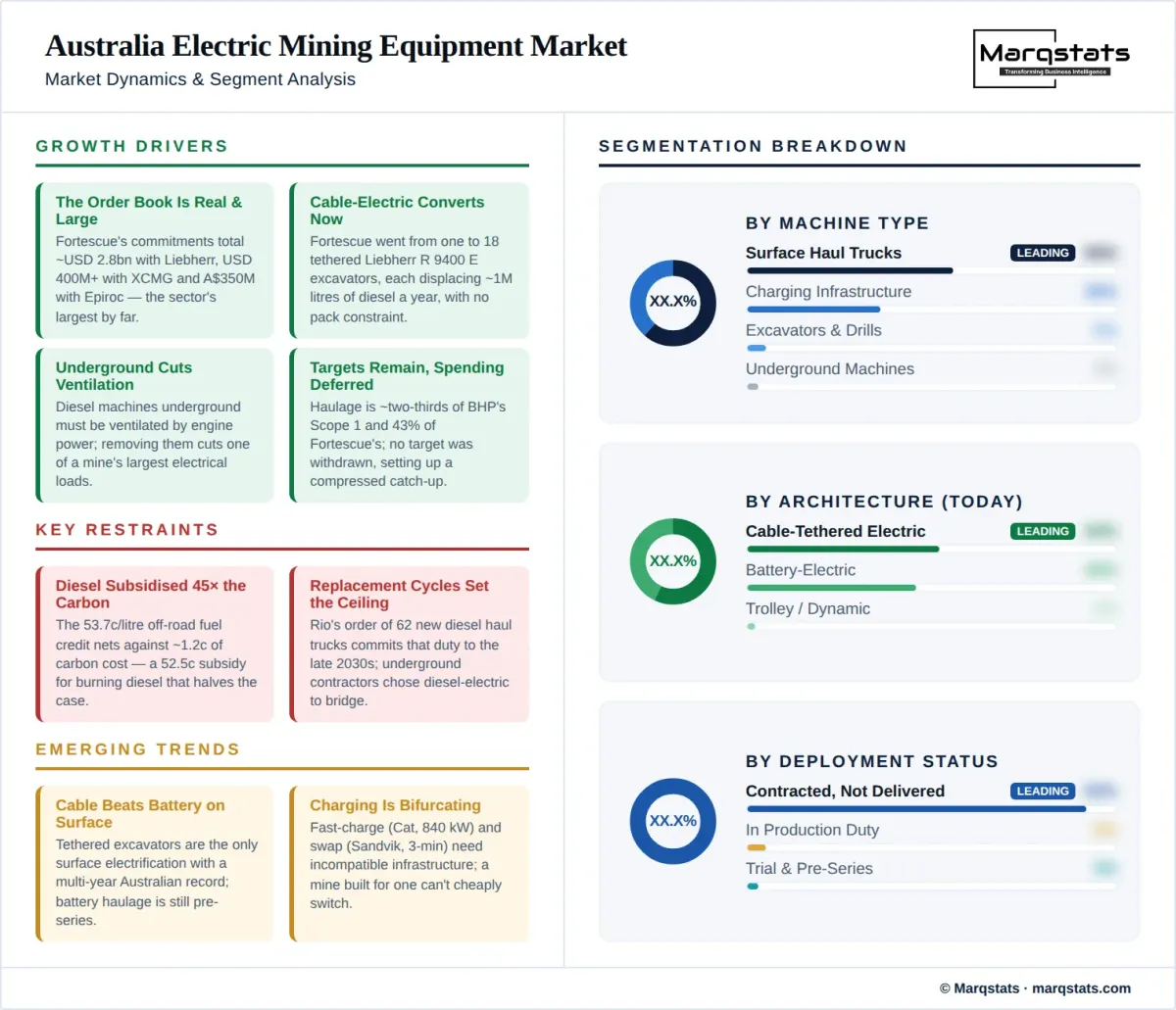
The order book is real, dated and large. Fortescue's disclosed commitments total roughly USD 2.8 billion with Liebherr and Fortescue Zero, more than USD 400 million with XCMG for over 100 machines, and A$350 million with Epiroc — Epiroc's largest order ever — inside a decarbonisation capital envelope of about USD 6.2 billion. It is the largest single electrification commitment in Australian mining by an order of magnitude.
Cable-electric machines are converting a real fleet now, without the constraints that stall battery haulage. Fortescue moved from one operational Liebherr R 9400 E excavator at Cloudbreak in December 2023 to 16 by May 2026 and 18 by July, each claimed to displace about a million litres of diesel a year. The April 2025 Epiroc award covers cable-electric Pit Viper 271 E drills claimed to remove 35 megalitres of diesel a year, though no Australian delivery has yet been evidenced.
Underground electrification removes ventilation load, the strongest business case in the sector even though nobody has published the Australian arithmetic. Diesel machines underground must be ventilated at rates set by engine power, and ventilation is among the largest electrical loads in a mine. The one rigorous Australian study — modelled on a nickel project placed on care and maintenance four months before publication and later written off — never released its numbers, so this report treats the ventilation credit as directionally established and quantitatively unevidenced.
Australian suppliers have cleared the hardest regulatory hurdle in the sector. 3ME Technology's BladeVOLT battery system was reported in March 2026 to have achieved IECEx certification for explosive atmospheres, having had Clean Energy Finance Corporation backing since 2021, and Safescape's Bortana EV has been in Australian mine service since 2020.
Emissions targets remain in force at every major miner even where the capital behind them has been cut. Haulage and rail produce about two-thirds of BHP's Scope 1 emissions and Fortescue puts heavy mobile equipment at 43% of its Scope 1 and 2. The targets have not been withdrawn, only the spending deferred, which sets up a compressed catch-up rather than an abandonment.
Key Restraints
★ The fuel tax credit halves the operating-cost case and the government has declined to change it. On climate-policy research estimates drawn from Taxation Office statistics, mining takes roughly 45% to 47% of all Australian fuel tax credits, worth A$4.5 billion in 2023-24, with BHP alone receiving A$622 million in 2024. The scheme costs A$10.8 billion in 2025-26 rising to A$13.1 billion by 2028-29, and the May 2026 Budget made no change. The off-road rate also moved three times during 2026 — 52.6 cents to 20.6, then 36.6, then 53.7 — so any calculation written between April and July is now wrong.
Fleet replacement cycles set the ceiling, and the grid connection binds what is left. Rio Tinto's order of 62 new diesel haul trucks, estimated at A$500 million, commits that duty to the late 2030s and potentially 2041 — the question is not when miners will buy electric trucks but when their diesel fleets come up for replacement, and a large block of that decision has just been pushed beyond the horizon. Meanwhile BHP deferred its Pilbara renewables balance into the 2030s and Rio's target fell 300 to 400 megawatts because electric trucks were delayed, so the absence of trucks destroyed the capacity that would have charged them.
Australia's dominant underground fleet buyers have chosen diesel-electric as a bridge. Byrnecut and Sandvik announced a diesel-electric loader and truck partnership in May 2024, and Byrnecut's June 2026 order of 20 machines contained no battery units. In Australian underground gold and base metals the contractor typically owns and specifies the fleet, not the mine owner, so miner-level commitments never reach the procurement decision.
There is no published list price for any electric mining machine, and government support is negligible against the subsidy running the other way. Marqstats derives a T 264 unit price near USD 6.06 million as the residual of the announced order value after assuming roughly USD 8 million per electric excavator and USD 3 million per battery dozer, neither published; the widely repeated USD 7.8 million figure fails arithmetic, since 360 trucks at that price would consume the entire USD 2.8 billion and leave nothing for the excavators and dozers in the same contract. Total Commonwealth grant funding for mine-fleet electrification is A$19.06 million, or 0.035% of mining capital expenditure.
Key Trends
Cable and tether are beating battery on the surface. Fortescue's operating electric machine count is dominated by tethered excavators, with cable-electric drills contracted since April 2025 but no Australian delivery evidenced, while its battery haul truck count remains at pre-series. The tethered machine has no charging requirement, no pack cost and no thermal management problem, and it is the only surface electrification technology with a multi-year Australian production record.
Marqstats located no trolley-assist installation, trial or planning application at any Australian mine, at any date, across searches of the major miners, the Pilbara, the Bowen Basin, the Hunter Valley and the relevant product ranges. The installed base is assessed as zero — an inference from comprehensive absence rather than a published statement — while BHP filed an environmental impact statement in July 2024 for trolley at Escondida Norte in Chile. The mechanism is documented: Fortescue terminated its battery locomotive programme in mid-2025 after engineering found the loaded downhill run could not regenerate enough to return the train, the remaining fix requiring 65 kilometres of overhead cable on cyclone-rated gantries.
Charging architecture is bifurcating into two mutually useless investments. Caterpillar's R1700 XE loader carries a 213 kilowatt-hour pack and charges at up to 840 kilowatts in under twenty minutes, demanding high-power reticulation to the working level. Sandvik's Toro LH518iB carries a 482 kilowatt-hour pack and swaps in about three minutes — its TH550B truck publishes an optimal charging power of just 242 kilowatts, taking 150 minutes. A mine that builds for fast charging cannot cheaply switch to swap, or the reverse.
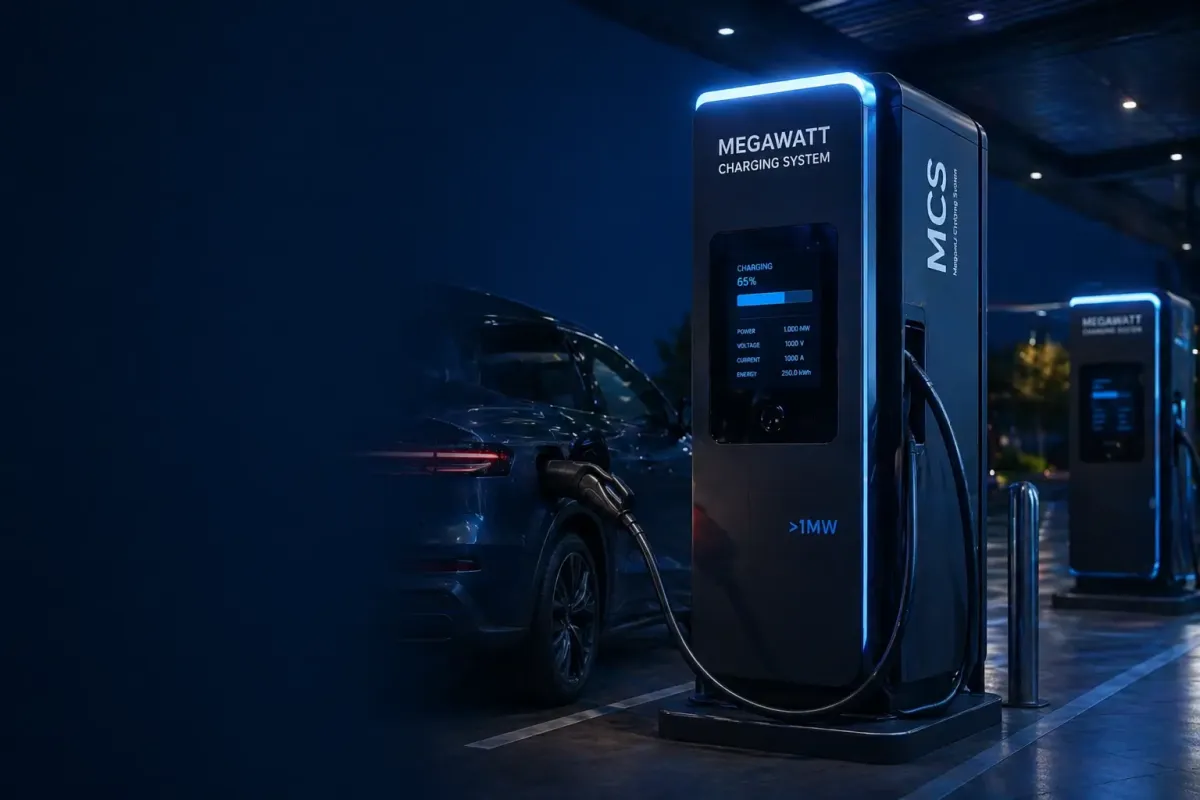
Megawatt-class static charging is being commissioned at mine sites for the first time. Fortescue began commissioning its first in-house 6 megawatt fast charger on 25 May 2026, with an automated connection system and a stated full charge in about 30 minutes, arithmetically consistent with the 2.6 megawatt-hour pack figure. Dynamic charging is a step behind: BluVein's fourth-generation system was reported in March 2026 to have completed extreme-condition laboratory testing before field trials in Queensland, ahead of a mine-site trial targeted for 2027.
Market Segmentation
The segment that carries the forecast and currently has an Australian operating fleet of zero in production duty. Two Caterpillar 793 XE trial units are commissioning at BHP's Jimblebar, and one Liebherr T 264 has had its Fortescue Zero battery system fitted at a proving ground outside Australia. Marqstats models 18 trial and pre-series units across 2025 to 2027, then 55 deliveries in 2028 rising to 160 in 2030 — a cumulative 335. That is consistent with Fortescue's restated 300-to-400-truck fleet arriving on its stated schedule and effectively no non-Fortescue Australian deliveries in the period, an assumption made explicitly rather than a coincidence of ranges. Haul trucks are 87% of 2030 machine value and 56% of total 2030 market value.
The Australian electric mining machine that actually works. Fortescue's Liebherr R 9400 E fleet went from one unit at Cloudbreak in December 2023 to 16 operating by May 2026 and 18 by July, against an order of 55 and a year-end target of roughly 35 that the observed run rate does not support.
The segment created by a single award, and not yet by a single delivery. Fortescue's A$350 million, five-year Epiroc order of April 2025 covers cable-electric Pit Viper 271 E blasthole drills and battery SmartROC D65 BE surface drills, operated driverless from an integrated operations centre in Perth more than 1,500 kilometres away. The unit count behind the award value has not been published and no Australian delivery has been evidenced, so the drill series here is a Marqstats allocation of a published contract value rather than a counted fleet.
Small, real, and growing more slowly than the trial record suggests. Around 16 battery machines are evidenced across six named Australian sites, including Sandvik loaders with Byrnecut at Prominent Hill and Carrapateena and single-unit trials at Sunrise Dam and St Ives. Marqstats models 7 deliveries in 2025 rising to 40 in 2030, calibrated so that cumulative deliveries across 2021 to 2025 land at 18 units, close to the evidenced fleet. No year in this series carries a published anchor.
The largest Australian electric mining fleet by unit count and the one with the longest operating record. Safescape's Bortana EV — built on the Agrale Marruá platform, a Brazilian military all-terrain vehicle, with a 3ME Technology battery system — has been in mine service since 2020. Zero Automotive's ZED70 and Murray Engineering's eLV are Toyota Land Cruiser 79-series conversions, and Batt Mobile Equipment supplies converted machines to South32, Barminco, Gold Fields and Aeris Resources. Marqstats models 17 deliveries in 2025 rising to 80 by 2030; the cumulative historical figure deliberately exceeds the ten to fifteen conversions evidenced at named sites, because supplier unit counts here are not published and the evidenced count is a floor, not a census.
Modelled as a segment in its own right because the equipment cannot be bought without it. Marqstats models this line at USD 0.03 billion in 2025 rising to USD 0.60 billion by 2030, or 36.0% of the market, at roughly 0.4 charging installations per haul truck delivered — deliberately below the only published deployment plan, approximately 250 chargers by the end of the decade against a 300-to-400-truck fleet, because that plan covers a fully converted fleet beyond this horizon. It covers chargers and site reticulation only. Generation, storage and transmission are a separate energy market: one operator's power-side spend alone exceeds USD 6 billion against a USD 2.8 billion equipment order, so a market that counts machines and ignores power understates addressable spend by roughly two to one.
Australia's only proven surface electrification architecture, proven by the R 9400 E excavators; the Pit Viper 271 E drills are contracted on the same architecture but not yet evidenced on site. Tethering requires medium-voltage reticulation to the working face and constrains machine mobility, but eliminates the pack, the charger and the thermal management system entirely, which is why it is in production while battery haulage is not.
The architecture the market is named after and the one with the least Australian surface evidence. Packs are large: the T 264 production battery is published at 2.6 megawatt-hours, against 3.2 at the 2024 reveal and a 1.4 figure that appears to describe an earlier prototype — this report uses 2.6 as the figure contemporaneous with the actual build. Underground packs run 482 kilowatt-hours on a Sandvik truck and 213 on a Caterpillar loader, split between fast-charge and swap philosophies requiring incompatible infrastructure. Underground machines carry this segment's entire Australian production record.
An installed base assessed as zero in Australia, against mature deployments in Chile, Sweden and Zambia. Dynamic charging is the Australian variant under development: BluVein, a joint venture involving the Queensland engineering firm OLITEK, was reported in March 2026 to have completed extreme-condition testing of its fourth-generation system and to be field testing on an Epiroc Minetruck MT42 Battery at a Queensland bluestone quarry on a one-in-seven grade, targeting a mine-site trial in 2027.
By Geography
Pilbara, Western Australia
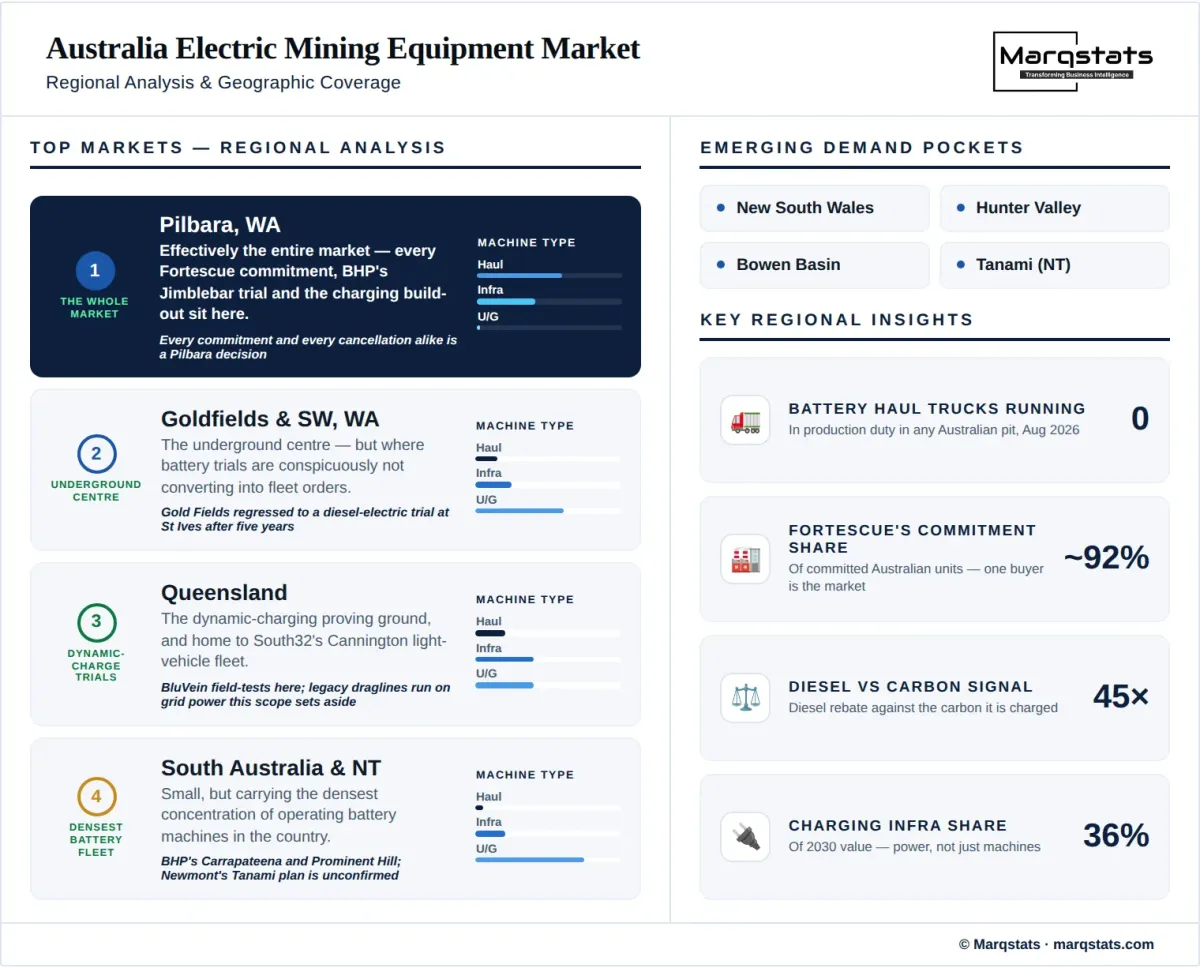
Effectively the whole market. Every Fortescue commitment, BHP's Jimblebar trial and Rio Tinto's iron ore operations sit here, and so does the charging build-out — Fortescue's 6 megawatt charger, its Turner River 690 megawatt solar project and a 650 megawatt-hour battery at Cloudbreak. It is also where the cancellations sit: BHP's Jimblebar solar farm and Newman battery, Rio Tinto's reduced renewables target and Rio's 62-truck diesel order are all Pilbara decisions.
Goldfields and South West, Western Australia
The underground centre of the market. Gold Fields trialled a Sandvik battery loader and truck at St Ives in 2021 and returned to trial a Sandvik diesel-electric truck at the same operation in March 2026 — a five-year regression at one site whose earlier result was never published, and the clearest evidence that Australian underground battery trials are not converting into fleet orders. Sunrise Dam took a Sandvik battery truck in 2023 with no follow-on order, and Murray Engineering's eLV was trialled at Granny Smith.
Queensland
The dynamic charging proving ground, and the state carrying South32's Cannington operation, which runs Bortana EVs and a Batt Mobile Equipment BIT120 alongside a Caterpillar diesel-electric loader trial. BluVein field-tests at a bluestone quarry south of Brisbane. Queensland open-cut coal has also run walking draglines and electric rope shovels on grid power for decades — 68 draglines across Queensland and New South Wales as at 1992 — the installed electric base this definition sets aside.
New South Wales
The domestic supply base rather than the deployment base. 3ME Technology is headquartered here, and its reported IECEx certification in March 2026 is the most significant Australian regulatory milestone in the sector. Hunter Valley coal runs the same legacy electric draglines as Queensland, and Safeguard Mechanism exposure concentrates in the same facilities.
South Australia and Northern Territory
Small but disproportionately significant for underground evidence. BHP's Carrapateena and Prominent Hill operations in South Australia carry Byrnecut's Sandvik battery loaders, Zero Automotive ZED70 and ZED70 Ti light vehicles and a Normet Charmec SmartDrive unit — the densest concentration of operating battery mining machines in the country. Newmont's Tanami plan in the Northern Territory is reported at 10 to 26 underground machines by 2027, none delivered and none confirmed in a Newmont primary document.
How Competition Is Evolving
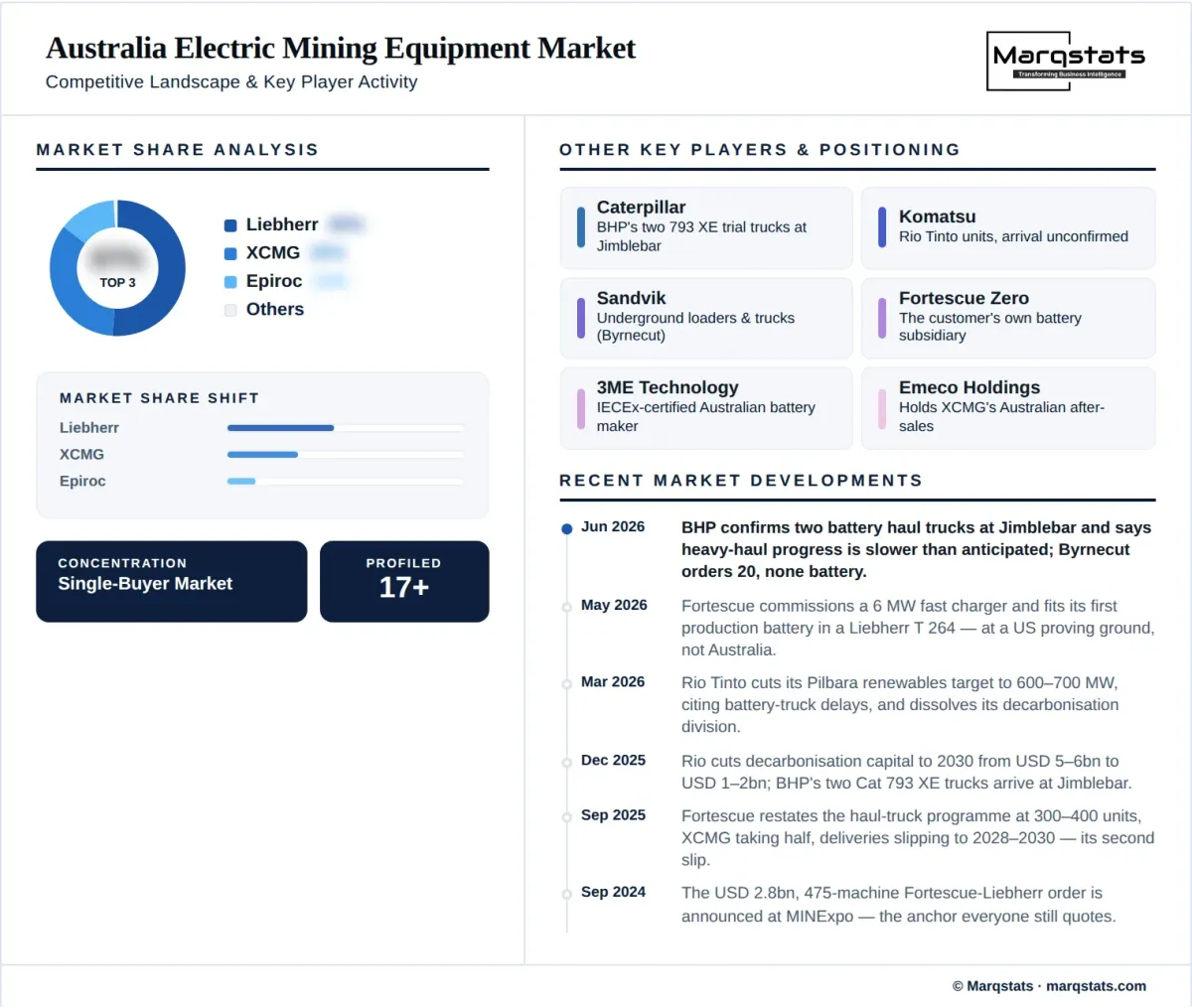
This is not a competitive market in any ordinary sense. One customer accounts for roughly 92% of committed Australian units, and that customer has awarded its business to three suppliers — Liebherr for haul trucks, excavators and dozers, XCMG for up to half the haul truck fleet plus more than 100 ancillary machines, and Epiroc for drills. Everything else in Australia is a trial. Market share here is therefore not a measure of competitive success but of who won a small number of very large procurement decisions at a single company, and any share table should be read as a description of one supplier panel.
The identity problem here runs in three directions. First, the battery in the flagship machine comes from the customer: Fortescue Zero, formerly Williams Advanced Engineering, is a Fortescue subsidiary supplying the pack that goes into the Liebherr chassis, so counting both a Liebherr sale and a Fortescue Zero sale double-counts one machine — the players list below names both and flags the relationship. Second, the conversion specialists split a single vehicle across three companies: a Bortana EV carries a Brazilian Agrale chassis, integration and branding by Safescape of Bendigo, and a battery and traction system from 3ME Technology in New South Wales. Third, several machines widely described as electric are diesel-electric — XCMG's XDE260 trucks landed at Port Hedland in March 2026 run Cummins engines with Wabtec AC drives, as do Caterpillar's R2900 XE and the 2026 St Ives trial truck.
The supplier sets differ sharply by application. Surface haulage is Liebherr, Caterpillar, Komatsu and XCMG, competing on machine and increasingly on charging architecture; underground is Sandvik, Epiroc and Normet, where the competitive question is not battery chemistry but whether a mine builds for fast charging or for pack swap. The Australian domestic layer competes on conversion, certification and infrastructure rather than new machines, and its maturity differs by an order of magnitude between participants — Electric Power Conversions Australia is the only party to have converted a full-size haul truck and run it at an Australian mine, a Caterpillar 777 at about A$2.5 million. The after-sales layer matters more than its profile suggests: Emeco Holdings holds XCMG's entire Australian after-sales function under a five-year agreement, so if XCMG delivers battery haul trucks to the Pilbara from 2028, Emeco maintains them.
Companies Covered
The report profiles 17+ companies with full strategy and financials analysis, including:
Recent Market Activity
Table of Contents
Coverage & Segmentation
This study covers battery-electric and cable-tethered electric mobile mining machines newly supplied to Australian mine sites across 2021 to 2030, together with the dedicated charging and site electrical infrastructure built to serve them. Machine coverage spans surface haul trucks, excavators and shovels, blasthole and production drills, dozers, underground loaders and trucks, and underground light and utility vehicles. Diesel-electric drivetrains are excluded because they consume diesel; the legacy grid-powered dragline and rope shovel fleet is excluded as a mature installed base with no meaningful new supply; and generation, storage and transmission are excluded from market value as a separate and substantially larger energy market.
Market value is measured at machine and installation supply price in United States dollars and converted to Australian dollars at annual average exchange rates for historical years and assumed rates thereafter, with both series reported because they diverge by 2.26 percentage points across the forecast. The base year is 2025, the historical period 2021 to 2025 and the forecast period 2026 to 2030. Readers should treat the forecast as schedule-dependent rather than demand-dependent: haul truck deliveries are approximately 87% of 2030 machine value and 56% of total 2030 market value, the overwhelming majority of them one customer's, and that programme has already slipped twice. A third slip of two years would remove the majority of the forecast growth. This report states that exposure rather than modelling a probability against it.