Market Snapshot
Key Takeaways
Market Overview & Analysis
Report Summary
This report sizes the Europe electric construction equipment market — battery-electric and cable-tethered electric non-road machinery supplied to European construction sites, plus the temporary site charging serving it. Coverage spans mini and compact excavators below six tonnes, midi and crawler excavators above six tonnes, wheel loaders and telehandlers, dumpers and site haulers, and compaction and other compact classes. Diesel-electric hybrids are excluded because they consume diesel, and the report deliberately treats the machine and the charging as one market because a site cannot buy one without the other.
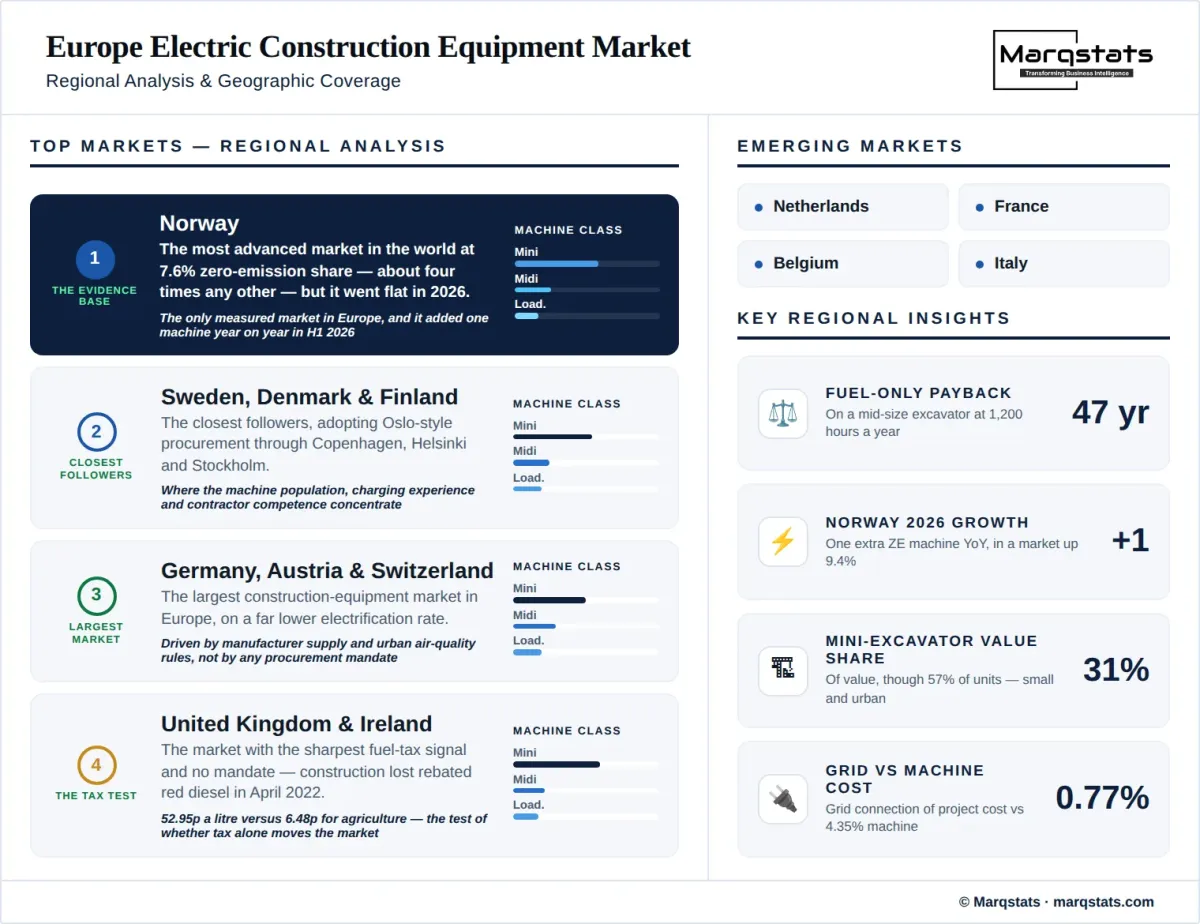
Norway is the evidence base, not the addressable market. Its equipment importers' association publishes the only quarterly national count of zero-emission machine sales located anywhere in Europe, and that series is what makes any statement about this market falsifiable. Norway's zero-emission share reached 7.6% across 2025 against 4.5% in 2024, which is roughly four times the level of any other European market — but on Marqstats' construction Norway is only 16.3% of European unit deliveries, because the large construction markets of Germany, the United Kingdom and France are far bigger and far less electrified.
The market's centre of gravity is small and urban. Mini and compact excavators are 57% of unit deliveries but only 31% of value, because they are the machines that fit a city site, work near buildings and people, and complete a day's work inside a battery. The heavy classes carry the value and the emissions but sit furthest from the technology's reach. Any reading of this market that starts from the heavy end will misjudge both its size and its direction.
Market Dynamics
Key Drivers
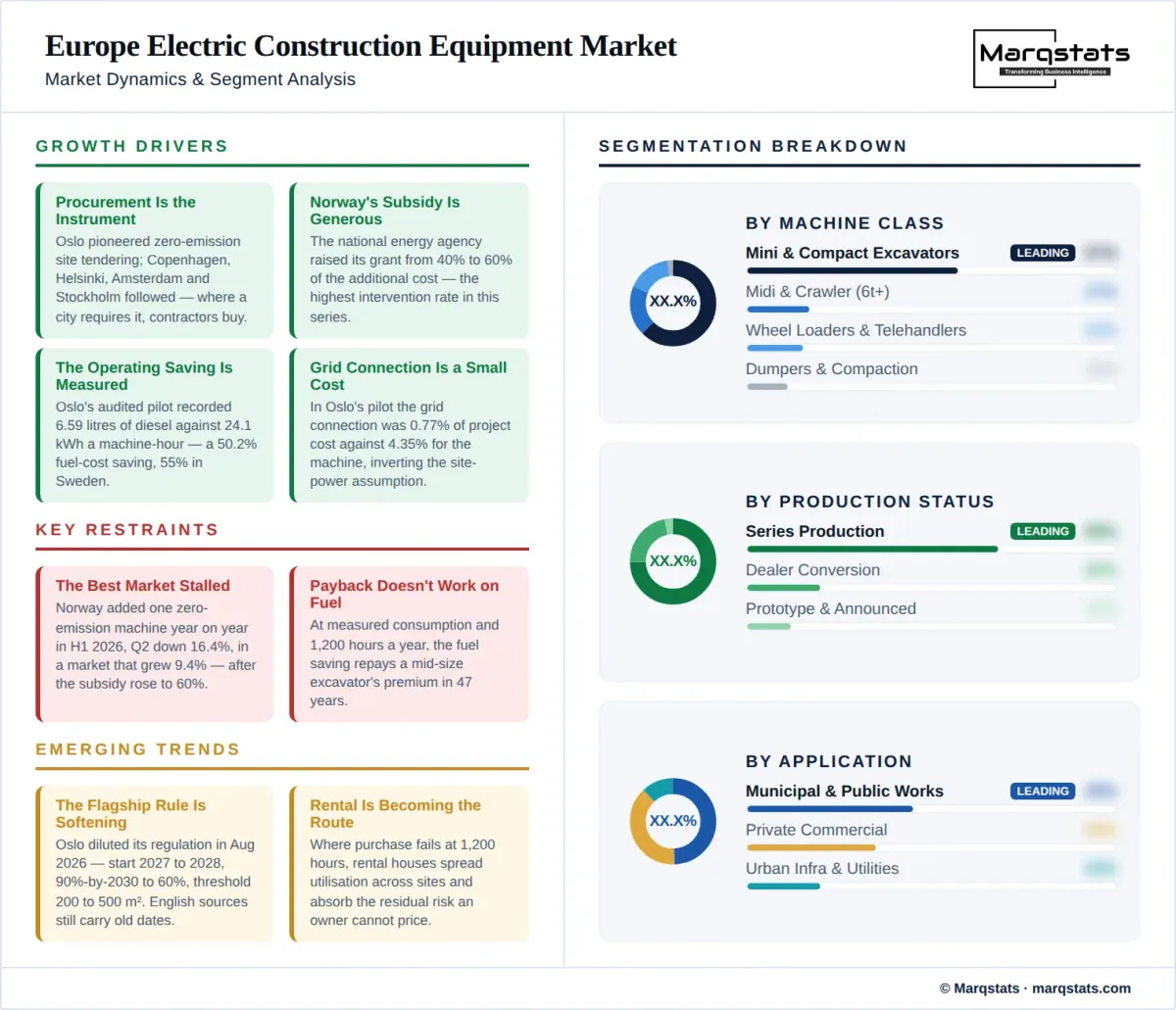
Municipal procurement is the only instrument in Europe that reliably creates demand for these machines. Oslo pioneered zero-emission construction site requirements in municipal tendering, and Trondheim, Bergen, Copenhagen, Helsinki, Amsterdam and Stockholm have adopted variants. Where a city scores or requires zero-emission plant, contractors buy the machines; where it does not, they generally do not.
Norwegian purchase support is unusually generous and was recently increased. The national energy agency raised its subsidy on zero-emission construction machinery from 40% to 60% of the additional cost, which is the highest intervention rate on any machine class covered in this report series.
The operating saving is real and measured. Oslo's audited pilot recorded 6.59 litres of diesel against 24.1 kilowatt-hours per machine-hour, giving a 50.2% fuel-cost saving at European prices — a figure independently matched by Swedish reporting at 55%.
Urban sites value what the machine does not produce. Zero local exhaust emissions and sharply lower noise give electric machines access to enclosed works, night-time operation, hospital and school sites and indoor demolition, which are precisely the jobs where a diesel machine is constrained or excluded.
Grid connection is a smaller obstacle than the sector believes. In Oslo's audited pilot the grid connection was 0.77% of project cost against 4.35% for the machine itself, which inverts the common assumption that temporary site power is the binding constraint.
Key Restraints
The most advanced market in the world stalled at a higher subsidy rate. Norway added one zero-emission machine year on year in the first half of 2026, with the second quarter down 16.4%, in a total market that grew 9.4% and after the subsidy rose from 40% to 60%. That is the single most important datapoint in this report.
Payback does not work on fuel alone. At Oslo's own measured consumption and 1,200 operating hours a year, the fuel saving repays the purchase premium on a mid-size excavator in 47 years. The machines that get bought are bought because a tender required them, not because they paid for themselves.
Fuel taxation and procurement policy point in opposite directions across Europe. The United Kingdom removed rebated diesel from construction in April 2022 and has no mandate; Norway keeps the rebate, cut its carbon tax by 57% in May 2026, and has the mandate. The country that taxes the fuel does not require the machines, and the country that requires the machines subsidised the fuel.
The mandate cannot reach the private market. A 2020 ministry legal opinion on the Planning and Building Act means Oslo cannot require zero-emission construction from private developers, which is why its city-wide instrument requires only fossil-free operation. In Oslo's own Climate Budget for 2026, biofuel delivers 1.72 times the abatement of the electrification instrument.
Key Trends
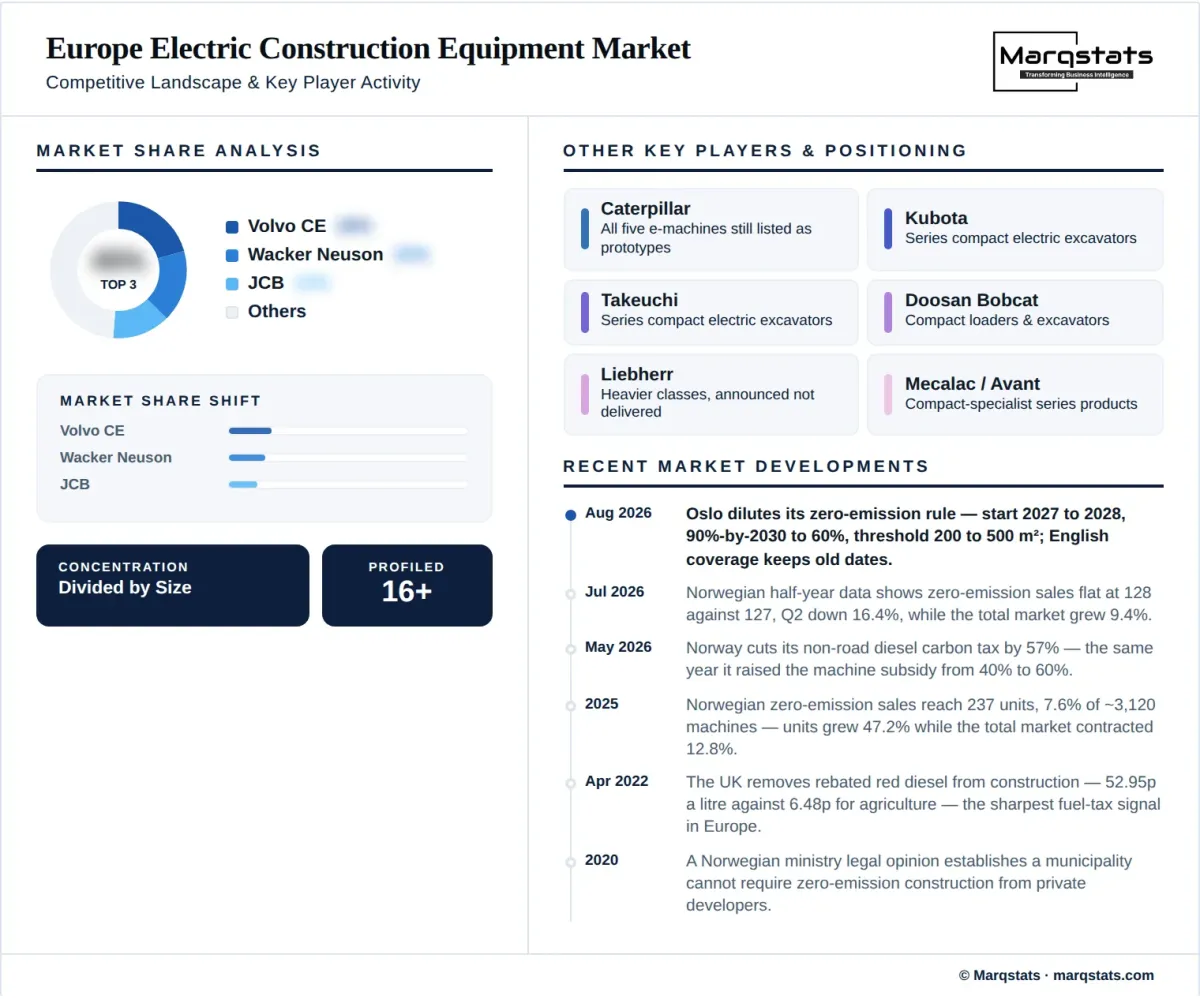
The flagship regulation is being softened, not tightened. Oslo's zero-emission construction regulation was diluted in August 2026: the start moved from 2027 to 2028, the 90%-by-2030 requirement became 60% by 2030 and 75% by 2032, and the size threshold rose from 200 to 500 square metres. Every English-language source Marqstats located still carries the superseded dates.
The installed base remains marginal against the fleet it must replace. Cumulative Norwegian zero-emission machines reached roughly 950 to 1,000 by mid-2026, against a Norwegian excavator fleet alone of about 18,000. Electric excavators above eight tonnes were 1.85% of that fleet in 2024, corroborated by an industry body's own submission putting zero-emission machines at 2% of available equipment.
Production status is being overstated across the sector. Caterpillar still lists all five of its battery-electric construction machines as prototypes in 2026, and the electric Caterpillar machines working on Norwegian sites are dealer conversions rather than factory products. Distinguishing an announced model from a delivered one changes the supplier ranking materially.
Rental is becoming the route to market. European contractors take a large share of their plant on hire, and the rental houses can spread a machine's utilisation across the sites that need it and absorb the residual-value risk that an owner cannot price. Where purchase economics fail at 1,200 hours a year, higher utilisation through hire is the only structural answer available.
Market Segmentation
The volume of the market and the class where the technology actually fits. Marqstats models deliveries rising from 820 units in 2025 to 2,250 by 2030, 57% of units but 31% of value. These are the machines that work urban infill, utilities, landscaping and indoor demolition, where a working day sits inside a battery and where noise and exhaust restrictions bite hardest.
The class that carries the emissions and the tender scoring. Deliveries rise from 250 units in 2025 to 740 by 2030, the fastest-growing excavator class at 24.24%. It is also where the payback arithmetic is worst — the 47-year fuel-only payback in Oslo's pilot is a mid-size excavator figure.
Marqstats models 215 units in 2025 rising to 600 by 2030. Load-and-carry duty around a fixed site suits battery operation and depot charging, and telehandlers in particular spend much of a shift stationary, which is where an electric machine consumes nothing and a diesel one idles.
Together 165 units in 2025 rising to 510 by 2030. Site dumpers are a natural fit on short fixed hauls, and compaction and compact loaders are the classes where the smallest machines and the lowest energy demands make the premium most survivable.
Where the mandates apply and where most of these machines actually work. Public clients can score or require zero-emission plant in tender, and this is the only demand channel in Europe that reliably converts policy into machine purchases. It is also the channel most exposed to a regulation being softened.
The larger market and the one the mandates cannot reach. Where a city has no legal power to impose zero-emission requirements on private developers, the machine must win on economics — and at a 47-year fuel-only payback it does not. This segment adopts through rental, corporate commitments and site-specific noise or air-quality constraints rather than through regulation.
Street works, cabling, district heating and rail maintenance, often at night and often adjacent to occupied buildings. This is the application where the electric machine's non-price advantages — no local exhaust, sharply lower noise, permitted night working — are worth paying for on their own.
By Geography
Norway
The evidence base for the whole of Europe and roughly 16.3% of its unit deliveries. Zero-emission machines reached 7.6% of new sales across 2025 against 4.5% in 2024, about four times any other European market, but the series went flat in 2026 at 128 machines in the first half against 127. Cumulative population is roughly 950 to 1,000 machines against an excavator fleet alone of about 18,000.
Sweden, Denmark and Finland
The closest followers, adopting Oslo-style procurement through Copenhagen, Helsinki and Stockholm. Swedish reporting independently corroborates the Norwegian fuel-saving measurement at 55%, and the Nordic region as a whole is where the machine population, the charging experience and the contractor competence are concentrated.
Germany, Austria and Switzerland
The largest construction equipment market in Europe and a far lower electrification rate. Demand here is driven by manufacturer supply rather than by procurement mandate, with several of the significant electric machine ranges built in the region, and by urban air-quality and noise rules rather than by any carbon instrument.
United Kingdom and Ireland
The market with the sharpest fuel-tax signal and no mandate. Construction lost rebated red diesel on 1 April 2022, moving to 52.95 pence a litre against 6.48 pence still available to agriculture, and London operates a mandatory Non-Road Mobile Machinery register — the only registration instrument of its kind Marqstats located in Europe. That combination makes the United Kingdom the natural test of whether taxation alone can move this market.
Rest of Europe
France, the Netherlands, Belgium, Spain, Italy and the remaining markets. Amsterdam has adopted zero-emission construction requirements and Dutch urban policy is the most advanced outside the Nordics, but across the region as a whole the absence of any European carbon standard for non-road machinery leaves adoption dependent on individual city decisions.
How Competition Is Evolving
The supplier field divides by machine size rather than by nationality, and the division matters because the two halves are at different stages. In the compact classes below six tonnes there are genuine series products from several European and Japanese manufacturers, sold through normal dealer channels at published list prices, and this is where the volume is. In the heavier classes the picture is thinner: announced ranges outnumber delivered machines, and several of the most-cited models remain limited-production or prototype.
Production status is the discriminator a buyer most needs and the one most often blurred. Caterpillar still lists all five of its battery-electric construction machines as prototypes in 2026, and the electric Caterpillar machines working on Norwegian sites are dealer conversions rather than factory output. That distinction also carries a corporate identity trap: the dealer responsible has changed, so contemporary references to the earlier distributor are out of date. Any competitive assessment that counts announced models alongside series products will rank the field wrongly.
The route to market is shifting toward rental, and that shift is rational rather than cosmetic. At 1,200 operating hours a year the purchase economics do not close, so the parties best placed to own these machines are those who can raise utilisation across multiple sites and absorb a residual value that nobody can yet price. European rental houses are becoming the effective buyers, which means the manufacturer's customer is increasingly a fleet operator with a utilisation model rather than a contractor with a single site.
Companies Covered
The report profiles 16+ companies with full strategy and financials analysis, including:
Recent Market Activity
Table of Contents
Coverage & Segmentation
This study covers battery-electric and cable-tethered electric non-road construction machinery supplied in Europe across 2021 to 2030, together with the temporary site charging that serves it. Machine coverage spans mini and compact excavators, midi and crawler excavators, wheel loaders and telehandlers, dumpers and site haulers, and compaction and other compact classes. Diesel-electric hybrids are excluded because they consume diesel; on-road trucks, mining equipment and agricultural tractors are excluded and covered by separate Marqstats reports. The overlap with the Marqstats Off-Highway Electric Vehicle report, which covers these machine classes globally, is stated rather than glossed.
Market value is measured at machine and installation supply price in euros and converted to United States dollars at annual average exchange rates for historical years and assumed rates thereafter, with both series reported because they diverge by 1.61 percentage points across the forecast. The base year is 2025, the historical period 2021 to 2025 and the forecast period 2026 to 2030. Readers should treat European totals as constructed rather than measured: there is no European registration database for non-road mobile machinery, and the only quarterly national count of zero-emission machine sales located anywhere in Europe is Norway's.