Market Snapshot
Middle bar: base-year value × (1 + CAGR), rounded to two decimals. This is a calculated illustration, not a separately researched annual estimate.
The electric ground support equipment market size is estimated at USD 1.84 billion in 2025 and is projected to reach USD 3.82 billion by 2030, at a CAGR of 15.76%. The market covers new electric GSE, retrofit conversions and airport charging infrastructure, across baggage tractors, loaders, pushbacks, ground power units and service vehicles. Regulation drives it: the Port Authority of New York and New Jersey requires all commercially available GSE to be zero-emission by 2030. Charging infrastructure compounds at 26.38% against equipment's 12.93%, and electric machines are roughly a fifth of the global GSE fleet today.
Market size and forecast figures are generated using Marqstats' proprietary estimation framework, updated as of August 2026.
Ground support equipment is the fleet that services an aircraft between arrival and departure — baggage and cargo tractors, belt and container loaders, pushback and towbarless tractors, ground power units, pre-conditioned air units, passenger stairs, catering and lavatory trucks, de-icers and refuellers. Electric machines account for roughly a fifth of a global motorised fleet variously estimated at 200,000 to 220,000 units, up from about a tenth in 2013. On the supply side the transition is already further advanced than the fleet suggests: the largest manufacturer reports electric units at 53% of equipment sold by volume in 2024, rising above 60% since, and states it ceased producing internal-combustion GSE at the end of 2025.
This market is regulatory, not economic. Electric GSE carries a capital premium of roughly 20% over the internal-combustion equivalent at broadly similar maintenance cost, and payback depends almost entirely on utilisation. The clearest public evidence sits in Delta Air Lines' 2025 decision to narrow its electrification target from its total ground fleet to its high-utilisation core fleet, after concluding that electrification impacts vary significantly with utilisation rates and fuel mix. Aircraft stairs running 200 to 1,200 hours a year model out at payback periods beyond fifteen years. The equipment that earns its investment is the equipment that runs all day.
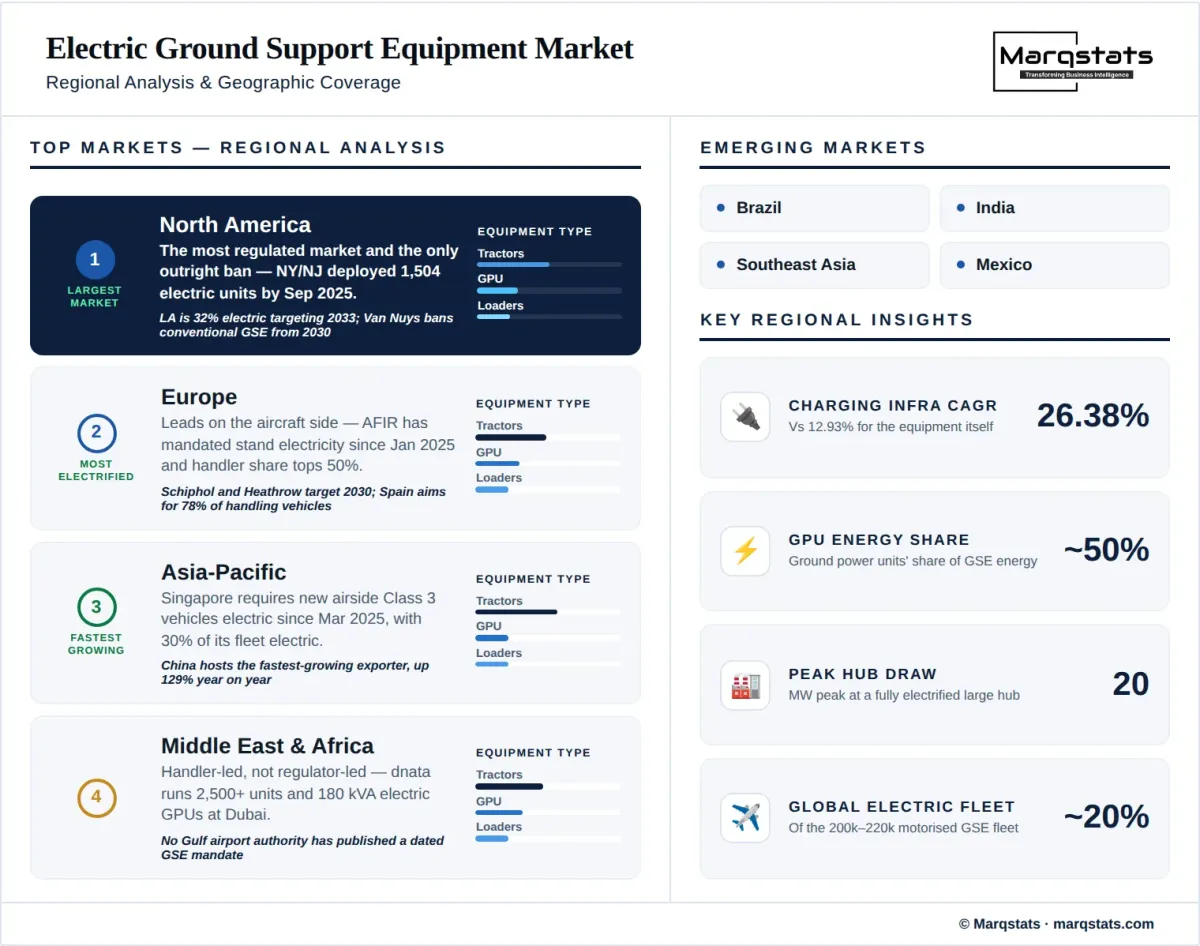
The more consequential shift is that the binding constraint has moved from the vehicle to the socket. Modelling of eight GSE types across 317 major United States airports, published in March 2026, found that ground power units alone account for nearly half of total GSE energy demand, and that a fully electrified large hub would draw up to 20 MW of peak power and 51 GWh a year. California's draft rulemaking makes airports, not handlers, responsible for installing the charging infrastructure. That is why charging infrastructure in this study grows at more than twice the rate of the equipment it serves, rising from 17.3% of market value in 2025 to 26.8% by 2030.
Scope for this study covers new electric ground support equipment sold worldwide, electric retrofit and conversion of existing units, and the charging infrastructure installed airside to support them. Internal-combustion and hybrid GSE, fixed 400 Hz ground power and pre-conditioned air systems built into passenger boarding bridges, aircraft towing systems used for taxiing, landside airport vehicles and ground handling services revenue fall outside scope.
Key Takeaways
Market Overview & Analysis
Report Summary
The electric ground support equipment market comprises battery-powered vehicles and equipment operating airside to service aircraft, together with the charging infrastructure required to keep them running and the conversion of existing internal-combustion units. Global GSE unit sales run at approximately 40,000 machines a year, of which Marqstats estimates 42% were electric in 2025. The installed motorised fleet is variously put at 200,000 to 220,000 units, with published estimates of the electric share clustering between 15% and 25%. A separate figure of more than 500,000 units in operation circulates in trade coverage and appears to include non-motorised equipment; the motorised figure is the relevant denominator.
Demand is created almost entirely by mandate. The Port Authority of New York and New Jersey established a zero-emission airside vehicle rule in 2022 requiring all commercially available GSE to be zero-emission by 2030, phased by category as each becomes commercially available — baggage tractors, narrow-body tractors and belt loaders were declared available in February 2023 with a January 2027 transition deadline, and ground power units, cargo loaders and small forklifts in January 2025 with a January 2030 deadline. As of September 2025 the three New York airports had 1,504 electric GSE units deployed. Los Angeles World Airports adopted a zero-emission GSE policy in January 2024 targeting 2033, and Van Nuys went further in April 2025, prohibiting all non-zero-emission GSE from 1 January 2030 and requiring new or replacement equipment to be zero-emission from 1 June 2025.
California's draft Statewide Clean Aviation Initiative, published in January 2026, would set the most demanding timetable anywhere. Phase 1 equipment — small carts, belt loaders, baggage tractors, lavatory carts, narrow-body tractors, lifts and cargo tractors — would need to be 75% zero-emission by the end of 2032 and 100% by the end of 2035. Phase 2, which includes wide-body tractors and ground power units, would reach 50% by 2032 and 100% by 2037. Critically, the draft places responsibility for charging infrastructure on airports, requiring capacity to support 75% zero-emission operation by the end of 2031. In Europe the Alternative Fuels Infrastructure Regulation has required electricity supply to stationary aircraft at contact stands across the trans-European network since 1 January 2025, extending to remote stands from 2030.
Growth to 2030 is therefore a function of how fast airports can build electrical capacity rather than how fast manufacturers can build vehicles. The manufacturing side has largely already turned: the largest supplier reports electric at more than 60% of units sold and claims to have exited internal-combustion production at the end of 2025, one major brand has been exclusively electric since 1945 and delivered its 7,000th unit in January 2026, and independent forecasts put electric above half of annual industry sales from 2028. The airside electrical side has not. Heathrow operates roughly 7,000 airside vehicles of which 23% are electric, served by 18 charging bays across two terminals with seven further hubs planned over three years.
Market Dynamics
Key Drivers
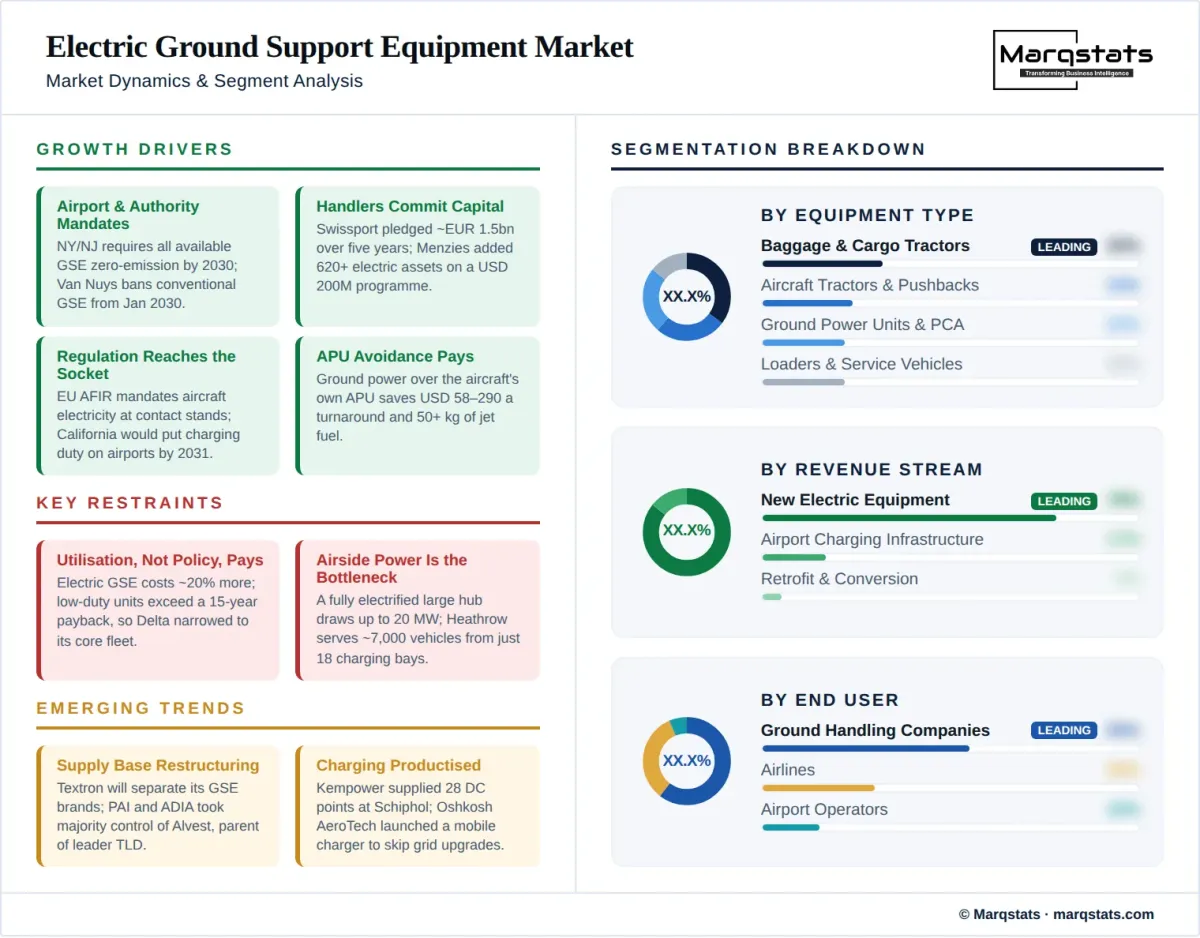
Airport and authority mandates create dated, enforceable demand. The Port Authority of New York and New Jersey requires all commercially available GSE to be zero-emission by 2030; Van Nuys prohibits conventional GSE entirely from 1 January 2030; Los Angeles targets 2033; Singapore has required all new airside Class 3 vehicles, forklifts and tractors to be electric since March 2025 with all airside vehicles on cleaner energy by 2040; and Spain's airport network targets 78% electrification of ground handling vehicles by 2030.
The ground handlers have committed capital at scale. Swissport has pledged approximately EUR 1.5 billion over five years against a fleet of roughly 14,500 motorised units already more than 25% electric, targeting 55% by 2032. Menzies Aviation reached 25% electric across its global fleet at the end of 2025, up from 22%, on a USD 200 million modernisation programme that added more than 620 electric assets in a single year. dnata committed USD 110 million to 800 units across ten countries.
Regulation is now reaching the electrical infrastructure itself, which unlocks the harder half of the market. The European Alternative Fuels Infrastructure Regulation has required electricity supply to stationary aircraft at contact stands since January 2025 and extends to remote stands in 2030, while California's draft rule would make airports responsible for charging capacity supporting 75% zero-emission operation by the end of 2031.
Manufacturer supply has already flipped, removing availability as an excuse. The largest GSE manufacturer reports electric units at 53% of equipment sold by volume in 2024, rising above 60% since, and states it stopped producing internal-combustion GSE at the end of 2025. Independent forecasts place electric above 50% of annual industry sales from 2028 and expect light equipment to be 80% of all electric GSE sales by 2030.
Auxiliary power unit avoidance provides the strongest single economic case in airside electrification. Running an aircraft on ground power rather than its own auxiliary power unit saves between USD 58 and USD 290 per turnaround depending on aircraft type, and a minimum of 50 kilograms of jet fuel on a narrow-body turnaround — economics that belong to the airline rather than the handler, which is why ground power units attract the largest single equipment incentives.
Key Restraints
The capital premium is real and the payback is utilisation-dependent. Electric GSE costs roughly 20% more than the internal-combustion equivalent at broadly similar maintenance cost. Aircraft stairs at 200 to 1,200 annual operating hours model out beyond a fifteen-year payback. Delta Air Lines narrowed its target in 2025 from total fleet to high-utilisation core fleet after concluding that electrification impacts vary significantly with utilisation and fuel mix.
Airside electrical capacity is the binding constraint, and it sits with a party that does not operate the equipment. A fully electrified large hub would draw up to 20 MW at peak and 51 GWh a year. Heathrow serves roughly 7,000 airside vehicles from 18 charging bays across two terminals. Swissport's electric-only procurement pledge is explicitly conditional on sufficient airport charging infrastructure being developed.
Commitments contain off-ramps that soften the apparent deadlines. The Port Authority rule triggers category by category only once equipment is declared commercially available. Heathrow and Schiphol both permit biofuel and hydrotreated vegetable oil as compliant with their 2030 targets, which is decarbonisation but not electrification — Menzies used two million litres of such fuel in 2025, up 50%, fully replacing diesel at four stations.
The remaining equipment categories are the hardest and the most energy-intensive. On California's 2022 baseline, catering trucks, de-icers, bobtails, generators and hydrant trucks were all at zero percent zero-emission, service trucks at 3% and lavatory trucks at 2%, against 80% for small motorised carts. The easy, light, low-power equipment has largely converted; what remains is heavy, high-duty and expensive.
Published market data for this sector is unusually unreliable, which complicates investment cases. Estimates of the total GSE market for 2025 range from USD 5.1 billion to USD 9.88 billion, a 1.9 times spread, and estimates of the electric segment range from USD 1.82 billion to USD 6.80 billion, a 3.7 times spread, driven by irreconcilable scope definitions rather than by data disagreement.
Key Trends
Ownership of the supply base is being restructured. Textron Inc. announced on 30 April 2026 its intent to separate its entire Industrial segment, including the Tug, Safeaero and Premier ground support brands, by sale or spin-off within twelve to eighteen months. PAI Partners and the Abu Dhabi Investment Authority completed the acquisition of a majority stake in Alvest, parent of the market leader, on 9 July 2025, naming electric GSE, autonomous units and decarbonisation as the investment thesis. Oshkosh Corporation acquired the AeroTech business for USD 800 million in 2023.
Charging is being productised as a distinct category rather than treated as a building service. Kempower Oyj supplied 28 DC charging points across three sites at Amsterdam Schiphol in January 2026, and Oshkosh AeroTech launched a battery-powered mobile charging platform in September 2025 specifically to serve electric GSE without triggering a grid upgrade — an explicit acknowledgement that airside electrical capacity, not equipment supply, is the bottleneck.
Fully electric turnarounds are moving from demonstration to routine. Swissport completed Switzerland's first fully electric aircraft turnaround at Geneva in January 2026 using electric baggage tractors, pushback, stairs and belt loaders, at a station now more than 60% electric. Individual stations are reaching very high penetration well ahead of network averages — Milan Malpensa above 80%, Amsterdam fully electric for one handler, Barcelona and Graz fully electric.
Heavy and specialist equipment is finally electrifying, opening the categories that were previously at zero. Vestergaard launched a fully electric de-icer in September 2025 carrying a 145 kWh battery and a full shift of endurance, and specialist manufacturers have brought fully electric catering trucks, tankers and belt loaders to market, one developed jointly with an airline customer.
Autonomy and electrification are converging, because an autonomous ramp vehicle is necessarily electric. Autonomous electric baggage tractors are in service, semi-robotic aircraft taxiing systems are being deployed at acquisition costs of USD 1.7 million to 2.3 million per unit against savings of USD 17 to 69 per movement, and ground handler equipment orders are increasingly specified as electric and autonomous together.
Market Segmentation
Equipment type determines both the pace of electrification and the size of the electrical load, and the two do not correlate. The categories that electrified first are the lightest; the categories that consume the most energy have barely started.
Baggage and cargo tractors are the highest-volume category and among the most electrified, at 46% and 28% zero-emission respectively on California's 2022 baseline. They are also the cheapest to convert, attracting incentives of USD 10,000 per unit against USD 65,000 for a ground power unit. High duty cycles and short, repetitive routes make this the category where electric economics work without subsidy.
Belt loaders are the most electrified powered category after small carts at 58%, while cargo and container loaders sit at only 10%. The gap is explained by mass and lift energy: a belt loader moves individual bags, a container loader lifts several tonnes to main-deck height. Cargo loaders also have the longest service lives in the fleet, with thirty-year lifespans reported, which slows replacement-driven conversion regardless of policy.
Narrow-body aircraft tractors were 35% zero-emission on the 2022 California baseline against 18% for wide-body. Towbarless electric tractors are an established product with models rated to tow between 40 and 51 tonnes, and one manufacturer has built exclusively electric tractors since 1945, delivering its 7,000th unit in January 2026. Wide-body pushback remains the hardest conventional application because of the power required and the low daily utilisation of the largest units.
Ground power units are the single most important category in this market and among the least converted, at 15% zero-emission on the 2022 California baseline. They account for nearly half of total GSE energy demand, which makes them the dominant driver of airport electrical load and the reason charging infrastructure grows faster than equipment. Battery-driven ground power units have been available since 2017; the constraint is airside power, not product. Pre-conditioned air systems are installed at more than 55% of contact stands but fewer than 20% of remote positions.
Catering trucks, de-icers, lavatory and water trucks, refuellers and bobtails are the least converted equipment in the fleet — several categories stood at zero percent zero-emission on the 2022 California baseline. These are truck-chassis vehicles where the electric premium runs to between USD 58,000 and USD 120,000 per unit. Fully electric de-icers and catering trucks reached the market during 2024 and 2025, which is what makes California's Phase 3 timetable to 2037 feasible at all.
Treating this market as equipment alone misses the fastest-growing part of it and misstates where investment is actually required.
New electric equipment is 77.9% of market value in 2025, falling to 68.8% by 2030 as infrastructure takes share, and compounds at 12.93%. Blended pricing is around USD 85,500 a unit across a mix weighted toward light equipment, ranging from tractors at the low end to ground power units and wide-body tractors well above.
Charging infrastructure is 17.3% of market value in 2025 rising to 26.8% by 2030, compounding at 26.38% — the fastest-growing line in this market. Demand comes from two sources: charging for newly delivered equipment, and catch-up installation for fleets already electrified faster than their airports. Deployments run from 22 kW units serving a single operator to 200 kW ultra-rapid bays handling several hundred charges a day.
Retrofit and conversion is the smallest stream at under 5% of value but serves an important function given fleet ages of ten to twenty years and up to thirty for heavy loaders. Conversion kits and formal electrification services for third-party fleets allow operators facing a 2030 deadline to comply without writing off serviceable equipment.
Ground handlers are the largest buyers and the most publicly committed. Swissport operates roughly 14,500 motorised units and has pledged approximately EUR 1.5 billion over five years; Menzies Aviation reached 25% electric on a USD 200 million programme; dnata operates more than 8,000 motorised units across 130 airports and has committed USD 110 million to 800 units. Handlers carry the capital cost but not the infrastructure obligation, which is the central commercial tension in this market.
Airlines own substantial GSE fleets, particularly in the United States, and buy on different logic — their case rests on auxiliary power unit avoidance and fuel saving, not on ramp emissions compliance. Delta Air Lines has deployed 2,576 electric units since 2020 and reached 42% electrification of its core fleet, targeting 100% of core GSE at hubs by 2035 after narrowing scope from the total fleet in 2025.
Airport operators buy comparatively little equipment but increasingly own the obligation that makes the market work. California's draft rule assigns charging infrastructure responsibility to airports; the European Alternative Fuels Infrastructure Regulation places the aircraft electricity supply duty on member states and therefore on airports. Spain's network targets 890 airside recharging points by 2030 against 250 by 2026.
By Geography
North America
North America is the largest and most regulated market, and the only one where a public authority has set an outright prohibition. The Port Authority of New York and New Jersey requires all commercially available GSE to be zero-emission by 2030 and had 1,504 electric units deployed across its three airports by September 2025 against roughly 10% overall penetration in early 2024. Los Angeles targets 2033 across a fleet that grew from 3,167 units in 2021 to 3,835 in 2024 and is already 32% electric. Van Nuys prohibits conventional GSE from January 2030. Federal support flows through the Federal Aviation Administration's Zero Emissions Vehicle and Voluntary Airport Low Emissions programmes.
Europe
Europe leads on the aircraft side rather than the vehicle side. The Alternative Fuels Infrastructure Regulation has required electricity supply to stationary aircraft at contact stands across the trans-European network since 1 January 2025, extending to remote stands in 2030 and requiring that the electricity be grid-supplied or generated on-site without fossil fuels from the same date. Schiphol targets emission-free ground operations by 2030 with fixed electrical ground power at every gate; Heathrow targets 2030 across roughly 7,000 airside vehicles currently 23% electric; Spain's network targets 78% of ground handling vehicles by 2030. Europe is also where handler penetration is highest, with several networks above 50%.
Asia-Pacific
Asia-Pacific combines the clearest single-airport mandate with the fastest-growing manufacturing base. Singapore has required all new airside Class 3 vehicles, forklifts and tractors to be electric since March 2025, with 30% of the airside fleet already electric and all airside vehicles on cleaner energy by 2040. China hosts the sector's fastest-growing exporter, whose overseas orders rose 129% year on year to approximately USD 112 million across the first three quarters of 2024, making it the principal price competitor to Western manufacturers. India's largest airport targets net-zero by 2030 but from a small deployed base.
Middle East and Africa
The Middle East is handler-led rather than regulator-led. dnata operates more than 2,500 motorised units at Dubai's two airports within a global fleet above 8,000, has deployed 180 kVA electric ground power units covering a third of ground power utilisation at Dubai International, and targets a 50% carbon reduction by 2030 — while explicitly stating that electrification is not the only solution and moving its entire non-electric United Arab Emirates fleet to biodiesel. No Gulf airport authority has published a dated GSE electrification mandate.
South America
South America is an emerging market served largely through the global handlers' network programmes rather than local mandates. Brazil is among the largest destinations for recent multi-country ground handler equipment orders. Absent airport-level requirements, adoption tracks handler group policy and equipment replacement cycles rather than regulation, which places the region several years behind North America and Europe on penetration.
How Competition Is Evolving
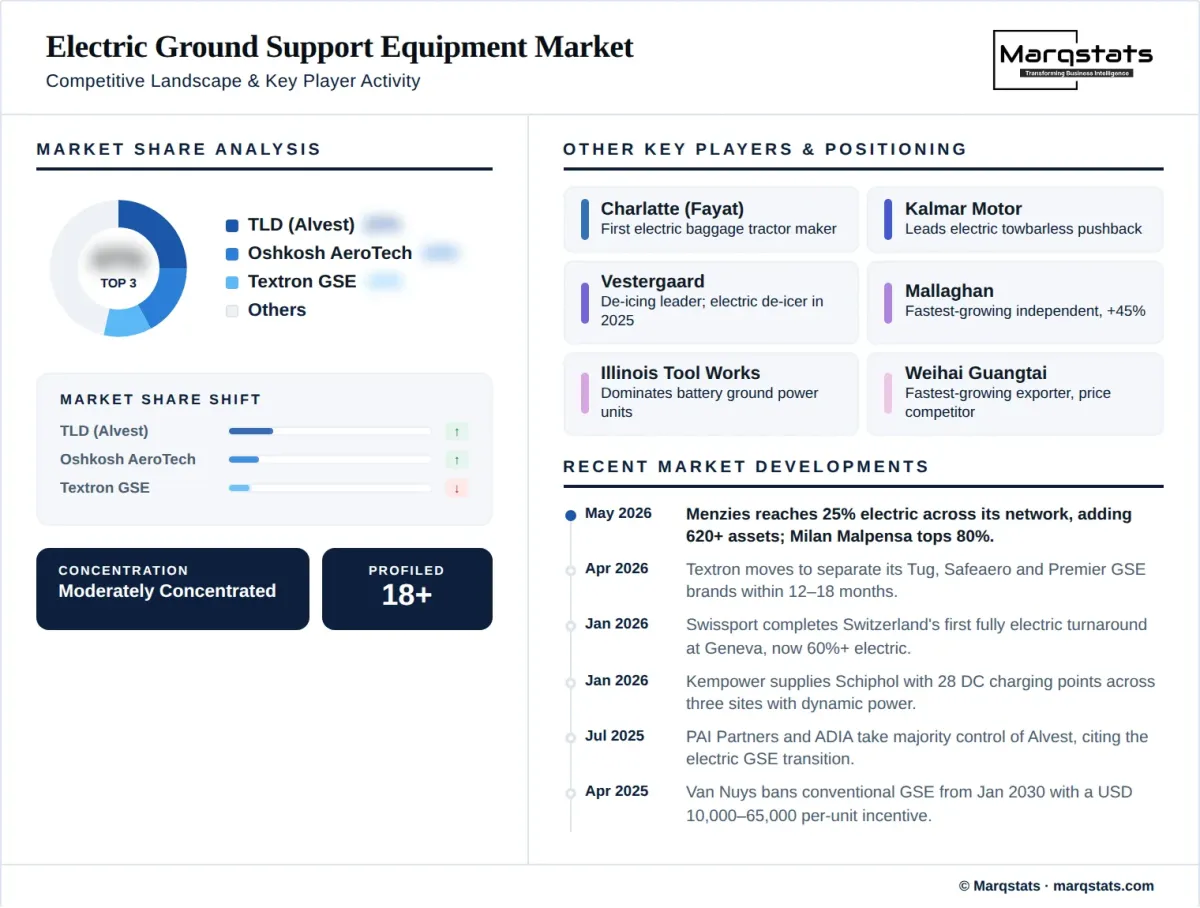
The electric ground support equipment market is moderately concentrated at the top and highly specialised beneath it, with distinct leaders in each equipment category rather than one supplier across the range. TLD, part of Alvest, is the clear leader with more than 4,000 employees, eleven factories and service at over 250 airports, and is the most electrified major manufacturer — electric units reached 53% of equipment sold by volume in 2024, exceeded 60% since, and the group states it ceased producing internal-combustion GSE at the end of 2025. Oshkosh Corporation's AeroTech business is the other broad-line platform, serving roughly 75% of United States air travellers, and owns the sector's purest electric brand, exclusively electric since 1945 and past 7,000 units delivered as of January 2026.
Beneath the two platforms the market fragments by category. Charlatte Manutention, part of Fayat Group, describes itself as the first manufacturer of electric baggage tractors and builds roughly 2,000 machines a year. Kalmar Motor AB, owned by Vestergaard Company A/S since 2022, leads in electric towbarless pushback. Vestergaard itself leads de-icing and brought a fully electric de-icer to market in September 2025. Mallaghan Engineering Limited has grown fastest of any independent, reporting revenue of GBP 121.5 million in its 2024 financial year, up 45%, with pre-tax profit up 120%, on the strength of electric catering trucks, tankers and belt loaders. Illinois Tool Works Inc. dominates battery ground power units, having introduced the first in 2017. Weihai Guangtai Airport Equipment Co., Ltd. is the fastest-growing exporter and the principal price competitor.
Ownership across the sector has changed hands repeatedly and is changing again. Oshkosh Corporation acquired the AeroTech business for USD 800 million in 2023. PAI Partners and the Abu Dhabi Investment Authority completed the acquisition of a majority stake in Alvest on 9 July 2025, explicitly citing the electric GSE transition and autonomous equipment as the investment case. And on 30 April 2026 Textron Inc. announced its intent to separate its entire Industrial segment, including the Tug, Safeaero and Premier GSE brands, by sale or spin-off within twelve to eighteen months, against segment revenue of USD 3.2 billion in 2025, down 9%. Three of the four largest Western platforms have changed control or are in play within four years.
A separate competitive layer is forming around charging and airside power, and it is not populated by GSE manufacturers. Kempower Oyj supplied Amsterdam Schiphol in January 2026; specialist charging firms supply fast-charging and on-board chargers designed for ramp duty; and Oshkosh AeroTech's mobile battery charging platform, launched in September 2025, is explicitly positioned to avoid grid upgrades. Cavotec SA, which supplies fixed ground power and pre-conditioned air, reported revenue of EUR 159.7 million for 2025, down 8.7%, with a net loss — a reminder that the infrastructure side of this market is not yet as profitable as its growth rate suggests.
Companies Covered
Companies covered in the report include:
Recent Market Activity
Table of Contents
Coverage & Segmentation
This report sizes and forecasts the global electric ground support equipment market over a 2022 to 2025 historical period and a 2026 to 2030 forecast period, using 2025 as the base year. Market value is expressed in USD billion and covers new electric ground support equipment sold worldwide, electric retrofit and conversion of existing units, and airside charging infrastructure installed to support electric GSE fleets. Volume is expressed in units and airport electrical demand in terawatt-hours. Internal-combustion and hybrid GSE, fixed 400 Hz ground power and pre-conditioned air built into passenger boarding bridges, aircraft taxiing systems, landside airport vehicles and ground handling services revenue are excluded.
Segmentation covers equipment type — baggage and cargo tractors, belt and cargo loaders, aircraft tractors and pushbacks, ground power units and pre-conditioned air, and service and specialist vehicles; revenue stream — new electric equipment, airport charging infrastructure, and retrofit and conversion; and end user — ground handling companies, airlines and airport operators. Geographic coverage spans North America, Europe, Asia-Pacific, the Middle East and Africa, and South America. The competitive section profiles eighteen suppliers across broad-line manufacturers, category specialists, charging and airside power suppliers, with product range, electrification position, ownership and recent strategic activity.