Market Snapshot
Middle bar: base-year value × (1 + CAGR), rounded to two decimals. This is a calculated illustration, not a separately researched annual estimate.
The electric forklift market size is estimated at USD 42.60 billion in 2025 and is projected to reach USD 65.79 billion by 2030, at a CAGR of 9.08%. The market covers Class 1, 2 and 3 battery-powered industrial trucks on a new-equipment, parts, service and rental basis. Lithium-ion adoption drives the value growth: lithium packs cost two to four times a lead-acid equivalent and pass majority share of new electric trucks during 2026. Asia-Pacific led with 52.0% of 2025 unit orders, and Toyota Industries Corporation and KION GROUP AG head a moderately fragmented supplier base.
Market size and forecast figures are generated using Marqstats' proprietary estimation framework, updated as of August 2026.
Electrification of the industrial truck fleet is, on a unit basis, close to finished. World Industrial Truck Statistics recorded 2,210,687 industrial truck shipments in 2025, of which 1,685,936 units — 76.3% — were battery-electric Class 1, 2 and 3 machines. Ten years ago that share sat in the low sixties. Europe has effectively completed the transition at 91.0% of 2025 orders, and even the Americas, the slowest of the three mature regions, reached 70.6%. The strategic question in this market is no longer whether forklifts electrify. It is which battery goes inside them, and what that substitution does to equipment value, service revenue and the supplier hierarchy.
That substitution is the reason the electric forklift market grows faster in value than in units. Lithium-iron-phosphate packs command a two-to-four-times premium over the lead-acid batteries they replace, add charger and infrastructure spend, and shift aftermarket revenue away from watering, equalisation and battery-room labour toward opportunity charging, battery management systems and energy services. Unit shipments of electric trucks are forecast to compound at 7.10% to 2030, but installed lithium energy in the global forklift fleet grows more than three times as fast. Marqstats estimates lithium battery demand from new electric industrial trucks at approximately 5.81 GWh in 2025, rising to 16.26 GWh by 2030 — a 22.84% CAGR that is invisible in any unit-based view of this industry.
Scope for this study covers Class 1 electric counterbalance rider trucks, Class 2 electric narrow-aisle rider trucks, and Class 3 electric pedestrian and rider warehouse trucks, across new equipment sales, spare parts, maintenance contracts, short- and long-term rental, and battery and charger hardware sold with the truck. Internal-combustion Class 4 and Class 5 trucks, financial-services income, standalone warehouse automation systems and non-industrial-truck material handling equipment fall outside scope.
Key Takeaways
Market Overview & Analysis
Report Summary
The electric forklift market comprises battery-powered industrial trucks used to lift, move, stack and retrieve palletised and unit loads inside warehouses, distribution centres, manufacturing plants, ports and retail backrooms. Industry convention divides these machines into Class 1 electric counterbalance rider trucks, Class 2 electric narrow-aisle rider trucks such as reach trucks and turret trucks, and Class 3 electric pedestrian and rider warehouse trucks including pallet trucks, stackers and order pickers. Together these three classes made up 76.3% of the 2,210,687 industrial trucks shipped worldwide in 2025, according to World Industrial Truck Statistics, the joint programme of the European, American and Japanese industrial truck associations.
Demand in 2025 was softer than in 2024. World orders fell 9.2% to 2,159,814 units and shipments fell 7.2% to 2,210,687, unwinding part of the post-pandemic warehousing boom. The decline was broad: Asia orders dropped from 1,282,714 to 1,123,273 units, the Americas from 388,195 to 347,429, and Europe held roughly flat at 639,201. Supplier results confirm the cycle. Hyster-Yale, Inc. reported FY2025 revenue of USD 3,769.3 million, down 13%, with backlog falling 34% to USD 1,280 million and an operating loss of USD 22.1 million. KION GROUP AG's Industrial Trucks and Services revenue fell 3.9% to EUR 8,272 million even as unit deliveries rose 8.6% to 266,000 trucks — a clear signal of price and mix pressure rather than volume weakness.
Beneath that cyclical softness, the structural shift accelerated. China sold 1,451,768 forklifts in 2025, a third consecutive record and up 12.93%, with exports rising 13.4% to 544,956 units and exports to Europe growing 36%, according to the China Construction Machinery Association. Electric machines were 78.81% of those exports, and lithium-ion had reached 47.4% of Chinese electric forklifts. Chinese producers now account for close to two-thirds of world unit output but roughly a tenth of tracked global supplier revenue, because their volume concentrates in low-price Class 3 pedestrian trucks that sell for as little as USD 1,000 against European averages above USD 24,000 per truck. Both KION GROUP AG and Jungheinrich AG named Chinese competition explicitly in their 2025 disclosures, and KION launched a EUR 140 million to EUR 160 million annual efficiency programme in February 2025 in direct response.
The market's growth to 2030 therefore rests on three compounding forces: continued substitution of internal-combustion trucks in the classes where electric alternatives have only recently become viable; the lithium-ion transition, which lifts average selling prices and reshapes the aftermarket; and warehouse construction and automation demand, which favours the narrow-aisle and warehouse classes where electric has always dominated. Against these sit tariff volatility, electrical infrastructure constraints at customer sites, and a price war imported from China that is compressing margins across the Western supplier base.
Market Dynamics
Key Drivers
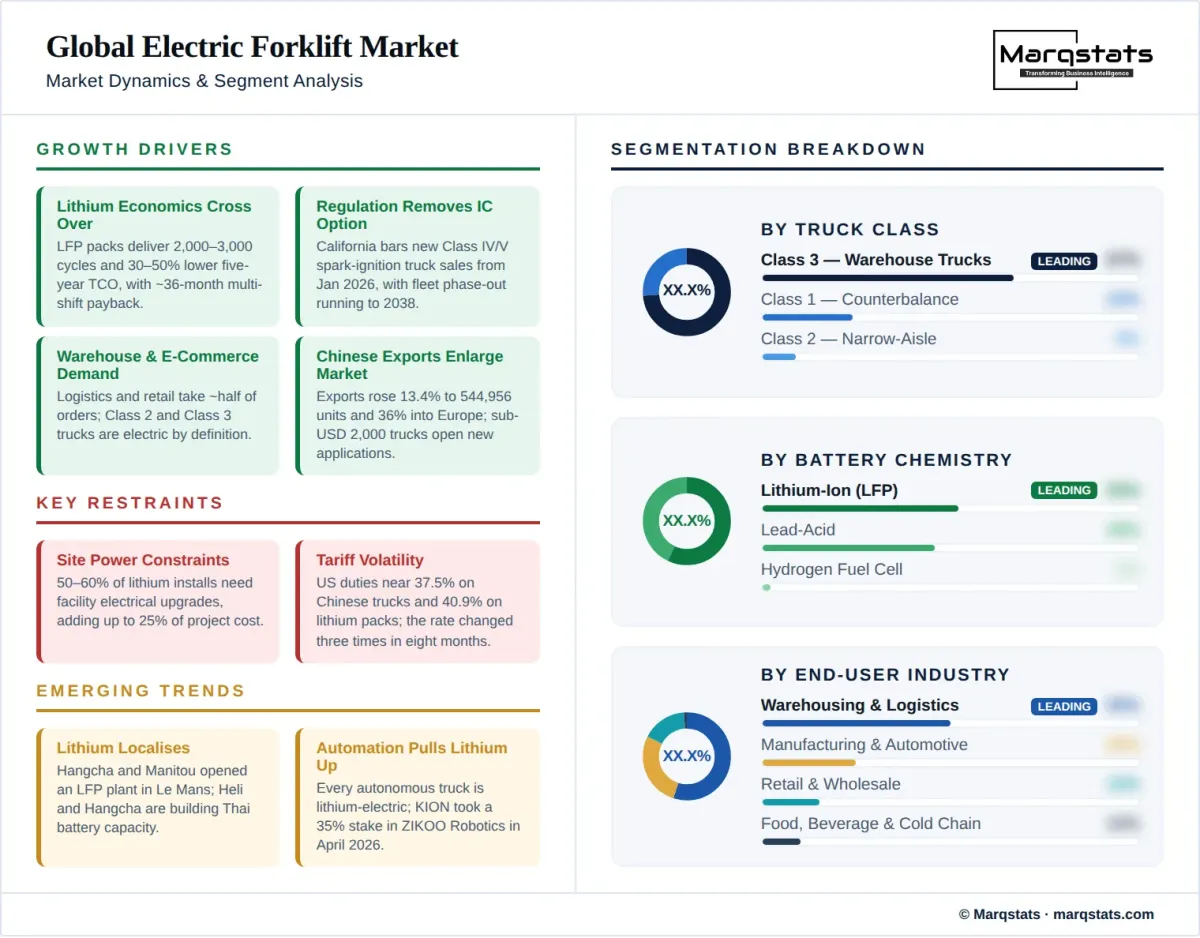
Lithium-ion economics have crossed the commercial threshold. A lithium-iron-phosphate pack costs USD 8,000 to USD 20,000 against USD 3,000 to USD 6,000 for lead-acid, but delivers 2,000 to 3,000 cycles over seven to ten years versus 1,000 to 1,500 cycles over three to five, charges at above 95% efficiency versus 75% to 80%, and supports one-to-two-hour opportunity charging instead of six-to-eight-hour cycles plus cooldown. Payback in multi-shift operations runs at roughly 36 months, with five-year total cost of ownership 30% to 50% below lead-acid.
Regulation has begun to remove the internal-combustion option outright. California's zero-emission forklift regulation, adopted in June 2024, prohibited the manufacture and sale of new Class IV and Class V large spark-ignition trucks in the state from 1 January 2026, with fleet phase-out obligations starting in 2028 for Class IV and 2030 for Class V and running to 2038. No unit is retired before age ten, which fixes a decade-long replacement pipeline in the largest state economy in the United States.
Warehouse and e-commerce construction sustains the demand base. Logistics and retail together accounted for roughly half of global industrial truck orders in 2024, and the classes those customers buy — Class 2 narrow-aisle and Class 3 warehouse trucks — are electric by definition. Class 3 alone represented 1,127,772 units of 2025 world shipments.
Chinese export expansion is enlarging the addressable market rather than simply redistributing it. Chinese forklift exports grew 13.4% to 544,956 units in 2025 and 36% into Europe, with electric machines at 78.81% of the export mix. Price points below USD 2,000 for basic warehouse trucks open applications that were previously served by manual handling equipment.
Total cost of ownership advantages compound in high-utilisation duty cycles. Removing the battery room releases floor space, eliminates watering and equalisation labour of USD 1,200 to USD 2,000 per truck per year, and removes the second and third battery sets required to run lead-acid across multiple shifts. A ten-truck multi-shift fleet saves in excess of USD 50,000 over five years on battery costs alone.
Key Restraints
Site electrical infrastructure is the binding physical constraint. Between 50% and 60% of lithium-ion forklift installations require facility electrical upgrades, adding up to 25% to total project cost. Older distribution centres frequently lack the panel capacity and service entrance rating to support opportunity charging across a full fleet, and utility interconnection timelines can exceed the equipment lead time.
Tariffs have made landed cost unpredictable. United States duties on Chinese-made electric forklifts stood at roughly 37.5% in August 2026, combining a Section 301 List 1 rate of 25% in force since July 2018 with a 12.5% forced-labour action effective 24 July 2026. Lithium traction batteries carry approximately 40.9%, after the non-electric-vehicle lithium-ion Section 301 rate rose from 7.5% to 25% on 1 January 2026. The applicable rate changed three times in the first eight months of 2026. Hyster-Yale, Inc. absorbed roughly USD 100 million in gross tariff cost in FY2025.
Upfront capital cost still deters single-shift operators. Where a truck runs one shift, lead-acid remains cost-competitive over its service life, and the lithium premium of USD 5,000 to USD 14,000 per truck cannot be recovered. This keeps a substantial installed base on lead-acid well beyond the point at which lithium is technically superior, and explains the seven-year gap between European and North American crossover dates.
Price compression is eroding supplier profitability. KION GROUP AG's Industrial Trucks and Services adjusted EBIT fell 21.3% in 2025 despite an 8.6% rise in unit deliveries; Jungheinrich AG's EBIT dropped from EUR 434 million to EUR 228 million; Anhui Heli Co., Ltd. grew revenue 11.35% while net profit fell 8.5%. Margin pressure is now visible on both sides of the competitive divide.
Key Trends
Lithium manufacturing is localising into tariff-protected regions. Hangcha Group Co., Ltd. and Manitou BF SA inaugurated HM Battery Solutions in Le Mans, France in July 2026, producing lithium-iron-phosphate modules, packs and chargers across a 3,000-square-metre site with more than 250 models developed spanning 5 kWh to 45 kWh. Anhui Heli Co., Ltd. is building a Thai base with 10,000 forklifts and 10,000 lithium battery sets of annual capacity, and Hangcha opened its own Thai plant in June 2026.
Lithium is moving up into the heavy classes that were previously diesel-only. Anhui Heli Co., Ltd. launched its G3 Series 12-to-18-tonne heavy-duty lithium-electric forklifts globally in July 2026, targeting ports, rail freight yards, mining and heavy manufacturing. LiuGong introduced a fourteen-model battery-electric materials handling range in North America in July 2026, including a fully electric 45-tonne reach stacker.
Hydrogen fuel cells are consolidating rather than expanding in this application. Hyster-Yale, Inc. downsized its Nuvera fuel-cell programme in April 2025, cutting scope to a single 125 kW unit for port equipment and redeploying engineering into lithium battery modules, chargers, battery management systems and the HydroCharge mobile charging platform, citing limited and very focused uptake of fuel cells.
Automation is converging with electrification. Automated guided and autonomous mobile forklifts exceeded 25,000 units in China in 2025 at 1.9% penetration, and KION GROUP AG took a 35% strategic stake in warehouse robotics developer ZIKOO Robotics in April 2026. Because every autonomous industrial truck is by necessity electric and lithium-powered, automation growth pulls the lithium mix upward independently of operator preference.
Market Segmentation
Class structure is the primary segmentation used across the industry, and it maps directly onto price point, duty cycle and battery requirement. The three electric classes behave as three distinct markets that happen to share a customer.
Class 1 shipped 402,293 units worldwide in 2025 and is the highest-value electric segment, with typical pricing from USD 8,000 for a one-to-two-tonne three-wheel model to above USD 55,000 for capacities over four tonnes. This is the class where electric substitution against internal combustion is still actively contested, because it competes head-on with Class 4 and Class 5 trucks in outdoor and rough-surface duty. It is also where lithium penetration is lowest and the commercial opportunity largest, since a Class 1 lithium pack carries roughly ten times the energy content of a pedestrian pallet truck battery.
Class 2 reach trucks, turret trucks and order pickers shipped 155,871 units in 2025, the smallest class by volume but the highest by average selling price at USD 20,000 to USD 40,000 for a one-to-two-and-a-half-tonne reach truck. Demand tracks high-bay warehouse construction and is concentrated in Europe and North America, which together took 95,798 of 2025 Class 2 orders. The class has always been fully electric, so its growth is driven by warehouse density rather than by substitution.
Class 3 dominates unit volume, with 498,294 pedestrian and 629,478 rider warehouse trucks shipped in 2025 — 1,127,772 units, or 51.0% of all industrial trucks. It is also the cheapest class, with stackers at USD 5,000 to USD 15,000 and basic Chinese pedestrian trucks near USD 1,000. Class 3 is where Chinese manufacturers hold near-monopoly positions, and it is the first class to cross 50% lithium penetration globally because small packs make the lithium premium easy to absorb.
Battery chemistry is the segmentation that matters most for the 2026 to 2030 forecast, because it is the only variable that materially changes revenue per truck without changing the truck.
Lithium-iron-phosphate accounted for roughly a third of new full-electric forklifts globally in 2024 and passes the 50% threshold during 2026, making 2026 the crossover year in which lithium overtakes lead-acid in new electric industrial trucks. China was already at 47.4% in 2025, up from 9.32% in 2018. Marqstats estimates lithium demand from new electric industrial trucks at approximately 5.81 GWh in 2025, rising to 16.26 GWh by 2030 at a 22.84% CAGR — the fastest-growing measurable quantity in this market.
Lead-acid retained roughly two-thirds to seven-tenths of forklift battery market value in 2025 and remains the default in single-shift operations, in price-sensitive emerging markets, and across the large installed replacement base. Its decline is a mix effect rather than a collapse in absolute terms: replacement demand from trucks sold before the crossover sustains volume through the forecast period even as its share of new installations falls below half.
Fuel cells remain a niche confined to very large multi-shift distribution operations, particularly cold-chain sites where lithium performance degrades and refuelling speed carries a premium. Supplier commitment has narrowed rather than widened, with Hyster-Yale, Inc. restricting its fuel-cell development to a single 125 kW port unit in April 2025 and redirecting resources to battery systems.
Logistics and retail together generated approximately half of global industrial truck orders in 2024, making this the largest and most electrified end-market. Multi-shift operation, indoor duty and predictable route patterns make it the natural first adopter of lithium and opportunity charging, and it is the segment where autonomous industrial trucks are being deployed first.
Manufacturing plants operate mixed fleets of Class 1 counterbalance and Class 3 warehouse trucks, and are the primary battleground for internal-combustion substitution because of yard and cross-dock duty. Automotive assembly in particular has accelerated electrification to align in-plant logistics with corporate decarbonisation targets covering scope one emissions.
Retail backrooms and wholesale cash-and-carry operations buy predominantly Class 3 pedestrian equipment at low price points and short replacement cycles. This is the segment most exposed to Chinese import pricing and the one where lithium adoption is fastest, because the incremental cost on a small pack is measured in hundreds of dollars.
Cold-storage operations run the most demanding duty cycle in the industry, with lead-acid capacity falling sharply below freezing and battery-room heating adding energy cost. Lithium chemistries with low-temperature management, and emerging sodium-ion formulations demonstrating above 90% usable capacity retention at minus forty degrees Celsius, address a pain point no incumbent technology solved.
By Geography
Asia-Pacific
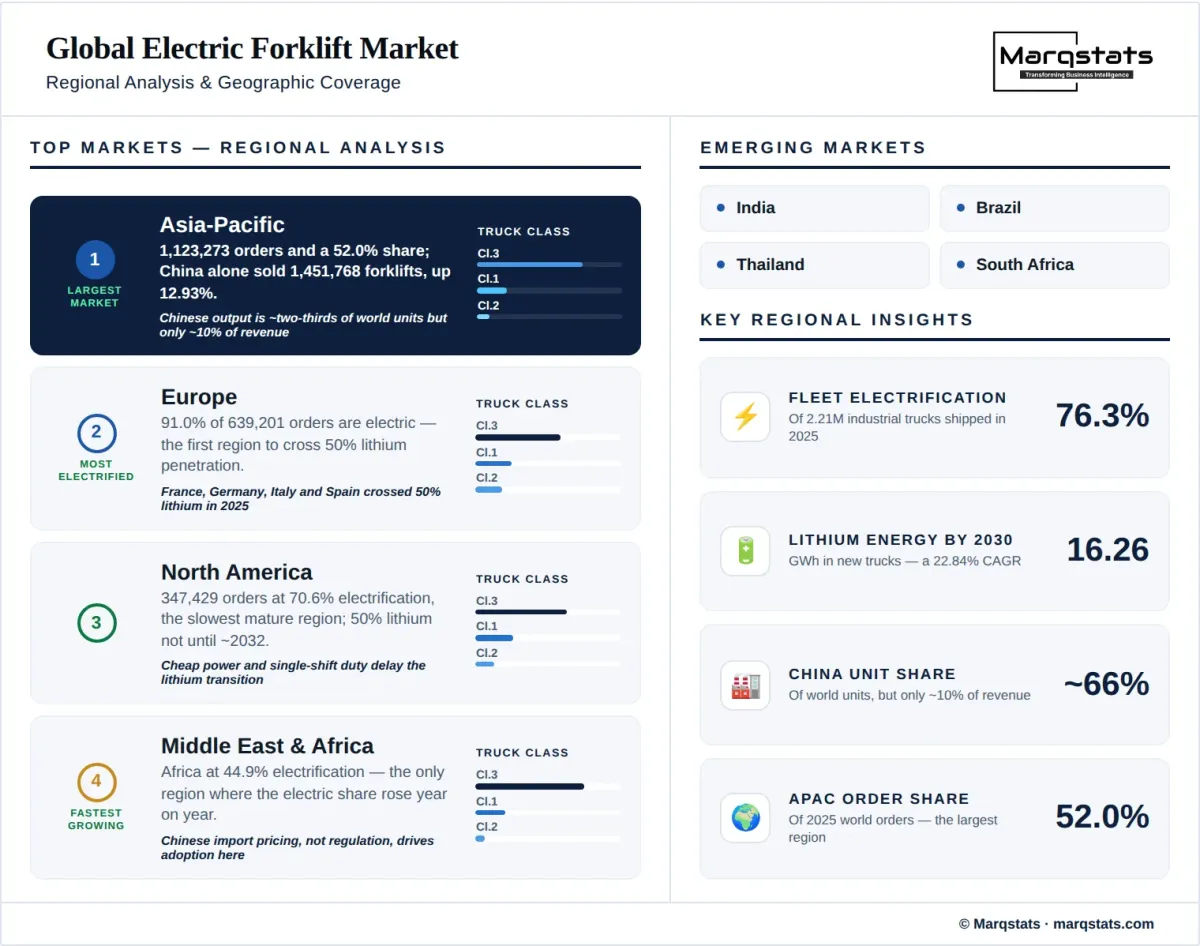
Asia-Pacific is the largest region, taking 1,123,273 of 2,159,814 world orders in 2025, a 52.0% share, with regional electrification at 71.9%. China dominates: the China Construction Machinery Association recorded 1,451,768 forklift sales in 2025, up 12.93%, split between 906,812 domestic units and 544,956 exports, with lithium-ion at 47.4% of Chinese electric forklifts. Chinese H1 2026 sales reached 861,934 units with electric machines at 80.2%. Japan, South Korea and India provide the balance, with Indian order growth running above 11% in both 2025 and 2026.
Europe
Europe is the most electrified region on earth, with 91.0% of 2025 orders being Class 1, 2 or 3 machines against 639,201 total orders. It is also the first region where lithium crosses 50% penetration, with France, Germany, Italy and Spain reaching that threshold in 2025 and the United Kingdom and Sweden following around 2027. Europe absorbed the fastest growth in Chinese imports in 2025 at 36%, which is why Toyota Material Handling Europe committed EUR 32.2 million to its Mjolby powder-coating plant in January 2026 to lift capacity from roughly 90,000 to 120,000 electric trucks a year.
North America
The Americas took 347,429 orders in 2025 with electrification at 70.6%, the lowest of the three mature regions, and lithium penetration is not expected to reach 50% until approximately 2032. Cheap electricity, abundant single-shift operations and a deep propane and diesel service infrastructure have all slowed the transition. Policy is now moving against that inertia: California barred new Class IV and Class V large spark-ignition forklift sales from 1 January 2026, and Toyota Material Handling North America opened a USD 100 million electric forklift plant in Columbus, Indiana in August 2026 to build Class 1 stand-up counterbalance trucks domestically.
Middle East and Africa
Africa recorded 21,683 orders in 2025 at only 44.9% electrification, by far the lowest of any region and the only region where the electric share rose year on year, from 41.5% in 2024. Adoption is being driven almost entirely by Chinese import pricing rather than by regulation or total cost of ownership analysis, and the region is expected to reach 50% lithium penetration among electric trucks around 2029 — ahead of North America — precisely because it is buying new Chinese equipment rather than replacing an installed lead-acid base.
South America
South America remains a small and predominantly internal-combustion market, served largely through import channels and concentrated in Brazil, Chile and Argentina. Warehouse modernisation programmes tied to e-commerce growth are lifting Class 3 demand, and the region is a primary target for Chinese export expansion given the absence of protective tariffs comparable to those in the United States.
How Competition Is Evolving
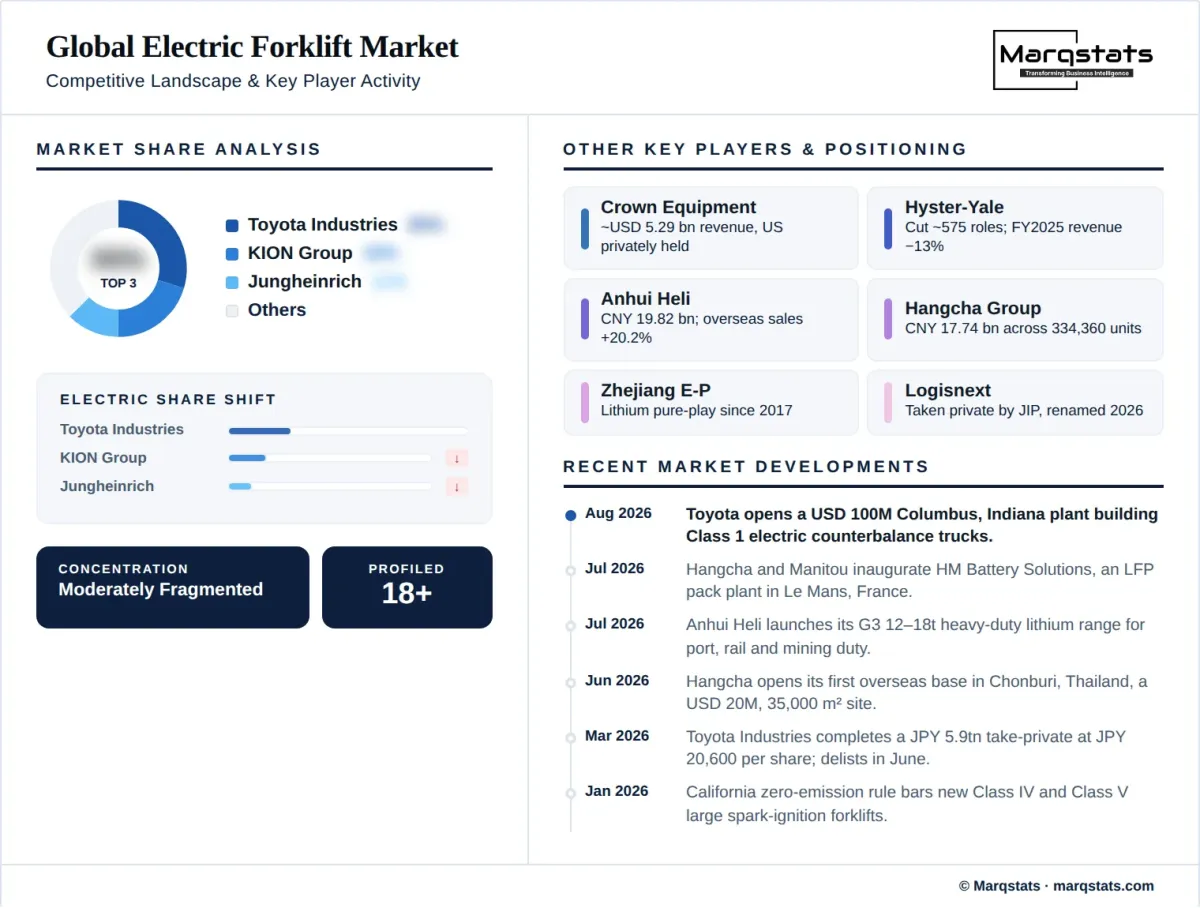
The electric forklift market is moderately fragmented. The top three suppliers hold roughly 49% to 57% of tracked global supplier revenue and the top five between 62% and 73%, but the tail is long — the standard industry league table needs eighteen companies to reach USD 58 billion, and ranks eleven through eighteen at only USD 3.6 billion combined. Toyota Industries Corporation has led the global industrial truck market for more than two decades, reporting Materials Handling Equipment segment revenue of JPY 3,043.0 billion in its financial year ended March 2026, though that figure includes logistics automation businesses that fall outside forklift scope. KION GROUP AG follows with Industrial Trucks and Services revenue of EUR 8,272 million, Jungheinrich AG at EUR 5,502 million, and Crown Equipment Corporation at approximately USD 5.29 billion.
The defining structural fact is the divergence between unit share and value share. Chinese manufacturers built close to two-thirds of world forklift units in 2025 but captured only 9% to 12% of tracked supplier revenue, because their volume is concentrated in Class 3 pedestrian trucks with implied average selling prices near USD 7,100 to USD 7,400 against roughly USD 24,300 for Jungheinrich AG. Anhui Heli Co., Ltd. reported CNY 19.82 billion in 2025 revenue with overseas sales up 20.17% and electric machines at about 70% of sales; Hangcha Group Co., Ltd. reported CNY 17.74 billion with 334,360 units, overseas revenue at 43.38% of total, and electric machines above 77% of exports. Zhejiang E-P Equipment Co., Ltd., a lithium pure-play since 2017, grew revenue 10.7% to CNY 7.25 billion.
Consolidation and restructuring reshaped ownership in 2026. Toyota Industries Corporation completed a take-private in March 2026 at JPY 20,600 per share, valuing the transaction at roughly JPY 5.9 trillion, and delisted in June 2026. Logisnext Co., Ltd. — formerly Mitsubishi Logisnext Co., Ltd. — was taken private by Japan Industrial Partners in February 2026 and renamed on 30 April 2026. Between them, the two largest Japanese suppliers removed roughly a third of the market by value from public disclosure within ten weeks. Meanwhile, incumbents restructured against Chinese pricing: KION GROUP AG's February 2025 efficiency programme targets EUR 140 million to EUR 160 million in annual savings against EUR 240 million to EUR 260 million of one-off cost, and Hyster-Yale, Inc. cut approximately 575 roles in November 2025 for USD 40 million to USD 45 million of annualised savings from 2026.
Companies Covered
Companies covered in the report include:
Recent Market Activity
Table of Contents
Coverage & Segmentation
This report sizes and forecasts the global electric forklift market over a 2022 to 2025 historical period and a 2026 to 2030 forecast period, using 2025 as the base year. Market value is expressed in USD billion and covers new equipment sales, spare parts, maintenance and service contracts, short- and long-term rental, and the battery and charger hardware supplied with the truck. Volume is expressed in units and cross-referenced against association shipment statistics. Internal-combustion Class 4 and Class 5 trucks, captive financial-services income, standalone warehouse automation systems, and material handling equipment outside the industrial truck definition are excluded.
Segmentation covers truck class — Class 1 electric counterbalance rider, Class 2 electric narrow-aisle rider, and Class 3 electric pedestrian and rider warehouse trucks; battery chemistry — lithium-ion, lead-acid and hydrogen fuel cell; and end-user industry — warehousing, logistics and e-commerce, manufacturing and automotive, retail and wholesale distribution, and food, beverage and cold chain. Geographic coverage spans Asia-Pacific, Europe, North America, South America, and the Middle East and Africa, with country-level detail for China, Japan, India, Germany, France, the United Kingdom and the United States. The competitive section profiles eighteen suppliers with revenue, unit volume, regional footprint, battery strategy and recent strategic activity, alongside market concentration analysis on both a unit and a value basis.