Market Snapshot
Key Takeaways
Market Overview & Analysis
Report Summary
The global construction equipment market comprises earthmoving, material handling, concrete and road-building, and compact machinery sold for infrastructure, residential, commercial, and industrial construction activity. This study segments the market by equipment type, propulsion type, and application, with a 2025 base year, historical coverage from 2021 to 2025, and forecasts to 2030. Market size is stated as new-equipment sales revenue in United States dollars, covering original equipment manufacturer shipments rather than end-user rental or aftermarket spend.
Demand is driven by public infrastructure programmes, urbanization in emerging economies, and a wave of data-centre and industrial-facility construction that has emerged as a distinct new demand pool alongside traditional residential and commercial building activity. Warehousing and logistics-facility construction is reinforcing the same demand pool, lifting material handling equipment sales even where general building activity has cooled. Chinese manufacturers have expanded their global footprint materially over the past three years, establishing assembly operations outside China to manage trade-policy exposure while offering equipment priced 15% to 25% below Western equivalents, according to industry procurement analyses.
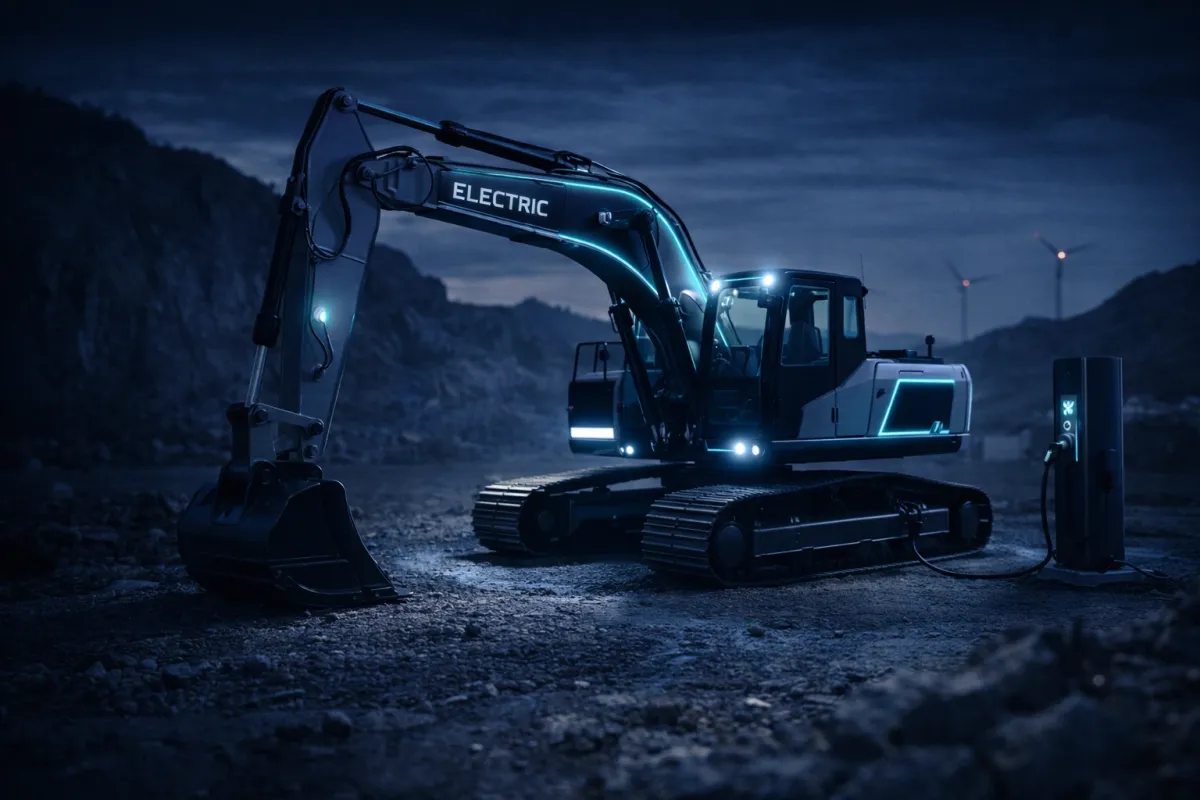
Electrification and autonomy are advancing fastest in compact and medium equipment classes, where duty cycles and charging logistics are most tractable, while large earthmoving and mining-adjacent equipment remains predominantly diesel-powered. Telematics adoption is consolidating around a shared industry data standard that allows fleet operators to monitor mixed-brand equipment on a single platform, reinforcing rental-channel growth as an adoption pathway for new technology. Replacement demand in North America and Europe is running alongside first-time mechanization in emerging construction markets, producing two distinct growth engines within the same global total.
Competitive structure has shifted materially over the past three years as Chinese manufacturers moved from domestic-focused suppliers to globally distributed competitors, backed by direct financing programmes and local support centres that narrow the service gap with incumbent Western and Japanese brands. This shift is most visible in the loader, backhoe, and compact-excavator categories, where Chinese equipment now competes on price within five to ten percentage points of established brands in several regional markets, while specialized categories such as large-scale tunnelling equipment retain higher entry barriers owing to complex safety certification requirements.
Market Dynamics
Key Drivers
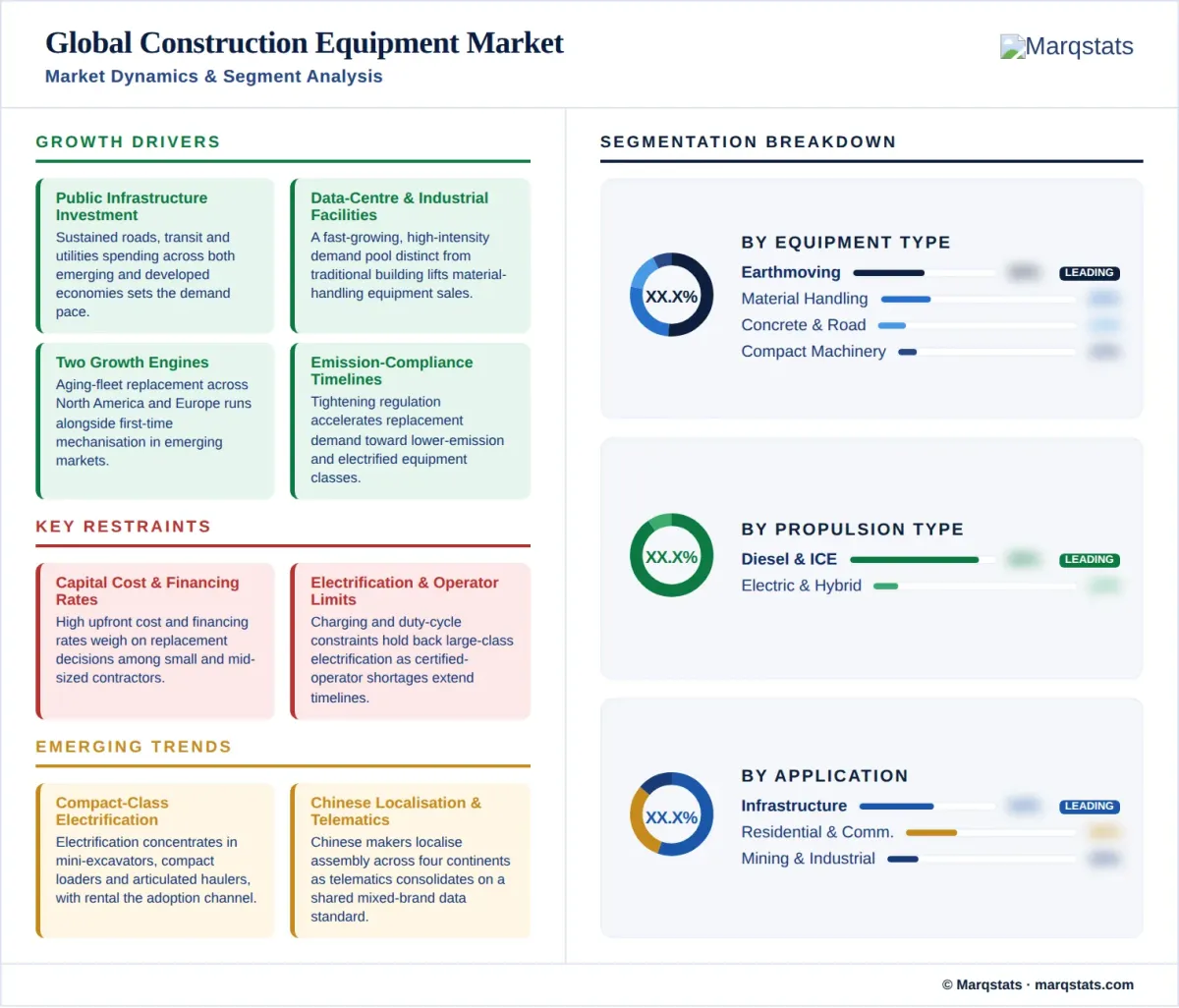
- Sustained public infrastructure investment across roads, transit, and utilities in both emerging and developed economies.
- Data-centre and industrial-facility construction has emerged as a fast-growing, high-intensity equipment-demand pool distinct from traditional building activity.
- Aging fleet replacement cycles in North America and Europe are running alongside first-time mechanization in emerging construction markets.
- Government emission-compliance timelines are accelerating replacement demand for lower-emission and electrified equipment classes.
- Expansion of rental and equipment-as-a-service models is lowering the adoption barrier for smaller contractors and newer equipment classes.
Key Restraints
- High upfront capital cost and financing rates weigh on replacement decisions among small and mid-sized contractors.
- Charging infrastructure and duty-cycle limitations constrain electrification of large earthmoving and mining-adjacent equipment classes.
- Trade-policy exposure and tariff uncertainty affect cross-border manufacturing and pricing strategy for globally distributed manufacturers.
- A persistent shortage of certified equipment operators is extending project timelines and moderating effective equipment utilisation in several developed markets.
Key Trends
- Electrification is concentrated in compact and medium equipment, led by mini-excavators, compact loaders, and articulated haulers.
- Autonomous and remote-operated features are moving from pilot to limited commercial deployment in mining-adjacent and large earthmoving applications.
- Telematics is consolidating around a shared industry data standard, enabling mixed-brand fleet monitoring as a standard buying consideration.
- Chinese manufacturers are localizing assembly in Brazil, Germany, India, and the United States to manage trade barriers and shorten lead times.
Market Segmentation
Earthmoving equipment, comprising excavators, loaders, dozers, and motor graders, is the dominant equipment-type segment by revenue, accounting for roughly half of global sales, and holds a similar or larger share within most individual regional markets. Excavators represent the single largest category within earthmoving, reflecting their central role in site preparation, foundation work, and utility trenching across every construction application. Demand for this category tracks infrastructure and residential construction activity most closely of any equipment type, making it the segment most sensitive to public capital-spending cycles.
Material handling equipment, including cranes, forklifts, and telehandlers, represents the second-largest revenue pool and is among the fastest-growing equipment-type segments, supported by warehousing, logistics-facility, and data-centre construction activity. Crane demand is increasingly concentrated in large-scale industrial and infrastructure projects, while telehandlers and compact forklifts are gaining share on smaller commercial and residential sites owing to their versatility across multiple tasks.
Concrete and road-building equipment, spanning pavers, compactors, and concrete mixing and pumping machinery, tracks public infrastructure budgets closely and shows the most cyclical demand pattern of the major equipment-type categories. This segment benefits disproportionately from transport-corridor and highway spending programmes, and demand tends to lag broader construction-sector recovery by several quarters as road and paving contracts are typically awarded later in an infrastructure cycle than earthmoving and foundation work.
Internal combustion propulsion accounts for the large majority of unit sales, with diesel-powered machines holding well over four-fifths of global volume, reflecting duty-cycle and charging-infrastructure constraints that remain most acute in large earthmoving and mining-adjacent equipment classes. Emission-compliance regulation is the primary force narrowing this share over time, pushing manufacturers toward cleaner diesel platforms in the near term even as electrification advances in smaller equipment classes.
Electric and hybrid propulsion is scaling fastest in compact and medium equipment classes, where several manufacturers introduced serial-production electric mini-excavators, compact loaders, and articulated haulers over 2025, with rental fleets serving as the primary adoption channel. Urban construction sites facing noise and emission restrictions are the strongest near-term demand pocket for electrified equipment, while large earthmoving and mining-adjacent classes are expected to electrify materially later given battery-weight and charging-duration constraints.
Across all three segmentation dimensions, the through-line is that revenue growth is increasingly decoupled from unit-volume growth: average selling prices are rising faster than unit shipments as fleets shift toward larger, more instrumented, and increasingly electrified machines, meaning revenue-based market sizing captures more of the underlying technology transition than a unit-count basis would on its own.
Infrastructure applications, covering roads, transit, utilities, and public works, represent the largest and most policy-sensitive application segment, accounting for more than half of global equipment demand, with government capital programmes setting the pace of activity and multi-year budget cycles creating a more predictable, if occasionally lumpy, demand pattern than private construction.
Residential and commercial building activity remains a steady demand base, with commercial construction increasingly weighted toward data-centre, warehousing, and logistics-facility projects rather than traditional office and retail development. This shift favours material handling and compact earthmoving equipment over the larger machinery classes more closely associated with greenfield infrastructure work.
Mining-adjacent and industrial applications draw on the largest equipment classes and show the closest correlation to commodity-price cycles among the application segments covered in this study, with demand for heavy-duty haulers and large excavators rising and falling alongside capital-spending decisions at mining and industrial-processing operators.
By Geography
Asia-Pacific
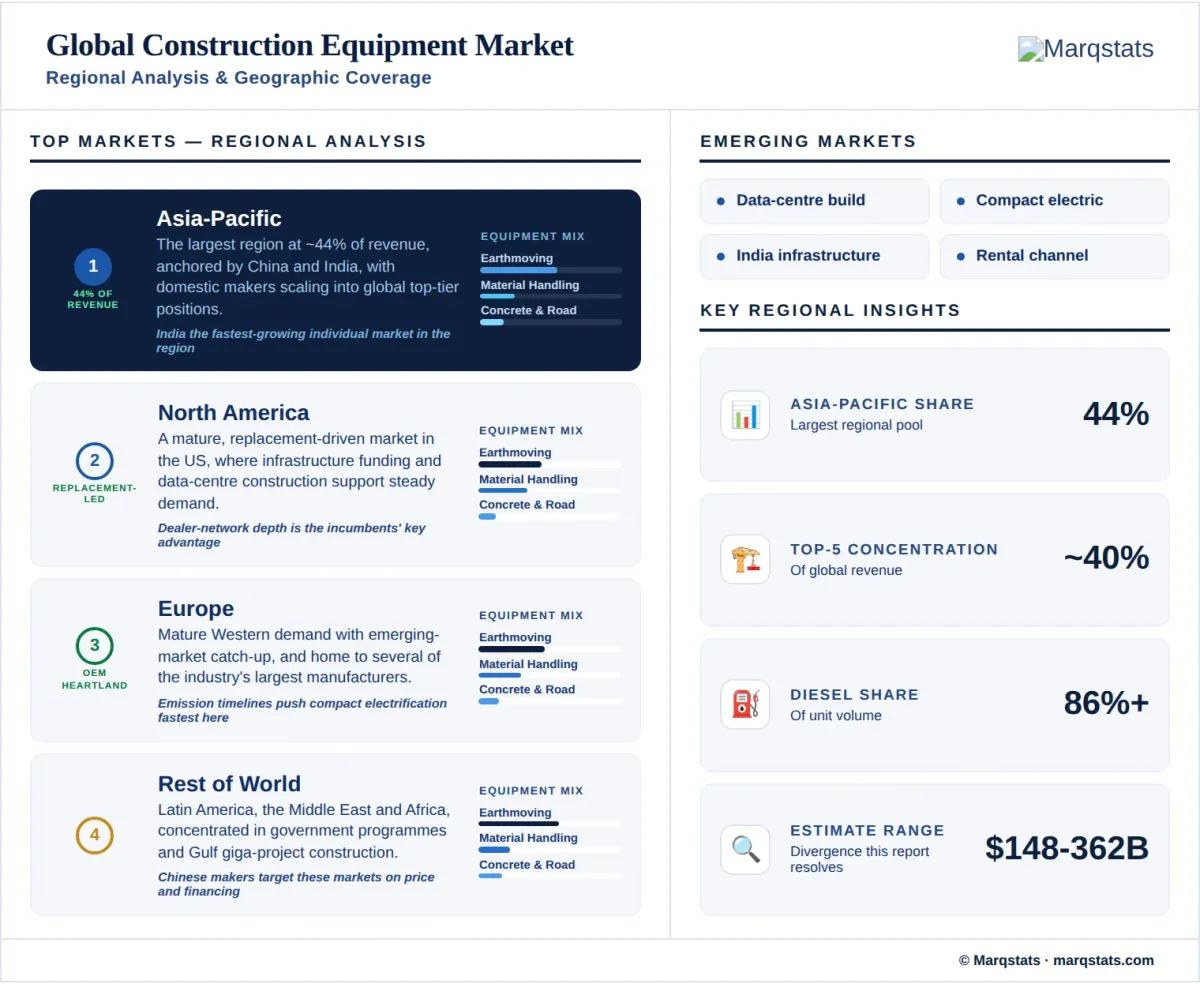
Asia-Pacific holds close to 44% of global revenue, the largest of any region, anchored by China and India. China’s domestic manufacturers, including XCMG and SANY, have scaled into global top-tier positions on the back of sustained home-market infrastructure spending and rapid overseas expansion into Southeast Asia, Africa, and Latin America. India is emerging as the region’s fastest-growing individual market, supported by national highway and metro-rail construction programmes, while Southeast Asian markets are mechanizing rapidly from a comparatively low equipment-penetration base. Japan and South Korea contribute a smaller, mature share of regional revenue, weighted toward replacement demand and export-oriented manufacturing rather than domestic construction growth.
North America
North America remains a mature, replacement-driven market concentrated in the United States, where public infrastructure funding, data-centre construction, and aging-fleet turnover support steady demand even as unit growth trails Asia-Pacific. Canada contributes a smaller, stable share, with demand weighted toward resource-sector and northern infrastructure projects. Electrification adoption in this region is advancing fastest in compact equipment used on urban and light-commercial sites, and dealer-network depth remains the primary competitive advantage for incumbent manufacturers defending share against newer entrants.
Europe
Europe combines mature Western European demand with faster catch-up growth across the region’s emerging markets, and is home to several of the industry’s largest manufacturers by global sales revenue, reflecting a deep domestic manufacturing base alongside end-market demand. Germany and France anchor regional demand on the strength of infrastructure-renewal and transit-expansion spending, while emission-compliance timelines are pushing the region’s fleet toward electrified compact equipment faster than most other markets. Southern and Eastern European markets are growing from a smaller base as European Union infrastructure-financing programmes extend construction activity beyond the region’s traditional Western European core.
Rest of World
Latin America, the Middle East, and Africa together represent a smaller, structurally important share of global revenue, with demand concentrated in government infrastructure programmes and, in the Middle East, large-scale giga-project construction. Chinese manufacturers have targeted these markets aggressively as an extension of their overseas expansion strategy, competing on price and financing terms against established Western and Japanese brands. Brazil anchors Latin American demand on the strength of mining-adjacent and agricultural-infrastructure investment, while Gulf Cooperation Council markets drive Middle East demand through sustained urban-development and transport-corridor spending.
How Competition Is Evolving
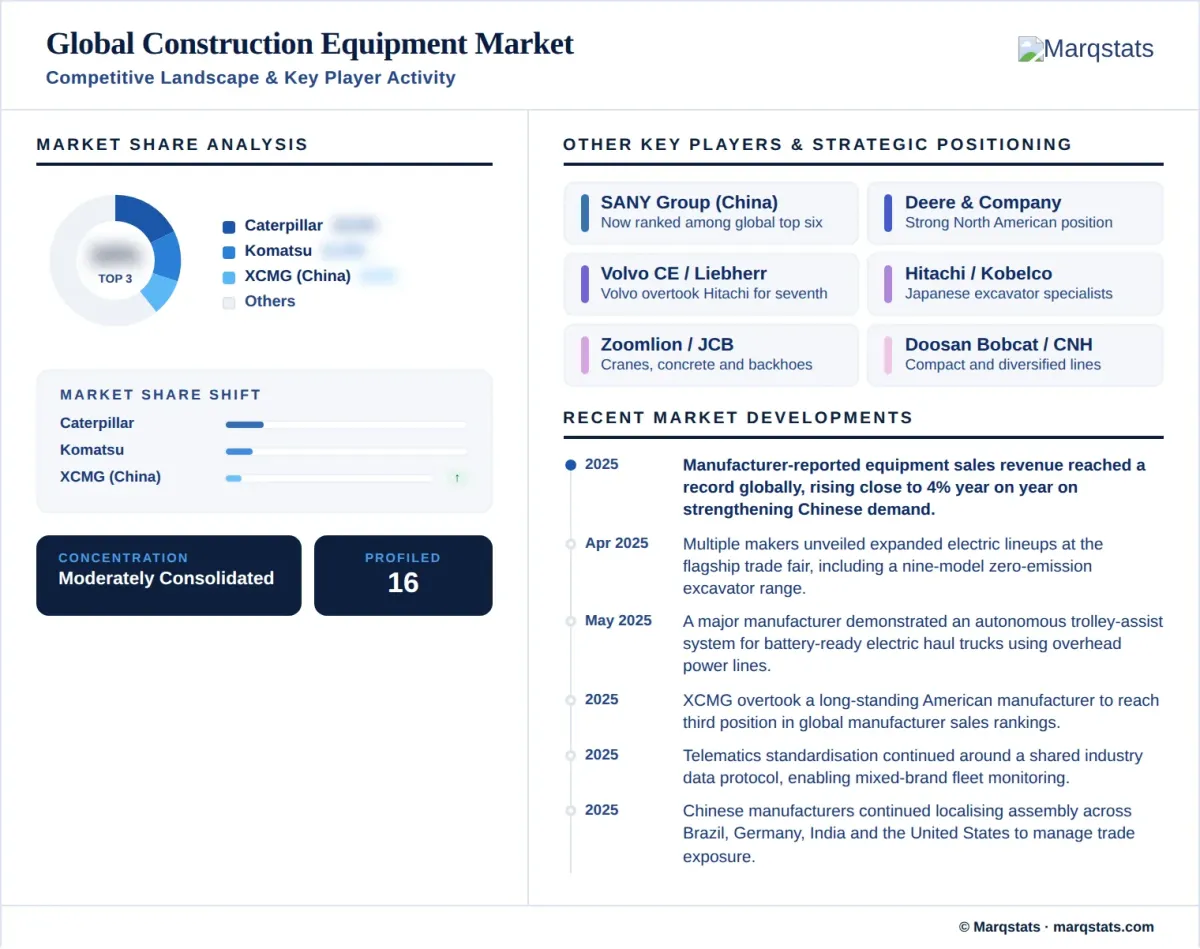
The market is moderately consolidated, with the top five manufacturers accounting for close to 40% of global revenue and the top ten for roughly 60%. Caterpillar Inc. retains global leadership with the single largest share of manufacturer-reported revenue, at just above 15%, followed by Komatsu Ltd. at roughly 11%. Chinese manufacturers XCMG Group and SANY Group have advanced into the global top tier, with XCMG overtaking a long-standing American manufacturer for third position on 2025 sales revenue, underscoring how materially the competitive order has shifted over the past three years. Deere & Company, Volvo Construction Equipment, Liebherr Group, and Hitachi Construction Machinery round out the remainder of the top ten, together holding roughly a fifth of global revenue, with Volvo Construction Equipment having overtaken Hitachi for seventh position on 2025 sales.
Competitive strategy centers on electrification and autonomy roadmaps, telematics platform differentiation, and geographic localization. Chinese manufacturers are establishing assembly operations across Brazil, Germany, India, and the United States to manage trade-policy exposure and shorten regional lead times, while Western and Japanese manufacturers are defending share through dealer-network depth, financing programmes, and premium after-sales service. Product strategy increasingly centers on electrified compact-equipment launches, with several manufacturers introducing serial-production electric models at the industry’s flagship 2025 trade fair, alongside early autonomous and remote-operation features aimed at large earthmoving and mining-adjacent equipment classes.
Companies Covered
The report profiles 16+ companies with full strategy and financials analysis, including:
Recent Market Activity
Table of Contents
Coverage & Segmentation
This report provides a comprehensive assessment of the global construction equipment market across a 2025 base year, historical data from 2021 to 2025, and forecasts spanning 2026 to 2030. Market size is stated as new-equipment sales revenue in United States dollars, covering original equipment manufacturer shipments. Segmentation covers three dimensions: equipment type, propulsion type, and application, alongside regional analysis spanning Asia-Pacific, North America, Europe, and the rest of world.
The scope covers demand drivers, restraints, and structural trends, with particular focus on resolving the published estimate divergence, the data-centre construction demand pool, electrification and autonomy adoption by equipment class, and the competitive rebalancing between Western, Japanese, and Chinese manufacturers. Country- and region-level detail beyond the four-region split covered here is available under customization, alongside deeper cuts by individual equipment class, propulsion type, or end-use application. The study excludes agricultural machinery, dedicated mining fleets sold directly to mine operators, and general industrial forklifts used outside construction and logistics-facility settings, each of which Marqstats covers separately.