Market Snapshot
Key Takeaways
Market Overview & Analysis
Report Summary
The global dredging equipment market comprises new dredger vessel construction, dredging systems and components including pumps and cutter heads, retrofit and life-extension work, and aftermarket parts and service. This study segments the market by dredger type, revenue component, and application, with a 2025 base year, historical coverage from 2021 to 2025, and forecasts to 2030. Market size is stated as equipment and related service revenue in United States dollars, explicitly excluding dredging contract and services value, which reflects the price of dredging work performed rather than the underlying equipment market. This scope choice keeps the reported figure focused specifically on the manufacturing and supply relationship between shipyards, component suppliers, and vessel operators, rather than the downstream project economics of dredging work itself.
Major dredging contractors, including the world's largest global dredging groups following recent industry consolidation, occupy a distinctive dual role in this market: they represent both a demand-side indicator, since their capital expenditure and fleet renewal decisions directly drive new vessel and equipment orders, and, in some cases, active participants in vessel design and specification given their scale and technical sophistication as newbuild customers. This report tracks their disclosed order books and capital expenditure as demand-intensity indicators specifically, never substituting contractor revenue for the equipment market value this report is designed to measure. Recent consolidation among the largest contractors has concentrated newbuild ordering power among fewer, larger fleet operators, a structural shift this report's competitive analysis addresses given its implications for equipment manufacturer customer relationships.
Equipment package value varies considerably by vessel type and capacity, meaning a single average value across the full dredger fleet would materially misrepresent this market's actual composition. A large capital-class trailing suction hopper dredger commands a substantially higher equipment value than a smaller maintenance-focused cutter suction or backhoe dredger, and this report's vessel-type segmentation is built specifically to avoid the distortion a single blended average would introduce. Share of proprietary versus third-party dredging systems within a given contractor's fleet represents a further variable this report tracks, since some large contractors specify substantial proprietary equipment content, while others rely more heavily on third-party component suppliers for core dredging systems.
Market Dynamics
Key Drivers
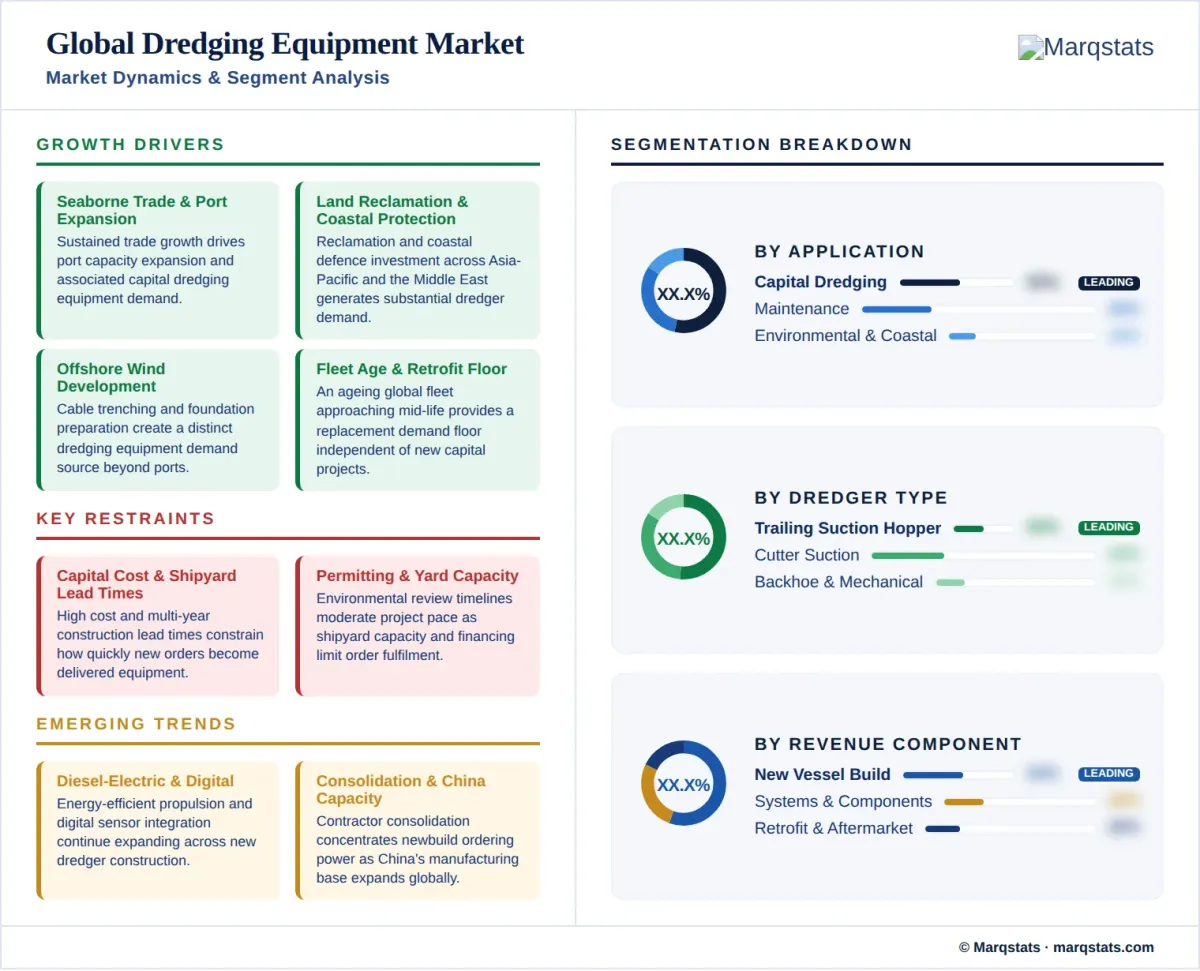
- Sustained global seaborne trade growth continues driving port capacity expansion and associated capital dredging equipment demand.
- Land reclamation and coastal protection investment, particularly across Asia-Pacific and the Middle East, is generating substantial new dredger demand.
- Offshore wind development is creating a distinct dredging equipment demand source tied to cable trenching and foundation preparation work.
- Fleet age and retrofit replacement opportunity provides a structural demand floor independent of new capital project activity.
- Environmental and emissions regulation is driving demand for newer, more efficient dredging equipment over continued operation of older vessels.
Key Restraints
- High capital cost and multi-year shipyard lead times constrain how quickly new dredger orders can translate into delivered equipment.
- Environmental review and project approval timelines for dredging projects indirectly moderate the pace of associated equipment demand.
- Shipyard capacity and financing availability for specialised dredger construction can constrain order fulfilment during periods of strong demand.
Key Trends
- Digital sensor integration and energy-efficient propulsion, including diesel-electric systems, continue expanding across new dredger vessel construction.
- Environmental regulation compliance, including emissions standards, is driving newer, more efficient equipment specification over older vessel operation.
- Industry consolidation among major dredging contractors is concentrating newbuild ordering power among a smaller number of very large fleet operators.
- China's dredging equipment manufacturing base continues expanding, supported by substantial domestic port infrastructure investment.
Market Segmentation
Trailing suction hopper dredgers represent the largest vessel-type category by equipment value, reflecting their scale, capital-dredging application, and typically higher per-unit construction cost relative to smaller vessel types. Recent newbuild activity, including mega-class hopper dredgers featuring diesel-electric propulsion and high-capacity hopper volumes, illustrates continued investment at the largest end of this vessel category specifically. These self-propelled vessels can operate independently across long distances between dredging and disposal sites, a capability that particularly suits large-scale capital projects spanning extensive port or channel areas.
Cutter suction dredgers serve both capital and maintenance dredging applications, valued for their precision excavation capability in harder or more compacted sediment conditions than trailing suction alternatives can efficiently handle, with newbuild activity spanning a wide range of capacity classes for different regional and project requirements. This vessel type typically operates anchored to the seabed via spuds rather than self-propelled across a project site, a structural difference from trailing suction hopper dredgers that shapes both its typical application and its equipment specification requirements.
Backhoe and mechanical dredgers, including grab dredgers, serve smaller-scale, precision, and confined-space applications where the larger hydraulic dredger types are less practical, representing a smaller, persistent equipment category given their continued relevance to specific project types. Their mechanical excavation approach, using a bucket or grab rather than hydraulic suction, also makes this category particularly suited to handling debris or oversized material that hydraulic dredgers would struggle to process efficiently.
New dredger vessel construction represents the largest revenue component, spanning the full range of vessel types and capacity classes, with orders typically allocated by delivery year given the multi-year construction timelines specialised dredger vessels require. Shipyard slot availability and financing terms materially affect how quickly a placed order translates into delivered equipment, a lead-time consideration this report's forecast methodology explicitly accounts for rather than assuming immediate order-to-delivery conversion.
Dredging systems and components, including pumps, cutter heads, and associated equipment packages, represent both newbuild-integrated equipment and standalone replacement orders for existing vessels, giving this revenue component a demand base independent of new vessel construction specifically. Specialist component suppliers, distinct from full-vessel shipyards, often play a particularly significant role within this revenue component, supplying core dredging systems across multiple shipyards' newbuild programmes rather than serving a single vessel manufacturer exclusively.
Retrofit and life-extension work, alongside aftermarket parts and service, collectively represent a structurally significant revenue component tied to the installed fleet's ongoing maintenance and mid-life upgrade needs, a demand source this report tracks independently of new capital project activity given its different underlying driver. Environmental and emissions regulation compliance increasingly drives a specific sub-category of retrofit demand, as fleet owners upgrade older vessels' propulsion and emissions control systems to meet tightening requirements rather than retire vessels that otherwise retain substantial remaining economic life.
Capital dredging, covering port deepening, new channel construction, and land reclamation, accounts for the largest application share, reflecting both the scale of individual capital projects and the larger, higher-value equipment these projects typically require relative to routine maintenance work. Post-Panamax and larger vessel classes calling at major ports continue driving channel-deepening capital dredging demand specifically, as ports compete to accommodate the largest vessels calling on major global trade routes.
Maintenance dredging, covering routine channel and harbour sediment removal to preserve navigability, represents a steady, recurring application less tied to individual large capital project cycles, giving this application category a demand pattern more closely correlated with overall port and waterway activity than with new infrastructure investment specifically. Government agencies and public port authorities represent a particularly significant customer base within this application, given their typical responsibility for ongoing navigable-waterway maintenance across public port and river systems.
Environmental remediation and coastal protection applications, including beach nourishment and flood defence work, represent a growing application category tied to climate adaptation investment, with equipment specification in this category often shaped by more stringent sediment handling and environmental compliance requirements than conventional capital or maintenance dredging. Offshore wind cable trenching and foundation preparation, a related emerging application, similarly requires specialised equipment configuration distinct from conventional port and channel dredging work.
By Geography
Asia-Pacific
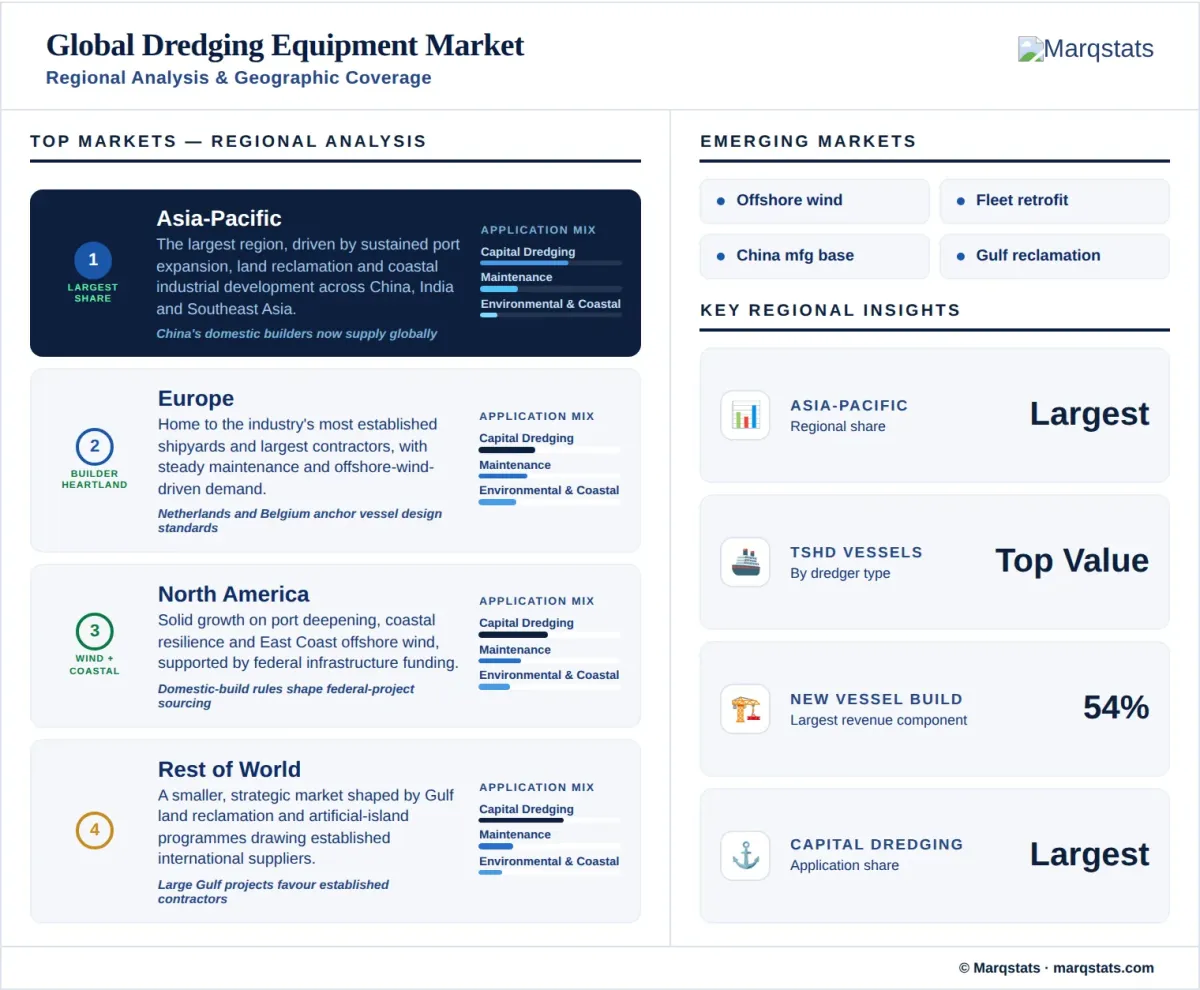
Asia-Pacific holds the largest regional share, driven by sustained port expansion, land reclamation, and coastal industrial zone development across China, India, and Southeast Asia. China's domestic dredging equipment manufacturing base has expanded substantially alongside the country's own port infrastructure investment programme, positioning Chinese manufacturers as increasingly significant global suppliers rather than domestically focused producers alone. India's port modernisation and expansion programme has similarly generated substantial regional demand, with international equipment manufacturers increasingly pursuing regional partnerships to serve this growing market, echoing the localisation strategies established manufacturers have pursued across other fast-growing Asian markets.
Europe
Europe combines a mature equipment manufacturing base, anchored by several of the industry's most established shipyards and component suppliers, with steady maintenance and environmental compliance-driven demand, supported by mature offshore wind activity along the region's coastlines generating a distinct cable-trenching and foundation-preparation demand source. The Netherlands and Belgium specifically anchor both substantial domestic shipbuilding capability and the corporate headquarters of several of the industry's largest global dredging contractors, giving these countries an outsized influence on industry technology and vessel design standards.
North America
North America shows solid growth supported by port deepening for larger vessel classes, coastal resilience project investment, and offshore wind build-out along the United States East Coast specifically, with federal infrastructure programmes providing a meaningful funding source for port and waterway equipment-relevant investment. Domestic maritime regulations governing vessel construction and operation shape equipment sourcing patterns within this region specifically, favouring domestically built or flagged equipment for certain categories of federally funded dredging work.
Rest of World
The Middle East and Latin America represent a smaller, strategically important market, with demand shaped by major land reclamation and port development programmes, particularly across Gulf markets pursuing large-scale coastal and artificial-island development as part of broader economic diversification strategies. These large, technically demanding projects have historically drawn heavily on established international dredging contractors and equipment suppliers, given the specialised vessel capability and project scale involved.
How Competition Is Evolving
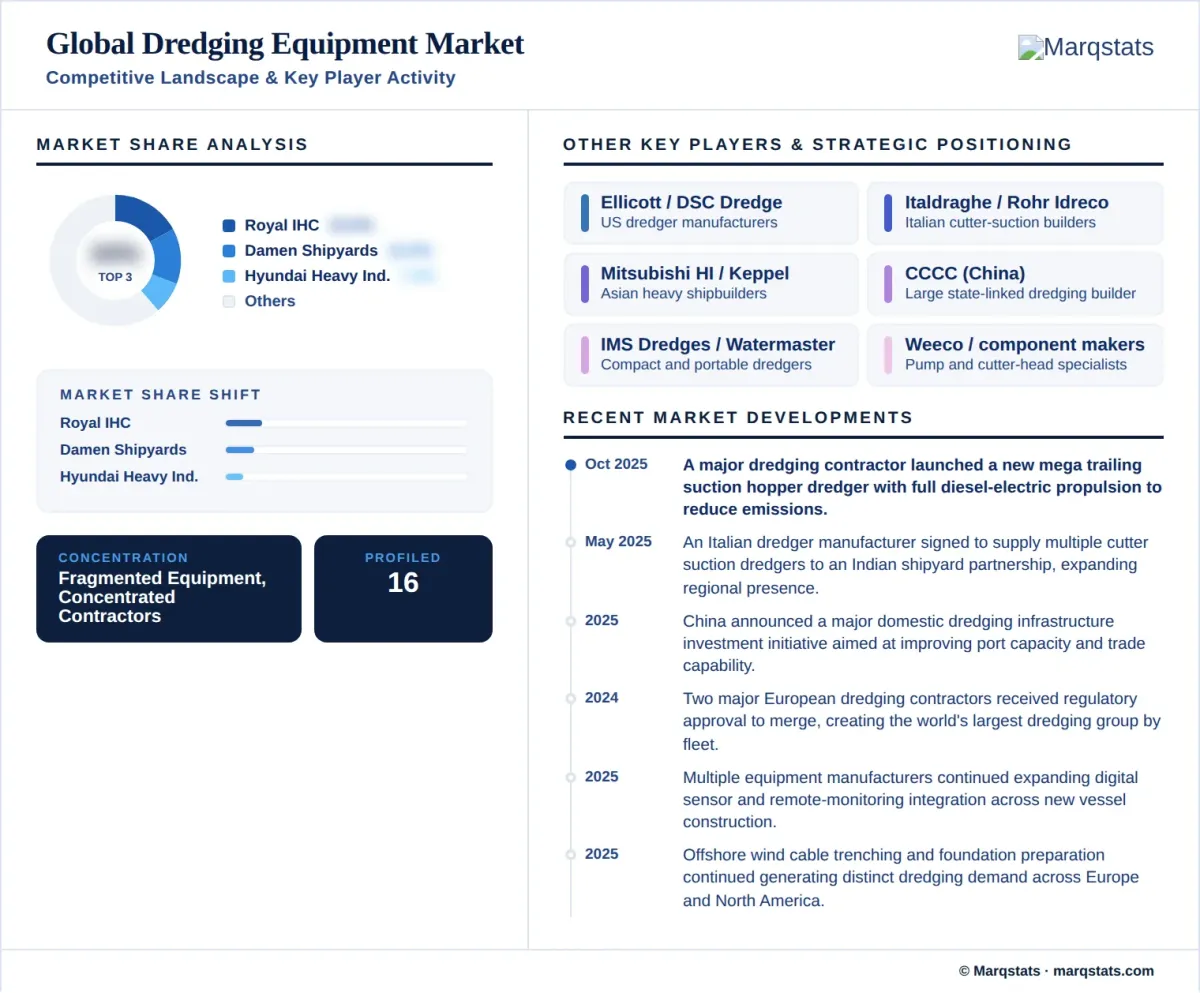
The market is fragmented among a group of established shipyards and specialist equipment manufacturers, including several long-established European and Asian builders with decades of dredger construction experience, alongside newer entrants expanding capacity to serve growing regional demand. Major dredging contractors occupy an influential adjacent position as the industry's largest newbuild customers, whose fleet renewal and expansion decisions directly shape order volume for the shipyards and component suppliers this report profiles as equipment manufacturers specifically. This fragmentation contrasts with the more concentrated dredging contractor market itself, where recent consolidation has produced a small number of very large operators controlling a substantial share of global fleet capacity.
Competitive strategy centers on vessel-type and capacity-class breadth, since customers increasingly favour manufacturers able to serve a range of project scales and sediment conditions, alongside technical capability in energy-efficient propulsion and digital equipment integration that differentiates premium newbuild offerings. Component suppliers, including pump and cutter-head specialists, compete on both original equipment integration into new vessel construction and standalone aftermarket replacement supply to the installed fleet. Regional presence and local partnership capability represent a further meaningful differentiator, particularly in fast-growing markets including India and Southeast Asia, where international manufacturers increasingly pursue joint ventures or local manufacturing partnerships to serve regional demand.
Companies Covered
The report profiles 16+ companies with full strategy and financials analysis, including:
Recent Market Activity
Table of Contents
Coverage & Segmentation
This report provides a comprehensive assessment of the global dredging equipment market across a 2025 base year, historical data from 2021 to 2025, and forecasts spanning 2026 to 2030. Market size is stated as equipment and related service revenue in United States dollars. Segmentation covers three dimensions: dredger type, revenue component, and application, alongside regional analysis spanning Asia-Pacific, Europe, North America, and the rest of world.
The scope covers new dredger vessel construction, dredging systems and components, retrofit and life-extension work, and aftermarket parts and service. The study excludes dredging contract and services revenue, which reflects the value of dredging work performed rather than the equipment used to perform it, and which Marqstats treats as a demand indicator rather than a component of the equipment market this report measures. Land-based earthmoving and excavation equipment covered within Marqstats' separate construction equipment coverage is similarly excluded, given dredging's distinct marine and waterborne application and supplier base. This scope boundary is a deliberate methodological choice given how frequently published dredging market figures conflate contractor services revenue with equipment sales, a conflation this report avoids by construction throughout. Country-level detail beyond the four-region split covered here is available under customization, alongside deeper cuts by dredger type, capacity class, or revenue component.