Market Snapshot
Middle bar: base-year value × (1 + CAGR), rounded to two decimals. This is a calculated illustration, not a separately researched annual estimate.
The India high-performance electric motorcycle market is estimated at 463,930 units in 2025 and is projected to reach 1,165,544 units by 2030, registering a volume CAGR of 20.23% over 2026–2030. In value terms the market is estimated at USD 800.01 million in 2025 and is projected to reach USD 1,892.44 million by 2030, a CAGR of 18.79%. The market comprises new road-registered battery electric two-wheelers in India with motor power above 5.0 kW, covering performance scooters and electric motorcycles. The band accounts for 36.21% of India's 1,281,230 electric two-wheelers in 2025 and 39.60% by 2030.
Market size and forecast figures are generated using Marqstats' proprietary estimation framework, updated as of October 2026.
Performance scooters supply at least 96.30% of the India high-performance electric motorcycle market, and dedicated electric motorcycles at most 3.70%. Ather Energy Limited, Ola Electric Mobility Limited and Hero MotoCorp Limited's VIDA supply most of the scooter volume, while Revolt, Oben Electric and Ultraviolette Automotive lead the motorcycle body type. Volume grows 23.40% to 572,497 units in 2026, and the average selling price eases from USD 1,724 to USD 1,624 by 2030 as lower-priced motorcycles from Ola, Oben and Revolt widen the base.
Key Takeaways
Market Overview & Analysis
Report Summary
The India high-performance electric motorcycle market covers new battery electric two-wheelers registered for road use in India with motor power above 5.0 kW. The market grew from 48,747 units in 2021 to 204,830 in 2022, 290,077 in 2023 and 402,070 in 2024, and reached 463,930 units in 2025, up 15.39%. It grows 23.40% to 572,497 units in 2026 and adds 701,614 units by 2030. Electric two-wheelers rated at 5.0 kW or less, electric bicycles, electric three-wheelers and internal combustion motorcycles sit outside the perimeter.
The signature finding is that India's high-performance electric two-wheeler market is a scooter market with a small motorcycle tail. India's electric motorcycle registrations rose 28% to 17,173 units in fiscal 2025-26 from 13,430 units, against 463,930 above-5.0 kW units in 2025. Even if every electric motorcycle sold in India were rated above 5.0 kW, motorcycles would hold at most 3.70% of the band, and performance scooters at least 96.30%. Petrol motorcycles of 150 to 200 cc sold 1,239,606 units in the first ten months of fiscal 2025-26, up 33%, which shows the size of the market electric motorcycles have yet to reach.
Performance scooters supply the volume. Ather Energy Limited retailed 200,797 scooters in 2025, up 58.1%, Ola Electric Mobility Limited 199,318, down more than 51%, and Hero MotoCorp Limited's VIDA 109,168, more than double its 2024 level, according to Federation of Automobile Dealers Associations (FADA) retail data reported by Storyboard18. The Ather 450 series, Ola S1 Pro and VIDA V1 use peak motor ratings of 6.0 kW and above, and non-Rizta models, mainly the 450 series, accounted for about 24% of Ather's record 260,070 scooters in fiscal 2025-26, about 62,417 units. Brand retail totals include models in lower bands, so the brand-to-band split is a Marqstats construction and not independently verified.
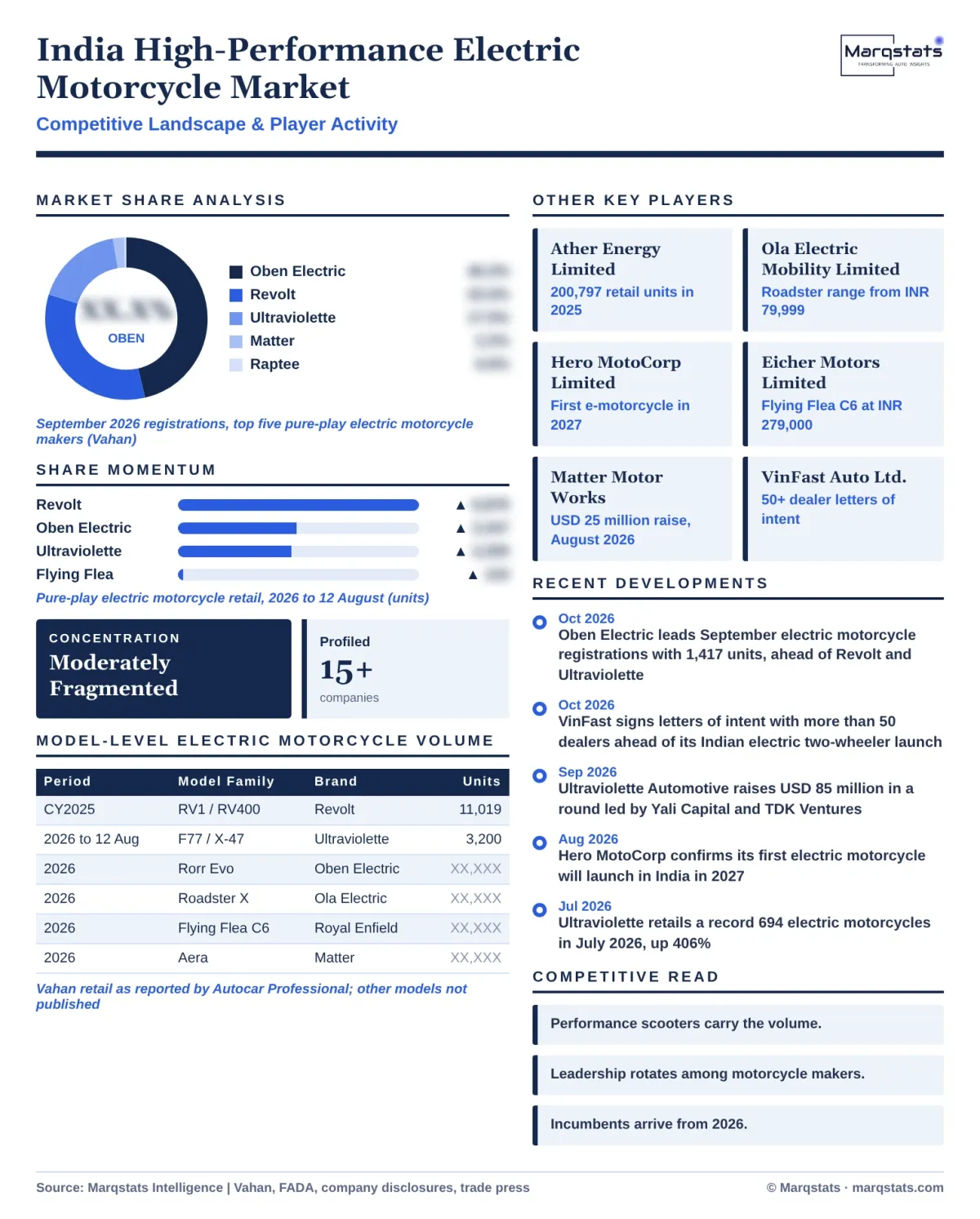
Electric motorcycle brands are small and grow unevenly. Revolt Intellicorp Private Limited sold 11,019 electric motorcycles in calendar 2025, up 10.69% from 9,955 in 2024, after 14,910 in 2022, and passed 51,216 cumulative deliveries in February 2026, according to Vahan data reported by Autocar Professional. In 2026 to 12 August, Revolt retailed 6,876 units, Oben Electric 3,347 and Ultraviolette Automotive Private Limited 3,200, while Royal Enfield's Flying Flea sold 124 units after deliveries began in June. In September 2026, Oben registered 1,417 units, Revolt 1,027, Ultraviolette 536, Matter Motor Works Private Limited 69 and Raptee Energy Private Limited 17.
Model prices span three tiers. Ola Electric launched an updated Roadster range from INR 79,999 in March 2026, Oben launched the Rorr Evo at an introductory INR 99,999 in May 2026, and Revolt prices the RV1 at INR 99,990 and the RV400 at INR 149,950. Ultraviolette prices the X-47 from about INR 249,000, or INR 149,000 with battery-as-a-service, and the F77 range at INR 309,000 to INR 424,000, while Royal Enfield priced the Flying Flea C6 at INR 279,000, or INR 199,000 with a battery subscription. Battery subscription is now a standard tool for bringing premium motorcycles within reach of the INR 150,000 buyer.
Capital is flowing ahead of demand. Ultraviolette raised USD 85 million in September 2026 in a round led by Yali Capital and TDK Ventures, after a USD 45 million Series E in December 2025, and plans a Tamil Nadu plant with initial capacity of 250,000 units a year, expandable to 500,000. Matter raised USD 25 million in August 2026 and set up capacity of 10,000 units a month in July 2025, against 69 registrations in September 2026. Oben built its 10,000th electric motorcycle at its Bengaluru plant in 2026, and Revolt expanded to 200 dealerships in April 2025 with a target of 400.
Incumbent makers enter from 2026. Royal Enfield, owned by Eicher Motors Limited, began Flying Flea C6 deliveries in Bengaluru in June 2026 and opened four sales and service points in Hyderabad in October 2026. Hero MotoCorp Limited confirmed its first electric motorcycle for 2027, and Bajaj Auto Limited plans electric motorcycles from fiscal 2028, with export markets first. VinFast Auto Ltd. signed letters of intent with more than 50 dealers ahead of its Indian electric two-wheeler launch in October 2026.
The average selling price is approximately USD 1,724 in 2025 and USD 1,624 by 2030, so value grows at 18.79% against 20.23% for units. Performance scooters and entry motorcycles sell at INR 80,000 to INR 150,000, while premium motorcycles sell above INR 249,000. Growth in the entry tier lowers the average, and premium brands rely on battery subscription to defend volume.
The conclusion for buyers and suppliers is that the motorcycle body type is the growth option, and the performance scooter is the volume base. Motorcycle makers with installed capacity far above sales compete for the same few thousand monthly buyers, and the arrival of Royal Enfield, Hero and Bajaj adds dealer reach that pure-play brands lack. Suppliers of motors, battery packs and controllers gain most from the scooter base to 2028, and from motorcycles once incumbents scale.
Policy support narrows for this band. PM E-DRIVE support for electric two-wheelers fell from INR 5,000 to INR 2,500 per kWh in April 2025 and applies to vehicles sold until 31 July 2026, with a cap of INR 5,000 per vehicle and an ex-factory price limit of INR 150,000, within a total of 2,479,120 subsidised vehicles. A 4 kWh performance scooter or motorcycle therefore receives at most INR 5,000, less than 4% of a INR 150,000 price. The subsidy no longer decides the purchase in the above-5.0 kW band, and running-cost savings and product appeal carry demand.
The petrol benchmark sets the size of the opportunity. Petrol motorcycles of 150 to 200 cc sold 1,099,816 units in fiscal 2024-25 and 1,239,606 units in the first ten months of fiscal 2025-26, and India sold about 20 million two-wheelers in calendar 2025, with motorcycles at 61% of the total. Electric motorcycles of 17,173 units in fiscal 2025-26 equal less than 1.4% of the 150 to 200 cc petrol segment in a shorter period, which shows how early the motorcycle body type remains. Electric performance scooters have already won a large share of the premium scooter buyer, and the next step is the commuter and sport motorcycle buyer.
The value chain depends on imported cells and magnets. Most cells and rare-earth magnets come from China, and China's April 2025 licensing of rare-earth exports disrupted motor supply to Indian makers. Ola Electric builds its own 4680 Bharat cell, which certified in the Roadster X+ 9.1 kWh pack in December 2025, and Ultraviolette's backers include TDK Ventures, the investment arm of a component maker. Makers that secure cells and magnets locally gain cost and supply advantages as volume grows.
Market Dynamics
Key Drivers
Five conditions drive the India high-performance electric motorcycle market, and the entry of incumbent motorcycle makers matters most for the motorcycle body type.
- Incumbent makers enter the segment. Royal Enfield began Flying Flea C6 deliveries in June 2026, Hero MotoCorp Limited plans its first electric motorcycle for 2027 and Bajaj Auto Limited from fiscal 2028. These brands bring dealer networks that reach buyers of 150 to 200 cc petrol motorcycles, a segment of more than 1.2 million units in ten months.
- Venture capital for Indian specialists. Ultraviolette raised USD 85 million in September 2026 and USD 45 million in December 2025, Matter USD 25 million in August 2026 and Oben INR 100 crore in a Series A in June 2025. Funding pays for new models, plants and charging.
- Lower entry prices. Ola's Roadster range starts at INR 79,999, Oben's Rorr Evo at INR 99,999 and Revolt's RV1 at INR 99,990. Entry motorcycles now sit in the price range of petrol commuter motorcycles, which widens the buyer base beyond enthusiasts. Oben's lead in September 2026 registrations, four months after the Rorr Evo launch, shows how quickly price moves share in this segment.
- Battery subscription for premium models. Ultraviolette offers the X-47 at INR 149,000 with battery-as-a-service against INR 249,000 outright, and Royal Enfield the Flying Flea C6 at INR 199,000 against INR 279,000. Subscription cuts the upfront price by INR 80,000 to INR 100,000.
- Fast-charging networks. Ultraviolette and Bolt.Earth deployed more than 130 Type-6 DC fast chargers for electric two-wheelers in May 2026. Fast charging supports highway use, which high-power motorcycles need to compete with petrol models. Charging access matters more for motorcycles than for scooters, because motorcycle buyers ride longer distances between home charges.
Key Restraints
Four constraints limit the market, and capacity running ahead of demand is the most serious.
- Installed capacity far above sales. Matter set up 10,000 units a month of capacity and registered 69 units in September 2026, and Ultraviolette plans 250,000 units a year of capacity against 3,200 retail units in 2026 to 12 August. Over-capacity compresses prices and margins for every pure-play maker.
- Subsidy limits exclude premium models. PM E-DRIVE support of INR 2,500 per kWh, capped at INR 5,000, applies only to vehicles with an ex-factory price up to INR 150,000 sold until 31 July 2026. Premium motorcycles such as the Flying Flea C6 and Ultraviolette F77 sit above the price cap.
- Volatile brand leadership. Ola Electric's retail volume fell more than 51% in 2025, from 407,700 to 199,318 units, and Revolt's January 2026 sales fell 37% year on year to 666 units. Volatility raises service and resale risk for buyers, and lenders price that risk into financing for smaller brands.
- Rare-earth magnet supply. China's April 2025 export licensing for rare-earth elements and magnets disrupted motor supply to Indian manufacturers. High-power motors carry more magnet material per unit, so the above-5.0 kW band is the most exposed to a repeat.
Key Trends
Four shifts show where the market is moving and which companies gain.
- Scooter brands move into motorcycle bodies. Ola Electric launched the Roadster X in 2025 and an updated range in March 2026, Revolt launched the RVX in July 2026 and Hero's VIDA registered the Ubex design in February 2026. Scooter brands use their scale to enter the motorcycle body type at lower prices than the specialists.
- Leadership rotates among pure-play makers. Revolt led pure-play makers in 2026 to 12 August, while Oben led September 2026 registrations with 46.22% of the five makers. The Rorr Evo at INR 99,999 moved Oben ahead of Revolt within four months of launch.
- Battery technology as a product feature. Ola Electric's Roadster X+ with a 9.1 kWh pack built on its in-house 4680 Bharat cell received certification in December 2025, and Raptee.HV prepared deliveries of a high-voltage electric motorcycle in November 2025. Larger packs and higher voltages target highway range and fast charging, where electric motorcycles trail petrol models on long trips.
- Exports from India. Ultraviolette entered Hungary and Central and Eastern Europe through Elektrorider in April 2026, and the F77 completed an Isle of Man TT lap in June 2026. Bajaj plans to sell its first electric motorcycles in export markets first. Exports give Indian makers volume to fill plants built ahead of domestic demand, and European sales test product quality against established brands.
Market Segmentation
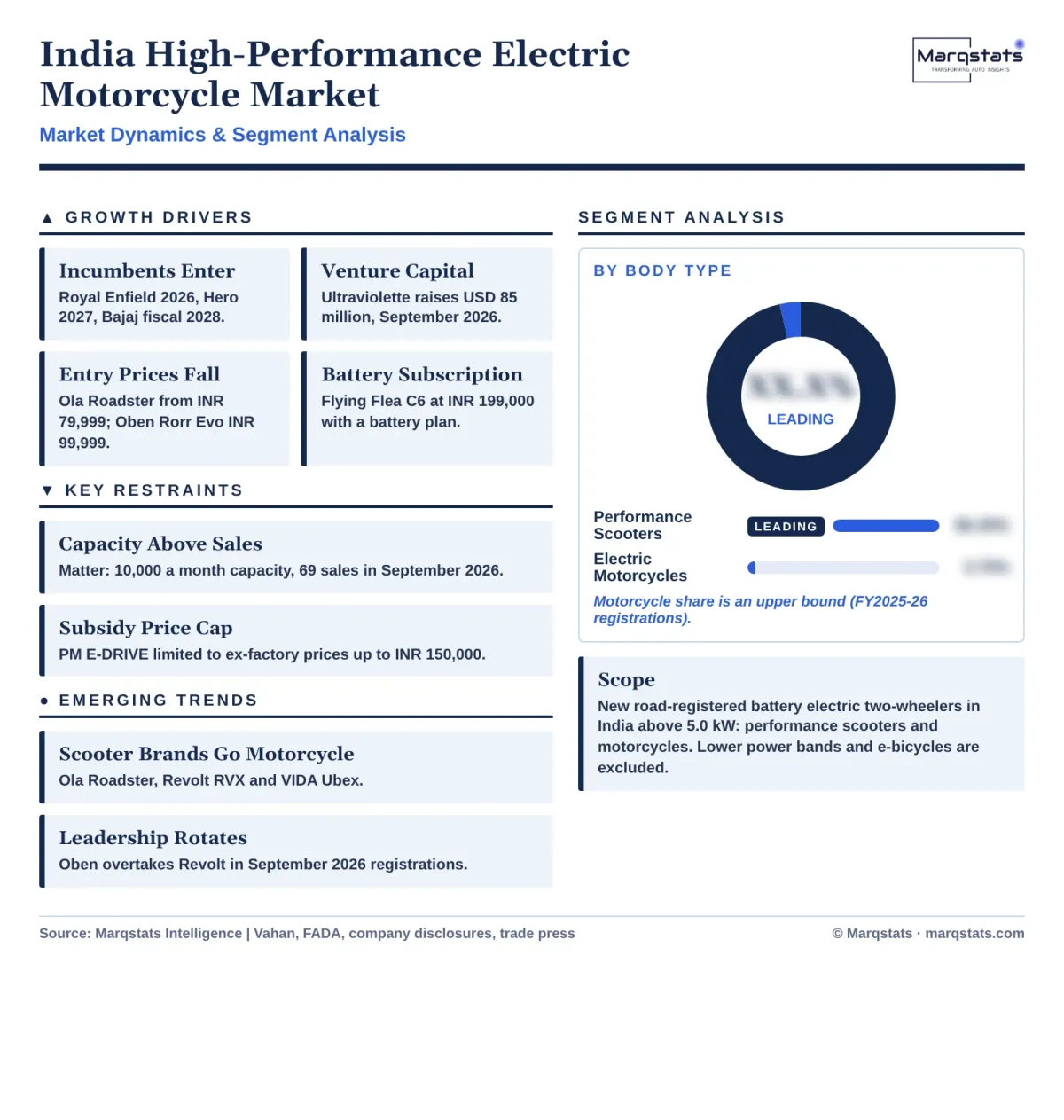
Performance scooters supply at least 96.30% of 2025 volume, led by the Ather 450 series, Ola S1 Pro and Hero VIDA V1. They share dealer networks, charging and financing with commuter scooters, which keeps their costs low, and they remain the volume base of the band to 2030.
Electric motorcycles hold at most 3.70% of 2025 volume, based on 17,173 registrations in fiscal 2025-26, led by Revolt, Oben and Ultraviolette. Oben, Revolt and Ultraviolette together registered 2,980 of the 3,066 units sold by the five pure-play makers in September 2026, a 97.19% share. The body type grows fastest as Ola, Royal Enfield, Hero and Bajaj add models, and its share is the main swing factor in the forecast.
The entry tier covers the Ola Roadster range from INR 79,999, the Oben Rorr Evo at INR 99,999, the Revolt RV1 and RV400 at INR 99,990 to INR 149,950, and most performance scooters. Vehicles in this tier qualify for PM E-DRIVE support up to the INR 150,000 ex-factory cap and supply most units.
The premium tier covers the Ultraviolette X-47 from INR 249,000 and F77 from INR 309,000, and the Royal Enfield Flying Flea C6 at INR 279,000. Brands in this tier use battery subscription to bring upfront prices to INR 149,000 to INR 199,000.
Most buyers purchase the vehicle and battery together, which keeps the vehicle eligible for PM E-DRIVE support where the price fits under the cap. Entry motorcycles from Ola, Oben and Revolt and most performance scooters sell this way.
Battery subscription separates the battery cost from the vehicle price and cuts the upfront price by INR 80,000 to INR 100,000 on premium models such as the Ultraviolette X-47 and Flying Flea C6. Ather offers the same option on scooters, and the model grows as premium brands seek volume.
By Geography
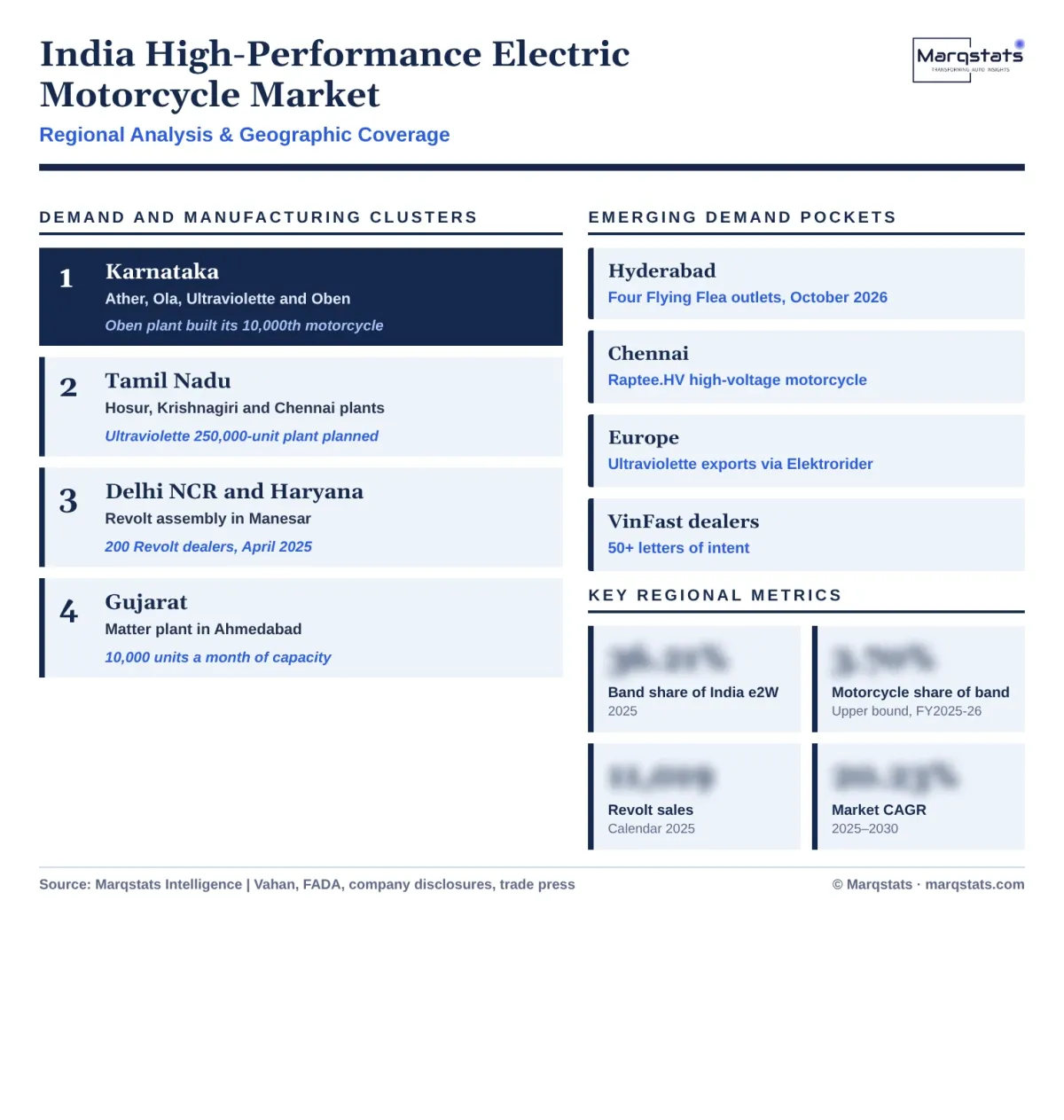
Karnataka
Karnataka is the brand and demand hub, home to Ather Energy, Ola Electric, Ultraviolette and Oben, whose plant in Bengaluru built its 10,000th motorcycle in 2026. Royal Enfield opened its first Flying Flea showroom in Jayanagar, Bengaluru, and began deliveries there in June 2026. The concentration of brands, test rides and charging in Bengaluru makes the state the first market for most new launches.
Tamil Nadu
Tamil Nadu is the manufacturing centre, with Ather's plant in Hosur, Ola Electric's Futurefactory in Krishnagiri and TVS Motor Company's Hosur operations. Ultraviolette plans its 250,000-unit plant in the state, and Raptee.HV builds high-voltage motorcycles in Chennai. Royal Enfield, owned by Eicher Motors Limited, is also based in Chennai, so the state hosts both the largest scooter plants and the newest motorcycle entrants.
Delhi NCR and Haryana
Revolt assembles motorcycles in Manesar, Haryana, and its RV1 and RV400 compete in the commuter motorcycle tier across the capital region. Revolt's dealer network of 200 outlets in April 2025, with a target of 400, reaches buyers across northern India, and Revolt passed 51,216 cumulative deliveries in February 2026.
Gujarat
Matter Motor Works builds the Aera geared electric motorcycle in Ahmedabad, with capacity of 10,000 units a month. Matter plans four new motorcycles after raising USD 25 million in August 2026, and announced plans in January 2026 to invest USD 100 million to USD 150 million over three years. Its September 2026 registrations of 69 units show how far demand trails capacity.
Telangana
Royal Enfield's Flying Flea opened four sales and service points in Hyderabad in October 2026, its first expansion outside Bengaluru. The expansion tests demand for the INR 279,000 C6 beyond its launch city.
How Competition Is Evolving
The market is moderately fragmented and splits into two groups. Ather Energy Limited, Ola Electric Mobility Limited and Hero MotoCorp Limited lead the performance scooter volume, while pure-play motorcycle makers compete for a few thousand registrations a month. In September 2026, Oben held 46.22% of the five pure-play makers, Revolt 33.50% and Ultraviolette 17.48%.
Strategies differ by price tier. Ola, Oben and Revolt compete at INR 80,000 to INR 150,000 with dealer reach and subsidy-eligible prices, while Ultraviolette and Royal Enfield sell premium motorcycles with battery subscription. Ola uses its own 4680 cell, Ultraviolette its charging partnership with Bolt.Earth, and Revolt its 200-dealer network.
The competitive question to 2030 is whether specialists keep share as incumbents arrive. Royal Enfield began deliveries in June 2026, Hero follows in 2027 and Bajaj from fiscal 2028, and VinFast Auto Ltd. prepared more than 50 dealers for its India launch in October 2026. Specialists are raising capital first, with Ultraviolette at USD 85 million and Matter at USD 25 million in 2026.
Model concentration is high. The Revolt RV400 and RV1 family, the Oben Rorr Evo and the Ultraviolette F77 and X-47 supply most electric motorcycle registrations, and the Ather 450 series, Ola S1 Pro and VIDA V1 most performance scooter volume. Flying Flea C6 sales of 124 units to 12 August 2026 show how slowly a premium launch builds in its first months.
Scale in performance scooters does not protect a brand. Ola Electric led India's electric two-wheeler retail in 2024 with 407,700 units, fell to 199,318 in 2025 and sold 80,282 units in January to July 2026, while Ather grew 58.1% in 2025 and Hero's VIDA more than doubled. Service quality, dealer reach and product reliability decided share more than motor power or price, and the same factors now decide which motorcycle brands keep buyers. Brands with established service networks, such as Hero, Bajaj and Royal Enfield, enter the motorcycle body type with an advantage the specialists must match through partnerships or faster dealer growth.
Companies Covered
Companies covered in the report include:
Recent Market Activity
Table of Contents
Coverage & Segmentation
The India high-performance electric motorcycle market comprises new road-registered battery electric two-wheelers in India with motor power above 5.0 kW, sized in units and in USD at manufacturer selling prices. The market is segmented by body type into performance scooters and electric motorcycles, and by price tier into vehicles up to INR 150,000 and above INR 150,000. State analysis covers Karnataka, Tamil Nadu, Delhi NCR and Haryana, Gujarat and Telangana, and is qualitative.
The base year is 2025, the historical period is 2021–2025 and the forecast period is 2026–2030. Electric two-wheelers rated at 5.0 kW or less, electric bicycles, electric three-wheelers and internal combustion motorcycles are excluded. Brand data come from Vahan registrations and FADA retail data, which cover brands across power bands, so the body-type split is an upper bound for motorcycles and a Marqstats construction that is not independently verified. Value is derived from Marqstats average selling prices by year.