Market Snapshot
Key Takeaways
Market Overview & Analysis
Report Summary
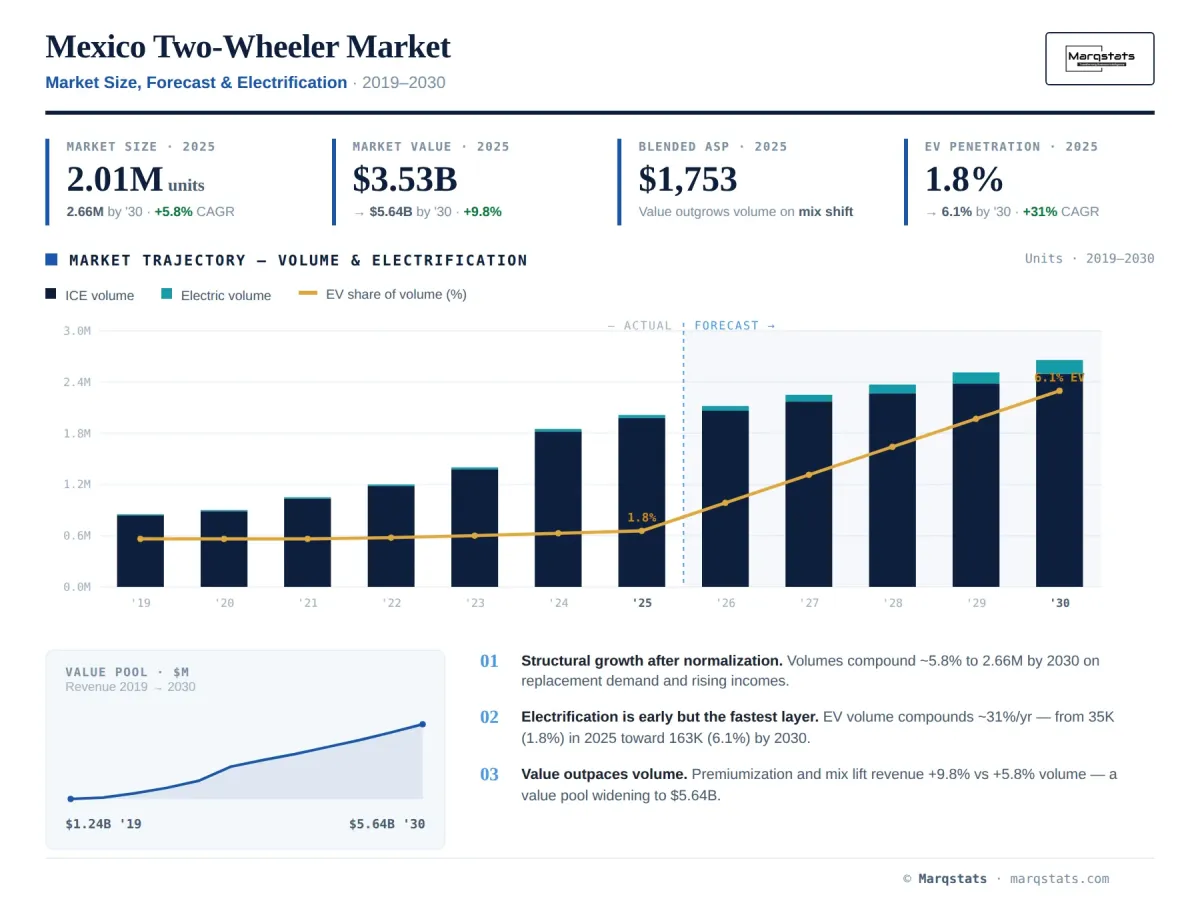
The Mexico two-wheeler market comprises motorcycles, scooters, and mopeds sold for personal and commercial use across internal combustion and electric propulsion. This study segments demand by vehicle type, propulsion type, engine displacement and motor power, price band, end user, sales channel, and brand, with a 2025 base year, historical coverage from 2021 to 2025, and forecasts to 2030. Mexico is a high-volume, low-price commuter market in which the two-wheeler functions primarily as an instrument of income generation.
The market's character sets it apart from every other market in this series. Industry association analysis holds that motorcycles have shifted from consumer goods to productive assets, with their value residing in the capacity to generate income rather than in ownership itself. Roughly seven of every ten machines sold are purchased by buyers intending to work as delivery riders, and demand is therefore driven by last-mile logistics, messaging, and independent commerce rather than by discretionary leisure spending. For most buyers, the choice is not between a motorcycle and a car; it is between a motorcycle and no motorised transport at all.
Supply is dominated by the domestic manufacturer Italika, founded in 2005 and part of a diversified retail conglomerate, which has sold over ten million cumulative units. Its distribution runs through more than a thousand retail stores nationwide, where purchase and instalment financing are completed in a single transaction, reaching semi-urban and rural buyers without formal credit histories. Honda operates a long-established plant near Guadalajara, Bajaj and other Indian manufacturers have built local capacity, and Chinese brands have expanded rapidly, making Mexico the second-largest destination for Chinese motorcycle exports.
The scale of the transformation is visible in the national fleet, which has expanded from just over two million machines a decade ago to about 8.9 million. Motorcycle sales surpassed automobile sales for the first time in 2022, and the market has since continued to widen its lead. Growth reflects rising pressure on household incomes alongside the expansion of last-mile logistics, in which a motorcycle reduces idle time and raises daily output. The vehicle's economics, rather than its appeal, explain the market's expansion.
Market Dynamics
Key Drivers
- Delivery and gig-economy demand drives the market, as most buyers purchase machines to generate income through last-mile logistics and messaging.
- Accessible instalment financing widens the buyer base, reaching consumers excluded from formal credit and from the automobile financing market.
- Urban congestion and limited public transport capacity make two-wheelers a practical mobility solution across all of the major metropolitan areas.
- Domestic and foreign assembly investment expands supply, with new plants raising capacity across combustion and electric categories.
Key Restraints
- An incomplete national regulatory framework governs licensing, safety enforcement, and technical standards, raising concerns over accident rates.
- New labour regulations affecting delivery-platform riders introduce uncertainty for the segment that anchors demand.
- The dominant 126–150cc class contracts through the forecast as demand disperses toward smaller and larger displacements.
Key Trends
- Electrification accelerates from a small base with new assembly investment; the Thailand electric two-wheeler market offers a comparison for commuter-led electric adoption.
- Chinese and Indian brands expand rapidly, with more than sixty brands now competing and new assembly capacity being built domestically.
- Online retail grows at about 25% annually, reaching about 15% of volume as digital channels supplement the dominant physical network.
- The displacement mix disperses, as sub-125cc and above-350cc classes both grow above 23% while the dominant mid-displacement band contracts.
Market Segmentation
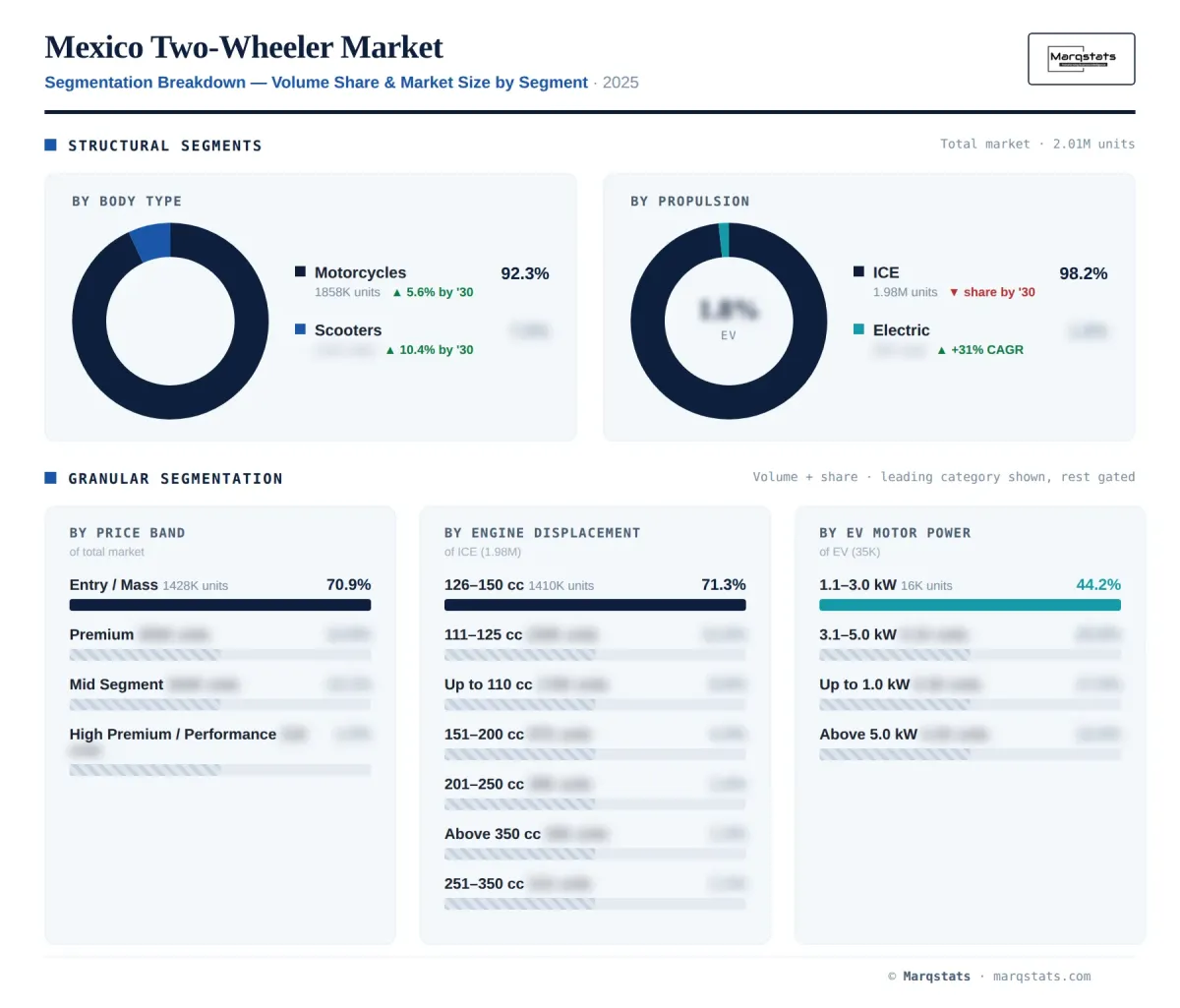
Motorcycles account for about 92% of 2025 volume, roughly 1.86 million units, growing at a 5.62% CAGR. The category is overwhelmingly composed of small, single-cylinder, air-cooled commuter machines below 200cc, built for durability, low running cost, and simple maintenance. These machines carry the delivery economy and everyday commuting, and they generate the great majority of market value. Premium and large-displacement motorcycles remain marginal, in sharp contrast to the North American and European markets covered in this series.
Scooters account for about 141,000 units in 2025, roughly 7% of volume, growing fastest among vehicle types at a 10.38% CAGR. Demand concentrates in dense urban centres and among delivery riders seeking automatic transmissions. Mopeds contract at about 29% annually toward negligible volumes by 2030, displaced by more capable scooters and small motorcycles that offer greater range and load capacity for the same purpose.
Combustion models hold about 98% of 2025 volume, roughly 1.98 million units, growing at about 5% annually. Combustion dominates the commuter and delivery classes that define the market, where low purchase price, fuel availability, and simple servicing outweigh other considerations. Combustion machines will retain the great majority of volume throughout the forecast period. Repairability matters as much as purchase price for buyers whose income depends on the machine remaining in service, and a nationwide parts and workshop network favours established combustion platforms.
Electric two-wheelers hold about 2% of 2025 volume, roughly 35,000 units, growing fastest at a 30.81% CAGR to reach about 163,000 units by 2030. Adoption concentrates in the 1.1–3.0 kW class, with the above-5.0 kW class growing fastest at about 40%. Growth is supported by new domestic assembly investment from electric specialists and by delivery operators seeking lower running costs across dense urban routes. The economics favour adoption where daily distances are high and predictable, making the delivery segment the natural entry point for electrification.
The 126–150cc class is overwhelmingly dominant at about 70% of 2025 volume, roughly 1.41 million units. This band contains the workhorse commuter and delivery machines that define the Mexican market, and it aligns with the core model ranges of the dominant domestic manufacturer. The class contracts at about 11% annually through the forecast as demand disperses toward both smaller and larger displacements. Machines in this band are typically single-cylinder and air-cooled, with drum brakes and twin rear shocks, engineered for durability and low-cost repair rather than performance.
The 111–125cc class holds about 11% of volume and grows at about 25% annually, while sub-110cc machines hold about 9% and grow at about 24%. At the other end, machines above 350cc represent about 1% of volume yet grow at about 26%, reflecting an emerging premium segment. This dispersion away from the dominant mid-displacement band is the market's defining structural shift. Smaller machines serve cost-sensitive urban riders and electric conversions, while larger machines serve an emerging middle class buying for leisure rather than income.
The entry and mass band accounts for about 71% of 2025 volume, roughly 1.43 million units, growing at about 4% annually. Base models sell from approximately USD 1,200, extending to about USD 2,800 for larger or better-equipped versions. Accessible instalment financing at these price points brings motorcycle ownership within reach of income groups entirely excluded from car financing. Requirements are minimal, and the financing is designed explicitly for buyers without formal credit histories, which is what converts affordability into actual purchase.
The mid segment holds about 13% of volume and grows at about 16% annually, while premium accounts for about 15% and remains broadly flat. The high-premium performance band, though about 1% of volume, grows fastest at about 43% from a small base. The premium and high-premium series reflect a reclassification in the underlying data from 2022 onward.
Private consumers account for about 95% of 2025 volume. The classification understates commercial intent, however, as most private buyers purchase machines to generate income through delivery, messaging, and independent commerce rather than for personal transport alone. Demand is therefore driven by earning capacity rather than by discretionary spending. This distinction matters for forecasting: the market responds to platform employment growth, fuel prices, and financing availability far more than to consumer confidence.
Formally recorded delivery and logistics demand accounts for about 4% of volume and grows at about 10% annually, while business and fleet users add a further 6%. Ride-hail, rental, and tourism grow at about 13%. These categories capture registered commercial fleets, and they sit alongside the far larger population of individually owned machines used for delivery work, which the private-consumer classification absorbs.
Offline retail accounts for about 85% of 2025 volume. The dominant manufacturer distributes through more than a thousand retail stores that extend deep into semi-urban and rural areas where dedicated motorcycle dealerships would not be commercially viable, and where purchase and financing are completed in a single transaction. This distribution reach is the market's central competitive asset. Foreign entrants building conventional dealership networks face a structural disadvantage in the regions where incremental demand is strongest.
The online channel reaches about 15% of 2025 volume and grows fastest at about 25% annually. Digital platforms serve younger and urban buyers comparing the growing range of Chinese, Indian, and electric models, and they supplement rather than displace the physical retail and financing network that anchors the market. Their growth is concentrated in the metropolitan areas where formal credit access is highest.
By Geography
Valley of Mexico
The Valley of Mexico, encompassing Mexico City and the surrounding State of Mexico, is the largest regional market. Severe congestion, extensive delivery activity, and constrained public transport capacity make two-wheelers essential to urban mobility and to the gig economy, and the region concentrates both commuter and early electric demand. It also hosts the densest concentration of delivery-platform riders, and it is where proposed regulation of licensing, safety, and platform labour would have the greatest effect.
Jalisco & the West
Jalisco, centred on Guadalajara, is a major market and a manufacturing hub. Honda has operated a plant near the city since 1985, and the dominant domestic manufacturer opened a second assembly facility in the state, positioned near the Pacific port of Manzanillo to serve northern Mexico across sixteen states. The concentration of assembly capacity in the region reflects both proximity to import terminals for components and access to the growing northern consumer base.
Nuevo León & the North
Nuevo León, centred on Monterrey, and the northern border states sustain strong demand supported by industrial employment, higher incomes, and cross-border commerce. The region shows the highest penetration of premium and imported machines, alongside substantial commuter and delivery volumes.
The Bajío & Southern Mexico
The Bajío industrial corridor and southern states form substantial markets where two-wheelers serve semi-urban and rural mobility needs. Retail distribution extending into these regions, combined with instalment financing, has brought motorcycle ownership to communities where formal credit and dealership networks are otherwise absent. For many households in these regions, the motorcycle represents the first motorised vehicle ever owned, and its purchase marks entry into both mobility and self-employment.
How Competition Is Evolving
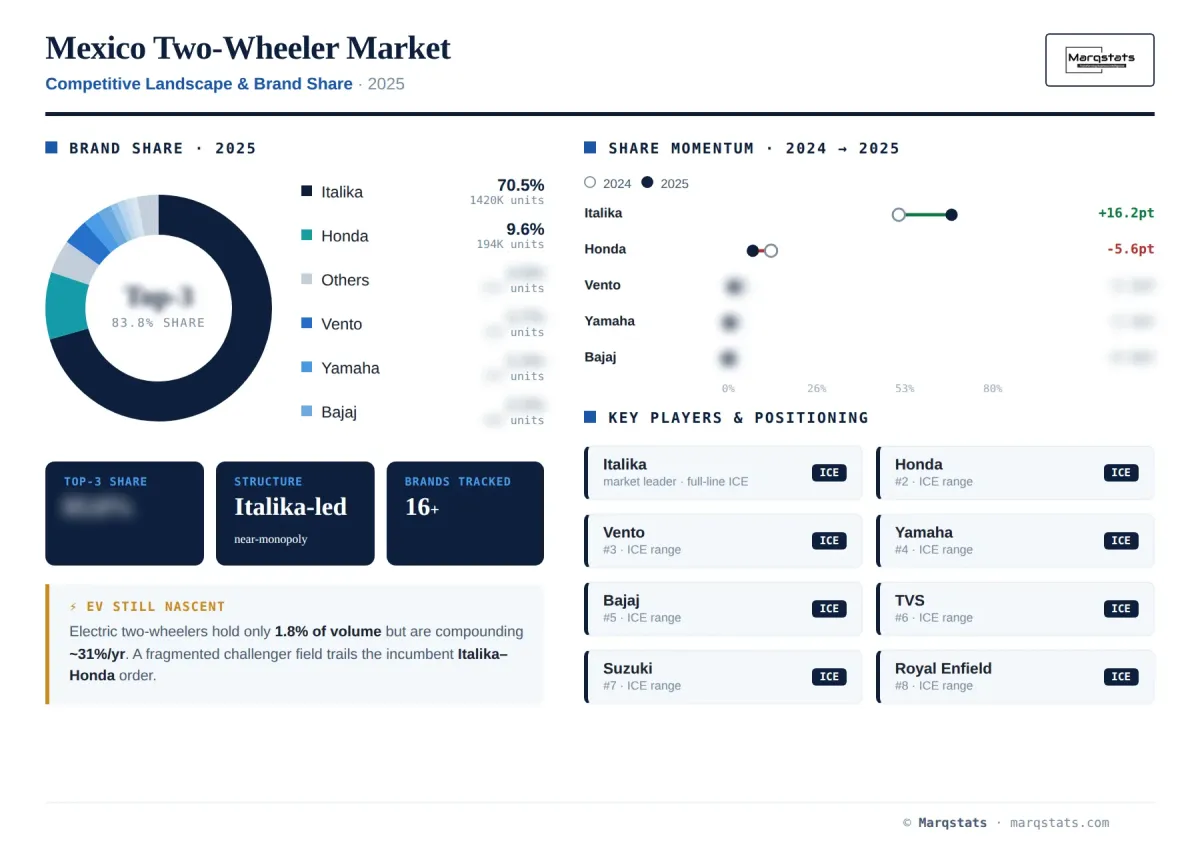
The Mexico two-wheeler market is highly concentrated. The domestic manufacturer Italika holds about 70% of volume, a dominance without parallel among the markets in this series, and has sold over ten million cumulative units since its founding in 2005. Honda follows at about 10%, and the domestic brand Vento at about 4%. Yamaha, Bajaj, Suzuki, TVS, Royal Enfield, Yadea, QJ Motor, Hero, and CFMoto compete across the remainder, and more than sixty brands now sell in the market.
Italika's position rests on distribution rather than product alone. Its machines are sold through a retail chain of more than a thousand stores, where the purchase is completed alongside instalment financing designed for buyers without formal credit histories. That combination of proximity, availability, and credit reaches semi-urban and rural customers whom conventional dealership networks cannot serve economically. Competitors have been unable to replicate the model, and Italika has instead extended it, assembling machines under partner brands including Hero, Benelli, and, from late 2025, Morbidelli.
The company's manufacturing base has expanded accordingly. A second assembly plant in Jalisco, built at a cost of about USD 27.6 million across 71,000 square metres, carries capacity for 500,000 units annually across 31 models and serves sixteen states from a position near the Pacific port of Manzanillo. Italika recorded its twenty-first consecutive record year in 2025, selling about 1.3 million units across all markets, of which roughly 96% were sold in Mexico. Its contract assembly for partner brands converts potential competitors into customers, a defensive strategy that has so far preserved its share against sustained foreign entry.
Competition is intensifying nonetheless. Honda posted the strongest growth among the major brands in 2025, rising about 20%, while Italika and Bajaj were broadly flat and the domestic brand Vento grew about 4%. TVS, CFMoto, QJ Motor, and Triumph each recorded double-digit gains. Growth is attributed to brands that combine competitive pricing with financing access and service coverage, moreover rewarding those building local assembly capacity. Chinese manufacturers have made Mexico their second-largest export destination, and all four major Indian manufacturers now compete in the market.
Companies Covered
The report profiles 16+ companies with full strategy and financials analysis, including:
Recent Market Activity
Table of Contents
Coverage & Segmentation
This report provides a comprehensive assessment of the Mexico two-wheeler market across a 2025 base year, historical data from 2021 to 2025, and forecasts spanning 2026 to 2030. Market sizing is presented in unit-volume terms and complemented by value analysis in United States dollars, with segmentation by vehicle type, propulsion type, engine displacement and motor power, price band, end user, sales channel, and brand. Brand-level shares, segment growth rates, and competitive positioning are quantified to support commercial and investment decisions in the largest market covered in this series.
The scope covers demand drivers, restraints, and structural trends, with particular focus on the delivery and gig economy that anchors demand, the dominance and distribution model of the domestic manufacturer, the dispersion of the displacement mix, the entry of Chinese and Indian competitors, the incomplete regulatory framework, and the electric transition. An extended forecast to 2035 is available under customization for subscribers requiring a longer planning horizon, alongside deeper cuts by state, brand, or channel on request.