Market Snapshot
Middle bar: base-year value × (1 + CAGR), rounded to two decimals. This is a calculated illustration, not a separately researched annual estimate.
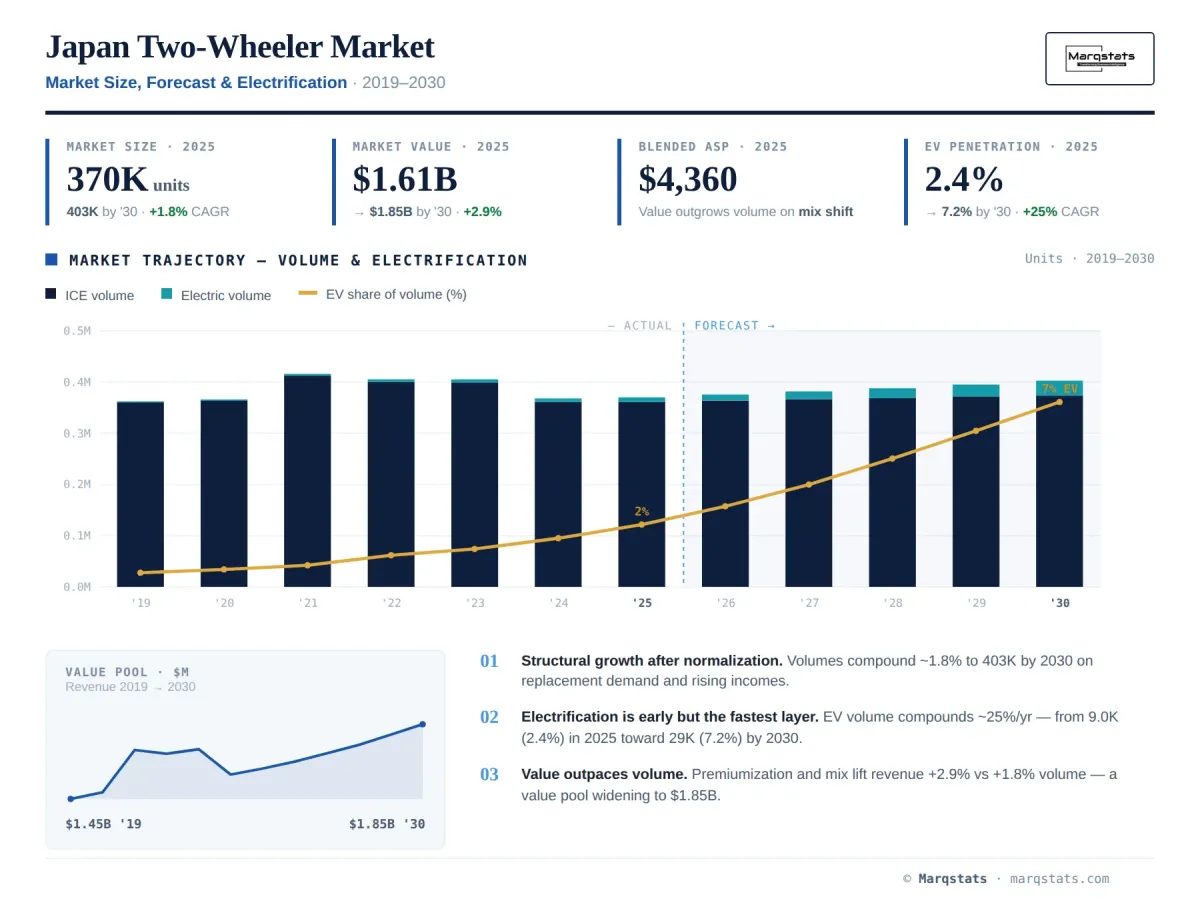
The Japan two-wheeler market reached 370,000 units in 2025 and is projected to reach 402,590 units by 2030, expanding at a 1.76% CAGR across the 2026–2030 forecast period; in value terms the market rises from USD 1.61 billion to USD 1.85 billion. Japan is a mature, premium, and highly concentrated market, the home base of the four global majors, Honda, Yamaha, Suzuki, and Kawasaki, whose products anchor a market that has shrunk from its 1980s peak yet stabilised around leisure, commuting, and a high-value big-bike segment.
Demand is overwhelmingly private and increasingly premium. Motorcycles and scooters sit at near parity by volume, while large-displacement machines above 350cc form the single largest revenue band, reflecting the importance of enthusiast and leisure riders. Honda dominates with about 54% of unit sales, ahead of Yamaha, and the four domestic majors together hold more than 90% of the market, one of the highest concentrations in the world.
Two forces are reshaping the market. Tightened emissions regulations effective November 2025 have ended production of the iconic sub-50cc moped class, shifting the entry segment toward power-restricted 125cc models and electric alternatives, while electric two-wheelers, though only about 2.4% of volume, grow fast on the strength of swappable-battery standardisation. Growth is driven by premiumisation and electrification, tempered by an aging population and long-term demographic decline, producing a small, stable, high-value market rather than a growth market.
Key Takeaways
Market Overview & Analysis
Report Summary
The Japan two-wheeler market comprises motorcycles, scooters, and mopeds sold for personal and commercial use across internal combustion and electric propulsion. This study segments demand by vehicle type, propulsion type, engine displacement and motor power, price band, end user, sales channel, and brand, with a 2025 base year, historical coverage from 2021 to 2025, and forecasts to 2030. The market is high-value and mature, defined by premium and leisure demand rather than the mass commuting that characterises emerging Asian markets.
Japan's two-wheeler industry is a shadow of its 1980s scale, when annual shipments approached three million units, yet it remains globally significant as the base of the four majors. Most motorcycles produced in Japan are now exported, chiefly larger machines destined for Europe and North America, while domestic demand has settled at a few hundred thousand units per year. The Japan Automobile Manufacturers Association reports a market that is broadly flat, with premium and big-bike demand offsetting decline in the smallest displacement classes.
Supply is dominated by domestic manufacturers. Honda leads decisively, followed by Yamaha and Kawasaki, while Suzuki has retreated from parts of the domestic range. European premium marques including BMW Motorrad, KTM, Ducati, and Triumph, along with Harley-Davidson and Royal Enfield, compete in the large-displacement and enthusiast segments, where imports are gaining share. Electric two-wheelers remain nascent, contested by the domestic majors and specialist electric brands, and shaped by standardisation efforts rather than large purchase subsidies.
The market's structure reflects decades of transformation. At the 1980s peak, Japanese makers shipped well over two million small mopeds a year for everyday commuting, yet the decline of the smallest displacement classes, the rise of cars, public transport, and electric bicycles, and an aging population have reshaped demand toward higher-value machines. Today the market bifurcates between a shrinking, price-sensitive entry tier and a resilient premium and big-bike segment sustained by enthusiasts and returning riders. This shift means that even as unit volumes have stabilised at a fraction of historic levels, average selling prices and total value have held up, giving Japan a small yet high-value profile distinct from the mass-market dynamics of emerging Asia.
Market Dynamics
Key Drivers
- Growth is driven by premiumisation and the big-bike segment, as affluent and returning riders sustain demand for large-displacement leisure and touring motorcycles.
- The retro and enthusiast trend supports value, with modern-classic models such as the Kawasaki Z900RS and Honda CB1000F drawing committed buyers.
- The delivery and gig economy expands commercial demand, with food-delivery services sustaining fleet and delivery two-wheeler use that grows faster than private ownership.
- Electrification and swappable-battery standardisation open a new segment, supported by cooperation among the domestic majors and energy partners.
Key Restraints
- An aging population and long-term demographic decline constrain the rider base, limiting structural demand growth across the market.
- The end of the sub-50cc class under November 2025 emissions rules removes a historic entry point, disrupting the smallest and most affordable segment.
- Competition from cars, public transport, and electric bicycles reduces reliance on small two-wheelers for everyday urban mobility.
Key Trends
- Electrification advances from a small base, guided by swappable-battery standardisation; the Thailand electric two-wheeler market offers a regional comparison for swap-based adoption.
- The entry segment is being reclassified, as power-restricted 125cc models rideable on a car licence replace the discontinued 50cc class.
- Imported premium brands gain share, with BMW Motorrad and others expanding in the large-displacement segment alongside the domestic majors.
- Online research and sales grow steadily, with the digital channel expanding at an 11% CAGR from a modest base.
Market Segmentation
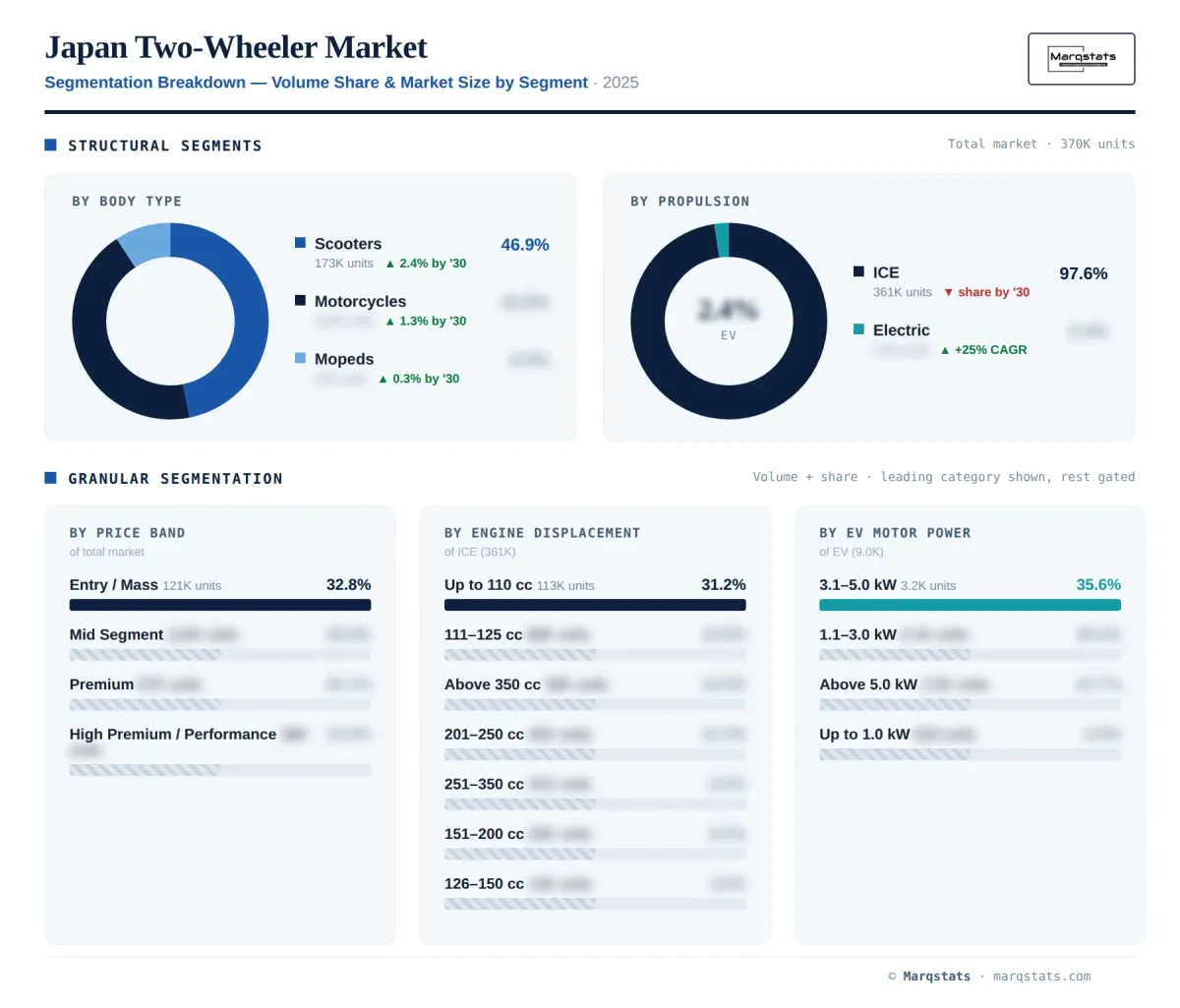
Scooters account for about 173,000 units in 2025, roughly 47% of volume, the largest vehicle type, growing at a 2.43% CAGR. Automatic scooters serve urban commuting and delivery, and they host most electric two-wheeler models. The segment's stability reflects the practical role of scooters in dense Japanese cities, even as the smallest 50cc variants exit the market. Mid-displacement automatic scooters and premium maxi-scooters are expected to absorb much of the demand displaced from the discontinued 50cc class, supporting the category through the entry-segment transition.
Conventional motorcycles account for about 162,000 units in 2025, roughly 44% of volume, growing at a 1.32% CAGR. This segment spans commuter machines and the premium, large-displacement models that define Japan's enthusiast market, and its value grows faster than its units as demand shifts toward higher-displacement leisure and touring motorcycles. Large-displacement machines above 350cc, though a minority of units, generate the single largest share of revenue, underscoring how the motorcycle category has evolved from mass transport toward high-value leisure and lifestyle riding.
Mopeds account for about 34,000 units in 2025, a small and stable share, though the category faces structural change as the sub-50cc class is discontinued and buyers move to power-restricted 125cc models and electric alternatives. The 50cc “gentsuki” moped, long valued because it can be ridden on an ordinary car licence, was unable to meet the tightened emissions standards cost-effectively, so production ended in late 2025. Its replacement, a 125cc class electronically restricted to comparable power and rideable under the same licence, together with lightweight electric models, is expected to preserve the accessibility that made the 50cc so popular while resetting the segment's technology and cost base.
Combustion models hold about 97.6% of 2025 volume, roughly 361,000 units, growing at close to a 1% CAGR. Combustion remains dominant across commuter and premium classes, supported by the majors' deep model ranges and by enthusiast demand for large-displacement machines, now built to EURO 5-equivalent standards with on-board diagnostics. The tightened emissions and diagnostics requirements raise development costs for smaller engines in particular, accelerating the shift away from the least powerful combustion models toward higher-displacement machines and electric alternatives.
Electric two-wheelers hold about 2.4% of 2025 volume, roughly 9,000 units, growing at a 25.26% CAGR to reach about 29,000 units by 2030. Adoption is early, concentrated in light electric models and delivery use, and supported by swappable-battery standardisation among the domestic majors. Growth is rapid in percentage terms yet small in absolute units, reflecting the market's maturity and the strength of established combustion demand.
A distinctive feature of Japan's transition is cooperation rather than competition on infrastructure. Honda, Yamaha, Suzuki, and Kawasaki, together with an energy partner, established a shared venture to standardise swappable batteries for electric two-wheelers, aiming to lower cost and range barriers through common, interchangeable packs. Combined with dedicated delivery-oriented electric models and lightweight replacements for the 50cc class, this positions the electric segment to grow steadily from its small base, though the pace will depend on model availability, pricing, and the speed at which swap infrastructure scales beyond early urban deployments.
The entry and mass band is the largest by volume at about 121,000 units in 2025, roughly 33%, though broadly flat, while the mid segment holds about 114,000 units and grows at 2.4%. The entry segment faces the greatest disruption from the 50cc phase-out, which is expected to reshape its composition over the forecast period. As buyers migrate from discontinued 50cc models to power-restricted 125cc machines and lightweight electric alternatives, the segment's average price is likely to rise, and its long-term size will depend on whether the reclassified entry class can retain the affordability and licence-free accessibility that sustained the original moped category.
Premium and high-premium performance bands together account for over a third of volume and the majority of market value. The high-premium and performance band, though about 10% of units, contributes more than a quarter of revenue on the strength of large-displacement machines, and premium demand grows steadily as enthusiast and returning riders drive the market upmarket. The retro and modern-classic trend is central to this segment, with models such as the Kawasaki Z900RS and the new Honda CB1000F drawing affluent, often older riders, while imported marques compete for the same high-value buyers, reinforcing the market's premium character and its resilience against declining entry-level volumes.
Private consumers account for about 93% of 2025 volume, an unusually high share reflecting Japan's leisure and commuter-led demand. Ownership is a considered purchase weighted toward enthusiasts, returning riders, and urban commuters rather than mass first-time buyers. The prominence of the “return rider”, an older consumer resuming motorcycling as a leisure pursuit, is a defining feature of the private segment and a key support for premium and big-bike demand, distinguishing Japan from markets where two-wheelers are primarily utilitarian.
Commercial demand is smaller yet growing. Delivery and logistics expands at a 6.4% CAGR as food-delivery services scale, and this segment is an early adopter of electric two-wheelers, since Honda and others target delivery use with dedicated electric models such as the Benly e: and Gyro e:. The predictable routes and high daily mileage of delivery work suit electric powertrains and battery swapping, making the commercial segment a likely early proving ground for electrification ahead of the private market.
Physical dealerships dominate, handling the large majority of sales and providing the service, financing, and community that premium and enthusiast buyers value. Established dealer networks remain central to the market's high-value character.
The online channel grows fastest at an 11% CAGR from a modest base, as buyers research models, compare specifications, and increasingly transact digitally. Online activity complements the dealer network, particularly for accessories, used machines, and pre-purchase research. Even so, the offline dealer relationship remains central to Japan's premium and enthusiast market, where test rides, servicing, and brand community continue to anchor high-value purchases.
By Geography
Greater Tokyo & Kanto
The Greater Tokyo area and the wider Kanto region form the largest market, combining dense urban commuting, a substantial delivery economy, and a concentration of premium and enthusiast buyers. The region leads early electric adoption and hosts the densest dealer and service networks. Its scale, affluence, and traffic conditions make it the primary market for both practical commuter scooters and high-value leisure motorcycles, and it is where swappable-battery infrastructure and delivery-fleet electrification are first concentrated.
Kansai & Western Japan
The Kansai region, centred on Osaka, Kyoto, and Kobe, sustains strong commuter and enthusiast demand, supported by major urban populations and proximity to manufacturing bases. Premium and scooter demand is well established across the region's cities. Kansai's dense urban fabric and active riding culture make it a significant secondary market for both practical scooters and large-displacement leisure machines, complementing the demand concentrated in Greater Tokyo.
Regional & Rural Japan
Beyond the major metropolitan areas, two-wheelers serve practical mobility needs in regional cities and rural areas, where scooters and small motorcycles remain useful for commuting and errands. Demographic decline weighs most heavily on these markets, tempering demand over the forecast period. In aging rural communities, the affordability and licence accessibility of small two-wheelers matter most, making these areas the most exposed to the disruption caused by the 50cc phase-out and the most dependent on affordable replacement models.
Japan in the Global Motorcycle Industry
Japan's significance extends well beyond its domestic market. As the home of Honda, Yamaha, Suzuki, and Kawasaki, the country anchors global two-wheeler design, engineering, and premium production, exporting most of its domestically built machines, chiefly large-displacement models, to Europe and North America. Domestic production today is a fraction of the industry's historic scale, with much manufacturing relocated to Southeast Asia and other regions, yet Japan retains the research, high-performance engineering, and brand equity that shape the global premium segment, making the domestic market a strategic showcase and testing ground rather than a volume centre.
How Competition Is Evolving
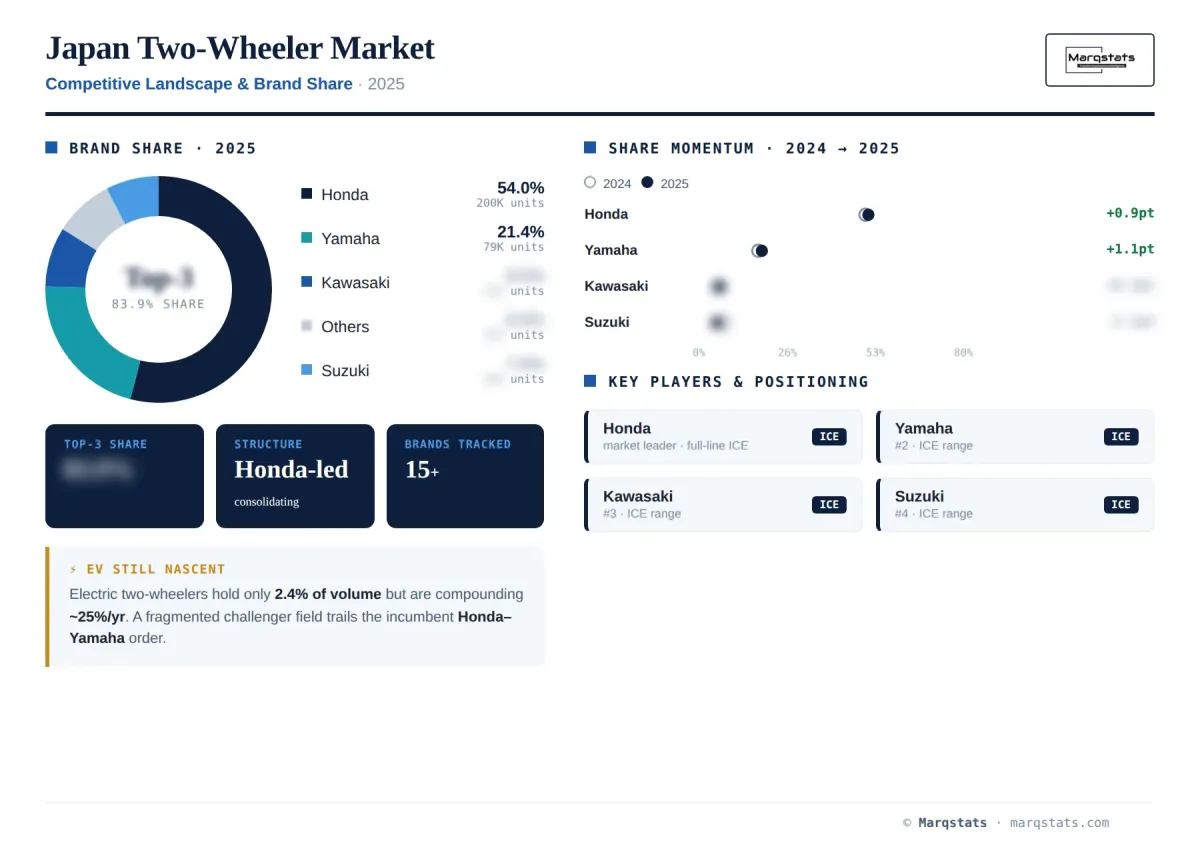
The Japan two-wheeler market is highly concentrated around its four domestic majors. Honda leads with about 54% of 2025 unit sales, a dominant position spanning commuter, scooter, and premium ranges, followed by Yamaha at roughly 21% and Kawasaki, which is strong in large-displacement machines. Suzuki has retreated from parts of the domestic range, and together the four majors hold more than 90% of the market, reflecting their status as global manufacturers competing on home ground. This concentration is unusual among major markets and stems from the majors' century of heritage, unrivalled dealer and service networks, and the trust of a discerning domestic rider base.
Competition at the premium end is intensifying. European marques including BMW Motorrad, KTM, Ducati, and Triumph, along with Harley-Davidson and Royal Enfield, compete in large-displacement and enthusiast segments, and imported brands are gaining share as the market premiumises. In electric two-wheelers, the domestic majors cooperate on swappable-battery standardisation through a shared venture with energy partners, while specialist electric brands and delivery-focused models add competition at the emerging edge of the market.
Competition centres on brand, model range, dealer network, and technology rather than price. Growth is attributed to manufacturers that combine strong premium and big-bike portfolios with credible electric strategies, moreover rewarding those that adapt fastest to the 50cc phase-out and the reclassified entry segment. The majors' scale, heritage, and service networks sustain their dominance, even as imports and electrification gradually diversify the competitive field.
Companies Covered
Companies covered in the report include:
Recent Market Activity
Table of Contents
Coverage & Segmentation
This report provides a comprehensive assessment of the Japan two-wheeler market across a 2025 base year, historical data from 2021 to 2025, and forecasts spanning 2026 to 2030. Market sizing is presented in unit-volume terms and complemented by value analysis in United States dollars, with segmentation by vehicle type, propulsion type, engine displacement and motor power, price band, end user, sales channel, and brand. Brand-level shares, segment growth rates, and competitive positioning are quantified to support commercial and investment decisions in a mature, high-value market.
The scope covers demand drivers, restraints, and structural trends, with particular focus on premiumisation and the big-bike segment, the phase-out of the 50cc class, the reclassified entry segment, and the early electrification transition. Competitive analysis quantifies brand shares and profiles domestic majors, importers, and electric entrants, while segment forecasts identify where the market's limited volume and value growth concentrate through 2030. An extended forecast to 2035 is available under customization for subscribers requiring a longer planning horizon, alongside deeper cuts by segment, brand, or channel on request.