Market Snapshot
Middle bar: base-year value × (1 + CAGR), rounded to two decimals. This is a calculated illustration, not a separately researched annual estimate.
Market Size (2025, Base Year): USD 3,052.35 Million (Transaction Price Realisation)
Estimated Value (2026): USD 3,191.53 Million
Forecast Value (2030): USD 3,917.69 Million
CAGR: 5.12% | Forecast Period: 2026 – 2030
Growth — Absolute: USD 865.34 Million
Physical Volume: 513.00 Million Litres (2025) to 604.06 Million Litres (2030), Volume CAGR 3.32%
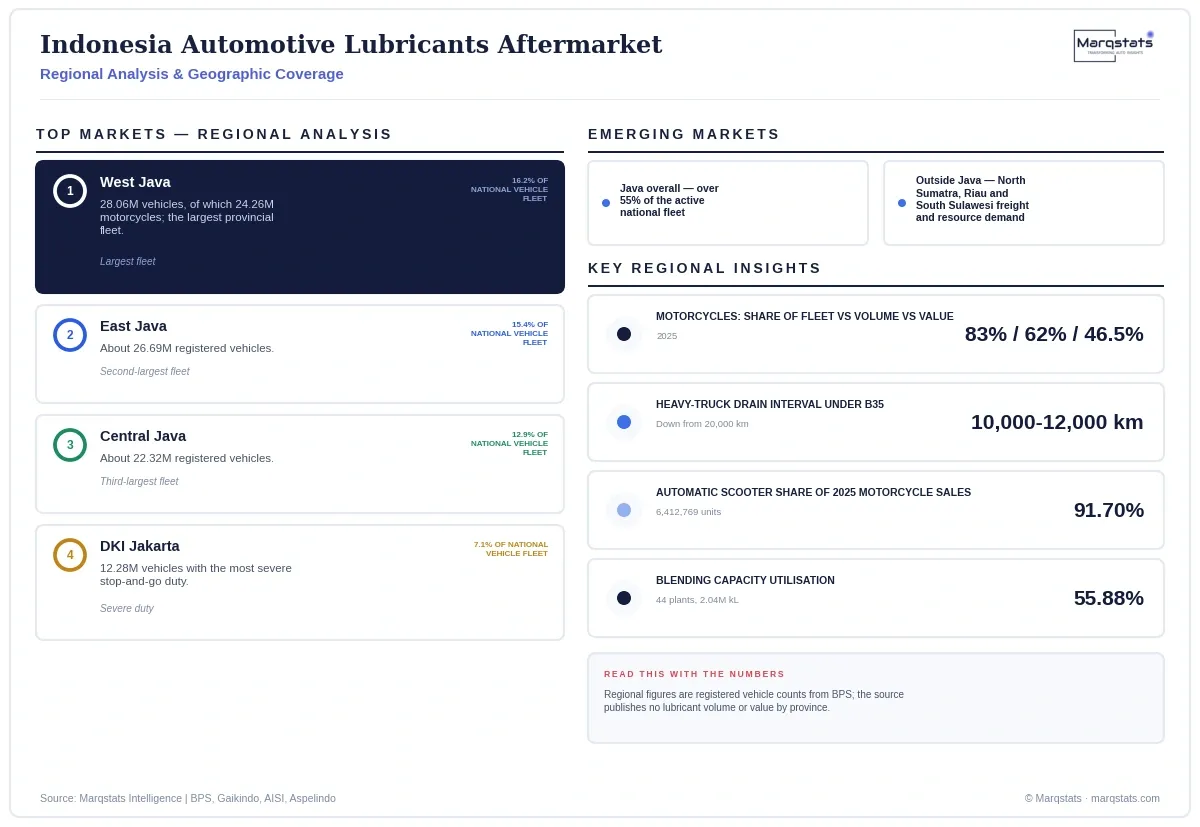
Largest Market: West Java (16.2% of national vehicle fleet)
Fastest Growing: Full Synthetic Oils (14.00% to 22.00% share, 2025-2030)
Dominant Segment: Two-Wheelers (62.00% of 2025 volume)
Market Concentration: Moderately Concentrated (Top Three About 66% of National Volume)
Base Year: 2025 | Historical Period: 2021 – 2025 | Forecast Period: 2026 – 2030
Units Considered: Value (USD Million) and Volume (Million Litres)
Segments Covered: 4 | Regions Covered: 4 | Companies Profiled: 14
Report Pages: 175 | Deliverables: PDF, Excel, PPT
Key Takeaways
Market Overview & Analysis
Report Summary
Indonesia's lubricants aftermarket is the largest in Southeast Asia and it is built on two-wheelers. Motorcycles carry most of the volume, cars and trucks carry most of the value, and the mix is moving toward semi-synthetic and full-synthetic oil while a fuel policy quietly raises how much oil heavy trucks buy.
The analysis measures the value of engine oils, transmission and driveline fluids, greases and functional fluids bought for on-road vehicles after factory delivery: USD 3,052.35 million in 2025, at transaction price realisation in workshops and retail. It excludes industrial, mining, marine and power-generation lubricants, which take 55% of national finished-lubricant demand.
The analysis is written for four readers: a blender weighing capacity in a market running at 55.88% utilisation, a fleet operator budgeting heavy-duty oil under B35 and B40 fuel, a workshop-network owner deciding how to win mechanic loyalty, and an investor tracking three very different 2030 outcomes.
A Fuel Policy That Raises Oil Demand
Most markets in this coverage set describe regulation as a force that cuts oil consumption. Indonesia's biodiesel mandate does the opposite for heavy trucks.
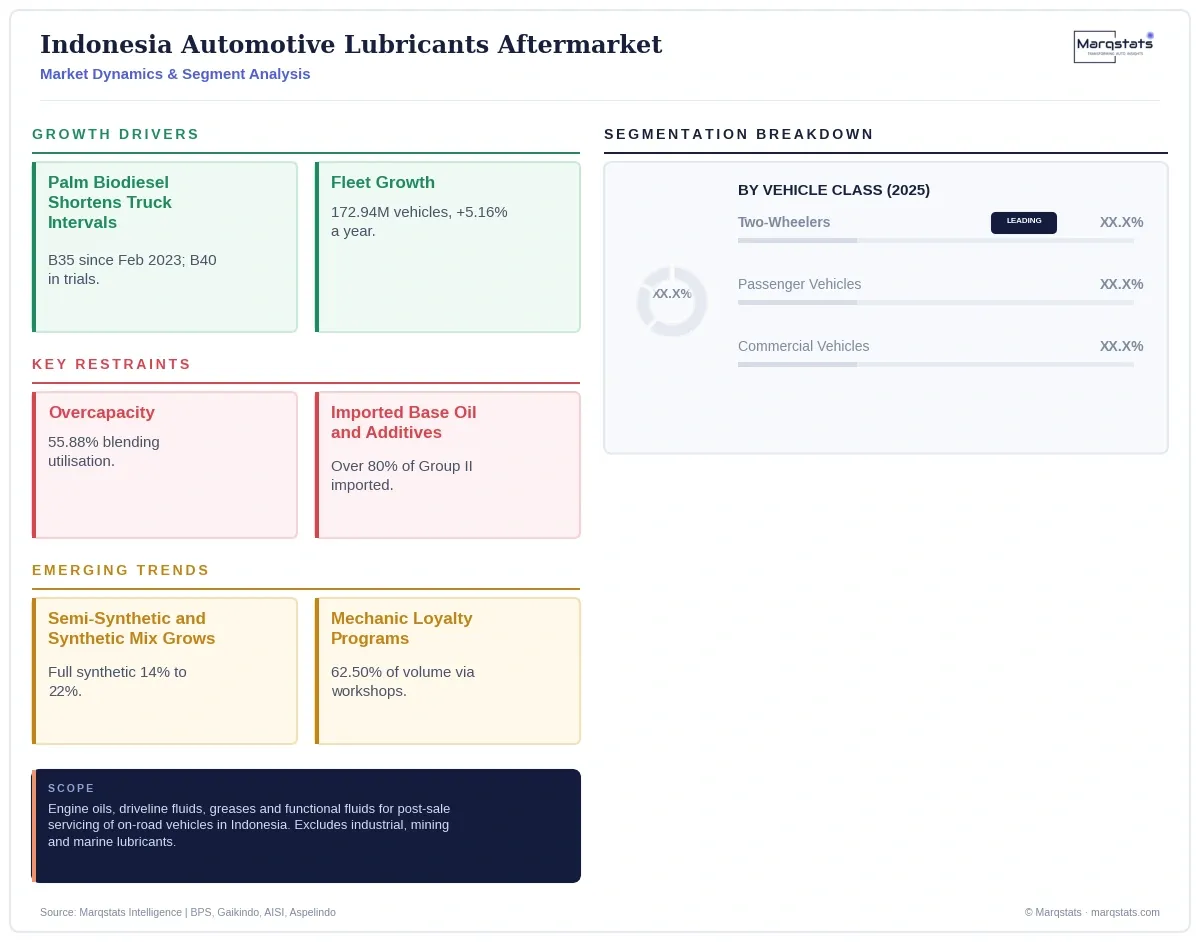
The government raised the palm methyl ester content of diesel from 30% to 35% (B35) in February 2023, and technical trials of B40 have run through 2025 and 2026. The research explains why this matters for the crankcase. Palm ester boils at 330 to 360 degrees Celsius, higher than petroleum diesel, so fuel that slips past the piston rings does not evaporate out of the sump. Fuel dilution passes 5% to 7%. The unsaturated fatty acids polymerise, the oil thickens and forms sludge, and the ester attracts water and oxidises into acids that use up the oil's alkaline reserve faster than petrodiesel does. Fleet operators running heavy trucks have shortened drain intervals from 20,000 km to 10,000 to 12,000 km. The pack's drain table puts severe-duty heavy trucks at 3.5 to 5.0 services a year and 75 to 120 litres a unit, against 18 to 24 litres for a light commercial diesel.
Two-Wheelers Carry the Litres, Cars Carry the Value
The fleet is dominated by motorcycles. The money is not.
Motorcycles are 143.54 million of the 172.94 million registered vehicles, 83.00%, and use 318.06 million litres, 62.00% of volume. They earn USD 1,419.34 million, 46.50% of value, because their oil is cheap, about USD 4.46 a litre on Marqstats arithmetic. Passenger cars, 20.23 million and 11.70% of the fleet, take larger sumps of 3.5 to 4.5 litres and more semi-synthetic and full-synthetic oil. They use 110.30 million litres, 21.50%, and earn USD 992.01 million, 32.50%, about USD 8.99 a litre. Commercial vehicles use 16.50% of volume and earn 21.00%, about USD 7.57 a litre.
The Scooter Effect on Oil Chemistry
Scooters changed the product. They did more than add volume.
Automatic scooters were 91.70% of the 6,412,769 motorcycles sold in 2025, up from 90.39% a year earlier. Their continuously variable transmissions use dry clutches, so they need JASO MB oils, low-friction and typically SAE 10W-30 or 10W-40, rather than the JASO MA or MA2 oils used in wet-clutch manual bikes. They also need a separate rear reduction gear oil, sold in 120-millilitre tubes. Severe stop-and-go traffic, heat of 30 to 35 degrees and dust push real drain intervals to 2,000 to 3,000 km, or every one and a half to two and a half months, against 4,000 to 6,000 km recommended.
A Protected Market With Too Much Capacity
Indonesia has a tough entry regime and a crowded supply side.
Every automotive lubricant sold must carry the SNI mark under the seven-part SNI 7069 series, after audits by accredited certification bodies and laboratory tests at LEMIGAS, and a registered lubricant number from the oil and gas directorate. Certification costs IDR 25 to 30 million per formulation variant. Even so, 44 licensed blending plants have 2.04 million kilolitres of capacity against 1.14 million kilolitres of national demand, a 55.88% utilisation. The barrier keeps out uncertified imports, but it has not prevented overcapacity or fierce rivalry among Pertamina, Shell, ExxonMobil and independents.
Where the Base Oil Comes From
Modern base oil is the structural gap.
Pertamina's Cilacap refinery makes Group I base oils, 400,000 to 450,000 kilolitres a year, enough for mineral formulations. Indonesia has no commercial-scale Group II refining, so blenders import more than 80% of their Group II from Singapore, South Korea and Taiwan. The Dumai plant of Patra SK makes Group III, but it is export-oriented and much of its output is shipped abroad, so independents re-import it. All additive packages are imported from four global suppliers, so margins move with the rupiah and ocean freight.
What the Evidence Does and Does Not Show
The headline chain is transparent, but the source has gaps.
The source's tables lost their 2030 columns, so 2030 splits by vehicle class, product and channel are not published. The national bus count of 2.94 million is inconsistent with the 36,679 buses reported for West Java, and it is not used. The registered motorcycle count implies only 2.22 litres a year per unit, against 3.5 to 5.0 litres for active bikes, so registered vehicles overstate active ones. Brand shares are shares of total national volume, not of the aftermarket, and their aftermarket equivalents are not confirmed. None of this changes the direction of the trends. It does limit how precisely the mix can be read.
Why Workshops, Not Brands, Decide What Goes in the Engine
The person who chooses the oil is usually the mechanic.
More than 92.00% of automotive oil is installed by a professional, and independent workshops and roadside garages, about 250,000 of them, handle 62.50% of volume. Mechanics therefore steer what the customer buys, and blenders compete for their loyalty with QR-code cap rewards, workshop incentive programs and shelf placement. Dealers keep vehicles only while they are under warranty and use OEM-branded genuine oils tolled by licensed blenders such as Idemitsu, Pertamina, Eneos and Shell, and once the warranty ends an estimated 60% of car owners and 85% of motorcycle owners move to independent workshops. The channel that grows as the fleet ages is therefore the one where a bottle's brand is chosen by the person holding it.
Compliance Is a Cost, and a Wall
Getting a product onto the shelf in Indonesia takes two separate approvals.
The first is the SNI mark. Under the Ministry of Industry regulation of 2018 and its amendments, seven categories of automotive lubricant, from four-stroke petrol car and motorcycle oils to high-speed diesel, manual gear and automatic transmission fluids, must pass tests for viscosity, shear stability, clutch friction and base number, and each container must carry the mark. The second is the registered lubricant number from the oil and gas directorate, which needs a verified laboratory analysis. Certification costs IDR 25 to 30 million per formulation variant, so a brand with many grades pays many times. The rules apply equally to imports.
Where the Downside and the Upside Differ
The three scenarios are not the same story told at three speeds.
The Downside keeps mineral oil at 38.00% of volume and two-wheelers at 64.50%, because slow fleet turnover and high interest rates leave owners on cheap commuter bikes and old engines. The Upside cuts mineral oil to 24.00%, lifts full synthetic to 28.00% and cuts two-wheelers to 58.50%, because faster four-wheel and delivery growth adds cars and trucks, while mandatory B40 shortens drain intervals. Price moves from USD 6.07 to USD 6.66 a litre. The spread between USD 3,450.00 million and USD 4,250.00 million is USD 800.00 million, close to the Base Case's entire five-year value gain of USD 865.34 million, so the choice of scenario matters as much as the trend itself.
Market Dynamics
Key Drivers
- The registered fleet grew at 5.16% a year from 2020 to 2024 to reach 172.94 million vehicles in 2025, expanding the base of vehicles that need recurring oil changes.
- Severe operating conditions, 30 to 35 degrees, humidity, dust and stop-and-go traffic, push real drain intervals well below manufacturer recommendations.
- Palm biodiesel at B35, and B40 trials, shorten heavy-truck drain intervals from 20,000 km to 10,000 to 12,000 km.
- Premiumisation: semi-synthetic oil reaches 48.00% of volume and full synthetic 22.00% by 2030, lifting the blended price from USD 5.95 to USD 6.49 per litre.
- Wholesale car sales are recovering: 599,491 units through August 2026, up 20.1%, toward the 850,000-unit target for the year.
Key Restraints
- Synthetic oils extend drain intervals, which lowers the number of oil changes per vehicle and moderates volume growth.
- Car sales fell 7.20% in 2025 to 803,687 units on high interest rates and tighter credit, and the Downside case assumes they stay below 900,000 a year.
- Base oil, especially Group II and Group III, is largely imported, and additive packages are entirely imported, so blenders' margins swing with the rupiah and freight.
- Overcapacity, 55.88% utilisation across 44 plants, holds down prices and intensifies rivalry, and battery electric vehicles, under 4% of 2025 car sales, add a slow long-term drag.
Key Trends
- Quick-service and forecourt chains are growing in larger cities, holding 12.00% of volume; Pertamina runs over 2,000 Olimart and Enduro Express outlets.
- Blenders compete for mechanic loyalty with QR-code cap rewards, workshop incentive programs and digital supply platforms, since mechanics decide most purchases.
- Demand is shifting to low-viscosity hybrid oils, 0W-16 and 0W-20 to API SP and ILSAC GF-6B, and to dielectric fluids for electric drive units.
- Manufacturers are localising higher-value products: Shell opened a 12-kiloton grease plant at Marunda in September 2026, and Castrol launched a hybrid-oriented MAGNATEC in 2025.
Strategic Implications
- New entrants should avoid commodity mineral oil and the cost of a greenfield plant. Niches include contract blending of dielectric fluids for electric vehicles, high-TBN heavy-duty oils for B40 fleets, and imported premium scooter oils sold online and through quick-lube chains.
- Incumbents should protect workshop loyalty with digital supply, verified warranty programs and mechanic rewards, and should manage rupiah risk with indexed pricing and selective domestic sourcing such as Patra SK Group III.
- Base oil and additive suppliers should focus on Group II and III stocks and on detergency packages that prevent palm-ester oil polymerisation, water uptake and rapid TBN loss.
- Fleet operators should plan for 10,000 to 12,000 km drain intervals under B35, test oil condition regularly, and choose high-TBN heavy-duty grades before B40 arrives.
- Investors should watch the B40 enforcement decision, interest-rate direction and car wholesales, the triggers that separate the Downside, Base and Upside cases.
Outlook
The underlying research presents three scenarios tied to named macroeconomic and fuel-policy triggers. All three sets of volume and value CAGRs were recomputed and match.
Under the Base Case, interest rates stabilise, motorcycle deliveries hold at 6.5 to 6.7 million a year, B35 stays the commercial diesel standard with phased regional B40, and two-wheelers fall to 61.00% of volume. Mineral oil falls to 30.00%, semi-synthetic rises to 48.00% and full synthetic to 22.00%. Volume reaches 604.06 million litres, a 3.32% CAGR, and value reaches USD 3,917.69 million (IDR 63.47 trillion), a 5.12% CAGR, at USD 6.49 a litre.
Under the Downside, Bank Indonesia keeps interest rates high, wholesale car sales stay below 900,000 a year and the energy ministry delays full B40. Fleet turnover slows and mineral oil stays at 38.00% of volume. Volume reaches 568.12 million litres, a 2.06% CAGR, and value reaches USD 3,450.00 million, a 2.48% CAGR, at USD 6.07 a litre.
Under the Upside, GDP growth exceeds 5.5%, the energy ministry enforces B40 across all commercial transport and wholesale car sales pass 1.05 million a year. Severe B40 duty shortens commercial drain intervals and lifts throughput, and full synthetics reach 28.00% of volume while two-wheelers fall to 58.50%. Volume reaches 638.52 million litres, a 4.47% CAGR, and value reaches USD 4,250.00 million, a 6.84% CAGR, at USD 6.66 a litre.
Market Segmentation
318.06 million litres (62.00% of volume) and USD 1,419.34 million (46.50% of value) in 2025. About USD 4.46 a litre (Marqstats arithmetic); 2030 base share is 61.00% (scenario table).
110.30 million litres (21.50% of volume) and USD 992.01 million (32.50% of value) in 2025. About USD 8.99 a litre; larger sumps of 3.5 to 4.5 litres and more semi-synthetic and full-synthetic oil.
84.65 million litres (16.50% of volume) and USD 641.00 million (21.00% of value) in 2025. About USD 7.57 a litre; palm biodiesel shortens drain intervals to 10,000-12,000 km.
428.36 million litres (83.50% of volume) and USD 2,594.50 million (85.00% of value) in 2025. The core category, driven by JASO MB scooter oils and API SP passenger car oils.
64.13 million litres (12.50% of volume) and USD 366.28 million (12.00% of value) in 2025. Includes ATF and CVT fluids meeting Toyota WS, Nissan NS-3 and Honda HCF-2, and scooter gear oils.
20.52 million litres (4.00% of volume) and USD 91.57 million (3.00% of value) in 2025. Includes wheel bearing greases, brake fluids and coolants; Shell's Marunda grease plant adds 12 kilotons a year.
210.33 million litres (41.00% share) in 2025, moving to 181.22 million litres (30.00% share) by 2030. Declining as blenders reformulate for OEM oxidation and fuel-efficiency needs.
230.85 million litres (45.00% share) in 2025, moving to 289.95 million litres (48.00% share) by 2030. The main formulation across light passenger and two-wheeler fleets.
71.82 million litres (14.00% share) in 2025, moving to 132.89 million litres (22.00% share) by 2030. Reaches 34.20% of 2030 value, USD 1,339.85 million.
320.63 million litres (62.50% of volume) in 2025. About 250,000 shops that serve older cars, motorcycles and trucks; mechanics steer purchases.
100.04 million litres (19.50% of volume) in 2025. Honda AHASS and Toyota, Daihatsu, Isuzu networks under Astra and Indomobil use OEM-branded oils; about 60% of car owners and 85% of motorcycle owners leave after warranty.
61.56 million litres (12.00% of volume) in 2025. Pertamina Olimart and Enduro Express, Shell Helix bays, Castrol Auto Service and Astra Shop&Drive.
30.78 million litres (6.00% of volume) in 2025. Independent parts shops and flagship stores on Tokopedia, Shopee, Lazada and TikTok Shop.
By Geography
West Java
28,057,560 registered vehicles (16.2% of the national fleet): 24,260,590 motorcycles, 2,980,773 cars, 779,518 trucks and 36,679 buses. The largest provincial fleet. The source gives no lubricant volume by province.
East Java
About 26.69 million registered vehicles (15.4% of the national fleet), the second-largest provincial fleet.
Central Java
About 22.32 million registered vehicles (12.9% of the national fleet).
DKI Jakarta
12,279,058 registered vehicles (7.1% of the national fleet), with the country's most severe stop-and-go duty.
Java Overall
Java holds over 55% of the active national fleet per the source, so lubricant demand is concentrated in Greater Jakarta, Surabaya, Bandung and the other Java cities.
Outside Java
Demand centres outside Java are North Sumatra, Riau and South Sulawesi, where resource extraction, agricultural logistics and inter-city freight drive heavy-duty demand.
Regional Data Notes
The regional data is vehicle counts, not lubricant volume or value; no regional split of the 513.00 million litres is published, and none is estimated. The itemised Java provinces add to 51.7% of the fleet.
How Competition Is Evolving
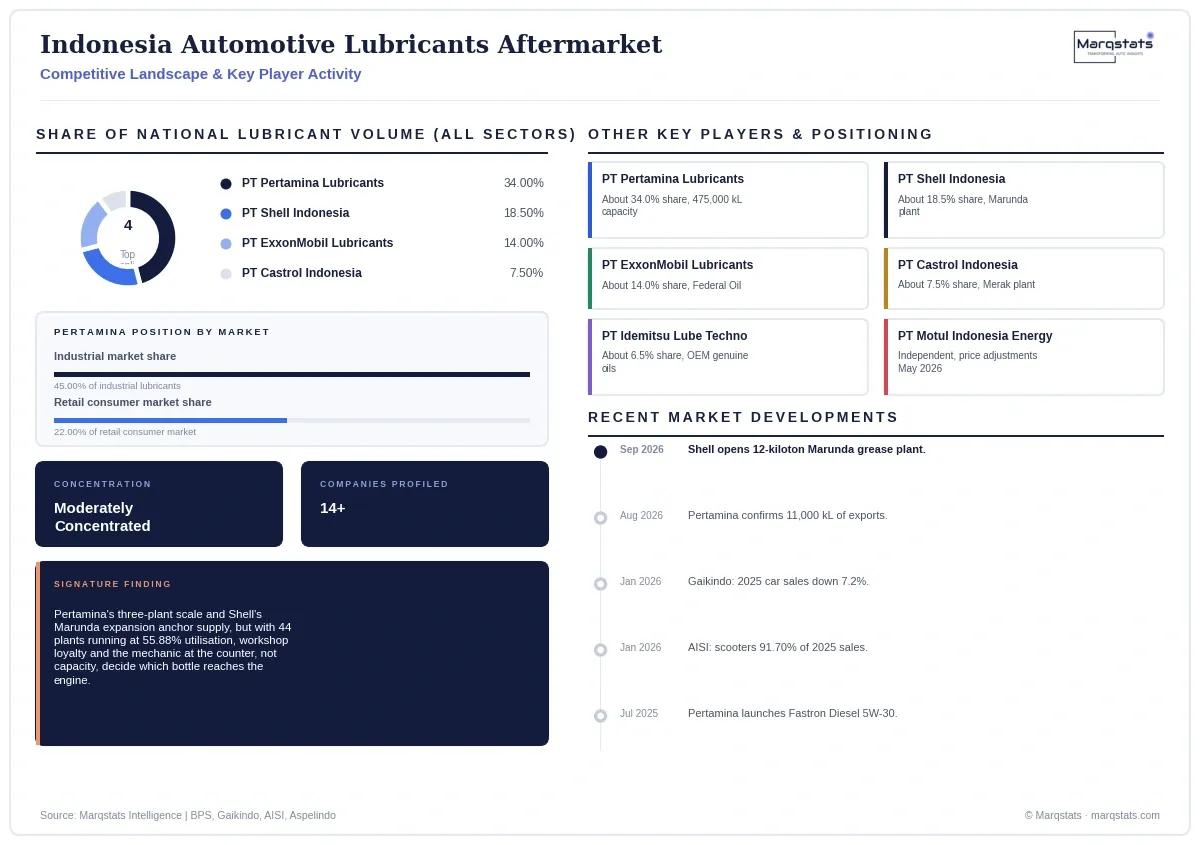
The source gives brand shares of TOTAL national lubricant volume (automotive and industrial, 1.14 million kilolitres), not of the automotive aftermarket. PT Pertamina Lubricants holds about 34.0%, Shell about 18.5%, ExxonMobil about 14.0%, Castrol about 7.5%, Idemitsu about 6.5% and other blenders about 19.5%. Pertamina alone holds 45.00% of the industrial market and 22.00% of the retail consumer market.
Pertamina has three blending complexes with 475,000 kilolitres of capacity, led by Tanjung Priok at 270,000, and sells Fastron, Enduro and Meditran. Shell's Marunda plant has 300,000 kilolitres of capacity after a 2022 expansion and added a 12-kiloton grease plant in September 2026. ExxonMobil blends 100,000 kilolitres at Cilegon and owns the Federal Oil motorcycle brand. Castrol blends about 90,000 kilolitres at Merak, and Idemitsu, the main blender of OEM genuine oils, has 115,000 kilolitres across Karawang and Cikarang.
The 44-plant industry has 2.04 million kilolitres of capacity against 1.14 million kilolitres of demand. Competition therefore centres on workshop loyalty, OEM genuine-oil tolling contracts and quick-service networks rather than on capacity, and independents such as Eneos, Motul, Repsol and Evalube hold the remaining 19.5%.
Companies Covered
Companies covered in the report include:
Recent Market Activity
Table of Contents
Coverage & Segmentation
The analysis measures engine oils, transmission and driveline fluids, greases and functional fluids bought after factory delivery for motorcycles, cars, trucks and buses in Indonesia, for a 2025 base year and a 2026 to 2030 forecast, in United States dollars at 16,200 rupiah per dollar. Values are transaction price realisation at workshop and retail level. Industrial, mining, marine and power-generation lubricants are excluded.
The analysis covers four segmentation dimensions, vehicle class, product category, formulation and channel, provincial fleet data and 14 profiled entities. Volumes and values partition to the national totals in 2025. Where 2030 splits are not published they are not estimated.