Market Snapshot
Middle bar: base-year value × (1 + CAGR), rounded to two decimals. This is a calculated illustration, not a separately researched annual estimate.
Market Size (2025, Base Year): USD 32.13 Million
Estimated Value (2026): USD 54.60 Million
Forecast Value (2030): USD 388.75 Million
CAGR: 64.65% | Forecast Period: 2026 – 2030
Growth — Absolute: USD 356.62 Million
Largest Market: Greater Jakarta (62.5% of 2025 maintenance spend)
Fastest Growing: Independent Aftermarket (16.50% to 34.00% share, 2025-2030)
Dominant Segment: Authorized OEM Dealerships (83.50% channel share, 2025)
Market Concentration: Moderately Fragmented
Base Year: 2025 | Historical Period: 2021 – 2025 | Forecast Period: 2026 – 2030
Units Considered: Value (USD Million)
Segments Covered: 3 | Regions Covered: 5 | Companies Profiled: 14
Report Pages: 240 | Deliverables: PDF, Excel, PPT
Key Takeaways
Market Overview & Analysis
Report Summary
This analysis reads Indonesia's own fully worked sizing chain, regional distribution data, and named-scenario regulatory framework together as a single coherent picture rather than isolated data points, since the underlying research itself was structured to support exactly that kind of integrated reading.
Indonesia's EV maintenance market is measured across scheduled periodic servicing, mechanical and braking work, and high-voltage battery systems, valued at USD 32.13 million (IDR 509.30 billion) in 2025. This figure is taken directly from the underlying research's own fully worked sizing chain, anchored to Kemenhub registration data covering an active fleet of 342,118 units across two-wheeler, passenger, and commercial vehicle segments.
Structurally, this is a market shaped by a genuine volume-value decoupling in its largest segment -- electric two-wheelers, dominant by unit count, whose battery care has migrated substantially into swap-station infrastructure outside the conventional workshop economy -- layered on top of a conventional warranty-driven dealership-to-independent transition and a CKD localization mandate reshaping domestic supply chains.
The analysis is built for four reader types making different decisions: an independent workshop operator weighing SKKNI No. 163/2021 technician certification investment against the post-warranty passenger-car volume wave, a battery-swap infrastructure operator scaling depot capacity, an authorized dealer group defending warranty-anchored revenue, and an investor tracking how CKD localization pace and open-access diagnostic policy shape this market's scenario range.
A Fleet Where the Biggest Segment's Real Maintenance Economy Is Invisible
Most EV maintenance markets measure workshop billing data and call it complete. Indonesia's own fleet composition shows exactly why that measurement misses a meaningful share of the real economy, and it's worth tracing through the mechanism.
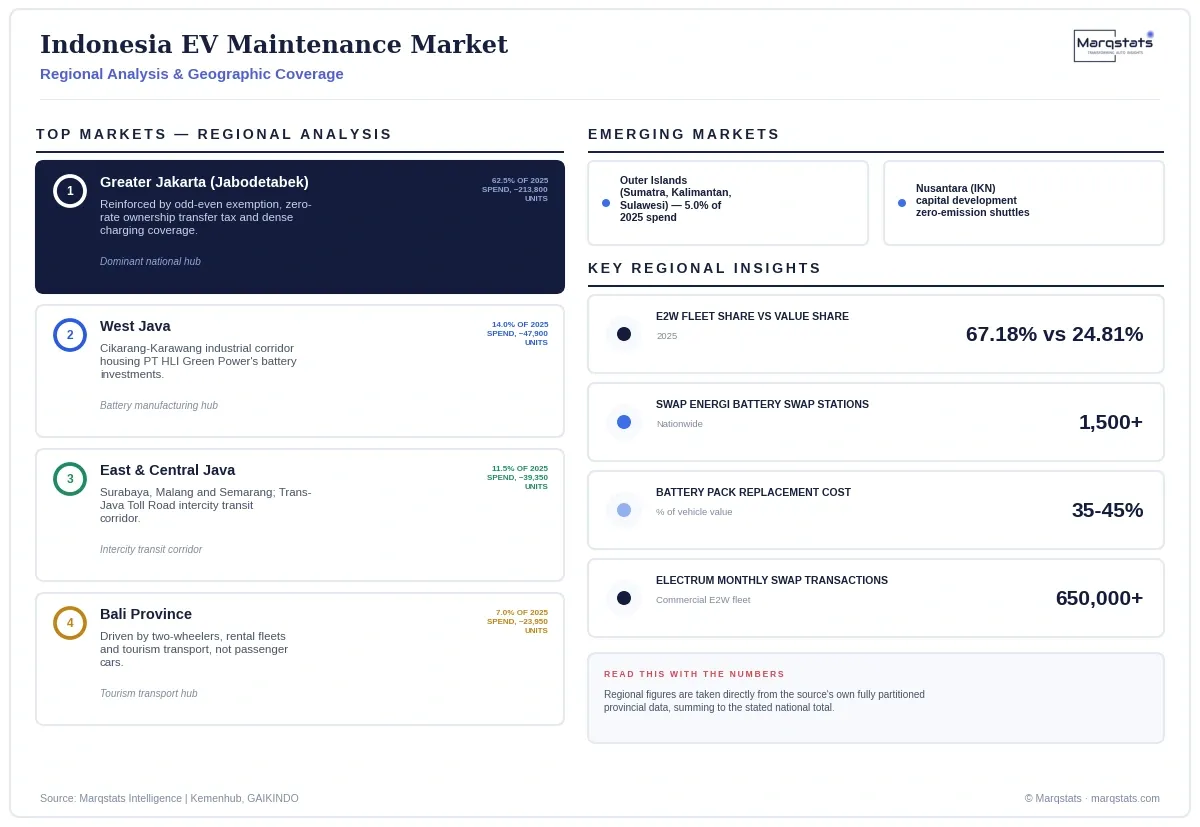
Electric two-wheelers make up 67.18% of Indonesia's entire EV fleet by unit count -- nearly seven in ten electrified vehicles on Indonesian roads -- yet generate just 24.81% of this market's 2025 maintenance value. Part of that gap is the usual story: smaller vehicles need simpler service. But for the meaningful share of that two-wheeler fleet running on swappable battery platforms, the single highest-value maintenance task a battery ever requires -- health monitoring, cell balancing, degradation management -- doesn't happen at a conventional repair workshop at all. It happens automatically every time a rider swaps a depleted pack for a charged one at one of PT SWAP Energi Indonesia's 1,500-plus stations or an Electrum depot processing over 650,000 monthly swap transactions. That battery-care economy has moved almost entirely outside the vehicle-owner-pays-workshop model this analysis measures, meaning the true scale of Indonesia's EV battery-care economy is larger than this market's own headline figure suggests.
Why a Single Component Carries Nearly Half a Vehicle's Value in Risk
Routine BEV maintenance in Indonesia costs a fraction of ICE servicing. That headline savings story obscures a very different risk sitting underneath it, and it's worth being precise about the scale.
Complete out-of-warranty replacement of a 30 to 60 kWh traction battery pack costs IDR 75,000,000 to IDR 120,000,000 -- 35% to 45% of the vehicle's initial retail value. That's not a routine maintenance line item; it's a low-probability, high-severity risk concentrated in a single component, one that factory warranties spanning 8 years and 160,000 kilometers exist specifically to manage. Once those warranties expire on the 2022-2025 registration cohort, this single risk category becomes the central question shaping independent workshop viability, secondary market vehicle values, and consumer willingness to keep an aging EV on the road.
Market Dynamics
Key Drivers
- Chinese manufacturers' lifetime warranty offerings on core electric powertrain assemblies for first individual retail owners are directly deepening customer retention within authorized dealership networks, reinforcing the channel-share dynamics this market's own scenario framework tracks through 2030.
- This market's own regional data shows a genuine concentration effect around provincial fiscal incentives, since DKI Jakarta's ownership-transfer tax exemption directly sustains higher vehicle turnover and replacement rates than provinces lacking equivalent local incentives, disproportionately seeding Jabodetabek's workshop demand.
- This market's own fully worked sizing chain shows scheduled periodic maintenance already the single largest technical category at 51.01% of 2025 value, a structural signal that routine servicing capacity represents the most immediate revenue opportunity for workshops entering this market.
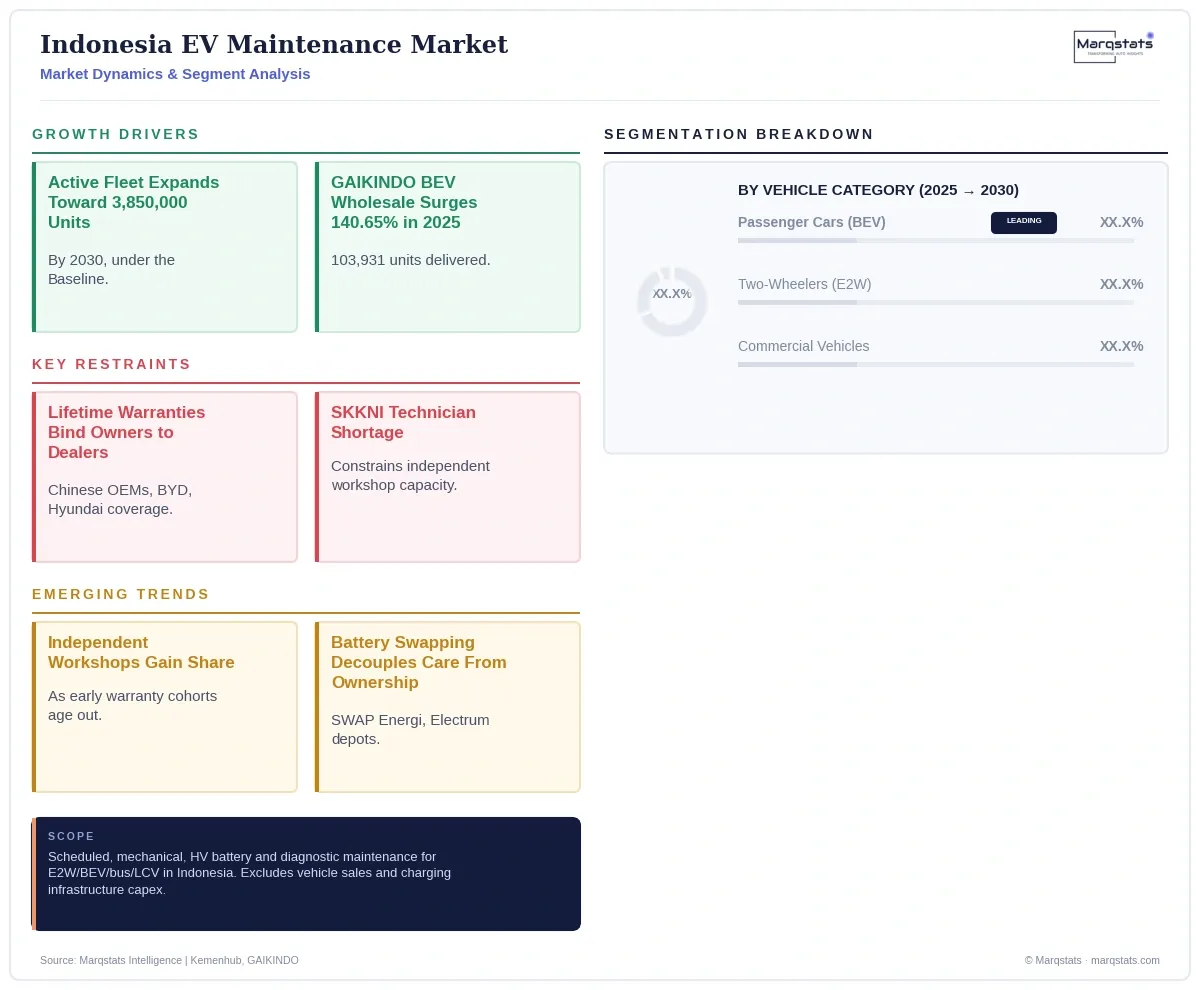
- Indonesia's active EV fleet is expanding rapidly, from 342,118 units in 2025 toward a projected 3,850,000 units by 2030 under the Baseline Scenario, directly growing the addressable base for recurring EV aftermarket maintenance demand.
- GAIKINDO-reported passenger BEV wholesale deliveries surging 140.65% in 2025 to 103,931 units, and continuing at a 99.36% year-on-year pace through August 2026, are directly accelerating the passenger-car segment's addressable maintenance base.
- The January 1, 2026 sunset of duty-free CBU import incentives under Regulation PMK No. 135/2024 is directly forcing automakers to localize CKD assembly and domestic spare parts supply chains, expanding component availability for the independent aftermarket.
- PT SWAP Energi Indonesia's Version 3.0.0 firmware upgrade, introducing automated battery diagnostic algorithms and predictive depot-level cell rebalancing, is directly expanding the technical sophistication of the swap-station battery-care economy.
- Domestic battery cell production scaling at PT HLI Green Power, the Hyundai-LG Energy Solution joint venture in the Cikarang-Karawang industrial belt, is directly working to stabilize replacement pack costs ahead of the warranty-expiration wave.
Key Restraints
- Indonesia's extreme ambient road surface temperatures, frequently surpassing 50C, genuinely accelerate tire tread wear and suspension component stress beyond the baseline 20% to 35% increase documented for EVs generally, compounding chassis-wear costs specifically for owners in the country's densest urban corridors.
- Manufacturer warranty structures spanning lifetime coverage for Chinese brands and 8-year/160,000 km coverage from BYD and Hyundai directly bind owners to authorized dealer networks during the initial ownership cycle, constraining independent workshop volume until early adoption cohorts exit warranty around 2028.
- A shortage of technicians certified under Ministry of Manpower SKKNI No. 163/2021 directly constrains independent workshop capacity, since compliance with high-voltage safety standards remains concentrated within franchised OEM dealership networks.
- This market's own three-scenario framework spans a genuinely wide 2030 range, from USD 245.50 million under the Downside Scenario to USD 512.40 million under the Upside Scenario -- a disclosed spread reflecting real uncertainty in CKD localization pace and open-access diagnostic policy, not a narrow band around a single central estimate.
- Sparse independent workshop capacity across the outer islands (Sumatra, Kalimantan, Sulawesi) directly extends component replacement lead times, since regional technicians are frequently dispatched from Java for complex repairs.
Key Trends
- Regional service capacity is beginning to diverge sharply between Jabodetabek's dense OEM-and-independent workshop concentration and the outer islands' sparse coverage, raising genuine open questions about whether that gap will narrow as CKD assembly-driven affordability expands the fleet toward the 2030 forecast.
- Independent workshop chains -- Astra Otoservice, DOMO Hybrid EV -- are directly gaining share against authorized dealerships, projected to expand from 16.50% to 34.00% of total market spend by 2030 as early warranty cohorts age out.
- Battery-as-a-service and automated battery swapping networks are directly decoupling battery maintenance from vehicle ownership in the electric two-wheeler segment, with infrastructure operators handling centralized testing, State-of-Health monitoring, and cell balancing rather than individual consumers.
- Commercial fleet operators are directly building centralized in-house maintenance depots, exemplified by Transjakarta's high-power gantry facilities supporting its expanding electric bus fleet past 150 units.
- Specialized independent high-voltage diagnostic facilities are directly emerging to serve out-of-warranty vehicles, led by DOMO Hybrid EV's traction battery balancing and inverter diagnostic services in Kelapa Gading.
Strategic Implications
- Component suppliers should also weight EV-specific tire inventory heavily nationwide, given how directly Indonesia's road surface heat compounds this market's already-accelerated tire wear rates.
- Insurers and secondary-market valuers should also weight traction battery replacement risk heavily in residual-value modeling nationwide, given how directly a single component representing 35% to 45% of vehicle value shapes total cost of ownership as the 2022-2025 fleet cohort ages toward warranty expiration.
- Independent workshop operators should prioritize SKKNI No. 163/2021 technician certification investment specifically, positioning ahead of the 2028-onward wave of early-adoption vehicles exiting lifetime and 8-year manufacturer warranties.
- Authorized dealership networks should extend structured post-warranty service retention programs specifically, given how directly bundled free-service agreements expiring on the 2022-2025 registration cohort will otherwise redirect volume toward independent multi-brand chains.
- Battery-swap infrastructure operators should formalize their battery-care data and reporting specifically, given how directly this activity sits outside conventional workshop statistics yet represents genuine maintenance economy value for a majority share of the national EV fleet.
- Investors and analysts should track CKD localization enforcement pace and open-access diagnostic framework enactment under SKKNI standards as the two clearest variables separating this market's Downside and Upside scenarios.
Outlook
The underlying research presents three genuinely distinct trajectories diverging on named regulatory and infrastructure trigger conditions. This market's own forecast horizon reaches 2030 directly, requiring no Marqstats extrapolation.
Under the Baseline Scenario, the sunset of CBU tax incentives under Regulation PMK No. 135/2024 leads to planned domestic CKD assembly across 2026 and 2027, and domestic battery manufacturing facilities such as PT HLI Green Power scale cell production to stabilize replacement pack costs; the active fleet reaches 3,850,000 units by 2030, generating USD 388.75 million (IDR 6,161.70 billion) in total market value at a 64.65% CAGR, with independent workshops expanding to 34.00% of total market value as early-generation vehicles exit factory warranty.
Under the Upside Scenario, municipal clean-air policies establish low-emission zones in Jakarta and Bali alongside mandatory electric fleet procurement for commercial logistics and public transit, and the Ministry of Transportation and Ministry of Industry establish standardized open-access diagnostic frameworks enabling accredited independent workshops to perform high-voltage repairs under SKKNI No. 163/2021 without voiding warranties; the active fleet expands to 5,200,000 units by 2030, lifting total market value to USD 512.40 million at a 73.98% CAGR, with independent workshop share reaching 45.00%.
Under the Downside Scenario, multiple automotive manufacturers delay planned domestic CKD assembly following the expiration of CBU tax relief, causing retail price increases and slower consumer adoption, while electric two-wheeler growth moderates due to the discontinuation of direct purchase subsidies; the active fleet reaches only 2,500,000 units by 2030, with total market value reaching only USD 245.50 million at a 50.19% CAGR, as authorized dealership networks retain 75.00% of market spend.
Market Segmentation
USD 22.10 million (68.78% share) in 2025, growing to USD 258.75 million (66.56% share) by 2030. Anchored by the BYD Atto 1, Wuling BinguoEV, Chery J6 and Hyundai Ioniq 5, driven by higher per-vehicle servicing requirements and accelerated tire wear.
USD 7.97 million (24.81% share) in 2025, growing to USD 101.85 million (26.20% share) by 2030. Anchored by Smoot Zuzu, Polytron Fox-R, Alva Cervo and Electrum H3, sustained by ride-hailing and delivery fleet electrification.
USD 2.06 million (6.41% share) in 2025, growing to USD 28.15 million (7.24% share) by 2030. Anchored by VKTR-BYD e-buses, DFSK Gelora E and Foton e-Trucks, driven by municipal transit and last-mile logistics fleets.
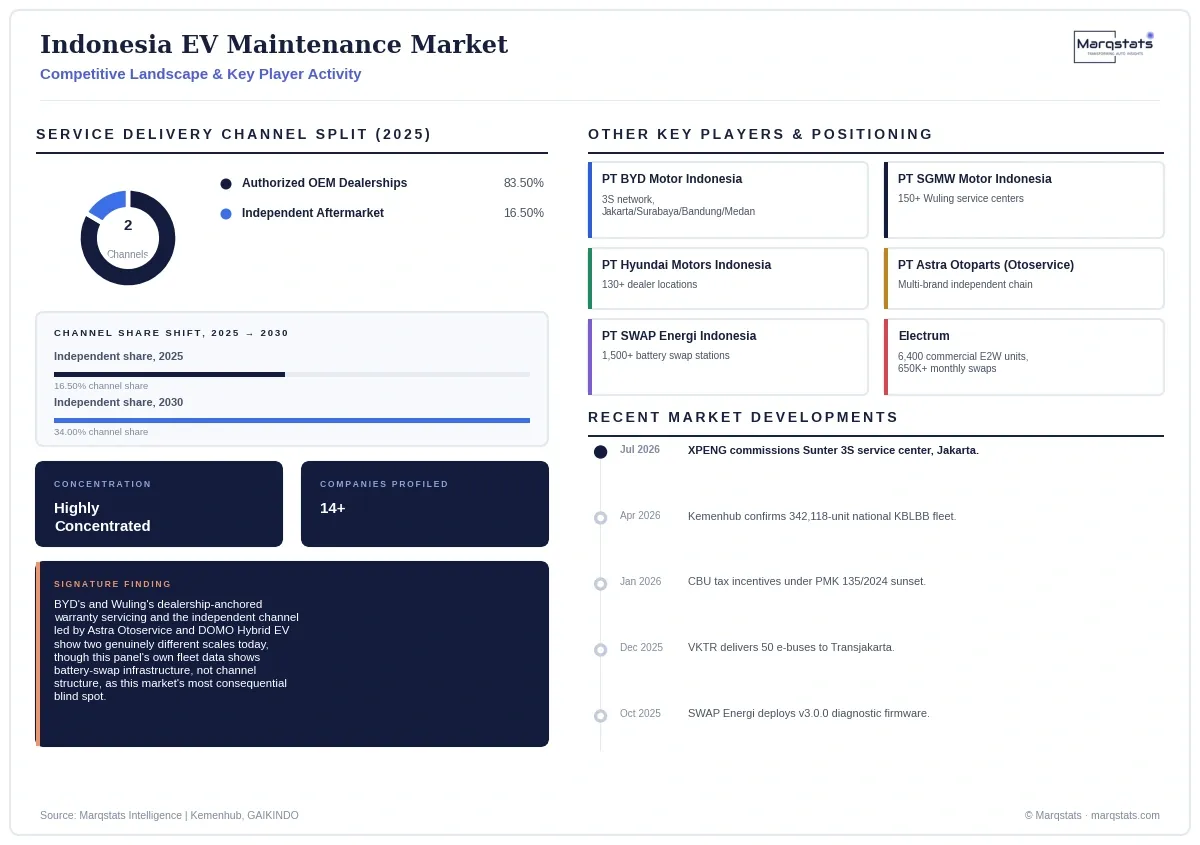
USD 26.83 million (83.50% share) in 2025, growing to USD 256.57 million (66.00% share) by 2030. Sustained by lifetime and 8-year high-voltage battery warranties from BYD, Hyundai, Wuling and Chery.
USD 5.30 million (16.50% share) in 2025, growing to USD 132.18 million (34.00% share) by 2030. The fastest-growing channel, led by Astra Otoservice and DOMO Hybrid EV.
USD 16.39 million (51.01% share) in 2025, growing to USD 174.94 million (45.00% share) by 2030. Anchored by reduction gearbox flushes, cabin filtration renewals and brake fluid changes.
USD 10.92 million (33.99% share) in 2025, growing to USD 147.72 million (38.00% share) by 2030. The fastest-growing category, driven by high-load EV-specific tire replacement under accelerated wear rates.
USD 4.82 million (15.00% share) in 2025, growing to USD 66.09 million (17.00% share) by 2030. Anchored by State-of-Health verification, module balancing and 12V auxiliary battery replacement.
By Geography
Greater Jakarta (Jabodetabek)
62.5% of 2025 maintenance spend (~213,800 units), reinforced by exemption from odd-even traffic rationing, zero-rate ownership transfer taxes, and dense public charging coverage, with DKI Jakarta alone accounting for approximately 63% of registered electric passenger cars nationally.
West Java (Rest of Province)
14.0% of 2025 maintenance spend (~47,900 units), concentrated along the Cikarang-Karawang industrial manufacturing corridor housing PT HLI Green Power's battery investments, and metropolitan Bandung.
East Java & Central Java
11.5% of 2025 maintenance spend (~39,350 units), centered on Surabaya, Malang and Semarang, supported by intercity passenger transit along the Trans-Java Toll Road, though independent repair capacity outside flagship 3S dealerships remains limited.
Bali Province
7.0% of 2025 maintenance spend (~23,950 units), driven by electric two-wheelers, light rental fleets and tourism transport rather than passenger cars, with provincial clean energy mandates accelerating fleet conversions among hotel operators and scooter rental businesses.
Outer Islands (Sumatra, Kalimantan, Sulawesi)
5.0% of 2025 maintenance spend (~17,118 units), limited to provincial administrative centers and the Nusantara (IKN) capital development's zero-emission transit shuttles, with independent workshop capacity constrained and complex repairs requiring technicians dispatched from Java.
How Competition Is Evolving
This landscape genuinely continues consolidating around named anchors.
Overall market concentration is genuinely expected to shift somewhat by 2030 as independent aftermarket share expands.
No single company in this market spans franchised OEM dealership warranty servicing, independent multi-brand chain coverage, and battery-swap infrastructure operation simultaneously, leaving genuine competitive white space for any group capable of bridging BYD's and Wuling's dealership-anchored warranty servicing with the independent and swap-infrastructure channels this market's own scenario framework shows expanding sharply by 2030.
Competition spans franchised OEM dealership networks, multi-brand independent chains, battery-swapping infrastructure operators, and commercial fleet depot operators. PT BYD Motor Indonesia operates 3S facilities across Greater Jakarta, Surabaya, Bandung and Medan in partnership with dealer conglomerates. PT SGMW Motor Indonesia (Wuling) maintains over 150 authorized service centers across Java, Sumatra, Bali and Sulawesi. PT Hyundai Motors Indonesia operates more than 130 dealer locations supported by mobile EV service units. XPENG Indonesia, operating under PT Erajaya Active Lifestyle, commissioned a 1,620-square-meter 3S Experience & Service Center in Sunter, North Jakarta in July 2026.
PT Astra Otoparts Tbk has integrated its Astra Otoservice multi-brand chain into the EV support landscape, pairing proprietary Astra Otopower charging infrastructure with computerized wheel alignment and specialized EV tire replacement. PT Dokter Mobil Indonesia launched DOMO Hybrid EV in May 2024, the country's first specialized multi-brand independent repair workshop for hybrid and electric vehicles. PT SWAP Energi Indonesia operates over 1,500 battery swap stations across convenience retail networks, while Electrum (PT Energi Kreasi Bersama), a TBS Energi Utama-GoTo joint venture, manages centralized maintenance depots supporting over 650,000 monthly swap transactions. Regulatory oversight rests with Kemenhub (registration and workshop certification), the Ministry of Manpower (SKKNI technician standards), and BSN (safety standards).
Companies Covered
Companies covered in the report include:
Recent Market Activity
Table of Contents
Coverage & Segmentation
The analysis measures scheduled periodic servicing, chassis alignment, braking and suspension overhauls, high-voltage powertrain and battery health diagnostics, and specialized tire replacements for electric two-wheelers, passenger cars, commercial buses, and light commercial vehicles in Indonesia, across a 2025 base year and a 2026 to 2030 forecast period, denominated in United States dollars at the pack's own stated 2025 average Bank Indonesia JISDOR rate of 15,850 IDR per USD. It excludes initial vehicle sales, insurance premiums, electricity charging tariffs, and charging infrastructure capital expenditure.
The analysis spans three segmentation dimensions — vehicle category, service delivery channel and technical service type — five regional groupings, and 14 profiled entities across dealer networks, independent chains, swap infrastructure operators and regulatory bodies. Fleet figures trace to Kemenhub and GAIKINDO statutory data; market value and all three segmentation dimensions trace directly to the underlying research's own fully worked sizing model, with both 2025 and 2030 figures directly source-stated throughout.