Market Snapshot
Middle bar: base-year value × (1 + CAGR), rounded to two decimals. This is a calculated illustration, not a separately researched annual estimate.
Market Size (2025, Base Year): USD 1,944.23 Million (THB 69.02 Billion)
Estimated Value (2026): USD 2,042.25 Million
Forecast Value (2030): USD 2,462.82 Million
CAGR: 4.84% | Forecast Period: 2026 – 2030
Growth — Absolute: USD 518.59 Million
Physical Volume: 373.07 Million Litres (2025) to 406.63 Million Litres (2030), Volume CAGR 1.74%
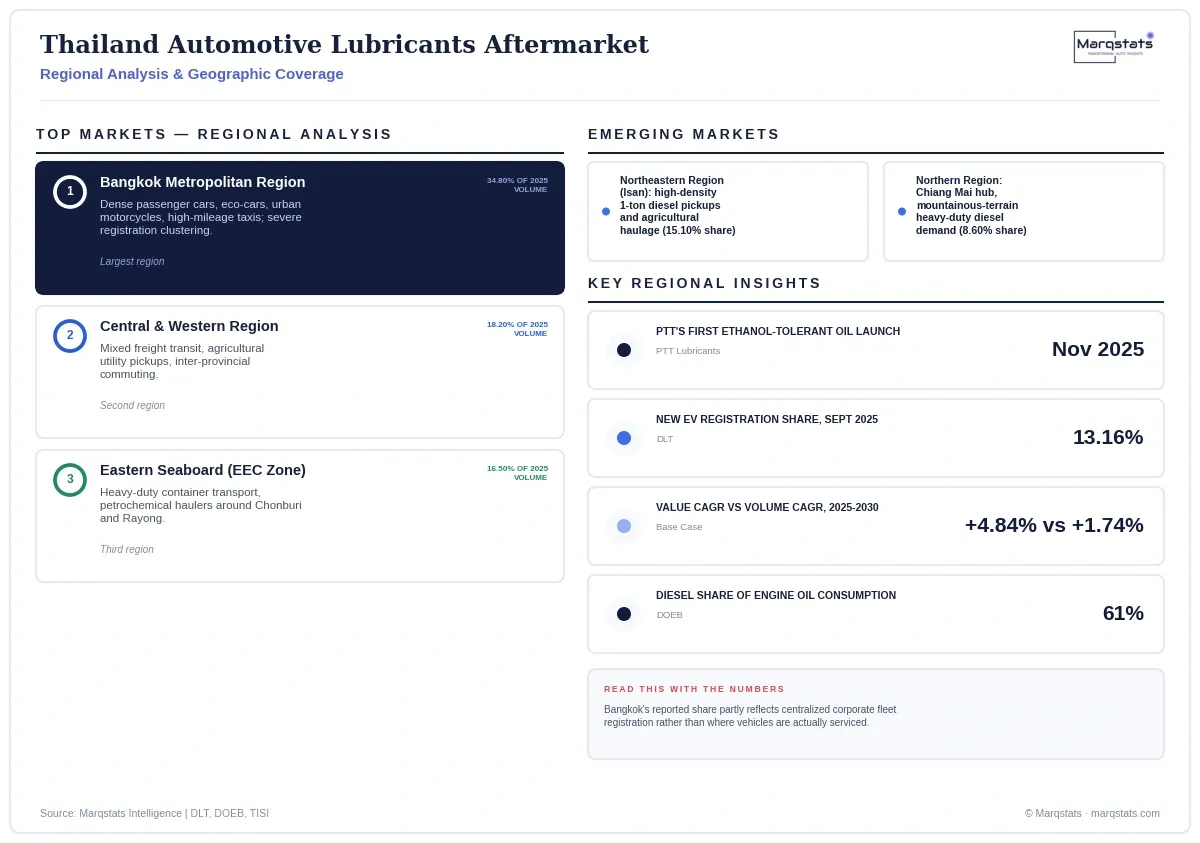
Largest Market: Bangkok Metropolitan Region (34.80% of 2025 volume)
Fastest Growing: Fully Synthetic/PAO/Ester Formulations (19.50% to 27.00% share, 2025-2030)
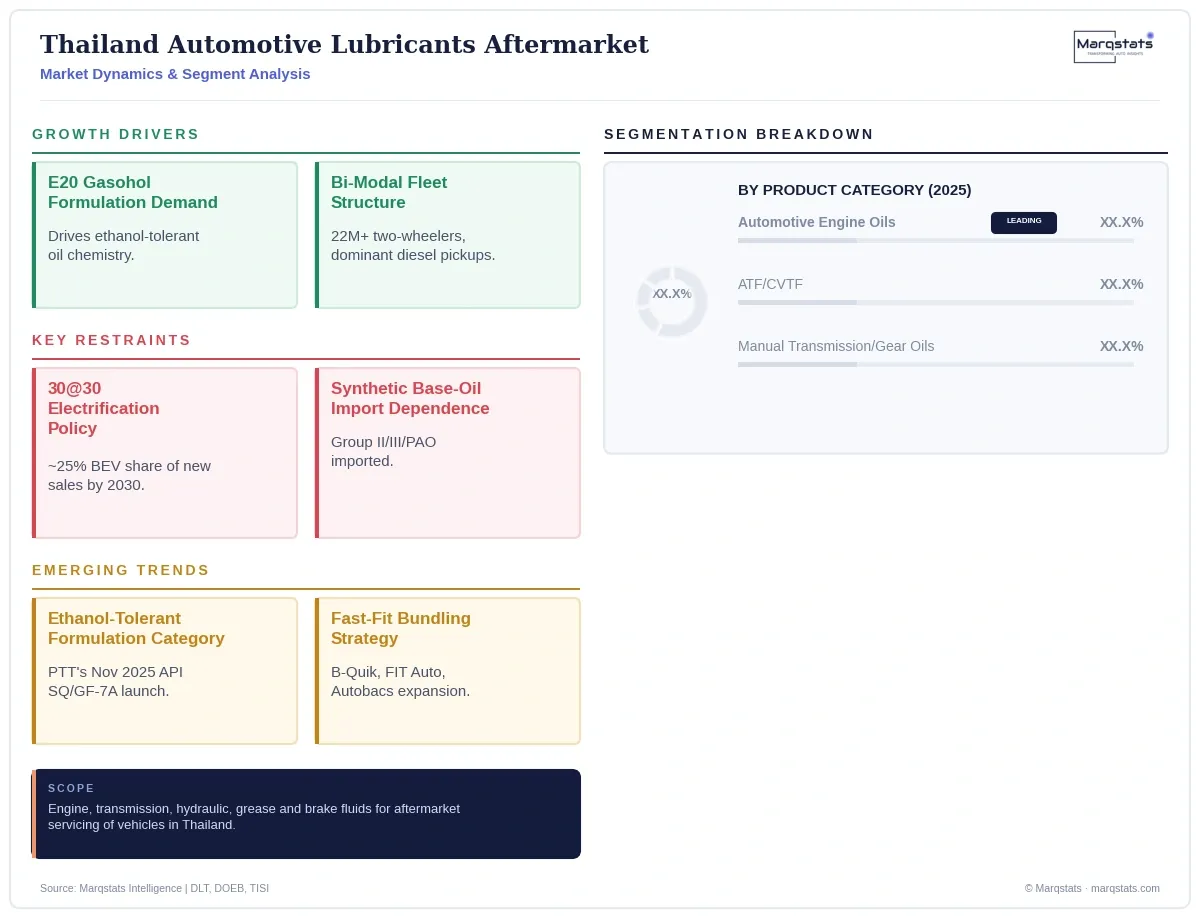
Dominant Segment: Automotive Engine Oils (57.45% of 2025 volume)
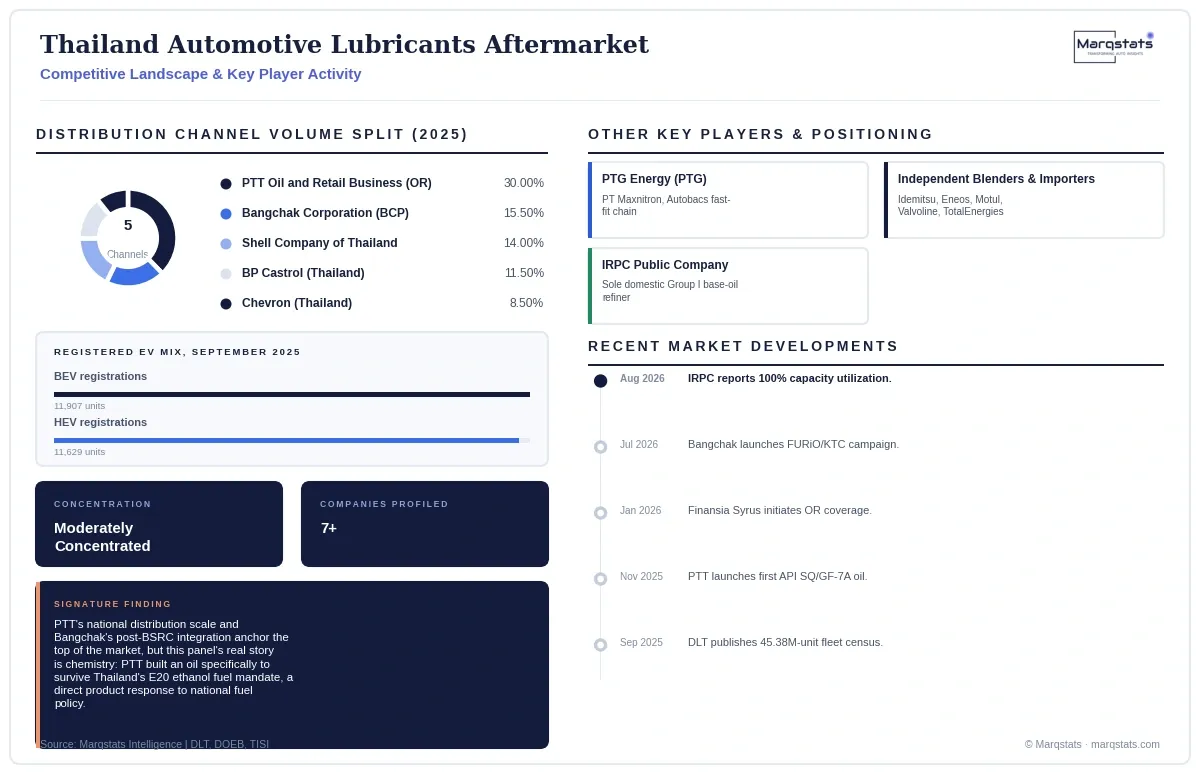
Market Concentration: Moderately Concentrated (PTT Leads at 30.0%)
Base Year: 2025 | Historical Period: 2021 – 2025 | Forecast Period: 2026 – 2030
Units Considered: Value (USD Million)
Segments Covered: 3 | Regions Covered: 6 | Companies Profiled: 7
Report Pages: 165 | Deliverables: PDF, Excel, PPT
Key Takeaways
Market Overview & Analysis
Report Summary
Thailand's lubricants aftermarket sits at the intersection of a bi-modal vehicle fleet, a national fuel policy that is quietly reshaping oil chemistry, and a retail channel shifting hard from unaffiliated garages toward organized fast-fit chains.
The analysis measures the value of engine oils, transmission and driveline fluids, hydraulic fluids, greases and brake fluids bought for aftermarket servicing of vehicles: USD 1,944.23 million in 2025.
The sizing and segmentation chain traces to a source Marqstats could not independently verify; this is disclosed prominently below and in the accompanying verification log, not omitted.
The analysis is written for four readers: a blender deciding how fast to formulate for E20 ethanol fuel tolerance, a distributor weighing entry against PTT's and Bangchak's national retail footprints, a fast-fit chain operator planning expansion, and an investor tracking two forward scenarios.
Thailand's position as an ASEAN manufacturing and export hub, combined with its own domestic base-oil self-sufficiency, makes this aftermarket a useful regional bellwether for how fuel-chemistry policy and organized-retail consolidation interact in a fast-growing Southeast Asian vehicle market.
A Fuel Policy That Created a Lubricant Problem, and the Oil Built to Solve It
Fuel policy does not usually show up as a headline lubricant-industry event. In Thailand, it just did.
The Department of Energy Business has been pushing E20 gasohol, a 20% bioethanol blend, toward becoming the baseline national gasoline grade, partly to absorb domestic agricultural ethanol output. High-ethanol combustion measurably increases the risk of crankcase oil dilution, water emulsification, and acid-driven piston corrosion, degradation pathways a conventional motor oil was never formulated to resist at this frequency. In November 2025, PTT Lubricants launched Thailand's first engine oil certified under the latest API SQ and ILSAC GF-7A performance standards, built with supplemental rust inhibitors, timing-chain wear protection, and enhanced emulsion stability specifically engineered for ethanol-blended fuel operation. This is a direct, dated instance of national fuel policy reshaping product formulation in real time, not a hypothetical future adjustment blenders might eventually need to make.
A Fleet Splitting Cleanly Into Two Very Different Product Categories
Thailand's vehicle parc is not one market with a single dominant vehicle type. It is two markets sharing a country.
More than 22 million two-wheelers sustain steady demand for small-format 0.8-and-1.0-litre crankcase fills under JASO MA2 wet-clutch and MB dry-clutch scooter classifications, while the four-wheel population is anchored by 1-ton diesel pickups like the Isuzu D-Max and Toyota Hilux, favoured by Thai excise tax treatment over equivalent passenger sedans. This bi-modal structure is why heavy-duty and light-duty diesel oils together account for 61% of national automotive engine lubricant consumption even in a market where motorcycles outnumber cars: the pickup segment's large sumps and high utilization dominate volume even though two-wheelers dominate unit count.
Electrification in Thailand Is Not a Single Story
New-vehicle electrification headlines usually report one number. Thailand's own data shows why that number hides the more useful story.
In September 2025 alone, new electric vehicle registrations reached 24,891 units, 13.16% of that month's total, but the mix inside that figure was nearly a three-way split: 11,907 battery-electric, 11,629 hybrid, and 1,355 plug-in hybrid. That split matters directly for lubricant demand, because it does not behave like a single electrification trend. Pure BEVs eliminate crankcase oil entirely while creating new demand for dielectric e-transmission fluids and immersion cooling chemistries. HEVs and PHEVs retain a combustion engine but run it through frequent start-stop cycling at lower average operating temperatures, pushing demand toward ultra-low-viscosity SAE 0W-16 and 0W-20 synthetic formulations rather than eliminating oil demand at all.
Fast-Fit Chains Are Capturing Volume by Bundling, Not Just Undercutting Price
The organized retail channel isn't winning share from independent garages purely on convenience or brand trust. It is winning on a specific commercial bundle unaffiliated garages structurally cannot match.
B-Quik operates over 200 modern service centers integrated into hypermarket complexes and arterial junctions; PTT's FIT Auto has expanded past 100 outlets co-located inside PTT fuel stations; PTG's Autobacs opened its 100th branch in October 2024, reached 117 by year-end, and targets 300 by 2026. All three bundle the oil change itself with free 30-to-35-point safety inspections, transparent fixed pricing, digital service-history records, and credit-card loyalty promotions, a combination that converts a single maintenance visit into a broader trust relationship an unaffiliated mom-and-pop garage, however competent, has no easy way to replicate.
Two Refiners, Two Very Different Paths to the Same Market Position
Thailand's top two lubricant sellers arrived at nearly comparable retail scale through opposite corporate histories, and that difference still shapes how each competes.
PTT Oil and Retail Business built its 30.0% lead organically, over 13 consecutive years of sustained leadership, backed by an Automated Distribution Center capable of 260-263 million litres of annual throughput and more than 2,300 of its own fuel stations. Bangchak reached its 15.5% share largely through acquisition, absorbing Esso's former Thai refining and retail assets (rebranded BSRC) and immediately converting that scale into a 61% marketing volume expansion. PTT's advantage is depth of an already-built national network; Bangchak's is the sudden addition of a second, previously independent distribution system now running under one commercial strategy. Both are now racing to put the same asset, physical fuel-station footprint, to the same use: bundling in quick-fit automotive service to capture downstream margin before electrification erodes fuel volume.
Why the Isuzu D-Max and Toyota Hilux Matter More Than New-Car Statistics Suggest
A single vehicle segment, priced and taxed favourably relative to its closest substitute, ends up anchoring a disproportionate share of national lubricant demand, and the mechanism is fiscal, not mechanical.
Thai excise tax schedules favour 1-ton pickup trucks like the Isuzu D-Max and Toyota Hilux over equivalent passenger sedans, a policy choice with nothing to do with engine oil, but with a direct downstream consequence for it: pickups carry larger diesel sumps, log higher commercial-grade utilization, and together with heavy commercial vehicles push diesel formulations to 61% of national engine lubricant consumption. A tax schedule written to support agricultural and small-business vehicle affordability is, as a side effect, one of the more powerful structural drivers of Thailand's lubricant product mix.
A Two-Wheeler Fleet Large Enough to Be Its Own Market
Most countries in this vertical treat motorcycle oil as a secondary category. In Thailand, the fleet size alone argues against that framing.
More than 22 million two-wheelers operate on Thai roads, sustaining structural demand for small-format 0.8-litre and 1.0-litre crankcase fills under two distinct technical classifications: JASO MA2 for wet-clutch motorcycles, where the oil shares a bath with the clutch pack and must carry specific friction characteristics, and JASO MB for dry-clutch continuously variable scooters, where it does not. Getting this classification wrong is not a minor formulation error: an MB-rated oil used in an MA2 wet-clutch application can cause the clutch to slip, and the reverse mismatch can produce excess friction and premature wear. With new motorcycle registrations representing 72.33% of new vehicle flow under the Motor Vehicle Act, this is a high-frequency, high-volume category that rewards precise SKU management over broad-spectrum formulations.
What the Rejected Third Scenario Actually Proves
The most informative part of a forecast is sometimes the scenario the analysts considered and then discarded, because the reasoning behind the rejection tells you more about the market's structural floor than either scenario that made the final table.
A third scenario modeling outright volumetric contraction by 2030 was tested against Thailand's own fleet-turnover mathematics and rejected. The average operational vehicle age already exceeds 10 years for commercial utilities and 7 years for passenger cars, and replacing the cumulative existing combustion parc, even under aggressive EV uptake concentrated in new registrations, requires 12 to 15 years given how slowly a 45.38 million-unit fleet actually turns over. That arithmetic is the real reason volumetric service-fill demand stays positive through 2030 in both surviving scenarios: not optimism about combustion vehicles' future, but the simple fact that a fleet this large cannot be replaced fast enough for outright volume contraction to be a plausible outcome within the forecast window, regardless of how aggressively new-vehicle electrification proceeds.
Market Dynamics
Key Drivers
- E20 gasohol fuel policy is directly driving demand for ethanol-tolerant formulations with enhanced emulsion stability and rust inhibition, a shift PTT's own November 2025 product launch has already put into commercial practice.
- A bi-modal fleet (22 million-plus two-wheelers, a dominant 1-ton diesel pickup segment) sustains structurally high diesel engine oil consumption even as unit counts skew toward small-engine motorcycles, a pattern reinforced by favourable excise tax treatment for pickups over equivalent passenger sedans.
- Euro 5/Euro 6-equivalent emissions enforcement is accelerating the shift toward low-SAPS API CK-4/SP/SQ formulations compatible with particulate filters and catalytic systems, with both standards already fully in force as of January 2025.
- Organized fast-fit chain expansion (B-Quik, FIT Auto, Autobacs) is consolidating volume from unaffiliated garages through bundled service and loyalty programmes, at a pace fast enough that Autobacs alone is targeting a near-tripling of its branch count within two years.
- Domestic Group I base-oil self-sufficiency via IRPC's Rayong refinery, running at 100% utilization, supports stable feedstock availability for local blenders, even as Group II, Group III and PAO synthetic stocks remain reliant on regional imports.
Key Restraints
- Thailand's 30@30 electrification policy will progressively remove crankcase oil demand from the newest vehicle cohort as BEV penetration in new registrations climbs toward the Base Case's roughly 25% share by 2030.
- A three-way split between BEV, HEV and PHEV adoption complicates formulation planning relative to a market with a single dominant electrification pathway.
- Accelerated EV subsidies and Bangkok low-emission zones, if enacted on the Downside scenario's timeline, would compress commercial diesel fleet volume faster than the Base Case assumes.
- Import dependence on Group II, Group III and Group IV (PAO) synthetic base oils from South Korea, Taiwan, Singapore and the Middle East exposes blenders to currency and margin volatility, a risk that grows as synthetic and semi-synthetic share of the market keeps expanding.
Key Trends
- Ethanol-tolerant, API SQ/ILSAC GF-7A certified formulations are becoming a genuine product category rather than a niche specification.
- Fast-fit chain bundling (inspection, transparent pricing, digital service history, loyalty rewards) is the primary mechanism driving channel share from independent garages.
- Hybrid-specific ultra-low-viscosity synthetic formulations are expanding alongside pure BEV e-transmission and immersion-cooling fluid demand, not instead of it.
- Domestic energy majors (PTT, Bangchak) are expanding lubricant exports across ASEAN, Africa and the Middle East, leveraging domestic blending scale into new international channels.
Strategic Implications
- Blenders should prioritise ethanol-tolerant, low-SAPS formulations and pursue certified network partnerships (Castrol Auto Service, Bangchak Furio) to secure credibility and distribution into the fast-growing organized retail channel, particularly as E20 adoption continues to widen the gap between a conventional formulation and what the fuel actually requires.
- Independent workshops should upgrade technical capability for Euro 5/6 vehicles and avoid legacy high-ash mineral oils in modern particulate-filter-equipped diesel pickups, where the liability and engine-damage risk is real, given how dominant the 1-ton pickup segment already is in national lubricant volume.
- Domestic energy majors should continue leveraging fuel-station footprints to scale organized quick-fit operations, capturing downstream service margin that would otherwise erode with electrification, following the pattern both PTT's FIT Auto and PTG's Autobacs have already demonstrated works at scale.
- Additive and base-oil suppliers should prioritise low-SAPS chemistries validated for local high-temperature conditions and E20/B7-B10 biofuel compatibility, and should pursue joint development agreements with domestic national champions for ASEAN export leverage, given how directly PTT and Bangchak have already signalled intent to export beyond Thailand's own borders.
- Investors should track 30@30 policy enforcement pace and Bangkok low-emission zone implementation, the two triggers separating the Base and Downside scenarios, and should treat the sizing and segmentation figures here with the caution disclosed in the evidence section, since the precise split between independently-sourced and flagged-source volume within the headline series is not confirmed for every individual year.
Outlook
The underlying research presents two scenarios tied to named electrification-policy triggers; a third, outright-contraction scenario was tested and rejected given Thailand's 12-to-15-year combustion-fleet replacement cycle.
Under the Base Case (Managed Powertrain Plurality), Thailand's 30@30 policy advances at a moderate pace, reaching roughly 25% BEV penetration in new light passenger car registrations by 2030 while 1-ton pickups and commercial heavy transport remain over 85% internal combustion and hybrid. High-mileage diesel logistics sustain continuous fluid replenishment while Euro 5/6 low-SAPS synthetic adoption drives value growth. Volume reaches 406.63 million litres, a 1.74% CAGR, and value reaches USD 2,462.82 million (THB 87.43 billion), a 4.84% CAGR.
Under the Downside Case (Accelerated Disruption & Policy Shift), the government accelerates EV subsidies under EV 3.5 policy continuation, achieves 35% new-vehicle electrification ahead of 2030, and enacts low-emission zones in the Bangkok Metropolitan Region restricting older commercial diesels. Volume reaches only 382.45 million litres, a 0.50% CAGR, and value reaches THB 78.40 billion, a 2.58% CAGR, as synthetic price realization only partially offsets the volumetric deceleration.
Market Segmentation
214.33 million litres (57.45% share) in 2025, moving to 231.25 million litres (56.87% share) by 2030, a 1.53% CAGR.
55.21 million litres (14.80% share) in 2025, moving to 61.12 million litres (15.03% share) by 2030, a 2.05% CAGR.
50.36 million litres (13.50% share) in 2025, moving to 53.25 million litres (13.10% share) by 2030, a 1.12% CAGR.
23.13 million litres (6.20% share) in 2025, moving to 24.80 million litres (6.10% share) by 2030, a 1.40% CAGR.
18.09 million litres (4.85% share) in 2025, moving to 19.82 million litres (4.87% share) by 2030, a 1.85% CAGR.
11.94 million litres (3.20% share) in 2025, moving to 16.39 million litres (4.03% share) by 2030, a 6.54% CAGR.
157.06 million litres (42.10% share) in 2025, moving to 130.12 million litres (32.00% share) by 2030.
143.26 million litres (38.40% share) in 2025, moving to 166.72 million litres (41.00% share) by 2030.
72.75 million litres (19.50% share) in 2025, moving to 109.79 million litres (27.00% share) by 2030.
31.50% of volume in 2025, moving to 38.00% by 2030.
35.00% of volume in 2025, moving to 27.50% by 2030.
21.00% of volume in 2025, moving to 22.00% by 2030.
8.50% of volume in 2025, moving to 8.50% by 2030.
4.00% of volume in 2025, moving to 4.00% by 2030.
By Geography
Bangkok Metropolitan Region (BMR)
129.83 million litres (34.80% share) in 2025.
Central & Western Region
67.90 million litres (18.20% share) in 2025.
Eastern Seaboard (EEC Zone)
61.56 million litres (16.50% share) in 2025.
Northeastern Region (Isan)
56.33 million litres (15.10% share) in 2025.
Northern Region
32.08 million litres (8.60% share) in 2025.
Southern Region
25.37 million litres (6.80% share) in 2025.
Registration Distortion
Commercial fleet leasing entities, corporate logistics operators and long-term rental businesses register vehicles in Bangkok and Chonburi to streamline corporate tax filings, even though actual vehicle operating hours and lubricant drain intervals occur across provincial corridors such as Mittraphap Road and Asian Highway 2.
How Competition Is Evolving
PTT Oil and Retail Business (OR) leads with 30.0% share, operating an Automated Distribution Center with 260-263 million-litre annual throughput, over 2,300 PTT stations, and the FIT Auto quick-fit chain; it launched Thailand's first API SQ certified oils in late 2025 and has held the leading market share for 13 consecutive years.
Bangchak Corporation (BCP) holds 15.5% share following its post-acquisition integration of Esso assets (Bangchak Sriracha, BSRC), operating over 2,200 stations and 2,050 Furio sales points; the integration drove a 61% marketing volume expansion, with its high-end synthetic Furio line expanding through quick-service bays.
Shell Thailand holds 14.0% share via Gas-to-Liquid PurePlus base-stock technology and an exclusive supply partnership with the Bridgestone Cockpit network. BP Castrol (Thailand) holds 11.5%, anchored by its nationwide Castrol Auto Service and Castrol Bike Point certified workshop network. Chevron (Thailand) holds 8.5%, strong in heavy diesel fleet and commercial transport logistics via Caltex Havoline and Delo.
PTG Energy holds 5.0% share, integrating its PT Maxnitron lubricant line with the 25-million-member PT Max Card ecosystem and its fast-growing Autobacs fast-fit chain, which recorded 70.9% gross profit expansion in its non-oil/service division. Independent blenders and importers (Idemitsu, Eneos, Motul, Valvoline, TotalEnergies) together hold 15.5%, concentrated in Japanese OEM dealerships, performance tuning shops and independent agricultural retailers.
Companies Covered
Companies covered in the report include:
Recent Market Activity
Table of Contents
Coverage & Segmentation
The analysis measures automotive engine oils, automatic and manual transmission fluids, hydraulic and power steering fluids, automotive greases, and brake fluids and functional chemical specialties bought for aftermarket servicing of vehicles in Thailand, for a 2025 base year and a 2026 to 2030 forecast, in United States dollars and Thai baht.
The analysis covers three segmentation dimensions, product category, base-stock chemistry and distribution channel, a six-region geographic split, and seven profiled entities. The sizing and segmentation chain carries a sourcing flag; company market shares, regional splits and fleet demographics do not. See the verification log for full disclosure.