Market Snapshot
Middle bar: base-year value × (1 + CAGR), rounded to two decimals. This is a calculated illustration, not a separately researched annual estimate.
Market Size (2025, Base Year): USD 1,205.71 Million (Ex-Distributor Wholesale)
Estimated Value (2026): USD 1,224.88 Million
Forecast Value (2030): USD 1,304.56 Million
CAGR: 1.59% | Forecast Period: 2026 – 2030
Growth — Absolute: USD 98.85 Million
Physical Volume: 203.90 Million Litres (2025) to 200.80 Million Litres (2030), Volume CAGR -0.31%
Largest Market: Northwest (34.50% of 2025 value)
Fastest Growing: Electric and Thermal Fluids Segment
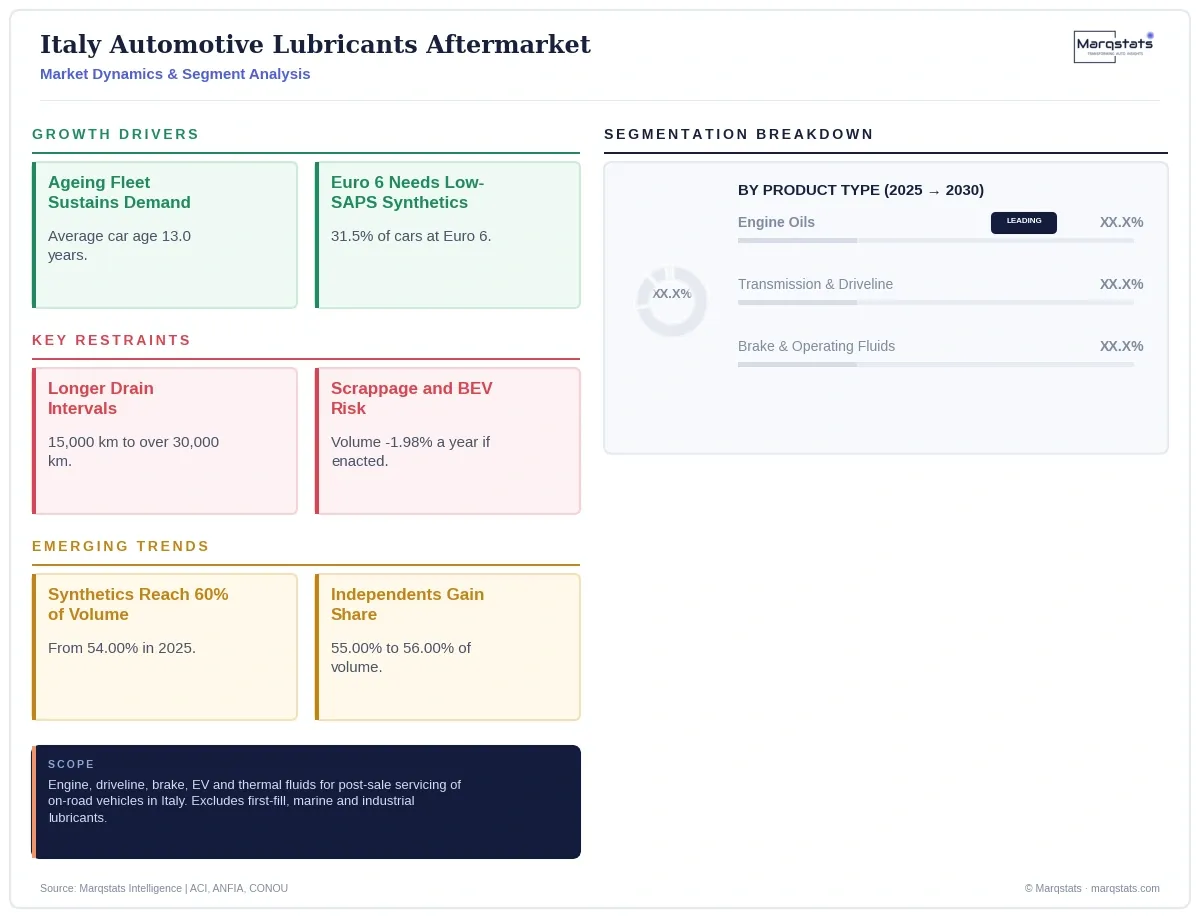
Dominant Segment: Engine Oils (72.50% of 2025 value)
Market Concentration: Moderately Concentrated (Qualitative; No Shares Published)
Base Year: 2025 | Historical Period: 2021 – 2025 | Forecast Period: 2026 – 2030
Units Considered: Value (USD Million) and Volume (Million Litres)
Segments Covered: 4 | Regions Covered: 4 | Companies Profiled: 14
Report Pages: 170 | Deliverables: PDF, Excel, PPT
Key Takeaways
Market Overview & Analysis
Report Summary
Italy's lubricants aftermarket is shrinking in litres and growing slowly in value. It is held up by one of Europe's oldest car fleets, and it is being repriced from below as owners of newer cars buy low-SAPS synthetics while owners of pre-Euro 4 cars keep buying high-viscosity oils.
The analysis measures the ex-distributor wholesale value of finished oils and functional fluids bought for post-sale servicing of on-road vehicles: USD 1,205.71 million in 2025, including statutory energy levies and consortium fees and excluding IVA. It excludes OEM first-fill, marine, aviation and industrial lubricants.
The analysis is written for four readers: a blender deciding how much capacity to move from 10W-40 to 0W-20, a distributor stocking for two very different fleets, a workshop owner weighing what a scrappage scheme would do to visits, and an investor sizing re-refining.
The Factories Shrank. The Oil Market Barely Moved.
Italy's car industry and its oil market are moving on different clocks.
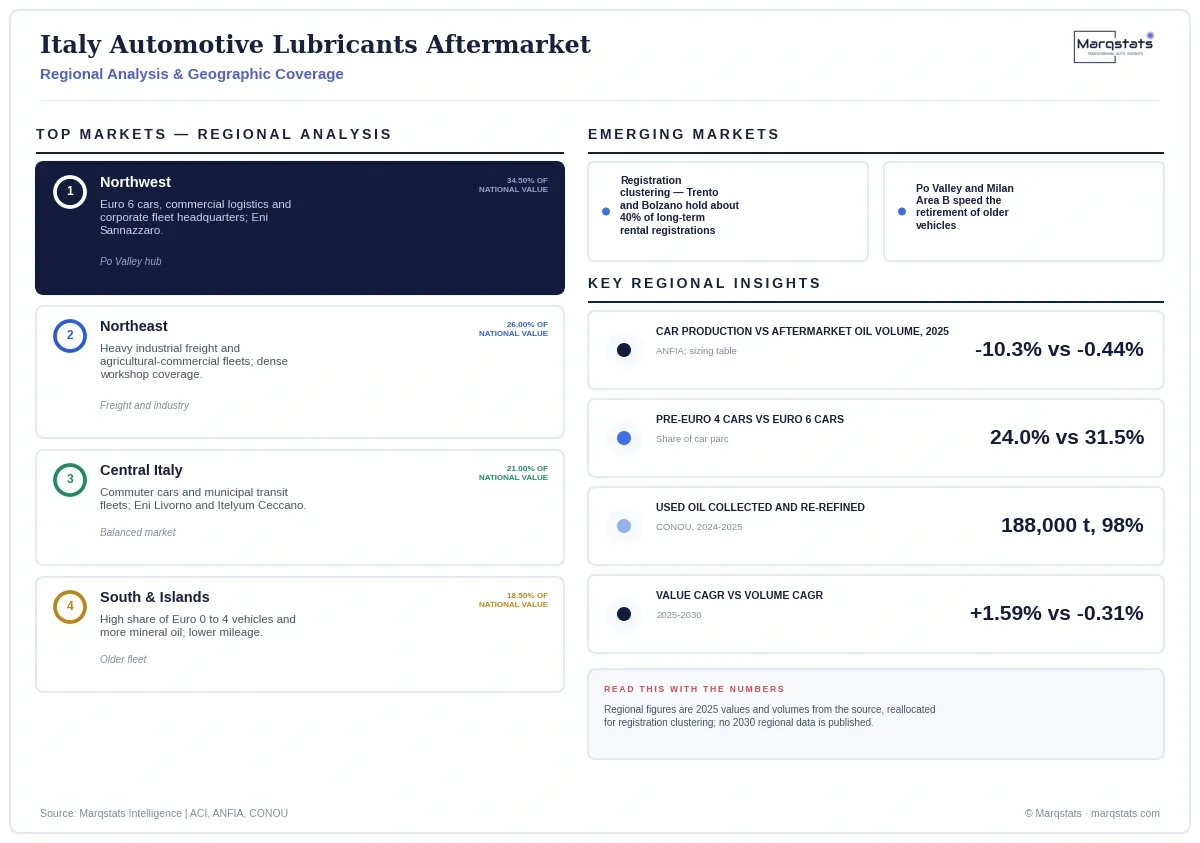
The industry body ANFIA reported that Italian automotive production fell 10.3% in 2025, with domestic car output below 300,000 units. Aftermarket oil volume in the research's sizing table fell 0.44%, from 204.80 to 203.90 million litres. The gap, about 9.9 percentage points on those two figures, shows that the market follows the cars already on the road. The passenger car fleet is 41.34 million and the whole registered fleet 55.59 million vehicles. Cars average 13.0 years, and the median scrapped car was 18 years and 9 months old. New-car sales are stable at about 1.6 million a year, while national spending on vehicle maintenance and repair passed EUR 29 billion.
Two Fleets, Two Opposite Oils
The Italian fleet is really two fleets, and they need different products.
About 24.0% of cars, 9.92 million, are Euro 0 to Euro 3 and have run for at least 19 years. They are served with SAE 10W-40 and 15W-40 mineral and semi-synthetic oils with traditional zinc dialkyldithiophosphate anti-wear additives that suit looser tolerances and older seals. 44.5% are Euro 4 and 5. The 31.5% at Euro 6 need ultra-low-viscosity SAE 0W-20 and 0W-16 synthetics that meet strict low-SAPS limits to protect gasoline particulate filters and selective catalytic reduction. Distributors therefore stock legacy grades and new grades at once, which is why the market's value grows even as its litres shrink.
Synthetics Are Winning Share, Not Volume
The formulation shift explains why value outgrows volume.
Fully synthetic oil rises from 91.76 to 100.40 million litres and from 54.00% to 60.00% of volume between 2025 and 2030. Semi-synthetic falls from 34.00% to 30.00% and mineral from 12.00% to 10.00%. At the research's prices, synthetic oil sells at about USD 7.10 a litre in 2025, semi-synthetic at USD 5.29 and mineral at USD 4.17 (Marqstats arithmetic). Fully synthetic value grows 3.75% a year to USD 782.74 million, while semi-synthetic and mineral value both decline. Modern automatic, dual-clutch and continuously variable transmissions add to the trend: shear-stable fluids sell above USD 12.00 a litre.
The Registration Trick That Inflates Trentino-Alto Adige
Regional statistics in Italy need a warning label.
About 40% of newly registered long-term rental and commercial fleet vehicles are registered in the autonomous provinces of Trento and Bolzano to use a lower provincial transfer tax. The vehicles run nationwide and are serviced in Lombardy, Emilia-Romagna, Lazio and Campania. The research says that sizing by registration alone would overstate Trentino-Alto Adige oil demand by more than 300% and understate workshop sales in the northwest and centre. Its regional table reallocates volume to where the vehicles run.
A Circular System That Recycles Almost Everything It Collects
Italy's used-oil system is one of its structural strengths.
The consortium CONOU, funded by an environmental contribution on all virgin lubricating oil, runs 60 regional concessionaires that collect crankcase oil free from garages and factories. It collected 188,000 tonnes of used oil in 2024 and 2025 and sent 98% to re-refining, against a European average of 61%, according to its own reporting. Each 100 kilograms of used oil yields about 67 kilograms of regenerated base oil, 21 kilograms of light gas oil, 4 kilograms of bitumen flux and 8 kilograms of treated water. Re-refined base oil supplies about 30% of Italy's base-oil demand. Itelyum runs the main re-refineries at Pieve Fissiraga and Ceccano.
What the Evidence Does and Does Not Show
The sizing is transparent. Some of its inputs are not verified.
The volume rests on an automotive tonnage of 188,000 that is cited to a competition authority document about the used-oil consortium, and it equals the tonnage of used oil collected, which the research itself notes cannot all be automotive. The value and forecast figures cite a source that could not be identified. The first-fill deduction does not reproduce from its stated basis, the fully synthetic growth rate in the summary is overstated against the tables, and no individual brand share is published. The direction of the trends is well supported by registration data. The absolute size is an estimate.
A Tax Change Aimed at Diesel
A fiscal reform is starting to change which oils the fleet uses.
Legislative Decree 43 of 28 March 2025 set a five-year schedule to align excise duty on diesel and gasoline, gradually removing the historical diesel tax advantage. The research expects the change to speed the retirement of older diesel passenger cars and to move service demand away from legacy mid-SAPS diesel oils toward ultra-low-viscosity synthetics for gasoline, hybrid and bi-fuel engines. The source does not quantify the effect and gives no diesel share of the Italian fleet, so the shift is a direction, not a number.
Why Workshops, Not Households, Change the Oil
Retail oil purchases are small, and the reasons are practical.
Retail DIY and online commerce are only 7.00% of value, USD 84.40 million, and about 9.00% of volume, and their value share falls to 6.00% by 2030. Owners are held back by strict disposal rules, the need to remove undertrays on modern cars, electronic tools that reset oil-life monitors and particulate filter regeneration sequences. Inside a garage, a technician lifts the car on a two-post lift, captures the hot drainings in a mobile basin, pipes them to a sealed double-walled tank for CONOU collection, and dispenses 0W-20 or 5W-30 from a 208-litre drum through an overhead reel. That is the channel that the independents, at 55.00% of volume, dominate.
Alternative Fuels and the Oil Bottle
Italy has an unusually large fleet with non-petrol propulsion.
ACI counts 7,259,795 alternative-propulsion cars, 17.56% of the parc. The research says they are primarily bi-fuel LPG and CNG, but the split by fuel is not itemised and the count may include hybrids and electric cars, so the LPG and CNG share is not verified here. The chemistry is real: gaseous fuel burns hotter and drier than atomised gasoline, speeding oil oxidation and valve-seat wear, so PETRONAS formulated Selenia DR 5W-30 for DR Automobiles' LPG models in March 2026. A price premium of 18.5% over standard mineral oil applies to dedicated LPG and CNG oils, and a 5.0% change in that premium moves value by USD 14.18 million.
Market Dynamics
Key Drivers
- An old fleet keeps demand alive: average car age is 13.0 years, and the median scrapped car is 18 years and 9 months old.
- Euro 6d and Euro 6e engines need low-SAPS 0W-20 and 0W-16 synthetics, and the 31.5% of cars at Euro 6 lift value per litre.
- Diesel excise alignment under Legislative Decree 43 of 2025 phases out the historical diesel tax advantage over five years, speeding the retirement of older diesels.
- Modern automatic, dual-clutch and CVT transmissions require shear-stable fluids that sell above USD 12.00 a litre.
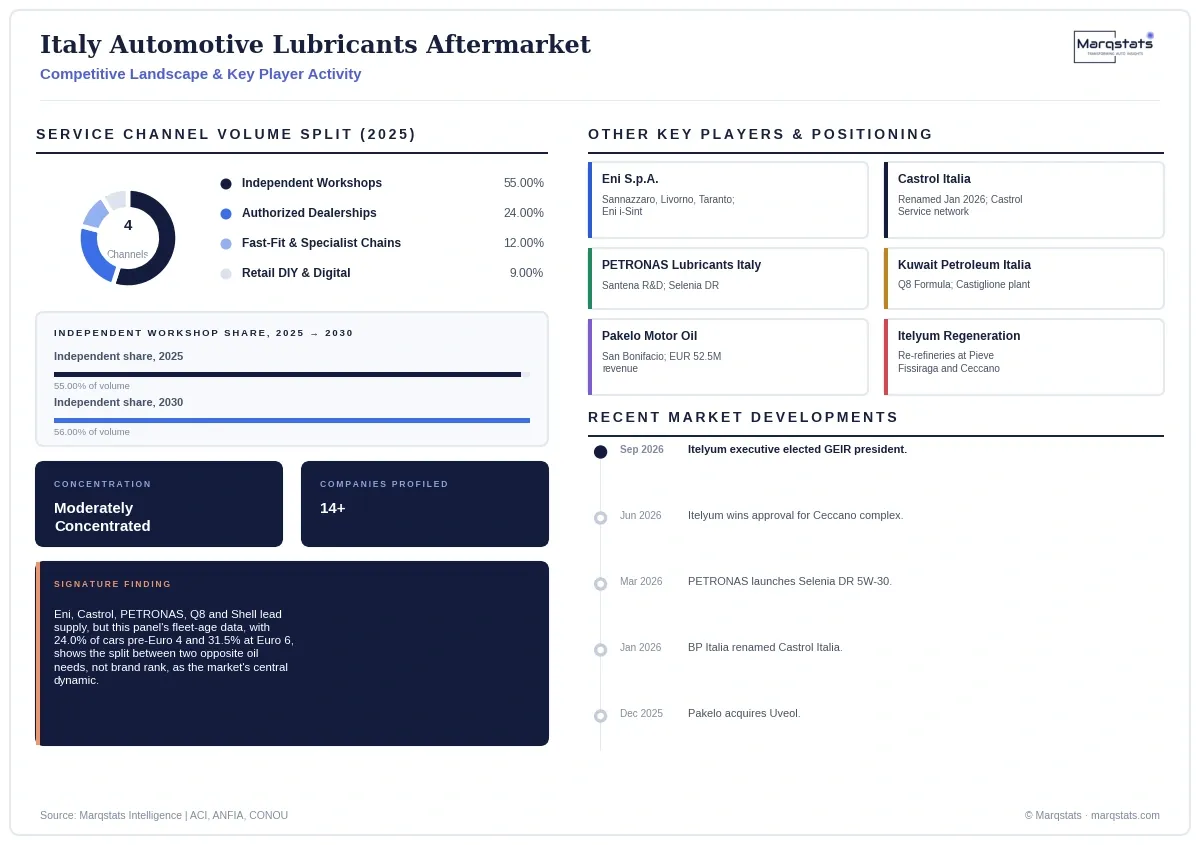
- Independent workshops take over service after the 24-to-36-month warranty window, and they hold 55.00% of volume.
Key Restraints
- Drain intervals have stretched from 15,000 km to over 30,000 km, cutting the number of oil changes per car.
- Battery electric cars are under 3.5% of the fleet in the Baseline Scenario, but a scrappage scheme with BEVs at 20% of new sales by 2028 would cut volume 1.98% a year.
- Retail DIY is only 7.00% of value, held back by disposal rules, undertray removal and electronic reset tools, limiting one growth channel.
- The market is small in litres and shrinking, so growth must come from price and mix, not volume.
Key Trends
- Dedicated fluids for alternative fuels are emerging: PETRONAS Lubricants Italy launched Selenia DR 5W-30 in March 2026 for LPG engines in DR Automobiles' range.
- Circular products advance: Itelyum won approval in June 2026 for a hydrometallurgical recycling complex at Ceccano beside its base-oil re-refinery, and its executive became president of the European re-refining group in September 2026.
- Workshop programmes gain weight: Castrol Italia, renamed from BP Italia in January 2026, is expanding its TUV-certified Castrol Service network.
- Hybrid-specific oils are arriving: PETRONAS launched Syntium CoolTech+ with a hybrid grade in February 2026 to prevent fuel dilution and cold sludge.
Strategic Implications
- New entrants should avoid commodity 10W-40 and target LPG and CNG oils, complex low-viscosity OEM-approved synthetics, and immersion-cooling and thermal fluids for hybrids and EVs, using multi-brand wholesalers such as Groupauto and LKQ Rhiag for reach.
- Incumbents should defend the independent workshop with certified garage programmes, digital inventory tools and training for Euro 6d, 6e and Euro 7 engines, and should tie supply to re-refiners such as Itelyum to market low-carbon oil to fleets.
- Additive suppliers and investors should back synthetic ester chemistry, low-viscosity friction modifiers and re-refining capacity, where 98% recovery and statutory collection protect feedstock.
- Workshop owners should stock two ranges, legacy 10W-40 for Euro 0 to 3 cars and low-SAPS 0W-20 for Euro 6, and plan for a scrappage scheme that could cut volume 1.98% a year.
- Analysts should track the scrappage programme and the 2026 review of the EU's 2035 engine rule, the two triggers that separate the Contraction and Expansion scenarios.
Outlook
The underlying research presents three scenarios tied to named regulatory and fleet triggers. All CAGRs were recomputed; the Expansion volume CAGR computes to +0.49% and not the +0.48% stated in the source.
Under the Baseline Scenario, fleet ageing continues with replacement at historical rates, Euro 7 durability rules apply without emergency scrappage, new car registrations stay between 1.55 and 1.65 million a year, average age reaches about 13.2 years and BEVs reach 8% to 10% of new registrations while staying under 3.5% of the fleet. Volume falls to 200.80 million litres, a -0.31% CAGR, and value rises to USD 1,304.56 million (EUR 1,202.36 million), a 1.59% CAGR.
Under the Contraction Scenario, a national scrappage programme funded by the recovery plan removes 1.5 million Euro 0 to 3 passenger cars, low-emission zones expand and BEVs reach 20% of new sales by 2028. Volume falls to 184.50 million litres, a -1.98% CAGR, and value reaches only USD 1,215.20 million, a 0.16% CAGR.
Under the Expansion Scenario, the EU's 2026 review of its 2035 rule permits carbon-neutral e-fuels and advanced biofuels, replacement slows, and the average car reaches 14.5 years by 2030. Rising base oil and additive costs lift the price to USD 6.65 a litre. Volume reaches 208.90 million litres, a +0.49% CAGR, and value reaches USD 1,388.40 million, a 2.86% CAGR.
Market Segmentation
152.93 million litres and USD 874.14 million (72.50% of value) in 2025, moving to 148.59 million litres and USD 932.76 million (71.50% of value) by 2030. Over 70% of revenue; passenger car oil for gasoline, diesel and hybrid engines and heavy-duty diesel oil.
30.59 million litres and USD 192.91 million (16.00% of value) in 2025, moving to 31.12 million litres and USD 215.25 million (16.50% of value) by 2030. Automatic, dual-clutch and CVT fluids sell above USD 12.00 a litre; share of value rises to 16.50%.
16.31 million litres and USD 108.51 million (9.00% of value) in 2025, moving to 16.06 million litres and USD 117.41 million (9.00% of value) by 2030. DOT 4 and low-viscosity brake fluids and coolants; share of value steady at 9.00%.
4.07 million litres and USD 30.15 million (2.50% of value) in 2025, moving to 5.03 million litres and USD 39.14 million (3.00% of value) by 2030. A niche because of low BEV penetration, but the fastest-growing product type at about 5.4% a year.
91.76 million litres and USD 651.08 million (54.00% of value) in 2025, moving to 100.40 million litres and USD 782.74 million (60.00% of value) by 2030. The growth engine, about USD 7.10 a litre in 2025; value CAGR 3.75%.
77.48 million litres and USD 410.00 million (34.00% of value) in 2025, moving to 68.27 million litres and USD 391.37 million (30.00% of value) by 2030. Loses share as owners move to synthetics; about USD 5.29 a litre.
34.66 million litres and USD 144.63 million (12.00% of value) in 2025, moving to 32.13 million litres and USD 130.45 million (10.00% of value) by 2030. Serves older cars and the South; about USD 4.17 a litre.
118.26 million litres and USD 723.43 million (60.00% of value) in 2025, moving to 114.46 million litres and USD 769.69 million (59.00% of value) by 2030. 41.34 million cars averaging 13.0 years; share of value slips from 60.00% to 59.00%.
79.52 million litres and USD 446.11 million (37.00% of value) in 2025, moving to 80.32 million litres and USD 495.73 million (38.00% of value) by 2030. 1.21 million medium and heavy trucks with 28 to 45 litre sumps, 4.32 million light commercials, and coaches; the only class gaining volume.
6.12 million litres and USD 36.17 million (3.00% of value) in 2025, moving to 6.02 million litres and USD 39.14 million (3.00% of value) by 2030. 7.72 million motorcycles and scooters with JASO MA2 4-stroke and JASO FD 2-stroke oils; stable at 3.00% of value.
112.15 million litres and USD 663.14 million (55.00% of value) in 2025, moving to 112.45 million litres and USD 730.55 million (56.00% of value) by 2030. Multi-brand meccatronici; take over after the 24-to-36-month warranty and gain share to 56.00%.
48.94 million litres and USD 325.54 million (27.00% of value) in 2025, moving to 46.18 million litres and USD 339.19 million (26.00% of value) by 2030. Dealer service networks including Stellantis Eurorepar and Intergea hubs; share slips to 26.00%.
24.47 million litres and USD 132.63 million (11.00% of value) in 2025, moving to 26.10 million litres and USD 156.55 million (12.00% of value) by 2030. Norauto Italia and Midas; gain share from 11.00% to 12.00% of value.
18.34 million litres and USD 84.40 million (7.00% of value) in 2025, moving to 16.07 million litres and USD 78.27 million (6.00% of value) by 2030. Large retail and specialised web shops; shrinking from 7.00% to 6.00%.
By Geography
Northwest
USD 415.97 million (34.50% of value) and 69.33 million litres in 2025. Lombardy, Piedmont, Liguria and Valle d'Aosta; Euro 6 passenger cars, intense commercial logistics and corporate fleet headquarters; Eni's Sannazzaro refinery and PETRONAS at Santena and Villastellone.
Northeast
USD 313.48 million (26.00% of value) and 53.01 million litres in 2025. Veneto, Emilia-Romagna, Trentino-Alto Adige and Friuli-Venezia Giulia; heavy industrial freight and agricultural-commercial fleets; Pakelo at San Bonifacio and Itelyum at Pieve Fissiraga.
Central Italy
USD 253.20 million (21.00% of value) and 42.82 million litres in 2025. Tuscany, Lazio, Umbria and Marche; commuter cars and municipal transit fleets; Eni's Livorno blending hub and Itelyum at Ceccano.
South & Islands
USD 223.06 million (18.50% of value) and 38.74 million litres in 2025. Eight regions with a high share of Euro 0 to 4 vehicles and more mineral and semi-synthetic oil; lower mileage and stretched service intervals; Ra.M.Oil at Casalnuovo, Rilub and Eni Taranto. Value share of 18.50% compares with more than a third of the population, on the research's figure.
Po Valley and Low-Emission Zones
The Northwest and Northeast use 60.50% of the market, driven by freight on the Po Valley corridor with 35 to 45 litre truck sumps, and by low-emission rules such as Milan's Area B and Area C that speed the retirement of older vehicles.
Registration Clustering
About 40% of new long-term rental registrations sit in Trento and Bolzano for tax reasons, and resident driving there is under 4.5% of national passenger vehicle kilometres. Registration counts would overstate local demand by more than 300%, so the regional table reallocates volume to where vehicles run. No 2030 regional data is published.
How Competition Is Evolving
The research describes the market as moderately consolidated, led by integrated majors and domestic operators, but publishes no individual company shares. Brand-level shares in the independent workshop channel are proprietary and cannot be audited from any single register, so none are shown here. Positioning below is based on company facts.
Eni, an integrated Italian major with refineries at Sannazzaro, Livorno and Taranto, sells Eni i-Sint and Eni Sigma oils and is expanding bio-based lubricants. Castrol Italia, renamed from BP Italia in January 2026, has a Milan headquarters and a TUV-certified Castrol Service workshop network. PETRONAS Lubricants Italy runs a research centre at Santena and plants at Villastellone and Naples, and it is adjusting to the end of its exclusive Stellantis supply arrangement. Kuwait Petroleum Italia blends Q8 Formula at Castiglione delle Stiviere and Shell Italia sells Helix Ultra and Rimula.
Independents defend niches. Pakelo, based at San Bonifacio near Verona with EUR 52.5 million of 2025 revenue, bought the industrial specialist Uveol in December 2025 and sells racing, synthetic passenger car and food-grade oils. Motul Italia is strong in high-performance motorcycle oil, Ra.M.Oil serves independent repairers in Southern Italy, and Itelyum supplies re-refined Group I and II base oil to blenders. TotalEnergies Marketing Italia sells Quartz, Rubia and EV fluids.
Companies Covered
Companies covered in the report include:
Recent Market Activity
Table of Contents
Coverage & Segmentation
The analysis measures engine oils, transmission and driveline fluids, brake and operating fluids, and electric-vehicle and thermal fluids bought for post-sale servicing of on-road vehicles in Italy, for a 2025 base year and a 2026 to 2030 forecast, in United States dollars at a constant 1.0850 per euro. Values are ex-distributor wholesale, including statutory energy levies and consortium fees and excluding IVA. Factory first-fill, marine, aviation and industrial lubricants are excluded.
The analysis covers four segmentation dimensions, product type, formulation, vehicle class and channel, four macro-regions and 14 profiled entities. Volumes and values in each dimension partition exactly to the national totals in 2025 and 2030.