Market Snapshot
Middle bar: base-year value × (1 + CAGR), rounded to two decimals. This is a calculated illustration, not a separately researched annual estimate.
Market Size (2025, Base Year): USD 1,591.02 Million (SAR 5.97 Billion)
Estimated Value (2026): USD 1,690.65 Million
Forecast Value (2030): USD 2,174.04 Million
CAGR: 6.44% | Forecast Period: 2026 – 2030
Growth — Absolute: USD 583.02 Million
Physical Volume: 402.79 Million Litres (2025) to 499.78 Million Litres (2030), Volume CAGR 4.41%
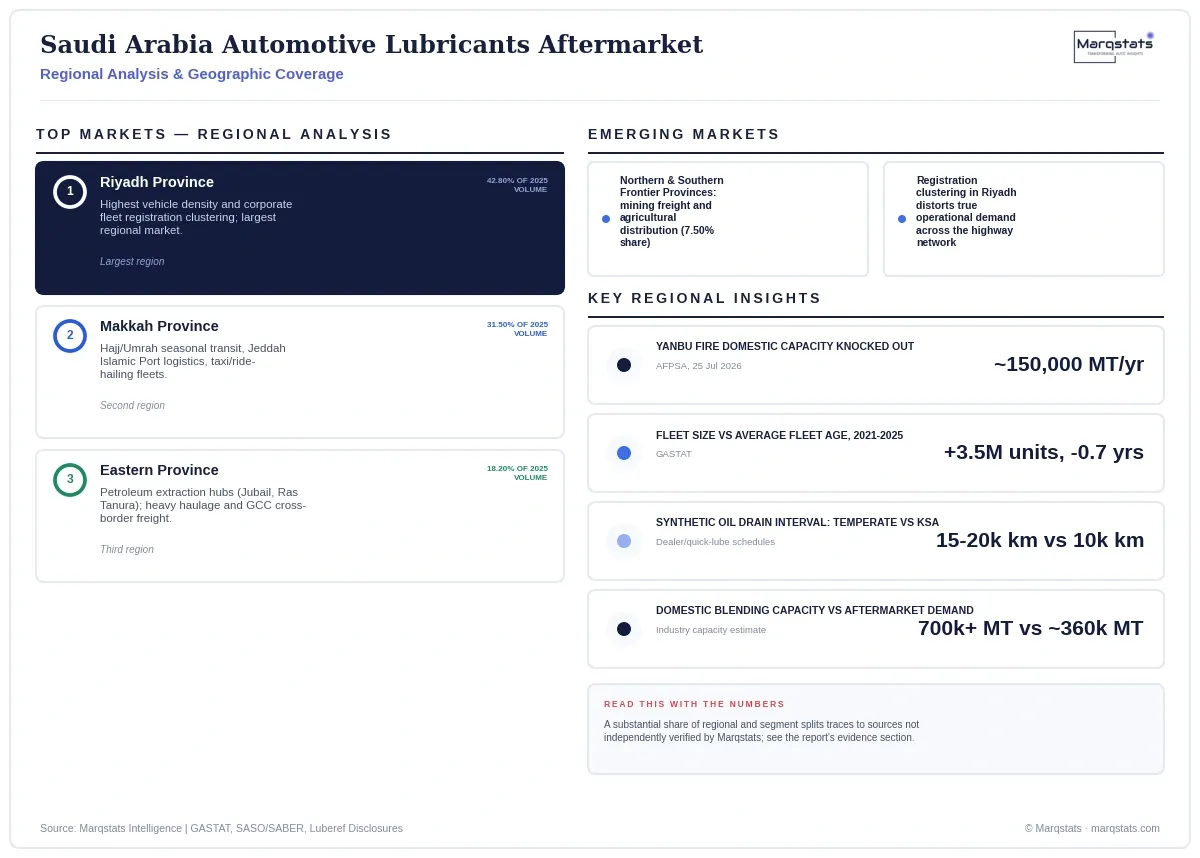
Largest Market: Riyadh Province (42.80% of 2025 volume)
Fastest Growing: Fully Synthetic Formulations (17.00% to 23.00% share, 2025-2030)
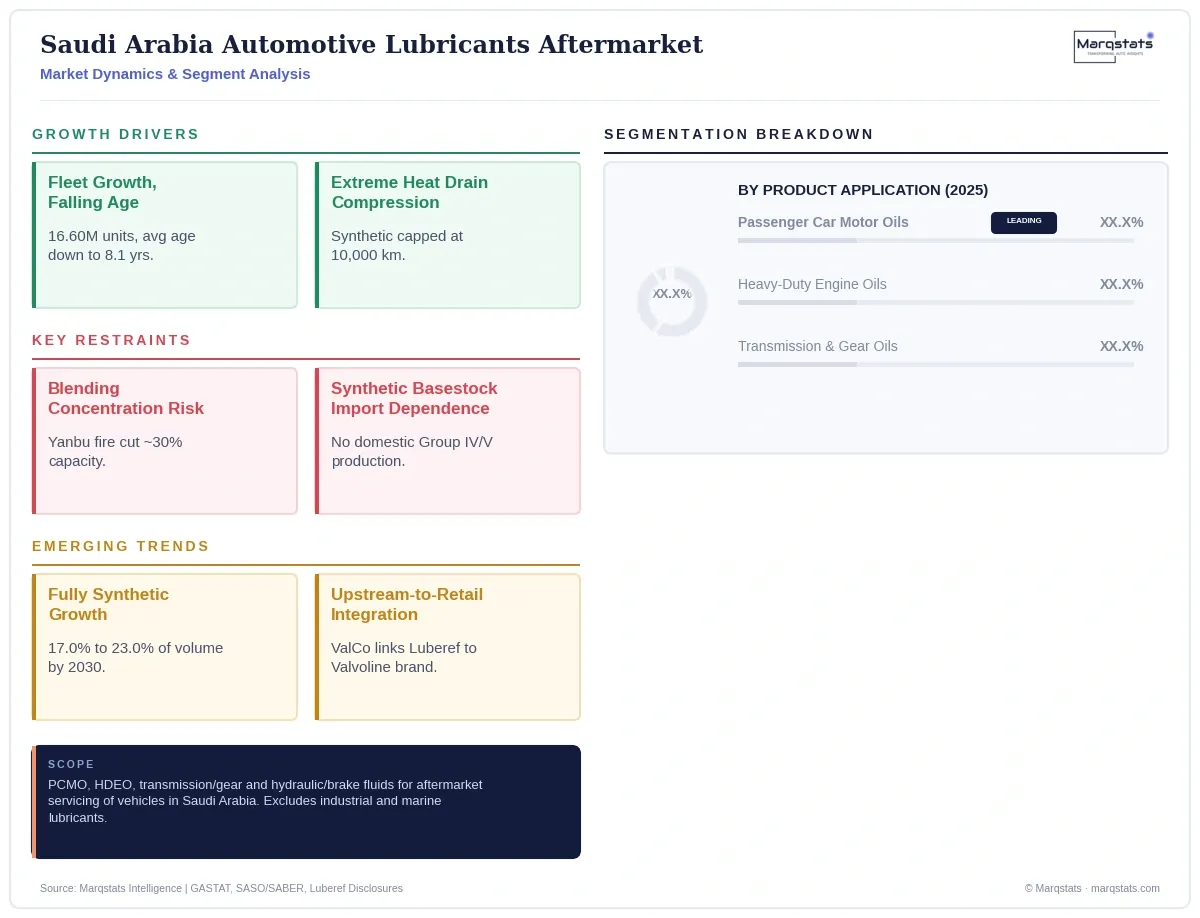
Dominant Segment: Passenger Car Motor Oils (58.46% of 2025 volume)
Market Concentration: Moderately Concentrated (Leading Domestic and JV Blenders)
Base Year: 2025 | Historical Period: 2021 – 2025 | Forecast Period: 2026 – 2030
Units Considered: Value (USD Million)
Segments Covered: 4 | Regions Covered: 4 | Companies Profiled: 7
Report Pages: 165 | Deliverables: PDF, Excel, PPT
Key Takeaways
Market Overview & Analysis
Report Summary
Saudi Arabia's lubricants aftermarket runs on some of the most concentrated blending infrastructure in the region, serving one of the fastest-growing and, unusually, youngest-trending vehicle fleets in the Middle East, under some of the harshest thermal operating conditions any lubricant formulation has to survive.
The analysis measures the value of engine oils, gear and transmission fluids, and hydraulic and brake fluids bought for aftermarket servicing of vehicles: USD 1,591.02 million in 2025. It excludes industrial and marine lubricants.
A substantial share of the market's headline sizing, segmentation and regional data traces to sources Marqstats could not independently verify; this is disclosed prominently below and in the accompanying verification log, not omitted.
The analysis is written for four readers: a blender deciding how fast to shift capacity toward synthetic formulations, a distributor assessing supply risk after a major plant fire, a fleet operator budgeting for compressed drain intervals in extreme heat, and an investor tracking three forward scenarios.
Saudi Arabia's dual role as the Gulf's largest vehicle parc and a major regional base-oil exporter makes this aftermarket a useful bellwether for lubricant demand across the broader GCC, even as its own supply chain remains concentrated enough that a single incident can remove close to a third of domestic blending capacity overnight.
A Fire That Erased Close to a Third of Domestic Supply Overnight
Concentration risk in a blending industry is usually a theoretical concern until a single incident makes it concrete. Saudi Arabia's aftermarket had exactly that moment in mid-2026.
On 25 July 2026, a fire damaged Alhamrani-Fuchs Petroleum Saudi Arabia's manufacturing and grease plant in Yanbu Industrial City. No personnel were injured, but the production and filling lines sustained extensive structural damage, forcing an indefinite suspension. The facility accounted for 150,000 metric tons of annual blending capacity and, by the report's own framing, roughly 30% of domestic lubricant volume. Fuchs SE's global parent activated regional contingency plans within days, securing third-party toll-blending arrangements and coordinating imports from regional manufacturing hubs to keep its Super GT and Titan product lines on shelves. The episode is a live demonstration of how few independent points of failure this market's supply chain actually has.
A Fleet That Is Growing and Getting Younger at the Same Time
Most mature automotive aftermarkets see fleet age rise as growth slows. Saudi Arabia is doing the opposite of both.
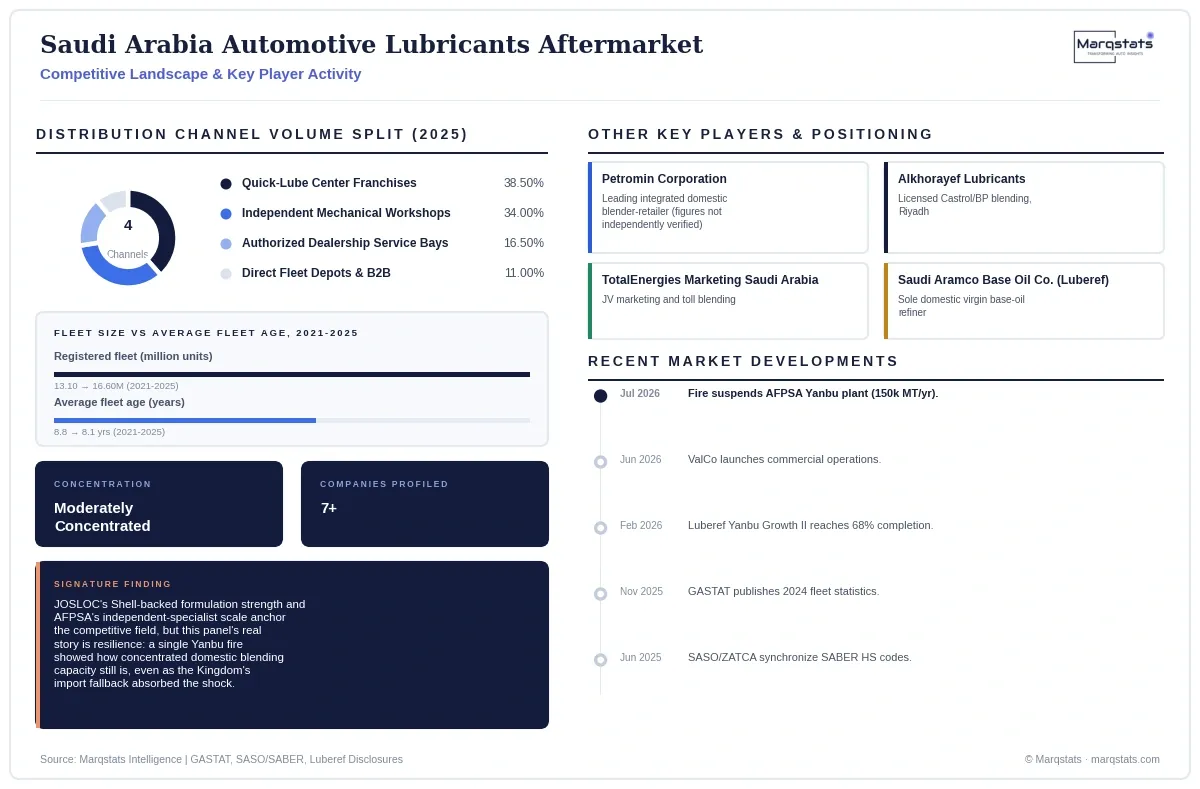
The registered vehicle fleet reached 16.60 million units in 2025, up from 15.88 million at end-2024, a 6.9% single-year expansion. Annual new vehicle registrations climbed from 805,034 to 827,544 units over the same period. At the same time, average fleet age fell from 8.8 years in 2021 to 8.1 years in 2025. A market usually has to choose between rapid growth and a stable, ageing base, or a mature market with a slowly modernizing fleet; Saudi Arabia's aftermarket is getting both a larger fleet and a younger one at once, which sustains volume growth while simultaneously pulling formulation demand toward the synthetic, OEM-specified oils newer vehicles require.
Engineered for a Climate That Halves the Oil-Change Interval
A lubricant specification written for a temperate climate does not survive a Saudi summer on the same schedule.
Summer temperatures routinely exceed 50°C across the central desert and coastal plains, driving rapid thermal breakdown, accelerated base-stock oxidation, and volatile component evaporation, while fine silica dust accelerates abrasive wear whenever air filtration is even slightly degraded. Synthetic engine oils engineered for 15,000-to-20,000-km intervals in North America or Western Europe are capped at 10,000 km by authorized dealer and quick-lube schedules in the Kingdom; standard mineral oils are replaced every 3,000 to 5,000 km. At an average 19,500 km a year, a private passenger vehicle undergoes roughly 2.1 service events annually; a commercial line-haul truck logging over 68,000 km a year needs 4 to 5 fluid replacement cycles. The operating environment itself, not just fleet size, is a structural volume driver.
Domestic Blending Capacity Runs Nearly Double What the Aftermarket Needs
A market can be self-sufficient in a raw sense and still export the majority of what it makes, and Saudi Arabia's lubricants sector shows exactly that pattern.
Profiled domestic blenders together operate more than 700,000 metric tons of annual capacity, against a domestic aftermarket of roughly 360,000 metric tons once industrial and export volumes are excluded. Luberef itself, the Kingdom's sole virgin base-oil refiner, exports roughly 70% of its output to regional markets across the Middle East, India and East Africa, with only about 30% consumed domestically by local blenders. The Kingdom runs a genuine net export surplus in base oils and finished lubricants under HS 271019, even as it maintains a structural import deficit in the specialty synthetic basestocks (Group IV PAO, Group V esters) and additive chemistry it cannot yet manufacture domestically.
A New Aramco-Backed Competitor Enters an Already Crowded Field
The Kingdom's competitive landscape just gained a well-capitalized new entrant built on a global acquisition rather than organic growth.
Saudi Aramco completed its USD 2.65 billion acquisition of Valvoline Global Operations and, in June 2026, launched Valvoline Arabia Lubricants Company (ValCo) as a commercial entity headquartered in Jeddah. ValCo directly integrates Luberef's domestic Group II base-oil production with Valvoline's global formulation portfolio, distributing through more than 185 Aramco- and TotalEnergies-branded service stations. This puts an internationally recognized retail brand behind Aramco's own base-oil supply chain for the first time, competing head-on with established domestic quick-lube and franchised dealer networks rather than entering as a pure import brand.
Two Entry Strategies for the Same Retail Real Estate
The two most consequential new competitive moves in this market took opposite structural approaches, and neither one built a new factory.
Saudi Aramco built ValCo entirely on acquisition: buying Valvoline Global Operations for USD 2.65 billion, then wiring the resulting brand directly into its own downstream retail network of Aramco- and TotalEnergies-branded stations, an instant distribution footprint no organic launch could match on the same timeline. Petromin, by contrast, built its moat through decades of physical retail investment, its own branded quick-lube network positioned to capture point-of-sale customer interaction directly rather than compete purely on formulation. Both strategies converge on the same insight: in a market where blending capacity already runs well ahead of demand, the competitive fight has moved almost entirely to who controls the point of sale, not who can blend the most oil.
What the Fire Actually Tested Was the Import Fallback, Not the Blending Loss
A domestic capacity outage this size is only a crisis if the supply chain has no external release valve, and Saudi Arabia's does.
Because the Kingdom already imports the bulk of its specialty synthetic basestocks and additive chemistry from Western Europe, North America and Asia as a matter of routine structural dependence, the toll-blending and import contingencies Fuchs activated after the Yanbu fire were an extension of an existing supply relationship, not an improvised one. That is a meaningfully different risk profile than a market with no import fallback at all: the Kingdom's structural reliance on foreign synthetic basestock and additive supply, normally framed as a vulnerability, is exactly what let one blender absorb the loss of nearly a third of national capacity without an immediate market-wide shortage.
A Regulatory Regime Built to Close the Gray Market, Not Just Set Standards
Saudi Arabia's lubricant regulation has moved past simply defining what a compliant product looks like; it is now actively closing the channels non-compliant product used to move through.
The SASO Technical Regulation for Lubricating Oils (M.A-155-16-03-01) requires a Type 3 Conformity Assessment for any finished lubricant entering the Kingdom: accredited laboratory testing combined with periodic factory audits of the blending facility itself, administered digitally through the SABER platform, which issues a Product Certificate of Conformity and consignment-specific Shipment Certificates verified at customs via the FASAH import portal. In June 2025, SASO and ZATCA synchronized their HS tariff codes on SABER, mandating that all Chapter 27 chemical preparations and finished motor oils clear accredited Type 3 documentation before customs release, a change the pack credits with closing gray-market overland import channels and shifting volume back toward fully certified domestic blenders. Bilingual labeling rules under GSO 1810 add a second layer: mandatory Arabic or bilingual disclosure of origin, viscosity grade and verified API/ACEA performance claims, enforced through retail and customs packaging inspection with market-sweep confiscation authority.
Market Dynamics
Key Drivers
- A vehicle fleet expanding nearly 7% a year while simultaneously getting younger sustains both volume growth and a shift toward OEM-specified synthetic formulations.
- Extreme ambient heat and fine silica dust compress drain intervals well below temperate-climate norms, structurally lifting service frequency.
- Vision 2030-linked infrastructure and logistics expansion is driving commercial vehicle and heavy-duty engine oil demand faster than passenger car demand.
- SASO/SABER Type 3 conformity enforcement and June 2025 ZATCA HS-code synchronization are closing gray-market import channels, shifting volume toward certified domestic blenders.
- Domestic Group II/III base-oil capacity expansion at Luberef's Yanbu Growth II project is reducing import dependence for modern low-viscosity synthetic formulations.
Key Restraints
- Concentrated blending infrastructure creates real single-point-of-failure supply risk, as demonstrated by the July 2026 Alhamrani-Fuchs Yanbu fire.
- Complete domestic dependence on imported Group IV/V synthetic basestocks and performance additive chemistry exposes blenders to foreign-exchange and global-supply-chain risk.
- The Accelerated Net-Zero Downside scenario's municipal ICE bans and mandatory re-refined base-oil content requirements would compress virgin base-oil crack margins if enacted on schedule.
- Independent workshop consolidation pressure from municipal zoning and SASO quality-compliance sweeps is reducing the number of low-cost mineral-oil retail points.
Key Trends
- Fully synthetic formulations are growing fastest of any formulation category, expanding at 10.92% a year as mineral oils contract.
- Ultra-low-viscosity 0W-16/0W-20 grades are the fastest-growing viscosity class, driven by SEEC fuel-economy standards and hybrid powertrain adoption.
- Quick-lube franchise networks are capturing a growing share of volume from traditional independent Sanaiya workshops as consumers shift toward convenience and transparent pricing.
- Aramco's downstream integration, from Luberef base oils through ValCo's retail brand, signals a broader trend of upstream players moving into consumer-facing lubricant distribution.
Strategic Implications
- New entrants should avoid greenfield blending capacity, given that installed capacity already runs nearly double domestic aftermarket demand, and should instead pursue toll-blending agreements and distribution concessions with organized quick-lube or dealership networks, bypassing the fragmented and margin-compressed independent Sanaiya trade entirely.
- Incumbent blenders should prioritize upgrading portfolios toward API SP/CK-4 synthetic formulations using domestic Group II/III base oils from Luberef's expanding capacity, and should build branded quick-lube footprints to defend share against ValCo and Petromin Express, both of which now combine upstream base-oil access with direct retail control.
- Fleet operators and workshop chains should build redundant supply relationships across multiple domestic blenders, given the demonstrated concentration risk from a single plant incident removing close to a third of national capacity, particularly for commercial accounts running on fixed-price annual supply tenders with no substitution clause.
- Additive manufacturers should prioritize formulations resistant to sustained temperatures above 50°C and fine silica contamination, and should partner with domestic blenders on SASO Type 3 testing to secure localized certification, since this testing requirement applies uniformly regardless of where the finished additive package itself is manufactured.
- Investors should track Luberef's Yanbu Growth II commissioning timeline and the pace of municipal zero-emission fleet mandates, the two triggers separating the three forecast scenarios, and should weigh the demonstrated concentration risk in domestic blending capacity when assessing supply continuity for any single-source commercial agreement.
Outlook
The underlying research presents three scenarios tied to named freight-logistics and decarbonization triggers.
Under the Base Scenario, the vehicle fleet expands to 20.6 million units by 2030, synthetic share reaches 23.0% of volume, and EV penetration stays under 2.5% of the total parc. Volume reaches 499.78 million litres, a 4.41% CAGR, and value reaches USD 2,174.04 million (SAR 8.15 billion), a 6.44% CAGR.
Under the Industrial Logistics Upside scenario, full execution of the Ministry of Transport and Logistic Services' intermodal freight master plan drives commercial truck registrations up more than 8.0% annually, pushing heavy-duty engine oil to 36.0% of volume. Volume reaches 532.15 million litres, a 5.73% CAGR, and value reaches USD 2,364.86 million, a 8.25% CAGR.
Under the Accelerated Net-Zero Downside scenario, the Royal Commission for Riyadh City and the Ministry of Municipal and Rural Affairs mandate 25% battery-electric conversion for urban transit buses, municipal vehicles and last-mile delivery vans by 2028, while MWAN requires a minimum 25% re-refined base-oil content in standard commercial lubricants. Volume reaches only 468.20 million litres, a 3.06% CAGR, and value reaches USD 2,059.08 million, a 5.29% CAGR.
Market Segmentation
235.47 million litres (58.46% share) in 2025, moving to 287.67 million litres (57.56% share) by 2030, a 4.09% CAGR.
134.61 million litres (33.42% share) in 2025, moving to 169.83 million litres (33.98% share) by 2030, a 4.76% CAGR.
24.65 million litres (6.12% share) in 2025, moving to 33.19 million litres (6.64% share) by 2030, a 6.13% CAGR.
8.06 million litres (2.00% share) in 2025, moving to 9.09 million litres (1.82% share) by 2030, a 2.44% CAGR.
209.45 million litres (52.00% share) in 2025, moving to 202.41 million litres (40.50% share) by 2030, a -0.68% CAGR.
124.86 million litres (31.00% share) in 2025, moving to 182.42 million litres (36.50% share) by 2030, a 7.87% CAGR.
68.48 million litres (17.00% share) in 2025, moving to 114.95 million litres (23.00% share) by 2030, a 10.92% CAGR.
32.5% of 2025 volume, moving to 18.0% by 2030.
28.0% of 2025 volume, moving to 22.5% by 2030.
14.5% of 2025 volume, moving to 17.0% by 2030.
16.0% of 2025 volume, moving to 24.5% by 2030.
5.5% of 2025 volume, moving to 8.0% by 2030.
3.5% of 2025 volume, moving to 10.0% by 2030.
38.5% of aftermarket volume.
34.0% of aftermarket volume.
16.5% of aftermarket volume.
11.0% of aftermarket volume.
By Geography
Riyadh Province (Central)
172.39 million litres (42.80% share) in 2025.
Makkah Province (Western)
126.88 million litres (31.50% share) in 2025.
Eastern Province
73.31 million litres (18.20% share) in 2025.
Northern & Southern Frontier Provinces
30.21 million litres (7.50% share) in 2025.
Registration Distortion
A substantial proportion of national commercial fleets are officially registered in Riyadh due to centralized corporate headquarters, skewing regional consumption statistics toward the capital even though those vehicles operate across the Kingdom's highway network.
How Competition Is Evolving
The Saudi lubricants market features a concentrated tier of domestic refiner-blenders and international joint ventures. Petromin Corporation is described in the source as the leading integrated domestic blender-retailer, though its specific capacity, share and station-count figures could not be independently verified beyond a single tertiary source and are withheld as numbers here; see the verification log.
Al Jomaih & Shell Lubricating Oil Company (JOSLOC), a joint venture between Al Jomaih Group and Shell plc, operates a fully automated blending facility in Riyadh with capacity exceeding 100,000 metric tons a year, supplying Shell Helix passenger car oils and Shell Rimula heavy-duty diesel oils. JOSLOC leverages Shell's global OEM approvals to secure factory-fill endorsements and service agreements with franchised dealership groups, national transport operators and premium fleet accounts.
Alhamrani-Fuchs Petroleum Saudi Arabia (AFPSA), a joint venture between the Alhamrani Group and Fuchs SE (32% equity interest), has historically held approximately 30% of historical volume share as the market's leading independent lubricant specialist, distributing its flagship Super GT and Titan brands through wholesale distributors and an affiliated footprint of over 60 Fuchs One-Stop auto centers. Its Yanbu blending complex (150,000 MT/year capacity) sustained extensive fire damage on 25 July 2026, forcing an indefinite production suspension.
Valvoline Arabia Lubricants Company (ValCo), a wholly owned Saudi Aramco subsidiary launched commercially in June 2026 following Aramco's USD 2.65 billion acquisition of Valvoline Global Operations, integrates Luberef base oils with Valvoline's global formulation portfolio across more than 185 Aramco- and TotalEnergies-branded stations. Alkhorayef Lubricants Company blends Castrol and BP products under license in Riyadh (60,000 MT/year capacity). TotalEnergies Marketing Saudi Arabia operates joint-venture marketing and toll-blending agreements through dealership networks and Sahel/TotalEnergies retail forecourts.
Companies Covered
Companies covered in the report include:
Recent Market Activity
Table of Contents
Coverage & Segmentation
The analysis measures passenger car motor oils, heavy-duty engine oils, transmission and gear oils, and hydraulic and brake fluids bought for aftermarket servicing of vehicles in Saudi Arabia, for a 2025 base year and a 2026 to 2030 forecast, in United States dollars and Saudi riyals at the pegged rate of SAR 3.75 per USD. Industrial and marine lubricants are excluded.
The analysis covers three segmentation dimensions, product application, formulation chemistry and viscosity grade, a four-region geographic split, and seven profiled entities. A substantial share of the headline sizing, segmentation, regional split, and one company's specific figures trace to sources Marqstats could not independently verify; see the verification log for full disclosure.