Market Snapshot
Middle bar: base-year value × (1 + CAGR), rounded to two decimals. This is a calculated illustration, not a separately researched annual estimate.
Market Size (2025, Base Year): USD 1,988.86 Million
Estimated Value (2026): USD 2,058.46 Million
Forecast Value (2030): USD 2,352.54 Million
CAGR: 3.42% | Forecast Period: 2026 – 2030
Growth — Absolute: USD 363.68 Million
Physical Volume: 361.61 Million Litres (2025) to 394.21 Million Litres (2030), Volume CAGR 1.74%
Largest Market: Peninsular Malaysia (79.2% of 2025 volume)
Fastest Growing: Fully Synthetic Lubricants (18.02% to 24.00% share, 2025-2030)
Dominant Segment: Engine Oils (49.84% of 2025 volume)
Market Concentration: Moderately Concentrated (Qualitative; No Shares Published)
Base Year: 2025 | Historical Period: 2021 – 2025 | Forecast Period: 2026 – 2030
Units Considered: Value (USD Million) and Volume (Million Litres)
Segments Covered: 4 | Regions Covered: 3 | Companies Profiled: 14
Report Pages: 170 | Deliverables: PDF, Excel, PPT
Key Takeaways
Market Overview & Analysis
Report Summary
Malaysia's lubricants aftermarket is bigger than its active fleet suggests and smaller than its vehicle registry suggests. It is built on motorcycles and cars that are actually driven, it is moving toward low-viscosity synthetics, and it has a counterfeiting problem in its biggest channel.
The analysis measures the value of engine oils, transmission and driveline fluids, gear oils, greases and hydraulic, brake and steering fluids bought for post-sale servicing of on-road vehicles: USD 1,988.86 million in 2025. It excludes industrial, marine and aviation lubricants. The base volume rests on one syndicated-research citation that Marqstats could not verify, and the limit runs through every figure.
The analysis is written for four readers: a blender planning for API SQ and ILSAC GF-7 grades, a workshop franchise owner deciding how to prove product authenticity, a fleet operator budgeting for heavy-duty oil after diesel subsidy reform, and an investor tracking a market where the registry overstates demand.
A Third of the Registry Is a Ghost Fleet
Any analyst who sizes Malaysian oil demand from vehicle registrations starts with the wrong number.
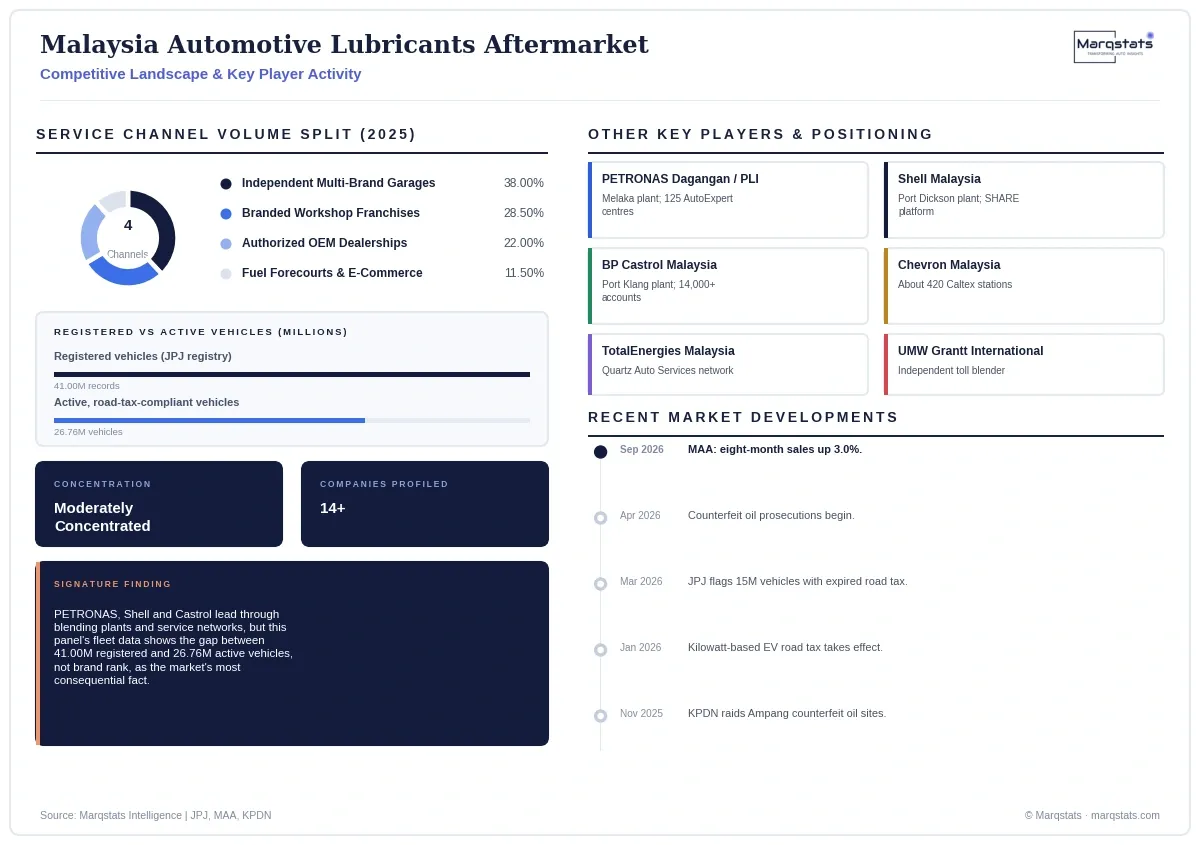
The Road Transport Department's registry holds about 41.00 million vehicle records. More than 15 million of them, 34.7% on the source's fleet table and about 37% on its text, belong to vehicles whose road tax has been expired for five consecutive years or longer. The research describes them as abandoned, scrapped, permanently unroadworthy or informally exported. The dormant share is highest for motorcycles: 9.20 million of 18.90 million records, against 4.08 million of 19.69 million passenger vehicles and 0.96 million of 2.41 million commercial vehicles. The active fleet is 26.76 million: 15.61 million passenger vehicles, 9.70 million motorcycles and 1.45 million commercial vehicles. Sizing on the registry would overstate the fleet that changes oil by about 53%.
Two-Wheelers Carry More Litres Than Cars
Cars take more oil per visit. Motorcycles visit far more often.
A commuter motorcycle takes only 0.8 to 1.2 litres, but tropical heat and stop-and-go riding cut the drain interval to 2,000 to 3,500 km, and gig-economy food and parcel delivery has raised mileage to four to six drains a vehicle a year. Passenger cars take 3.5 to 4.5 litres every 7,000 to 10,000 km. The research therefore puts motorcycles at 58.92% of engine oil, 106.19 million litres, against 28.64% for cars and 12.44% for heavy-duty vehicles. The number is an estimate: it implies far more oil per bike than the source's own drain data supports.
Fuel Subsidy Reform Is Changing the Oil
Malaysia's fuel policy is shifting which oil people buy.
On 10 June 2024 the government began replacing blanket diesel subsidies in Peninsular Malaysia with a floating price and targeted support, and the pump price moved from RM 2.15 a litre to a market level. Commercial vehicle sales fell 14.0% in 2024 and 11.4% in 2025, to 61,654 units. Hauliers that keep running are moving from monograde SAE 40 and mineral 15W-40 to API CK-4 and FA-4 semi-synthetic 10W-30 and 5W-30, which the research says saves 1.0% to 2.5% of diesel on long-haul routes. Targeted petrol subsidy reform for high earners has raised awareness of engine friction and lifted demand for 0W-20 and 0W-16.
Counterfeit Oil Is a Channel Problem
The largest channel is also the easiest to infiltrate.
Independent multi-brand garages handle 38.0% of volume through unbranded mechanics and stockists, with credit terms and rebates that give mechanics control of the choice. That supply chain is where counterfeit oil enters. In November 2025 KPDN Selangor raided six industrial sites in Kampung Baru Ampang, arrested 42 people, 28 of them foreign workers, and seized counterfeit oil worth over RM 1.00 million. The syndicate collected spent oil, neutralised and distilled it crudely, blended it with cheap base stock and dye, and packed it in forged brand containers. Prosecutions began in April 2026 under the Trademarks Act 2019.
Where the Oil Is Sold
Regional demand splits between two Malaysias.
Peninsular Malaysia uses 79.2% of volume, 286.40 million litres, concentrated in the Klang Valley, which has the country's highest motorisation and is the testing ground for 0W-20 and API SQ products, with freight corridors along the North-South Expressway and to Singapore. East Malaysia uses 20.8%, 75.21 million litres, of which Sarawak has 40.50 and Sabah and Labuan 34.71. Four-wheel-drive pickups such as the Hilux, D-Max and Triton, plantation and logging trucks, and prime movers dominate its fleet, so heavy-duty oil, driveline fluids and greases weigh more, and coastal shipping adds distribution costs.
What the Evidence Does and Does Not Show
The headline is transparent. Several inputs are not verified.
The national volume rests on a single syndicated-research source and is not independently verified. The regional table adds to 108% of the national total and is cited to an unrelated report, so only the Peninsular and East Malaysia split is used. The motorcycle and car oil split does not reproduce from the source's own drain data. Company market shares in the source trace to the same single source and are not shown. None of this changes the direction of the trends, which rest on registry, sales and enforcement facts. It does limit how precisely the size can be quoted.
Why Dealers Lose Most Customers by Year Five
Warranty ties vehicles to dealers, and then it stops.
Authorised three-S and four-S centres handle 22.00% of volume. Warranty terms require owners to service at franchised facilities for five to seven years to keep powertrain cover, and dealers supply only OEM-branded oil, blended under toll agreements by the major marketers. After warranty, more than 70% of owners move to independent or branded workshops by year five to avoid the labour premium. Branded franchises, at 28.50% of volume and the fastest-growing channel, target vehicles aged three to ten years and sell provenance assurance without the dealer's labour rates.
Waste-Oil Rules Close a Loophole
Regulation is also part of the anti-counterfeit response.
Spent lubricating oil is Scheduled Waste SW 305 under the Environmental Quality (Scheduled Wastes) Regulations 2005. Workshops, fleet depots and dealers must store it in bunded, impermeable containment and consign it only to licensed recovery facilities, and every consignment must be logged in the Electronic Scheduled Waste Information System. The research says this closes routes that once supplied used oil to illicit blenders. The Ampang syndicate collected spent oil, so tracking it is a supply-side control on counterfeiting.
Hybrids Keep the Engine, Electrics Remove It
The electrified fleet is growing, but the two kinds do opposite things to oil demand.
Combined hybrid and battery electric registrations rose 52.0% in 2025 to 69,363. Battery electric cars more than doubled to 30,848 ahead of the 31 December 2025 end of import and excise duty exemptions on fully built-up imports, and the Malaysian Automotive Association projects 49,000 for 2026. Hybrids grew 25.0% to 38,515, keeping a combustion engine that needs low-viscosity oil, and are projected at 51,000. From 1 January 2026 the electric road tax moved to a kilowatt scale, from RM 40 a year for a 70 kW compact car to RM 615 to RM 1,065 for vehicles above 300 kW. In the Base Case, electrified vehicles reach 18% to 20% of new sales by 2030 and combustion and hybrid engines stay above 92% of the active fleet.
Market Dynamics
Key Drivers
- Record new vehicle sales, 820,752 in 2025, and a growing active fleet, 26.76 million, keep adding vehicles that need servicing.
- Delivery and gig-economy work raises motorcycle mileage to four to six oil changes a bike a year.
- Modern Perodua and Proton engines, including 1.5-litre turbo direct-injection units, require 0W-20 or 5W-30 to prevent low-speed pre-ignition.
- Fuel subsidy reform, diesel from 10 June 2024 and targeted RON95 support for high earners, pushes owners toward fuel-saving low-viscosity oils.
- Hybrid registrations grew 25.0% to 38,515 in 2025, keeping combustion engines and adding demand for low-viscosity hybrid oils.
Key Restraints
- The market rests on one syndicated-research estimate for its base volume, and the source's own usage figures do not reproduce it, so absolute size carries more uncertainty than the direction of change.
- Battery electric registrations doubled to 30,848 in 2025, and the Downside Scenario has electric vehicles above 25% of sales by 2028 and 1.2 million zero-engine-oil vehicles by 2030.
- Cost-of-living pressure leads owners to stretch drain intervals from 10,000 to 15,000 km or buy cheaper mineral and unregulated oil.
- Commercial vehicle sales fell 11.4% in 2025 after a 14.0% fall in 2024, weakening the heavy-duty replacement cycle.
- Counterfeit and illicit re-refined oil undermines brand equity and legitimate volume in the independent channel.
Key Trends
- Malaysian carmakers' models set the oil specification for the mass market: national marques Perodua and Proton took 62.3% of 2025 sales, 511,468 units, so their engine requirements shape what workshops stock.
- Branded workshop franchises are the fastest-growing channel, at 28.5% of volume: PETRONAS ran 125 AutoExpert and 18 MotoExpert centres at the end of 2025.
- Authentication is becoming a product feature: Shell uses peel-and-reveal QR labels and Castrol uses FastScan verification.
- New API SQ and ILSAC GF-7 lines are arriving: PETRONAS Syntium Supreme with CoolTech+ and Shell Helix Ultra ECT C6 0W-20 made from gas-to-liquid base oil.
- Waste-oil tracking is tightening: spent oil is Scheduled Waste SW 305 and must be logged in the eSWIS system and sent to licensed recovery facilities.
Strategic Implications
- Workshop owners should stock 0W-20 and 5W-30 for Perodua and Proton engines, a mineral or semi-synthetic grade for older bikes and vans, and buy only from authenticated supply chains.
- Marketers should size the market on the 26.76 million active fleet, not the 41.00 million registry, and target the 9.70 million active motorcycles and high-mileage commercial fleets.
- Marketers should sell verifiable total-cost-of-ownership claims, with documented 1.5% to 3.0% fuel savings from ultra-low-viscosity oils, instead of generic protection claims.
- Blenders and franchisors should expand branded workshop networks and use tamper-evident QR codes and technician loyalty programs to counter counterfeits and secure post-warranty volume.
- Fleet operators should move from monograde and mineral 15W-40 to CK-4 and FA-4 synthetic grades to offset diesel costs after subsidy reform.
- Investors should watch electric vehicle incentives under the energy transition roadmap and road-tax policy, which separate the Downside and Base cases.
Outlook
The underlying research presents three scenarios tied to named policy and economic triggers. The volume CAGRs and the Base value CAGR were recomputed and match; the Downside and Upside value CAGRs are Marqstats arithmetic on the stated endpoints.
Under the Base Case, targeted RON95 subsidies continue beside the floating commercial diesel price, new vehicle sales settle near 800,000 to 810,000 a year, electrified vehicles reach roughly 18% to 20% of new sales by 2030 and combustion and hybrid engines remain over 92% of the active fleet. Volume reaches 394.21 million litres, a 1.74% CAGR, and value reaches USD 2,352.54 million (RM 10,468.80 million), a 3.42% CAGR, with synthetics at 24.0% of volume.
Under the Upside Case, the East Coast Rail Link feeder routes, the Pan-Borneo Highway and the Johor-Singapore Special Economic Zone lift freight, GDP growth exceeds 5.2% a year, passenger sales stay above 830,000 and the active fleet passes 29.0 million by 2030. Volume reaches 412.85 million litres, a 2.69% CAGR, and value reaches USD 2,545.10 million (RM 11,325.70 million), a 5.06% CAGR, with synthetics at 28.5%.
Under the Downside Case, accelerated local assembly incentives for electric vehicles under the National Energy Transition Roadmap take them above 25% of sales by 2028 and put 1.2 million zero-engine-oil vehicles on the road by 2030, while cost-of-living pressure stretches drain intervals from 10,000 to 15,000 km. Volume reaches 374.52 million litres, a 0.70% CAGR, and value reaches USD 2,120.45 million (RM 9,436.00 million), a 1.29% CAGR, with synthetics at 19.5%.
Market Segmentation
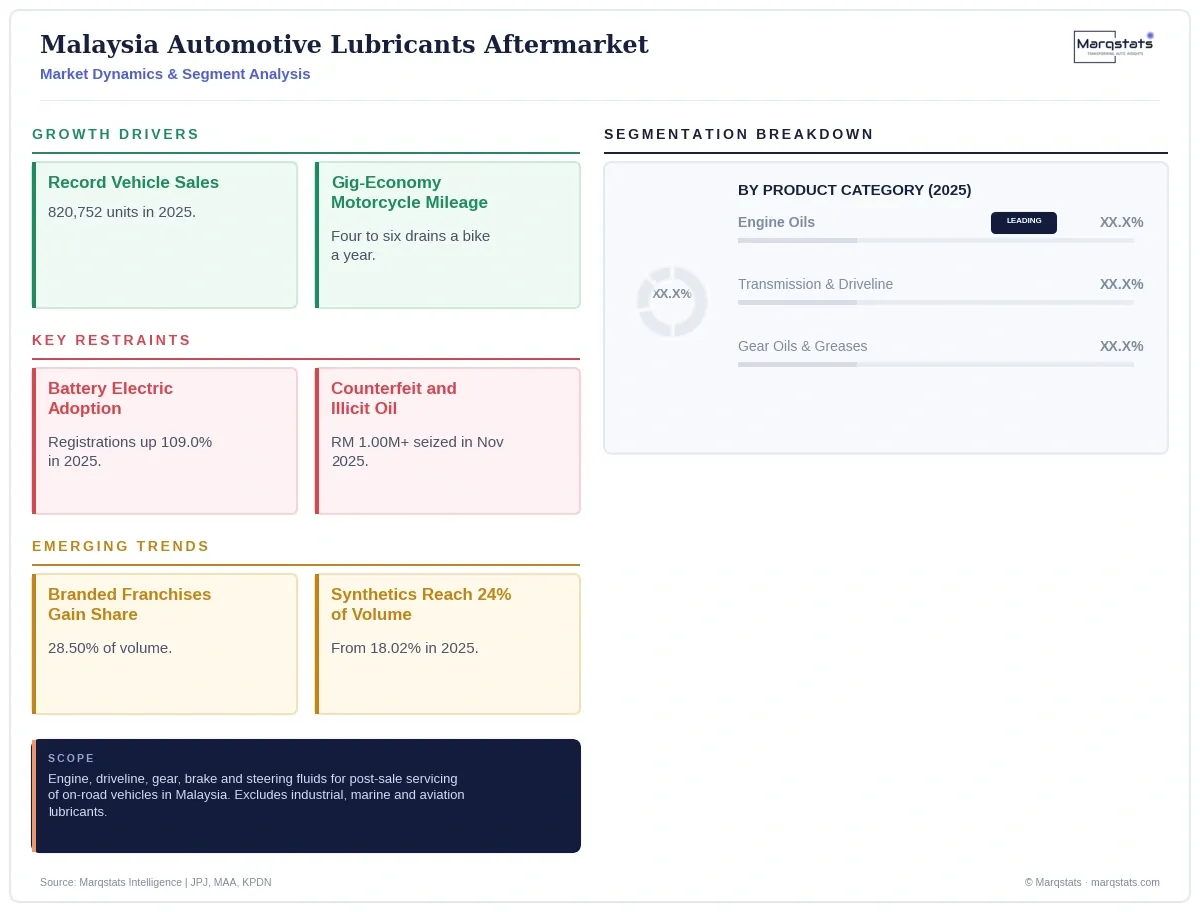
180.23 million litres (49.84% of volume) in 2025, moving to 196.20 million litres by 2030. Estimated at 106.19 million litres for motorcycles, 51.62 for passenger cars and 22.42 for heavy-duty vehicles; the split does not reconcile with the source's own drain data.
75.94 million litres (21.00% of volume) in 2025, moving to 86.12 million litres by 2030, the fastest-growing large category at about 2.5% a year (Marqstats arithmetic).
62.05 million litres (17.16% of volume) in 2025. The source gives no separate 2030 figure.
43.39 million litres (12.00% of volume) in 2025. Gear oils, greases and hydraulic, brake and steering fluids together are 111.89 million litres in 2030 (Marqstats arithmetic).
198.81 million litres (54.98% share) in 2025, moving to 185.28 million litres (47.00% share) by 2030. 15W-40, 20W-50 and SAE 40; declines 1.40% a year as older engines leave the fleet.
97.63 million litres (27.00% share) in 2025, moving to 114.32 million litres (29.00% share) by 2030. 10W-40 and 10W-30 for API SN and SP; grows 3.21% a year.
65.17 million litres (18.02% share) in 2025, moving to 94.61 million litres (24.00% share) by 2030. 0W-16, 0W-20 and 5W-30 for API SP and SQ and ILSAC GF-7; grows 7.74% a year.
15.61 million active of 19.69 million registered (58.33% of the active fleet); sump 3.5-4.5 litres; drain every 7,000-10,000 km or 6 months.
9.70 million active of 18.90 million registered (36.25%); underbones, scooters and big bikes; drain every 2,000-3,500 km or 2 months.
1.45 million active of 2.41 million registered (5.42%); rigid trucks, prime movers and vans; drain every 15,000-30,000 km.
By Geography
Peninsular Malaysia
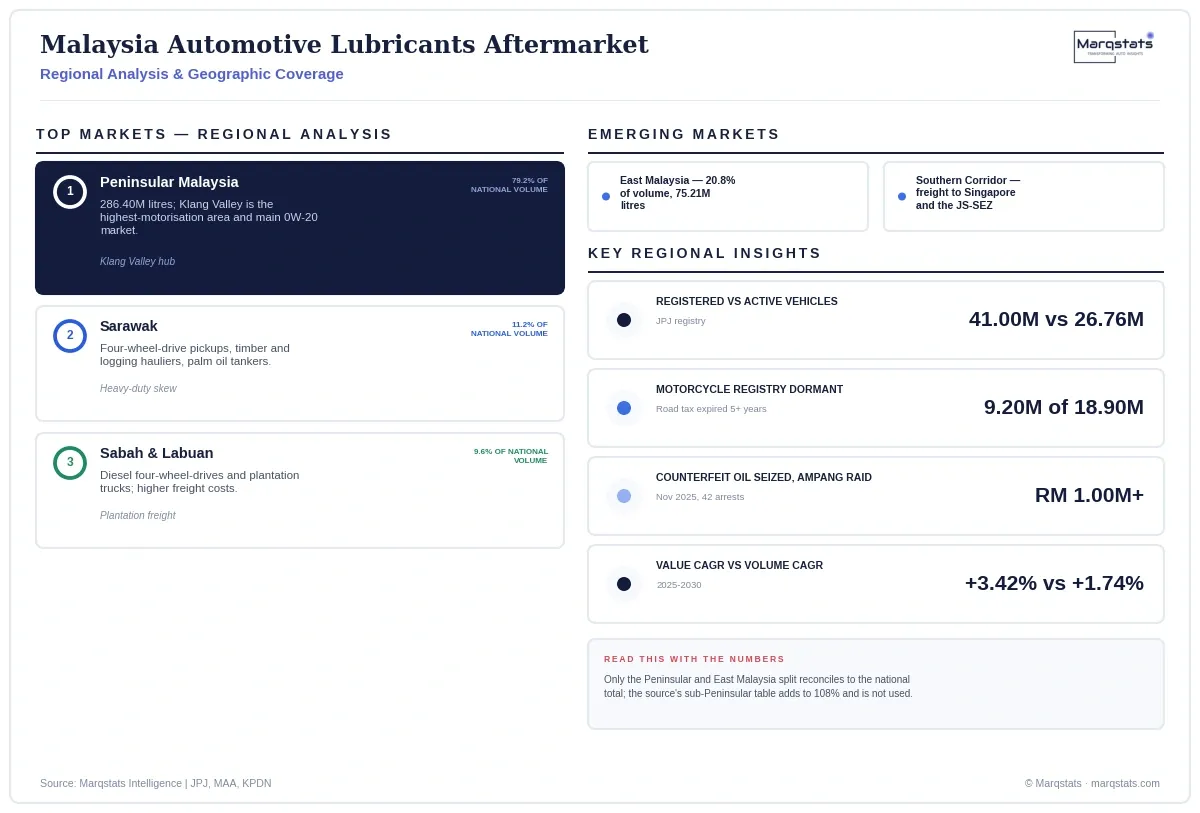
286.40 million litres (79.2% of national volume) in 2025. The Klang Valley is the highest-motorisation area in Southeast Asia and the main market for 0W-20 and 5W-30. The Northern Corridor (Penang, Perak, Kedah, Perlis) and Southern Corridor (Johor, Melaka, Negeri Sembilan) carry freight along the North-South Expressway and to Singapore, and the East Coast states use low-cost mineral motorcycle oil. The source's sub-regional volumes add to more than the Peninsular total and are not quoted.
Sarawak
40.50 million litres (11.2% of national volume) in 2025. Four-wheel-drive pickups, timber and logging hauliers and palm oil tankers, with coastal barge shipments through Bintulu and Kuching.
Sabah & Labuan
34.71 million litres (9.6% of national volume) in 2025. Diesel four-wheel-drives and plantation trucks, with remote inland logistics and higher maritime freight surcharges.
East Malaysia Overall
75.21 million litres, 20.8% of national volume. Lower statutory road-tax rates for East Malaysian vehicles reduce the tax barrier for larger diesel engines. Warehousing hubs are in Kuching, Bintulu, Sibu, Kota Kinabalu and Sandakan.
Regional Data Notes
The source's regional table cites a Marqstats connected-car report and its national shares add to 108%. Only the Peninsular and East Malaysia split, which reconciles to 361.61 million litres, is used. No 2030 regional data is published.
How Competition Is Evolving
The source describes the market as consolidated around the national oil company, multinational majors and toll blenders. Its market-share estimates trace to a single syndicated-research source and are not shown here. Positioning below rests on company facts.
PETRONAS Lubricants International runs an automated blending and filling plant in Melaka with 195,000 tonnes a year of capacity. PETRONAS Dagangan distributes through more than 1,000 stations, 800 Kedai Mesra stores, 125 AutoExpert and 18 MotoExpert centres, and reported 14.0% lubricants sales volume growth in FY2025. Shell blends at Port Dickson, uses gas-to-liquid Group III+ base oil and runs about 950 stations and the SHARE digital platform. Castrol blends at Port Klang and has over 14,000 retail and workshop accounts, with a strong motorcycle position through Activ and Power1.
Chevron sells Havoline and Delo through about 420 Caltex stations. TotalEnergies runs a Quartz Auto Services network and toll blends regionally. Independent blenders and toll manufacturers include UMW Grantt International, Posim Petroleum Marketing's Hi-Rev, Glide Technology and Idemitsu Lube Malaysia, and they supply unbranded garages, where distribution credit and mechanic incentives decide brand choice.
Companies Covered
Companies covered in the report include:
Recent Market Activity
Table of Contents
Coverage & Segmentation
The analysis measures engine oils, transmission and driveline fluids, gear oils and greases, and hydraulic, brake and steering fluids bought for post-sale servicing of on-road vehicles in Malaysia, for a 2025 base year and a 2026 to 2030 forecast, in United States dollars at RM 4.45 per dollar. Industrial, marine and aviation lubricants are excluded.
The analysis covers four segmentation views, product category, formulation, channel and active fleet, a two-part regional split and 14 profiled entities. Volumes in the formulation and product views partition to the national totals in 2025 and 2030.