Market Snapshot
Middle bar: base-year value × (1 + CAGR), rounded to two decimals. This is a calculated illustration, not a separately researched annual estimate.
Market Size (2025, Base Year): USD 583.00 Million
Estimated Value (2026): USD 612.35 Million
Forecast Value (2030): USD 745.00 Million
CAGR: 5.03% | Forecast Period: 2026 – 2030
Growth — Absolute: USD 162.00 Million
Physical Volume: 94.19 Million Litres (2025) to 113.06 Million Litres (2030), Volume CAGR 3.72%
Largest Market: Dubai (53.00% of 2025 volume)
Fastest Growing: Fully Synthetic Formulations (17.00% to 25.00% share, 2025-2030)
Dominant Segment: Passenger Car Motor Oil (55.00% of 2025 volume)
Market Concentration: Moderately Concentrated (No Published Company Shares)
Base Year: 2025 | Historical Period: 2021 – 2025 | Forecast Period: 2026 – 2030
Units Considered: Value (USD Million)
Segments Covered: 3 | Regions Covered: 4 | Companies Profiled: 8
Report Pages: 165 | Deliverables: PDF, Excel, PPT
Key Takeaways
Market Overview & Analysis
Report Summary
The UAE's lubricants story starts upstream, not downstream. Before it is a retail aftermarket at all, it is a regional base-oil refining and export hub, and that manufacturing scale shapes everything about how the domestic market is served.
The analysis measures the value of engine oils, transmission fluids and driveline gear lubricants bought for post-sale servicing of vehicles: USD 583.00 million in 2025, growing to USD 745.00 million by 2030. It excludes OEM factory first-fill, marine, aviation and industrial lubricants.
The sizing, segmentation, distribution-channel and regional chain traces to sources Marqstats could not independently verify; this is disclosed prominently below and in the accompanying verification log, not omitted, so purchasers can weigh it accordingly.
The analysis is written for four readers: a blender deciding whether to prioritise domestic retail scale or export capacity, a distributor weighing entry against ADNOC's and ENOC's forecourt networks, a fleet operator budgeting for compressed drain intervals, and an investor tracking three forward scenarios.
The UAE's dual identity, a genuine regional base-oil export hub layered under a comparatively small domestic retail aftermarket, makes this market a useful reference point for understanding how Gulf lubricant supply chains actually work beneath their consumer-facing brands, a distinction worth keeping in mind for anyone comparing headline market-size figures across Gulf countries.
A Manufacturing Hub First, a Retail Market Second
Most countries in this vertical are sized purely as consumption markets. The UAE has to be read differently, because its domestic aftermarket is a comparatively small slice of a much larger manufacturing and export operation.
ADNOC Refining's Ruwais complex alone produces 500,000 tonnes a year of Group III paraffinic base oil, the high-viscosity-index stock that underlies most modern synthetic engine oils, plus a further 100,000 tonnes a year of Group II. That output doesn't just feed the domestic ADNOC Voyager retail brand; ADNOC has separately signed a base-oil supply agreement to export to India. Layer on TotalEnergies' 225,000-tonne-a-year Jebel Ali blending plant and the toll-blending capacity concentrated in JAFZA and Hamriyah Free Zone, and the picture is clear: the UAE blends and refines lubricants at a scale calibrated to serve the Middle East, East Africa and the Indian subcontinent, with the domestic aftermarket riding alongside that infrastructure rather than driving it, a distinction that matters for anyone sizing the opportunity purely off retail consumption numbers.
A Circularity Gap Between What's Collected and What Comes Back
The UAE has built real regulatory infrastructure for used-oil collection. What happens to that oil afterward is a different story.
Federal Law No. 12 of 2018 assigns clear extended producer and generator responsibility for spent lubricants, and enforcement is genuinely active at the emirate level: Abu Dhabi's Tadweer Group requires licensed-transporter handoffs, Dubai Municipality's digital 'Rasid' platform GPS-tracks collection vehicles in real time, and Bee'ah Group manages collection concessions across Sharjah and the Northern Emirates. Despite that infrastructure, a structural circularity deficit remains: domestic hydro-processing capacity for high-tier Re-Refined Base Oil, the kind that can go back into a new engine oil formulation, is limited. Most collected spent oil instead becomes low-grade industrial burner fuel, asphalt fluxing oil, or marine bunker blending stock, genuine reuse, but not the closed-loop crankcase-to-crankcase cycle the collection infrastructure was built to enable. The bottleneck sits in processing capacity, not collection compliance, which is precisely the kind of gap a targeted infrastructure investment could close.
A Hybrid-First Electrification Path That Doesn't Cut Oil Demand
Where the UAE is electrifying fastest, oil demand isn't actually falling.
The primary vehicle electrification pathway in the UAE is the non-plug-in hybrid, not the pure battery-electric vehicle. A hybrid retains a full internal combustion crankcase that cycles on and off under frequent start-stop conditions, which is precisely the operating pattern that demands low-viscosity, fully synthetic formulations such as SAE 0W-16 and 0W-20 with specialized additive chemistry to resist moisture accumulation and fuel dilution. Because average vehicles in the UAE remain in service for around a decade, and BEVs represented only a small fraction of the active road parc at year-end 2025, the near-term effect of electrification on aftermarket lubricant volume is closer to a formulation shift than a demand collapse: hybrid adoption supports higher value realization per litre while broadly maintaining engine oil replacement volume, a pattern likely to persist for several more years.
Dubai's Taxi Fleet Went Electric Before the Rest of the Market Had To
Regulatory mandates in the UAE don't wait for the broader market to catch up when a specific fleet segment is easy to control directly.
The Dubai Roads and Transport Authority mandated that all municipal taxis transition to hybrid, electric or hydrogen drivetrains, a directive the RTA could enforce directly because it licenses and regulates the taxi fleet itself, unlike the broader privately owned passenger parc. ADNOC Distribution has moved in parallel, operating 402 fast and super-fast EV charging points across its station network with a target of 500 to 750 by 2028. This is a useful preview of how targeted, directly-regulated fleet segments electrify well ahead of market-wide adoption curves, and a signal for where dedicated e-transmission and immersion-cooling fluid demand will concentrate first, well before it becomes a mainstream aftermarket product line.
Two Retail Networks, One Playing Offense on Base Oil Supply
ADNOC's and ENOC's forecourt networks compete for the same customer, but only one of them controls its own upstream base-oil supply chain, and that difference shapes how each prices and expands.
ADNOC Distribution builds its Voyager brand on Group III ADbase produced at its own Ruwais refining complex, giving it a structural cost advantage from crude to crankcase and freedom to pursue export deals, such as the India base-oil supply agreement, independent of its domestic retail volume. ENOC, by contrast, blends finished lubricants at its JAFZA facility without the same scale of captive upstream base-oil production, competing instead on Dubai-centric retail density through its AutoPro fast-fit network, servicing over 300,000 vehicles annually. Both are expanding branded quick-lube capacity, but ADNOC's expansion is backed by a genuinely vertically integrated supply chain, while ENOC's rests more on distribution and service execution within its home emirate.
Why an Independent Garage in Sharjah Still Wins on Price
Organized quick-lube expansion is real, but it hasn't eliminated the economic logic that keeps independent workshops the single largest channel by volume.
Independent garages and unorganized workshops, concentrated in industrial zones like Al Quoz and Umm Ramool in Dubai, Sharjah's Industrial Areas, and Mussafah in Abu Dhabi, serve post-warranty vehicles and grey-market imports with bulk 208-litre drums of conventional mineral oil. That bulk-drum procurement model, paired with lower overhead than a branded forecourt bay, lets independents undercut organized chains on price for exactly the vehicle segment, older, post-warranty, budget-conscious, where price sensitivity is highest. Organized fast-fit chains are winning share primarily from the middle of the market, newer vehicles whose owners value the bundled inspection-and-pricing-transparency package, not from the bottom, where an independent garage's cost structure remains genuinely competitive, at least for now.
Heat, Not Mileage, Sets the UAE's Real Drain Interval
In most markets, oil-change frequency tracks distance driven. In the UAE, ambient temperature does at least as much of the work.
Manufacturer service intervals calibrated for temperate climates assume the oil spends most of its life well below the thermal stress it faces routinely in the UAE's summer months. Sustained high ambient temperatures accelerate base-stock oxidation and volatile-component evaporation regardless of how many kilometres the vehicle has actually covered since its last service, which is why authorized dealer and quick-lube schedules across the country compress drain intervals below what an identical vehicle would follow in Europe or North America. For a blender or a fleet operator, this means treating the printed OEM interval as a starting point to be shortened for local conditions, not a fixed target, and it is a structural reason aftermarket volume stays resilient even as vehicles individually travel fewer kilometres each year.
A Regulatory Regime That Restricts What Can Even Be Sold
The UAE's technical standards don't just certify quality. They actively remove outdated product tiers from the shelf entirely.
UAE.S GSO 1785-1:2019 sets baseline testing parameters, while UAE.S GSO 1785-2:2023 goes further, mandating compliance with ACEA European Oil Sequences for light-duty petrol and diesel engines alongside heavy-duty diesel standards, and explicitly restricting obsolete API performance categories, SF, SG, CC and CD among them, from the retail market entirely. This is a stronger intervention than a simple labelling requirement: it removes an entire tier of legacy mineral formulations from legal sale, compelling independent blenders serving the price-sensitive garage segment to reformulate toward modern low-ash chemistry rather than continuing to sell what the market has historically demanded at the low end.
Market Dynamics
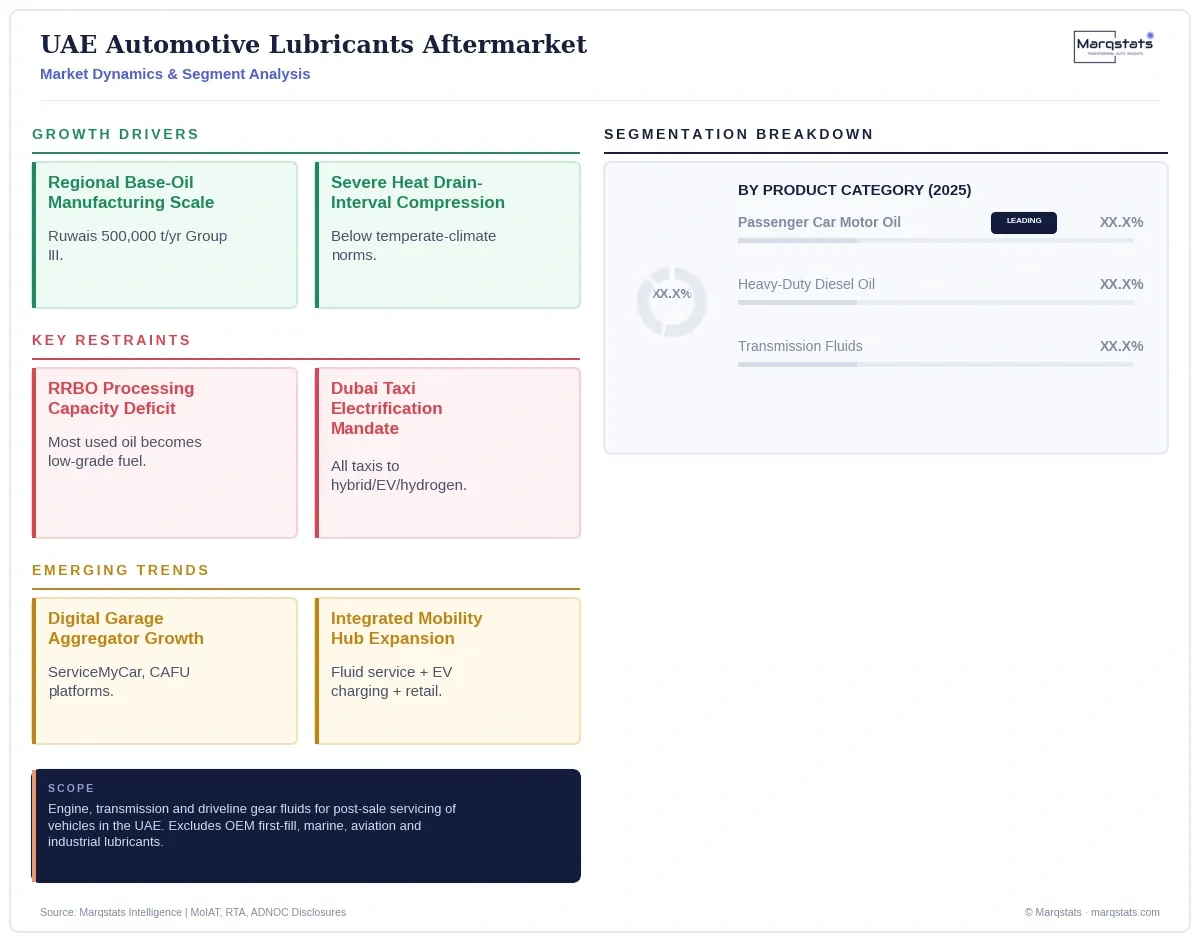
Key Drivers
- Regional base-oil manufacturing scale, anchored by ADNOC's 500,000-tonne Ruwais Group III capacity, supports both domestic supply security and export revenue, most visibly in its new base-oil supply agreement with India.
- Severe ambient heat compresses drain intervals well below temperate-climate norms, structurally lifting service frequency independent of how far a given vehicle actually travels between services.
- MoIAT's UAE.S GSO 1785-2:2023 enforcement is phasing out obsolete API SF/SG/CC/CD mineral oils, accelerating the shift toward modern low-SAPS synthetic formulations across both franchised and independent service channels.
- National oil company forecourt expansion (ADNOC, ENOC, Emarat) is consolidating volume into branded quick-lube networks with digital customer management, drawing share primarily from mid-market vehicles rather than the price-sensitive independent-garage segment.
- Hybrid-led electrification, rather than pure BEV adoption, is sustaining crankcase oil demand while shifting the product mix toward ultra-low-viscosity synthetics engineered for frequent start-stop thermal cycling.
Key Restraints
- A structural circularity deficit in domestic Re-Refined Base Oil processing capacity limits the value UAE can capture from its own collected used oil, despite genuinely strong collection compliance infrastructure.
- Targeted municipal electrification mandates (Dubai taxi fleet) will progressively remove crankcase oil demand from directly-regulated fleet segments faster than the broader privately owned passenger parc is likely to electrify.
- Registration clustering in Dubai and Abu Dhabi distorts regional demand data relative to where vehicles actually operate and are serviced, complicating inventory allocation decisions based purely on registration statistics.
- Accelerated zero-emission new-vehicle sales mandates, if enacted on the faster scenario's timeline, would compress ICE passenger mileage faster than the base case assumes, though even in that scenario absolute lubricant volume continues to expand through 2030.
Key Trends
- Digital garage aggregators and on-demand maintenance platforms (ServiceMyCar, CAFU) are emerging as a wholesale volume channel outside traditional fuel-station distribution, giving independent distributors a route to market that bypasses forecourt gatekeeping.
- National oil companies are integrating fluid-service bays with EV charging and convenience retail into broader mobility hub formats, positioning for a fleet mix that includes both combustion and electric vehicles simultaneously.
- Fleet telematics and automated fluid-analysis services are being deployed to secure sticky commercial supply agreements with large fleet operators, replacing simple price competition with a data-backed service relationship.
- ADNOC Voyager's regional export expansion, including a new North African production hub via a joint venture in Egypt targeting 3,000 retail points by year-end 2026, signals growing ambition beyond the domestic UAE market.
Strategic Implications
- International entrants should target niche high-value applications (hybrid-specific synthetics, luxury/supercar performance fluids, e-driveline lubricants) rather than competing head-on in commoditized mineral segments already controlled by national oil company forecourt networks, where scale advantages are difficult to overcome directly.
- National energy incumbents should continue expanding integrated mobility hubs combining fluid service, EV charging and convenience retail, and should pursue RRBO processing partnerships with Tadweer and Bee'ah to capture circular-economy value currently lost to low-grade fuel conversion, an investment opportunity the market has not yet closed.
- Independent toll-blenders should upgrade formulation capability toward Group III/synthetic-blend production to meet tightening MoIAT quality requirements, and should build supply relationships with digital garage aggregators to diversify beyond fuel-station channels, since MoIAT enforcement is only likely to tighten further over the forecast period.
- Investors should track zero-emission mandate enforcement timing and global crude price trajectory, the two triggers separating the three forecast scenarios, and should treat the sizing, segmentation and channel figures here with the caution disclosed in the evidence section, since the precise proportional weighting between independently-sourced and flagged-source volume is not confirmed for every table.
Outlook
The underlying research presents three scenarios tied to named electrification-policy and macroeconomic triggers.
Under the Base Trajectory scenario, population and economic growth continue steadily, EV adoption reaches roughly 15% of annual passenger vehicle sales by 2030, and severe-duty drain interval compression persists. Volume reaches 113.06 million litres, a 3.72% CAGR, and value reaches USD 745.00 million, a 5.03% CAGR.
Under the Accelerated Modernization & Electrification scenario, federal and emirate transport authorities enforce zero-emission mandates requiring a defined share of new light-vehicle registrations to be zero-emission by 2028, supported by rapid charging infrastructure deployment. Volume reaches only 106.85 million litres, a 2.55% CAGR, and value reaches USD 721.20 million, a 4.35% CAGR, as a higher fully-synthetic mix partially offsets the volumetric deceleration.
Under the Protracted ICE Logistics & Commercial Fleet Boom scenario, sustained regional freight and construction activity combined with lower global crude prices moderate EV adoption and keep internal combustion powertrains dominant. Volume reaches 118.60 million litres, a 4.72% CAGR, and value reaches USD 764.95 million, a 5.58% CAGR, as mineral-based formulations remain relatively resilient.
Market Segmentation
51.80 million litres (55.00% share) in 2025, moving to 62.75 million litres (55.50% share) by 2030, a 3.91% CAGR.
31.08 million litres (33.00% share) in 2025, moving to 36.18 million litres (32.00% share) by 2030, a 3.09% CAGR.
11.31 million litres (12.00% share) in 2025, moving to 14.13 million litres (12.50% share) by 2030, a 4.55% CAGR.
55.57 million litres (59.00% share) in 2025, moving to 54.27 million litres (48.00% share) by 2030, a -0.47% CAGR.
22.61 million litres (24.00% share) in 2025, moving to 30.53 million litres (27.00% share) by 2030, a 6.19% CAGR.
16.01 million litres (17.00% share) in 2025, moving to 28.26 million litres (25.00% share) by 2030, a 12.03% CAGR.
41.44 million litres (44.00% share) in 2025, moving to 46.35 million litres (41.00% share) by 2030.
26.37 million litres (28.00% share) in 2025, moving to 35.05 million litres (31.00% share) by 2030.
16.95 million litres (18.00% share) in 2025, moving to 20.35 million litres (18.00% share) by 2030.
9.43 million litres (10.00% share) in 2025, moving to 11.31 million litres (10.00% share) by 2030.
By Geography
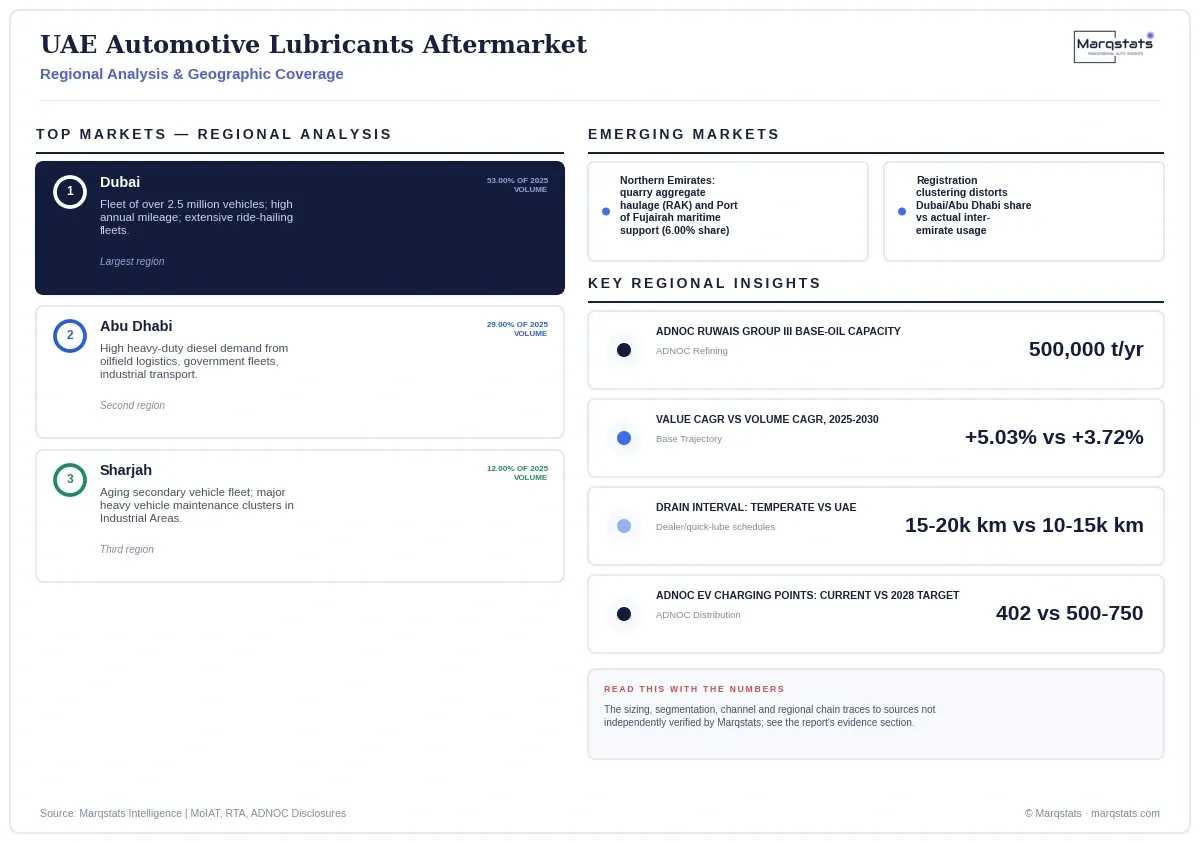
Dubai
53.00% share of national volume in 2025.
Abu Dhabi
29.00% share of national volume in 2025.
Sharjah
12.00% share of national volume in 2025.
Northern Emirates
6.00% share of national volume in 2025.
Registration Distortion
Large vehicle-leasing firms, commercial delivery fleets and multinational corporate operators routinely register vehicles centrally in Dubai or Abu Dhabi to optimize administration and fleet-licensing costs, even though actual vehicle operation and recurring maintenance frequently occur along inter-emirate transit corridors and in Sharjah and Northern Emirates workshops.
How Competition Is Evolving
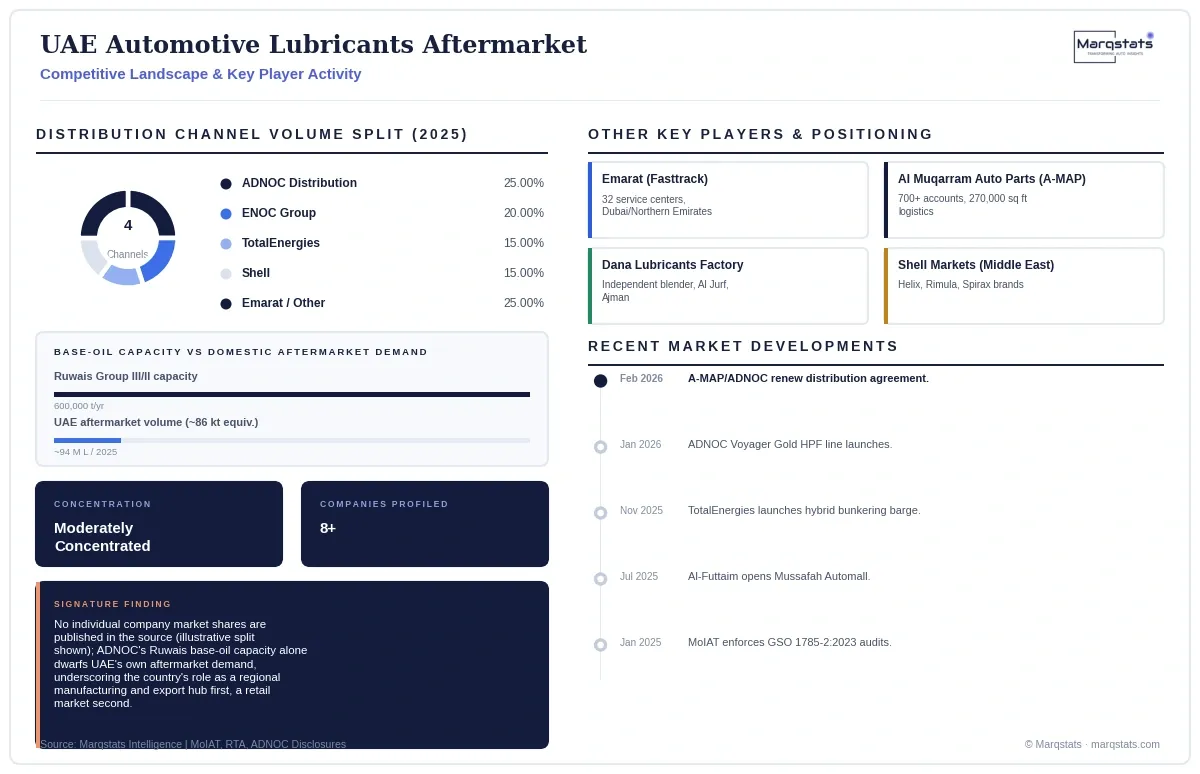
The UAE competitive landscape features strong national oil company retail networks operating alongside multinational energy majors and independent blenders. No aggregate market-share percentages are published for individual companies in the source; positioning below rests on named operational facts (station counts, capacity, dated agreements).
ADNOC Distribution, the retail arm of Abu Dhabi National Oil Company, operates 567 fuel stations and 157 dedicated lube change centers nationwide, marketing its proprietary ADNOC Voyager brand (built on Group III ADbase from the Ruwais refinery's 500,000 tonne/year capacity). It renewed its exclusive distribution agreement with Al Muqarram Auto Parts (A-MAP) in February 2026; A-MAP manages 270,000 sq ft of logistics space across 700+ third-party dealer and garage accounts and surpassed 10 million litres of domestic sales in 2025.
ENOC Group, owned by the Investment Corporation of Dubai, blends finished lubricants at its JAFZA facility and leads distribution in Dubai and parts of the Northern Emirates; its AutoPro subsidiary operates 52 locations servicing over 300,000 vehicles annually. Emarat serves Dubai and the Northern Emirates through its Fasttrack division, operating 32 service outlets.
TotalEnergies Marketing Middle East operates a 225,000 tonne/year blending plant in Jebel Ali supplying its Quartz and Rubia lines domestically and regionally. Shell, BP (Castrol), ExxonMobil and Chevron (Caltex) maintain a dual presence through regional blending infrastructure and franchised dealership supply agreements. Independent blenders, including Dana Lubricants Factory (Al Jurf, Ajman) and Star Lubricants, supply toll-blended oils and private-label formulations to the price-sensitive independent garage sector.
Companies Covered
Companies covered in the report include:
Recent Market Activity
Table of Contents
Coverage & Segmentation
The analysis measures internal combustion engine oils, transmission fluids and driveline gear lubricants bought for post-sale servicing of vehicles in the UAE, for a 2025 base year and a 2026 to 2030 forecast, in United States dollars. OEM factory first-fill, marine bunkering, aviation and static industrial lubricants are excluded.
The analysis covers three segmentation dimensions, product category, base-oil formulation and distribution channel, a four-emirate regional split, and eight profiled entities. The sizing, segmentation, channel and regional chain carries a sourcing flag; no company carries a stated numeric market share. See the verification log for full disclosure.