Market Snapshot
Middle bar: base-year value × (1 + CAGR), rounded to two decimals. This is a calculated illustration, not a separately researched annual estimate.
Market Size (2025, Base Year): USD 1,102.74 Million (Wholesale, Net of VAT)
Estimated Value (2026): USD 1,154.50 Million
Forecast Value (2030): USD 1,387.50 Million
CAGR: 4.70% | Forecast Period: 2026 – 2030
Growth — Absolute: USD 284.76 Million
Physical Volume: 158.23 Million Litres (2025) to 180.95 Million Litres (2030), Volume CAGR 2.72%
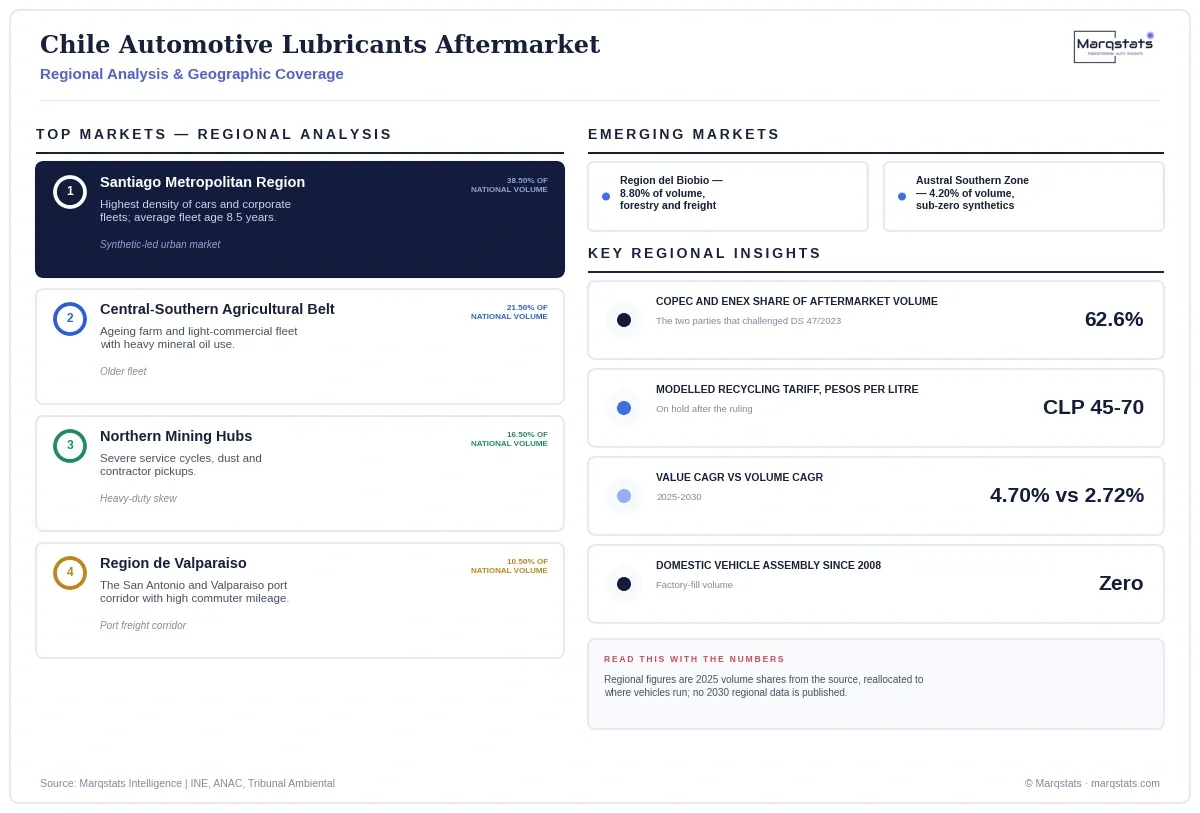
Largest Market: Santiago Metropolitan Region (38.50% of 2025 volume)
Fastest Growing: Fully Synthetic Lubricants (22.00% to 32.00% share, 2025-2030)
Dominant Segment: Passenger Cars and SUVs (46.00% of 2025 volume)
Market Concentration: Highly Concentrated (Top Three at 77.70%)
Base Year: 2025 | Historical Period: 2021 – 2025 | Forecast Period: 2026 – 2030
Units Considered: Value (USD Million) and Volume (Million Litres)
Segments Covered: 3 | Regions Covered: 6 | Companies Profiled: 14
Report Pages: 170 | Deliverables: PDF, Excel, PPT
Key Takeaways
Market Overview & Analysis
Report Summary
Chile's lubricants aftermarket grows steadily in litres and faster in value as emissions rules move workshops toward synthetics. What sets it apart is that it is a pure aftermarket: there is no domestic vehicle assembly, no factory-fill, and a downstream sector dominated by three fuel distributors that are now fighting a recycling rule in court.
The analysis measures the wholesale value of finished lubricants bought after a vehicle is sold: USD 1,102.74 million in 2025, net of VAT. It excludes stationary industrial, off-road mining, marine and aviation lubricants. It includes 158.23 million litres of aftermarket demand and treats 0.80 million litres of dealer pre-delivery top-ups as a separate layer.
The analysis is written for four readers: a blender planning for a redrafted used-oil decree, a workshop owner choosing between mineral and low-ash synthetic stock, a fleet operator budgeting for heavy-duty diesel oil as buses electrify, and an investor tracking three very different 2030 outcomes.
The Oil Sellers Who Sued to Stop a Recycling Rule
Most markets treat used-oil rules as a cost that suppliers pass through. In Chile the two largest suppliers took the rule to court and won.
Chile's Extended Producer Responsibility law designated used lubricating oil a priority product, and Decreto Supremo 47/2023, published on 11 November 2024, set collection and recovery targets starting at 50% in Year 1, 1 January 2027, and rising to 90% by Year 12. Producers and importers had to fund collective management systems. Copec and Enex, which together supply 62.6% of aftermarket volume, challenged the decree. On 7 August 2026 the Segundo Tribunal Ambiental declared it entirely void. It found that the decree's tracking rules made individual compliance systems practically impossible, although producers have a statutory right to choose between collective and individual systems, and that it gave parts distributors and retailers the power to recover used oil independently, in conflict with the underlying law. The Environment Ministry must redraft, and the modelled recycling tariff of 45 to 70 pesos per litre is on hold.
The Fee Is Small. The Control Is Not.
The number attached to the rule is small, which suggests what the dispute was about.
At 939.85 pesos per dollar, 45 to 70 pesos is about USD 0.05 to 0.07 per litre, or roughly 0.7% to 1.1% of the USD 6.97 average price (Marqstats arithmetic). The court's reasoning turned on structure: who may choose individual or collective compliance, and who may recover used oil. The source does not state the parties' motives, and this analysis does not assert them. What is clear is that the redrafted decree, which the Base Scenario expects by mid-2027 with compliance from January 2028, will decide who controls collection in a market where three firms hold 77.7% of sales.
A Market With No Factory-Fill
Chile's demand structure differs from its larger neighbours.
Chile closed its last vehicle assembly plant, General Motors in Arica, in 2008. Every new vehicle, 310,598 light and medium units in 2025, is imported as a finished unit carrying its own factory oil, so all domestic demand is replacement demand. Blenders such as Copec at Quintero and Esmax at Maipu do not have to bid for factory-fill contracts, as blenders in Brazil, Mexico and Argentina do. They compete instead for workshops, dealer service fills and fleet fuel-card accounts.
Euro 6c Is Changing What Workshops Stock
An emissions rule is changing the oil on the shelf.
Phase Two of Euro 6c took effect on 30 September 2025 for new light and medium vehicles. The engines use gasoline particulate filters, selective catalytic reduction and tight-tolerance turbochargers, and high-ash oils poison catalysts and clog filters. Workshops are therefore moving to low-SAPS oils meeting ACEA C2, C3, C5 and C6 and API CK-4 and FA-4, and to 0W-20, 0W-16 and 5W-30 grades. TotalEnergies released Quartz Ineo SDE 0W-30 in September 2026 for exactly this segment.
Two Chiles by Fleet Age
The average light-duty vehicle is 10.4 years old, but the average hides a split.
The Santiago Metropolitan Region holds 38.50% of volume and has an average fleet age of 8.5 years, so it buys 0W-20, 5W-30 and synthetic transmission fluid. Regional fleets in the agricultural south and the northern mining hubs are older, above 12.8 years in some regions, and run in rugged terrain and extreme temperatures, which keeps demand for 15W-40 and 20W-50 grades and heavy greases. The two markets are moving at different speeds within one national forecast.
What the Evidence Does and Does Not Show
The headline chain is auditable, and one segmentation dimension is less certain.
Fleet, registration and mileage inputs come from INE and ANAC, and the volume and value arithmetic reconciles. The split by oil formulation, 47.00% mineral, 31.00% semi-synthetic and 22.00% synthetic in 2025, rests partly on a citation to a competing research publisher, so the split is not independently verified and it should be read as an estimate. Regional data exists for 2025 only, brand shares are the research's estimates, and whether the tribunal ruling has been appealed is not confirmed in the source.
How Much Oil Each Kind of Vehicle Actually Uses
Fleet counts and litres tell different stories, and the sizing chain makes that visible.
A private passenger car travels 13,200 km a year and is drained about every 9,800 km, so it uses roughly 6.8 litres a year from a 4.2 litre sump. An ageing car, older than eight years, is serviced closer to every 7,500 km because oil burns and breaks down faster. A pickup or delivery van travels 28,500 km a year and uses 18.5 litres. A heavy truck travels about 95,000 km, drains 32 litres every 35,000 km on API CK-4 or FA-4 oils, and uses about 96 litres a year, more than fourteen times a passenger car. Passenger cars and SUVs are 4.465 million of the 6.58 million modelled vehicles but the heavy fleet of 268,500 trucks consumes nearly as much crankcase oil as they do.
A Volume Path Shaped by Stimulus and Credit
The 2021 to 2025 volume path is not a smooth line.
Emergency pension-fund withdrawals and fiscal transfers pushed new light-vehicle sales above 400,000 units a year in 2021 and 2022, and volume rose from 146.50 million litres in 2021 to 153.20 million in 2022. Sales then fell back to roughly 310,000 a year in 2023 and 2024, and volume slipped to 150.80 million litres in 2023 before recovering to 154.40 and 158.23 million. The ageing of the vehicle base sustained consumption through independent workshops during the downturn. The Stagnation Scenario is essentially a return to that pattern, which is why it keeps volume high and price low.
Why Dealers Keep Growing Share While Ownership Rises
The dealership channel is small but it is the only professional channel gaining share.
Dealerships hold vehicles during the first three to five years of warranty and enforce OEM-branded synthetic service fills. Their volume rises from 26.90 to 31.67 million litres, a 3.32% CAGR, lifting share from 17.00% to 17.50%, while independent workshops and forecourt bays hold their shares and parts retailers slip from 10.00% to 9.50%. OEM alliances such as TotalEnergies and Kia, and fleet leasing contracts such as TotalEnergies and Arval, support that captive volume.
Market Dynamics
Key Drivers
- The circulating fleet grew from 6,727,472 vehicles in 2024 to 6,922,500 in 2025, and new light and medium vehicle sales rose 2.7% to 310,598, which keeps replacement demand rising.
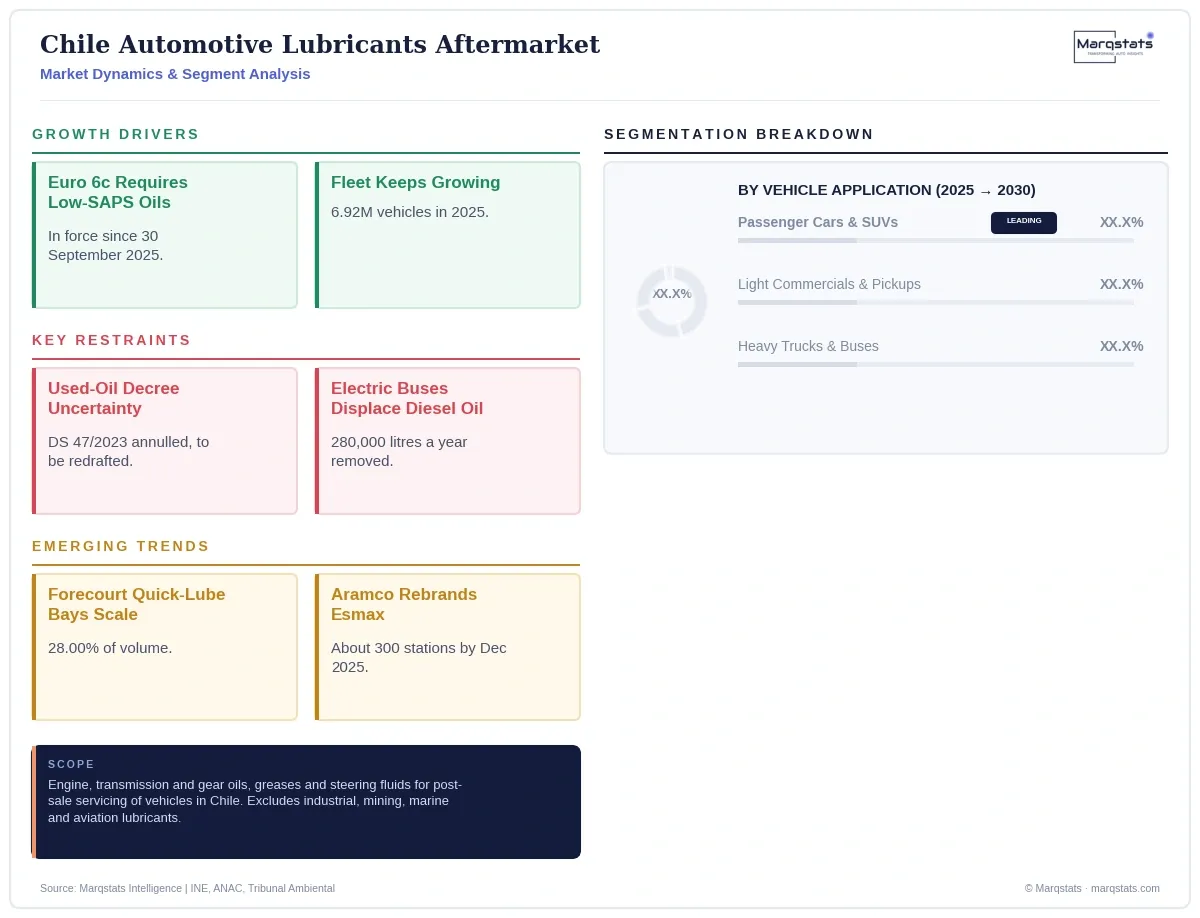
- Euro 6c Phase Two, in force since 30 September 2025, requires low-SAPS oils for particulate filters and catalysts and lifts the price per litre.
- SUVs were 51.1% of new light-vehicle sales in 2025, raising average sump capacity from 3.8 to 4.2 litres per service.
- Heavy truck sales rose 18.0% to 14,394 and bus sales 110.7% to 3,809 in 2025, expanding the base of large-sump vehicles.
- Fleet leasing contracts, such as TotalEnergies' August 2026 agreement with Arval covering over 5,000 vehicles, lock in volume for suppliers.
Key Restraints
- Longer drain intervals, 10,000 to 15,000 km on synthetics in modern vehicles, reduce the number of changes per vehicle.
- Santiago's electric bus programme, over 2,500 buses, has removed about 280,000 litres a year of heavy-duty diesel oil, and the Accelerated scenario adds low-emission zones.
- The used-oil decree's annulment creates regulatory uncertainty: producers cannot finalise collection systems or pricing until the Environment Ministry redrafts.
- The three fuel distributors hold 77.7% of volume and most forecourts, which limits room for independent importers and specialty brands.
Key Trends
- Value grows 1.98 percentage points faster than volume, from 4.70% against 2.72%, because emissions rules replace low-cost mineral oil with higher-priced synthetics.
- Forecourt quick-lube bays under Copec Lub, Shell Helix Point and Aramco AutoStop hold 28.00% of volume and use fleet fuel cards to win commercial accounts.
- Aramco's purchase of Esmax completed in early 2024, and about 300 stations were converted to the Aramco brand by December 2025.
- OEM tie-ups are spreading: TotalEnergies renewed its five-year global agreement with Kia in March 2026, making it the recommended aftermarket oil across Kia dealers in Chile.
- Environmental credentials are becoming a sales tool: Enex holds product carbon footprint certification under the HuellaChile programme and has joined the ReSimple and ProREP collective waste systems ahead of used-oil rules.
Strategic Implications
- Fleet operators should model heavy-duty oil at about 96 litres per truck a year and plan for 30,000 to 45,000 km intervals on CK-4 and FA-4 grades, while tracking where electric buses and vans replace diesel units.
- Blenders should use the 2026 to 2027 pause to build traceable collection with certified hazardous-waste handlers and to move Quintero and Maipu capacity toward Group III stocks.
- Independent importers and specialty brands should focus on lubricentros and digital wholesale, and on 0W-16, 0W-20 and low-SAPS grades that modern Asian and European imports need, rather than forecourts where three firms dominate.
- Dealerships and quick-lube centres should bundle multi-point checks, transmission fluid, differential oil and brake fluid services to offset longer intervals.
- Investors and analysts should track the Environment Ministry's redrafting timetable and any appeal, the variable that separates the three 2030 scenarios.
- Lubricentro owners should formalise used-oil disposal agreements with certified handlers, since any redrafted decree will still require traceable collection.
Outlook
The underlying research presents three scenarios tied to named regulatory and economic triggers. All three sets of endpoints, CAGRs and prices per litre were recomputed and match.
Under the Base Scenario, the Environment Ministry publishes a revised used-oil decree by mid-2027, with calibrated targets from early 2028 and workable individual systems. Euro 6c stays in force and the fleet grows 2.6% a year. Synthetics reach 32.00% of volume. Volume reaches 180.95 million litres, a 2.72% CAGR, and value reaches USD 1,387.50 million (CLP 1,304.04 billion), a 4.70% CAGR, at USD 7.67 per litre.
Under Accelerated Transformation, an expedited replacement decree in early 2027 restores the 50% collection baseline, Santiago adds low-emission zones and regional capitals buy electric buses, and commercial fleets adopt electric vans and pickups. Premium synthetics and recycling charges lift the price to USD 8.40 per litre and synthetics to 39.50% of volume. Volume reaches 172.50 million litres, a 1.74% CAGR, and value reaches USD 1,448.95 million (CLP 1,361.80 billion), a 5.61% CAGR.
Under Macroeconomic Stagnation, the used-oil regulatory gap runs past 2028, GDP growth stays under 1.5% and new-vehicle registrations stay below 280,000 a year. The average passenger car ages from 10.4 to 12.2 years and owners keep buying 15W-40 and 20W-50 mineral oils. Volume reaches 184.20 million litres, a 3.09% CAGR, but the price stays at USD 6.95 per litre and value reaches only USD 1,280.10 million (CLP 1,203.11 billion), a 3.03% CAGR. It sells the most oil and earns the least.
Market Segmentation
74.37 million litres (47.00% share) in 2025, moving to 65.14 million litres (36.00% share) by 2030. Group I and II oils such as 15W-40 and 20W-50; retreating as older engines leave the fleet.
49.05 million litres (31.00% share) in 2025, moving to 57.90 million litres (32.00% share) by 2030. Group II and III blends for owners moving out of warranty.
34.81 million litres (22.00% share) in 2025, moving to 57.91 million litres (32.00% share) by 2030. The growth engine, driven by OEM warranty rules and Euro 6c compliance.
72.79 million litres (46.00% share) in 2025, moving to 85.05 million litres (47.00% share) by 2030. The largest class, lifted by SUVs at 51.1% of new light-vehicle sales.
41.14 million litres (26.00% share) in 2025, moving to 47.95 million litres (26.50% share) by 2030. Heavy duty cycles across northern mining and southern forestry.
39.56 million litres (25.00% share) in 2025, moving to 42.52 million litres (23.50% share) by 2030. Growth of 1.45% a year, held back by electric buses on Santiago's RED network.
4.74 million litres (3.00% share) in 2025, moving to 5.43 million litres (3.00% share) by 2030. Last-mile couriers with small sumps and frequent servicing.
71.20 million litres (45.00% share) in 2025, moving to 81.43 million litres (45.00% share) by 2030. Neighbourhood presence and lower labour rates for vehicles older than five years.
44.30 million litres (28.00% share) in 2025, moving to 50.67 million litres (28.00% share) by 2030. Copec Lub, Shell Helix Point and Aramco AutoStop, backed by fleet fuel-card accounts.
26.90 million litres (17.00% share) in 2025, moving to 31.67 million litres (17.50% share) by 2030. Derco, Kaufmann and Gildemeister keep vehicles for the first three to five years.
15.83 million litres (10.00% share) in 2025, moving to 17.18 million litres (9.50% share) by 2030. AutoPlanet, Sodimac, Easy and local repuesteras; the only channel losing share.
By Geography
Región Metropolitana de Santiago
60.92 million litres (38.50% of national volume) on a motorised fleet of 2,495,000 vehicles in 2025. Highest density of cars, couriers and corporate fleets; average fleet age 8.5 years; 0W-20, 5W-30 and synthetic ATF.
Región de Valparaíso
16.61 million litres (10.50% of national volume) on a motorised fleet of 738,000 vehicles in 2025. The port corridor of San Antonio and Valparaiso with high commuter mileage; 5W-30, 10W-40 and hypoid gear oils.
Región del Biobío
13.92 million litres (8.80% of national volume) on a motorised fleet of 569,000 vehicles in 2025. Forestry transport, manufacturing and regional freight; 10W-40, 15W-40 and heavy greases.
Northern Mining Hubs
26.11 million litres (16.50% of national volume) on a motorised fleet of 884,000 vehicles in 2025. Antofagasta, Atacama, Tarapaca and Coquimbo; severe service cycles, dust and contractor pickups; 15W-40 CK-4, 5W-40 and EP greases.
Central-Southern Agricultural Belt
34.02 million litres (21.50% of national volume) on a motorised fleet of 1,675,000 vehicles in 2025. O'Higgins to Los Lagos; an ageing farm and light-commercial fleet with heavy use of mineral oils, UTTO and tractor oils.
Austral Southern Zone
6.65 million litres (4.20% of national volume) on a motorised fleet of 223,500 vehicles in 2025. Aysen and Magallanes; sub-zero conditions requiring low-pour-point synthetics.
Registration Clustering
High-income Santiago municipalities such as Providencia, Las Condes and Penalolen record 100,000 to 180,000 circulation permits a year because leasing and trucking firms base their fiscal headquarters there. The regional table reallocates volume to where the vehicles actually run. Regional 2030 volumes are not published in the source.
How Competition Is Evolving
Independent workshops, dealers and parts stores buy through different routes. Copec integrates its TCT and Copec Pago fuel-card systems with bulk lubricant contracts for freight and bus operators, Enex has 224 upa! convenience stores beside its Shell forecourts, and Esmax rebranded its convenience stores to aStop. Distribution, not brand ownership, is the barrier to entry.
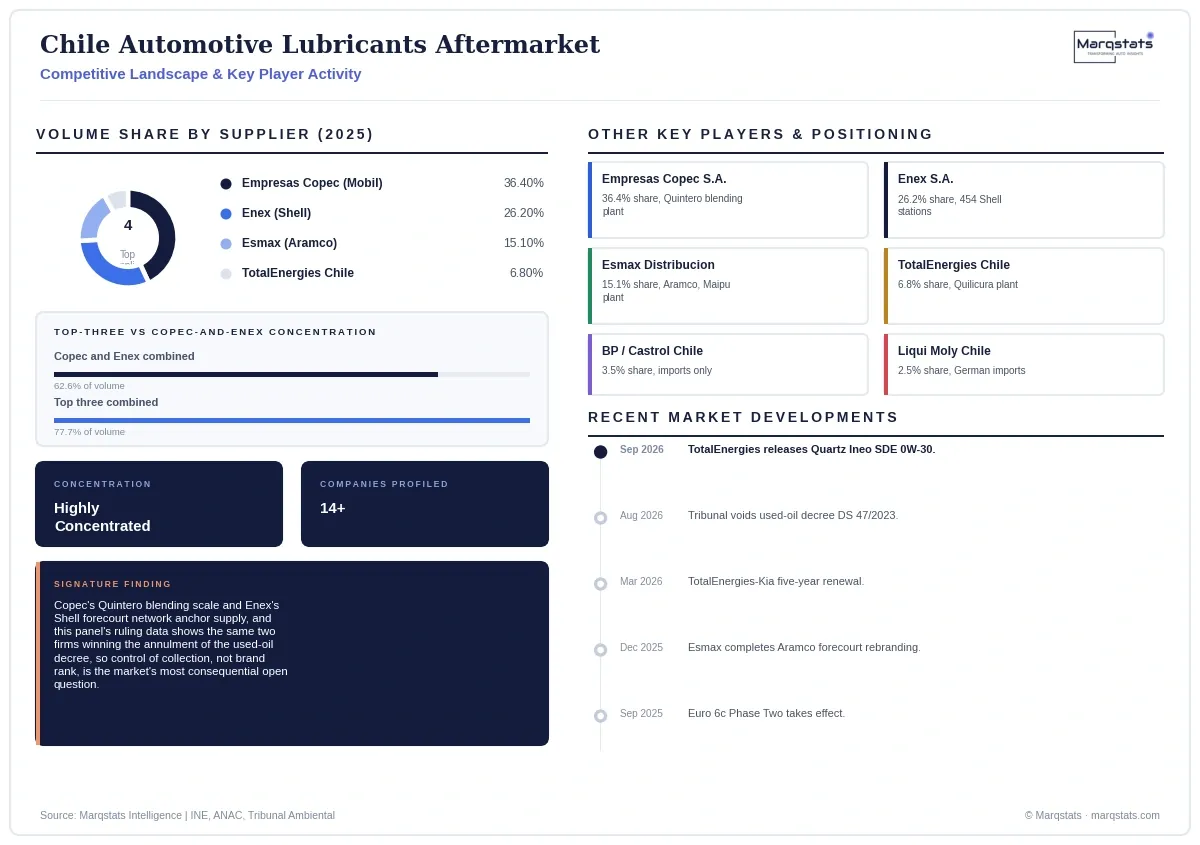
The market is a consolidated oligopoly. Empresas Copec holds 36.4% (57.60 million litres), Enex 26.2% (41.46), Esmax 15.1% (23.89), TotalEnergies 6.8%, Castrol 3.5%, Liqui Moly 2.5%, YPF Chile 2.0% and other importers and private labels 7.5%. The top three hold 77.7%, and they own imported-oil terminals, blending plants, fuel-card platforms and national forecourt networks.
Copec markets ExxonMobil's Mobil brands under an exclusive licence covering Chile, Colombia, Ecuador and Peru and blends at Quintero (about 85,000 tonnes a year). Enex is the exclusive Shell macro-distributor with 454 Shell stations. Esmax, acquired by Saudi Aramco in early 2024, blends at Maipu (over 15 million litres) and sells Aramco, Valvoline, Lubrax and Chevron. TotalEnergies blends at Quilicura and focuses on OEM partnerships with Kia and Stellantis.
Castrol and Liqui Moly import finished products with no domestic plant, and YPF supplies overland from Argentina. Because forecourts belong to the three leaders, smaller brands reach the market mainly through workshops, parts retailers and hypermarket private labels.
Companies Covered
Companies covered in the report include:
Recent Market Activity
Table of Contents
Coverage & Segmentation
The analysis measures finished engine oils, transmission and gear oils, greases and steering fluids consumed in post-sale servicing of on-road vehicles in Chile, for a 2025 base year and a 2026 to 2030 forecast, in United States dollars at 939.85 pesos per dollar. Values are wholesale, net of VAT. Stationary industrial, off-road mining, marine, power-generation and aviation lubricants are excluded.
The analysis covers three segmentation dimensions, formulation, vehicle application and channel, six regional zones and 14 profiled entities. Volumes in each dimension partition to the national total in 2025 and 2030.