Market Snapshot
Middle bar: base-year value × (1 + CAGR), rounded to two decimals. This is a calculated illustration, not a separately researched annual estimate.
Market Size (2025, Base Year): USD 270.87 Million (Ex-Distributor Wholesale)
Estimated Value (2026): USD 275.33 Million
Forecast Value (2030): USD 290.81 Million
CAGR: 1.43% | Forecast Period: 2026 – 2030
Growth — Absolute: USD 19.94 Million
Physical Volume: 54.80 Kilotonnes (2025) to 49.60 Kilotonnes (2030), Volume CAGR -1.97%
Largest Market: National (No Regional Split Published)
Fastest Growing: Ultra-Low Viscosity Oils (0W-8 to 0W-30) (38.32% to 52.42% share, 2025-2030)
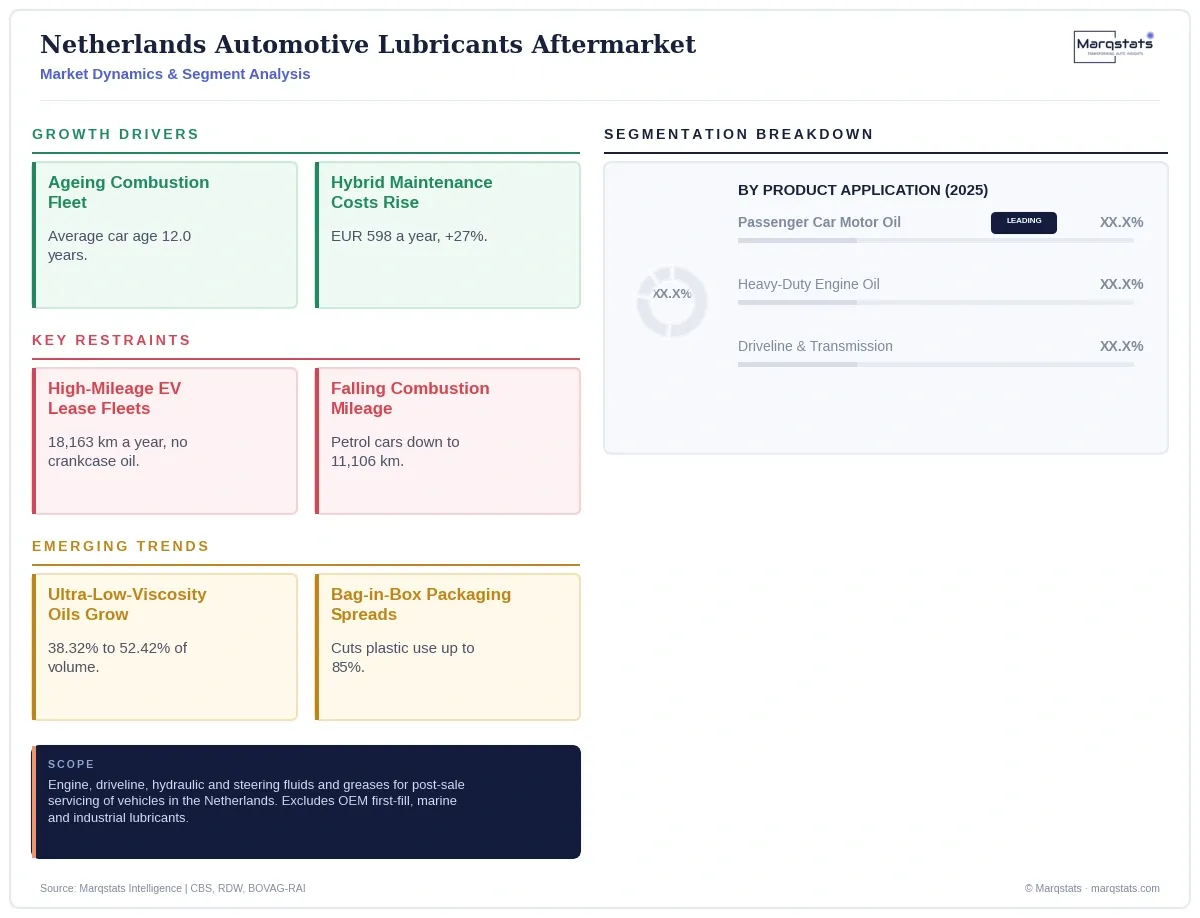
Dominant Segment: Passenger Car Motor Oil (52.01% of 2025 volume)
Market Concentration: Fragmented (No Aggregate Shares Published)
Base Year: 2025 | Historical Period: 2021 – 2025 | Forecast Period: 2026 – 2030
Units Considered: Value (USD Million) and Volume (Kilotonnes)
Segments Covered: 3 | Regions Covered: 1 | Companies Profiled: 14
Report Pages: 165 | Deliverables: PDF, Excel, PPT
Key Takeaways
Market Overview & Analysis
Report Summary
The Dutch lubricants aftermarket is shrinking in tonnage while the fleet it serves keeps growing, because the fastest-growing part of that fleet, electric vehicles in high-mileage corporate lease, needs no engine oil at all. What remains is getting more technical and more valuable per litre.
The analysis measures the ex-distributor wholesale value of engine oils, transmission and driveline fluids, hydraulic and steering fluids, and greases bought for post-sale servicing of vehicles: USD 270.87 million in 2025. It excludes OEM factory first-fill and marine and industrial lubricants, which the source shows would otherwise double the apparent market.
The analysis is written for four readers: a blender deciding how much shelf space to give ultra-low-viscosity oils, a workshop group planning for consolidation as service frequency falls, a fleet manager budgeting hybrid maintenance costs, and an investor tracking three regulatory scenarios.
A Growing Fleet and a Shrinking Oil Market
Vehicle counts and oil demand usually move together. In the Netherlands they have come apart.
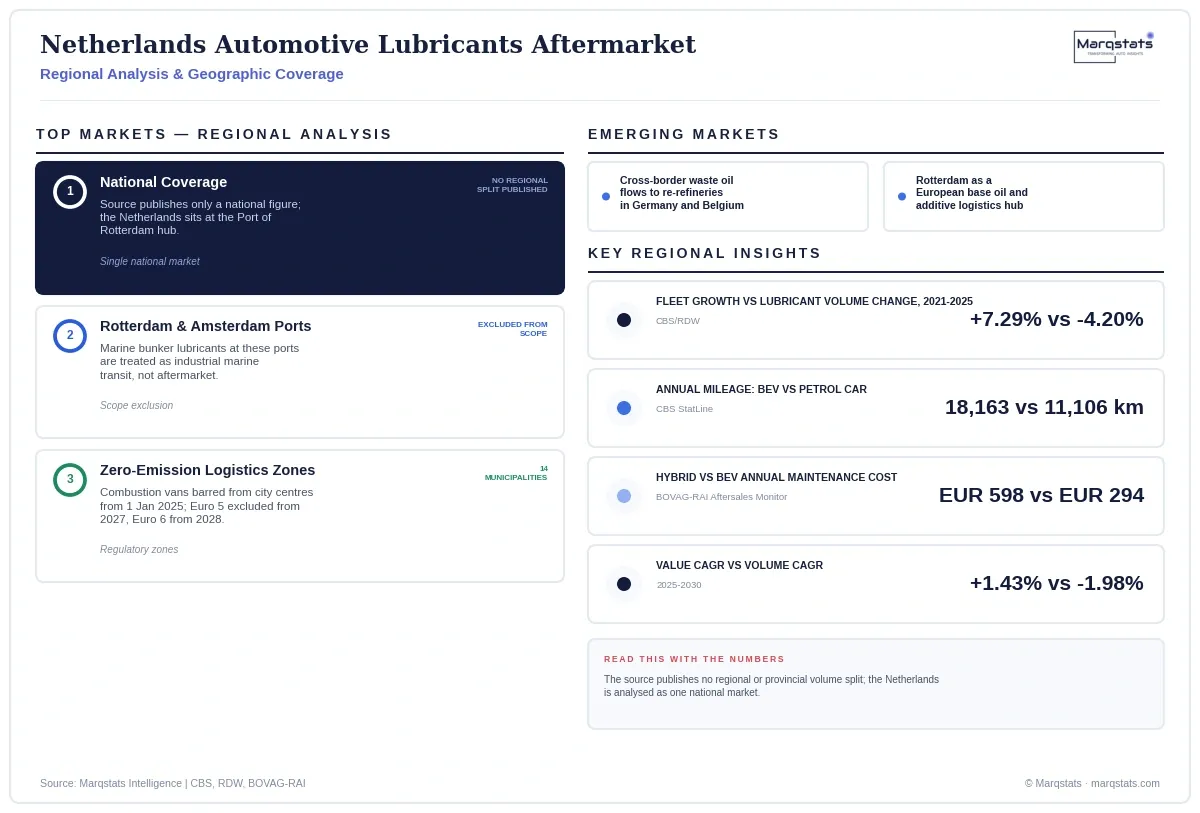
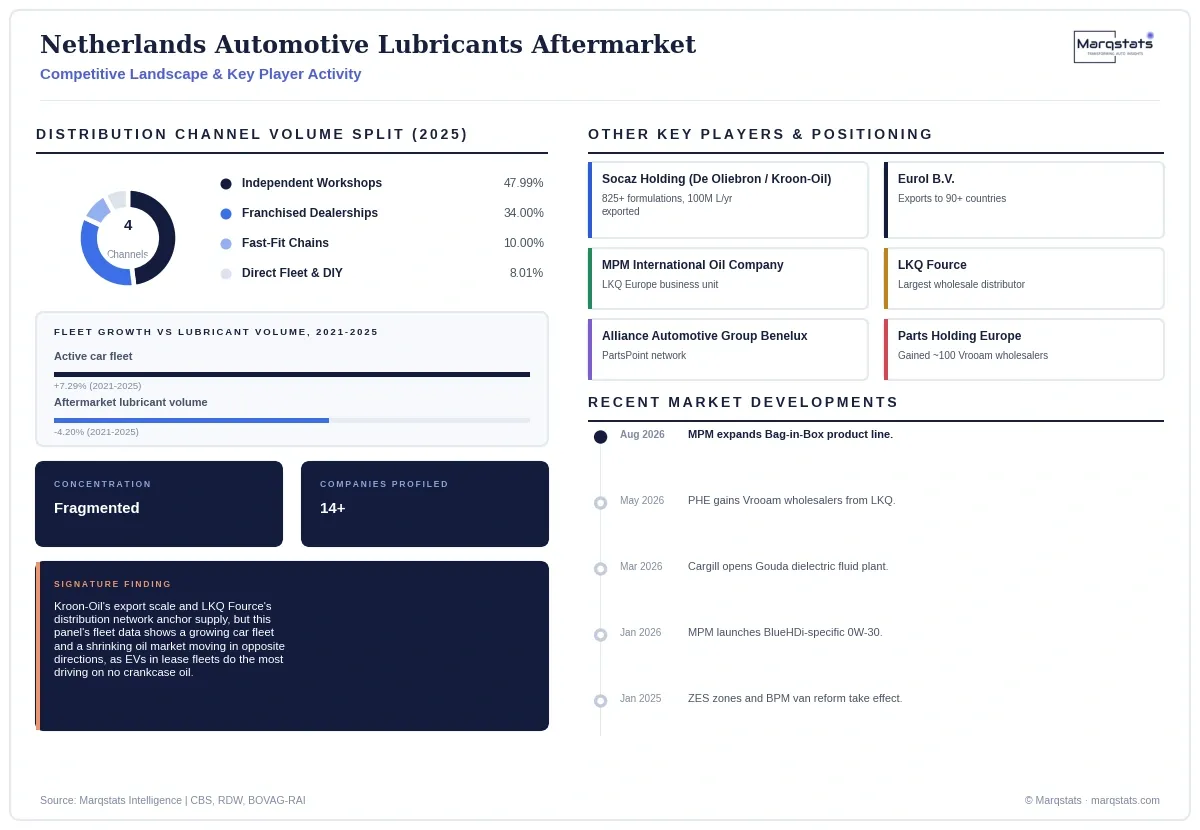
Between 2021 and 2025 the active passenger car fleet grew 7.29%, from 8.78 million to 9.42 million vehicles, while aftermarket lubricant volume fell 4.20%. CBS mileage data explains the gap. Petrol car mileage fell from 11,350 to 11,106 km a year and diesel van mileage from 18,800 to 17,600 km, while electric cars, concentrated in high-mileage corporate lease fleets, average 18,163 km a year and need no crankcase oil. The vehicles doing the most driving are the ones that buy no oil at all, and that effect will strengthen as electric vehicles grow from 5.7% of the fleet in 2025 to 16.5% by 2030.
Hybrids Are Propping Up the Workshop Bill
Electrification does not uniformly shrink workshop revenue. One powertrain raises it.
The BOVAG-RAI Aftersales Monitor found that hybrid vehicles visited workshops 1.63 times a year in 2024/2025, up 7% on 2023, and cost EUR 598 a year to maintain, 27% more than the year before. Battery-electric vehicles cost only EUR 294, about 60% below combustion cars. The dual powertrain in a hybrid needs diagnostics on both systems, thermal management checks and shear-stable 0W-20 and 0W-16 oils, and hybrids took 45.3% of new 2025 registrations, so this cost gap is becoming a structural feature of the market rather than a passing one.
A Belt Failure That Reversed a Viscosity Trend
Most of the market is moving to thinner oil. One engine family moved the other way.
Stellantis' 1.2-litre PureTech engine runs its timing belt submerged in oil. Incorrect or degraded oil can soften or swell the belt's elastomer, shedding debris that clogs the oil pickup strainer and starves the engine. Stellantis responded by re-mandating a dedicated 5W-30 specification, FPW9.55535/03, superseding the 0W-20 grade it had recommended earlier, across dealer and independent networks alike. MPM introduced a matching MPM 05000SPC 0W-30 oil for 2.2-litre BlueHDi commercial diesels in January 2026 to address the same timing-belt and particulate-filter risk in vans.
A Tax Change That Front-Loaded Then Shrank a Fleet
Fiscal policy just rewrote the commercial van replacement cycle in one year.
On 1 January 2025 the government abolished the entrepreneurial BPM tax exemption for diesel commercial vans, adding EUR 11,000 to 15,000 to the purchase cost of a new one. Buyers responded before the deadline: registrations spiked 18% in late 2024. Once the exemption ended, the LCV fleet contracted 2.7% by 1 January 2026, to roughly 1.03 million vehicles. At the same time, 14 municipalities enforced Zero-Emission Logistics Zones barring new combustion vans from city centres, pushing urban delivery fleets toward electric vans while regional freight operators extended the service lives of older Euro 6 diesels instead of replacing them.
Where the Product Line Is Heading
The formulation mix is moving in one direction, with one exception already covered above.
Ultra-low-viscosity oils, 0W-8 through 0W-30, rise from 38.32% to 52.42% of volume by 2030, driven by WLTP fuel-efficiency targets, while mainstream 5W-30 and 5W-40 synthetics fall from 43.80% to 35.48% and conventional mineral and semi-synthetic oils from 17.88% to 12.10%. These thinner oils carry a wholesale premium of 35% to 60% over mineral grades, which is a direct part of why value keeps growing as volume shrinks.
What the Evidence Does and Does Not Show
The sizing chain is transparent, including about its own limits, and the reconciliation itself is not independently verified beyond what the source states.
The source's own reconciliation section states plainly that gross national lubricant statistics would overstate the addressable aftermarket by nearly double if marine, industrial and first-fill volumes were not separated out, and shows the working. The 2030 PCMO value line is nearly flat despite a projected 15.8% volume decline, which the source does not further explain; it is reported as stated. Scenario CAGRs in USD are Marqstats conversions at the source's own constant exchange rate, not pack-stated directly, though they recompute to match.
A Duopoly Becoming a Triopoly in Wholesale Distribution
Parts distribution, not blending, is where the Dutch aftermarket's competitive fight is happening.
LKQ Fource runs the market's largest logistics operation, a 50,000 square metre automated distribution centre in Berkel en Rodenrijs using TGW Systems shuttle technology, and supports affiliated workshops under its Vakgarage and Qualitygarage concepts. Alliance Automotive Group Benelux distributes Castrol, TotalEnergies and Valvoline through its PartsPoint network alongside its own NAPA Oils & Lubricants private label. A third competitor, Parts Holding Europe, owned by D'Ieteren Group, moved from a minor presence to a serious rival in 2025 and 2026 when about 100 independent wholesalers affiliated with the Vrooam buying group switched supply agreements from LKQ to PHE's logistics platform. Whoever controls distribution controls which brand of oil reaches a given independent garage's shelf.
Circular Base Oil Is Becoming a Purchasing Requirement, Not Just an Option
Sustainability reporting law is starting to shape which base oil a fleet buys.
The EU Waste Framework Directive gives regeneration into base oil a legal preference over incineration, and Regulation (EU) 2024/1157 tightened tracing requirements for cross-border waste-oil shipments to re-refineries in Germany and Belgium from May 2024. Producing regenerated base oil this way avoids roughly 29 kilograms of crude oil extraction and cuts CO2 by about 850 kilograms per tonne of base oil against virgin processing, according to the research. As the EU's Corporate Sustainability Reporting Directive and Corporate Sustainability Due Diligence Directive phase in through 2026 to 2028, major parts distributors and fleet operators are required to report Scope 1, 2 and 3 emissions across their supply chains, which is pulling re-refined oil into mainstream commercial product lines rather than leaving it a niche.
Market Dynamics
Key Drivers
- An ageing combustion fleet, averaging 12.0 years, keeps demand for top-up and scheduled maintenance oils steady across independent garages.
- Hybrid vehicles, 45.3% of 2025 new registrations, generate 27% higher annual maintenance spend than combustion cars, sustaining workshop revenue.
- WLTP fuel-efficiency and emissions standards push OEMs toward ultra-low-viscosity 0W-16 and 0W-8 oils, which carry a 35% to 60% price premium over mineral grades.
- A wet-timing-belt failure in Stellantis PureTech engines forced a dedicated 5W-30 specification, reversing the trend toward lower viscosities in that vehicle segment.
- Extended-drain heavy-duty specifications (Scania LDF-4, Volvo VDS-4.5) sustain value in the commercial trucking segment even as volume declines slightly.
Key Restraints
- Battery-electric vehicles, concentrated in high-mileage corporate lease fleets averaging 18,163 km a year, remove crankcase oil demand faster than their share of vehicle sales alone would suggest.
- Combustion vehicle mileage is falling: petrol cars from 11,350 to 11,106 km a year and diesel vans from 18,800 to 17,600 km, reducing oil-change frequency.
- The 2025 abolition of the diesel van tax exemption and Zero-Emission Logistics Zones in 14 municipalities are accelerating commercial fleet electrification in cities.
- OEM specification fragmentation forces independent garages to stock dozens of distinct oil grades, straining working capital even as total volume contracts.
Key Trends
- Bag-in-Box 20-litre packaging is replacing 208-litre drums for slow-moving specifications, cutting plastic packaging use by up to 85%; MPM expanded its BiB line to four driveline oils in August 2026.
- Wholesale distribution is consolidating into three competing platforms: LKQ Fource, Alliance Automotive Group Benelux, and Parts Holding Europe, which absorbed about 100 Vrooam-affiliated wholesalers from LKQ in May 2026.
- Circular base oil is scaling: re-refiners such as AVISTA OIL avoid about 29 kilograms of crude oil and 850 kilograms of CO2 per tonne of base oil produced, and CSRD and CSDDD reporting rules are pulling re-refined oil into mainstream product lines.
- Dedicated EV fluids are a growing category: Cargill is investing EUR 30 million to triple bio-based dielectric battery-cooling fluid capacity at its Gouda plant.
Strategic Implications
- Blenders should expand ultra-low-viscosity and dedicated hybrid formulations, since these carry the pricing power offsetting volume decline, and should watch for further OEM specification reversals like the PureTech wet-belt case.
- Workshop groups should plan for consolidation pressure as service frequency falls with electrification, and should adopt Bag-in-Box systems to manage a widening range of specifications without tying up working capital.
- Fleet operators should budget hybrid maintenance at roughly double the cost of battery-electric servicing and plan van replacement around the BPM exemption's end and Zero-Emission Logistics Zone deadlines (Euro 5 vans excluded from January 2027, Euro 6 from January 2028).
- Waste-oil handlers and re-refiners should position for growth under CSRD and CSDDD reporting pressure, which is pulling closed-loop base oil into distributor and fleet purchasing decisions.
- Investors should track the MRB battery-electric tax discount phaseout and municipal Zero-Emission Logistics Zone enforcement, the two triggers separating the three scenarios.
Outlook
The underlying research presents three scenarios tied to named fiscal and regulatory triggers. Volume and value CAGRs were recomputed from the stated endpoints and match to within rounding.
Under the Base Case (Regulated Decoupling), the 30% MRB motor vehicle tax discount for battery electric vehicles is maintained through 2029 before phasing out, and municipal Zero-Emission Logistics Zones are enforced on schedule with standard commercial exemptions. Volume falls to 49.60 kilotonnes, a -1.97% CAGR, and value rises to USD 290.81 million (EUR 266.80 million), a 1.43% CAGR, at EUR 5,379 a tonne. Average fleet age reaches 12.9 years and hybrids capture 27.5% of the fleet.
Under the Accelerated Transition (Green Shock) scenario, enhanced fiscal incentives for used battery electric vehicles and stricter enforcement of Zero-Emission Logistics Zones without commercial exemptions speed the retirement of combustion vans. Volume falls to 44.80 kilotonnes, a -3.95% CAGR, and value falls to USD 267.27 million (EUR 245.20 million), a -0.27% CAGR, as lower service frequency reduces workshop billings and smaller independent garages exit the market.
Under the Secondary Parc Retention (Fiscal Pushback) scenario, the full phase-out of the MRB discount dampens private consumer electric vehicle adoption, while municipalities grant exemptions to Euro 6 diesel vans because of electrical grid congestion. The combustion fleet ages further, to 13.8 years. Volume reaches 53.20 kilotonnes, a -0.59% CAGR, and value reaches USD 310.11 million (EUR 284.50 million), a 2.74% CAGR, as demand for high-mileage top-up oils increases.
Market Segmentation
28.50 kilotonnes (52.01% share) and EUR 142.50 million in 2025, moving to 24.00 kilotonnes (48.39% share) and EUR 144.00 million by 2030. ACEA C5/C6, VW 508.00/509.00, BMW LL-17FE+ and Stellantis FPW9.55535/03; the largest category by volume and value, though both decline as electric vehicles grow.
14.25 kilotonnes (26.00% share) and EUR 54.15 million in 2025, moving to 13.60 kilotonnes (27.42% share) and EUR 58.48 million by 2030. ACEA E8/E11, Scania LDF-4, Volvo VDS-4.5, MAN M 3677; the most volume-resilient category, sustained by Euro VI diesel logistics fleets.
6.58 kilotonnes (12.01% share) and EUR 32.90 million in 2025, moving to 6.85 kilotonnes (13.81% share) and EUR 39.73 million by 2030. ZF Lifeguard 8/9, Dexron VI, dedicated EV e-axle synthetics; the only category growing in both volume and share.
3.29 kilotonnes (6.00% share) and EUR 11.52 million in 2025, moving to 3.10 kilotonnes (6.25% share) and EUR 15.50 million by 2030. DIN 51524 Part 3 HVLP, ISO VG 32/46, Central Hydraulic Fluid; a small, stable category.
2.18 kilotonnes (3.98% share) and EUR 7.43 million in 2025, moving to 2.05 kilotonnes (4.13% share) and EUR 9.09 million by 2030. NLGI GC-LB, lithium-complex and polyurea; includes high-speed EV motor bearing greases as a new sub-category.
21.00 kilotonnes (38.32% share) in 2025, moving to 26.00 kilotonnes (52.42% share) by 2030. Group IV PAO, synthetic esters and Group III+ GTL/hydrocracked stocks; driven by WLTP fuel-efficiency targets and carrying a wholesale price index of 1.35 to 1.60 against mainstream synthetics.
24.00 kilotonnes (43.80% share) in 2025, moving to 17.60 kilotonnes (35.48% share) by 2030. Group III severely hydrocracked petroleum base oils; the pricing baseline (index 1.00), shifting toward older, post-warranty vehicle servicing.
9.80 kilotonnes (17.88% share) in 2025, moving to 6.00 kilotonnes (12.10% share) by 2030. Solvent-refined Group I, hydrotreated Group II and re-refined base oils, priced at 0.60 to 0.75 of the mainstream synthetic baseline; remains in legacy commercial transport, agricultural equipment and vintage vehicles.
26.30 kilotonnes and EUR 114.31 million (USD 124.60 million) in 2025. The largest channel, at 47.99% of volume; captures vehicles once the manufacturer warranty expires, via networks such as Vakgarage, Bosch Car Service, Qualitygarage and James.
18.63 kilotonnes and EUR 94.43 million (USD 102.93 million) in 2025. Captures newer vehicles (0 to 6 years) and corporate lease fleets on long-term service agreements, using OEM-branded genuine oils.
5.48 kilotonnes and EUR 22.37 million (USD 24.38 million) in 2025. Standardised express servicing and tyre programmes, including KwikFit, Profile Car & Tyreservice and Euromaster.
4.39 kilotonnes and EUR 17.39 million (USD 18.96 million) in 2025. Municipal transit and logistics depot direct fills, plus retail top-up purchases by private owners.
By Geography
National Coverage
The source publishes no regional or provincial split of Dutch lubricant volume or value; the Netherlands is analysed as a single national market. It does note the Netherlands' position around the Port of Rotterdam and the Merwede and Maas river corridors as a European lubricant blending and distribution hub, with direct access to base oil shipments and multimodal logistics reaching Northwestern Europe.
Rotterdam and Amsterdam Ports
Marine bunker lubricants dispensed to inland waterway barges, coastal cargo vessels and deep-sea shipping at these ports are explicitly excluded from the automotive aftermarket scope and are treated as industrial marine transit.
Zero-Emission Logistics Zones
14 municipalities enforced Zero-Emission Logistics Zones from 1 January 2025, barring newly registered combustion commercial vans from urban centres; Euro 5 vans will be excluded entirely from 1 January 2027 and Euro 6 vans from 1 January 2028 in participating cities.
Cross-Border Waste Oil Flows
Regulation (EU) 2024/1157 strengthens tracing requirements for cross-border hazardous waste shipments to certified re-refineries in neighbouring Germany and Belgium, reflecting the Netherlands' role as a regional collection and logistics hub rather than a purely domestic system.
How Competition Is Evolving
The market splits between domestic independent blenders with deep toll-manufacturing and export positions, and multinational majors concentrated in franchised dealer channels through OEM factory-fill partnerships. The source gives no aggregate market-share percentages; positioning below rests on named company facts.
Socaz Holding, through De Oliebron (Zwijndrecht, founded 1891, one of Western Europe's largest independent toll blenders, producing over 825 formulations) and Kroon-Oil (Almelo, founded 1906, about 100 million litres a year exported to over 80 countries), anchors the domestic independent segment. Eurol, based in Nijverdal with its own R&D and testing labs, exports to more than 90 countries. MPM International Oil Company, based in Delft and a business unit of LKQ Europe, formulates OEM-approved oils integrated with LKQ Fource's wholesale parts catalogue across the Benelux region.
Wholesale distribution is consolidated under three competing platforms. LKQ Fource is the largest, running a 50,000 square metre automated distribution centre in Berkel en Rodenrijs and supporting the Vakgarage and Qualitygarage independent garage concepts. Alliance Automotive Group Benelux, a Genuine Parts Company subsidiary, distributes Castrol, TotalEnergies and Valvoline plus its own NAPA Oils & Lubricants line through its PartsPoint network. Parts Holding Europe, owned by D'Ieteren Group, expanded in 2025 and 2026 as roughly 100 wholesalers affiliated with the Vrooam buying group moved from LKQ supply agreements to PHE's logistics platform. Shell, TotalEnergies, Castrol and ExxonMobil hold strong positions in franchised dealer channels through OEM factory-fill agreements.
Companies Covered
Companies covered in the report include:
Recent Market Activity
Table of Contents
Coverage & Segmentation
The analysis measures crankcase engine oils, transmission and driveline fluids, hydraulic and steering fluids, and automotive greases bought for post-sale servicing of passenger cars, light commercial vehicles and medium-to-heavy commercial vehicles in the Netherlands, for a 2025 base year and a 2026 to 2030 forecast, in United States dollars at a constant 1.09 per euro. Values are ex-distributor wholesale. OEM factory first-fill, marine bunkering and industrial lubricants are excluded.
The analysis covers three segmentation dimensions, product application, viscosity grade and distribution channel, and 14 profiled entities. The source publishes no regional or provincial split. Volumes in each dimension partition exactly to the national totals in 2025 and 2030.