Market Snapshot
Middle bar: base-year value × (1 + CAGR), rounded to two decimals. This is a calculated illustration, not a separately researched annual estimate.
Market Size (2025, Base Year): USD 828.09 Million (PLN 3,163.3 Million, Wholesale)
Estimated Value (2026): USD 860.86 Million
Forecast Value (2030): USD 1,014.62 Million
CAGR: 4.15% | Forecast Period: 2026 – 2030
Growth — Absolute: USD 186.53 Million
Physical Volume: 131,804 Metric Tons (2025) to 136,450 Metric Tons (2030), Volume CAGR 0.70%
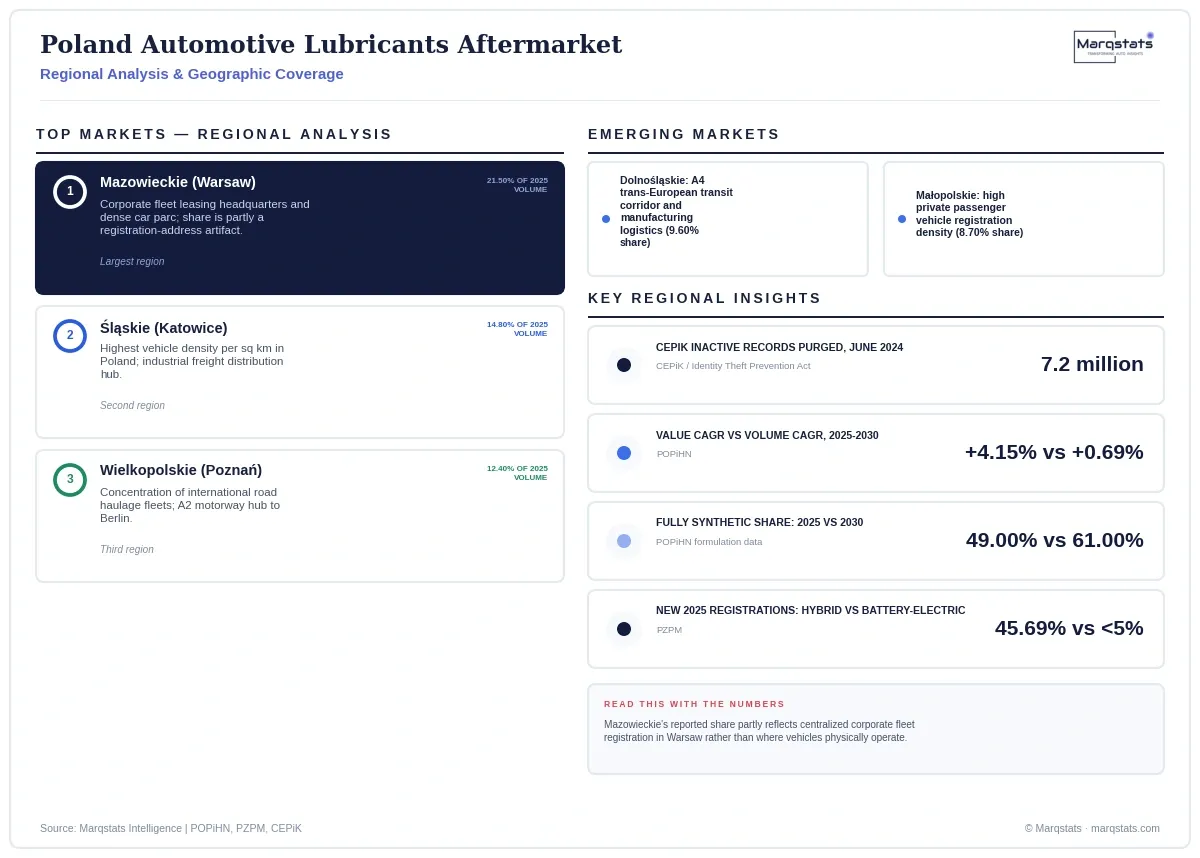
Largest Market: Mazowieckie / Warsaw (21.50% of 2025 volume)
Fastest Growing: Fully Synthetic Lubricants (49.00% to 61.00% share, 2025-2030)
Dominant Segment: Passenger Car Motor Oil (54.00% of 2025 volume)
Market Concentration: Moderately Concentrated (ORLEN OIL Leads at 27.50%)
Base Year: 2025 | Historical Period: 2021 – 2025 | Forecast Period: 2026 – 2030
Units Considered: Value (USD Million)
Segments Covered: 3 | Regions Covered: 7 | Companies Profiled: 12
Report Pages: 165 | Deliverables: PDF, Excel, PPT
Key Takeaways
Market Overview & Analysis
Report Summary
Poland's lubricants aftermarket is built on a fleet that just got smaller on paper and older in fact. A registry cleanup erased a quarter of what the official vehicle count had shown, and what remains is a mature, 16-year-old average fleet that independent workshops, not dealerships, overwhelmingly service.
The analysis measures the wholesale value of engine oils, transmission fluids and functional hydraulic fluids bought for post-sale servicing of vehicles: USD 828.09 million in 2025. It excludes OEM factory first-fill and industrial, marine and process oils.
The analysis is written for four readers: a blender deciding how fast to shift capacity toward fully synthetic formulations, a distributor weighing entry against Inter Cars' and Auto Partner's logistics networks, a fleet operator budgeting for Euro VI-E extended-drain trucks, and an investor tracking three regulatory scenarios.
Poland's scale and its position as the European Union's largest international road-haulage hub make its lubricants aftermarket a bellwether for Central and Eastern European demand more broadly, even as the country's own volume growth stays capped by extended drain intervals and a maturing, largely out-of-warranty vehicle population.
A Quarter of the Registry Turned Out to Be Ghosts
Fleet data is only as good as the registry behind it, and Poland's registry carried a structural problem for years.
Poland's Central Register of Vehicles and Drivers, CEPiK, had long been distorted by millions of obsolete records. In June 2024, a statutory cleanup under the Identity Theft Prevention Act purged approximately 7.2 million inactive vehicle records: units registered before 14 March 2005 that had lacked valid mandatory insurance and inspection for at least six consecutive years. What remained after the purge, a verified 20.4 million-unit active passenger car parc averaging 16.1 years old, is the real base this market serves. Because vehicles over four years old have exited factory warranty coverage, their servicing moves almost entirely into the independent aftermarket, where lubricant brand choice is decided by the workshop and the wholesale distributor behind it, not the OEM.
Volume Nearly Flat, Value Growing Six Times Faster
Two numbers describing the same market can tell very different stories, and Poland is a clean example.
Between 2025 and 2030, physical aftermarket volume expands by an absolute 4,646 metric tons, a 0.70% CAGR. Wholesale value over the same period grows 4.15% a year, six times faster in percentage terms. The gap is chemistry, not more vehicles or more oil changes: fully synthetic formulations rise from 49.00% to 61.00% of volume as GPF, SCR and DPF aftertreatment systems require low-ash synthetic chemistry to avoid catalyst poisoning, and blended wholesale price rises from PLN 24.00 to PLN 28.41 per kilogram as a result.
A Truck Fleet That Drives the EU's Freight and Barely Changes Its Oil Consumption
Poland runs the largest international commercial trucking fleet in the European Union, and that fleet's lubricant demand is almost recession-proof, for a specific reason.
Polish road hauliers accumulate 110,000 to 140,000 kilometres a year per tractor-trailer, insulating heavy-duty diesel engine oil demand from broader consumer spending cycles. Yet HDDO volume is projected to grow only 0.29% through 2030, not because trucking activity is slowing, but because modern Euro VI-E engines, serviced with synthetic ACEA E4/E8/E11 formulations, support extended drain intervals of up to 100,000 kilometres. The world's busiest trucking fleet is changing its oil less often per kilometre driven, even as it keeps driving more.
Warsaw's Share Is Partly an Accounting Artifact
Regional lubricant data can be distorted by where a fleet is registered rather than where it actually operates, and the pack is explicit about this for its largest region.
Mazowieckie, the Warsaw region, reports 21.50% of national aftermarket volume, the largest of any voivodeship. Part of that figure reflects where major national fleet-management and leasing companies register their vehicles centrally, in Warsaw, rather than where those vehicles physically operate and are serviced. Actual physical consumption of heavy commercial lubricants is described as more concentrated in logistics clusters surrounding Warsaw and along motorway junctions in neighbouring Łódzkie, notably Stryków and Piotrków Trybunalski.
Illegal Burning, and the Enforcement That Is Ending It
Not all of Poland's used engine oil made it back into the circular economy, and the gap was large enough to be a national policy problem.
Research from POPiHN, the Polish Chamber of Commerce for Sustainable Development, and the UN Global Compact Network Poland found that up to 40% of collectible waste oil historically bypassed official recycling channels, with meaningful volumes burned illegally in small space heaters in unmonitored workshops and agricultural buildings during winter months. Coordinated enforcement by the National Revenue Administration and the Chief Inspectorate of Environmental Protection, backed by higher non-compliance fines, has curtailed this practice across the 2024/2025 and 2025/2026 heating seasons, redirecting volume into authorized re-refining capacity such as the ORLEN Południe plant in Jedlicze.
A Distribution Network That New Entrants Cannot Route Around
Poland's wholesale lubricant distribution is unusually consolidated for Europe, and that consolidation is itself a barrier to entry.
Inter Cars S.A. alone reported group revenues exceeding PLN 21.0 billion in 2025, with domestic sales generating roughly 39% of that through more than 246 logistics branches capable of multiple intra-day deliveries nationwide. Alongside Auto Partner (over PLN 4.4 billion in 2025 revenue) and Mekonomen's Elit Polska, these master distributors control the procurement flow for independent workshops through formal garage-network programs like Inter Cars' Q-Service Castrol and Auto Partner's MaXserwis. A new blender cannot realistically sell direct to Polish garages at scale; entry runs through formal catalogue inclusion with one of these distributors.
Two Separate Base-Oil Strategies Compete for the Same Customer
The market's two largest players win share through opposite supply-chain designs, not just different brands.
ORLEN OIL blends domestically, drawing base oil from its own Płock refining complex and distributing through more than 1,900 company-owned fuel stations, an integrated model that gives it a structural cost advantage and the largest single wholesale share at 27.50%. Shell Polska instead competes on chemistry and OEM alignment, using Pure-Plus gas-to-liquid Group III base-stock technology in Shell Helix Ultra and leaning on international OEM service-fill endorsements to hold franchised dealership relationships. Neither approach is strictly better; ORLEN wins on cost and reach in the independent aftermarket, Shell wins on technical credibility in the warranty-period segment.
A Product Line That Is Shrinking, Not Just Slowing
Every other segment in this market is growing, even if slowly. One is not.
Functional and hydraulic fluids, power steering fluid, suspension oils and DOT brake fluids, are the only product category projected to contract in absolute volume through 2030, from 5,273 to 4,775 metric tons, a 9.44% decline. The category's fluid-per-vehicle requirement is falling as electric power steering displaces hydraulic assist systems and brake-by-wire architectures reduce fluid reservoir sizes, a structural shift with no offsetting driver elsewhere in the analysis.
What Survived Three Years of Sanctions-Driven Supply Disruption
Poland's lubricants supply chain absorbed a genuine shock between 2021 and 2023, and the market that emerged looks structurally different from the one that went in.
European trade sanctions on Russian petroleum imports, combined with escalating feedstock costs and volatile additive pricing, disrupted the Polish aftermarket's supply base over this period. Blenders responded by building alternative supply corridors, principally Group II and Group III base oil shipments routed through Western European hubs, supplemented by domestic hydrocracking capacity. The price structures that emerged from this adjustment did not fully reverse once volumes stabilized: the blended wholesale price per kilogram has continued rising through the 2025 base year and into the forecast, suggesting the sanctions period permanently repriced the market's cost base rather than producing a temporary spike. The precise split between that permanent repricing and any residual sanctions-era premium is not confirmed in the source data.
Why New Registrations Matter More for Spec Compliance Than for Volume
A market where volume barely grows can still see its product mix reshaped quickly by new-vehicle sales, and Poland's 2025 registration data shows exactly why.
Institutional fleet registrations, corporate leasing and car-fleet-management purchases, accounted for 68.85% of all new 2025 passenger car purchases. These buyers overwhelmingly specify OEM-approved synthetic oil programs from the first service, which means new registrations reshape the specification mix of the fleet far faster than they add to its absolute size. A fleet growing only modestly in unit count can still see its dominant viscosity grade shift within a few service cycles, because the newest, most specification-sensitive vehicles are disproportionately corporate-owned and serviced on contract.
A Circular Economy Built on Enforcement, Not Just Regulation
Poland's environmental rules on used oil existed well before the recent enforcement push, which is exactly why the enforcement gap matters more than the rulebook.
Extended Producer Responsibility law has required a minimum 50% recovery and regeneration target for used lubricants for years, backed by a statutory product fee of up to PLN 2.50 per kilogram for undocumented non-compliant volume, tracked through the BDO electronic waste registry. None of that stopped up to 40% of collectible waste oil from historically bypassing official channels. What changed the outcome was coordinated field enforcement, tax authority and environmental inspectorate action against illegal burning, across two consecutive heating seasons, not a change in the underlying law. For re-refiners and compliant blenders, this is the clearer signal: regulatory design was already adequate, and the addressable circular base-oil supply is now expanding because enforcement finally caught up to it.
A Market Where Institutional Buyers Set the Technical Standard
Retail buyers eventually follow wherever corporate fleets lead on specification, and Poland's fleet-heavy new-car market makes that lag shorter than in most European markets.
Because institutional and leasing buyers already dictate synthetic, OEM-approved servicing from day one on the majority of new vehicles, independent workshops that want to retain those cars once they exit corporate fleets and enter the used-car market must stock the same specification-correct oils those cars were serviced with under warranty. This pulls the independent aftermarket's technical bar upward faster than organic private-buyer demand alone would, and it is a structural reason Poland's IAM channel has kept pace with, rather than lagged, the formulation shift toward fully synthetic products despite serving an older, out-of-warranty vehicle population on average.
Market Dynamics
Key Drivers
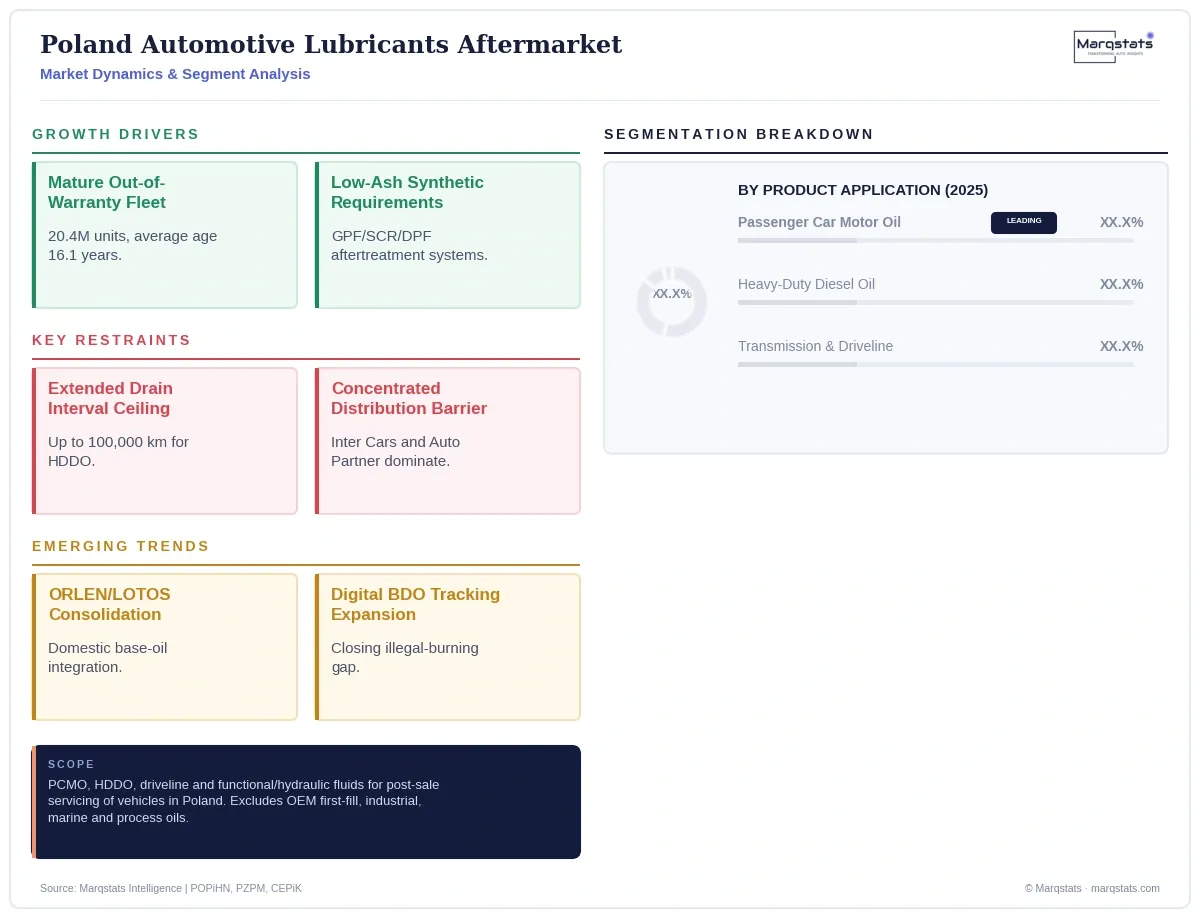
- A mature 20.4 million-unit fleet averaging 16.1 years old, almost entirely outside factory warranty, sustains steady independent-workshop demand.
- Advanced exhaust aftertreatment (GPF, SCR, DPF) requires low-ash fully synthetic formulations, lifting value even as physical volume growth stays capped.
- Poland's position as the EU's largest international trucking fleet, with 110,000-140,000 km/year duty cycles, sustains heavy-duty diesel oil demand.
- Hybrid powertrain growth (45.69% of new 2025 registrations) requires specialized ultra-low-viscosity oils resistant to fuel dilution and LSPI.
- Enforcement-driven redirection of previously illegal used-oil burning into certified re-refining capacity is expanding the domestic circular base-oil supply.
Key Restraints
- Extended drain intervals, 15,000 to 20,000 km in modern passenger cars and up to 100,000 km in long-haul trucks, structurally cap physical volume growth to under 1% a year.
- Gradual fleet electrification, though currently under 5% of new registrations, will progressively remove crankcase oil demand from the newest vehicle cohort.
- A concentrated wholesale distribution network controlled by Inter Cars and Auto Partner raises the effective cost of market entry for new blenders.
- A 2021-2023 period of European sanctions on Russian petroleum imports and volatile additive pricing previously disrupted supply chains, a risk that has since stabilized but remains a latent cost pressure.
Key Trends
- Consolidation of state-backed refining: ORLEN's merger with Grupa LOTOS folded the former Lotos Oil portfolio into the ORLEN OIL brand, strengthening domestic base-oil integration.
- Fuchs Oil Corporation completed the operational integration of LUBCON Polska in 2026, expanding specialized driveline and industrial grease capabilities from its Gliwice base.
- Digital BDO waste-transfer tracking is closing the gap on unauthorized used-oil disposal, pushing volume toward certified re-refiners.
- Private-label growth, led by Inter Cars' 4Max brand, is capturing price-sensitive demand from older vehicles and commercial fleets.
Strategic Implications
- Blenders should prioritise fully synthetic and specialized hybrid-compatible formulations, since these carry the pricing power offsetting near-flat volume growth.
- New entrants should pursue formal catalogue inclusion or co-branding with Inter Cars or Auto Partner rather than attempting direct workshop sales, given the depth of these distributors' logistics networks.
- Fleet operators should budget for extended-drain synthetic formulations on Euro VI-E trucks and track BDO compliance costs as enforcement tightens.
- Re-refiners and base-oil suppliers should position for growth as enforcement redirects previously illegal used-oil disposal into certified circular channels.
- Investors should track Euro 7 enforcement timing and European freight-demand trends (particularly German industrial activity), the two triggers separating the three forecast scenarios.
Outlook
The underlying research presents three scenarios tied to European regulatory timelines and freight-demand conditions.
Under the Structural Baseline scenario, domestic road haulage activity grows 2.5% to 3.0% annually, the active fleet continues its gradual transition toward synthetic formulations, and volume expands modestly to 136,450 metric tons, a 0.70% CAGR, while wholesale value reaches USD 1,014.62 million (PLN 3,875.9 million), a 4.15% CAGR.
Under the High-Value Modernization scenario, complete BDO digital-tracking enforcement eliminates unauthorized oil transactions, Euro 7 technical standards accelerate ultra-low-viscosity fluid adoption, and hybrid vehicle uptake speeds up. Volume edges down slightly to 134,800 metric tons on extended drain intervals, but value reaches USD 1,105.40 million (PLN 4,222.6 million), a 5.95% CAGR, driven by higher wholesale realizations for ester- and PAO-rich synthetics.
Under the Fleet Stagnation scenario, an economic slowdown among Poland's primary Western European trading partners, particularly Germany, reduces cross-border road logistics and heavy-duty truck mileage, while domestic inflation pushes consumers to extend oil change intervals or trade down to semi-synthetic oils. Volume reaches only 132,100 metric tons and value growth slows to a 1.50% CAGR, reaching USD 892.30 million (PLN 3,408.6 million) by 2030.
Market Segmentation
71,174 metric tons (54.00% share) in 2025, moving to 75,730 metric tons (55.50% share) by 2030. ACEA C2/C3/C5/C6 and API SP low-SAPS chemistries; the largest segment, restructuring toward 0W-20/0W-30 as older mineral-oil vehicles retire.
42,177 metric tons (32.00% share) in 2025, moving to 42,300 metric tons (31.00% share) by 2030. ACEA E4/E8/E11, Euro VI-E durability formulations supporting drain intervals up to 100,000 km.
13,180 metric tons (10.00% share) in 2025, moving to 13,645 metric tons (10.00% share) by 2030. Moving from manual transmission fluids toward AMT, ATF, CVT and wet-DCT chemistries.
5,273 metric tons (4.00% share) in 2025, moving to 4,775 metric tons (3.50% share) by 2030. Power steering fluids, suspension oils, DOT brake fluids; the only segment in volume decline.
64,584 metric tons (49.00% share) in 2025, moving to 83,235 metric tons (61.00% share) by 2030.
46,131 metric tons (35.00% share) in 2025, moving to 38,206 metric tons (28.00% share) by 2030.
21,089 metric tons (16.00% share) in 2025, moving to 15,009 metric tons (11.00% share) by 2030.
94,899 metric tons (72.00% share) in 2025, moving to 100,973 metric tons (74.00% share) by 2030. 208L barrels and 1,000L IBCs; serves the out-of-warranty parc (4-20 years), the dominant channel at 72.00% of volume.
23,725 metric tons (18.00% share) in 2025, moving to 24,561 metric tons (18.00% share) by 2030. Premium OEM-branded packages for vehicles under 4 years old; constrained by customer defection once warranty expires.
13,180 metric tons (10.00% share) in 2025, moving to 10,916 metric tons (8.00% share) by 2030. Small retail packs (1L, 4L, 5L) for emergency top-up; contracting as vehicle complexity makes home maintenance impractical.
By Geography
Mazowieckie (Warsaw)
28,338 metric tons (21.50% share) in 2025.
Śląskie (Katowice)
19,507 metric tons (14.80% share) in 2025.
Wielkopolskie (Poznań)
16,344 metric tons (12.40% share) in 2025.
Dolnośląskie (Wrocław)
12,653 metric tons (9.60% share) in 2025.
Małopolskie (Kraków)
11,467 metric tons (8.70% share) in 2025.
Łódzkie (Łódź)
9,885 metric tons (7.50% share) in 2025.
Remaining 10 Voivodeships
33,610 metric tons (25.50% share) in 2025.
Registration vs Physical Consumption
Mazowieckie's reported share is partly a registration-address artifact: national fleet-management and leasing companies register vehicles centrally in Warsaw. Actual physical consumption of heavy commercial lubricants concentrates in logistics clusters around Warsaw (Pruszków, Błonie, Grodzisk Mazowiecki) and motorway junctions in Łódzkie (Stryków, Piotrków Trybunalski).
How Competition Is Evolving
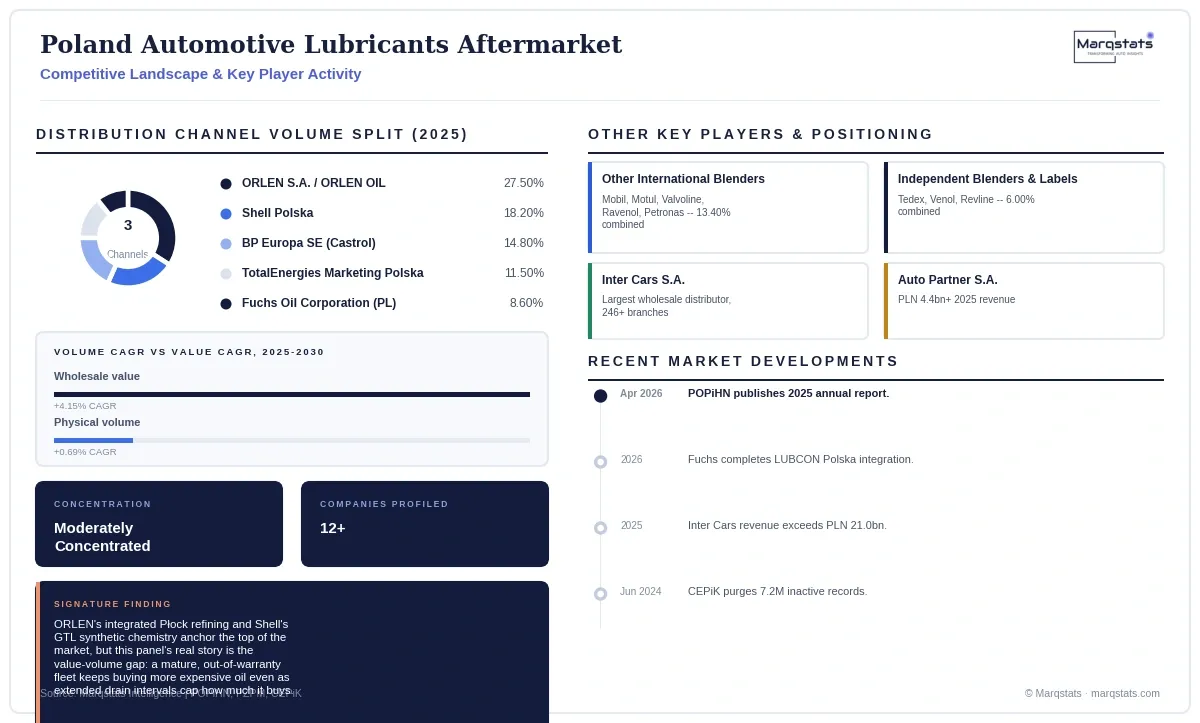
The Polish market is led by ORLEN S.A./ORLEN OIL with a 27.50% wholesale volume share, followed by Shell Polska (18.20%), BP Europa SE/Castrol (14.80%), TotalEnergies Marketing Polska (11.50%) and Fuchs Oil Corporation (8.60%). All company shares are independently and specifically sourced.
ORLEN OIL, headquartered in Kraków with blending facilities in Trzebinia, Jedlicze and Czechowice-Dziedzice, leads through domestic base-oil production at the Płock refining complex and captive retail distribution through more than 1,900 company-owned fuel stations. Following its merger with Grupa LOTOS, ORLEN consolidated the former Lotos Oil portfolio into the ORLEN OIL brand, spanning the Platinum passenger car and Ultor commercial vehicle lines.
Shell Polska holds second position through Pure-Plus GTL synthetic base-stock technology (Shell Helix Ultra) and strong franchised dealership alignment. BP Europa SE markets the Castrol brand, retaining high independent-garage brand recognition through the co-branded Q-Service Castrol network operated with Inter Cars. TotalEnergies is supported by its Rubia commercial diesel line and Stellantis OEM partnerships.
Fuchs Oil Corporation, blending from Gliwice, strengthened its technical portfolio in 2026 by integrating LUBCON Polska, expanding specialized driveline and industrial grease capacity. The remaining share splits between other international majors (Mobil, Motul, Valvoline, Ravenol, Petronas) and independent regional blenders (Tedex, Venol, Flukar's Revline brand), plus distributor private labels such as Inter Cars' 4Max.
Companies Covered
Companies covered in the report include:
Recent Market Activity
Table of Contents
Coverage & Segmentation
The analysis measures passenger car motor oils, heavy-duty diesel engine oils, transmission and driveline fluids, and functional hydraulic fluids bought for post-sale servicing and retail top-up of vehicles in Poland, for a 2025 base year and a 2026 to 2030 forecast, in United States dollars at the NBP 2025 average reference rate of 3.820 PLN per USD. Values are wholesale, excluding VAT and retail surcharges. OEM factory first-fill and industrial, marine and process oils are excluded.
The analysis covers three segmentation dimensions, product application, base-stock chemistry and distribution channel, a 16-voivodeship regional split, and twelve profiled entities. All figures, including company market shares, are independently and specifically sourced; no publish-gate disclosure applies here.