Market Snapshot
Middle bar: base-year value × (1 + CAGR), rounded to two decimals. This is a calculated illustration, not a separately researched annual estimate.
Market Size (2025, Base Year): USD 1,158.88 Million (Wholesale Net)
Estimated Value (2026): USD 1,197.12 Million
Forecast Value (2030): USD 1,392.40 Million
CAGR: 3.74% | Forecast Period: 2026 – 2030
Growth — Absolute: USD 233.52 Million
Physical Volume: 182,500 m3 (2025) to 199,200 m3 (2030), Volume CAGR 1.77%
Largest Market: Buenos Aires Province & CABA (46.60% of national fleet)
Fastest Growing: Fully Synthetic Formulation (21.00% to 28.00% share, 2025-2030)
Dominant Segment: Crankcase Engine Oils (76.00% of 2025 volume)
Market Concentration: Highly Concentrated (CR4 89.50%)
Base Year: 2025 | Historical Period: 2021 – 2025 | Forecast Period: 2026 – 2030
Units Considered: Value (USD Million) and Volume (Cubic Meters)
Segments Covered: 4 | Regions Covered: 7 | Companies Profiled: 14
Report Pages: 175 | Deliverables: PDF, Excel, PPT
Key Takeaways
Market Overview & Analysis
Report Summary
This analysis reads Argentina's own fully worked sizing chain, regional distribution data, and named-scenario macroeconomic framework together as a single coherent picture rather than isolated data points, since the underlying research itself was structured to support exactly that kind of integrated reading.
Argentina's automotive lubricants aftermarket is entering a structurally distinct phase: a rapidly aging fleet is locking in mineral oil demand even as newer vehicle platforms pull the market toward synthetic premiumization, producing a genuine value-volume divergence rather than uniform growth. Macroeconomic normalization -- the expiration of the Impuesto PAIS, reduced import tariffs, and eliminated export withholding taxes -- has simultaneously restored blender cost structures and export competitiveness after three years of foreign exchange disruption.
This report measures finished lubricating oils, driveline fluids, hydraulic brake fluids, and functional greases consumed in post-sale vehicle maintenance, sized at the wholesale net level (USD 1,158.88 million in 2025) excluding IVA and provincial gross turnover taxes. Excluded and separately sized: non-automotive industrial lubricants (78,200 m3 in 2025) and OEM factory-fill fluids (13,025 m3), both outside the aftermarket boundary.
The analysis is built for four reader types making different decisions: an independent lubricentro operator weighing synthetic-service capacity investment against a mineral-dependent customer base, a blender or specialty brand evaluating entry against an 89.50%-concentrated oligopoly, a fleet manager planning heavy-duty diesel maintenance budgets, and an investor tracking how Mercuria's integrated shale-to-forecourt supply chain reshapes competitive structure.
A Fleet That's Aging Faster Than Argentina Can Replace It
Most lubricant markets in this coverage set describe fleet aging as one driver among several. In Argentina, it's the mechanism the underlying research itself identifies as the market's defining structural constraint, and it's worth tracing through exactly why the math doesn't close.
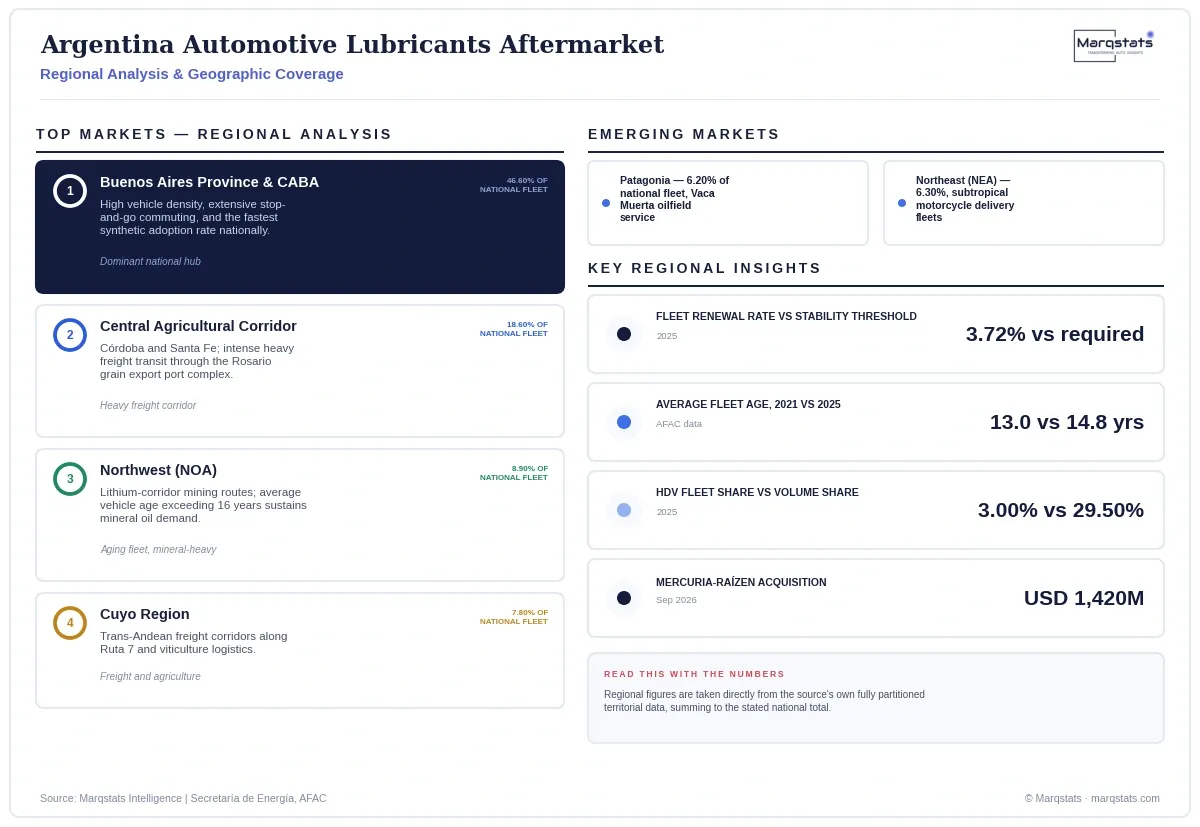
AFAC's own technical models state that holding the fleet's average age stable would require roughly 1,100,000 new vehicle registrations annually. Argentina delivered just 586,625 in 2025 -- barely more than half that figure, and still an improvement over 2024's 411,406. The resulting fleet renewal rate of 3.72% guarantees continued aging throughout the 2026-2030 forecast window regardless of how consumer preferences shift. The direct consequence shows up in the product mix: conventional mineral formulations still account for 41.00% of 2025 physical volume, not because Argentine consumers prefer them, but because a fleet with loose mechanical tolerances and worn seals genuinely cannot use, and does not benefit from, extended-drain synthetic oils built for newer engines.
Why 3% of the Fleet Drives Nearly a Third of All Lubricant Volume
Vehicle count and lubricant consumption rarely track together this unevenly. Argentina's heavy-duty segment shows exactly how far the two can diverge, and the mechanism is entirely mechanical rather than behavioral.
Commercial trucks and buses number just 473,531 units nationally -- 3.00% of the circulating fleet -- yet consume 29.50% of total aftermarket lubricant volume. The leverage comes from two multiplying factors: average annual mileage of 85,000 km, roughly seven times a passenger car's 11,500 km, and crankcase capacities of 28 to 40 liters against a passenger car's 3.5 to 4.5 liters. Concentrated along the Rosario grain export corridor and the Vaca Muerta hydrocarbon basin, this segment anchors heavy-duty diesel engine oil as the most stable commercial volume base for integrated refiners, largely insulated from the premiumization dynamics reshaping the passenger car segment.
Market Dynamics
Key Drivers
- Argentina's expanding energy trade surplus, driven by Vaca Muerta crude and gas exports, is directly providing macroeconomic liquidity that supports continued blender access to imported synthetic base stocks nationwide.
- This market's own fully worked sizing chain shows crankcase engine oils already the single largest product function category at 76.00% of 2025 volume, a structural signal that scheduled drain-interval capacity represents the most immediate revenue opportunity for blenders and workshops entering this market.
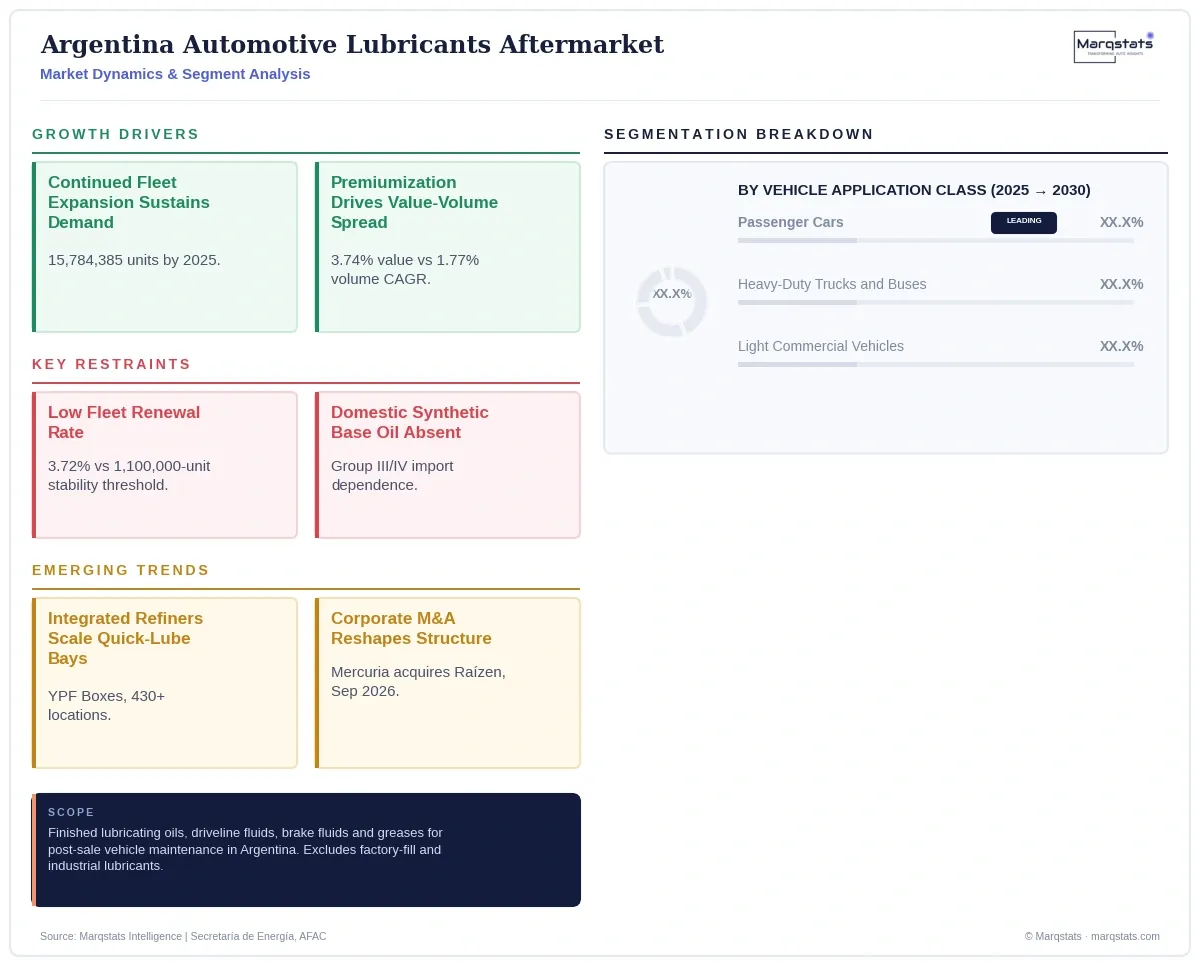
- Argentina's continued fleet expansion to 15,784,385 units in 2025, even amid slow renewal, is directly sustaining baseline lubricant demand across an aging vehicle population requiring frequent top-up and drain service.
- The expiration of the Impuesto PAIS in January 2025 and Decreto 513/2025's tariff reductions on capital goods and chemical additives are directly lowering blender raw material costs, supporting expanded domestic synthetic formulation capacity.
- Premiumization toward API SP and ACEA C-grade synthetic formulations for newer vehicle platforms is directly driving the 197 basis point value-volume growth spread, with fully synthetic volume expanding at 7.79% annually against the market's 1.77% overall pace.
- YPF's commercial alliance with Prestige Auto (Mercedes-Benz), securing exclusive service-fill status across passenger and van dealer networks from June 2026, is directly demonstrating how integrated refiners are capturing captive OEM channel volume.
- The elimination of the 8.00% export withholding tax in late 2025 is directly restoring Mercosur export competitiveness for 51 domestic blenders shipping into Brazil, Uruguay and Paraguay.
Key Restraints
- This market's own two-scenario framework spans a genuinely wide 2030 range, from USD 1392.40 million under the Baseline Scenario to USD 1,571.25 million under the Expansion Scenario -- a disclosed spread reflecting real uncertainty in fleet renewal pace and GDP growth, not a narrow band around a single central estimate.
- A fleet renewal rate of just 3.72% directly constrains the pace of synthetic formulation adoption, since mineral and semi-synthetic oils remain structurally necessary for the aging majority of the circulating parc through 2030.
- Argentina's lack of domestic refining capacity for API Group III and Group IV base oils directly exposes blenders to import dependence on North American and Asian synthetic base stock suppliers, a structural vulnerability despite the Impuesto PAIS's expiration.
- An 89.50% four-firm concentration ratio directly restricts margin opportunity for new market entrants and specialty brands, who must avoid commoditized mineral segments where domestic refiners hold insurmountable logistics and cost advantages.
- An estimated 6.50% of total automotive fluid volume moves through unbranded, uninspected bulk drum dispensing outside Resolución 1104/2004 compliance channels, directly constraining packaged branded revenue capture in the informal workshop segment.
Key Trends
- Regional demand concentration is beginning to diverge sharply between Buenos Aires Province's dense synthetic-adopting urban fleet and the Northwest's aging, mineral-dependent rural fleet, raising genuine open questions about whether premiumization will spread evenly or continue concentrating around the capital region driving this market's current value growth.
- Integrated refiners are directly scaling proprietary quick-lube bay networks within fuel retail stations -- led by YPF's 430-plus "Boxes" network -- to disintermediate traditional independent lubricentros and capture retail replacement margin directly.
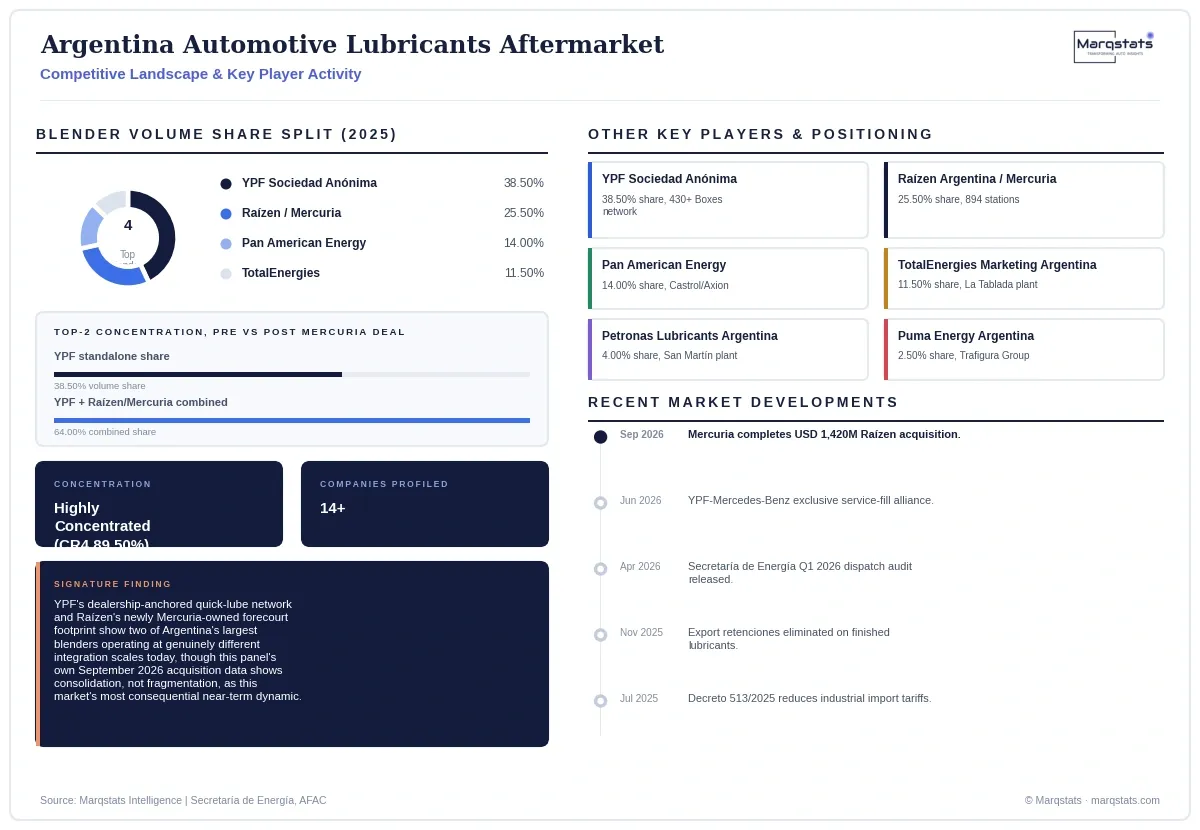
- Corporate M&A is directly reshaping competitive structure, exemplified by Mercuria Energy Group's September 2026 acquisition of Raízen Argentina's downstream assets, creating an integrated shale-to-forecourt supply chain challenging YPF's dominance.
- OEM commercial alliances are directly extending integrated refiners' reach into captive dealership channels, following YPF's June 2026 agreement securing exclusive Mercedes-Benz service-fill status across 61 dealer workshops.
- Dual-fuel CNG vehicle owners are directly sustaining demand for specialized shear-stable, nitration-resistant formulations, a niche largely insulated from standard gasoline engine oil margin pressure across Argentina's 1.67 million-unit CNG fleet.
Strategic Implications
- Insurers and fleet risk managers should also weight heavy-duty diesel engine oil supply contracts heavily nationwide, given how directly the 3.00%-of-fleet, 29.50%-of-volume concentration in commercial trucking makes this segment the single most consequential demand anchor for integrated refiners.
- New market entrants and specialty brands should target high-margin synthetic formulations and CNG-specific niche products specifically, avoiding commoditized mineral segments where domestic refiners hold structural cost advantages.
- Incumbent blenders should accelerate quick-lube bay integration within service station networks specifically, given how directly this model captures retail replacement margin ahead of independent lubricentros.
- Additive and base stock suppliers should establish consignment inventory hubs in Buenos Aires and Campana specifically, given how directly the Impuesto PAIS's expiration and export retenciones removal have restored flexible Mercosur supply chain economics.
- Investors and analysts should track new vehicle registration pace against the 1,100,000-unit fleet-stability threshold as the single clearest variable separating this market's Baseline and Expansion trajectories.
Outlook
The underlying research explicitly tested and rejected a default three-scenario structure, finding the market bound to two evidenced macroeconomic and regulatory pathways rather than three arbitrary trajectories. This market's own forecast horizon reaches 2030 directly, requiring no Marqstats extrapolation.
Under the Baseline Scenario, GDP growth stabilizes at 2.5% to 3.0% annually, new vehicle sales average 600,000 units per year, and average fleet age plateaus near 14.5 years as adherence to currency convertibility and full implementation of Decreto 513/2025's tariff rationalizations continue; physical volume reaches 199,200 m3 by 2030 at a 1.77% CAGR, generating USD 1,392.40 million in wholesale net value at a 3.74% CAGR, with the formulation mix shifting to 32.00% mineral, 40.00% semi-synthetic and 28.00% fully synthetic.
Under the Expansion Scenario, GDP growth exceeds 4.5% annually, consumer credit expansion pushes new vehicle sales past 850,000 units per year, and accelerated fleet renewal lowers average fleet age below 12.5 years, backed by bilateral Mercosur automotive free-trade pacts and a zero-tariff regime for Group III/IV base oils; physical volume reaches 209,500 m3 by 2030 at a 2.80% CAGR, lifting wholesale net value to USD 1,571.25 million at a 6.27% CAGR, with the formulation mix shifting further to 22.00% mineral and 38.00% fully synthetic.
A third "severe currency contraction" scenario was evaluated and explicitly rejected: Argentina's energy trade surplus of USD 7,834 million in the first eight months of 2026, driven by Vaca Muerta crude and gas exports, provides structural macroeconomic liquidity that insulates the downstream refining sector from the foreign exchange crises that characterized previous decades.
Market Segmentation
80,300 m3 (44.00% share) in 2025, growing to 88,644 m3 (44.50% share) by 2030. Anchored by a 12.94 million-unit fleet averaging 11,500 km annually with 3.5-4.5 L crankcase capacity.
39,238 m3 (21.50% share) in 2025, growing to 43,824 m3 (22.00% share) by 2030. Anchored by 8 of 13 domestic assembly platforms being 1-tonne pickups (Hilux, Ranger, Amarok).
53,838 m3 (29.50% share) in 2025, growing to 55,776 m3 (28.00% share) by 2030. The outsized volume driver -- 3.00% of the fleet consuming 29.50% of total volume via 85,000 km annual mileage.
9,125 m3 (5.00% share) in 2025, growing to 10,956 m3 (5.50% share) by 2030. Anchored by rapid urban delivery usage across an 8.5 million-unit registered motorcycle base.
74,825 m3 (41.00% share) in 2025, growing to 63,744 m3 (32.00% share) by 2030. The only contracting category, sustained by the aging fleet's mechanical tolerance requirements despite a -3.16% CAGR.
69,350 m3 (38.00% share) in 2025, growing to 79,680 m3 (40.00% share) by 2030. The transitional volume anchor for passenger cars and light commercial utilities.
38,325 m3 (21.00% share) in 2025, growing to 55,776 m3 (28.00% share) by 2030. The fastest-growing category at +7.79% CAGR, driven by newer platforms and OEM extended-warranty mandates.
138,700 m3 (76.00% share) in 2025, growing to 150,396 m3 (75.50% share) by 2030. The primary volume driver, governed by API SP/CK-4 and ACEA C2/C3/E7/E9 standards.
25,550 m3 (14.00% share) in 2025, growing to 28,884 m3 (14.50% share) by 2030. Anchored by API GL-4/GL-5 gear oils and Dexron VI/Mercon LV automatic transmission fluids.
11,862 m3 (6.50% share) in 2025, growing to 12,948 m3 (6.50% share) by 2030. Anchored by DOT 3, DOT 4 and DOT 5.1 specifications for power steering and brake systems.
6,388 m3 (3.50% share) in 2025, growing to 6,972 m3 (3.50% share) by 2030. Anchored by NLGI Grade 2 Lithium, Lithium Complex and Calcium sulfonate greases.
78,475 m3 (43.00% share) in 2025, growing to 83,664 m3 (42.00% share) by 2030. The traditional commercial backbone, dominant for post-warranty fleets older than 5 years.
54,750 m3 (30.00% share) in 2025, growing to 63,744 m3 (32.00% share) by 2030. The fastest-growing channel, anchored by YPF's 430-plus Boxes network and bundled fuel loyalty programs.
27,375 m3 (15.00% share) in 2025, growing to 29,880 m3 (15.00% share) by 2030. The exclusive provider for in-warranty fleets (0-3 years) with mandated synthetic use.
21,900 m3 (12.00% share) in 2025, growing to 21,912 m3 (11.00% share) by 2030. Anchored by over-the-counter and digital sales including Mercado Libre for DIY servicing.
By Geography
Buenos Aires Province & CABA
46.60% of the national fleet (7,355,523 units, USD 545.68 million in 2025 market value), driven by high vehicle density, extensive stop-and-go urban commuting, and the fastest synthetic adoption rate nationally.
Central Agricultural Corridor (Córdoba & Santa Fe)
18.60% of the national fleet (2,935,896 units, USD 230.15 million), sustained by intense heavy freight transit through the Rosario grain export port complex and a dense 1-tonne pickup market.
Northwest (NOA)
8.90% of the national fleet (1,404,810 units, USD 94.62 million), characterized by lithium-corridor mining supply routes and average vehicle age exceeding 16 years, sustaining elevated mineral 20W-50 consumption.
Cuyo Region
7.80% of the national fleet (1,231,182 units, USD 91.25 million), anchored by Trans-Andean freight corridors along Ruta 7 and viticulture logistics.
Northeast (NEA)
6.30% of the national fleet (994,415 units, USD 66.80 million), shaped by subtropical operating profiles and extensive motorcycle delivery fleets.
Patagonia Region
6.20% of the national fleet (978,632 units, USD 90.34 million), sustained by disproportionate commercial fleet concentration around Vaca Muerta oilfield heavy service and sub-zero cold-cranking demand.
Other Central / Pampa Territories
5.60% of the national fleet (884,927 units, USD 45.04 million), anchored by agricultural feeder transport and grain and livestock arterial logistics.
How Competition Is Evolving
Consolidation pressure among independent domestic blenders is genuinely likely to increase further as compliance costs and import logistics complexity rise nationwide.
The Argentine automotive lubricants market operates as a concentrated oligopoly, with the top three players -- YPF (38.50%), Raízen/Mercuria (25.50%) and Pan American Energy/Axion-Castrol (14.00%) -- controlling 78.00% of national volume individually, and the top four reaching 89.50% once TotalEnergies (11.50%) is included; this ordering has just shifted structurally following Mercuria's September 2026 acquisition of Raízen's downstream assets, rather than remaining settled.
Competitors compete primarily on integrated retail forecourt access rather than price alone: proprietary quick-lube bay networks embedded within fuel retail stations -- YPF's Boxes, Shell's Helix Point, Axion's Castrol Auto Service, TotalEnergies' Quartz Auto Services -- let integrated blenders capture high-margin retail replacement revenue that would otherwise flow to independent lubricentros, backed by digital loyalty ecosystems like YPF's ServiClub.
Structural position in this market is determined by domestic blending and refining footprint: YPF's Complejo Industrial La Plata, Raízen's Dock Sud refinery and Buenos Aires lubricant plant, Pan American Energy's Refinería Campana, and TotalEnergies' 50,000 metric ton-per-year La Tablada facility collectively anchor the 89.50% concentration ratio, since Argentina's lack of domestic Group III/IV base oil refining capacity makes integrated blending-and-import logistics the primary barrier to entry for new competitors.
Companies Covered
Companies covered in the report include:
Recent Market Activity
Table of Contents
Coverage & Segmentation
The analysis measures finished lubricating oils, driveline and transmission fluids, hydraulic brake fluids, and functional greases consumed during post-sale operational maintenance, servicing, and mechanical repair of on-road motor vehicles in Argentina, across a 2025 base year and a 2026 to 2030 forecast period, sized at the wholesale net level (ex-blender and primary distributor realization, excluding the 21.00% IVA and provincial gross turnover taxes). It excludes initial factory-fill fluids, non-automotive industrial lubricants, marine and aviation lubricants, and cross-border export shipments.
The analysis spans four segmentation dimensions — vehicle application class, base stock formulation, product function and distribution channel — seven regional groupings, and 14 profiled entities across refiners, blenders and regulatory bodies. Fleet figures trace to AFAC, Promotive S.A. and ADEFA statutory data; market value and all four segmentation dimensions trace directly to the underlying research's own fully worked sizing model, with both 2025 and 2030 figures directly source-stated throughout.
