Market Snapshot
Middle bar: base-year value × (1 + CAGR), rounded to two decimals. This is a calculated illustration, not a separately researched annual estimate.
Market Size (2025, Base Year): USD 917.70 Million (Wholesale)
Estimated Value (2026): USD 971.05 Million
Forecast Value (2030): USD 1,225.75 Million
CAGR: 5.96% | Forecast Period: 2026 – 2030
Growth — Absolute: USD 308.05 Million
Physical Volume: 266.00 Million Litres (2025) to 332.18 Million Litres (2030), Volume CAGR 4.54%
Largest Market: National (No Regional Split Published)
Fastest Growing: Fully Synthetic Formulations (12.00% to 20.00% share, 2025-2030)
Dominant Segment: Two-Wheelers / Motorcycles (58.00% of 2025 volume)
Market Concentration: Moderately Concentrated (Top 5 Hold 60.50%)
Base Year: 2025 | Historical Period: 2021 – 2025 | Forecast Period: 2026 – 2030
Units Considered: Value (USD Million)
Segments Covered: 4 | Regions Covered: 1 | Companies Profiled: 8
Report Pages: 165 | Deliverables: PDF, Excel, PPT
Key Takeaways
Market Overview & Analysis
Report Summary
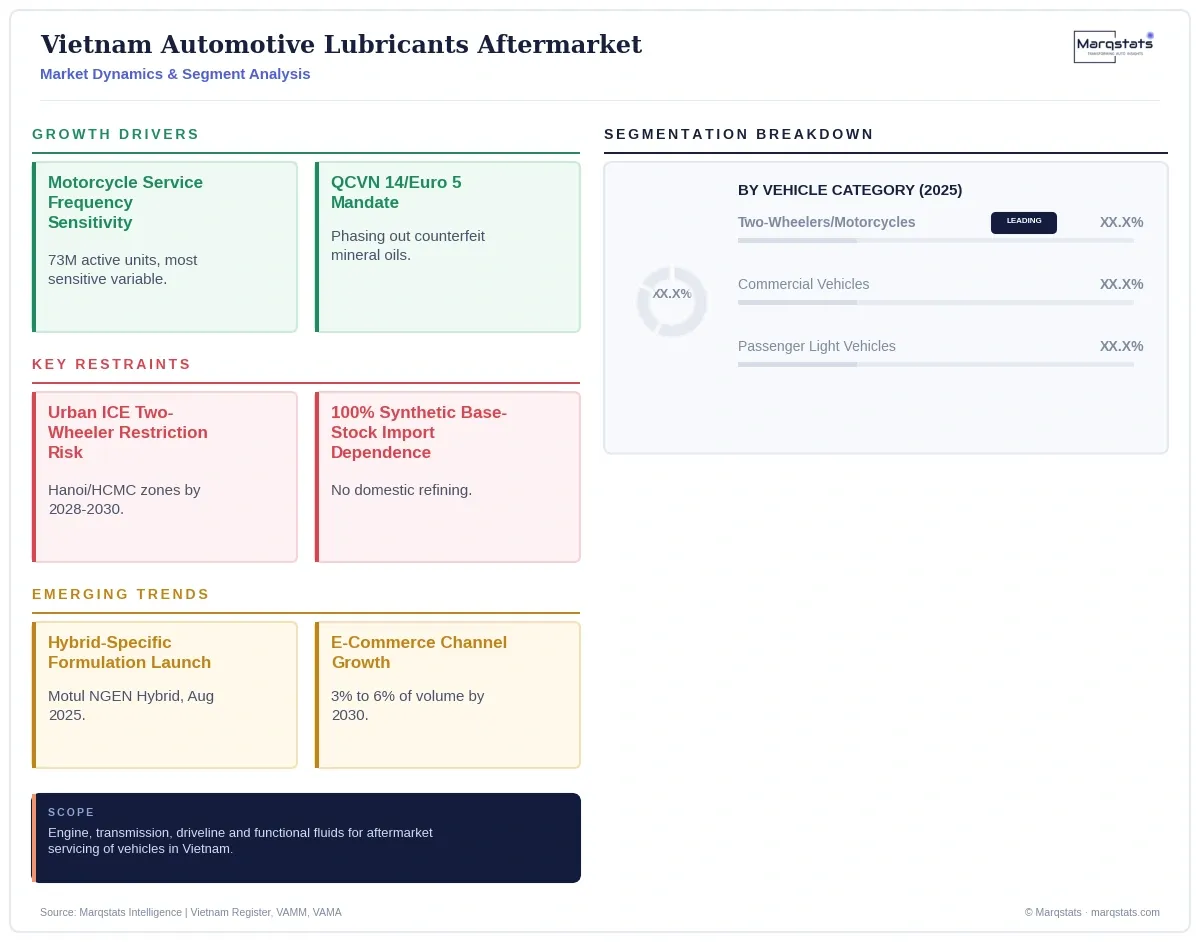
Vietnam's lubricants aftermarket runs on the largest motorcycle fleet of any market in this vertical's coverage, a fleet so large that a small shift in how often it gets serviced moves the entire national market more than any other single variable.
The analysis measures the wholesale value of engine oils, transmission and driveline fluids, and functional fluids and greases bought for aftermarket servicing of vehicles: USD 917.70 million in 2025, growing to USD 1,225.75 million by 2030.
The sizing chain traces to three separate sources Marqstats could not independently verify; this is disclosed prominently below and in the accompanying verification log, not omitted, so purchasers can weigh it accordingly.
The analysis is written for four readers: a blender deciding how fast to build hybrid-specific and synthetic capacity, a distributor weighing entry against Castrol's and Petrolimex's distribution networks, a fleet operator budgeting for Euro 5 compliance, and an investor tracking three forward scenarios.
Vietnam's combination of the region's largest per-capita motorcycle fleet, rapid passenger car ownership growth, and complete import dependence for synthetic base stocks makes this aftermarket a distinctive test case for how a fast-modernizing Southeast Asian vehicle market balances volume from an ageing two-wheeler base against value from an emerging four-wheeled one.
The One Number That Moves the Whole Market
Most sensitivity analyses in this vertical point to fleet growth or formulation mix as the biggest swing factor. Vietnam's own model points somewhere more specific.
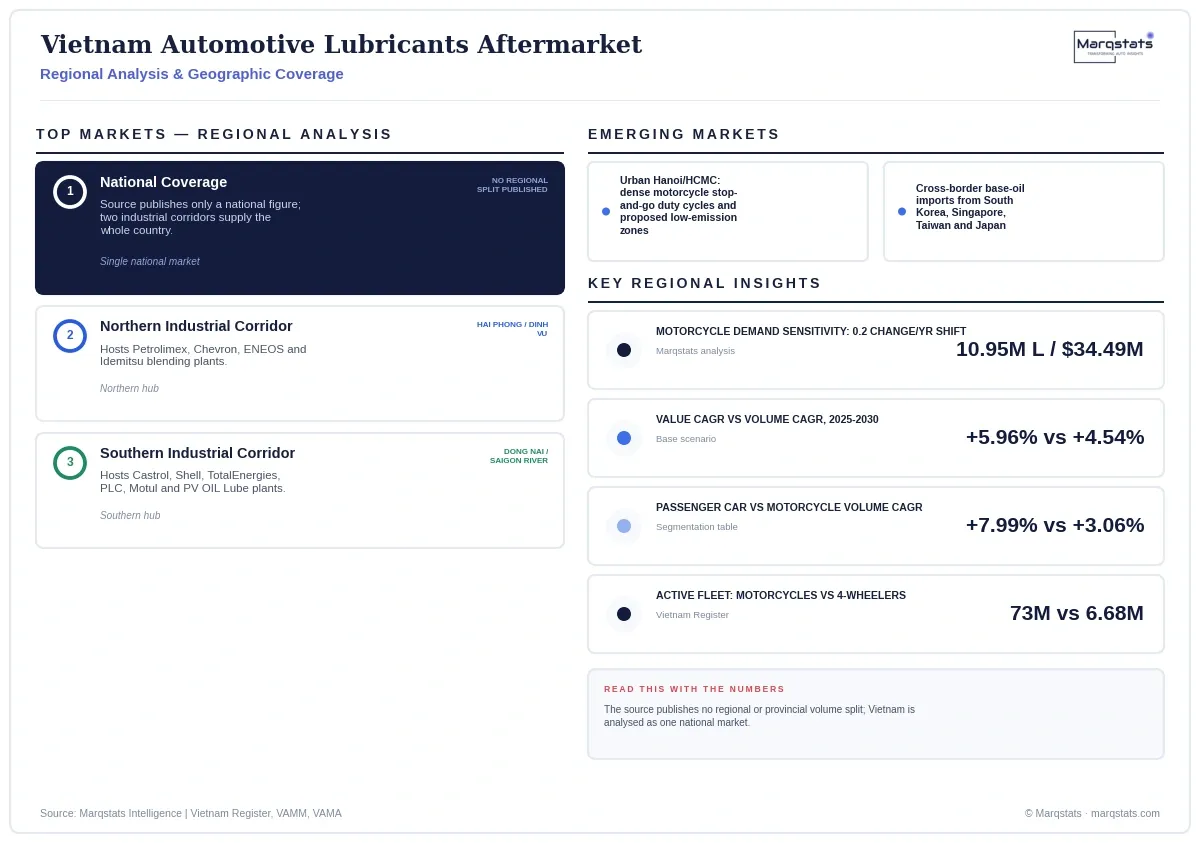
A shift of just 0.2 oil changes a year across the country's roughly 73 million active motorcycles, among the highest per-capita two-wheeler densities anywhere, alters national aftermarket lubricant demand by 10.95 million litres and adjusts wholesale market turnover by USD 34.49 million, a bigger single-variable swing than any tested change in passenger car sump size, commercial fleet drain interval, or synthetic-formulation penetration. At 8,000 to 12,000 km of annual commuter mileage against conservative 1,500-to-3,000 km mineral-oil drain intervals, the average motorcycle already changes oil 3.0 to 4.5 times a year; small movements in that frequency, driven by fuel prices, urban congestion, or simple habit, carry more weight in this market than almost any policy lever blenders and distributors can directly influence.
A Circular-Economy Fee Structure Built to Change Blender Behaviour
Vietnam's Extended Producer Responsibility rule doesn't just ask blenders to comply. It prices non-compliance directly into their cost structure.
Under Law No. 72/2020/QH14 and Decree No. 08/2022/ND-CP, lubricant blenders and importers must either operate a certified collection and recycling system for used crankcase oil themselves, or pay an environmental compliance fee of roughly VND 2,000 per litre into the Vietnam Environment Protection Fund. That fee structure creates a direct financial incentive to build collection infrastructure rather than simply pay the toll, and it is already reshaping investment decisions: Petrolimex has partnered with GGenTec to construct re-refining assets that process waste oil back into usable base stocks. The same fee also gives commercial fleet operators a reason to adopt extended-drain synthetic formulations, since fewer oil changes mean fewer litres subject to the compliance fee in the first place.
Two Different Fleets, Growing at Two Very Different Speeds
Vietnam's aftermarket volume growth and its aftermarket value growth are being pulled by two structurally different vehicle populations.
The motorcycle fleet, still 58.00% of aftermarket volume in 2025, is projected to contract to 54.00% of share by 2030 as urban electrification and extended-drain synthetics moderate drain frequency; its volume CAGR of just 3.06% reflects a mature, large-base market growing slowly. Passenger light vehicles, by contrast, are expanding at a 7.99% CAGR, nearly triple the motorcycle segment's rate, as rising personal incomes and urbanization drive private car ownership. Value follows the same divergence: passenger cars generate 28.5% of wholesale aftermarket value from just 17.00% of volume, because a passenger car's larger sump, higher-tier synthetic formulation requirements, and higher realized price per litre all compound in the same direction.
A Base-Oil Supply Chain With No Domestic Refining Behind It
Vietnam blends a genuinely large volume of finished lubricant domestically, but almost none of the underlying chemistry actually originates there.
Domestic finished-lubricant blending capacity exceeds 400,000 metric tons a year, split between northern plants clustered around Hai Phong and Dinh Vu and southern plants along the Dong Nai and Saigon Rivers. But Vietnam's domestic refineries, Dung Quất and Nghi Sơn, focus on fuels and petrochemicals rather than lubricant base-stock production, so the blending industry imports essentially 100% of its Group II, Group III and synthetic base-stock needs from South Korea, Singapore, Taiwan and Japan. That leaves every domestic blender's margin structure directly exposed to regional base-oil pricing and currency movements, a structural vulnerability no amount of domestic blending capacity can offset on its own.
Two Joint Ventures Competing on Distribution Depth, Not Just Product
Vietnam's two largest lubricant sellers both built their positions through state-linked joint ventures, and the specific structure of each partnership shapes how deep their distribution actually reaches.
Castrol BP Petco pairs BP's global formulation and brand strength (65% ownership) with Petrolimex's domestic fuel-retail relationships (35% ownership), a structure stable enough that the partners extended it through 2042 in late 2021. That stability lets Castrol invest in genuinely deep distribution, over 90 primary distributors and more than 8,000 franchised workshops spanning all 63 provinces, a reach that would be difficult to replicate without decades of accumulated relationship capital. Petrolimex Petrochemical (PLC), by contrast, leverages its own parent company's fuel-station network directly, distributing through 2,898 company-owned stations and an affiliated network exceeding 5,500 forecourts. Two different joint-venture structures, both converging on the same conclusion: in Vietnam's lubricants market, owning or renting distribution depth matters as much as owning the formulation.
A Nano-Additive Arms Race Aimed Squarely at Foreign Multinationals
Domestic Vietnamese blenders can't out-brand Shell or Castrol. So at least one of them is trying to out-innovate them on a specific technical claim instead.
PV OIL Lube, a PetroVietnam Oil subsidiary, has built its competitive differentiation around nano-graphene additive technology, marketed under the VSpeed Nano Graphene and VTech Ultra product lines, claiming improved thermal conductivity, reduced mechanical friction, and extended oil service life relative to conventional formulations. This is a deliberate strategic choice: rather than compete on brand recognition or global distribution scale, where multinationals hold a structural advantage, PV OIL Lube is competing on a specific, marketable chemistry claim that a domestic manufacturer with PetroVietnam's backing can credibly make and defend.
Why an Automatic Scooter Needs More Than Just an Oil Change
The shift from geared motorcycles to automatic scooters looks like a simple product substitution on the surface. Mechanically, it adds a second fluid category entirely.
A manual-transmission underbone motorcycle couples its engine lubrication and transmission through a single shared oil bath. An automatic scooter decouples the two: the engine runs on a low-friction JASO MB-specification crankcase oil optimized purely for fuel economy, while the continuously variable transmission and rear final-drive reduction box need a separate, specialized gear lubricant entirely. Because scooters also run at higher continuous engine RPM and higher internal operating temperatures than geared motorcycles, they degrade oil faster and lean harder toward semi-synthetic and fully synthetic formulations. For a blender, the underbone-to-scooter shift isn't just a viscosity-grade update on an existing SKU; it is the creation of an entirely new product line most geared-motorcycle owners never needed.
Market Dynamics
Key Drivers
- Motorcycle service frequency, the single most sensitive variable in the market model, sustains a large and recurring baseline demand independent of new-vehicle sales cycles, a stability few other segments in this market can match.
- QCVN 14:2018 enforcement and Euro 5 emissions standards are phasing out counterfeit and low-quality mineral oils, accelerating the shift toward certified semi-synthetic and synthetic formulations across both urban and rural distribution channels.
- Rising personal incomes and urbanization are driving passenger car ownership growth well ahead of the broader market, lifting both volume and value in that segment faster than any other vehicle category tracked.
- EPR compliance fees are incentivizing blenders to invest in collection and re-refining infrastructure rather than simply absorb the per-litre environmental cost, a shift already visible in Petrolimex's GGenTec partnership.
- Commercial freight expansion, tied to North-South Expressway construction, sustains heavy-duty diesel oil demand alongside logistics sector growth, with commercial vehicle sales already growing 32% year-over-year in 2025.
Key Restraints
- Urban ICE two-wheeler restrictions being considered in Hanoi and Ho Chi Minh City, if enacted on the faster scenario's timeline, would curb the motorcycle segment's already-sensitive drain-frequency dynamics faster than the baseline case assumes.
- Complete import dependence for Group II, Group III and synthetic base stocks exposes domestic blenders to foreign-exchange and regional crude-price volatility, since none of it can currently be sourced from Vietnam's own refineries.
- Domestic electric scooter and electric taxi/ride-hailing adoption, led by VinFast, Yadea and Dat Bike, would progressively remove crankcase oil demand from the newest vehicle cohort in the Accelerated Electrification scenario.
- Price-sensitive rural motorcycle owners and older commercial fleets continue to sustain mineral-oil demand, slowing the pace of premiumization in parts of the market even as urban centres move toward synthetics.
Key Trends
- Hybrid-specific formulations are emerging as a distinct product category, led by Motul's NGEN Hybrid series launched in August 2025 for gasoline-electric passenger vehicles, addressing cold-start wear from frequent engine cycling.
- E-commerce and digital direct-to-consumer channels are the fastest-growing distribution avenue, expanding from 3.00% to 6.00% of volume as platforms capture DIY motorcycle enthusiasts and automotive hobbyists alike.
- Nano-additive product tiers, such as PV OIL Lube's graphene-enhanced VSpeed and VTech lines, are emerging as a domestic differentiation strategy against foreign multinationals that compete primarily on global brand recognition.
- Automatic scooter adoption is displacing manual-transmission underbones, requiring JASO MB low-friction formulations and specialized final-drive gear lubricants that geared motorcycles never needed.
Strategic Implications
- New entrants should avoid competing directly in commoditized mineral engine oil categories against Castrol's 8,000-workshop network and Petrolimex's forecourt scale, and should instead target synthetic passenger-car and hybrid-specific formulations through independent garage and e-commerce partnerships, where incumbent distribution advantages matter less.
- Incumbent blenders should accelerate the phase-out of Group I base stocks in favour of hydrotreated Group II and hydrocracked Group III formulations to meet API SP/CK-4 and JASO MA2/MB standards, while strengthening independent-workshop relationships through certification and digital inventory programmes that reduce channel attrition.
- Base-oil suppliers and additive manufacturers should establish bonded terminal capacity near Hai Phong and Ba Ria-Vung Tau to shorten lead times and reduce domestic blenders' working-capital exposure to import volatility, particularly given the 100% import dependence for synthetic base stocks.
- Investors should track urban low-emission zone enforcement timing in Hanoi and Ho Chi Minh City and QCVN 14 counterfeit-elimination enforcement, the two triggers separating the three forecast scenarios, and should treat the sizing and segmentation figures here with the caution disclosed in the evidence section, since the specific proportional weighting between the three underlying sizing sources is not confirmed.
Outlook
The underlying research presents three scenarios tied to named electrification-policy and enforcement triggers.
Under Scenario A (Baseline Modernization), GDP grows roughly 6.5% annually, EV adoption reaches 15% of new two-wheeler sales and 12% of new passenger car sales by 2030, and baseline EPR compliance holds. Volume reaches 332.18 million litres, a 4.54% CAGR, and value reaches USD 1,225.75 million, a 5.96% CAGR.
Under Scenario B (Accelerated Fleet Electrification), Hanoi and Ho Chi Minh City enforce low-emission access zones restricting internal combustion two-wheelers in central districts by 2028-2030, and VinFast/Xanh SM capture over 30% of light vehicle share. Volume reaches only 304.85 million litres, a 2.76% CAGR, and value reaches USD 1,085.20 million, a 3.41% CAGR.
Under Scenario C (Synthetic Upgrade & Delayed Electrification), charging infrastructure and grid bottlenecks delay EV rollout, passenger car ownership outpaces mass transit, and strict QCVN 14 enforcement eliminates counterfeit mineral oils. Volume reaches 348.50 million litres, a 5.55% CAGR, and value reaches USD 1,365.80 million, a 8.28% CAGR.
Market Segmentation
154.28 million litres (58.00% share) in 2025, moving to 179.38 million litres (54.00% share) by 2030, a 3.06% CAGR.
45.22 million litres (17.00% share) in 2025, moving to 66.44 million litres (20.00% share) by 2030, a 7.99% CAGR.
66.50 million litres (25.00% share) in 2025, moving to 86.36 million litres (26.00% share) by 2030, a 5.36% CAGR.
223.44 million litres (84.00% share) in 2025, moving to 272.39 million litres (82.00% share) by 2030, a 4.04% CAGR.
29.26 million litres (11.00% share) in 2025, moving to 43.18 million litres (13.00% share) by 2030, a 8.09% CAGR.
13.30 million litres (5.00% share) in 2025, moving to 16.61 million litres (5.00% share) by 2030, a 4.54% CAGR.
148.96 million litres (56.00% share) in 2025, moving to 139.52 million litres (42.00% share) by 2030, a -1.30% CAGR.
85.12 million litres (32.00% share) in 2025, moving to 126.23 million litres (38.00% share) by 2030, a 8.20% CAGR.
31.92 million litres (12.00% share) in 2025, moving to 66.43 million litres (20.00% share) by 2030, a 15.80% CAGR.
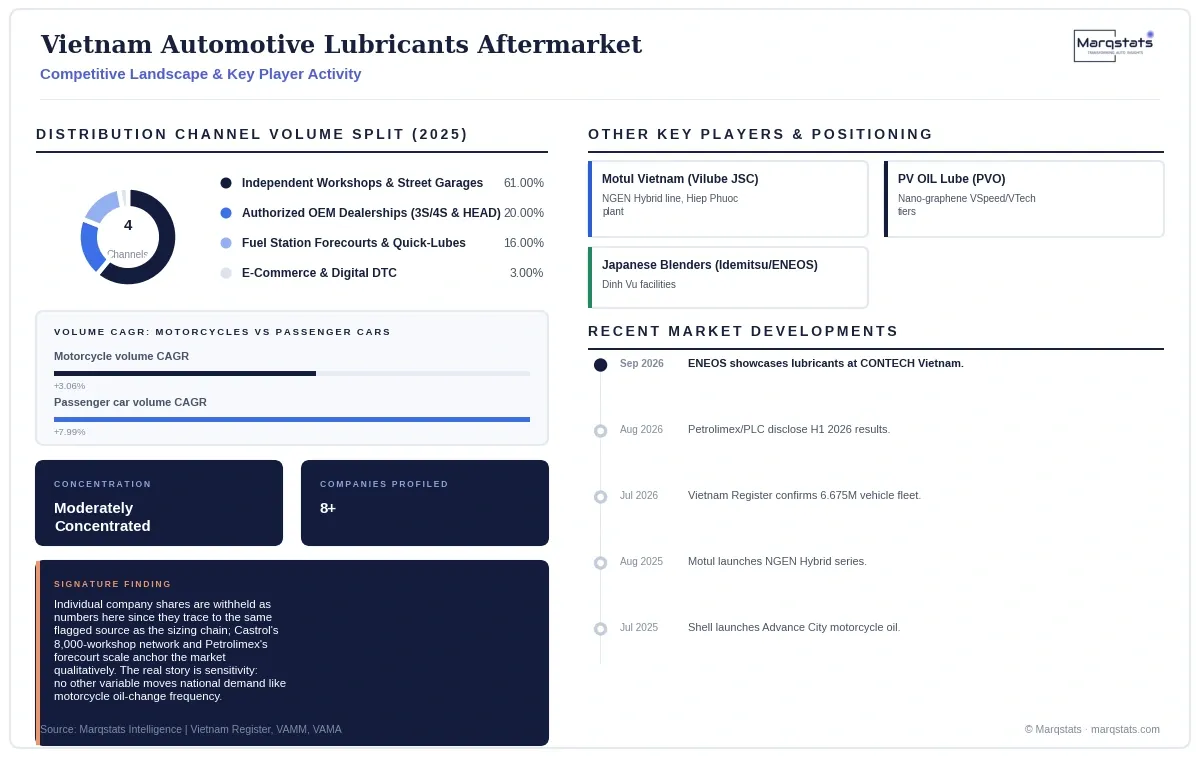
162.26 million litres (61.00% share) in 2025, moving to 176.06 million litres (53.00% share) by 2030.
53.20 million litres (20.00% share) in 2025, moving to 83.05 million litres (25.00% share) by 2030.
42.56 million litres (16.00% share) in 2025, moving to 53.15 million litres (16.00% share) by 2030.
7.98 million litres (3.00% share) in 2025, moving to 19.92 million litres (6.00% share) by 2030.
By Geography
National Coverage
The source publishes no regional or provincial volume split; Vietnam is analysed as a single national market, reflecting the concentration of blending infrastructure in two industrial corridors (Hai Phong in the north, Dong Nai/Saigon River in the south) that together supply the whole country.
Northern Industrial Corridor
Centred on the Port of Hai Phong, hosting Petrolimex Petrochemical's Thuong Ly plant, Chevron's Dinh Vu facility, ENEOS's plant, and Idemitsu Lube's facility.
Southern Industrial Corridor
Along the Dong Nai and Saigon Rivers, hosting Castrol BP Petco's Nha Be plant, Shell's Go Dau facility, TotalEnergies' Go Dau plant, PLC's southern Nha Be plant, Motul's Hiep Phuoc facility, and PV OIL Lube's Binh Chieu facility.
Urban Demand Concentration
Metropolitan Hanoi and Ho Chi Minh City generate outsized motorcycle lubricant demand due to dense urban traffic congestion and severe stop-and-go duty cycles, while both cities are separately considering low-emission zone restrictions on internal combustion two-wheelers by 2028-2030.
How Competition Is Evolving
The Vietnamese aftermarket is moderately concentrated among five major blenders. Individual company market-share percentages are withheld as numbers in this build since they trace to the same source as the flagged sizing chain; positioning below rests on independently-sourced operational and financial facts.
Castrol BP Petco, a joint venture between BP (65%) and Petrolimex (35%) established in 1992 and extended through 2042 in late 2021, is the market's leading blender, operating the Nha Be blending plant in Ho Chi Minh City and distributing through more than 90 primary distributors and over 8,000 franchised workshops across all 63 provinces. Financial filings show Castrol BP Petco contributed VND 346 billion in profit to Petrolimex in 2024, VND 320 billion in 2025, and over VND 200 billion in H1 2026.
Shell Vietnam operates the Go Dau blending plant in Dong Nai, differentiating through its proprietary Gas-to-Liquid PurePlus Group III+ synthetic base-oil technology; it launched Shell Advance City, a motorcycle oil formulated for urban stop-and-go commuting, in July 2025. Chevron Lubricants Vietnam operates the Dinh Vu blending plant in Hai Phong under the Caltex Havoline and Delo brands.
Petrolimex Petrochemical Corporation (HNX: PLC), 79.07% owned by Petrolimex, operates a combined 100,000-tonne blending capacity across its Thuong Ly and Nha Be plants, distributing through 2,898 company-owned fuel stations and an affiliated network exceeding 5,500 forecourts; it recorded H1 2026 net profit approaching VND 240 billion. PV OIL Lube, majority owned by PetroVietnam Oil, operates the Binh Chieu plant in Ho Chi Minh City and differentiates through its nano-graphene VSpeed and VTech product tiers, distributed through PV OIL's 800+ owned fuel stations.
TotalEnergies Marketing Vietnam operates the Go Dau blending facility; Motul Vietnam (Vilube JSC), majority owned by Motul Group France, operates the Hiep Phuoc plant and launched the hybrid-specific NGEN Hybrid line in August 2025. Japanese blenders Idemitsu and ENEOS operate Dinh Vu facilities. Domestic capacity is rounded out by AP Saigon Petro, NPOIL, Mekong Petrochemical and regional distributors of Kixx, S-Oil and Repsol.
Companies Covered
Companies covered in the report include:
Recent Market Activity
Table of Contents
Coverage & Segmentation
The analysis measures automotive engine oils, transmission and driveline fluids, and functional fluids and greases bought for post-sale servicing of vehicles in Vietnam, for a 2025 base year and a 2026 to 2030 forecast, in United States dollars.
The analysis covers four segmentation dimensions, vehicle category, product application, base-oil chemistry and distribution channel, and eight profiled entities. The sizing, segmentation and company-share chain carries a sourcing flag; fleet demographics and regulatory content do not. See the verification log for full disclosure.