Market Snapshot
Middle bar: base-year value × (1 + CAGR), rounded to two decimals. This is a calculated illustration, not a separately researched annual estimate.
The global next generation eCall market size is estimated at USD 1,847.28 million in 2025 and is projected to reach USD 4,384.27 million by 2030, growing at a CAGR of 18.87% over 2026 – 2030. Shipments of factory-fitted systems rise from about 26.85 million to 75.80 million a year, a 23.07% annual rate, lifting fitment from 27.85% of global vehicle production to 72.19%, while the average system price falls from USD 68.80 to USD 57.84.
Marqstats defines next generation eCall as vehicle emergency call systems that place the call and send crash data over 4G LTE or 5G networks using IP Multimedia Subsystem voice and data, rather than over 2G and 3G voice channels. The market is valued at the ex-factory price paid by carmakers for the emergency call subsystem of the telematics unit: the cellular modem and radio, back-up battery, satellite positioning receiver, crash sensor interfaces, audio path, emergency antenna, protocol software and housing. Complete telematics units, infotainment systems and connected service subscriptions are excluded.
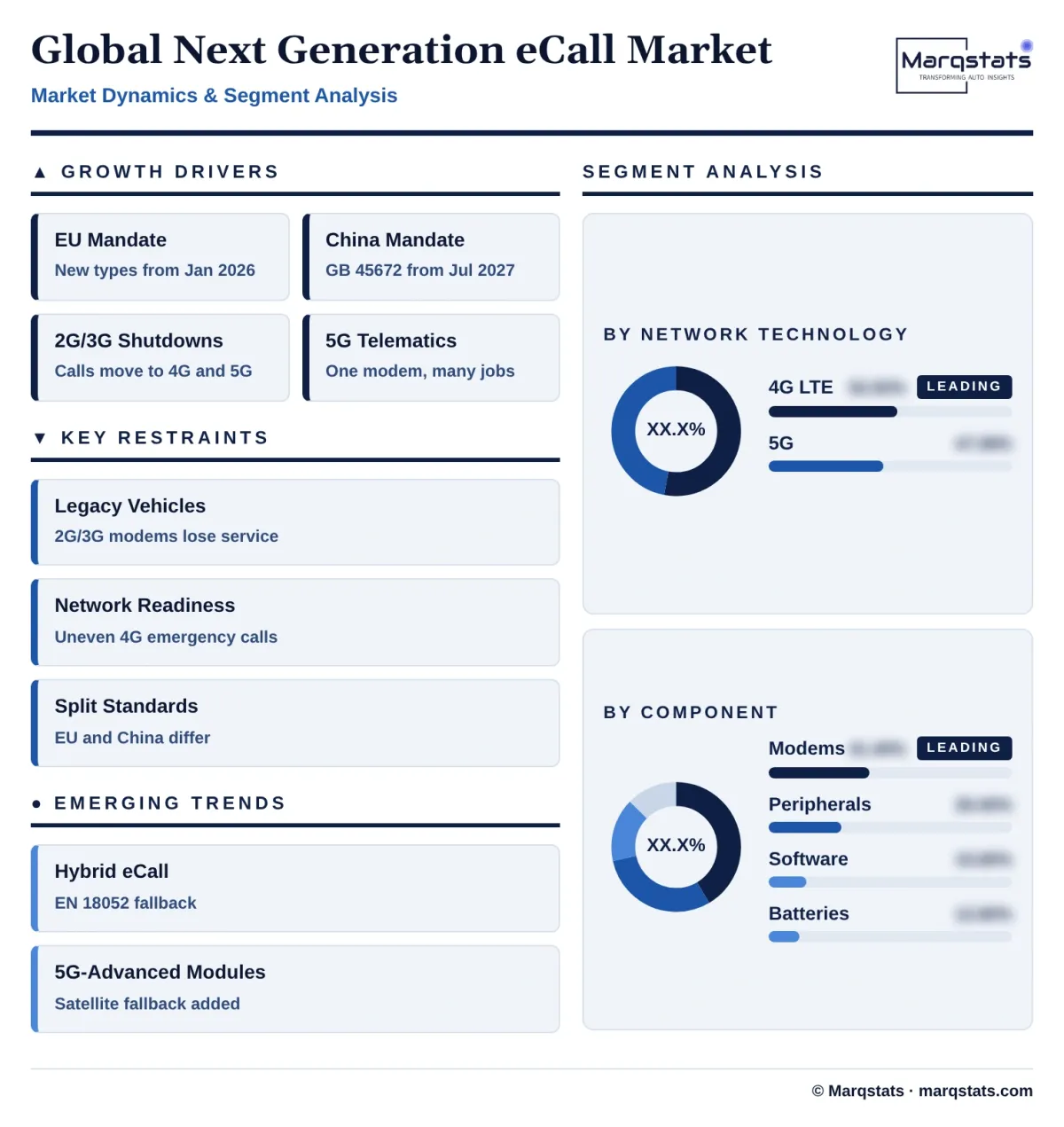
5G systems account for an estimated 47.08% of 2025 value and passenger cars for 84.17%. Europe accounts for 38.92% of 2025 value and North America for 32.03%. The study segments the market by network technology, component, vehicle type, sales channel and region.
Key Takeaways
Market Overview & Analysis
Report Summary
Marqstats sizes the next generation eCall market as the ex-factory value of emergency call subsystems that use 4G or 5G packet-switched networks, fitted in new passenger cars, light commercial vehicles, trucks and buses, plus a small aftermarket retrofit channel. In 2025 about 26.85 million systems were shipped worldwide, worth an estimated USD 1,847.28 million at an average of USD 68.80 per vehicle.
The first generation of eCall, required in the EU on new car and van types from 31 March 2018 under Regulation (EU) 2015/758, uses 2G and 3G voice calls. Crash data, known as the minimum set of data, is sent as audio tones inside the voice call, which takes about 12 to 20 seconds, during which the occupants cannot talk to the emergency operator. As mobile operators switch off 2G and 3G networks to reuse the spectrum for 4G and 5G, these systems stop working.
Next generation eCall sends the call over IP. The vehicle opens a Session Initiation Protocol session over 4G voice or 5G voice to the emergency service, and the crash data is attached to the first message, so it reaches the emergency operator in well under a second, before or at the same time as the voice call connects. Wideband voice codecs improve speech quality, and the vehicle can send additional data, such as battery fire alerts, during the call without interrupting the conversation.
Hybrid eCall systems, defined in EN 18052:2025, use the IP connection first and fall back to the older circuit-switched method where the visited network does not support emergency calls over 4G, which matters for vehicles crossing borders. Test equipment makers such as Rohde & Schwarz, Keysight and Anritsu provide certification systems for these standards.
The market grew from about 6.80 million systems worth USD 574.60 million in 2021 to 10.15 million worth USD 824.18 million in 2022, 14.50 million worth USD 1,113.60 million in 2023 and 20.10 million worth USD 1,455.24 million in 2024, as US operators retired 2G and 3G networks and carmakers moved to 4G telematics. Marqstats expects 34.20 million systems worth USD 2,264.04 million in 2026.
Regulation is the main driver, but its timing differs by region. The EU requires packet-switched eCall for new types from January 2026, with certificates for non-compliant vehicles losing validity from January 2027. China requires its own emergency call system on new passenger cars and light commercial vehicles from July 2027, with BeiDou positioning. The United States has no emergency call mandate, but the end of 2G and 3G networks has led carmakers to fit 4G and 5G telematics with crash notification across most new vehicles.
The emergency call subsystem must survive the crash it reports. Under EU rules, the system must keep working after standard crash tests, maintain power when the main vehicle battery is disconnected, and route voice through a dedicated speaker if the cabin audio system is damaged. Electric vehicles add a further challenge because the high-voltage system is isolated in a crash, so the emergency call unit needs its own back-up battery. China's GB 45672-2025 likewise requires the system to be checked after frontal, side and rear crash tests and to support BeiDou positioning.
Component value is spread across the subsystem. Marqstats estimates cellular modems and processors account for 41.40% of 2025 value, antennas, audio and other peripherals for 30.00%, software and protocol stacks for 15.80% and back-up batteries for 12.80%. Factory fitting dominates, with 96.09% of value, because the system must be validated with the vehicle's crash sensors, wiring and antenna positions during type approval, leaving a small aftermarket retrofit channel focused on commercial fleets in regions where older networks have closed.
Global Next Generation eCall Market Size and Forecast
The global next generation eCall market grows from USD 1,847.28 million in 2025 to USD 4,384.27 million in 2030, a CAGR of 18.87%. Marqstats expects USD 2,844.80 million in 2027, USD 3,451.68 million in 2028 and USD 3,991.68 million in 2029. Annual growth peaks at about 25.65% in 2027, when EU certificate rules and China's standard both take effect, and slows to 9.84% in 2030 as fitment approaches the limits set by regulation.
Volume grows faster than value. Shipments rise 23.07% a year while the average system price falls from USD 68.80 to USD 57.84. Marqstats estimates the cellular modem and radio front end fall from about USD 28.50 per vehicle to USD 21.00, the back-up battery from USD 8.80 to USD 6.50, positioning from USD 7.50 to USD 5.20, the audio subsystem from USD 4.40 to USD 3.30, the emergency antenna from USD 5.20 to USD 4.10, crash sensor interfaces from USD 3.60 to USD 2.80, software from USD 4.80 to USD 3.44, and the circuit board and housing from USD 6.00 to USD 4.50.
Fitment rises sharply. Marqstats estimates next generation eCall fitment rises from 8.48% of global vehicle production in 2021 to 27.85% in 2025, 45.03% in 2027 and 72.19% in 2030, when global production reaches about 105.00 million vehicles.
The back-up battery is the component most affected by new rules. Marqstats estimates its cost rose from about USD 4.20 per vehicle in older systems to USD 8.80 in 2025 as suppliers moved to batteries that survive crash tests and meet the EU 5 + 60 + 5 minute endurance requirement, before falling to about USD 6.50 by 2030 with production scale.
Marqstats tracks four indicators to monitor the forecast: EU type-approval and certificate deadlines, China's implementation of GB 45672-2025 for passenger cars and light commercial vehicles, the pace of 2G and 3G network shutdowns, and prices of automotive 5G RedCap modules.
The regional mix changes sharply. Europe and North America together account for 70.95% of 2025 value but only 44.46% by 2030, as Asia-Pacific grows from 25.70% to 52.11% once China's standard applies. Marqstats estimates Asia-Pacific shipments rise from about 6.90 million systems in 2025 to 39.50 million in 2030, while European shipments rise from 10.45 million to 16.50 million and North American shipments from 8.60 million to 17.20 million.
Market Dynamics
Key Drivers
Five forces are moving vehicle emergency calling onto 4G and 5G networks.
- EU mandate. Delegated Regulations (EU) 2024/1180 and 2025/1871 require new vehicle types to use packet-switched eCall and make certificates of conformity for non-compliant vehicles invalid from 2027 and 2028, forcing fitment across all new cars and vans sold in the EU. Under Delegated Regulation (EU) 2024/1084, emergency service answering points must also be able to receive packet-switched eCalls.
- China mandate. GB 45672-2025, issued on 25 April 2025 by the State Administration for Market Regulation and the Standardization Administration of China, requires emergency call systems in passenger cars and light commercial vehicles from 1 July 2027, with BeiDou positioning.
- 2G and 3G shutdowns. US operators retired 2G and 3G networks between 2022 and 2024, and European operators are following, so emergency calls must move to 4G and 5G.
- Move to 5G telematics. Carmakers are fitting 5G telematics for software updates and connected services, and adding emergency call functions to the same modem lowers the cost of compliance.
- Better data for rescuers. IP-based calls send crash data in under a second and support wideband voice and extra data, such as electric vehicle battery alerts, improving emergency response.
Key Restraints
Four constraints complicate the move to packet-switched emergency calls.
- Stranded older vehicles. Millions of vehicles built with 2G and 3G emergency call modems lose service as networks close, and retrofit options are limited.
- Uneven network readiness. Emergency calls over 4G are not configured consistently across mobile operators and borders, so vehicles need hybrid systems that can fall back to older networks where they still operate. Emergency calls over 4G depend on each operator configuring its network and roaming agreements correctly, which is still incomplete in parts of Europe.
- Different regional standards. The EU and China use different positioning priorities, data sets and test procedures, so carmakers need region-specific hardware and software variants.
- Higher certification and hardware costs. New standards, back-up power endurance tests and crash tests add engineering and certification costs for suppliers.
Key Trends
Four shifts are changing how emergency call systems are designed and tested.
- Hybrid eCall. Systems certified to EN 18052:2025 combine IP calls with fallback to circuit-switched calls, and Anritsu and Keysight gained certification for test systems in 2026.
- 5G RedCap and 5G-Advanced modules. Quectel launched the AR588MA, an automotive 5G-Advanced module based on 3GPP Release 18 that supports EU next generation eCall and China's AECS, in January 2026.
- Satellite fallback. Next generation modules add non-terrestrial network support so emergency calls can connect where there is no mobile coverage.
- Live-network interoperability testing. ETSI held next generation eCall Plugtests on Telekom Slovenije's live network in Ljubljana in June 2026 to test vehicle systems against emergency services and mobile networks.
Strategic Implications
- For carmakers, one design no longer fits every market. Modular telematics platforms that can take region-specific communication and positioning modules reduce the cost of meeting EU and Chinese rules.
- For telematics suppliers, back-up power and hybrid fallback are now core requirements. Suppliers that can pass the EU endurance test and EN 18052:2025 certification early will win programmes as deadlines approach.
- For chip and module makers, low-cost 5G is the opportunity. Automotive 5G RedCap and 5G-Advanced modules with emergency call software built in can replace 4G at similar cost.
- For mobile operators and regulators, network shutdowns and emergency calling must be coordinated. Delaying switch-offs or ensuring emergency calls over 4G work across borders protects drivers of older vehicles.
- For test and certification providers, demand grows with every new standard. Automated test systems that cut certification time help suppliers meet tight deadlines.
- For fleet operators and dealers, older vehicles need attention. Vehicles with 2G and 3G emergency call modems may lose the function as networks close, so fleets and dealer networks should check which vehicles are affected and plan for replacement telematics or other emergency calling options where permitted.
Market Segmentation
4G LTE systems account for 52.92% of 2025 value, USD 977.60 million, and about 18.80 million systems, and grow only 2.28% a year to USD 1,094.40 million by 2030, when their share falls to 24.96% as carmakers move to 5G.
5G systems account for 47.08% of 2025 value, USD 869.68 million, and about 8.05 million systems, and grow 30.49% a year to USD 3,289.87 million and 47.00 million systems by 2030, 75.04% of value.
Cellular modems and processors account for 41.40% of 2025 value, USD 764.77 million, rising to USD 1,591.49 million by 2030, a 15.79% CAGR, while their share falls to 36.30% as silicon prices fall.
Antennas, audio components, positioning receivers and other peripherals account for 30.00% of 2025 value, USD 554.18 million, rising to USD 1,324.05 million by 2030, a 19.03% CAGR.
Software, protocol stacks and middleware account for 15.80% of 2025 value, USD 291.88 million, and grow fastest, at 27.24% a year, to USD 973.31 million, 22.20% of 2030 value.
Back-up batteries account for 12.80% of 2025 value, USD 236.45 million, rising to USD 495.42 million by 2030, a 15.94% CAGR, supported by the EU endurance test for new approvals from 2027.
Passenger cars account for 84.17% of 2025 value, USD 1,554.88 million and about 22.60 million systems, rising to USD 3,655.48 million and 63.20 million systems by 2030, an 18.65% CAGR.
Light commercial vehicles account for 13.04% of 2025 value, USD 240.80 million, rising to USD 589.97 million by 2030, a 19.63% CAGR, as EU and Chinese rules cover vans and light trucks.
Heavy trucks and buses account for 2.79% of 2025 value, USD 51.60 million, and grow at 21.89% a year to USD 138.82 million by 2030 as fleet operators fit systems voluntarily.
Factory-fitted systems account for 96.09% of 2025 value, USD 1,775.04 million, rising to USD 4,280.16 million by 2030, a 19.25% CAGR, because type approval requires validated crash performance and antenna placement.
Aftermarket retrofits account for 3.91% of 2025 value, USD 72.24 million, rising to USD 104.11 million by 2030, a 7.58% CAGR, mainly for commercial fleets.
By Geography
Europe
Europe is the largest market in 2025, with 38.92% of value, USD 718.96 million and about 10.45 million systems, rising to USD 954.36 million by 2030, a 5.83% CAGR, while its share falls to 21.77%. EU rules require packet-switched eCall for new types from January 2026 and invalidate certificates for non-compliant vehicles from 2027, so fitment reaches nearly all new cars and vans by 2027. Older 2G and 3G systems and inconsistent cross-border support for emergency calls over 4G remain problems, and the European Emergency Number Association has called for network shutdowns to be delayed.
North America
North America accounts for 32.03% of 2025 value, USD 591.68 million and about 8.60 million systems, rising to USD 994.85 million by 2030, a 10.95% CAGR. AT&T, Verizon and T-Mobile retired their 2G and 3G networks between 2022 and 2024, so carmakers moved crash notification services to 4G and 5G telematics without a federal mandate.
Asia-Pacific
Asia-Pacific accounts for 25.70% of 2025 value, USD 474.72 million and about 6.90 million systems, and grows fastest, at 36.92% a year, to USD 2,284.68 million and 52.11% of the market by 2030. China's GB 45672-2025 applies to passenger cars and light commercial vehicles from 1 July 2027 and requires BeiDou positioning, while Japanese and Korean carmakers fit systems for export to Europe.
Rest of World
Latin America, the Middle East and Africa account for 3.35% of 2025 value, USD 61.92 million, rising to USD 150.38 million by 2030, a 19.42% CAGR, held back by continued operation of 2G and 3G networks and the absence of mandates, although Gulf states have adopted UN Regulation No. 144 as a national standard.

How Competition Is Evolving
The next generation eCall market is moderately concentrated across several layers. Qualcomm and MediaTek supply most automotive cellular chips; Quectel, Telit Cinterion and Rolling Wireless package them into automotive modules; and Continental, Bosch, Harman, LG Electronics and Denso integrate modules, batteries, antennas and crash interfaces into telematics units sold to carmakers.
Test and certification providers act as gatekeepers. Rohde & Schwarz verified next generation eCall on Qualcomm's Snapdragon Auto 5G Modem-RF against EN 17240:2024 in July 2025, Anritsu launched automated EN 18052:2025 hybrid eCall certification testing in April 2026, and Keysight's hybrid eCall test solution was validated by DEKRA in June 2026.
Mobile operators and emergency services complete the chain. Telekom Slovenije hosted the ETSI next generation eCall Plugtests in June 2026, Kontron supplied test network equipment, and emergency service answering points must be able to receive IP-based calls.
Competition will be decided by certification speed, multi-region support and cost. Suppliers whose modules and telematics units are certified for both EU and Chinese rules, include hybrid fallback and meet back-up power tests at low cost will win the largest programmes.
Chip and module suppliers compete on multi-region support. Quectel's AR588MA, built on a MediaTek platform, supports EU next generation eCall and China's AECS in one module and adds satellite connectivity, while Qualcomm's Snapdragon Auto 5G Modem-RF has been verified against EN 17240:2024. Analog chip makers such as Texas Instruments and STMicroelectronics supply audio, power management and bus interface parts that help systems meet crash and back-up power tests.

Companies Covered
Companies covered in the report include:
Recent Market Activity
Table of Contents
Coverage & Segmentation
The study covers the global next generation eCall market, with 2025 as the base year, 2021 – 2025 as the historical period and 2026 – 2030 as the forecast period. Values are in US dollars at ex-factory supplier prices to carmakers, and volumes are annual shipments of emergency call subsystems. The market is segmented by network technology, component, vehicle type, sales channel and region.
Legacy 2G and 3G eCall systems, complete telematics units beyond the emergency call subsystem, infotainment systems, connected service subscriptions and emergency service answering point equipment are excluded. Segment and regional splits are Marqstats estimates built on regulatory timelines, vehicle production data, supplier disclosures and component price benchmarks.