Market Snapshot
Middle bar: base-year value × (1 + CAGR), rounded to two decimals. This is a calculated illustration, not a separately researched annual estimate.
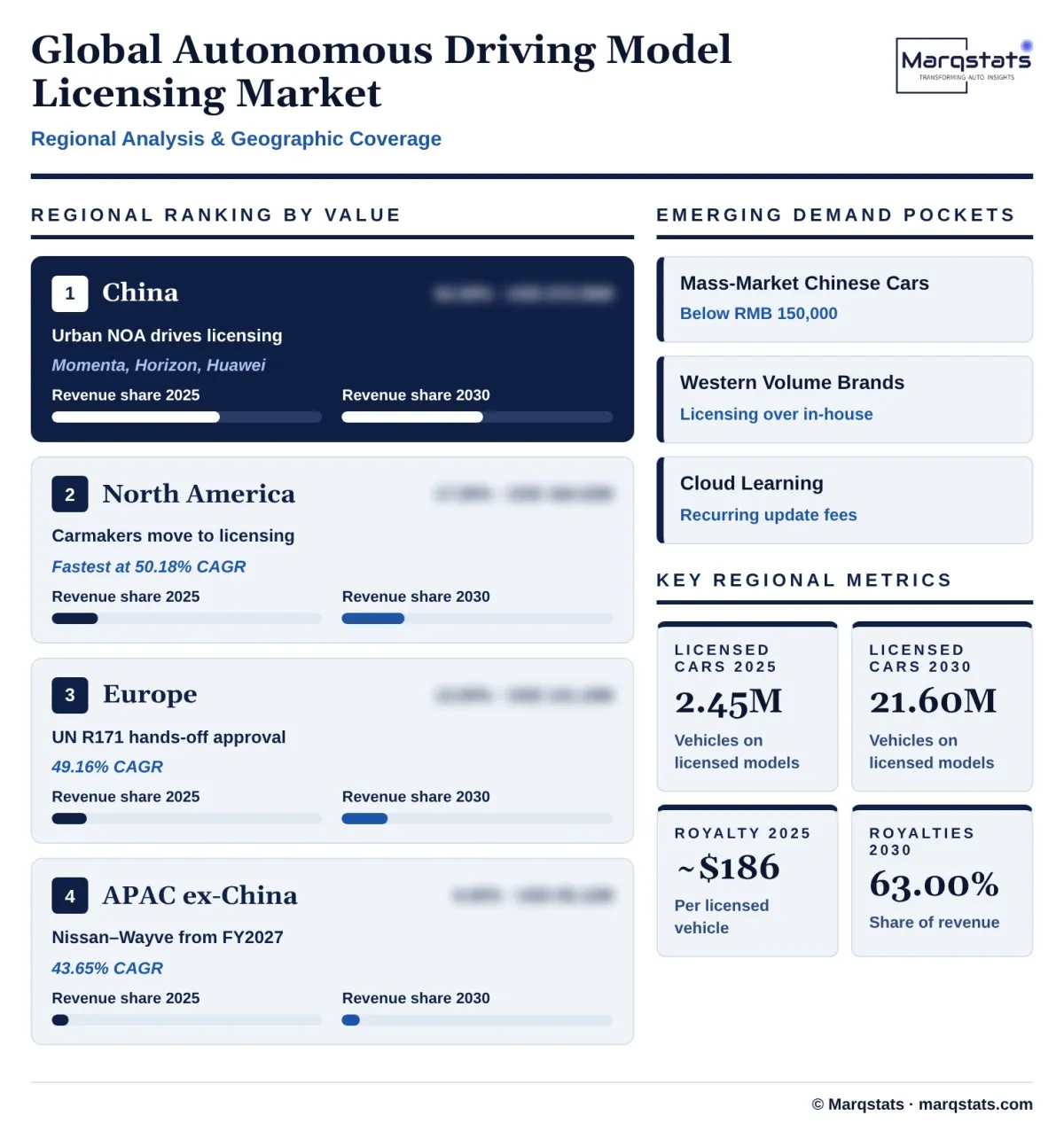
The global autonomous driving model licensing market size is estimated at USD 1,085.40 million in 2025 and is projected to reach USD 6,128.50 million by 2030, growing at a CAGR of 41.37% over 2026 – 2030. Vehicles fitted with licensed third-party end-to-end or vision-language-action (VLA) driving models grow from about 2.45 million in 2025 to 21.60 million in 2030, a 54.55% annual rate.
Marqstats defines the market as revenue from licensing end-to-end neural and VLA autonomous driving models to carmakers by third-party developers. It covers per-vehicle production royalties, upfront engineering fees to adapt models to each vehicle platform, and cloud subscriptions for continuous fleet learning and model updates. In-house development by carmakers such as Tesla and XPeng, driving chips sold as hardware, sensors and consumer feature subscriptions are excluded.
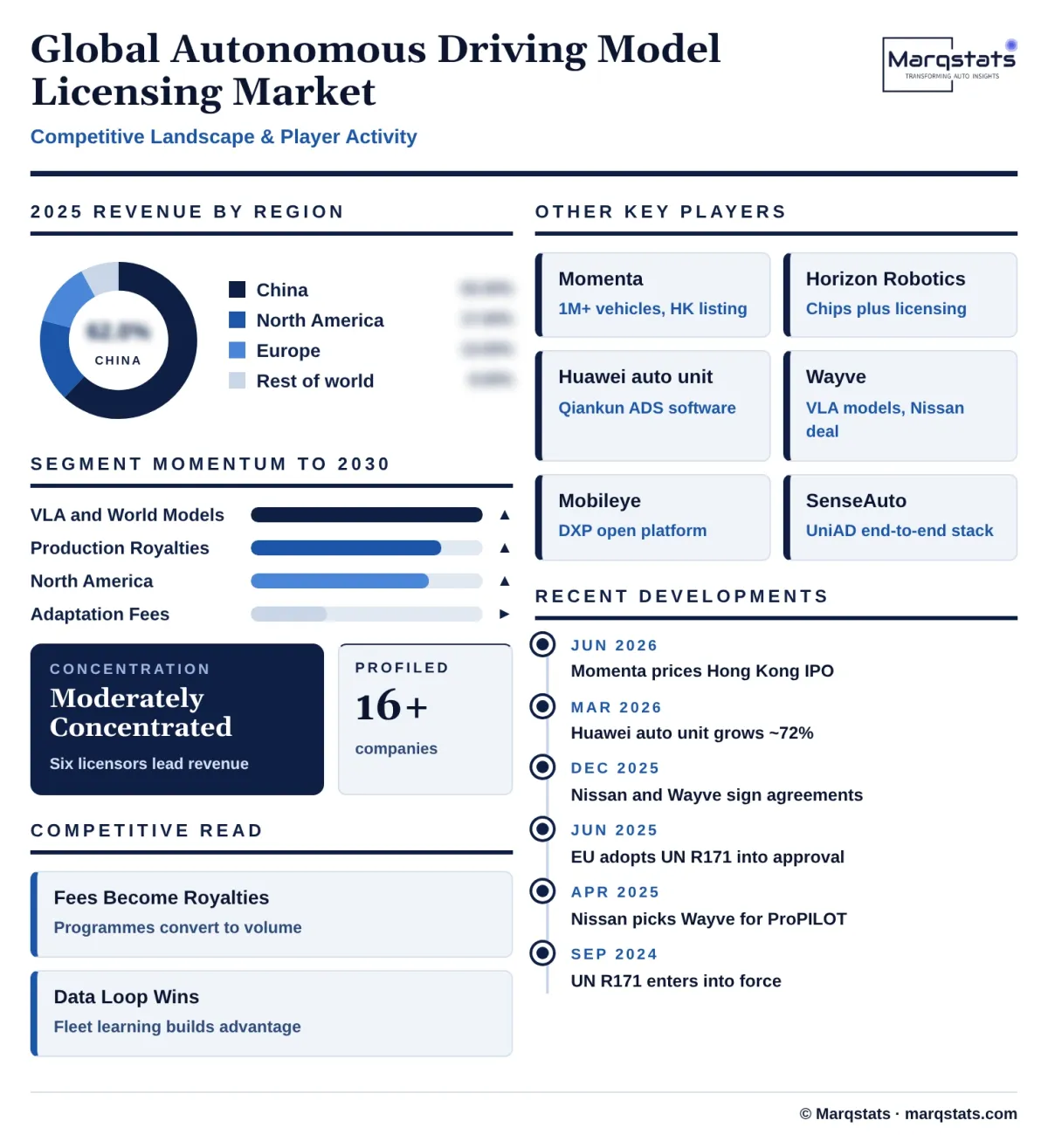
China accounts for an estimated 62.00% of 2025 revenue, North America for 17.00% and Europe for 13.00%. Upfront adaptation fees are the largest revenue stream in 2025 at 45.01%, but production royalties become dominant by 2030 at 63.00%. Modular end-to-end models generate 78.00% of 2025 revenue, while VLA models grow to 48.00% by 2030. The study segments the market by licensing model, model architecture and region.
Key Takeaways
Market Overview & Analysis
Report Summary
Marqstats sizes the autonomous driving model licensing market as revenue earned by third-party developers from licensing end-to-end neural and vision-language-action driving models to carmakers. It includes royalties paid for each production vehicle running a licensed model, engineering fees to adapt models to specific vehicle platforms, and recurring cloud fees for collecting fleet data, retraining models and sending updates over the air. In 2025 the market was worth an estimated USD 1,085.40 million.
Driving software is changing from rule-based to learned systems. Traditional systems used separate hand-written programs for perception, prediction, planning and control. End-to-end models learn these tasks together from driving data, and VLA models add language and reasoning so they can interpret unusual scenes. Modular end-to-end models keep inspectable intermediate stages, which helps safety certification, while VLA models offer broader reasoning but need more powerful computers.
The market sits within a much larger automotive software and electronics industry. Automated driving hardware and software together are worth about USD 48.5 billion a year, autonomous driving software and algorithm development about USD 16.8 billion, and all third-party merchant driving software licensing about USD 3.4 billion. End-to-end and VLA model licensing is the fastest-growing part of merchant licensing.
Training these models is expensive. Frontier driving models need clusters of more than 10,000 AI accelerators, petabytes of curated video and large simulation systems, which only a few carmakers such as Tesla, Huawei and XPeng can afford alone. Most carmakers therefore license models and pay for adaptation, rather than building their own, cutting development time by about 18 to 24 months.
Licensing changes how carmakers buy driving systems. Under the old model, suppliers such as Bosch, Continental and ZF sold sealed modules with cameras, chips and fixed code, and software was hidden in the component price. End-to-end models are tied to each vehicle's cameras, dimensions, steering and braking, so they must be adapted to each platform and updated continuously, which makes software a separately priced, recurring product.
About 78.4% of the 2025 estimate is anchored in disclosed company financials from Momenta, Horizon Robotics, Mobileye and Huawei's automotive business. The rest is estimated from adaptation contracts, joint venture royalties and cloud subscriptions. Marqstats expects revenue of USD 1,780.20 million in 2026, USD 2,620.00 million in 2027, USD 3,650.00 million in 2028 and USD 4,810.00 million in 2029.
Global Autonomous Driving Model Licensing Market Size and Forecast
The global autonomous driving model licensing market grows from USD 1,085.40 million in 2025 to USD 6,128.50 million in 2030, a CAGR of 41.37%. Licensed vehicles grow from 2.45 million to 21.60 million, a 54.55% annual rate. The market grew from USD 42.10 million in 2021, with about 50,000 licensed vehicles, to USD 98.50 million in 2022, USD 215.30 million in 2023 and USD 512.80 million in 2024.
Growth slows from 111.66% in 2025 to 63.98% in 2026, 47.17% in 2027, 39.31% in 2028, 31.78% in 2029 and 27.41% in 2030 as the base grows, but annual revenue additions keep rising, from about USD 695 million in 2026 to about USD 1,319 million in 2030.
Revenue per licensed vehicle falls. Including royalties, adaptation fees and cloud services, average revenue per licensed vehicle falls from about USD 443 in 2025 to USD 419 in 2026, USD 369 in 2027, USD 326 in 2028, USD 299 in 2029 and USD 284 in 2030. The fall reflects the shift from one-off adaptation fees to royalties spread across many more vehicles, and price competition in cars below RMB 150,000.
Royalties vary by capability. Highway navigation models on Level 2+ cars earn about USD 150 to 220 per vehicle, while urban door-to-door VLA systems with hands-off or eyes-off capability earn about USD 380 to 550. Adaptation programmes for a vehicle platform cost USD 25 million to 60 million, and cloud learning subscriptions cost about USD 3.00 to 6.50 per vehicle per month.
Margins differ by revenue stream. Adaptation work is labour-intensive, with gross margins of about 45% to 55%, cloud learning services carry about 60% to 70% because of computing and bandwidth costs, and production royalties earn about 85% to 95% because each extra copy costs almost nothing to deliver. As royalties grow to 63.00% of revenue, licensors' overall profitability rises sharply.
Volume growth depends on mass-market adoption. Licensed models are moving from premium cars into vehicles priced below RMB 150,000 in China and mainstream models in Europe and North America. Marqstats expects licensed vehicles to reach about 4.25 million in 2026, 7.10 million in 2027, 11.20 million in 2028 and 16.10 million in 2029, giving licensed models a growing share of global light vehicle production.
Sensitivities are significant. A USD 10 change in the average per-vehicle royalty shifts the 2025 market by about USD 24.50 million, a 10% change in adaptation fees by about USD 48.85 million, and a USD 1 change in monthly cloud fees by about USD 18.40 million. The key long-term variable is how quickly carmakers separate driving software from supplier hardware packages.
Market Dynamics
Key Drivers
Five forces are pushing carmakers to license AI driving models rather than build them.
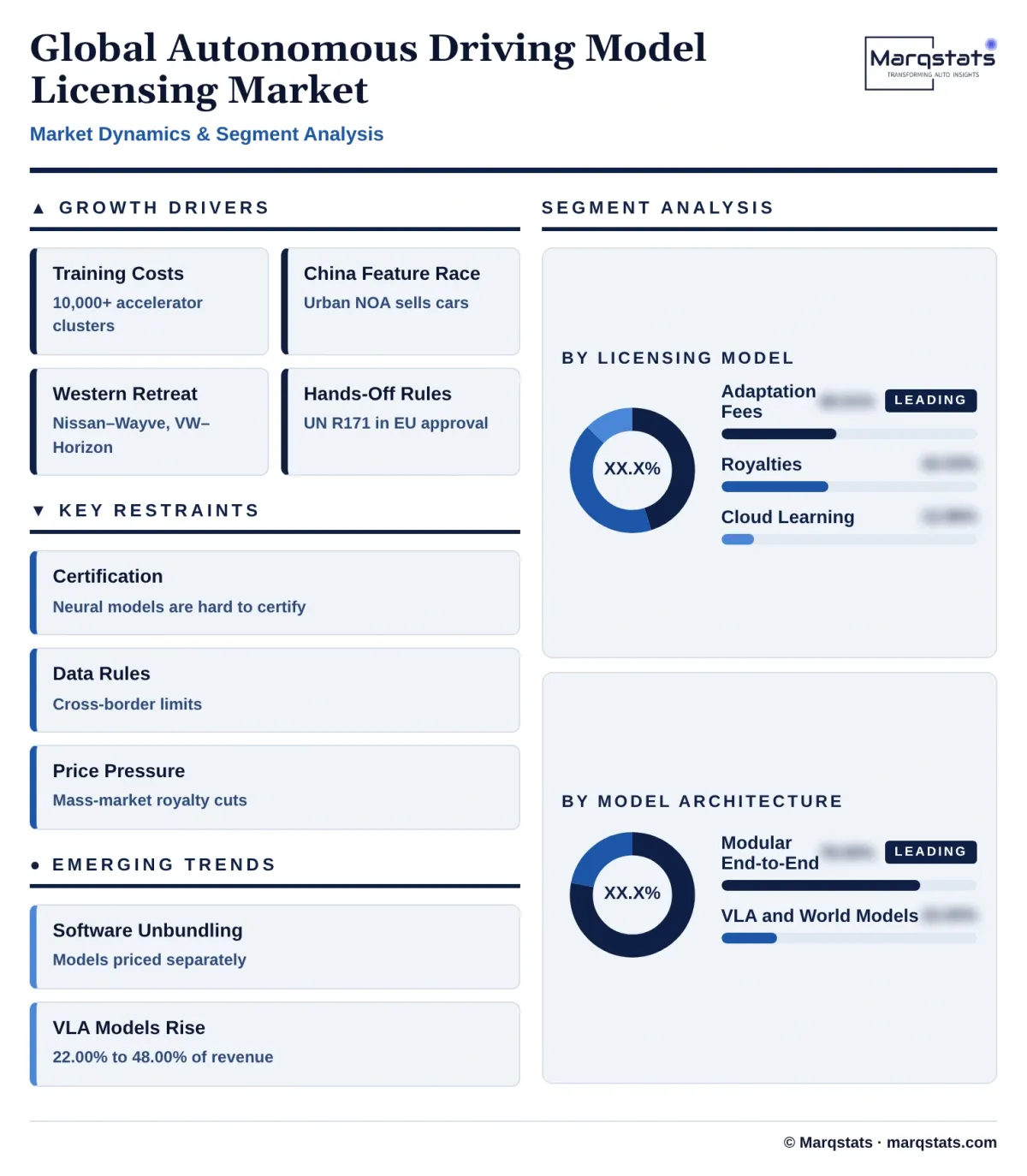
- Model training costs exceed most carmakers' budgets. Continuous training on large AI clusters and fleet video, and validation in simulation, require investment that only the largest players can sustain. Licensing gives other carmakers access to frontier models at a fraction of the cost.
- Driving features drive car sales in China. Urban navigation-on-autopilot has become a key purchase criterion for Chinese buyers, and carmakers such as SAIC, Changan, BYD, Geely and GAC license models to keep pace with Tesla, Huawei-linked brands and Li Auto.
- Western carmakers are scaling back in-house software. After costly setbacks in captive autonomous driving programmes, Western carmakers are licensing models instead, as shown by Nissan's agreement with Wayve and Volkswagen's CARIZON venture with Horizon Robotics in China.
- Regulation enables hands-off driving. UN Regulation No. 171, adopted into EU type-approval in 2025, allows hands-off, eyes-on assistance including system-initiated lane changes, Germany approved Mercedes-Benz DRIVE PILOT Level 3 at up to 95 km/h, and China's pilot programme allows Level 3 and Level 4 production vehicles in selected cities.
- Software economics attract investment. Per-vehicle royalties carry gross margins of 85% to 95%, and licensors such as Momenta have shown rapid margin expansion as volumes grow. This attracts capital, as shown by Momenta's 2026 IPO and Horizon Robotics' growth.
Key Restraints
Four constraints shape how fast third-party driving models are adopted.
- Safety certification is demanding. Neural models behave statistically, making them harder to certify than rule-based software. Regulators require extensive testing, driver monitoring and incident reporting, and changes to driving behaviour through over-the-air updates require regulatory filings in China.
- Data and security rules fragment markets. US restrictions on connected vehicle software from certain countries and data localisation rules in China and Europe limit cross-border licensing and the sharing of fleet data needed to improve models.
- Pricing pressure is strong. Competition among licensors and the move into mass-market cars push per-vehicle prices down, and carmakers may renegotiate royalties as volumes grow.
- Compute requirements raise vehicle costs. VLA models need more powerful in-vehicle processors than earlier systems, adding hardware cost that limits their use in cheaper cars until next-generation chips become affordable. Carmakers must balance model capability against vehicle price.
- Some carmakers keep development in-house. Tesla, Huawei-linked brands, XPeng, Li Auto and others build their own models, limiting the addressable market, and large carmakers may bring development back in-house if they gain scale.
Key Trends
Four shifts are changing how AI driving software is built, priced and sold.
- Software is being separated from hardware. Instead of buying sealed supplier modules combining camera, chip and fixed code, carmakers increasingly buy computing platforms and license driving software separately, creating a distinct market for models.
- VLA and world models are moving towards production. Developers such as Wayve, DeepRoute.ai and Waabi are building models that combine vision, language and action, and generative world models are used to train and test driving policies in simulation.
- Revenue is shifting to recurring cloud services. Licensors increasingly sell continuous learning, in which vehicles flag rare events, the licensor retrains the model and updates are sent over the air, creating recurring subscription revenue.
- Licensors are expanding beyond China. Momenta works with BMW, Honda, Toyota and Mercedes-Benz on programmes for China and other markets, Horizon Robotics supplies Volkswagen through CARIZON, and Wayve partners with Nissan and Uber, showing how licensed models are moving across regions and carmaker groups.
- Chip makers are opening their platforms. Mobileye's DXP platform lets carmakers customise driving policy on EyeQ6 High chips, and Horizon Robotics combines its chips with licensable software, competing with pure software licensors while widening the market.
Strategic Implications
- For carmakers, licensing saves time and capital. Licensing pre-trained models with adaptation programmes can shorten development by 18 to 24 months, while contracts should secure access to model updates, data rights and the ability to switch suppliers.
- For model developers, the data loop is the advantage. Licensors that collect rare events from customer fleets, retrain models quickly and deliver safe updates will build lasting advantages and recurring revenue.
- For traditional suppliers, software must become a product. Tier-1 suppliers whose value lay in hardware modules must offer software platforms or partner with model developers to stay relevant.
- For chip makers, open platforms widen the market. Supporting third-party models on their processors lets chip makers sell to carmakers using different software suppliers.
- For investors, the royalty transition is the key metric. Licensors whose adaptation programmes convert on schedule into high-volume production royalties will show rising margins and predictable revenue, while delays in vehicle launches can push revenue out by years.
- For regulators, consistent validation rules matter. Clear requirements for testing, monitoring and updating neural driving models would help certification and support safe cross-border licensing.
Market Segmentation
Per-vehicle royalties paid for each production car running a licensed model account for 42.03% of 2025 revenue, USD 456.20 million, and grow at 53.29% a year to USD 3,860.95 million and 63.00% of the market by 2030, becoming the largest revenue stream. The average royalty is about USD 186 per vehicle in 2025 and USD 179 in 2030. Momenta, Horizon Robotics, Huawei's automotive unit and Mobileye are leading licensors.
Upfront fees for adapting models to vehicle platforms, covering sensor calibration, optimisation for in-vehicle chips, safety integration and local validation, account for 45.01% of 2025 revenue, USD 488.50 million, making them the largest stream in 2025. They grow at 21.38% a year to USD 1,287.00 million by 2030, while their share falls to 21.00%. Wayve, SenseAuto and CARIZON earn significant adaptation revenue.
Recurring subscriptions for cloud training, simulation and over-the-air model updates account for 12.96% of 2025 revenue, USD 140.70 million, and grow at 47.45% a year to USD 980.55 million and 16.00% of the market by 2030, as the base of connected vehicles on licensed models grows.
Modular end-to-end neural networks, which learn perception, prediction and planning together while keeping inspectable intermediate stages, account for 78.00% of 2025 revenue, USD 846.60 million, rising to USD 3,186.82 million by 2030, a 30.36% CAGR, while their share falls to 52.00%. They run on existing automotive chips and are easier to certify. Examples include SenseAuto UniAD, Momenta's end-to-end system and Horizon SuperDrive.
VLA and world models, which combine camera input with language-based reasoning to handle unusual situations, account for 22.00% of 2025 revenue, USD 238.80 million, mainly from development contracts. They grow fastest, at 65.24% a year, to USD 2,941.68 million and 48.00% of the market by 2030, as more powerful in-vehicle computers reach production. Wayve, DeepRoute.ai and Waabi are leading developers.
By Geography
China
China is the largest market, with an estimated 62.00% of 2025 revenue, USD 672.95 million, rising to USD 3,186.82 million by 2030, a 36.48% CAGR, while its share falls to 52.00%. China produced 34.53 million vehicles and sold 16.49 million new energy vehicles in 2025, and urban navigation features are a key purchase factor. Momenta, Horizon Robotics, Huawei's automotive unit and SenseAuto license models to domestic carmakers, and the government's Level 3 and Level 4 pilot programme covers nine carmaker consortia.
North America
North America accounts for an estimated 17.00% of 2025 revenue, USD 184.52 million, and grows fastest, at 50.18% a year, to USD 1,409.56 million and 23.00% of the market by 2030. Tesla develops its own models, but other carmakers are turning to licensing after setbacks in in-house programmes. NHTSA crash reporting rules, the AV STEP exemption programme and the automatic emergency braking rule (FMVSS No. 127) shape demand.
Europe
Europe accounts for an estimated 13.00% of 2025 revenue, USD 141.10 million, rising to USD 1,041.84 million and 17.00% of the market by 2030, a 49.16% CAGR. UN Regulation No. 171, adopted into EU type-approval in 2025, allows hands-off driving assistance, and Germany's approval of Mercedes-Benz DRIVE PILOT at up to 95 km/h sets a benchmark for premium brands. EU car registrations were about 10.6 million in 2025.
Asia-Pacific excluding China
Asia-Pacific outside China accounts for an estimated 6.00% of 2025 revenue, USD 65.12 million, rising to USD 398.35 million by 2030, a 43.65% CAGR. Nissan's plan to use Wayve's AI Driver from fiscal 2027 and the software-defined vehicle programmes of Japanese and Korean carmakers drive demand.
Rest of the World
The Middle East, Latin America and other regions account for an estimated 2.00% of 2025 revenue, USD 21.71 million, rising to USD 91.93 million by 2030, a 33.46% CAGR, mainly through imported premium vehicles fitted with licensed driving models.
How Competition Is Evolving
The autonomous driving model licensing market is moderately concentrated. Momenta, Horizon Robotics, Huawei's automotive unit, Mobileye, Wayve and SenseAuto account for most licensing revenue. Momenta reported software licence revenue of RMB 968 million in 2025 and has systems in more than one million vehicles across more than 210 models, with customers and investors including SAIC, Mercedes-Benz, BMW, Toyota, Honda and BYD.
Business models differ. Momenta and Wayve license software across chip platforms. Horizon Robotics combines its chips with software and licensing, reported RMB 1,647.5 million of licensing and service revenue in 2024 and claims more than half of driver assistance solutions among Chinese domestic brands in the first half of 2026. Huawei's automotive unit, whose revenue grew about 72% to about RMB 45 billion in 2025, offers its Qiankun ADS software and hardware to partner brands. Mobileye opens its EyeQ platform through DXP while offering its own SuperVision and Chauffeur systems.
Partnerships and joint ventures are common. Volkswagen works with Horizon Robotics through CARIZON in China, Nissan with Wayve, BMW and Honda with Momenta, and Changan-backed Avatr and Seres hold stakes in Huawei's automotive unit. These ties give licensors guaranteed volume and give carmakers influence over model development.
New entrants keep arriving. Start-ups such as DeepRoute.ai, QCraft and Waabi, chip makers such as NVIDIA and Qualcomm offering reference driving software, and traditional suppliers such as Bosch and Valeo building end-to-end capabilities all compete for carmaker programmes, keeping pressure on prices.
Competition will be decided by data scale, model quality and certification. Licensors with the largest fleets to learn from, the strongest VLA models and proven safety certification in China, Europe and North America will win the platform programmes that turn into royalties later in the decade.
Companies Covered
Companies covered in the report include:
Recent Market Activity
Table of Contents
Coverage & Segmentation
The study covers the global autonomous driving model licensing market, with 2025 as the base year, 2021 – 2025 as the historical period and 2026 – 2030 as the forecast period. Values are in US dollars at constant 2025 exchange rates. The market covers third-party licensing of end-to-end neural and vision-language-action driving models, including production royalties, platform adaptation fees and cloud learning subscriptions. It is segmented by licensing model, model architecture and region.
In-house carmaker software development, driving chips and sensors sold as hardware, rule-based and legacy perception software, and consumer feature subscriptions are excluded. Licensed vehicle volumes, royalty rates, segment and regional splits are Marqstats estimates built on company financial disclosures, carmaker programme announcements, vehicle production data and pricing benchmarks.