Market Snapshot
Key Takeaways
Market Overview & Analysis
Report Summary
The GCC autonomous commercial vehicle market covers goods-carrying and industrial vehicles capable of driving without a human operator in control, deployed under permit across Saudi Arabia, the United Arab Emirates, Qatar, Kuwait, Oman and Bahrain. Four vehicle categories fall inside it: heavy trucks and tractors on corridor freight, light commercial and delivery vehicles, port and terminal handling equipment, and mining and industrial vehicles. Passenger robotaxis, autonomous shuttles and sidewalk delivery robots fall outside, because each answers a different regulatory pathway and a different commercial question.
The market is best understood as two markets developing in parallel rather than one. National corridor freight is a policy-led programme play concentrated in Saudi Arabia, where the Transport General Authority launched an initial operational phase in Riyadh in July 2025 and opened a formal application route for operators that September, and where a single sovereign-backed programme sets the trajectory. Industrial and port autonomy is an operator-led efficiency play spread across Abu Dhabi, and increasingly Qatar, where deployment decisions sit with a zone or terminal owner and scale is bounded by the site rather than by national approval.
Corridor by corridor is the right unit of analysis, not a national fleet total. An autonomous truck programme is authorised for a defined operational design domain covering specific routes, weather conditions, speeds and traffic environments, and each extension of that domain is a separate technical and regulatory exercise. A forecast built as a single national fleet number conceals the fact that growth arrives as discrete corridor authorisations, each of which can slip independently of the others.
Autonomous Commercial Vehicle Fleet Size and Forecast
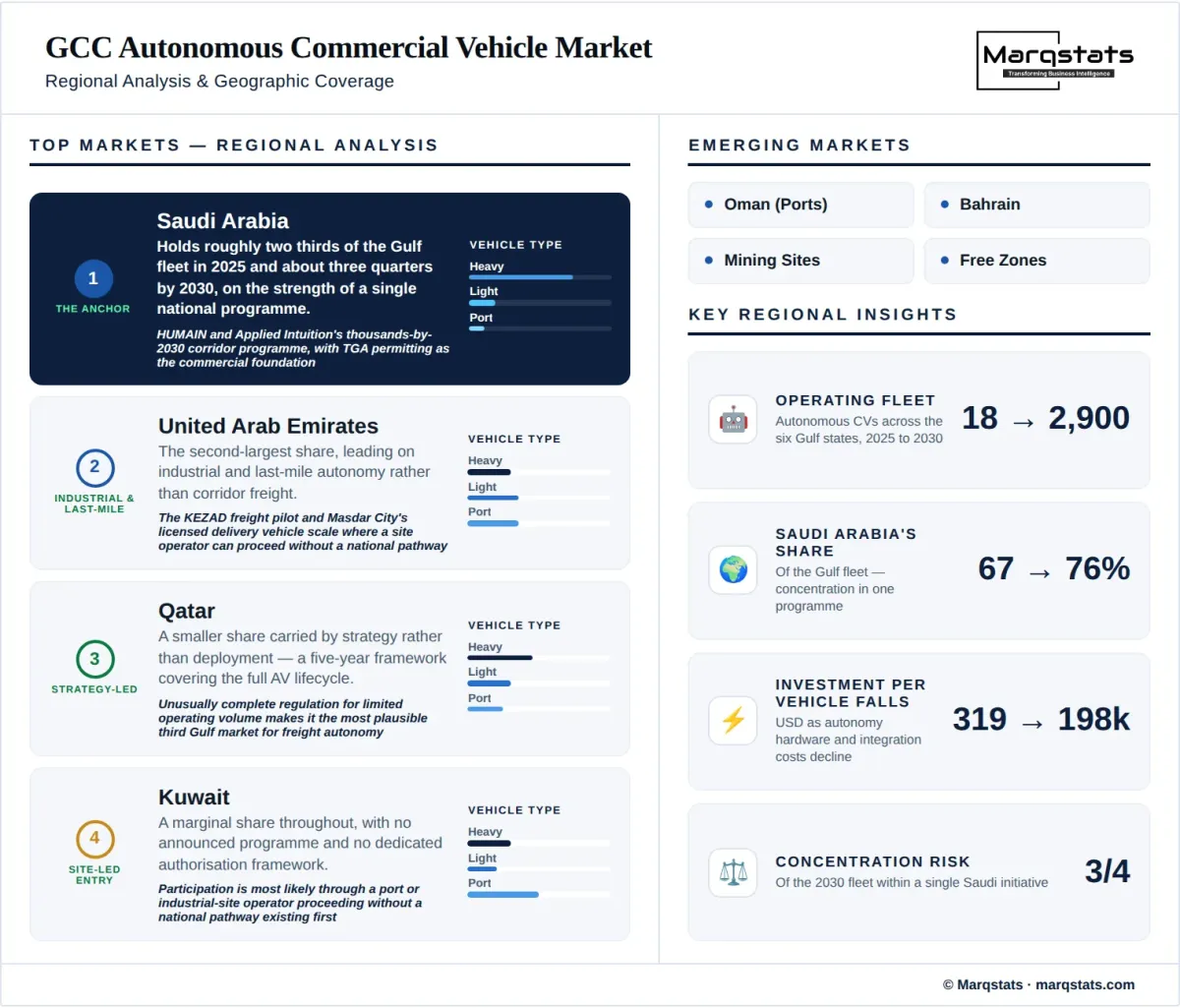
The autonomous commercial vehicle fleet across the six Gulf states rises from 18 vehicles in 2025 to 2,900 by 2030, a 176.33% compound annual growth rate, with an indicative 2031 fleet near 4,500 vehicles. The 2025 figure comprises the Saudi national programme's initial vehicles together with the first licensed autonomous delivery vehicles in Abu Dhabi, and the count covers vehicles operating or permitted under a transport authority or zone authorisation rather than vehicles announced.
Saudi Arabia contributes approximately 12 of the 18 vehicles in 2025 and about 2,200 of the 2,900 in 2030, which is roughly two thirds of the Gulf fleet rising to three quarters. That concentration is the defining structural feature of the market and it carries a specific risk: a delay to one programme moves the regional forecast more than any other single event. The remaining volume is distributed across United Arab Emirates industrial and port operations and smaller pilots in Qatar and the other states.
Market value is built from vehicles entering service in each year rather than from the operating fleet, because an autonomous truck generates its investment once at deployment. Approximately 1,580 vehicles enter service in 2030 against 18 across the whole of 2025, and investment per vehicle entering service falls from around USD 319,000 to USD 198,000, a 9.15% annual decline. Multiplying the 2,900-vehicle 2030 fleet by a per-vehicle cost would produce roughly USD 574 million against the correct USD 313.50 million, an overstatement of more than 80%.
The value curve therefore compounds more slowly than the fleet, at 122.57% against 176.33%, and the gap is entirely the falling cost of autonomy hardware and integration. Sensor suites, compute and redundant braking and steering systems decline in cost as volumes rise globally, and Gulf programmes move past first-of-kind builds toward repeatable configurations. A forecast holding per-vehicle investment constant would overstate 2030 value by approximately 60%.
Estimates are fleet-equivalent working figures rather than an audited stock count. Gulf authorities disclose pilots, permits and strategic targets more often than they publish operating fleet numbers, and no participant reports autonomous commercial vehicle revenue as a segment. The Saudi component is anchored on the national programme's own announced trajectory; the remainder is modelled from pilot scale, zone capacity and announced operator commitments. Confidence is low, and the 2031 range is wide.
Market Dynamics
Key Drivers
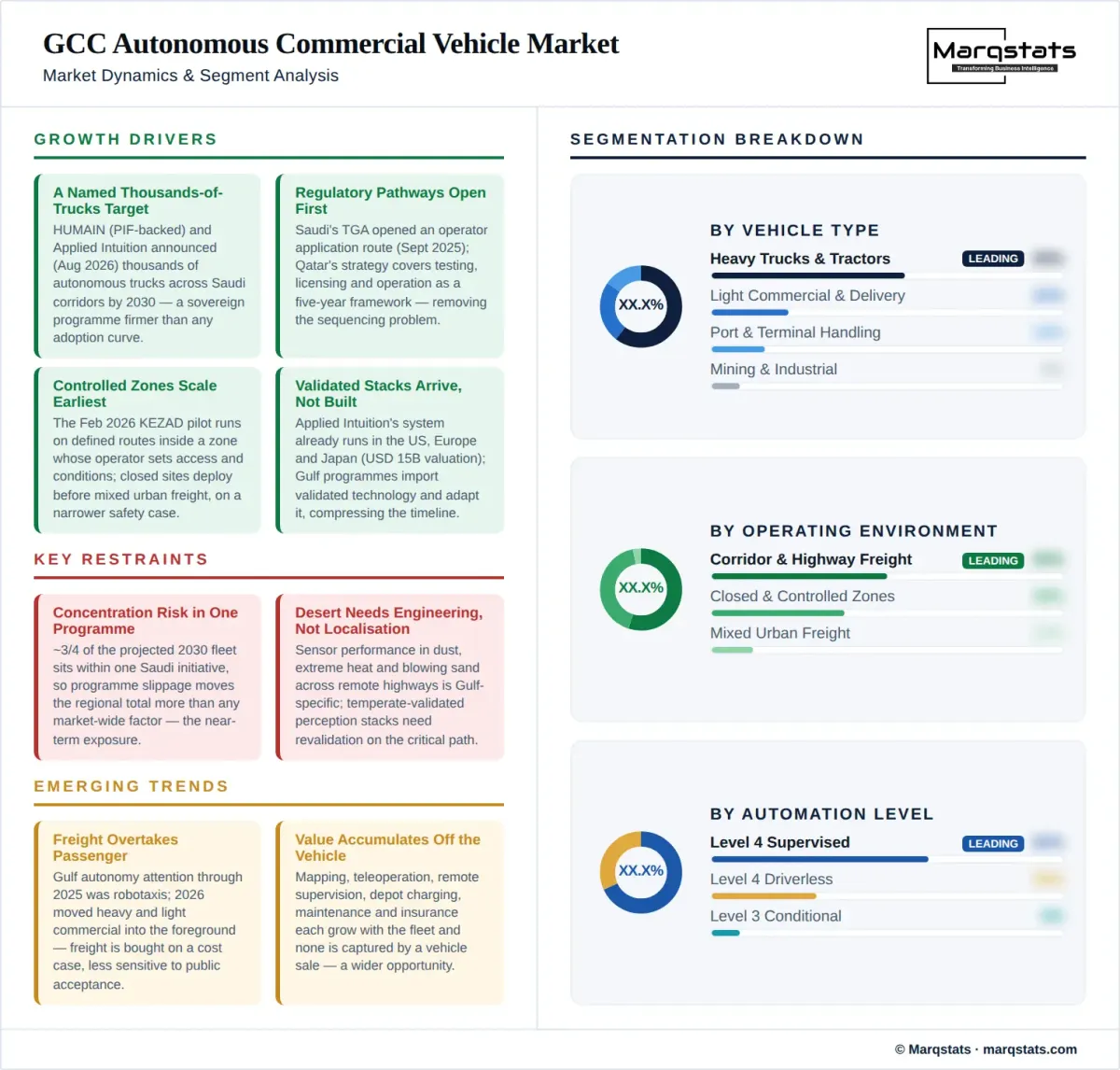
- A national programme with an explicit thousands-of-trucks target. HUMAIN, backed by the Public Investment Fund, and Applied Intuition announced in August 2026 a plan to deploy thousands of autonomous trucks across Saudi logistics corridors by 2030, intended to form a national autonomous logistics network and later extend into ports, mining and other industrial applications. A named programme with a sovereign backer and a stated date is a materially firmer forecast foundation than a technology adoption curve.
- Regulatory pathways opening ahead of vehicles. Saudi Arabia launched an initial operational phase for autonomous vehicles in Riyadh in July 2025 and opened a formal application route for operators that September, with Transport General Authority technical evaluation and operating permissions forming the central commercial gate. Qatar's autonomous vehicle strategy covers development, testing, licensing, procurement, operation, reporting and regulation as a five-year implementation framework. Approval routes existing before commercial demand is unusual and removes the sequencing problem that has slowed deployment elsewhere.
- Controlled industrial environments allowing early scale. The February 2026 pilot inside Khalifa Economic Zones Abu Dhabi runs on defined routes within a zone whose operator controls access, traffic and conditions. Ports, mining sites and closed logistics zones can deploy earlier than mixed urban freight because the operational design domain is set by a single owner rather than negotiated with a road authority, and the safety case is correspondingly narrower.
- Proven autonomy stacks arriving rather than being developed locally. Applied Intuition's self-driving system and vehicle operating software already operate in the United States, Europe and Japan, and the company was valued at USD 15 billion in a 2025 funding round. Gulf programmes are importing validated technology and adapting it to local conditions rather than funding development from a standing start, which compresses the timeline between announcement and road deployment.
- Freight economics that suit long, sparse corridors. Gulf freight runs long distances between ports, industrial cities and distribution centres on routes with low traffic density and few intersections, which is the environment autonomous trucking addresses most readily. Driver availability, cost and hours-of-service constraints on those routes make the operating case stronger than in dense urban freight networks.
Key Restraints
- Concentration risk in a single programme. Roughly three quarters of the projected 2030 fleet sits within one Saudi initiative, so programme slippage moves the regional total more than any market-wide factor. Trucks are expected on public roads within a year of the August 2026 announcement, and the interval between that milestone and multi-hundred-vehicle operation is where the forecast is most exposed.
- Environmental conditions demanding genuine engineering rather than localisation. Sensor performance in dust, extreme heat and blowing sand that obscures sightlines, across long stretches of remote highway, is a Gulf-specific requirement. Perception stacks validated in temperate conditions require revalidation rather than recalibration, and that work sits on the critical path between pilot and commercial operation.
- Vehicle platform readiness as a separate constraint from software. Autonomous operation requires redundant braking and steering, drive-by-wire capability and a service network able to maintain both, and truck manufacturers rather than software developers control that. Regional programmes depend on platform availability and on aftersales support that does not yet exist at scale for autonomous-capable heavy vehicles.
- Compliance workstreams that are unresolved rather than merely demanding. Operational design domain definition, remote supervision architecture, cybersecurity, insurance and liability allocation, and high-definition map and data governance are each active questions rather than settled requirements. Liability allocation in particular has no established Gulf precedent for a driverless goods vehicle at fault, and no operator can price risk it cannot bound.
Key Trends
- Autonomy extending from passenger to freight as the regional centre of gravity. Gulf autonomy attention through 2025 concentrated on robotaxis; the 2026 announcements moved heavy and light commercial vehicles into the foreground. That shift matters commercially because freight autonomy is bought by operators against a cost case rather than adopted by consumers against a convenience case, which makes demand less sensitive to public acceptance.
- Ports and economic zones positioning as autonomy proving grounds. A port group, a zone operator and a transport authority jointly running the region's first freight pilot establishes a template other Gulf industrial landlords can copy. Zone-based deployment also creates a commercial route for technology suppliers that does not require national approval, lowering the entry threshold for firms without sovereign relationships.
- Last-mile commercial autonomy licensed as a distinct vehicle category. Abu Dhabi issued its first official licence plate for a self-driving delivery vehicle in September 2025, separating road-legal autonomous delivery vehicles from both passenger autonomy and from sidewalk robots. A distinct plate category is an administrative signal that the vehicle type is expected to scale.
- Value accumulating outside the vehicle itself. Mapping, teleoperation and remote supervision, depot charging, maintenance, data infrastructure and insurance each grow with the fleet and none is captured by a vehicle sale. For an investor the addressable opportunity is materially wider than the market measured here, and several of those layers have lower capital intensity and earlier revenue than vehicle supply.
Market Segmentation
Heavy trucks and tractors dominate the market by value throughout, carrying the Saudi national programme and the highest investment per vehicle. Corridor freight between ports, industrial cities and distribution centres is the application the programme was announced to serve, and the segment's trajectory is effectively the trajectory of that programme. Level 4 operation with safety drivers aboard is the entry configuration, with driverless operation following corridor by corridor.
Light commercial and delivery vehicles are the fastest-growing category by unit count and the smallest by investment per vehicle, covering road-legal autonomous vans and delivery vehicles operating under transport authority permits. Abu Dhabi's first licensed self-driving delivery vehicle in Masdar City established the category administratively, and growth follows the extension of permitted service areas rather than the opening of freight corridors.
Port and terminal handling vehicles cover autonomous tractors, shuttles and yard equipment operating inside terminal boundaries, where the operational design domain is fully controlled and no public road authorisation is required. The segment is small in the early years and grows as Gulf port operators extend the industrial pilots now running, and its economics rest on labour productivity and continuous operation rather than on corridor distance.
Mining and industrial vehicles are the smallest category through the forecast and the one with the clearest international precedent, since autonomous haulage is established practice in mining elsewhere. Gulf deployment follows the industrial expansion of the Saudi programme rather than leading it, and the segment carries the highest investment per vehicle of the four.
Closed and controlled zones hold the largest share of vehicles in the early forecast years, covering economic zones, ports, mining sites and private logistics estates where a single operator sets access, traffic and conditions. The February 2026 pilot inside Khalifa Economic Zones Abu Dhabi is the regional template. Deployment here requires zone operator agreement rather than national authorisation, which is why it moves first.
Corridor and highway freight becomes the largest environment by value from the middle of the forecast, as national programme authorisations convert into multi-vehicle operations on defined routes. Each corridor is a separate operational design domain requiring its own technical evaluation and operating permission, so growth arrives in discrete steps rather than continuously, and the pace is set by the regulator's throughput as much as by the operator's readiness.
Mixed urban freight is the smallest environment throughout and the last to develop, because urban operational design domains contain the pedestrian, cyclist and unpredictable-actor conditions that are hardest to validate. Light commercial delivery vehicles operating in defined districts represent the segment's practical near-term form rather than heavy vehicles in city traffic.
Level 4 supervised operation, with a safety driver aboard a vehicle that drives itself within its operational design domain, is the dominant configuration through the early and middle forecast years. It is the entry configuration for the Saudi national programme and the standard condition of most Gulf operating permits, and it allows commercial operation to begin while the safety case for removing the operator is still being built.
Level 4 driverless operation, with no human aboard, grows fastest across the forecast and is where the operating economics of autonomous freight are actually realised, since a supervised vehicle carries the labour cost the technology was adopted to remove. Progression to driverless status is granted domain by domain and depends on accumulated evidence, which makes it a regulatory milestone rather than a technical one.
Level 3 conditional automation covers vehicles requiring driver readiness to intervene on request, and occupies a declining share of the market. Its role in the Gulf is transitional, providing operating experience and data collection on corridors where full Level 4 authorisation has not yet been granted, rather than serving as a commercial endpoint.
Programme and sovereign-backed ownership holds the largest share by value, reflecting a market whose largest single initiative is led by a Public Investment Fund-backed entity in partnership with an international technology supplier. Capital availability is not the constraint in this model; regulatory throughput and platform readiness are, and the model's advantage is the ability to commit to fleet scale before unit economics are proven.
Port and industrial operator ownership covers deployments funded by the zone, terminal or site owner against an internal productivity case. Fleet sizes are bounded by site throughput rather than by capital, decisions are made on payback periods rather than strategic positioning, and this model produces the most reliable near-term volume because it does not depend on public road authorisation.
Logistics operator and third-party fleet ownership is the smallest model through the forecast and the one that determines whether the market becomes self-sustaining. A commercial haulier buying autonomous capacity on its own cost case, rather than participating in a national programme or an owner-operator productivity project, is the signal that the technology has crossed into ordinary procurement.
By Geography
Saudi Arabia
Saudi Arabia holds roughly two thirds of the Gulf fleet in 2025 and about three quarters by 2030, on the strength of a single programme. HUMAIN and Applied Intuition announced in August 2026 a plan for thousands of autonomous trucks across national logistics corridors by 2030, with trucks expected on public roads within a year and Level 4 operation using safety drivers initially. The Transport General Authority launched an initial operational phase in Riyadh in July 2025 and opened a formal operator application route that September, providing the permitting foundation.
United Arab Emirates
The United Arab Emirates holds the second-largest share and leads on industrial and last-mile autonomy rather than on corridor freight. Abu Dhabi Mobility, Autotech and AD Ports Group began the region's first autonomous logistics and freight truck pilot inside Khalifa Economic Zones Abu Dhabi in February 2026, following the emirate's first licensed self-driving delivery vehicle in Masdar City in September 2025 with K2 and EMX. Emirate-level authorities operate phased testing with real-time oversight and operating permits.
Qatar
Qatar holds a smaller share carried by strategy rather than by deployment. Its autonomous vehicle strategy covers development, testing, licensing, procurement, operation, reporting and regulation as a five-year implementation framework, which is unusually complete for a market with limited operating volume. Commercial vehicle pilots have a defined route to authorisation, and the framework's breadth makes Qatar the most plausible third Gulf market for freight autonomy.
Kuwait
Kuwait holds a marginal share throughout, with no announced autonomous commercial vehicle programme and no dedicated authorisation framework comparable to those in Saudi Arabia, the Emirates or Qatar. Participation is most likely to arrive through port or industrial site deployment, where a site operator can proceed without a national regulatory pathway existing first.
Oman and Bahrain
Oman and Bahrain together hold a negligible share across the forecast. Neither has announced a commercial vehicle autonomy programme, and both sit outside the supplied commercial vehicle baseline that anchors the rest of the estimate, making their contribution the least precisely measured. Oman's port and logistics development provides the more plausible entry route of the two.
How Competition Is Evolving
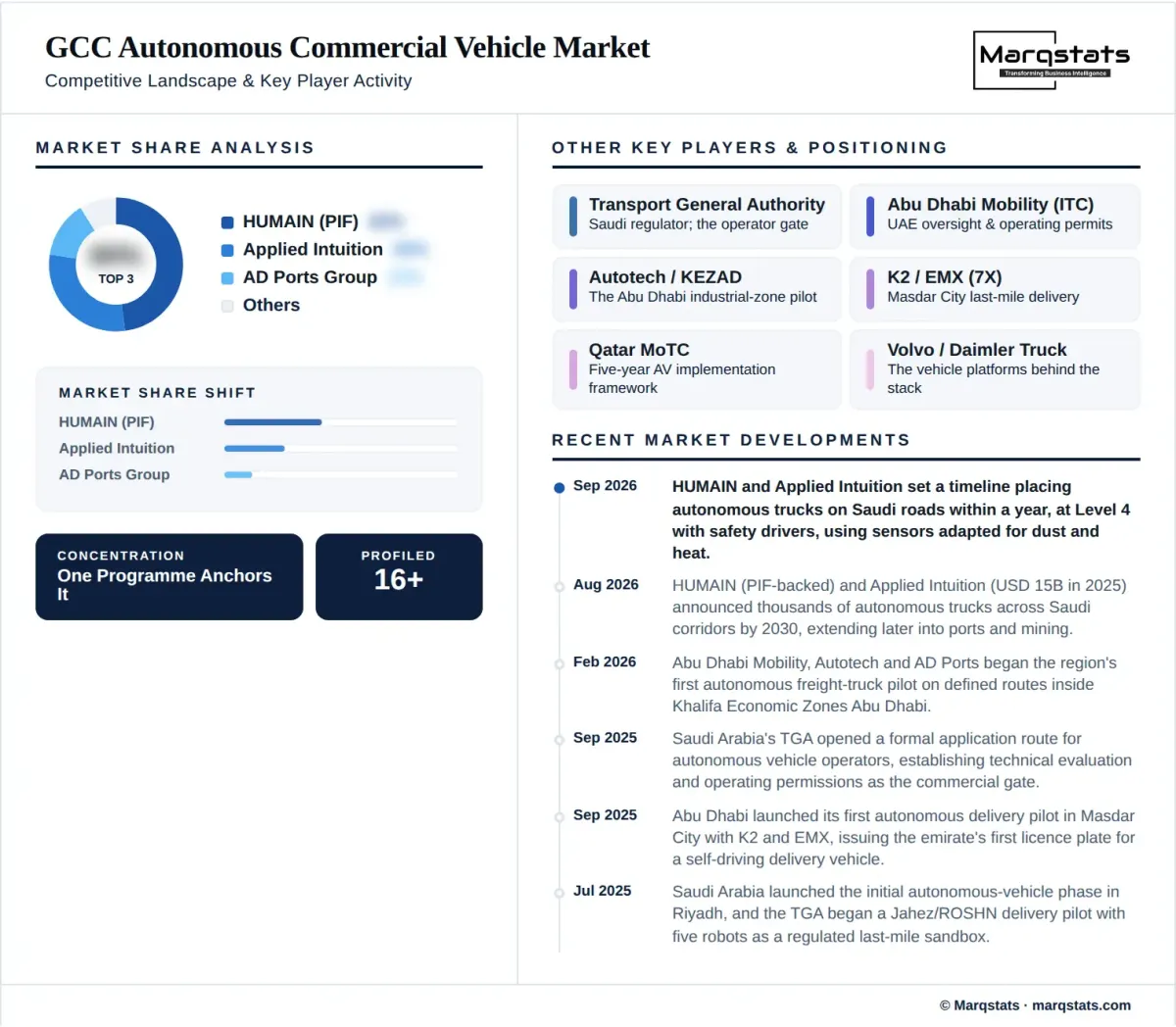
The market is highly concentrated and unusually so, because a single sovereign-backed programme accounts for the majority of projected volume and was announced with a scale target rather than built up from contracts. HUMAIN in partnership with Applied Intuition occupies a position no commercial competitor can contest directly: it combines Public Investment Fund backing, a national corridor mandate and an autonomy stack already operating in the United States, Europe and Japan. Competition in Saudi corridor freight is therefore for supplier positions within that programme rather than against it.
The industrial and port segment is structured differently and is genuinely contestable. Deployments there are decided by zone and terminal operators against internal productivity cases, and the February 2026 Khalifa Economic Zones pilot brought together a transport authority, a technology firm and a port group as three separate parties. That structure creates entry points for technology suppliers without sovereign relationships, and it is where a commercial autonomy vendor is most likely to win regional work on merit.
The decisive constraint on every participant is neither capital nor software but vehicle platform and service capability. Autonomous operation requires redundant braking and steering, drive-by-wire architecture and an aftersales network able to maintain both, and truck manufacturers control all three. Programmes that have secured capital and an autonomy stack still depend on platform availability, which puts established heavy vehicle manufacturers and their regional distributors in a stronger position than their absence from the announcements suggests.
Companies Covered
The report profiles 16+ companies with full strategy and financials analysis, including:
Recent Market Activity
Table of Contents
Coverage & Segmentation
The study covers the six Gulf Cooperation Council states with country-level detail for Saudi Arabia, the United Arab Emirates, Qatar, Kuwait, and Oman and Bahrain combined. It measures annual investment in autonomous commercial vehicles entering service, in United States dollars, with the operating fleet carried as the secondary unit. The base year is 2025, the historical period covers 2024 to 2025, and the forecast period runs from 2026 to 2030 with an indicative 2031 endpoint. Segmentation covers vehicle type, operating environment, automation level and ownership model.
Four boundaries define the market. Passenger robotaxis and autonomous shuttles are excluded as distinct regulatory categories answering a different commercial question. Sidewalk and pavement delivery robots are excluded because they are not road-legal vehicles, which places the five-robot Riyadh pilot outside the market even though it is cited as regulatory evidence. Conventional driver-operated commercial vehicles are excluded entirely. Vehicles announced but not operating or permitted are excluded, which matters in a market where strategic targets are disclosed more readily than operating counts.
Saudi Arabia's autonomous truck fleet is a component of this market rather than a separate one. The 12 vehicles operating nationally in 2025 and the approximately 2,200 projected for 2030 sit inside the Gulf figures of 18 and 2,900, so the national and regional counts describe one population measured at two geographic scales rather than two populations that combine.