Market Snapshot
Middle bar: base-year value × (1 + CAGR), rounded to two decimals. This is a calculated illustration, not a separately researched annual estimate.
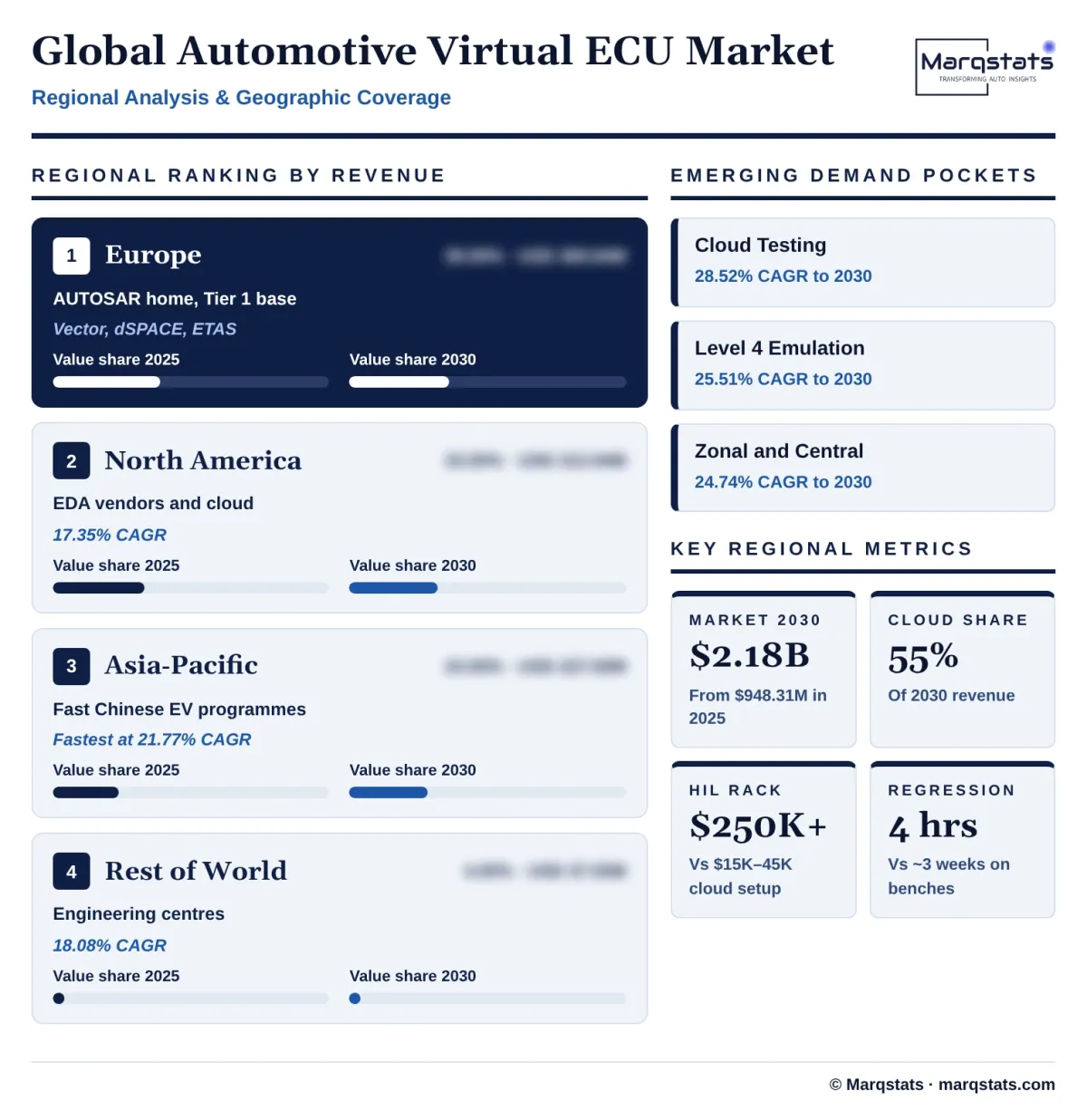
The global automotive virtual ECU market size is estimated at USD 948.31 million in 2025 and is projected to reach USD 2,176.45 million by 2030, growing at a CAGR of 18.08% over 2026 – 2030. Growth comes from software-defined vehicle programmes, the move to central computers and zonal controllers, cybersecurity and software update regulations, and the cost of physical hardware-in-the-loop test benches.
Marqstats defines the market as revenue from software used to build and run virtual electronic control units, meaning software models of a vehicle ECU that run on a desktop computer, server or cloud instance instead of physical hardware. It covers virtual ECU authoring tools, execution engines, virtual bus networks, software-in-the-loop and virtual hardware-in-the-loop runtimes, and cloud test platforms, sold as licences, subscriptions, maintenance and cloud usage. Physical ECUs, physical test benches, engineering services and vehicle-level digital twin and sensor simulation tools are excluded.
Basic software emulation accounts for an estimated 32.00% of 2025 revenue, ADAS and autonomous driving for 35.00% and on-premises deployment for 64.00%. Europe accounts for 39.00% of 2025 revenue and North America for 33.00%. The study segments the market by abstraction level, vehicle application domain, deployment model and region.
Key Takeaways
Market Overview & Analysis
Report Summary
Marqstats sizes the automotive virtual ECU market as revenue from software that lets carmakers and suppliers run vehicle ECU software without the physical ECU. In 2025 the market was worth an estimated USD 948.31 million, a small but fast-growing part of a much larger automotive electronics industry in which physical ECUs are worth more than USD 100 billion a year.
Virtual ECUs are built at four levels of detail. Level 1 runs application software compiled for a normal computer and checks control algorithms. Level 2 adds simulated basic software services, such as the operating system and diagnostics, and checks how software components work together. Level 3 runs production basic software with stubs for the microcontroller drivers and checks network communication and diagnostics at the frame level. Level 4 emulates the target processor, such as an Arm Cortex-R52 or Infineon TriCore, and runs the unchanged production binary, including low-level drivers and secure boot.
Speed and fidelity trade off. Level 1 and Level 2 models can run much faster than real time on standard cloud servers, making them suitable for large parameter sweeps. Level 4 models reproduce the real hardware exactly but run near real time unless spread across many cloud machines. Most carmakers use all four levels at different stages of development.
Virtual ECUs change the development process. In the traditional process, software integration could only start once prototype hardware, microcontrollers and wiring were built and mounted in hardware-in-the-loop rigs, 12 to 18 months before production. Virtual ECUs allow testing 36 to 48 months before production, using models of chips that have not yet been manufactured. Physical rigs are then kept for final approval, power electronics and electromagnetic compatibility tests.
The market grew from USD 532.10 million in 2021 to USD 608.40 million in 2022, USD 704.25 million in 2023 and USD 817.60 million in 2024, a 15.54% annual rate to 2025. Marqstats expects USD 1,095.30 million in 2026, USD 1,297.93 million in 2027, USD 1,545.80 million in 2028 and USD 1,836.50 million in 2029.
Virtual ECUs depend on standards. AUTOSAR Classic and Adaptive define how ECU software is structured, the Functional Mock-up Interface 3.0 lets models from different tools work together, ASAM XIL standardises test interfaces, and the open-source SIL Kit connects virtual ECUs from different vendors. Wider use of these standards lets carmakers combine models from many suppliers in one virtual vehicle.
Regulation has made software testing part of vehicle approval. In the European Union, UN Regulation No. 155 on cybersecurity management has applied to new vehicle types since July 2022 and to all newly registered vehicles since July 2024, and UN Regulation No. 156 on software update management follows the same timetable. Japan and South Korea apply the same regulations. Carmakers must show that ECUs and networks are protected against attacks and that software updates install safely across every vehicle variant, which requires thousands of automated tests that are impractical on physical benches alone.
Safety standards add further demand. ISO 26262 requires fault injection for the most safety-critical functions, including memory corruption, timing errors and clock drift. On physical rigs these tests can damage prototype hardware and need manual set-up, while on Level 3 and Level 4 virtual ECUs engineers can corrupt registers, drop bus messages and flip memory bits in software and record the results exactly. ISO/SAE 21434 adds cybersecurity verification of key management and secure boot, best done on processor-accurate models.
Global Automotive Virtual ECU Market Size and Forecast
The global automotive virtual ECU market grows from USD 948.31 million in 2025 to USD 2,176.45 million in 2030, a CAGR of 18.08%. Annual growth rises from about 15.50% in 2026 to around 18.50% to 19.10% a year between 2027 and 2030 as zonal architectures and cloud testing pipelines are adopted across vehicle programmes.
Revenue is linked to the number of software developers and test pipelines. Marqstats estimates average annual spending on virtual ECU tools of about USD 3,850 per active automotive software developer seat across desktop and cloud use. A change of USD 250 in this figure moves the 2025 market by about 6.5%.
The mix of revenue changes over the forecast. Level 3 and Level 4 models rise from 42.00% to 50.00% of revenue, cloud deployment from 36.00% to 55.00%, and central compute and zonal gateway testing from 19.00% to 25.00%. Level 1 application-level simulation, body electronics and infotainment grow more slowly as these areas mature.
Marqstats tracks four indicators to monitor the forecast: the number of carmakers running cloud-based continuous testing pipelines, the share of new vehicle platforms using central computers and zonal controllers, adoption of FMI 3.0 and SIL Kit for model exchange between vendors, and the availability of virtual models for new automotive processors before silicon.
Test economics support the shift. Marqstats estimates a hardware-in-the-loop rack costs USD 250,000 to 650,000 plus lab space, power and cable maintenance, and runs one test suite at a time in real time. A cloud virtual ECU pipeline costs USD 15,000 to 45,000 to set up and USD 0.50 to 2.50 per instance-hour to run. Virtual ECUs can take over 70% to 85% of early functional testing, regression testing and cybersecurity fuzzing, letting carmakers cut physical bench fleets by 40% to 60% while testing more code.
Market Dynamics
Key Drivers
Five forces are moving automotive software testing from hardware benches to virtual ECUs.
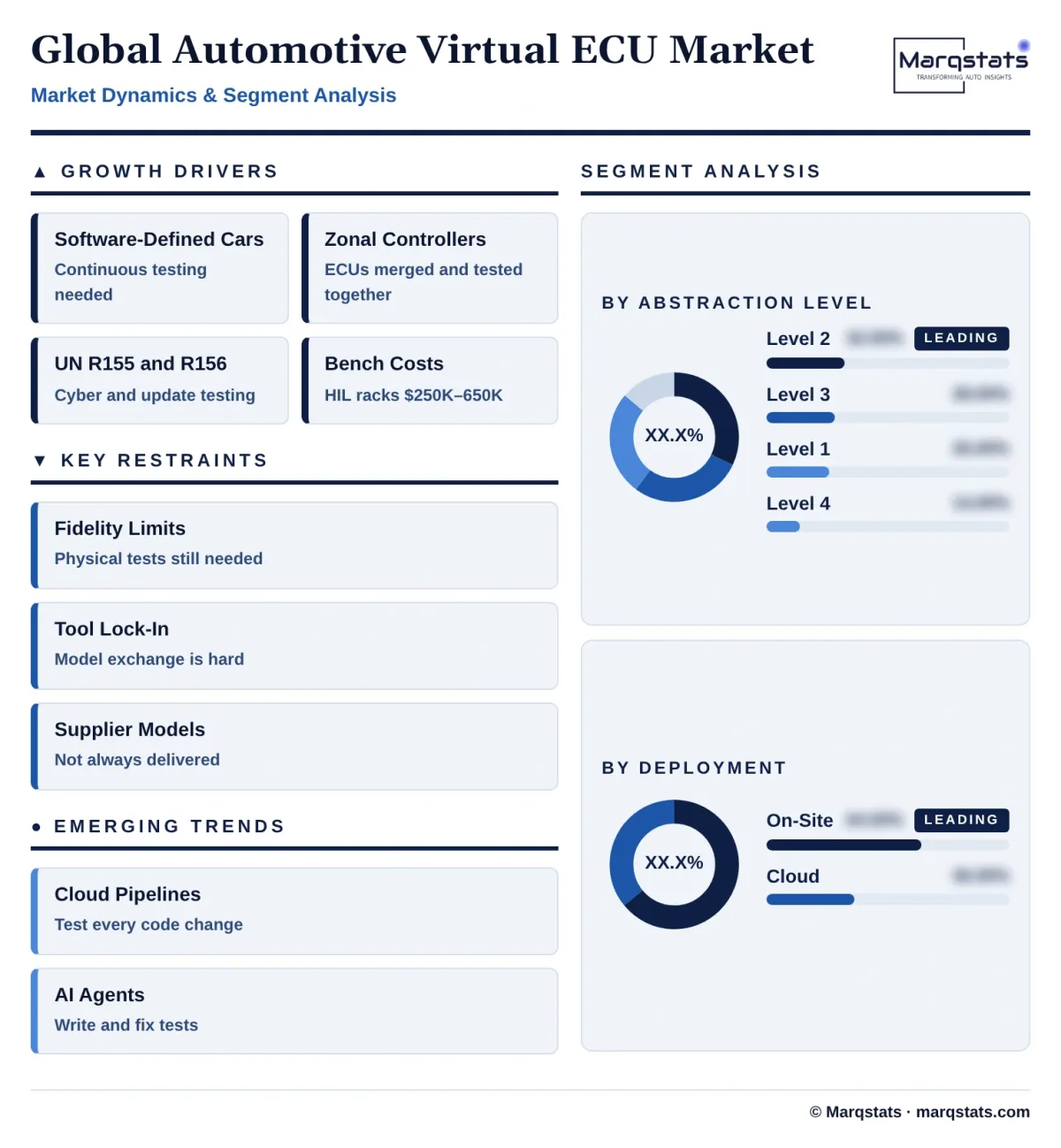
- Software-defined vehicles. Carmakers now develop, update and sell features through software throughout the life of the vehicle, which requires continuous testing that physical benches cannot provide at scale.
- Central computers and zonal controllers. Merging dozens of ECUs into a few high-performance controllers creates complex interactions between software from many suppliers that must be tested together before hardware is ready.
- Cybersecurity and software update regulation. UN R155 and R156 require carmakers to manage cybersecurity and software updates across the vehicle life, encouraging automated fuzz testing and update testing on virtual ECUs.
- Cost and availability of test benches. Hardware-in-the-loop racks cost hundreds of thousands of dollars each, take space and run one test at a time, while virtual ECUs scale on demand.
- Shorter development cycles. Chinese electric vehicle makers have cut development programmes to 18 to 24 months, forcing software to be integrated virtually before physical prototypes are built.
- Silicon schedules. New automotive processors take years to design and manufacture, and virtual models of chips such as Infineon AURIX TC4x and Arm-based system-on-chips let software teams start work up to two years before silicon is available, removing a long wait between chip tape-out and software bring-up.
Key Restraints
Four constraints slow the replacement of physical test benches with virtual ECUs.
- Fidelity limits. Lower-level models may not reproduce exact timing, analogue behaviour or power electronics, so physical tests remain necessary for final approval.
- Tool lock-in and model exchange. Proprietary formats between vendors make it hard to combine models from different suppliers, slowing adoption of shared virtual vehicles.
- Model availability from suppliers. Tier 1 suppliers do not always provide virtual models of their ECUs, and building models internally takes time and skills.
- Licensing and cloud costs. Seat- and core-based licences can make large-scale cloud testing expensive, and some carmakers prefer to keep code on their own servers for security reasons.
- Skills and process change. Moving testing to virtual ECUs requires new skills in modelling, continuous integration and cloud operations, and changes to established validation processes built around physical benches, which slows adoption at some carmakers and suppliers.
Key Trends
Four shifts are changing how virtual ECUs are built, sold and used.
- Cloud-native continuous testing. Containerised virtual ECUs run in GitLab and other continuous integration pipelines on Arm-based cloud servers, testing every software change automatically.
- AI agents in test tools. Vector added AI agents to CANoe that can write and correct test scripts from requirements, dSPACE showed virtual ECUs generated with AI assistants at CES 2026, and Cadence showed AI-assisted debugging on its VLAB platform.
- Pre-silicon virtual platforms. Chip designers and EDA vendors provide virtual models of new automotive processors, such as Arm Zena compute subsystems, so software development can start before chips are made.
- Open standards. FMI 3.0, ASAM XIL and the open-source SIL Kit make it easier to combine models from different tools and suppliers.
- Functional twins of complete ECUs. Suppliers are building virtual ECUs that include simulated electrical components such as fuses and drivers, as AUMOVIO showed with a windshield wiper ECU on Cadence VLAB, so that fault conditions can be tested without hardware.
Strategic Implications
- For carmakers, a shared virtual vehicle cuts development time. Requiring suppliers to deliver virtual ECU models with their software lets carmakers test integration continuously and reduce the number of physical benches by an estimated 40% to 60%.
- For Tier 1 suppliers, virtual models are becoming part of the delivery. Suppliers that provide Level 3 and Level 4 models compatible with carmaker cloud pipelines will be better placed in new sourcing decisions.
- For tool vendors, cloud and open standards are the growth path. Usage-based pricing, containerised runners and support for FMI 3.0 and SIL Kit address the fastest-growing part of the market.
- For chip companies, virtual models win designs. Providing processor models up to two years before silicon lets carmakers start software development early and choose the chip platform sooner.
- For cloud providers, automotive testing is a growing workload. Arm-based cloud instances that run automotive code without translation make large-scale virtual testing cheaper.
- For regulators and test services, virtual evidence is becoming more important. Type approval authorities and technical services are increasingly asked to accept simulation results as part of cybersecurity, software update and functional safety evidence, and clear rules on model qualification would speed adoption.
- For engineering service providers, virtual integration is a new service line. Companies that build and maintain virtual ECU models and cloud test pipelines for carmakers and suppliers can grow as demand for models outpaces in-house capacity.
Market Segmentation
Application-level simulation accounts for 26.00% of 2025 revenue, USD 246.56 million, rising to USD 457.05 million by 2030, a 13.14% CAGR, while its share falls to 21.00%. MathWorks Simulink and similar tools test control algorithms early in development.
Basic software emulation is the largest segment, with 32.00% of 2025 revenue, USD 303.46 million, rising to USD 631.17 million by 2030, a 15.77% CAGR, and 29.00% of the market. Vector CANoe and SIL Kit, ETAS COSYM and Synopsys Silver are widely used.
Hardware-dependent software models account for 28.00% of 2025 revenue, USD 265.53 million, and grow at 20.50% a year to USD 674.70 million, becoming the largest segment with 31.00% of 2030 revenue. dSPACE VEOS and Vector vVIRTUALtarget are leading tools.
Full instruction-set emulation accounts for 14.00% of 2025 revenue, USD 132.76 million, and grows fastest, at 25.51% a year, to USD 413.53 million and 19.00% of the market by 2030. Synopsys Virtualizer, Siemens PAVE360 and Cadence VLAB lead this segment.
ADAS and autonomous driving is the largest domain, with 35.00% of 2025 revenue, USD 331.91 million, rising to USD 805.29 million by 2030, a 19.40% CAGR, and 37.00% of the market, driven by safety-critical fault injection and sensor fusion testing.
Powertrain, electrification and battery management systems account for 25.00% of 2025 revenue, USD 237.08 million, rising to USD 478.82 million by 2030, a 15.09% CAGR.
Central compute and zonal gateways account for 19.00% of 2025 revenue, USD 180.18 million, and grow fastest, at 24.74% a year, to USD 544.11 million and 25.00% of the market by 2030.
Body electronics and chassis systems account for 12.00% of 2025 revenue, USD 113.80 million, rising to USD 195.88 million by 2030, an 11.47% CAGR.
Digital cockpit and infotainment account for 9.00% of 2025 revenue, USD 85.34 million, rising to USD 152.35 million by 2030, a 12.29% CAGR, focused on hypervisor and operating system testing.
On-premises workstations and servers account for 64.00% of 2025 revenue, USD 606.92 million, rising to USD 979.40 million by 2030, a 10.04% CAGR, while their share falls to 45.00%. Node-locked desktop licences and fixed regression servers dominate.
Cloud-hosted and software-as-a-service environments account for 36.00% of 2025 revenue, USD 341.39 million, and grow at 28.52% a year to USD 1,197.05 million, overtaking on-premises in 2029 and reaching 55.00% of the market by 2030.
By Geography
Europe
Europe is the largest market, with an estimated 39.00% of 2025 revenue, USD 369.84 million, rising to USD 783.52 million by 2030, a 16.20% CAGR, while its share falls to 36.00%. Europe is home to AUTOSAR, large Tier 1 suppliers such as Bosch and Continental, and leading virtual ECU vendors including Vector, dSPACE and ETAS, and EU type approval requires compliance with UN R155 and R156.
North America
North America accounts for an estimated 33.00% of 2025 revenue, USD 312.94 million, rising to USD 696.46 million by 2030, a 17.35% CAGR. EDA vendors Synopsys and Cadence, cloud providers and software-led electric vehicle makers drive demand for cloud-based and processor-level virtual testing. US carmakers and electric vehicle start-ups favour in-house software stacks tested in continuous integration pipelines on public cloud, and processor vendors in the region supply virtual models of new chips for early software development.
Asia-Pacific
Asia-Pacific accounts for an estimated 24.00% of 2025 revenue, USD 227.60 million, and grows fastest, at 21.77% a year, to USD 609.41 million and 28.00% of the market by 2030. Chinese electric vehicle makers with 18- to 24-month development programmes, and software-defined vehicle programmes in Japan and South Korea, drive adoption. Chinese carmakers often develop software in-house and run large cloud test farms, while Japanese and Korean carmakers are adopting AUTOSAR Adaptive and central computers for new platforms.
Rest of World
The rest of the world accounts for an estimated 4.00% of 2025 revenue, USD 37.93 million, rising to USD 87.06 million by 2030, an 18.08% CAGR, mainly from engineering centres in South America and the Middle East.
How Competition Is Evolving
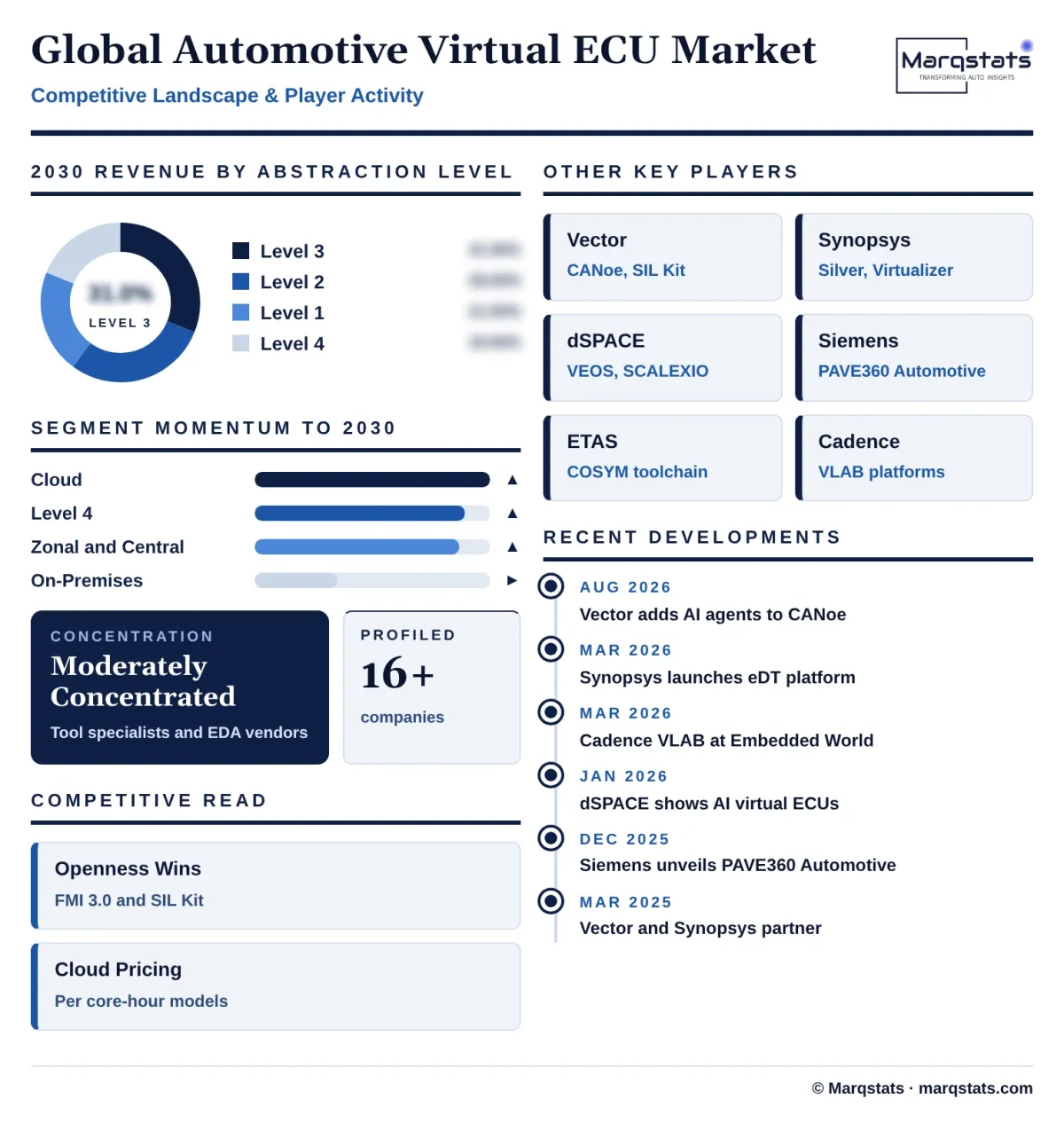
The automotive virtual ECU market is moderately concentrated. Automotive tool specialists Vector, dSPACE and ETAS lead at Levels 2 and 3, where AUTOSAR compliance and automotive bus protocols matter most. EDA vendors Synopsys, Cadence and Siemens lead at Level 4, using their chip emulation technology to model processors before they are manufactured. MathWorks dominates model-based design at Level 1.
Partnerships are joining these groups. Vector and Synopsys announced a strategic collaboration in March 2025 to combine Vector MICROSAR and CANoe with Synopsys Silver and Virtualizer. Siemens works with Arm on virtual models of Arm Zena compute subsystems, and Cadence showed VLAB working with Vector CANoe and TASKING debuggers at Embedded World 2026.
Cloud providers and suppliers are entering. AWS provides Arm-based Graviton instances that run automotive code natively, Valeo announced a Virtualized Hardware Lab for AWS in January 2025, and QNX, Vector and TTTech Auto announced a foundational vehicle software platform in January 2025.
Competition will be decided by model fidelity, cloud readiness and openness. Vendors that combine accurate processor models, containerised cloud runners, AI-assisted testing and support for open standards will win the largest carmaker contracts.
Business models are changing. Traditional desktop tools are sold as node-locked or floating licences with annual maintenance, while cloud offerings increasingly charge per core-hour or per test run. Synopsys offers its Electronics Digital Twin platform as software-as-a-service or on a customer's own cloud, and dSPACE and Vector connect their tools to GitLab and other continuous integration systems. Vendors that can price for large parallel workloads without making cloud testing more expensive than desktop use will gain share.
Companies Covered
Companies covered in the report include:
Recent Market Activity
Table of Contents
Coverage & Segmentation
The study covers the global automotive virtual ECU market, with 2025 as the base year, 2021 – 2025 as the historical period and 2026 – 2030 as the forecast period. Values are in US dollars and cover licence, subscription, maintenance and cloud usage revenue for virtual ECU tools and runtimes. The market is segmented by abstraction level, vehicle application domain, deployment model and region.
Physical ECUs, physical hardware-in-the-loop benches, engineering services, vehicle operating systems, and vehicle-level digital twin, scenario and sensor simulation tools are excluded. Segment and regional splits are Marqstats estimates built on vendor disclosures, developer seat counts, product announcements and pricing benchmarks.