Market Snapshot
Middle bar: base-year value × (1 + CAGR), rounded to two decimals. This is a calculated illustration, not a separately researched annual estimate.
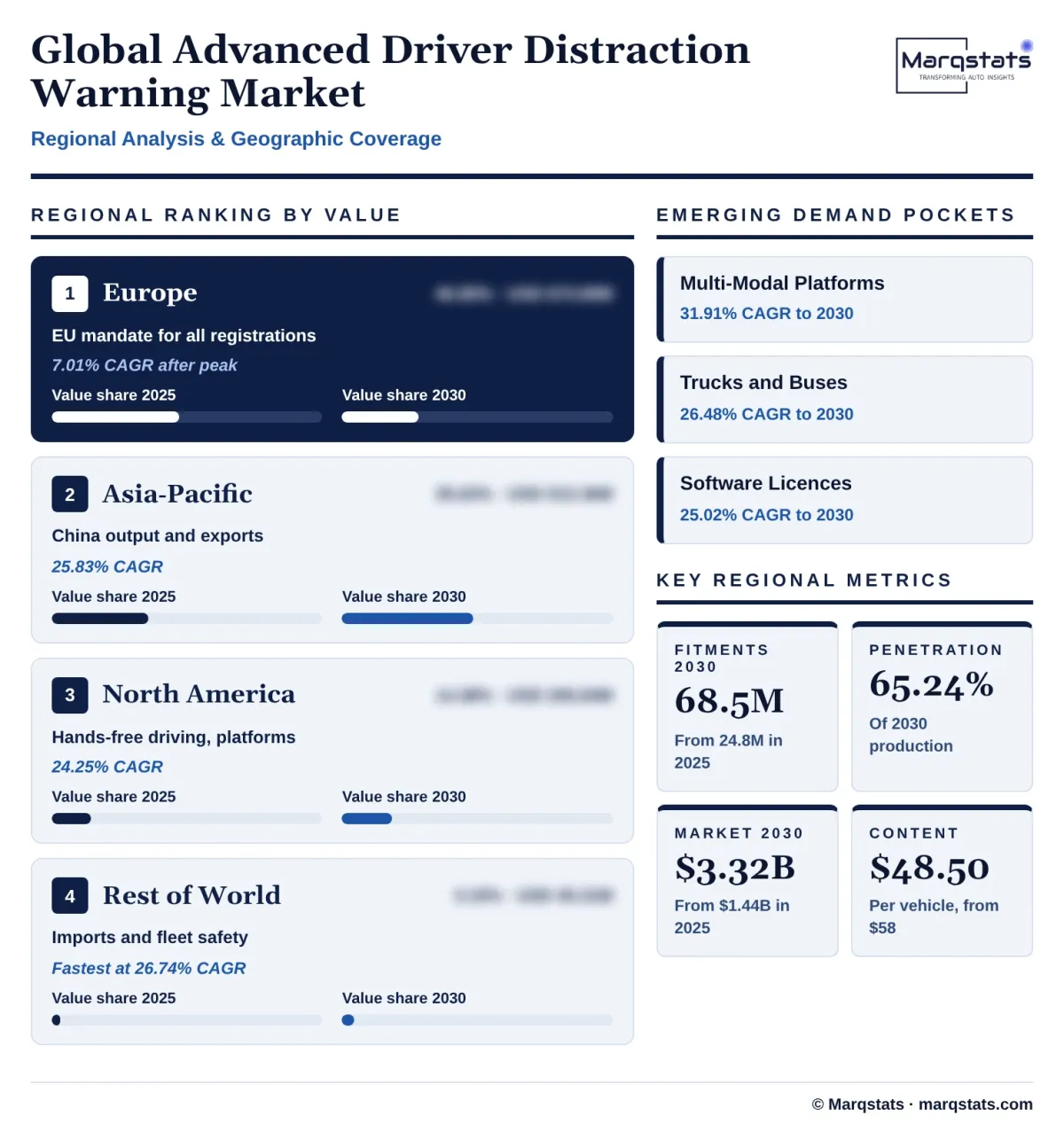
The global advanced driver distraction warning market size is estimated at USD 1,438.40 million in 2025 and is projected to reach USD 3,322.25 million by 2030, growing at a CAGR of 18.23% over 2026 – 2030. Annual fitments rise from about 24.80 million vehicles to 68.50 million, a 22.53% annual rate, lifting the share of new vehicles fitted from 25.73% to 65.24%, while average system content per vehicle falls from USD 58.00 to USD 48.50.
Marqstats defines advanced driver distraction warning, or ADDW, as camera-based systems that track where the driver is looking and warn when attention leaves the road, meeting Regulation (EU) 2019/2144 and Commission Delegated Regulation (EU) 2023/2590. The market covers the near-infrared camera module and illuminator, the processor or share of a shared chip that runs the software, and per-vehicle software licence fees paid by carmakers and their suppliers. Indirect drowsiness systems based on steering or lane data, displays, cockpit computers, child-presence detection and fleet video telematics services are excluded.
Standalone gaze-tracking systems account for an estimated 68.57% of 2025 value and passenger cars for 78.43%. Europe accounts for 46.85% of 2025 value and Asia-Pacific for 35.62%. The study segments the market by technology architecture, component, vehicle class and region.
Key Takeaways
Market Overview & Analysis
Report Summary
Marqstats sizes the advanced driver distraction warning market as the value of camera-based driver attention systems fitted to new vehicles. In 2025 about 24.80 million vehicles were fitted, about 25.73% of the roughly 96 million vehicles built worldwide, at an average content of USD 58.00 per vehicle, giving a market of USD 1,438.40 million.
A typical system has three parts. A near-infrared camera module with a 940 nanometre illuminator, worth about USD 31.50 per vehicle in 2025, lets the system see the driver's eyes at night and through most sunglasses. A processor, or a share of a larger chip in the cockpit or ADAS computer, worth about USD 18.00, runs the perception software. A software licence, worth about USD 8.50 per vehicle, pays for the algorithms that estimate head position, eyelid closure and gaze direction.
European law sets the performance standard. Delegated Regulation (EU) 2023/2590 requires the system to warn the driver when the gaze leaves the driving task for more than 3.5 seconds at higher speeds or 6 seconds at lower speeds, to work in darkness and with most glasses, and to switch itself back on at every start. ADDW became mandatory for new vehicle types in the EU on 7 July 2024 and for all newly registered vehicles on 7 July 2026, covering cars, vans, trucks and buses.
Indirect systems that infer drowsiness from steering inputs or lane position do not meet these requirements, so carmakers selling in Europe have replaced them with driver-facing cameras. EU data protection rules require images and gaze data to be processed inside the vehicle, so ADDW is sold as hardware and per-vehicle software licences rather than as a subscription service.
The market grew from USD 273.60 million in 2021, when about 3.80 million vehicles were fitted, to USD 421.60 million in 2022, USD 670.80 million in 2023 and USD 1,006.50 million in 2024. Marqstats expects USD 2,003.55 million in 2026 as European registrations reach full compliance, and USD 3,322.25 million in 2030.
Other markets are following through ratings rather than law. Euro NCAP has included direct driver monitoring in its Safety Assist assessment since 2023 and expanded its Safe Driving protocols in 2026 to test long distractions, repeated short glances away from the road and phone use. China's C-NCAP added driver monitoring to active safety scoring from July 2024, supported by national standard GB/T 41798-2022 on driver attention testing. In the United States, the Infrastructure Investment and Jobs Act directed NHTSA to set a standard for impaired-driving prevention technology, but no binding rule has yet been issued, so fitment depends on carmaker choice.
Value is spread across three supplier groups. Image sensor and chip makers supply the silicon, Tier 1 suppliers build and certify the camera modules and integrate them into the cabin, and software specialists license the perception algorithms. Each group faces different pressures: hardware prices fall with scale and integration, while software fees hold up better because algorithms must be validated for each carmaker and each new function.
Global Advanced Driver Distraction Warning Market Size and Forecast
The global advanced driver distraction warning market grows from USD 1,438.40 million in 2025 to USD 3,322.25 million in 2030, a CAGR of 18.23%. Marqstats expects USD 2,395.60 million in 2027, USD 2,743.80 million in 2028 and USD 3,044.25 million in 2029.
Fitments grow faster than value. Annual fitments rise from 24.80 million in 2025 to 36.10 million in 2026, 45.20 million in 2027, 53.80 million in 2028, 61.50 million in 2029 and 68.50 million in 2030, while global vehicle production rises from about 96 million to 105 million. Average content per vehicle falls from USD 72.00 in 2021 to USD 58.00 in 2025 and USD 48.50 in 2030 as camera and chip costs fall and processing moves onto shared chips.
2026 is the largest single step. Value jumps about 39% in 2026 as every vehicle newly registered in Europe must comply from 7 July and carmakers fit cameras across remaining models and trims. Growth then slows to between 10% and 20% a year as Europe approaches full fitment and adoption spreads in Asia and North America.
Value sensitivity is easy to track. Marqstats estimates that each percentage point of global fitment in 2025 equals about 964,000 vehicles and about USD 56 million of value, and each USD 1 change in average content per vehicle moves 2025 value by about USD 24.8 million.
Marqstats tracks four indicators to monitor the forecast: fitment rates by region and vehicle class, average content per vehicle, the share of systems running on shared chips, and regulatory or rating changes in the United States, China, Japan and India. A binding US driver monitoring rule would raise the forecast, while faster price falls from Chinese suppliers would lower it.
The mix changes more than the total. Multi-modal platforms rise from 31.43% to 54.34% of value, software licences from 14.66% to 19.38%, and medium and heavy commercial vehicles from 8.60% to 12.05%. Regionally, Asia-Pacific overtakes Europe during the forecast period as European fitment approaches 100% of new registrations and Chinese, Japanese, Korean and Indian production adds most of the new volume. North America rises from 14.38% to 18.44% of value as hands-free driving and global platforms spread cameras to mid-range models.
Market Dynamics
Key Drivers
Five forces are putting a driver-facing camera into most new vehicles.
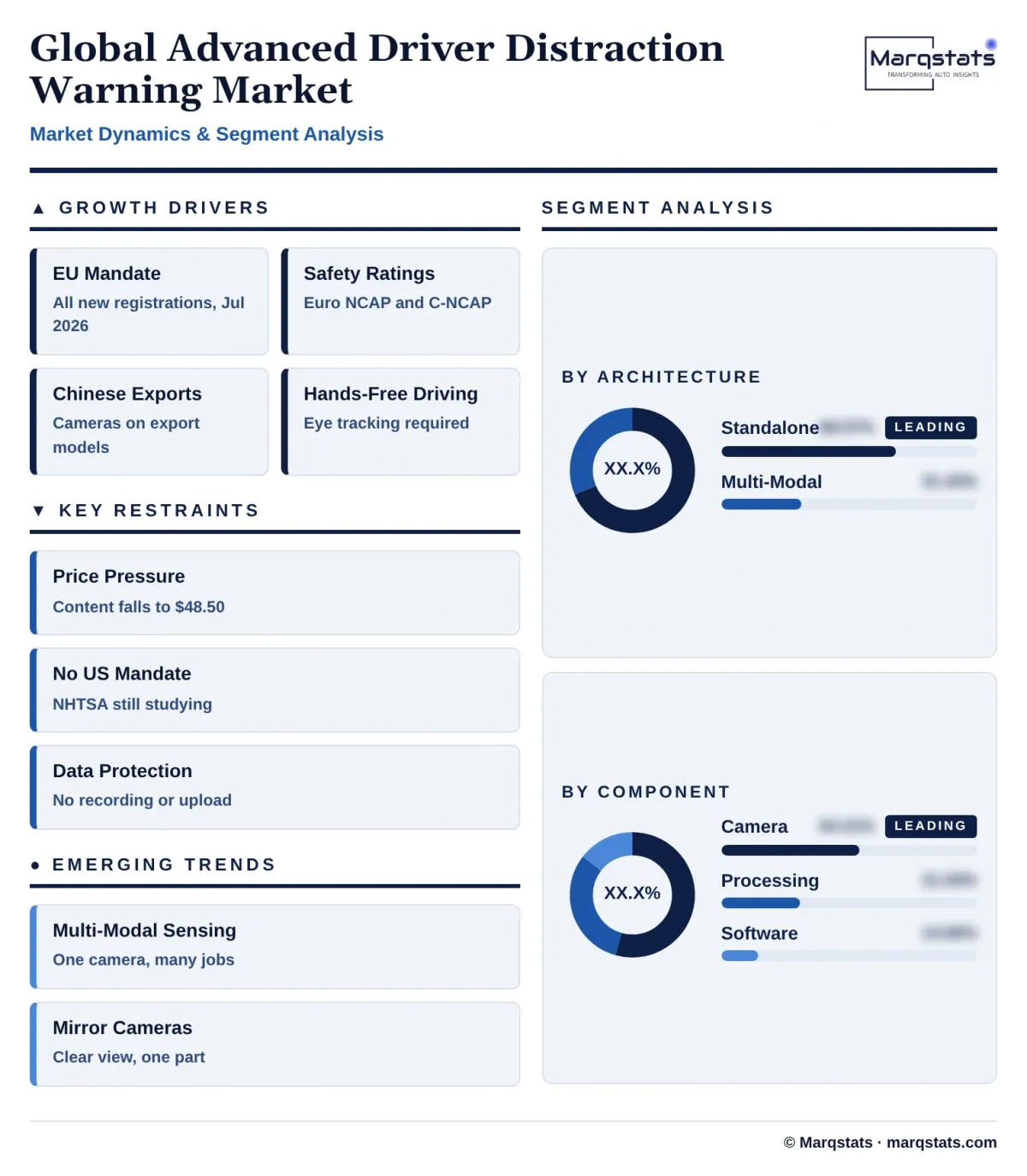
- EU mandate. Regulation (EU) 2019/2144 and Delegated Regulation (EU) 2023/2590 require camera-based distraction warning on all newly registered cars, vans, trucks and buses in the EU from 7 July 2026, following the July 2024 requirement for new vehicle types.
- Safety ratings. Euro NCAP rewards direct driver monitoring that detects long distractions, repeated short glances and phone use, and C-NCAP in China includes driver monitoring in its active safety scoring, so carmakers fit cameras to win top ratings even where the law does not require it.
- Chinese exports. Chinese carmakers exporting to Europe and other rated markets fit driver monitoring across domestic and export models, adding volume in the world's largest production base.
- Hands-free driving. Hands-free driving systems such as General Motors Super Cruise and Ford BlueCruise rely on eye tracking to confirm the driver is watching the road, spreading cameras across North American models.
- Commercial vehicle safety. EU rules cover trucks and buses, and fleet operators use driver monitoring to cut crash and insurance costs.
- Lower component costs. Automotive near-infrared image sensors, illuminators and vision processors have fallen in price, making a driver camera affordable on mass-market models in Asia and Latin America as well as premium cars.
Key Restraints
Four constraints limit how much value each fitted vehicle brings to suppliers.
- Price pressure. Carmakers treat ADDW as a compliance cost and push suppliers for lower prices, and Chinese suppliers offer lower-cost modules, reducing average content per vehicle.
- No US federal rule. NHTSA has not issued a binding driver monitoring standard, so some entry-level North American models still omit driver cameras.
- False alerts and driver acceptance. Systems that warn too often irritate drivers, so suppliers must test across faces, glasses, lighting and cabin layouts, which adds validation cost.
- Data protection limits. EU data protection rules prevent recording or transmitting driver images, limiting recurring revenue from the data.
- Integration complexity. Fitting cameras where the steering wheel, sun visors or dashboard do not block the view requires different solutions for each cabin, adding engineering time and cost for carmakers with many models.
Key Trends
Four shifts are changing how distraction warning systems are built and paid for.
- Multi-modal cabin sensing. Wider-angle cameras and shared software combine driver monitoring with occupant detection, seat-belt checks and child-presence detection.
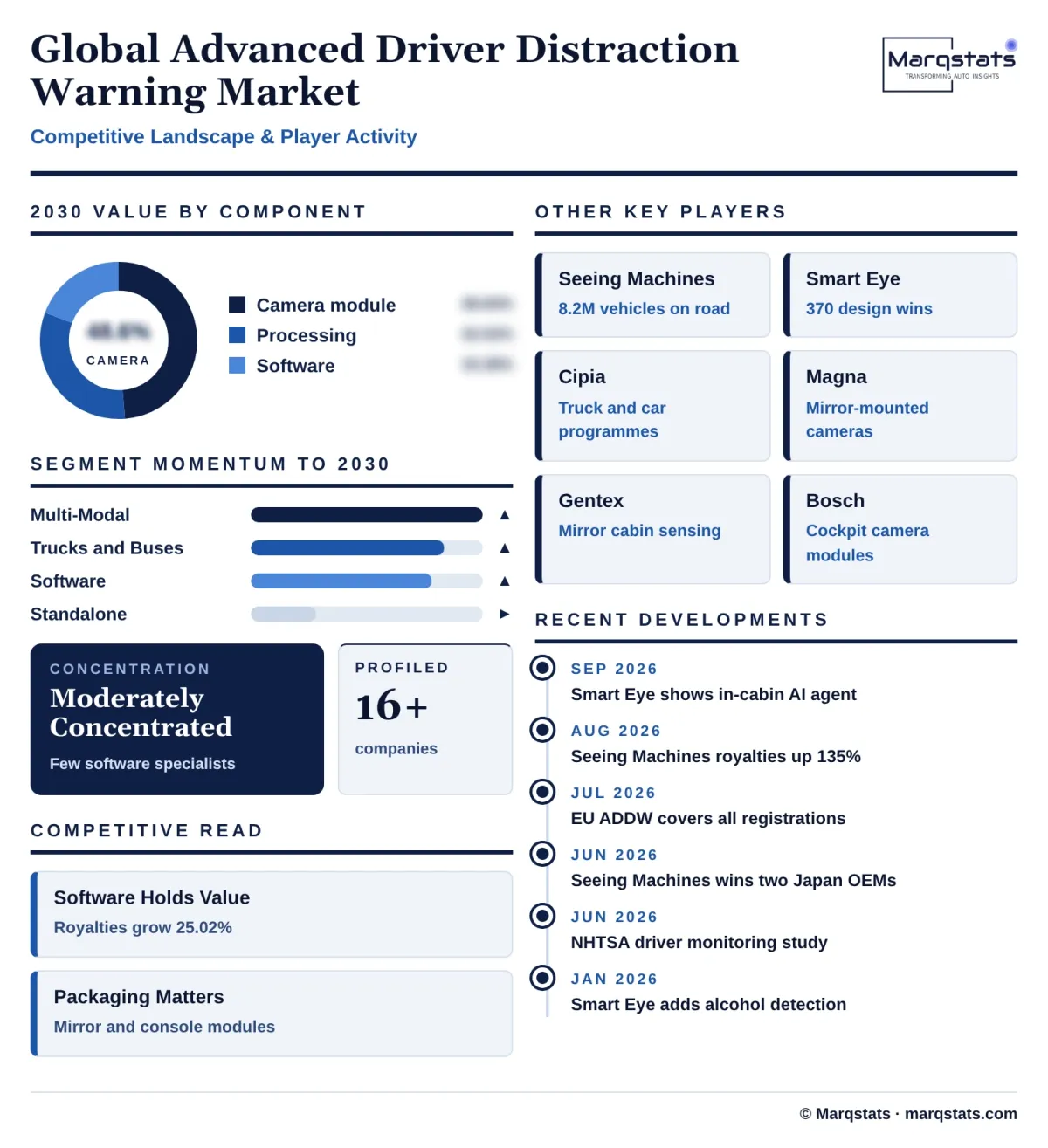
- Mirror-mounted cameras. Carmakers and suppliers such as Magna and Gentex place the camera and illuminator in the interior mirror, giving a clear view of the driver and a single part for left- and right-hand-drive vehicles.
- Processing moves to shared chips. Perception software increasingly runs on cockpit or ADAS processors from Qualcomm, Texas Instruments, Ambarella and others instead of a dedicated chip.
- Beyond distraction. Suppliers are adding impairment, cognitive distraction and in-cabin assistant features. Smart Eye included alcohol impairment detection in a design win with a Japanese carmaker in January 2026.
- Commercial vehicle specialisation. Truck and bus programmes use wider-angle cameras, stronger illuminators and rugged brackets, and Cipia supplies its Driver Sense software for European heavy-duty truck models running on dedicated vision chips.
Strategic Implications
- For perception software suppliers, multi-modal capability protects royalties. Suppliers that offer driver and occupant monitoring from one software stack can keep or raise per-vehicle fees even as hardware prices fall.
- For Tier 1 suppliers, packaging is a differentiator. Mirror and overhead console modules that combine camera, illuminator and electronics simplify carmaker assembly and are harder to replace on price alone.
- For chip suppliers, shared processing is the growth path. Cockpit and ADAS chips that can run driver monitoring alongside other functions will win as dedicated vision chips are phased out.
- For carmakers, one camera for several functions saves cost. Combining distraction warning, occupant monitoring and child-presence detection on one sensor reduces parts and earns more rating points.
- For regulators outside Europe, harmonised rules reduce cost. Aligning US, Chinese, Japanese and Indian requirements with EU performance thresholds would let carmakers use one system worldwide.
- For fleet operators and insurers, factory-fitted monitoring reduces retrofit costs. As new trucks, vans and buses arrive with compliant driver cameras, fleets can use built-in warnings for safety programmes instead of buying separate aftermarket systems, while data protection rules limit how the data can be used.
- For investors, recurring per-vehicle royalties are the clearest value pool. Software licence revenue scales directly with production volumes once a programme is in production, giving specialists high profit flow-through as fitment rises.
Market Segmentation
Dedicated driver cameras tuned to track head position, eyelid closure and gaze account for 68.57% of 2025 value, USD 986.31 million, rising to USD 1,516.94 million by 2030, an 8.99% CAGR, while their share falls to 45.66%. They are the lowest-cost route to EU compliance and are widely used on high-volume models.
Wide-angle or multi-camera systems that combine driver monitoring with occupant, seat-belt and child-presence detection account for 31.43% of 2025 value, USD 452.09 million, and grow fastest, at 31.91% a year, to USD 1,805.31 million and 54.34% of value by 2030, as carmakers consolidate sensors and chase Euro NCAP cabin points.
Near-infrared camera modules with 940 nanometre illuminators, lenses and housings account for 54.31% of 2025 value, USD 781.20 million, rising to USD 1,614.62 million by 2030, a 15.63% CAGR, with share falling to 48.60% as image sensor costs fall.
Dedicated vision processors and the share of cockpit or ADAS chips used for driver monitoring account for 31.03% of 2025 value, USD 446.40 million, rising to USD 1,063.78 million by 2030, an 18.97% CAGR.
Per-vehicle licence fees for gaze tracking and cabin perception software account for 14.66% of 2025 value, USD 210.80 million, and grow fastest, at 25.02% a year, to USD 643.85 million and 19.38% of value by 2030.
Passenger cars account for 78.43% of 2025 value, USD 1,128.14 million, rising to USD 2,440.19 million by 2030, a 16.68% CAGR, with share falling to 73.45%.
Vans and pickups account for 12.97% of 2025 value, USD 186.56 million, rising to USD 481.73 million by 2030, a 20.89% CAGR, as EU rules extend to all new light commercial vehicles.
Trucks and buses account for 8.60% of 2025 value, USD 123.70 million, and grow fastest, at 26.48% a year, to USD 400.33 million by 2030, because larger cabins need wider-angle cameras and stronger illumination.
By Geography
Europe
Europe is the largest market in 2025, with 46.85% of value, USD 673.89 million, as carmakers prepared for the July 2026 deadline covering all new registrations in the EU. Growth slows to 7.01% a year once almost every new vehicle is fitted, reaching USD 945.51 million and 28.46% of value by 2030. Corporate fleets and leasing companies that register vehicles centrally pulled compliant vehicles forward ahead of the deadline. Truck and bus makers such as Daimler Truck, Traton and Volvo Group fit driver monitoring across their European ranges.
Asia-Pacific
Asia-Pacific accounts for 35.62% of 2025 value, USD 512.36 million, and grows at 25.83% a year to USD 1,615.95 million, becoming the largest region with 48.64% of value by 2030. China produced more than 34 million vehicles in 2025 and exported about 7 million, and C-NCAP scoring and EU export requirements push camera-based monitoring across Chinese models. Japanese carmakers are adding driver monitoring to export platforms, with Seeing Machines and Smart Eye both announcing new Japanese carmaker programmes in 2026. India and South-East Asia are smaller today, but Indian carmakers are adding driver monitoring to premium SUVs and export models, and safety rating programmes in the region are expected to follow Euro NCAP practice.
North America
North America accounts for 14.38% of 2025 value, USD 206.84 million, and grows at 24.25% a year to USD 612.62 million and 18.44% of value by 2030. Without a binding federal standard, fitment is led by premium models, hands-free driving systems and global platforms shared with Europe. NHTSA published a request for comment in June 2026 on a study of contextual driver monitoring systems under docket NHTSA-2025-0060.
Rest of World
Latin America, the Middle East, Africa and Australia account for 3.15% of 2025 value, USD 45.31 million, and grow at 26.74% a year to USD 148.17 million by 2030, driven by imported vehicles built to European or Chinese specifications and by commercial fleet safety programmes.
How Competition Is Evolving
The advanced driver distraction warning market has three layers. Perception software is concentrated among a few specialists, led by Seeing Machines, Smart Eye and Cipia, whose algorithms are integrated by Tier 1 suppliers. Tier 1 suppliers including Bosch, Continental, Magna, Valeo, Gentex, DENSO and Aptiv package cameras, illuminators and electronics into approved modules. Chip and sensor suppliers including onsemi, OmniVision, Texas Instruments, Qualcomm, Ambarella and NXP provide image sensors and processors.
Software specialists are scaling fast. Seeing Machines reported 8,216,143 vehicles on the road with its technology in August 2026, up 120% in a year, with fourth-quarter production of 2.11 million units, up 333%. Smart Eye reported 370 design wins from 24 carmakers in January 2026 and net sales of SEK 403.7 million in 2025, and Cipia holds 61 design wins across nine carmakers.
Carmakers rarely build their own algorithms because validating performance across faces, glasses, lighting and cabin layouts needs years of data, which keeps software concentrated among specialists.
Competition is moving to multi-modal cabin sensing, mirror and overhead console packaging and integration on shared chips. Suppliers that combine all three will win the largest programmes.
Hardware packaging is consolidating. Early systems placed the camera on the steering column or in the instrument cluster, where the steering wheel rim could block the view. Mirror and overhead console locations give a clearer view and one part for left- and right-hand-drive vehicles, favouring mirror specialists such as Magna and Gentex. Seeing Machines' June 2026 Japanese programmes include both steering column and overhead console mounting, showing that carmakers still use several locations.
Companies Covered
Companies covered in the report include:
Recent Market Activity
Table of Contents
Coverage & Segmentation
The study covers the global advanced driver distraction warning market, with 2025 as the base year, 2021 – 2025 as the historical period and 2026 – 2030 as the forecast period. Values are in US dollars at carmaker and Tier 1 procurement prices, and volumes are annual new-vehicle fitments. The market is segmented by technology architecture, component, vehicle class and region.
Indirect drowsiness systems based on steering or lane data, displays, cockpit and ADAS computers apart from the share used for driver monitoring, child-presence detection sold separately, aftermarket fleet cameras and video telematics services are excluded. Segment and regional splits are Marqstats estimates built on vehicle production, regulatory deadlines, supplier disclosures and component price benchmarks.
Vehicle production volumes are calendar-year figures. Fitment counts each new vehicle with a compliant camera-based system once, regardless of the number of cameras fitted.