Market Snapshot
Middle bar: base-year value × (1 + CAGR), rounded to two decimals. This is a calculated illustration, not a separately researched annual estimate.
The India connected two-wheeler market size is estimated at USD 315.00 million in 2025 and is projected to reach USD 1,280.00 million by 2030, growing at a CAGR of 32.37% over 2026 – 2030. Connected two-wheeler sales rise from about 5.52 million in 2025, 26.93% of new two-wheeler sales, to 16.43 million in 2030, about 62% of sales, a 24.38% annual rate.
Marqstats defines the market as the value of the connected technology layer fitted to new two-wheelers sold in India. It covers telematics control units with cellular modems and satellite positioning, digital instrument clusters with Bluetooth or cellular links, machine-to-machine eSIMs, and recurring software, cloud and data subscriptions. Hardware is valued at Tier-1 ex-factory prices and services at annual billings. In rupee terms, the market grows from INR 2,740.50 crore in 2025 to INR 11,136.00 crore in 2030, converted at INR 87.00 per US dollar. Vehicle value, batteries, drivetrains and standalone aftermarket trackers and phone mounts are excluded.
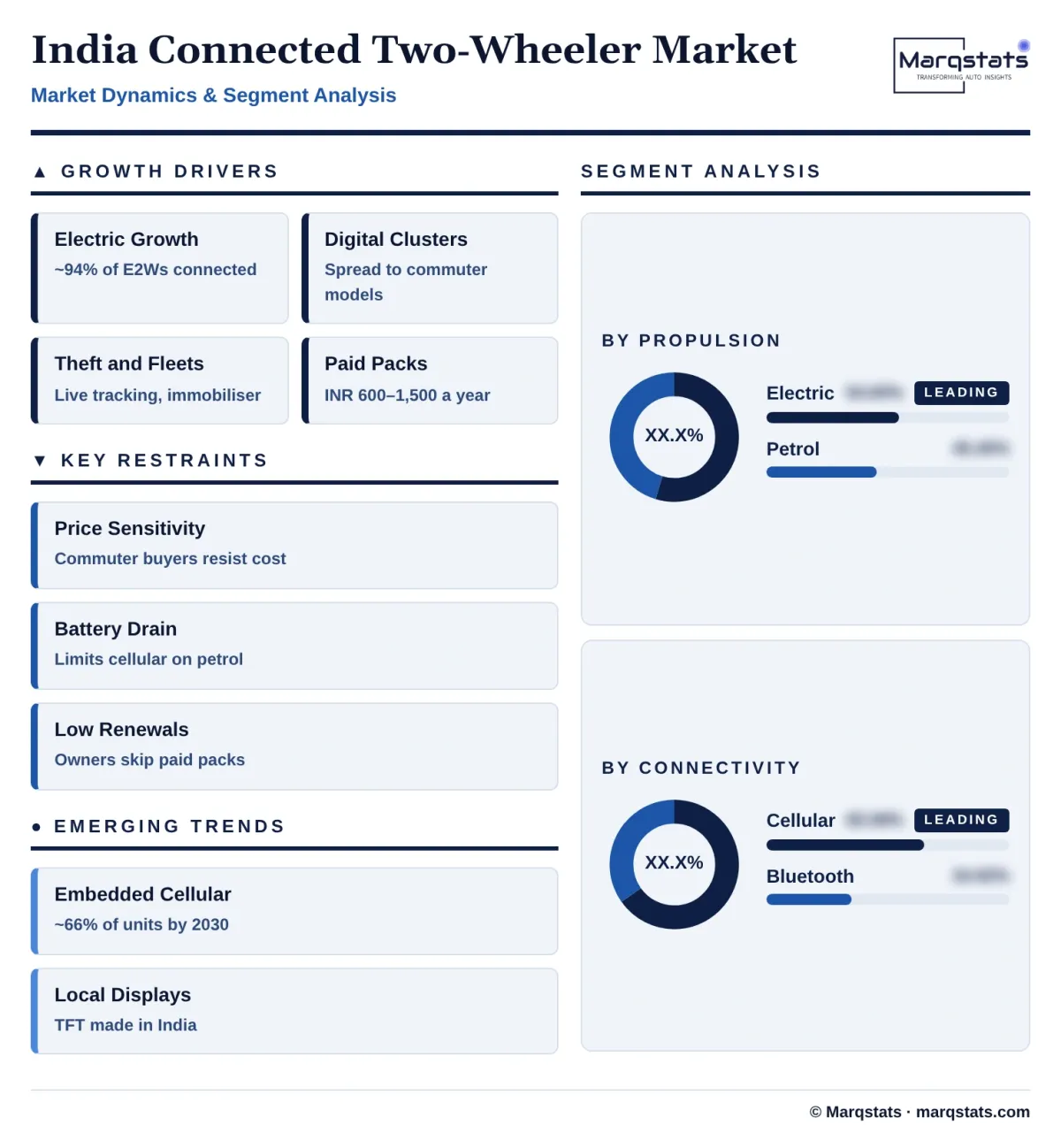
Battery electric two-wheelers account for an estimated 54.60% of 2025 value and embedded cellular systems for 65.08%. Western India accounts for 34.00% of 2025 value and Southern India for 29.00%. The study segments the market by propulsion, connectivity type, component, vehicle type and region.
Key Takeaways
Market Overview & Analysis
Report Summary
Marqstats sizes the India connected two-wheeler market as the value of connectivity hardware fitted to new two-wheelers and the recurring software and data services billed on connected vehicles. Hardware includes telematics control units with 4G modems, microcontrollers and GNSS receivers compatible with India's NavIC system, digital instrument clusters with Bluetooth Low Energy or cellular links, and machine-to-machine eSIMs. Services include cellular data, cloud telemetry, navigation, over-the-air updates and app subscriptions. In 2025 the market was worth an estimated USD 315.00 million, of which hardware accounted for USD 264.96 million and services for USD 50.04 million.
The market sits within the world's largest two-wheeler market. Dealers registered 20,295,650 new two-wheelers in India in 2025, up 7.24% on 2024, and about 1.34 million of these were high-speed electric two-wheelers. Marqstats estimates about 1.25 million electric two-wheelers and 4.27 million petrol two-wheelers were sold with connected features, a total of about 5.52 million connected vehicles and 26.93% of sales.
Connectivity differs sharply by powertrain. Nearly all electric scooters and motorcycles have factory-fitted cellular telematics because battery safety rules require continuous battery data logging and because OEMs use connectivity for battery health monitoring, remote diagnostics and software updates. Petrol two-wheelers mostly use lower-cost Bluetooth clusters that pair with the rider's phone for navigation prompts and call and message alerts, concentrated in 125 cc to 250 cc motorcycles and feature-rich scooters.
Hardware value varies widely. Basic Bluetooth LCD clusters on high-volume commuter models such as the Hero Splendor XTEC and TVS Jupiter cost OEMs about USD 18 to 28. Full-colour TFT cockpits with application processors, CAN interfaces and embedded 4G eSIMs on models such as the Ather 450X, TVS iQube ST and Ola S1 Pro cost about USD 85 to 135. Marqstats estimates the blended hardware value per connected vehicle at about USD 48 in 2025, rising to about USD 60 in 2030.
Services are becoming a business. After OEMs offered free introductory periods, connected services moved in 2025 towards tiered packs with annual renewals of about INR 600 to 1,500 per vehicle. The market grew from USD 62.40 million in 2021 to USD 98.80 million in 2022, USD 162.50 million in 2023 and USD 228.10 million in 2024, and Marqstats expects USD 442.20 million in 2026.
Regulation underpins connectivity. AIS-156 battery safety rules require electric two-wheelers to log battery data across the vehicle network, BS-VI OBD-II rules from April 2025 standardised electronic networks on petrol two-wheelers, AIS-140 tracking applies to commercial vehicles, and Department of Telecommunications instructions issued in June 2025 govern the use of embedded SIMs in machine-to-machine devices. TRAI began consulting on a framework for vehicle-to-everything communication in April 2026.
Connected features have become a buying factor. Riders use turn-by-turn navigation, call and message alerts, ride statistics, live vehicle location and theft alerts, and electric two-wheeler owners use apps to check charge level, range and battery health remotely. Delivery, quick-commerce and rental fleets use the same data to track vehicles, plan routes, monitor batteries and immobilise vehicles when payments are missed, making connectivity a working tool rather than an extra.
Two-wheeler connectivity is also a supply chain story. The instrument cluster has become the main computing unit on a modern scooter, combining display, processor, vehicle network interface and in many cases the cellular modem. Tier-1 suppliers such as Pricol, Uno Minda, Minda Corporation and Bosch design these units, while telecom operators supply eSIMs and data plans and cloud providers host OEM platforms. Localisation of displays and electronics is a policy goal, and suppliers are investing in Indian manufacturing to reduce reliance on imported panels and chips.
India Connected Two-Wheeler Market Size and Forecast
The India connected two-wheeler market grows from USD 315.00 million in 2025 to USD 1,280.00 million in 2030, a CAGR of 32.37%. Marqstats expects USD 442.20 million in 2026 with 7.35 million connected vehicles and 33.40% of sales, USD 595.60 million in 2027 with 9.42 million and 40.50%, USD 784.00 million in 2028 with 11.60 million and 47.70%, and USD 1,010.50 million in 2029 with 13.95 million and 55.10%, before reaching 16.43 million connected vehicles and about 62% of sales in 2030.
Value grows faster than volume. Connected vehicle sales grow at 24.38% a year, while value grows at 32.37%, because average hardware content rises from about USD 48 to USD 60 per vehicle and recurring services grow from USD 50.04 million to USD 294.20 million as the base of connected vehicles on the road reaches about 45 million by 2030.
Electric two-wheelers drive volume. Marqstats expects connected electric two-wheeler sales to rise from about 1.25 million to 8.50 million, overtaking connected petrol models at 7.93 million, as electric two-wheelers reach about 32% of all two-wheeler sales by 2030. Connected features on petrol models expand from about 22% to about 44% of petrol sales as digital clusters spread to commuter motorcycles.
Hardware content is the key sensitivity. Each USD 1.00 change in average hardware content changes the 2025 market by about USD 5.52 million and the 2030 market by about USD 16.43 million, so the pace at which colour TFT displays replace LCD clusters on commuter models has a large effect on market value.
Marqstats tracks four indicators to monitor the forecast: electric two-wheeler share of sales, connected fitment on petrol commuter models, average cluster and telematics prices from Tier-1 suppliers, and renewal rates for paid connected service packs.
Connectivity type shifts towards cellular. Marqstats estimates embedded cellular systems grow from about 1.88 million vehicles to 10.84 million, rising from 34% to 66% of connected units, while phone-paired Bluetooth systems grow more slowly from about 3.64 million to 5.59 million. Because cellular systems carry higher hardware value and generate service revenue, their share of value rises from 65.08% to 78.52%.
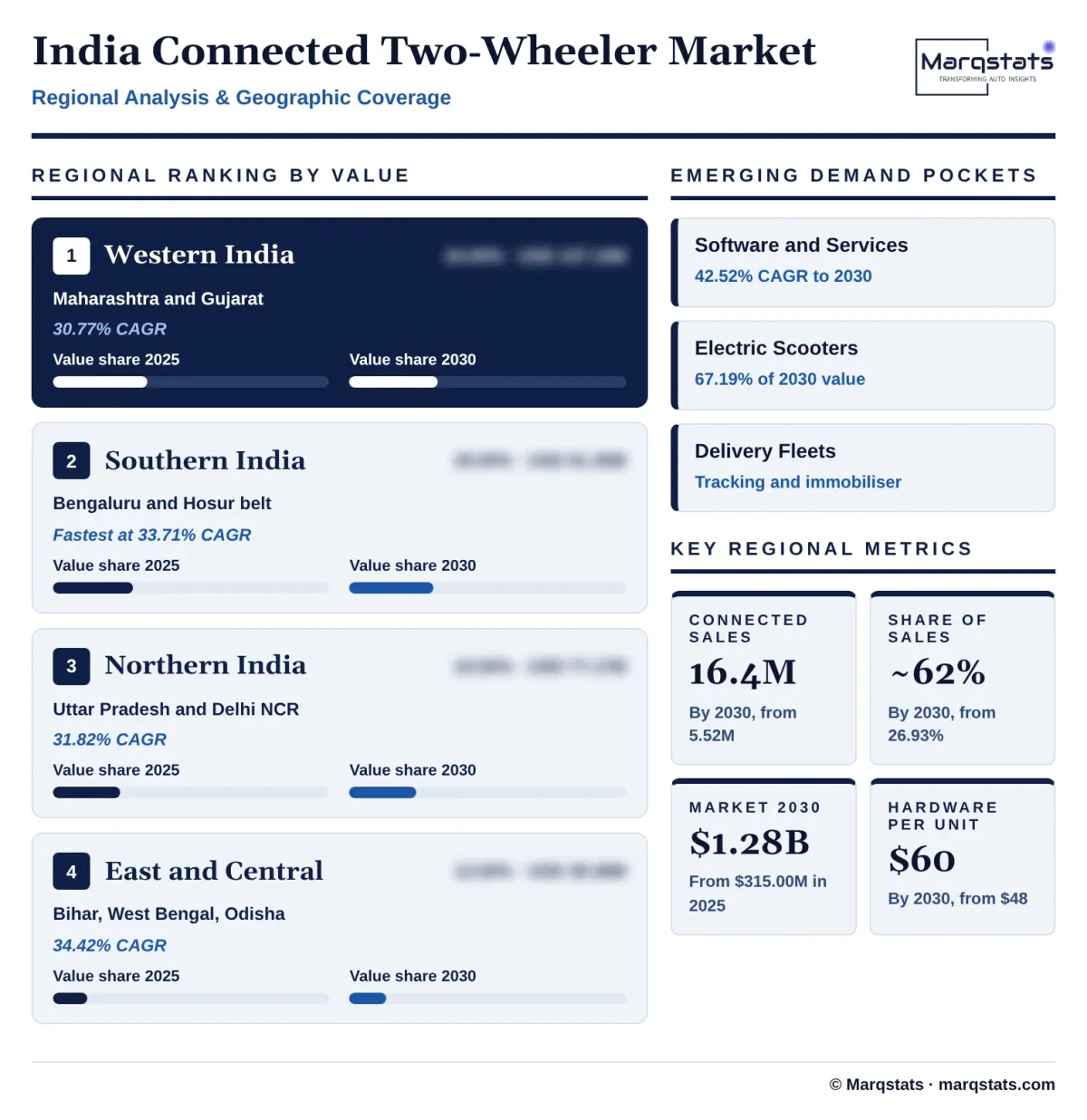
Regional growth follows electric adoption. Southern India grows fastest because of high electric two-wheeler use in Karnataka and Tamil Nadu, Eastern and Central India grows from a smaller base as digital clusters reach entry motorcycles, and Western and Northern India grow steadily on the back of large commuter and fleet markets. Western India remains the largest region in 2030 at 32.00% of value.
Market Dynamics
Key Drivers
Five forces are putting connectivity into most new Indian two-wheelers.
- Electric two-wheeler growth. Almost every high-speed electric two-wheeler has cellular telematics, so rising electric sales add connected volume directly. Battery safety rules under AIS-156 require battery data logging that telematics units use for remote alerts. Under PM E-DRIVE, the Ministry of Heavy Industries supports electric two-wheeler purchases and ties incentives to local manufacturing of electronics such as battery management systems and control units.
- Digital clusters spread to commuter models. Standardised electronic networks under BS-VI OBD-II rules and falling LCD and TFT prices let OEMs fit Bluetooth clusters to high-volume commuter scooters and motorcycles at low cost.
- Theft protection and fleet tracking. Embedded cellular systems allow live location, remote immobilisation and geofencing, which matter to private owners and to delivery, quick-commerce and rental fleets.
- OEMs want recurring revenue. Paid connected packs, feature unlocks such as Bajaj's TecPac, and software updates give OEMs income after the sale and data to improve products and service.
- Cheaper 4G modules. Falling prices for 4G LTE Cat-1 modules and machine-to-machine eSIMs from Bharti Airtel, Reliance Jio and Vodafone Idea make always-on connectivity affordable on mid-priced scooters.
Key Restraints
Four constraints slow connected technology on mass-market two-wheelers.
- Price sensitivity. Mass-market commuter buyers resist paying more for connectivity, limiting full TFT and cellular systems to premium and electric models.
- Battery drain on petrol models. Always-on telematics can drain the small 12-volt batteries of parked petrol two-wheelers, which is why most petrol models use phone-paired Bluetooth systems instead.
- Low subscription renewals. Many owners do not renew paid packs after free periods end, limiting recurring revenue and pushing OEMs to bundle basic features free. OEMs are responding with cheaper basic packs, multi-year bundles at purchase and features unlocked once rather than by subscription.
- Imported components. LCD and TFT panels account for about 45% to 50% of cluster material costs and are mostly imported, exposing suppliers to currency and supply risk.
Key Trends
Four shifts are changing how Indian two-wheelers are connected and monetised.
- From Bluetooth to embedded cellular. Embedded eSIM systems rise from about one-third of connected units to about two-thirds by 2030 as fleets and owners want tracking that works without a phone. Dual-profile eSIMs that switch between networks help keep vehicles connected in areas with patchy coverage.
- Software platforms as differentiators. Ather's AtherStack, TVS SmartXonnect, Ola's MoveOS and Hero's Vida platform compete on navigation, voice control, ride data and over-the-air updates.
- Local display manufacturing. Pricol licensed automotive TFT display technology from BOE Varitronix to make displays in India, reducing import dependence.
- Data rules tighten. Department of Telecommunications instructions on machine-to-machine eSIMs require profile management servers to be located in India, shaping how OEMs and telecom operators supply connectivity.
Strategic Implications
- For OEMs, connectivity is now a retention tool. Paid packs and feature unlocks create revenue, but reliability and service quality decide whether buyers stay, as the fall in Ola Electric's share shows.
- For Tier-1 suppliers, TFT clusters and telematics are the growth area. Suppliers that localise displays and offer combined cluster and telematics modules at commuter price points will win the largest volumes.
- For telecom operators, two-wheelers are a large machine-to-machine market. Dual-profile eSIMs, India-hosted profile management and fleet platforms position operators to capture recurring data revenue.
- For fleet operators, connected vehicles cut cost and risk. Live tracking, battery monitoring and remote immobilisation reduce theft and downtime in delivery and rental fleets.
- For insurers and financiers, ride and battery data enable better pricing. Connected data on usage and battery health support usage-based insurance and resale value estimates.
- For regulators, clear data rules support growth. Defined rules on eSIM management, data localisation, vehicle-to-everything spectrum and transfer of connectivity on resale give OEMs and telecom operators the certainty to invest in connected services.
- For cloud and software providers, OEM platforms need scale. Over-the-air update pipelines, telemetry storage and analytics for tens of millions of vehicles create steady demand for India-hosted cloud services.
Market Segmentation
Electric two-wheelers account for an estimated 54.60% of 2025 value, USD 172.00 million from about 1.25 million connected vehicles, and grow at 37.97% a year to USD 860.00 million and 67.19% of value by 2030, as connected electric sales rise to about 8.50 million. Ather Energy, TVS iQube, Bajaj Chetak, Hero Vida and Ola Electric fit cellular telematics as standard.
Petrol two-wheelers account for 45.40% of 2025 value, USD 143.00 million from about 4.27 million connected vehicles, growing at 24.05% a year to USD 420.00 million by 2030, mainly through Bluetooth clusters on commuter and premium motorcycles and scooters such as TVS SmartXonnect, Hero XTEC and Royal Enfield Tripper.
Systems with built-in eSIM and 4G modem account for 65.08% of 2025 value, USD 205.00 million from about 1.88 million vehicles, and grow at 37.43% a year to USD 1,005.00 million and 78.52% of value by 2030, as cellular units reach about 10.84 million vehicles.
Bluetooth systems that pair with the rider's phone account for 34.92% of 2025 value, USD 110.00 million from about 3.64 million vehicles, and grow at 20.11% a year to USD 275.00 million. They are the low-cost entry point for commuter models.
Telematics units, digital clusters and eSIMs account for 84.11% of 2025 value, USD 264.96 million, growing at 30.05% a year to USD 985.80 million and 77.02% of value by 2030.
Cellular data, cloud, navigation and app subscriptions account for 15.89% of 2025 value, USD 50.04 million, and grow fastest, at 42.52% a year, to USD 294.20 million and 22.98% of value by 2030.
Scooters account for 62.22% of 2025 value, USD 196.00 million, and grow at 32.88% a year to USD 812.00 million by 2030. Their front aprons provide weather-protected space for 5-inch to 7-inch displays and telematics units, and most electric two-wheelers are scooters.
Motorcycles account for 37.78% of 2025 value, USD 119.00 million, and grow at 31.50% a year to USD 468.00 million by 2030, led by premium commuter and mid-size models from Hero MotoCorp, Bajaj Auto, TVS Motor and Royal Enfield.
By Geography
Western India
Western India is the largest region, with an estimated 34.00% of 2025 value, USD 107.10 million, rising to USD 409.60 million by 2030, a 30.77% CAGR. Maharashtra has the highest electric two-wheeler registrations and a motor vehicle tax waiver under its EV policy, and Gujarat has high commuter density in Ahmedabad and Surat. Many fleet operators register vehicles in Mumbai and Pune and deploy them in other states.
Southern India
Southern India accounts for 29.00% of 2025 value, USD 91.35 million, and grows fastest, at 33.71% a year, to USD 390.40 million and 30.50% of value by 2030. Bengaluru is India's leading connected mobility cluster, home to Ather Energy, and the Hosur, Krishnagiri and Chennai belt hosts TVS Motor, Ather and Ola Electric plants.
Northern India
Northern India accounts for 24.50% of 2025 value, USD 77.17 million, rising to USD 307.20 million by 2030, a 31.82% CAGR. Uttar Pradesh is India's largest two-wheeler market, and Delhi's aggregator and delivery fleet rules drive adoption of electric and tracked vehicles.
Eastern and Central India
Eastern and Central India accounts for 12.50% of 2025 value, USD 39.38 million, rising to USD 172.80 million by 2030, a 34.42% CAGR, as Bluetooth clusters spread to entry motorcycles in Bihar, West Bengal and Odisha and mobile network coverage improves.
How Competition Is Evolving
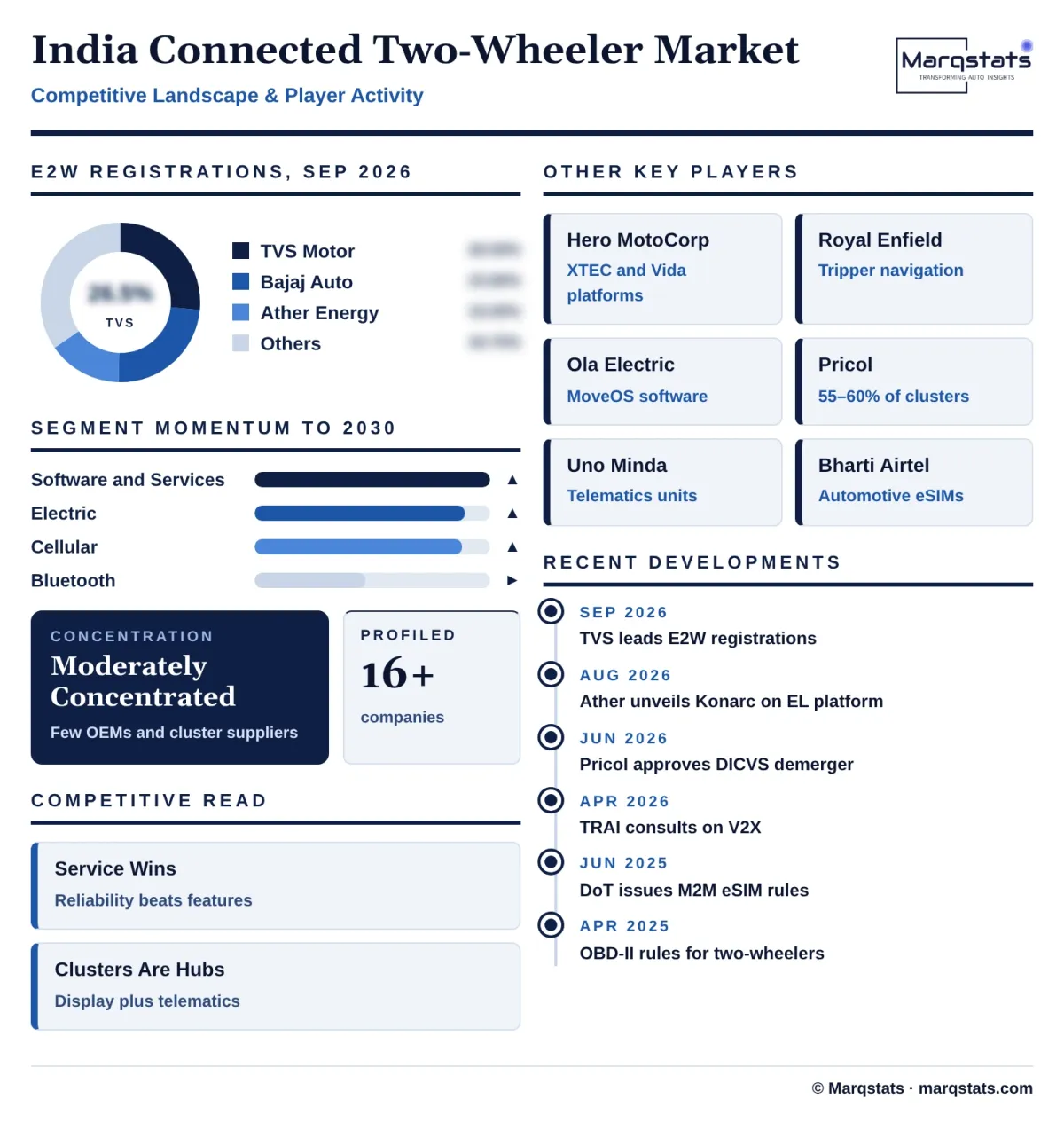
The India connected two-wheeler market is moderately concentrated. On the vehicle side, Hero MotoCorp, TVS Motor, Bajaj Auto, Honda Motorcycle and Scooter India, Royal Enfield, Ather Energy and Ola Electric decide which models are connected. On the supply side, Pricol, Uno Minda, Minda Corporation and Bosch supply clusters and telematics units, and Bharti Airtel, Reliance Jio and Vodafone Idea supply connectivity.
Established OEMs have taken the lead in electric two-wheelers. In September 2026, TVS Motor registered about 53,989 electric two-wheelers, 26.5% of the market, Bajaj Auto about 48,383, 23.8%, Ather Energy about 30,477, 15.0%, and Hero Vida about 24,305, 11.9%, while Ola Electric fell to about 13,449, 6.6%, from about 35% in 2024. Service networks and product reliability proved as important as software features.
Suppliers are scaling up. Pricol supplies an estimated 55% to 60% of two-wheeler instrument clusters and most two-wheeler TFT displays in India. Its driver information and connected vehicle business generated INR 2,424.63 crore of revenue in FY26, 61.17% of the group total, and its board approved its demerger into Pricol Autotech on 27 June 2026. Uno Minda supplies telematics units and body controllers, and Minda Corporation partners with LocoNav for fleet telematics.
Competition will be decided by cost, software quality and service. Suppliers that offer TFT clusters with integrated telematics at commuter price points, OEMs whose connected platforms are reliable and useful, and telecom operators with dependable machine-to-machine networks will capture the largest share of growth.
Connected platforms differ by OEM. Ather fits factory 4G telematics on every scooter and sells Pro packs for navigation and ride features, TVS offers SmartXonnect with Bluetooth on petrol models and cellular on iQube, Bajaj sells TecPac upgrades on Chetak, Hero uses XTEC Bluetooth on commuter models and cellular on Vida, Royal Enfield offers Tripper navigation pods, and Ola Electric runs its own MoveOS software. These choices decide how much hardware each OEM buys and how much service revenue it earns.
Companies Covered
Companies covered in the report include:
Recent Market Activity
Table of Contents
Coverage & Segmentation
The study covers the India connected two-wheeler market, with 2025 as the base year, 2021 – 2025 as the historical period and 2026 – 2030 as the forecast period. Values are in US dollars, with rupee values converted at INR 87.00 per US dollar. The market covers Tier-1 ex-factory value of connectivity hardware fitted to new two-wheelers and annual billings for connected software and data services. It is segmented by propulsion, connectivity type, component, vehicle type and region.
Vehicle value, batteries, drivetrains, low-speed electric two-wheelers below the registration threshold, standalone aftermarket trackers and phone mounts are excluded. Segment value splits and 2030 regional values are Marqstats estimates built on registration data, fitment rates by model, component price benchmarks and subscription pricing.