Market Snapshot
Middle bar: base-year value × (1 + CAGR), rounded to two decimals. This is a calculated illustration, not a separately researched annual estimate.
The global motorcycle advanced rider assistance systems (ARAS) market size is estimated at USD 311.05 million in 2025 and is projected to reach USD 1,028.60 million by 2030, growing at a CAGR of 27.02% over 2026 – 2030. Production of motorcycles fitted with radar-based assistance grows from about 135,000 units to 685,000, a 38.38% annual rate, lifting radar fitment on motorcycles above 500cc from 8.18% to 35.86%.
Marqstats defines the market as the value of the perception layer of motorcycle rider assistance supplied to manufacturers: front and rear 77 GHz radar sensors, camera sensors, dedicated rider assistance control units and the perception and control software that delivers adaptive cruise control, forward collision warning, emergency brake assist, blind spot detection and rear collision warning. Base anti-lock braking modulators, brake calipers and discs, inertial measurement units used without radar fusion, and the wider motorcycle are excluded.
Sensors account for an estimated 48.20% of 2025 value, adaptive cruise control functions for 34.79% and motorcycles above 500cc for 85.40%. Europe accounts for 31.72% of 2025 value and Asia-Pacific for 30.50%. The study segments the market by component, function, engine displacement and region.
Key Takeaways
Market Overview & Analysis
Report Summary
Marqstats sizes the motorcycle ARAS market as the value of radar sensors, cameras, dedicated control units and software that give motorcycles awareness of surrounding traffic. In 2025 the market was worth an estimated USD 311.05 million, and about 135,000 motorcycles were built with radar-based assistance, mostly touring and adventure motorcycles above 500cc from European and Japanese manufacturers.
Rider assistance is harder to engineer than car driver assistance. A motorcycle leans into corners, and braking or accelerating at the wrong moment can unsettle it. Radar-based functions therefore rely on a six-axis inertial measurement unit that tracks lean, pitch and yaw, and on cornering anti-lock braking and stability control that limit how hard the system can brake at a given lean angle. Sensors must also be small, light and sealed against weather and pressure washing, and draw little power from the motorcycle battery.
Three layers make up the technology. The chassis layer includes the inertial sensor and the anti-lock braking and stability control modulator, which are mature and mandatory in many markets. The perception layer, which Marqstats sizes, adds 77 GHz radar sensors at the front and rear, camera sensors, a control unit and fusion software. A connected layer, still in early development, will let motorcycles share their position with cars and infrastructure to improve visibility in traffic.
Bosch introduced the first production motorcycle with front and rear radar on the Ducati Multistrada V4 for model year 2021, followed by BMW Motorrad, KTM and Kawasaki. Its newest generation of radar assistance was developed with KTM for the 1390 Super Adventure S EVO and adds stop-and-go adaptive cruise control when combined with KTM's automated manual transmission, together with group ride assist, riding distance assist, emergency brake assist and rear collision warning. Yamaha's Tracer 9 GT+ links its front radar with a unified braking system and semi-active suspension.
The market grew from about USD 88.50 million in 2021 to USD 125.40 million in 2022, USD 172.60 million in 2023 and USD 235.80 million in 2024, as radar moved from a few flagship models to options across touring and adventure ranges. Marqstats expects USD 383.06 million in 2026.
Each function uses the sensors in a different way. Adaptive cruise control uses the front radar to hold a set distance to the vehicle ahead, and on the newest systems can bring the motorcycle to a stop and pull away again in traffic. Forward collision warning alerts the rider when closing speed is too high, and emergency brake assist adds braking pressure if the rider brakes too gently before an obstacle. The rear radar supports blind spot detection, lane change warning and rear collision warning, which flashes the hazard lights when a following vehicle approaches too fast. Group ride assist tracks the nearest motorcycle in a staggered formation so the system does not speed up past a riding partner.
Global Motorcycle Advanced Rider Assistance Systems Market Size and Forecast
The global motorcycle ARAS market grows from USD 311.05 million in 2025 to USD 1,028.60 million in 2030, a CAGR of 27.02%. Marqstats expects USD 498.00 million in 2027, USD 642.50 million in 2028 and USD 818.00 million in 2029.
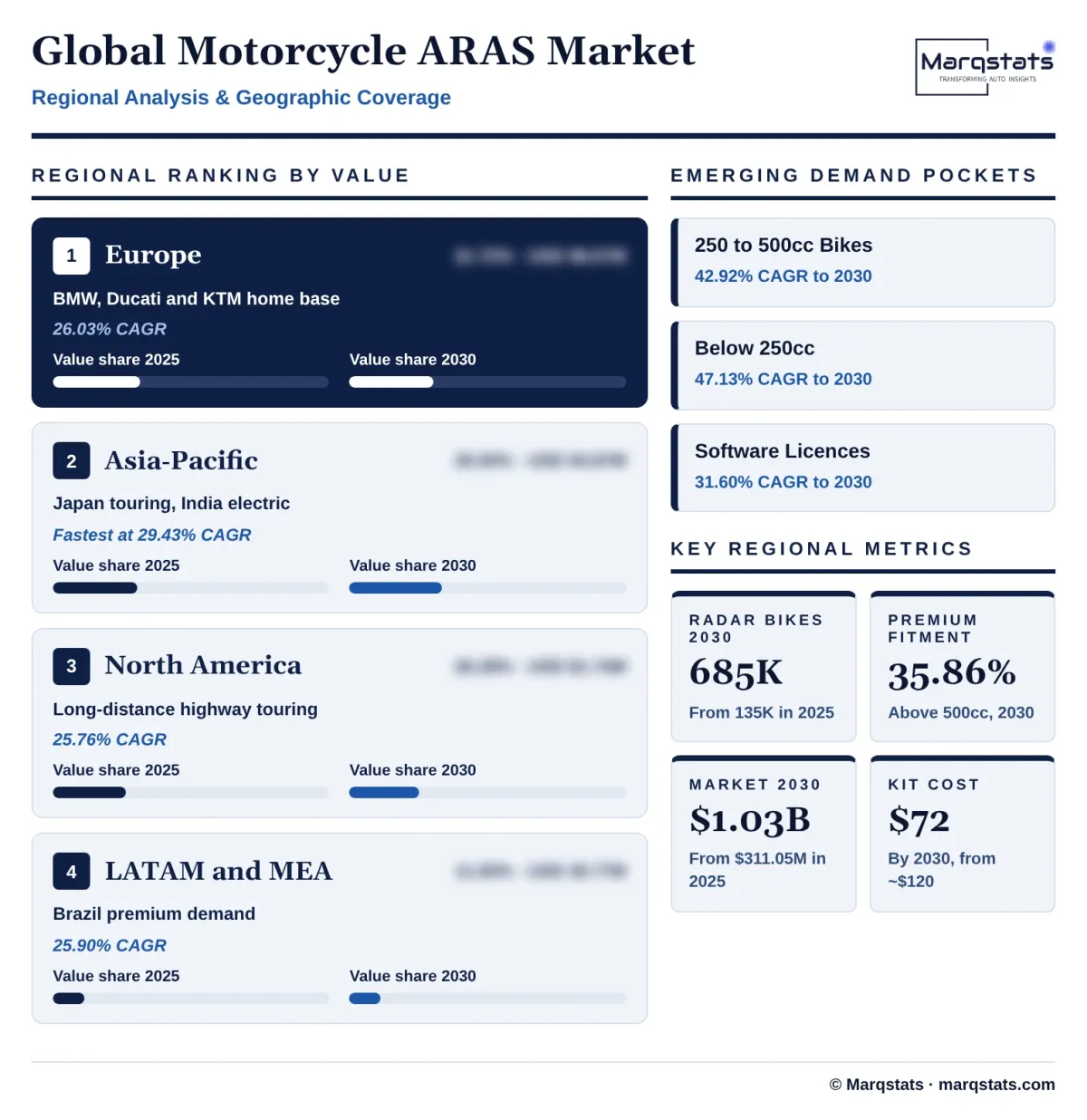
Volume grows faster than value. Radar-equipped motorcycle production rises from about 135,000 units in 2025 to 185,000 in 2026, 265,000 in 2027, 375,000 in 2028, 510,000 in 2029 and 685,000 in 2030, a 38.38% annual rate. Sensor costs fall as radar chips move to high-volume silicon processes, and Marqstats estimates the average dual-radar kit cost falls from about USD 120 to USD 72 over the period.
Premium motorcycles remain the core of demand. Marqstats estimates about 1.65 million motorcycles above 500cc were built worldwide in 2025, rising to about 1.91 million in 2030, a 2.97% annual rate. Radar fitment in this segment rises from 8.18% in 2025 to 11.01% in 2026 and 35.86% in 2030, so fitment rather than motorcycle sales drives growth.
The wider active safety market grows more slowly. Marqstats estimates the full active safety package for motorcycles, including cornering anti-lock braking, stability control modulators, inertial sensors and the perception layer, grows from USD 949.80 million in 2025 to USD 2,056.40 million in 2030, a 16.71% CAGR. Anti-lock braking is already required in Europe, Japan and India for many motorcycles, so most new growth comes from perception sensors and software.
Marqstats tracks four indicators to monitor the forecast: radar fitment rates on new touring and adventure models, the cost of radar and camera sensors, the share of mid-sized motorcycles offered with blind spot or collision warning, and changes to braking and safety rules in Asian markets.
The mix of value shifts across the forecast. Software and licences rise from 24.30% to 29.00% of value, forward collision warning and brake assist from 28.00% to 31.00%, and motorcycles below 500cc from 14.60% to 27.00%. Asia-Pacific overtakes Europe as the largest region, rising from 30.50% to 33.50% of value, while Europe eases from 31.72% to 30.50% and North America from 26.28% to 25.00%.
Market Dynamics
Key Drivers
Six forces are expanding radar and camera-based rider assistance on motorcycles.
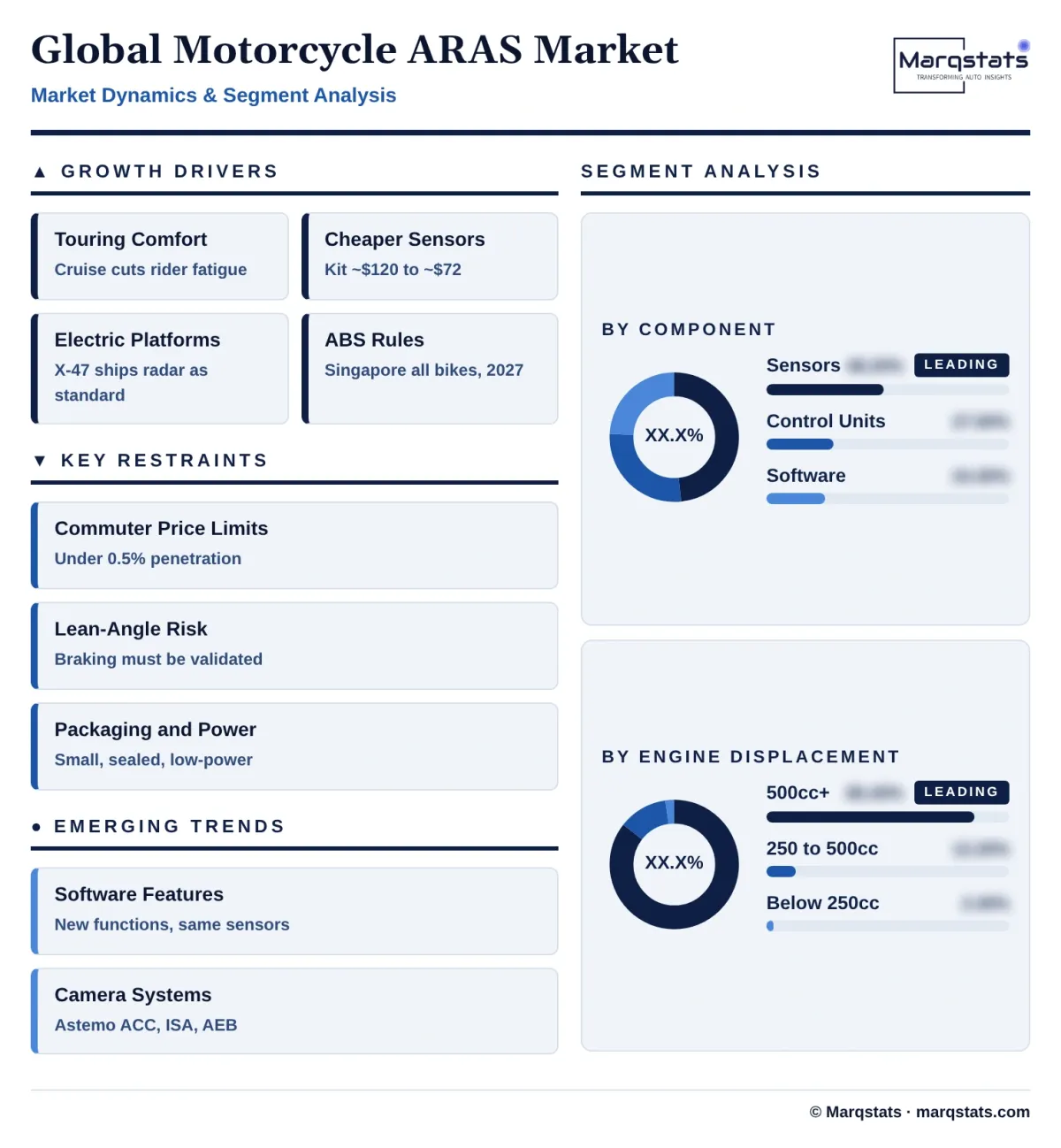
- Touring riders want less fatigue. Adaptive cruise control and stop-and-go functions reduce the effort of long highway rides, and riders of premium touring and adventure motorcycles are willing to pay for them.
- Sensor costs are falling. Radar chips built on high-volume silicon processes, smaller second-generation radar modules and shared automotive components cut the cost of each system and make single-sensor packages viable on mid-sized motorcycles.
- Manufacturers use safety to compete. BMW Motorrad, Ducati, KTM, Kawasaki and Yamaha offer radar on flagship models, and the BMW R 1300 RT unveiled in April 2025 offers active cruise control, front collision warning and lane change warning.
- Electric motorcycles suit rider assistance. Electric motorcycles have high-voltage batteries, fast data networks and motors that can slow the motorcycle smoothly, and Ultraviolette launched its X-47 in India in September 2025 with its own radar system for blind spot monitoring, lane change assist and rear collision warning.
- Safety rules raise the baseline. Singapore will require anti-lock braking on all newly registered motorcycles from 1 April 2027, and Europe, Japan and India already require it on many motorcycles, building the braking and sensor base that rider assistance needs.
- Car safety ratings help. Euro NCAP tests whether car emergency braking systems detect motorcycles, pushing suppliers to improve radar detection of two-wheelers and to share know-how between car and motorcycle systems.
Key Restraints
Five constraints slow the spread of rider assistance beyond premium motorcycles.
- Price sensitivity outside the premium segment. Commuter motorcycles in India and Southeast Asia sell on tight margins, so adding even a few dollars of electronics is difficult, keeping perception-based assistance below 0.50% of these motorcycles.
- Safety and liability risk. An unexpected brake intervention while leaning can cause a fall, so manufacturers must validate systems extensively and limit automatic braking, slowing the rollout of active functions.
- Packaging and power limits. Motorcycles have little space for sensors, small batteries and full exposure to weather, so sensors must be smaller, sealed and low-power, adding engineering cost.
- Premium sales cycles. Demand for radar-equipped motorcycles depends on discretionary spending on expensive touring motorcycles, which falls when interest rates and consumer credit tighten.
- Weather and road clutter. Radar must filter reflections from the road surface at high lean angles, and cameras lose performance in rain, glare and darkness, limiting how much control the system can take.
Key Trends
Five shifts are changing how rider assistance is designed, sold and priced.
- Software-defined features. Manufacturers add new functions such as group ride assist and riding distance assist through software on the same sensors, and may sell features as paid upgrades.
- Single-sensor packages for mid-sized motorcycles. A rear radar for blind spot and rear collision warning, without a front radar, gives mid-sized motorcycles useful protection at lower cost.
- Cameras as an alternative to radar. Astemo showed camera-based adaptive cruise control, intelligent speed assistance and emergency braking for motorcycles at EICMA in November 2025, offering a lower-cost route for Asian manufacturers.
- Integration with automated transmissions and suspension. KTM combines radar cruise with an automated manual transmission for stop-and-go riding, and Yamaha links radar with braking and suspension to keep the motorcycle stable when slowing.
- Connected safety. Bosch and motorcycle manufacturers are developing systems that let motorcycles share their position with cars and road infrastructure, which could later be combined with radar and cameras to make motorcycles more visible in traffic.
Strategic Implications
- For motorcycle manufacturers, standard fitment protects flagships. Making radar standard on top touring and adventure models, and building mid-sized platforms with sensor mounts and wiring ready for later upgrades, lets manufacturers spread costs and sell features after purchase.
- For component suppliers, integration wins. Suppliers that combine the inertial sensor, control unit and braking modulator in one compact unit, and adapt automotive radar to motorcycle size, power and sealing needs, will win mid-sized motorcycle programmes.
- For new entrants, warnings come before braking. Electric motorcycle makers and new suppliers can start with blind spot and collision warnings shown on the dashboard or through vibration, before adding automatic braking that needs long validation.
- For Asian manufacturers, camera systems lower the entry price. Camera-based warnings and speed assistance can bring rider assistance to mid-sized and commuter motorcycles at a lower cost than dual radar.
- For regulators, braking rules lay the foundation. Wider anti-lock braking requirements in Asia and common test methods for automatic motorcycle braking would make advanced assistance easier to approve and adopt.
- For investors, the software layer is the margin pool. As sensor prices fall, value moves to software that delivers new functions on existing hardware, so suppliers and manufacturers with validated software libraries and feature upgrade models will earn the highest returns.
Market Segmentation
Radar, camera and related sensors account for 48.20% of 2025 value, USD 149.93 million, rising to USD 457.73 million by 2030, a 25.01% CAGR, while their share falls to 44.50% as sensor prices fall. Bosch and Continental supply most motorcycle radar sensors.
Dedicated rider assistance control units account for 27.50% of 2025 value, USD 85.54 million, and grow at 26.09% a year to USD 272.58 million, 26.50% of 2030 value, as fusion of radar, camera and inertial data moves to more powerful safety processors.
Perception, fusion and control software accounts for 24.30% of 2025 value, USD 75.58 million, and grows fastest, at 31.60% a year, to USD 298.29 million and 29.00% of value by 2030.
Adaptive cruise control, including stop-and-go, accounts for 34.79% of 2025 value, USD 108.21 million, and grows at 24.92% a year to USD 329.15 million by 2030. The KTM 1390 Super Adventure S EVO and Yamaha Tracer 9 GT+ are leading examples.
Forward collision warning and emergency brake assist account for 28.00% of 2025 value, USD 87.10 million, and grow at 29.63% a year to USD 318.87 million, 31.00% of 2030 value.
Blind spot detection, lane change assist and rear collision warning account for 25.00% of 2025 value, USD 77.76 million, and grow at 28.02% a year to USD 267.44 million, helped by easy packaging of a single rear radar on mid-sized motorcycles.
Group ride assist, riding distance assist and similar convenience functions account for 12.21% of 2025 value, USD 37.98 million, rising to USD 113.14 million by 2030, a 24.40% CAGR.
Premium touring, adventure and sport-touring motorcycles above 500cc account for 85.40% of 2025 value, USD 265.64 million, and grow at 23.10% a year to USD 750.88 million, while their share falls to 73.00%.
Mid-sized motorcycles of 250cc to 500cc account for 12.20% of 2025 value, USD 37.95 million, and grow at 42.92% a year to USD 226.29 million and 22.00% of value by 2030, led by rear radar blind spot packages and electric motorcycles.
Commuter motorcycles and scooters below 250cc account for 2.40% of 2025 value, USD 7.46 million, and grow fastest, at 47.13% a year, to USD 51.43 million and 5.00% of 2030 value as camera-based warnings are trialled.
By Geography
Europe
Europe is the largest region in 2025, with 31.72% of value, USD 98.67 million, rising to USD 313.72 million by 2030, a 26.03% CAGR. BMW Motorrad, Ducati and KTM are based in Europe and sell many radar-equipped touring and adventure motorcycles there. BMW Motorrad delivered 118,814 motorcycles in Europe in 2025. Registrations in the five largest markets fell 12.9% in 2025 after pre-registrations ahead of Euro 5+, then rose 21.1% in the first quarter of 2026 and 16.8% in the first half.
Asia-Pacific
Asia-Pacific accounts for 30.50% of 2025 value, USD 94.87 million, and grows fastest, at 29.43% a year, to USD 344.58 million and 33.50% of value by 2030, becoming the largest region. Japanese manufacturers widen radar fitment on touring models, and India, where domestic two-wheeler wholesales reached about 21.71 million in fiscal year 2025-26, is adding radar on electric motorcycles such as the Ultraviolette X-47. Singapore will require anti-lock braking on all new motorcycles from April 2027.
North America
North America accounts for 26.28% of 2025 value, USD 81.74 million, rising to USD 257.15 million by 2030, a 25.76% CAGR. Long-distance touring on highways creates strong demand for adaptive cruise control, forward collision warning and blind spot detection on large touring and adventure motorcycles. BMW Motorrad, Ducati and KTM dealers sell radar-equipped models across the United States and Canada, and riders of large touring motorcycles are among the most likely buyers of comfort and safety options.
Latin America, Middle East and Africa
Latin America, the Middle East and Africa account for 11.50% of 2025 value, USD 35.77 million, rising to USD 113.15 million by 2030, a 25.90% CAGR. Brazil is the main market for premium motorcycles in the region, while commuter motorcycles limit wider adoption.
How Competition Is Evolving
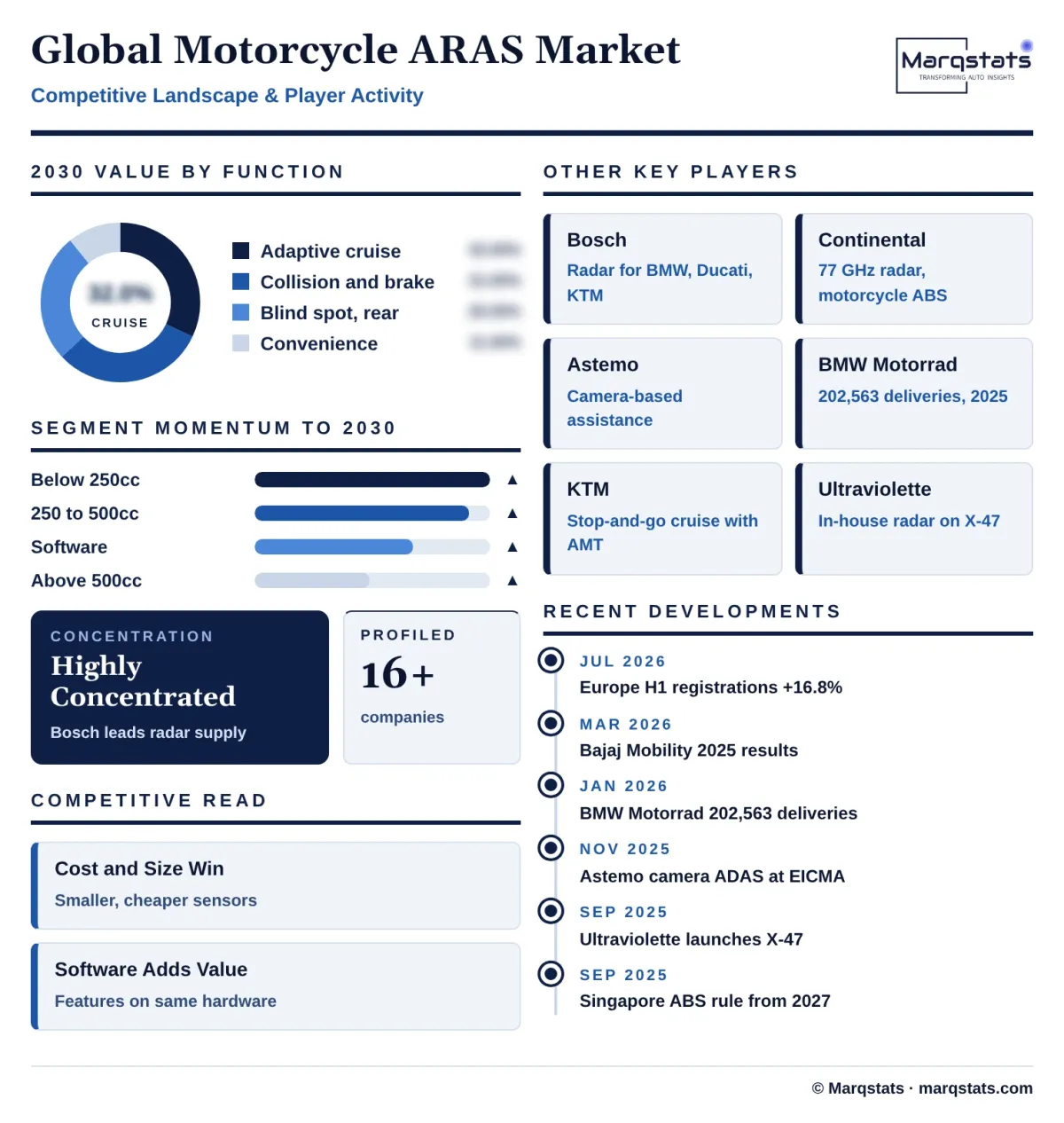
The motorcycle ARAS market is highly concentrated. Bosch supplies most production motorcycle radar systems and runs its two-wheeler business from Japan, close to Japanese manufacturers. It supplies radar, inertial sensors, stability control and engine management to BMW Motorrad, Ducati, KTM and Kawasaki.
Continental supplies 77 GHz short-range radar and motorcycle anti-lock braking systems for blind spot detection, lane change assist and rear collision warning. Astemo, formed from Hitachi Automotive Systems, Keihin, Showa and Nissin Kogyo, develops camera-based assistance and integrated braking for Japanese manufacturers. ZF supplies braking and stability electronics.
Manufacturers shape demand. BMW Motorrad delivered 202,563 motorcycles in 2025, led by the R 1300 GS Adventure with 33,570 units and the R 1300 GS with 32,555, both offered with radar assistance. Bajaj Mobility, the parent of KTM, sold 209,704 motorcycles in 2025 with revenue of EUR 1.009 billion after restructuring. Ducati delivered 54,495 motorcycles in 2024, with the Multistrada as its main radar platform.
Competition will be decided by cost, size and software. Suppliers that shrink sensors, reduce power use and combine sensors, control units and braking into compact modules, while offering validated software functions, will win the move into mid-sized motorcycles.
Motorcycle manufacturers take different routes. European brands rely on Bosch radar and offer it on touring and adventure models, Yamaha combines radar with its own braking and suspension control, Honda focuses on cornering anti-lock braking, inertial sensors and electronically adjusted suspension on touring models such as the CB1000GT shown at EICMA 2025, while working with Astemo on camera-based assistance. BMW Motorrad's F 450 GS, developed with TVS Motor Company, shows how premium electronics are moving into smaller global platforms.
Companies Covered
Companies covered in the report include:
Recent Market Activity
Table of Contents
Coverage & Segmentation
The study covers the global motorcycle advanced rider assistance systems market, with 2025 as the base year, 2021 – 2025 as the historical period and 2026 – 2030 as the forecast period. Values are in US dollars at supplier prices to manufacturers. The market is segmented by component, function, engine displacement and region.
Base anti-lock braking modulators, brake calipers and discs, inertial sensors without radar or camera fusion, aftermarket accessories and the wider motorcycle are excluded. Segment and regional splits are Marqstats estimates built on manufacturer deliveries, radar fitment rates, supplier disclosures and component cost benchmarks.