Market Snapshot
Middle bar: base-year value × (1 + CAGR), rounded to two decimals. This is a calculated illustration, not a separately researched annual estimate.
The global electric MPV market size is estimated at USD 27,000.00 million in 2025 and is projected to reach USD 64,500.00 million by 2030, growing at a CAGR of 19.03% over 2026 – 2030. Annual sales rise from about 575,000 vehicles to 1,450,000, a 20.32% annual rate, while the average transaction price eases from about USD 46,956 to USD 44,483 as battery costs fall and production scales.
Marqstats defines the market as the value of new factory-built passenger MPVs and minivans with three rows or a multi-row passenger layout and a rechargeable traction battery, covering battery electric vehicles and plug-in hybrids, including extended-range electric vehicles. Cargo-only panel vans registered as goods vehicles, full hybrids without a charging socket, mild hybrids and conventional petrol and diesel MPVs are excluded.
Battery electric MPVs account for an estimated 57.15% of 2025 value and large executive MPVs for 72.74%. China accounts for 77.04% of 2025 value and Europe for 11.48%. The study segments the market by powertrain, vehicle size, application and region.
Key Takeaways
Market Overview & Analysis
Report Summary
Marqstats sizes the global electric MPV market as the value of new rechargeable passenger MPVs and minivans sold in a year. In 2025 about 575,000 battery electric and plug-in hybrid MPVs were sold worldwide, worth an estimated USD 27,000.00 million at an average transaction price of about USD 46,956.
MPVs and minivans are defined by passenger layout rather than body shape. Under UNECE and EU type approval they are passenger vehicles in category M1, with up to eight seats in addition to the driver, while the same body built without rear seats and with a cargo partition is a goods vehicle in category N1. In the United States, minivans with three rows and flat-loading floors are classed as light trucks for fuel economy rules under 49 CFR Part 523. In China, MPVs are a separate category within passenger cars. Marqstats counts only passenger versions, so the cargo version of the Volkswagen ID. Buzz and panel versions of the Mercedes-Benz eVito are excluded.
Two types of electric MPV dominate. In China and Southeast Asia, the large executive MPV, more than about 5.1 metres long with lounge seats in the second row, has become a status vehicle for business leaders and a workhorse for chauffeur and airport services. In North America and Europe, the electric MPV is mostly a mid-size family vehicle or a passenger version of a commercial van platform, such as the Volkswagen ID. Buzz and Mercedes-Benz EQV.
Battery electric and plug-in hybrid designs both have a role. Large battery electric MPVs carry packs of 100 kWh or more, such as the 103.4 kWh Blade battery in the Denza D9 and the 116 kWh pack in the Zeekr 009, and many use 800-volt systems for fast charging. Plug-in hybrids and extended-range models use packs of about 16 kWh to 45 kWh, giving 50 to 180 km of electric driving with a petrol engine for long trips, which suits fleets in areas with limited fast charging.
The market grew from about 112,000 vehicles worth USD 4,820.00 million in 2021 to 185,000 worth USD 8,350.00 million in 2022, 310,000 worth USD 14,260.00 million in 2023 and 445,000 worth USD 20,700.00 million in 2024. Value grew at 53.84% a year from 2021 to 2025. Marqstats expects about 695,000 vehicles worth USD 32,100.00 million in 2026.
Electric MPVs face particular engineering challenges. Their tall, square shape gives drag coefficients of about 0.28 to 0.33, and fully loaded they weigh 2.8 to 3.2 tonnes, so motorway range falls faster than in a saloon or crossover. Designers respond with larger batteries, efficient silicon carbide inverters, flat floors with the battery built into the structure, and powered sliding doors that need reinforced body structures to meet side-impact rules.
Fleet buyers shape the market more than in any other passenger car segment. Chauffeur companies, hotels, airport transfer operators, corporate fleets and government agencies buy more than half of all electric MPVs by value. Their vehicles often cover 150 to 350 km a day, so energy and maintenance savings repay the higher purchase price quickly, and fast charging during short breaks matters more than maximum range. Private buyers, mostly families, put more weight on cabin flexibility, child-seat fittings, driver assistance and overnight home charging.
Global Electric MPV Market Size and Forecast
The global electric MPV market grows from USD 27,000.00 million in 2025 to USD 64,500.00 million in 2030, a CAGR of 19.03%. Marqstats expects USD 38,600.00 million in 2027, USD 46,100.00 million in 2028 and USD 54,800.00 million in 2029, with annual volume growth of about 20% to 22% throughout the forecast.
Growth slows from the pace of 2022 to 2024, when volumes rose 44% to 68% a year, because China, the largest market, is maturing and its purchase tax exemption has been cut. Sales in Europe, North America, Southeast Asia, Australia and the Middle East grow from a small base as Chinese brands export and Western carmakers launch new models.
Prices fall slowly. The average transaction price eases from about USD 46,956 in 2025 to USD 46,187 in 2026, USD 45,680 in 2027 and USD 44,483 in 2030, as battery pack costs fall and production scales, partly offset by a shift towards larger, better-equipped vehicles outside China.
Battery electric MPVs grow faster than plug-in hybrids. Battery electric sales rise from about 315,000 vehicles in 2025 to 915,000 in 2030, a 23.77% annual rate, while plug-in hybrid and extended-range sales rise from about 260,000 to 535,000, a 15.53% annual rate. Battery electric value grows at 21.94% a year against 14.63% for plug-in hybrids.
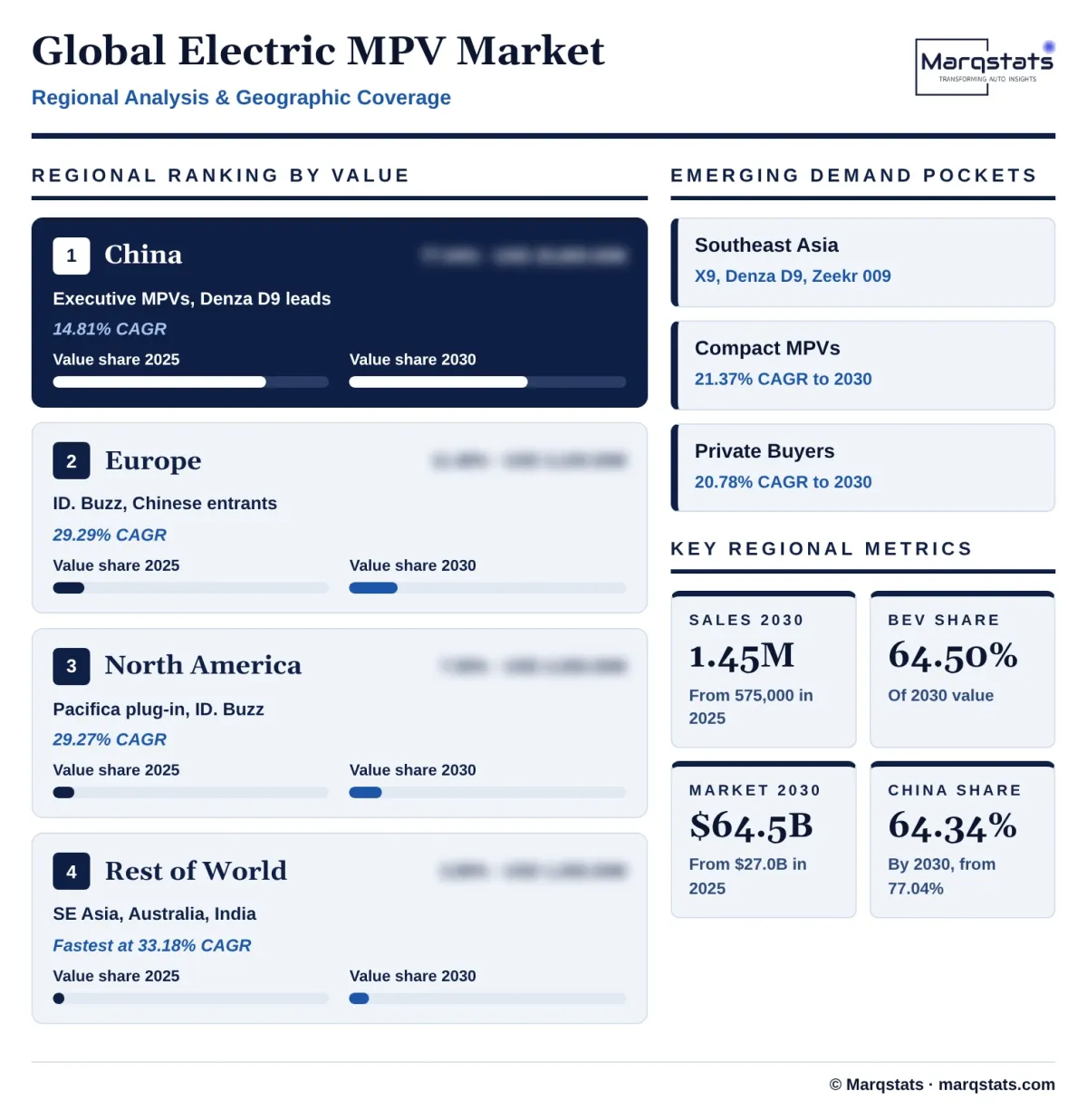
The mix shifts away from China. China's value grows at 14.81% a year to USD 41,500.00 million, while Europe grows to USD 11,200.00 million, North America to USD 7,400.00 million and the rest of the world to USD 4,400.00 million. Marqstats tracks four indicators to monitor the forecast: monthly MPV registrations in China, Chinese electric MPV exports, new electric MPV launches by Western and Japanese carmakers, and changes to tariffs and purchase incentives in the main import markets.
Fleet demand grows more slowly than private demand. Fleet and chauffeur value rises from USD 15,660.00 million to USD 35,350.00 million, a 17.68% annual rate, while private ownership rises from USD 11,340.00 million to USD 29,150.00 million, a 20.78% annual rate, as more affordable family models launch and public fast charging spreads in suburban areas. Compact and mid-size MPVs grow faster than large executive models, at 21.37% against 18.10% a year, because most new launches outside China target families rather than executives.
Market Dynamics
Key Drivers
Six forces are expanding demand for electric MPVs and minivans.
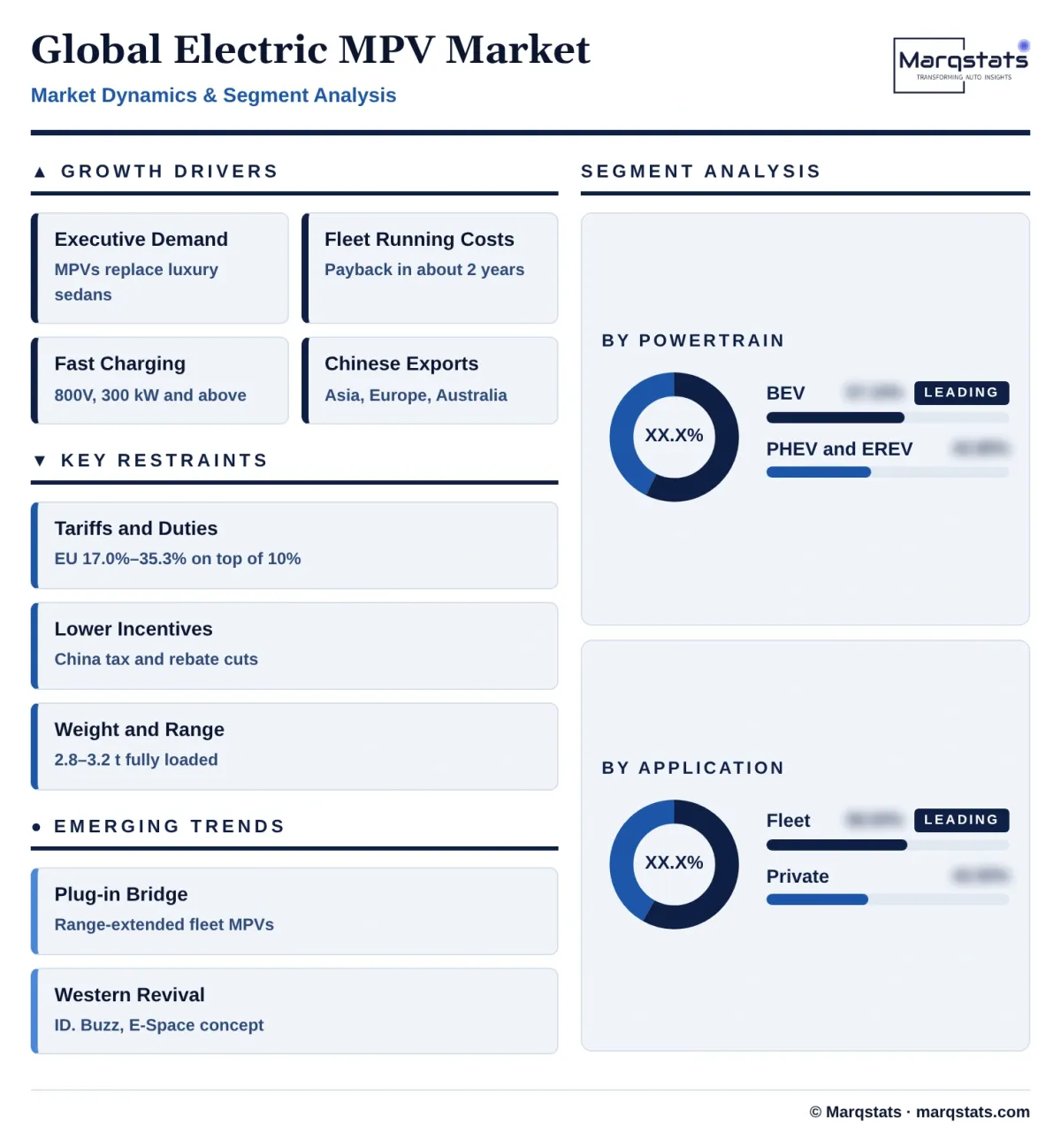
- Executive demand in Asia. In China and Southeast Asia, large MPVs with lounge seats in the second row have replaced luxury sedans as the preferred vehicle for business leaders and chauffeur services.
- Fleet running costs. Chauffeur, shuttle and airport fleets driving 150 to 350 km a day can recover the higher price of an electric MPV through lower energy and maintenance costs, typically within about two years.
- Fast charging. 800-volt platforms charging at 300 kW or more cut charging stops to 10 to 20 minutes, and BYD is taking its Flash Charging network, rated at up to 1,500 kW, to Indonesia, its first overseas market for the technology.
- Emissions rules. EU fleet CO2 targets under Regulation (EU) 2019/631 push carmakers to replace petrol and diesel MPVs with electric versions, and city low-emission zones restrict older vans and shuttles.
- Exports of Chinese models. Denza, Zeekr, XPeng, Voyah and Li Auto are taking executive MPVs to Southeast Asia, Australia, the Middle East, Europe and India, widening choice in markets long dominated by the Toyota Alphard and Vellfire.
- Longer battery and vehicle life. Commercial MPV platforms designed for high annual mileage, with durable lithium iron phosphate batteries and warranties of up to eight years, make electric models easier to finance and resell for fleet owners.
Key Restraints
Four constraints limit how fast electric MPVs spread beyond China.
- Tariffs and duties. EU countervailing duties of 17.0% to 35.3% on Chinese-built battery electric cars, high US tariffs, and Indian customs duty of 70% plus cess on imported cars above USD 40,000 raise the price of imported electric MPVs.
- Less generous Chinese incentives. China halved its purchase tax exemption from January 2026, and the export VAT rebate on new energy vehicles falls from 13% to 9% from April 2027, squeezing margins at home and abroad.
- High prices outside China. Western electric MPVs such as the Volkswagen ID. Buzz start above USD 60,000 in the United States, limiting family demand.
- Weight and range. Heavy, boxy MPVs lose range quickly at motorway speeds, requiring large and costly batteries.
Key Trends
Four shifts are changing how electric MPVs are designed, sold and used.
- Plug-in hybrids as a bridge. Extended-range and plug-in hybrid MPVs such as the Buick GL8 plug-in hybrid and the Denza D9 DM-i serve fleets in regions without enough fast charging.
- Living-room cabins. Zero-gravity seats, ceiling screens, refrigerators and multi-zone climate control turn the MPV into a mobile office and lounge.
- Local assembly. As tariffs rise and export rebates fall, Chinese brands are moving assembly closer to their export markets.
- A Western revival. Volkswagen's ID. Buzz and Renault's E-Space concept show European carmakers reconsidering a body style they largely abandoned for SUVs.
Strategic Implications
- For carmakers, dedicated platforms win. Flat-floor electric platforms with low step-in height and battery packs built into the structure package three rows of seats better than converted SUV platforms or adapted commercial vans.
- For Western incumbents, timing matters. Toyota, Honda and Stellantis must balance profitable petrol and hybrid minivans against the cost of electric models, but China shows that executive fleet demand can move to electric alternatives within three years.
- For fleet operators, charging access decides the powertrain. Battery electric MPVs suit operators with depot or fast charging; plug-in hybrids with 120 km or more of electric range suit long-distance and regional work.
- For suppliers, comfort and power electronics create value. Air suspension, adaptive dampers, active noise cancellation, cabin displays and silicon carbide inverters for 300 kW to 450 kW drive systems are growing content areas.
- For importers and dealers, tax rules shape the line-up. India's 5% GST on battery electric cars against much higher rates on plug-in hybrids, and EU duties that vary by carmaker, decide which versions are worth bringing in.
- For policymakers, MPV electrification cuts fleet emissions quickly. Because fleets drive several times the distance of private cars, switching chauffeur, shuttle and airport MPVs to electric power reduces emissions and local pollution per vehicle more than switching private cars, which is why city access rules and fleet incentives have a large effect on this market.
Market Segmentation
Battery electric MPVs account for 57.15% of 2025 value, USD 15,430.00 million and about 315,000 vehicles, rising to USD 41,600.00 million by 2030, a 21.94% CAGR, and 64.50% of the market. The Denza D9 EV, Zeekr 009, Li Mega, XPeng X9 and Volkswagen ID. Buzz lead, many on 800-volt platforms.
Plug-in hybrid and extended-range MPVs account for 42.85% of 2025 value, USD 11,570.00 million and about 260,000 vehicles, rising to USD 22,900.00 million by 2030, a 14.63% CAGR, while their share falls to 35.50%. The Buick GL8 plug-in hybrid, Denza D9 DM-i, Wey Gaoshan, Trumpchi models and Chrysler Pacifica Plug-in Hybrid lead this segment.
Large MPVs, generally more than 5.1 metres long with a wheelbase above 3.1 metres, account for 72.74% of 2025 value, USD 19,640.00 million and about 385,000 vehicles, and grow at 18.10% a year to USD 45,120.00 million, 69.95% of 2030 value. They include the Denza D9, Zeekr 009, Voyah Dreamer, Li Mega and Buick GL8 plug-in hybrid.
Compact and mid-size MPVs account for 27.26% of 2025 value, USD 7,360.00 million and about 190,000 vehicles, and grow faster, at 21.37% a year, to USD 19,380.00 million and 30.05% of the market by 2030, led by the Volkswagen ID. Buzz, Chrysler Pacifica Plug-in Hybrid and family MPVs from BYD, Maxus and GAC.
Corporate, chauffeur, airport transfer, hospitality and government fleets account for 58.00% of 2025 value, USD 15,660.00 million, rising to USD 35,350.00 million by 2030, a 17.68% CAGR, and 54.81% of the market.
Private family buyers account for 42.00% of 2025 value, USD 11,340.00 million, and grow faster, at 20.78% a year, to USD 29,150.00 million and 45.19% of the market by 2030, as fast charging spreads and more affordable family models launch.
By Geography
China
China is the largest market, with an estimated 77.04% of 2025 value, USD 20,800.00 million and about 460,000 vehicles, rising to USD 41,500.00 million by 2030, a 14.81% CAGR, while its share falls to 64.34%. Electrified models account for a large and rising share of China's roughly one million annual MPV sales. The Denza D9 has been China's best-selling MPV for consecutive years and passed 300,000 cumulative deliveries in November 2025, while the Wey Gaoshan, Voyah Dreamer, Buick GL8 plug-in hybrid and Trumpchi models compete closely; in November 2025 the Wey Gaoshan sold about 10,400 units, the first MPV that year to pass 10,000 in a month. The halving of the purchase tax exemption from January 2026 and intense price competition slow domestic growth.
Europe
Europe accounts for an estimated 11.48% of 2025 value, USD 3,100.00 million and about 55,000 vehicles, and grows at 29.29% a year to USD 11,200.00 million and 17.36% of the market by 2030. The Volkswagen ID. Buzz leads, with Mercedes-Benz EQV and electric passenger versions of Stellantis and Renault vans. Chinese brands including Zeekr, XPeng and Dongfeng Forthing are entering, though EU duties on Chinese-built battery electric cars raise prices. Renault's E-Space concept, shown at the 2026 Paris Motor Show, signals renewed European interest in the MPV.
North America
North America accounts for an estimated 7.59% of 2025 value, USD 2,050.00 million and about 38,000 vehicles, and grows at 29.27% a year to USD 7,400.00 million and 11.47% of the market by 2030. The Chrysler Pacifica Plug-in Hybrid, built in Windsor, Ontario, and the Volkswagen ID. Buzz, which sold 7,300 units in the United States in 2025, are the main electric minivans. Minivans are classed as light trucks for emissions and fuel economy rules, which reduces pressure on carmakers to electrify them, and tariffs keep Chinese models out.
Rest of World
Southeast Asia, Japan, Australia, India and the Middle East account for an estimated 3.89% of 2025 value, USD 1,050.00 million and about 22,000 vehicles, and grow fastest, at 33.18% a year, to USD 4,400.00 million and 6.82% of the market by 2030. XPeng says the X9 is the best-selling premium battery electric MPV in Malaysia, Thailand and Indonesia, BYD launched the Denza D9 with Flash Charging in Indonesia in October 2026, the Zeekr 009 is on sale in Australia from AUD 115,900, and BYD plans to bring the Denza D9 to India as an imported vehicle.
How Competition Is Evolving
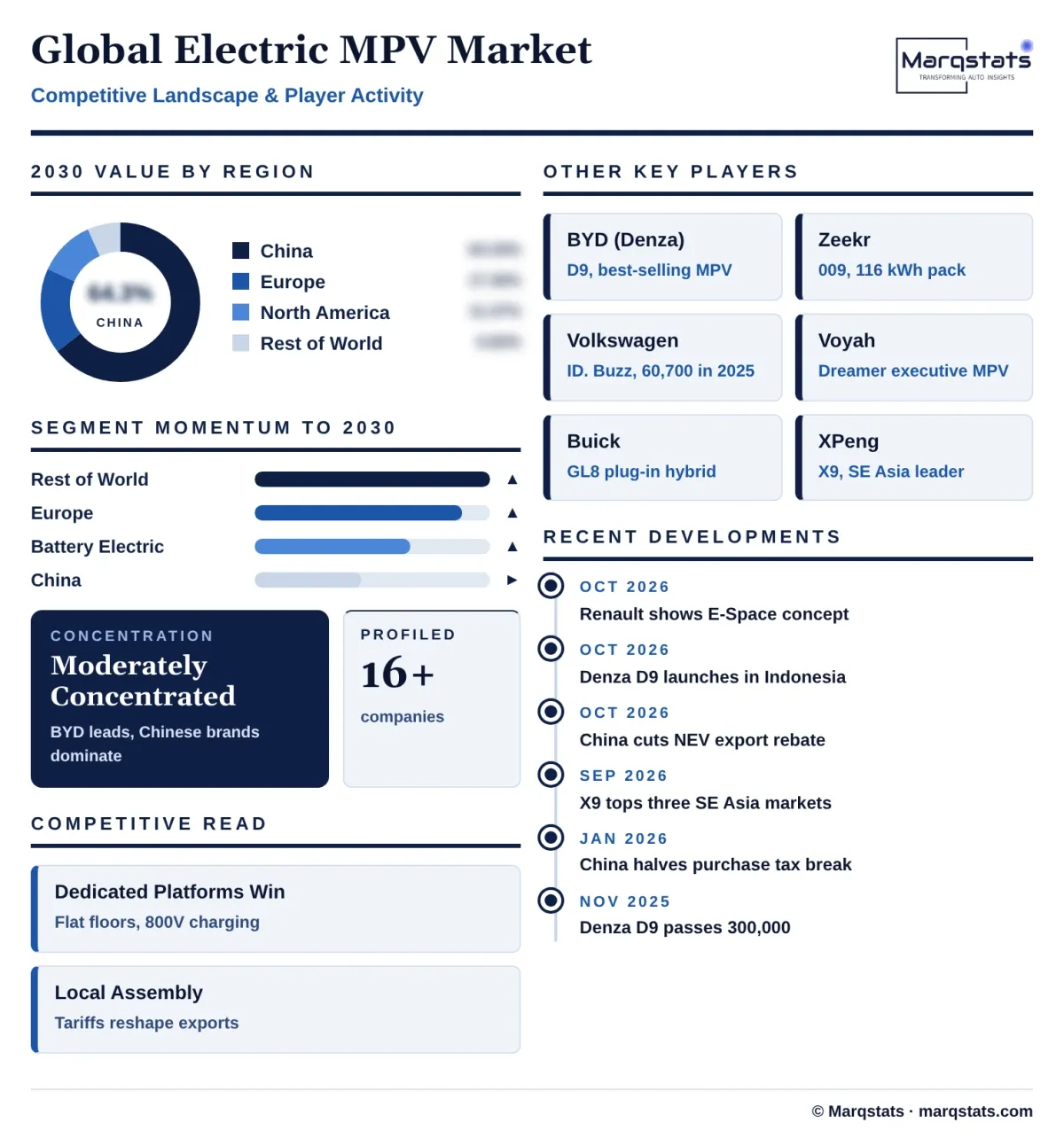
The electric MPV market is moderately concentrated. Marqstats estimates BYD, through Denza and BYD-brand MPVs, holds about a quarter of global volume, followed by Geely through Zeekr and LEVC, Dongfeng's Voyah, SAIC-GM's Buick, GAC, Great Wall's Wey brand, Volkswagen, Stellantis, XPeng and Li Auto.
Two strategies compete. Chinese brands build dedicated electric MPVs on their own platforms, with large batteries, 800-volt charging and luxury cabins. Established Western carmakers mostly adapt van platforms or add plug-in hybrid powertrains to existing minivans, which costs less but can compromise refinement and space.
Legacy nameplates can hold their ground. SAIC-GM's addition of a plug-in hybrid powertrain to the Buick GL8 has kept the nameplate among China's best-selling MPVs, and Toyota's Sienna and Granvia remain strong sellers with full hybrid powertrains that fall outside the market scope.
Competition will be decided by price, charging speed and access to export markets. Brands that combine low battery costs, fast charging, luxury cabins and local assembly or tariff-free access to markets abroad will capture the largest share of growth outside China.
New entrants keep arriving. Huawei-linked brands, including the Maextro range built with JAC, Great Wall's Wey Gaoshan and new models from Li Auto, XPeng and Zeekr have added executive MPVs in China, while Volkswagen, Mercedes-Benz, Stellantis and Renault defend Europe with van-based and dedicated models. In North America, the Chrysler Pacifica Plug-in Hybrid remains the only plug-in minivan from a domestic brand, alongside the Volkswagen ID. Buzz.
Companies Covered
Companies covered in the report include:
Recent Market Activity
Table of Contents
Coverage & Segmentation
The study covers the global electric MPV market, with 2025 as the base year, 2021 – 2025 as the historical period and 2026 – 2030 as the forecast period. Values are in US dollars at transaction prices, and volumes are annual new vehicle sales. The market covers factory-built passenger MPVs and minivans with battery electric, plug-in hybrid or extended-range powertrains, segmented by powertrain, vehicle size, application and region.
Cargo-only panel vans registered as goods vehicles, small leisure activity vehicles under about 4.4 metres, full hybrids without a charging socket, mild hybrids, conventional petrol and diesel MPVs and minibuses are excluded. Size, application and regional value splits are Marqstats estimates built on registration data, carmaker disclosures and price benchmarks.