Market Snapshot
Key Takeaways
Market Overview & Analysis
Report Summary
Malaysia's premium electric vehicle segment is where the country's electrification story is least about price and most about brand. Volume is small at an estimated 8,600 units in 2025, the transaction values are the highest in any Malaysian panel at MYR 420,000, and the competitive movement is faster than in the mass market because premium buyers are the least constrained by charging availability and the most willing to switch marque.
The measure is the retail value of new battery electric and plug-in hybrid passenger vehicles sold in Malaysia above MYR 250,000, covering European, Chinese, American and other premium and luxury marques, together with the local assembly and import policy shaping the segment. It is a price band cut across two powertrains and therefore intersects the national electrified series rather than sitting alongside it. Full hybrids and mild hybrids are excluded, as are electrified models below the threshold.
The analysis is written for premium manufacturers deciding whether local assembly is now a requirement rather than an option, distributors assessing a segment where new marques took share within two years of entry, charging operators whose premium-brand partnerships carry disproportionate network value, and policymakers who set a CIF threshold that reshaped the segment's supply within a single quarter.
Malaysia Premium and Luxury Electric Vehicle Market Size and Forecast
Premium and luxury electrified retail value is estimated at USD 860.00 million in 2025, USD 1,180.00 million in 2026 and USD 2,834.29 million by 2030, an increase of USD 1,974.29 million against 23,400 additional units. Volume moves from 8,600 to 32,000 vehicles, with average transaction value falling from MYR 420,000 to MYR 372,000, or USD 100,000 to USD 88,571 at a constant MYR 4.20 per USD.
Two growth rates apply and they are close. The five-year value rate connecting 2025 and 2030 is 26.94%; the four-year rate connecting 2026 and 2030 is 24.49%. The 2.45-point gap is narrow because 2026 carries a step rather than a spike: the import rule and the arrival of locally assembled premium models lift the year without creating the kind of single-model discontinuity seen in the mass-market plug-in hybrid segment.
Value compounds 3.12 points behind volume at 26.94% against 30.06%, and the mechanism is the segment broadening downward within its own band rather than any brand discounting. The MYR 250,000 to 400,000 tier grows from an estimated 5,600 units to 21,500 and holds the majority of volume throughout, while the luxury tier above MYR 600,000 falls from an estimated 9.30% of units to 7.81%.
The segment sits inside the national electrified series rather than beside it. Its 8,600 units in 2025 are 27.88% of the 30,848 battery electric and plug-in hybrid vehicles sold in that year, and because it cuts across both powertrains it overlaps the battery electric and plug-in hybrid panels in this catalogue simultaneously. It is never additive to either.
A sizing range is published rather than a point. The 2030 figure sits within a band of USD 2,180.00 million to USD 3,540.00 million against 26,000 to 39,000 units, corresponding to rates of 20.42% and 32.69%, and the spread turns on how quickly the announced Chinese premium entrants convert dealer networks into volume.
The MYR 250,000 Threshold Excludes the Best-Known Electric Brand
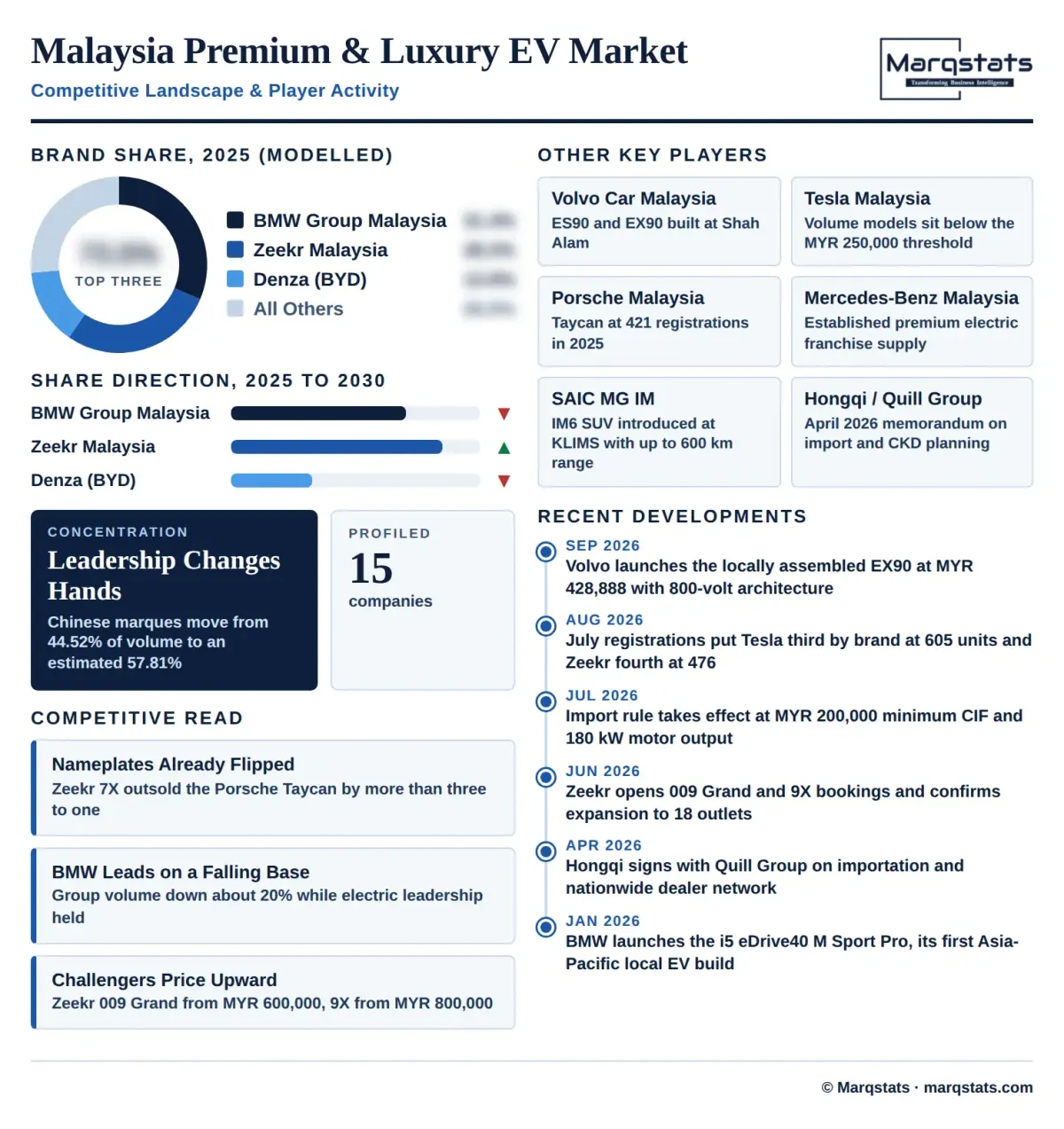
Tesla is Malaysia's most visible electric brand and mostly falls outside this segment. The Model Y took 4,401 registrations in 2025 and the Model 3 2,880, making them the country's most-registered imported electric cars, and both are priced below MYR 250,000. Tesla's 2,567 registrations across January to July 2026, running 197 units in May, 935 in June and 605 in July, are overwhelmingly those two models.
Drawing the line at MYR 250,000 is a choice and it is the choice that makes the segment analytically useful. Above the threshold sit vehicles bought on marque, specification and dealer relationship; below it sit vehicles bought on running cost against an internal combustion alternative. A segment defined to include the Model 3 would measure two different purchase decisions and would be dominated by the cheaper one.
The models that do qualify make the point. The Volvo ES90 starts at MYR 339,888 and the locally assembled EX90 at MYR 428,888, around MYR 14,000 below the previous imported version, with an 800-volt architecture, 350 kW direct current charging and up to 617 km of range. The BMW i5 eDrive40 M Sport Pro sits at MYR 368,800. The Zeekr 009 Grand opens from MYR 600,000 and the Zeekr 9X from MYR 800,000.
Chinese Premium Nameplates Already Outsell European Ones
The 2025 registration table is the clearest statement available. The Zeekr 7X took 1,510 units and the Denza D9 1,200, against 421 for the Porsche Taycan, which means two marques that entered Malaysia recently outsold an established European electric flagship by three to one and by nearly three to one respectively.
The monthly data since confirms it rather than reversing it. Zeekr registered 413 units in May 2026, 459 in June and 476 in July, placing it fourth by brand in July, while the same month's premium comparison shows BMW at 65, Volvo at 41, Denza at 34 and Porsche at 22 for May. Zeekr Malaysia is expanding from eight outlets to 18 by the end of 2026 with 12 service centres and 20 ultra-fast charging stations of up to 480 kW within three years.
The pipeline is wider than Zeekr. SAIC introduced its premium IM brand at KLIMS 2026 as MG IM, with the imported IM6 electric sport utility vehicle offering up to 600 km of range scheduled for the third quarter of 2026. FAW's Hongqi signed a memorandum with Quill Group in April 2026 covering importation, completely knocked down distribution planning and a nationwide dealer network. Changan was reported to be planning a multi-brand entry spanning Changan, Nevo, Deepal and Avatr with completely knocked down assembly targeted.
BMW Still Leads and Is Doing It on a Falling Base
BMW Group Malaysia delivered more than 10,800 units across BMW, MINI and Motorrad in 2025, about 20% below 2024, with BMW at more than 7,700 and MINI at more than 1,500, the latter up 8.7%. More than 2,700 of those were fully electric, around 25% of group sales, and the group retained premium electric leadership for a sixth consecutive year.
A 20% decline in total volume alongside retained electric leadership describes a brand rotating its mix rather than losing its position. The group also operates the segment's deepest charging proposition, with more than 2,000 charging points and more than 100 dealer chargers at BMW i and MINI locations as of January 2026, against a national total of 6,416 public chargers of which 2,143 are direct current.
Its manufacturing answer came first. The i5 eDrive40 M Sport Pro launched in January 2026 at MYR 368,800 as BMW Group's first locally assembled electric vehicle in Asia-Pacific, with tax exemption running through 31 December 2027. It is built at Inokom's Kulim plant, which produced more than 31,800 units in 2025 across BMW, MINI, Porsche, Mazda, Hyundai and Chery, up from 20,500 in 2021.
The Import Rule Rewrote the Segment's Supply in One Quarter
From 1 July 2026, fully imported electric vehicles entering Malaysia under franchise approved permits require a minimum CIF value of MYR 200,000 and a minimum motor output of 180 kW, raised from a 200 kW proposal. Research commentary expects the rule to raise imported retail prices and to favour brands with local assembly, which is precisely what the segment's supply decisions show.
Locally assembled premium electric vehicles move from an estimated 15.12% of segment volume in 2025 to an estimated 68.75% by 2030. The BMW i5, the Volvo ES90 and the Volvo EX90 are already assembled domestically, Zeekr plans 7X assembly at Tanjung Malim from 2027 at the earliest, and Hongqi and Changan have both signalled completely knocked down intent. The Volvo EX90's local build cut about MYR 14,000 from its price.
A second condition applies further upstream and is easily missed. Electric vehicle assembly projects approved after 1 September 2025 carry a minimum local price of MYR 100,000, must export at least 80% of output and are capped at 20% domestic sales. A premium brand choosing local assembly now is choosing an export platform with a domestic allocation attached, which is a different investment case from the one the earlier entrants faced.
Market Dynamics
Key Drivers
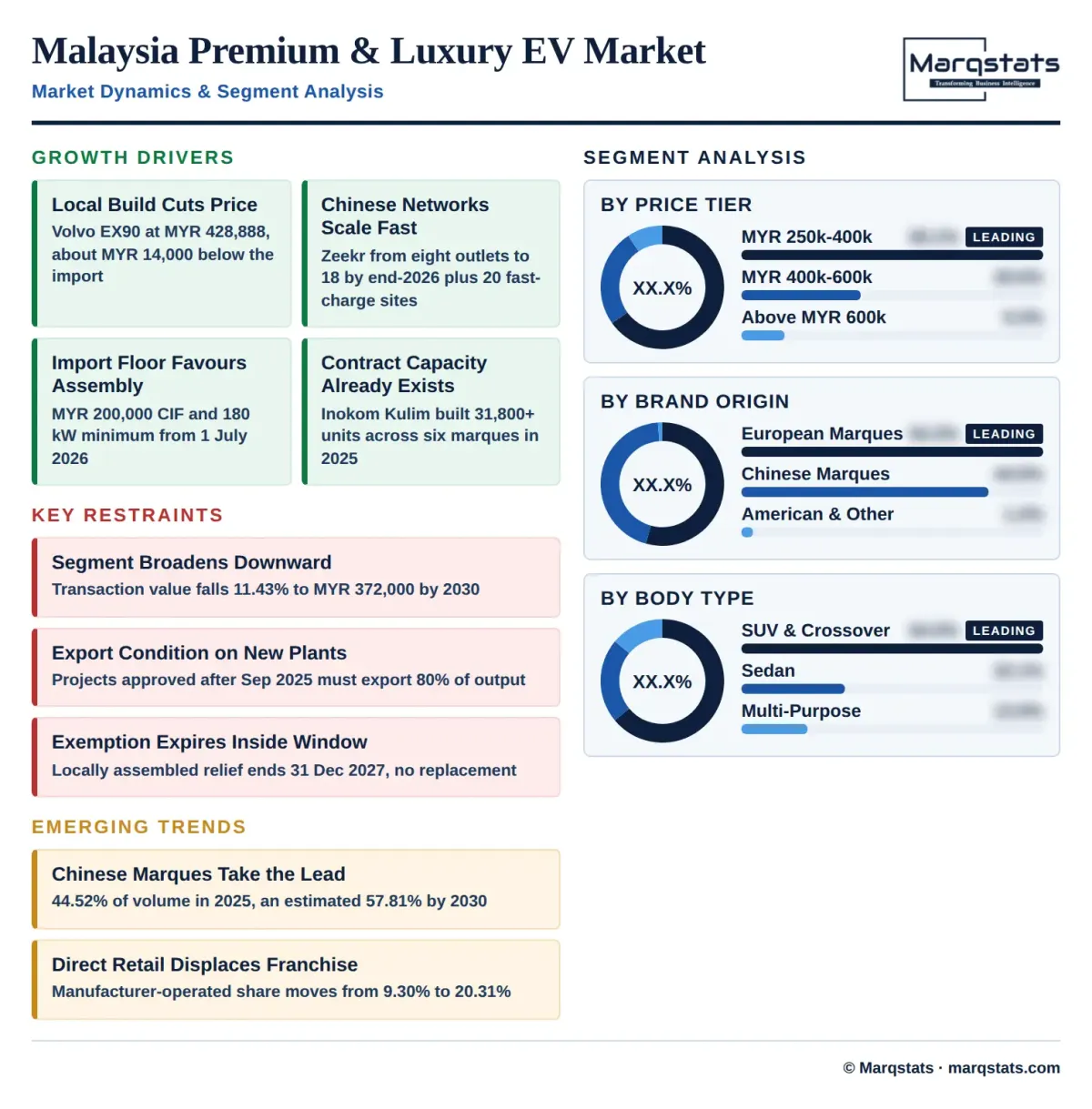
- Local assembly economics improved sharply, with the Volvo EX90 at MYR 428,888 around MYR 14,000 below its imported predecessor and tax exemption on locally assembled models running to 31 December 2027.
- Chinese premium entrants are building networks fast, with Zeekr moving from eight outlets to 18 by end-2026 alongside 12 service centres and 20 ultra-fast stations of up to 480 kW within three years.
- The 1 July 2026 import rule, setting a MYR 200,000 minimum CIF value and 180 kW minimum motor output, pushes the segment toward domestic assembly and away from imported supply.
- Premium buyers are the least charging-constrained cohort, and BMW Group alone operates more than 2,000 charging points including over 100 dealer chargers against a national total of 6,416.
- Contract assembly capacity is available without greenfield investment, with Inokom's Kulim plant producing more than 31,800 units in 2025 across six marques, up from 20,500 in 2021.
Key Restraints
- Average transaction value falls 11.43% from MYR 420,000 to MYR 372,000 as the segment broadens downward within its own band, so value compounds 3.12 points behind volume.
- Assembly projects approved after 1 September 2025 must export at least 80% of output with domestic sales capped at 20%, which changes the investment case for any brand entering local assembly now.
- Established premium volume is contracting, with BMW Group Malaysia down about 20% in 2025 to more than 10,800 units across all brands.
- The locally assembled tax exemption expires on 31 December 2027, inside the window, with no published replacement, and the segment's local share is forecast to rise to 68.75% by 2030.
Key Trends
- Chinese marques overtake European ones on volume within the window, moving from 44.52% to an estimated 57.81% while European brands fall from 54.31% to an estimated 37.50%.
- Direct manufacturer operation grows from an estimated 9.30% of segment volume to 20.31%, as Tesla and Zeekr operate their own retail and charging networks rather than appointing distributors.
- Multi-purpose vehicles are becoming a premium electric body type, with the Denza D9 at 1,200 registrations and the Zeekr 009 at 914 in 2025 and the 009 Grand opening from MYR 600,000.
- Charging is becoming a brand proposition rather than a utility, with Zeekr committing to 20 Zeekr Power stations of up to 480 kW and BMW operating more than 2,000 points.
Market Segmentation
The premium tier accounted for an estimated 5,600 units in 2025, 65.12% of segment volume and an estimated USD 426.56 million or 49.60% of value, growing to an estimated 21,500 units or 67.19% by 2030. The Volvo ES90 from MYR 339,888 and the BMW i5 eDrive40 M Sport Pro at MYR 368,800 are the tier's locally assembled anchors.
The upper premium tier accounted for an estimated 2,200 units in 2025, 25.58% of volume and an estimated USD 251.12 million or 29.20% of value, reaching an estimated 8,000 units or 25.00% by 2030. The locally assembled Volvo EX90 at MYR 428,888, with 800-volt architecture, 350 kW charging and up to 617 km of range, defines the tier.
The luxury tier accounted for an estimated 800 units in 2025, 9.30% of volume and an estimated USD 182.32 million or 21.20% of value, the highest value-to-volume ratio in the segment, reaching an estimated 2,500 units or 7.81% by 2030. The Zeekr 009 Grand from MYR 600,000 and the Zeekr 9X from MYR 800,000, at up to 1,030 kW and 1,250 km of combined range, set the tier's ceiling.
European marques accounted for an estimated 4,671 units in 2025, 54.31% of segment volume, led by BMW Group Malaysia's more than 2,700 fully electric deliveries alongside Volvo, Mercedes-Benz and Porsche, the last at 421 Taycan registrations. The group falls to an estimated 12,000 units or 37.50% by 2030, holding strong absolute growth while losing leadership.
Chinese marques accounted for an estimated 3,829 units in 2025, 44.52% of segment volume, on the Zeekr 7X at 1,510 registrations, the Zeekr 009 at 914 and the Denza D9 at 1,200. The group reaches an estimated 18,500 units or 57.81% by 2030 and takes segment leadership inside the window, with MG IM, Hongqi and Changan's Avatr broadening the offer.
American and other marques accounted for an estimated 100 units in 2025, 1.16% of segment volume, reaching an estimated 1,500 units or 4.69% by 2030. The group is small because Tesla's volume models, the Model Y at 4,401 registrations and the Model 3 at 2,880, both sit below this segment's MYR 250,000 threshold.
Battery electric models accounted for an estimated 7,100 units in 2025, 82.56% of segment volume, reaching an estimated 24,500 units or 76.56% by 2030. The BMW i5, Volvo ES90 and EX90, Zeekr 7X and 009 and Porsche Taycan are all in this powertrain, as is the MG IM6 at up to 600 km of range.
Plug-in hybrid models accounted for an estimated 1,500 units in 2025, 17.44% of segment volume, reaching an estimated 7,500 units or 23.44% by 2030, gaining share throughout. The Denza D9 at 1,200 registrations leads, with the Great Wall Motor WEY G9 at MYR 269,800 and the Zeekr 9X from MYR 800,000 above it.
Locally assembled premium electrified vehicles accounted for an estimated 1,300 units in 2025, 15.12% of segment volume, reaching an estimated 22,000 units or 68.75% by 2030. Inokom's Kulim plant produced more than 31,800 units in 2025 across six marques, up from 20,500 in 2021, and Volvo assembles the ES90 and EX90 at Shah Alam.
Fully imported premium electrified vehicles accounted for an estimated 7,300 units in 2025, 84.88% of segment volume, falling to an estimated 10,000 units or 31.25% by 2030. The channel is constrained by the 1 July 2026 rule requiring a MYR 200,000 minimum CIF value and 180 kW minimum motor output, which the segment's models clear but at a rising cost.
Sport utility vehicles and crossovers accounted for an estimated 5,500 units in 2025, 63.95% of segment volume, reaching an estimated 20,500 units or 64.06% by 2030. The Volvo EX90, Zeekr 7X, MG IM6 and Zeekr 9X sit here, and the body type holds its share almost exactly across the window.
Sedans accounted for an estimated 1,900 units in 2025, 22.09% of segment volume, reaching an estimated 6,500 units or 20.31% by 2030. The BMW i5 eDrive40 M Sport Pro at MYR 368,800, the Volvo ES90 from MYR 339,888 and the Porsche Taycan at 421 registrations define the body type.
Multi-purpose vehicles accounted for an estimated 1,200 units in 2025, 13.95% of segment volume, reaching an estimated 5,000 units or 15.63% by 2030, the only body type gaining share. The Denza D9 at 1,200 registrations and the Zeekr 009 at 914 established it, and the 009 Grand from MYR 600,000 extends it upward.
Franchised distributor networks carried an estimated 7,800 units in 2025, 90.70% of segment volume, falling to an estimated 25,500 units or 79.69% by 2030. Sime Darby's Inokom operation, Bermaz Auto and Quill Group, the last appointed by Hongqi in April 2026, are the established route to market.
Direct manufacturer operation carried an estimated 800 units in 2025, 9.30% of segment volume, reaching an estimated 6,500 units or 20.31% by 2030. Tesla and Zeekr both operate their own retail and charging networks, with Zeekr moving from eight outlets to 18 by the end of 2026 and committing to 20 Zeekr Power stations.
By Geography
Klang Valley
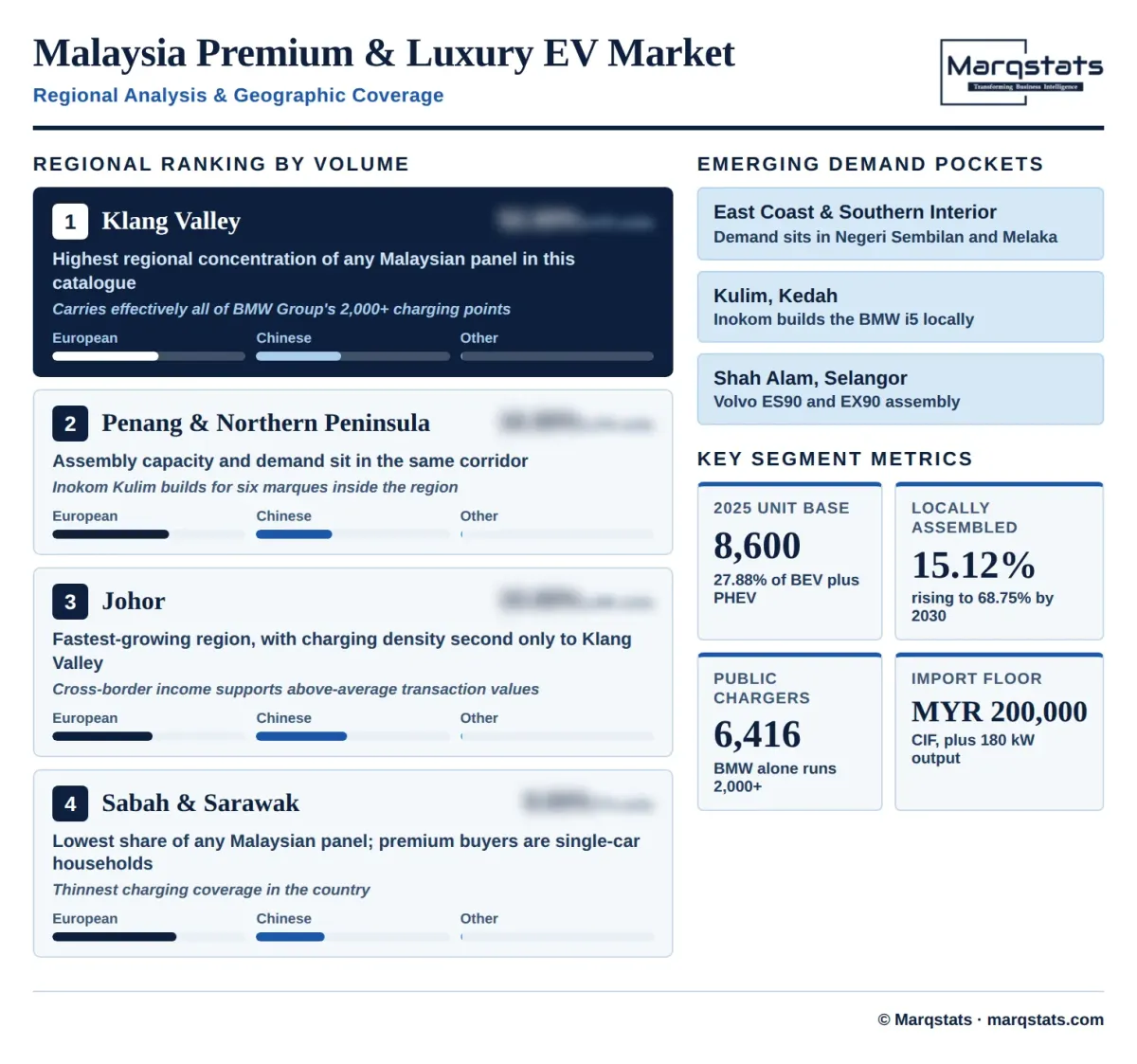
Selangor and Kuala Lumpur account for an estimated 4,472 premium electrified registrations in 2025, 52.00% of the segment, the highest regional concentration in any Malaysian panel in this catalogue. The region carries most of the country's 6,416 public chargers and effectively all of BMW Group's more than 2,000 charging points, and premium electric buying is more concentrated here than mass-market electric buying.
Penang and the Northern Peninsula
Penang, Kedah, Perlis and Perak account for an estimated 1,376 registrations, 16.00% of the segment. Inokom's Kulim plant sits inside the region, producing more than 31,800 units in 2025 across six marques, which places the segment's principal assembly capacity and a meaningful share of its demand in the same corridor.
Johor
Johor accounts for an estimated 1,290 registrations, 15.00% of the segment, and is the fastest-growing region. Cross-border income supports transaction values above the national average, and premium electric adoption there benefits from charging density second only to the Klang Valley.
Sabah and Sarawak
East Malaysia accounts for an estimated 774 registrations, 9.00% of the segment, the lowest share of any Malaysian panel in this catalogue. Charging coverage within the national total of 6,416 public chargers is thinnest there, and premium battery electric buyers are more exposed to that than mass-market buyers because their vehicles are more often the household's only car.
East Coast and Southern Interior
Pahang, Terengganu, Kelantan, Negeri Sembilan and Melaka account for an estimated 688 registrations, 8.00% of the segment. The region's premium demand is concentrated in Negeri Sembilan and Melaka rather than on the east coast, and its share rises only slowly as dealer networks that today total fewer than 20 premium electric outlets nationally extend beyond the main corridors.
How Competition Is Evolving
Malaysia's premium electric segment has an incumbent leader and a challenger cohort that is already winning on individual nameplates. BMW Group Malaysia holds the leadership position, with more than 2,700 fully electric deliveries in 2025 at around 25% of its own mix and a sixth consecutive year as premium electric leader, supported by more than 2,000 charging points and a locally assembled i5 at MYR 368,800.
The challenge is not coming from other European marques. The Zeekr 7X outsold the Porsche Taycan by more than three to one in 2025 at 1,510 registrations against 421, the Denza D9 took 1,200, and Zeekr reached fourth place by brand in July 2026 on 476 registrations while investing in 18 outlets, 12 service centres and 20 ultra-fast charging stations. Chinese marques move from 44.52% of segment volume to an estimated 57.81% inside the window.
What separates this segment from Malaysia's mass market is that the challengers are competing on network and specification rather than on price. Zeekr's 009 Grand opens from MYR 600,000 and the 9X from MYR 800,000, well above the European volume models, and the brands entering behind them, MG IM, Hongqi through Quill Group and Changan's Avatr, are positioning above rather than below the incumbents. A premium buyer switching marque here is not trading down.
Companies Covered
The report profiles 15+ companies with full strategy and financials analysis, including:
Recent Market Activity
Table of Contents
Coverage & Segmentation
The analysis measures the retail value of new battery electric and plug-in hybrid passenger vehicles sold in Malaysia above MYR 250,000 from 2021 to 2030, with 2025 as the base year and 2026 to 2030 as the forecast period, covering European, Chinese, American and other premium and luxury marques, local assembly and the import policy framework shaping supply. The panel is a price band cut across two powertrains and therefore intersects the national electrified series rather than sitting beside it: its 8,600 units in 2025 are 27.88% of the 30,848 battery electric and plug-in hybrid vehicles sold, and it is never additive to either powertrain panel. Full hybrids and mild hybrids are excluded, as are electrified models below the threshold. Values are expressed in USD at a disclosed constant MYR 4.20 per USD.
Coverage spans three price tiers, three brand origin groups, two powertrains, two assembly origins, three body types and two retail models, with five regional clusters analysed on registration concentration and charging density. Premium and luxury electrified unit volume is carried as the unit series at 8,600 in 2025 and average transaction value as a derived series at MYR 420,000, and both are published alongside the value panel because a segment broadening downward within its own band cannot be represented by either alone. Fifteen entities are profiled across manufacturers, the contract assembler carrying most premium local production, and the distributor groups holding the franchises.