Market Snapshot
Key Takeaways
Market Overview & Analysis
Report Summary
This analysis sizes China's plug-in hybrid electric vehicle market on the statutory basis used by the Ministry of Industry and Information Technology's New Energy Vehicle administrative catalog, which classifies Extended-Range Electric Vehicles (EREVs) inside the PHEV regulatory envelope alongside Dedicated Hybrid Transmission (DHT) parallel and series-parallel architectures. The market is measured as factory wholesale shipments reported by the China Association of Automobile Manufacturers (CAAM), the primary published series used here; the China Passenger Car Association (CPCA) publishes a narrower domestic passenger retail series that separates DHT PHEVs from EREVs, and the two series diverge by 1,265,000 units in 2025 for reasons reconciled below. Conventional hybrids without external plug-in capability are excluded, as China classifies them as energy-saving internal combustion vehicles under Corporate Average Fuel Consumption credit accounting rather than as New Energy Vehicles.
China's PHEV wholesale volume expanded from 251,000 units in 2020 to 5,835,000 units in 2025, a period in which PHEV share of NEV wholesale rose from 18.36% to a 2024 peak of 40.00% before easing to 35.39% in 2025 as BEV wholesale growth reaccelerated. The market's structural inflection arrived in December 2025: monthly PHEV wholesale fell 3.7% year-on-year to 599,000 units, the category's first recorded year-on-year decline in over five years, even as full-year PHEV exports grew 230% year-on-year to 969,000 units. Demand concentrates in the RMB 100,000–200,000 price bracket (45.60% of passenger NEV volume) and in SUV body styles (over 58% of PHEV/EREV sales), purchased overwhelmingly by private buyers responding to total-cost-of-ownership parity with battery-electric vehicles rather than by fleet operators.
The 2030 forecast of 8,250,000 wholesale units and USD 160.88 billion rests on the scheduled continuation of Announcement No. 39 of 2023's 5% purchase tax rate through 2027 before the standard 10% rate resumes in 2028, on export volumes stabilizing between 2.0 and 2.3 million units annually as Southeast Asian, Latin American and Central Asian markets absorb incremental output, and on domestic retail penetration plateauing at 25–28% of passenger registrations as lower-tier-city adoption matures. The binding constraint on the upside case is whether central fiscal authorities extend the 5% tax cap past 2027; the binding constraint on the downside case is whether additional Tier-1 cities beyond Shanghai withdraw green-plate privileges for non-battery-electric vehicles.
Market Dynamics
Key Drivers
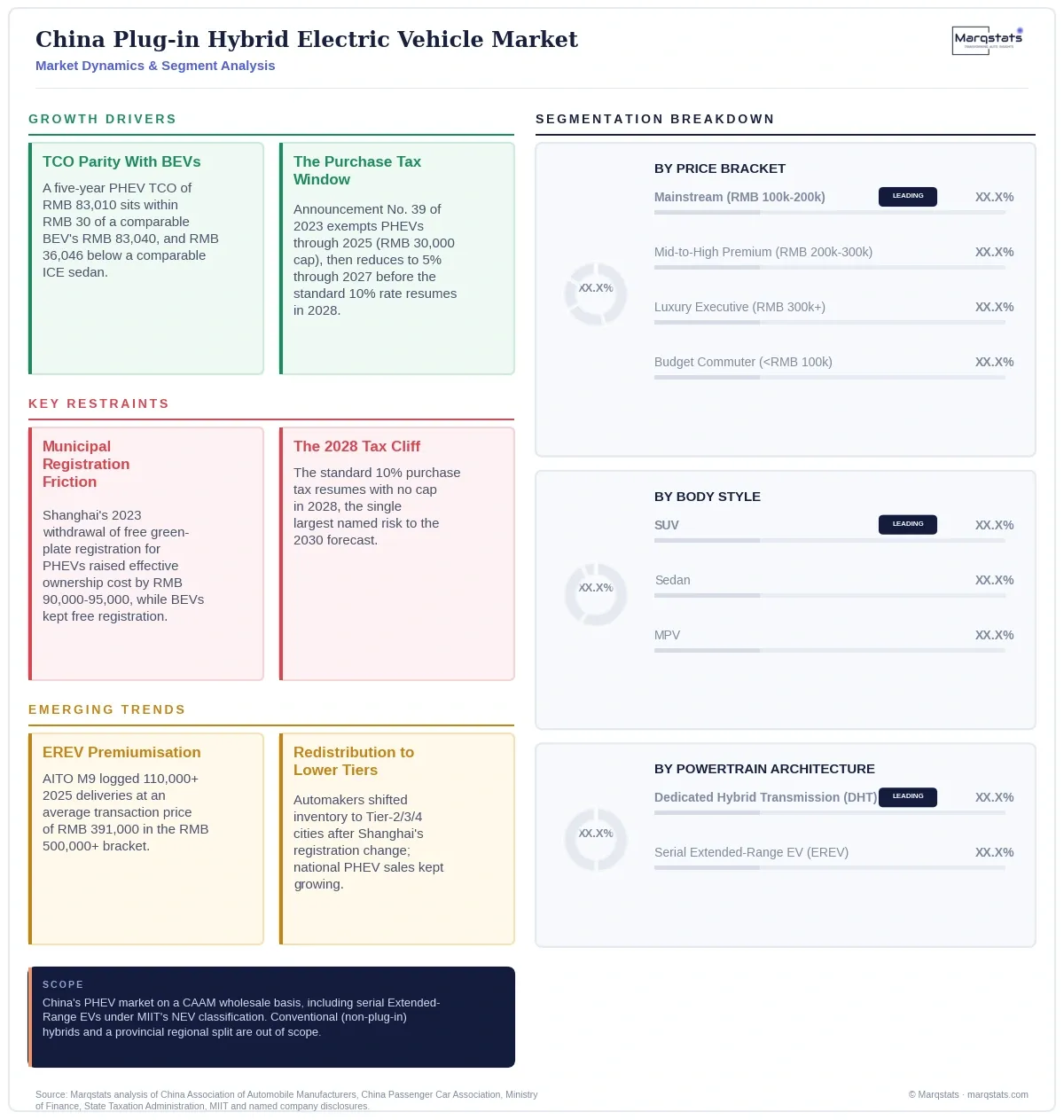
- Total cost of ownership parity with battery-electric vehicles, not sticker-price competition with internal-combustion cars alone, is now the primary purchase driver. A five-year, 100,000 km lifecycle model built on the BYD Qin Plus DM-i shows a net PHEV TCO of RMB 83,010 against RMB 83,040 for a comparable BEV and RMB 119,056 for a comparable ICE sedan — a RMB 30 gap to the BEV and a RMB 36,046 advantage over the ICE alternative, achieved without public fast-charging dependency.
- Announcement No. 39 of 2023 exempts PHEVs from vehicle purchase tax through 2025, capped at RMB 30,000 per vehicle, jointly issued by the Ministry of Finance, the State Taxation Administration and the Ministry of Industry and Information Technology in June 2023. The exemption reduces to a 5% rate (RMB 15,000 cap) for 2026–2027 before the standard 10% rate resumes with no cap in 2028, making the current window the most favorable purchase-tax environment PHEVs will see under the published schedule.
- Falling lithium iron phosphate battery cell costs, below RMB 320/kWh by early 2024, enabled BYD's shift from 'Oil and Electricity at Equal Price' (2022) to 'Electricity Lower Than Oil' (early 2024), commercially launched in February 2024 with the Qin Plus DM-i and Destroyer 05 Glory Editions at RMB 79,800 — pricing PHEVs below comparable joint-venture internal-combustion models for the first time and triggering an industry-wide repricing.
- Export markets absorbed the bulk of 2025's incremental PHEV output, with shipments growing 230% year-on-year to 969,000 units against roughly 8–9% domestic retail growth, as overseas tariff structures shifted to favor plug-in hybrid shipments over pure battery-electric exports. The export CAGR of 18.35% through 2030 is more than triple the domestic retail CAGR of 5.06%, making export policy the primary forward growth lever in the sizing chain.
- The National Development and Reform Commission's ultra-long-term special treasury bond program funded scrappage subsidies of RMB 20,000 for consumers replacing older vehicles with qualifying NEVs, including PHEVs, in 2024 and 2025, against RMB 15,000 for sub-2.0-litre internal-combustion replacements; from March 2026 the program shifted to a price-indexed 8% of transaction value, capped at RMB 15,000, aligning the trade-in incentive with the purchase-tax reduction schedule.
Key Restraints
- Municipal registration policy is fragmenting the effective cost of PHEV ownership within China. Shanghai's withdrawal of complimentary green-plate registration for PHEVs and EREVs on 1 January 2023, while retaining it for battery-electric vehicles, raised the effective acquisition cost of a Shanghai-registered PHEV by an auction-clearing RMB 90,000–95,000, a cost battery-electric buyers in the same city do not bear.
- The scheduled restoration of the standard 10% purchase tax in 2028, with no exemption cap, removes the single largest fiscal advantage PHEVs currently hold over internal-combustion vehicles. Under the report's downside scenario, this restoration alone — combined with a distance-based road-maintenance levy under consideration for New Energy Vehicles — could reduce 2030 wholesale volume to 6.50 million units, 1.75 million units below the base case.
- December 2025 marked the first year-on-year monthly PHEV wholesale decline in over five years, at negative 3.7%, while BEV wholesale grew 13.8% in the same month — evidence that battery-electric vehicles are beginning to substitute for PHEV demand in China's own domestic market as fast-charging infrastructure deployment continues, rather than PHEVs and BEVs simply growing in parallel.
- Li Auto Inc.'s full-year deliveries fell 18.81% in 2025, from 500,508 to 406,343 units, illustrating that scale alone does not protect an established EREV manufacturer from a well-capitalized rival entering the same price bracket — Seres Group's Huawei-backed AITO expanded directly into Li Auto's RMB 300,000–400,000 segment over the same period, compressing Li Auto's gross margin to 18.7% in 2025.
Key Trends
- Serial Extended-Range architecture is gaining ground on Dedicated Hybrid Transmission platforms in the premium bracket, not on cost alone. Seres Group's AITO M9 recorded over 110,000 deliveries in 2025 in the RMB 500,000-plus segment at an average transaction price of RMB 391,000, evidence that EREV's lower mechanical complexity is being monetized as a premium software-and-cockpit platform rather than purely a cost-reduction architecture.
- Manufacturers are converting municipal registration friction into geographic redistribution rather than absorbing it as lost demand. Following Shanghai's 2023 green-plate withdrawal, automakers redirected inventory toward Tier-2, Tier-3 and Tier-4 cities with broader residential charging access, and national PHEV sales continued growing through 2024 despite the Shanghai-specific decline.
- Capital markets are validating the EREV-plus-software business model directly, not just the underlying vehicle economics. Seres Group's November 2025 dual-listing on the Hong Kong Stock Exchange raised HK$170 billion in gross proceeds, oversubscribed 133 times, with roughly 70% of proceeds earmarked for R&D — the largest IPO by a Chinese automaker and the largest global automaker IPO of 2025.
- Hybrid battery technology is converging toward BEV-grade specifications rather than remaining a lesser-capacity category. CATL's October 2024 Freevoy Super Hybrid Battery delivers pure-electric ranges exceeding 400 kilometres with 4C fast-charging, closing much of the range gap that previously separated PHEVs from dedicated battery-electric vehicles.
- Thermal efficiency competition among Dedicated Hybrid Transmission engines has become a publicly disclosed specification war. BYD's DM 5.0, launched May 2024, achieves 46.06% peak engine thermal efficiency via a 16:1 compression ratio; Seres Power's range extender separately achieves 44.8% thermal efficiency and 3.63 kWh of electrical output per litre of fuel, each figure now a marketed differentiator rather than an internal engineering metric.
Strategic Implications
For an entrant, capital-intensive competition in the sub-RMB 150,000 mass-market Dedicated Hybrid Transmission tier is not viable without annual production scale exceeding 300,000 units to reach bill-of-materials parity with vertically integrated incumbents such as BYD and Geely. A contract-manufactured serial EREV strategy in the RMB 200,000–350,000 SUV bracket, sourcing range extenders from established Tier-1 suppliers such as Seres Power or Horse Powertrain Limited, allows capital to concentrate on software and cockpit differentiation rather than powertrain tooling.
For an incumbent joint venture such as SAIC-VW, SAIC-GM, GAC Toyota or FAW-VW, whose combined passenger retail share fell to approximately 35% by 2025, converting depreciated internal-combustion assembly lines to produce dedicated hybrid combustion units and sourcing localized dual-motor hybrid transmissions is close to a defensive necessity. The same converted platforms can be adapted for export to Southeast Asia, Latin America and Eastern Europe, where PHEV export volume is growing at more than three times the domestic retail rate.
For a Tier-1 supplier or investor, the structural shift away from conventional multi-speed automatic and dual-clutch transmissions toward single-speed hybrid reducers and integrated DHT electric-drive modules favors reallocating capital expenditure now rather than after the December 2025 BEV/PHEV divergence becomes an established trend. Battery cell manufacturers should prioritize high-rate lithium iron phosphate cells engineered for 3C–4C charge acceptance, which carry higher margins than commoditized battery-electric-oriented cells.
Outlook
Base case: wholesale volume reaches 8.25 million units and USD 160.88 billion by 2030, a 7.17% unit CAGR from the 2025 base. This trajectory assumes the 5% purchase tax rate under Announcement No. 39 of 2023 holds through 2027 before the standard 10% rate resumes in 2028, export shipments stabilize between 2.0 and 2.3 million units annually, and domestic retail penetration plateaus at 25–28% of passenger registrations.
Upside case: wholesale volume reaches 9.80 million units and USD 186.20 billion by 2030. The specific trigger is central fiscal authorities extending the 5% purchase tax cap through 2030 rather than allowing it to expire in 2027 — a named, not-yet-taken policy decision — combined with bilateral trade agreements holding PHEV import tariffs below 15% across Latin America and the Middle East, and further LFP cost declines enabling 50-plus kWh packs in sub-RMB 120,000 platforms.
Downside case: wholesale volume contracts to 6.50 million units and USD 120.25 billion by 2030. The specific trigger is the full restoration of the 10% purchase tax in 2028 combined with a new distance-based road-maintenance levy on New Energy Vehicles, alongside Tier-1 cities beyond Shanghai — Guangzhou and Shenzhen are named candidates — withdrawing green-plate privileges for non-battery-electric vehicles as 6C ultrafast BEV charging infrastructure reduces the charging-friction advantage PHEVs currently hold.
Market Segmentation
The Mainstream Volume bracket (RMB 100,000–200,000) leads with 45.60% of 2025 passenger NEV volume, equivalent to 5.90 million units, anchored by the BYD Song Plus DM-i, BYD Seal 06 DM-i, Geely Galaxy L7/Starship 7 and Changan Deepal S07. This is the bracket in which Dedicated Hybrid Transmission and serial EREV platforms compete most directly on total cost of ownership rather than on specification.
The RMB 200,000–300,000 bracket carries approximately 21.50% of passenger NEV volume, split between multi-speed DHT platforms and early-generation EREVs, anchored by the Li Auto L6, BYD Tang DM-p, Fangchengbao Bao 5 and Changan Deepal G318.
The RMB 300,000-plus bracket carries approximately 16.30% of passenger NEV volume and is dominated by serial EREV architecture, anchored by the AITO M7, M8 and M9, the Li Auto L7, L8 and L9, and the Voyah Dreamer. The AITO M9 alone recorded over 110,000 deliveries in 2025 at an average transaction price of RMB 391,000.
The sub-RMB 100,000 bracket carries 16.60% of passenger NEV volume, the smallest of the four price segments, anchored by the BYD Qin Plus DM-i Glory, BYD Destroyer 05 and SAIC-GM-Wuling Starlight PHEV. Single-speed DHT parallel architecture dominates this bracket on cost grounds.
SUVs represent the largest PHEV/EREV body-style segment at over 58% of aggregate sales, favored by the underfloor packaging space needed for 30–50 kWh battery integration alongside a combustion engine, fuel tank and exhaust routing, and aligned with family-utility purchasing preferences.
Sedans account for approximately 35% of PHEV volume, concentrated in the sub-RMB 150,000 price bracket and anchored by models such as the BYD Qin Plus DM-i, where the DHT architecture's packaging efficiency is less of a constraint than in the SUV segment.
Multi-Purpose Vehicles account for roughly 7% of the segment, led by the BYD Denza D9 DM-i, Trumpchi E9 and Voyah Dreamer, which are capturing commercial and family-fleet share from traditional internal-combustion nameplates such as the Buick GL8.
DHT parallel and series-parallel platforms — BYD's DM-i/DM-p, Geely's NordThor EM-i and Thor Hi-X, Chery's Kunpeng C-DM, and Great Wall Motor's Hi4/Hi4-T — lock a clutch at highway speeds (typically 60–80 km/h) to drive the wheels mechanically, avoiding double energy-conversion losses on sustained expressway travel at the cost of higher transmission manufacturing precision. No aggregate published unit total exists for this architecture independent of individual manufacturer deliveries; it is tracked here through named platforms and company-level shares (Major Players, Competitive Landscape).
Serial EREV platforms — Li Auto's range-extension system, Seres/AITO's SERES Super Range Extender, Changan's Deepal Force system, and Zhejiang Leapmotor's dual-powertrain architecture — maintain complete mechanical isolation between the combustion engine and the drive wheels, eliminating the gearbox and clutch pack at the cost of higher energy consumption during sustained highway driving due to double conversion. As with DHT, no industry-wide aggregate unit total independent of company deliveries is published.
By Geography
China's PHEV market lacks a published provincial or regional unit-share series; demand geography instead resolves through municipal vehicle-registration policy, which materially changes the effective cost of ownership from one city to the next and has driven measurable volume redistribution since 2023.
Shanghai
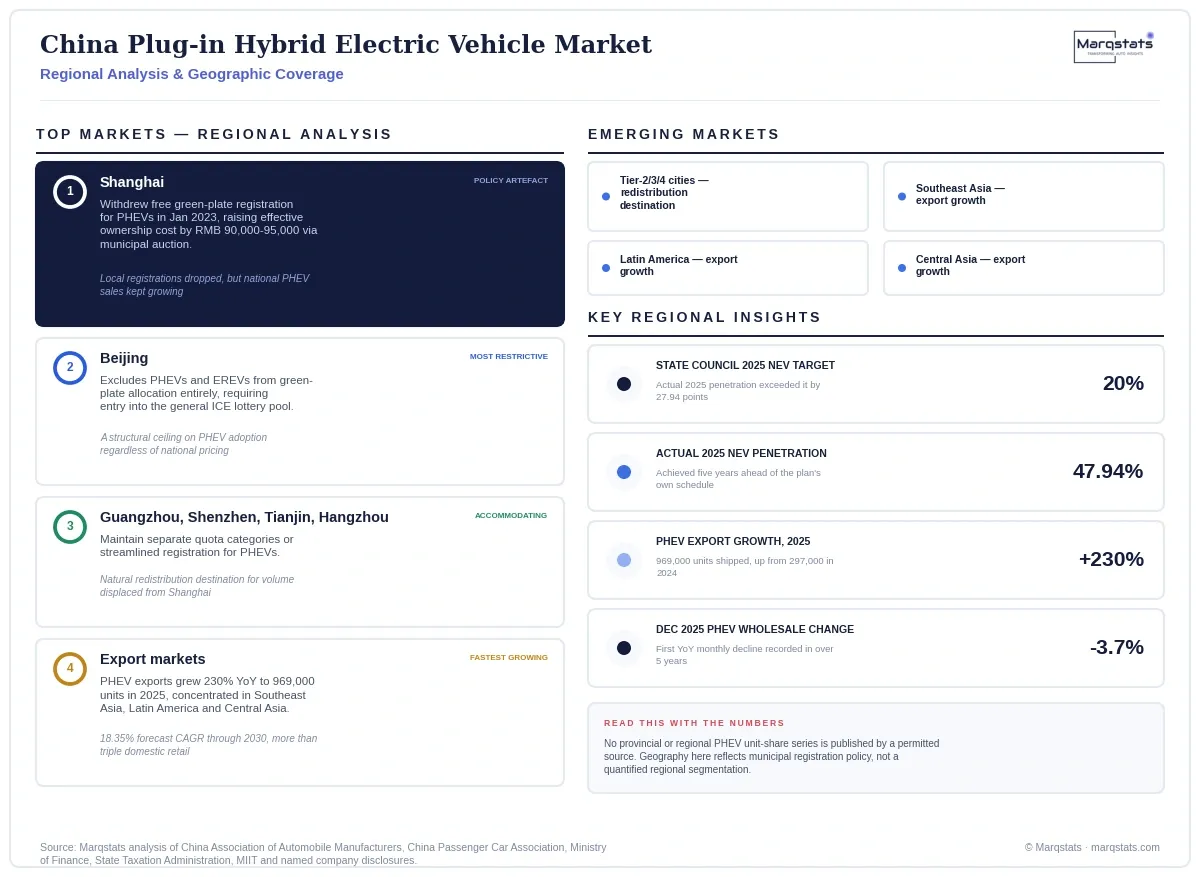
Shanghai withdrew complimentary green-plate registration for PHEVs and EREVs on 1 January 2023 while retaining it for battery-electric vehicles, requiring PHEV buyers to purchase a license plate via municipal auction at an average clearing cost of RMB 90,000–95,000. Local PHEV registrations dropped sharply following the change, but national PHEV sales continued to grow, indicating the effect was substitution across geography rather than a net demand loss.
Beijing
Beijing excludes PHEVs and EREVs from local green-plate allocation entirely, requiring buyers to enter the general internal-combustion vehicle lottery pool — a more restrictive regime than Shanghai's auction-based system and a structural ceiling on PHEV adoption in the capital regardless of national pricing trends.
Guangzhou, Shenzhen, Tianjin and Hangzhou
These four municipal centers maintain separate registration quota categories or streamlined registration for PHEVs, in contrast to Beijing and post-2023 Shanghai, supporting continued dual-powertrain adoption across southern and central provincial hubs and making them the natural redistribution destination for volume displaced from Shanghai.
Tier-2, Tier-3 and Tier-4 cities
Following Shanghai's 2023 policy change, automakers redirected inventory allocation toward lower-tier cities where residential driveway access is broader and charging infrastructure is less congested — converting a Tier-1 municipal registration cost shock into an accelerant of PHEV adoption outside China's largest metropolitan markets rather than a national demand drag.
Export markets: Southeast Asia, Latin America and Central Asia
PHEV exports grew 230% year-on-year to 969,000 units in 2025, concentrated in Southeast Asia, Latin America and Central Asia as overseas tariff structures shifted to favor plug-in hybrid shipments. The export channel's 18.35% forecast CAGR through 2030, more than triple the domestic retail CAGR, makes these markets the primary geographic growth vector in the sizing chain rather than any single domestic province.
How Competition Is Evolving
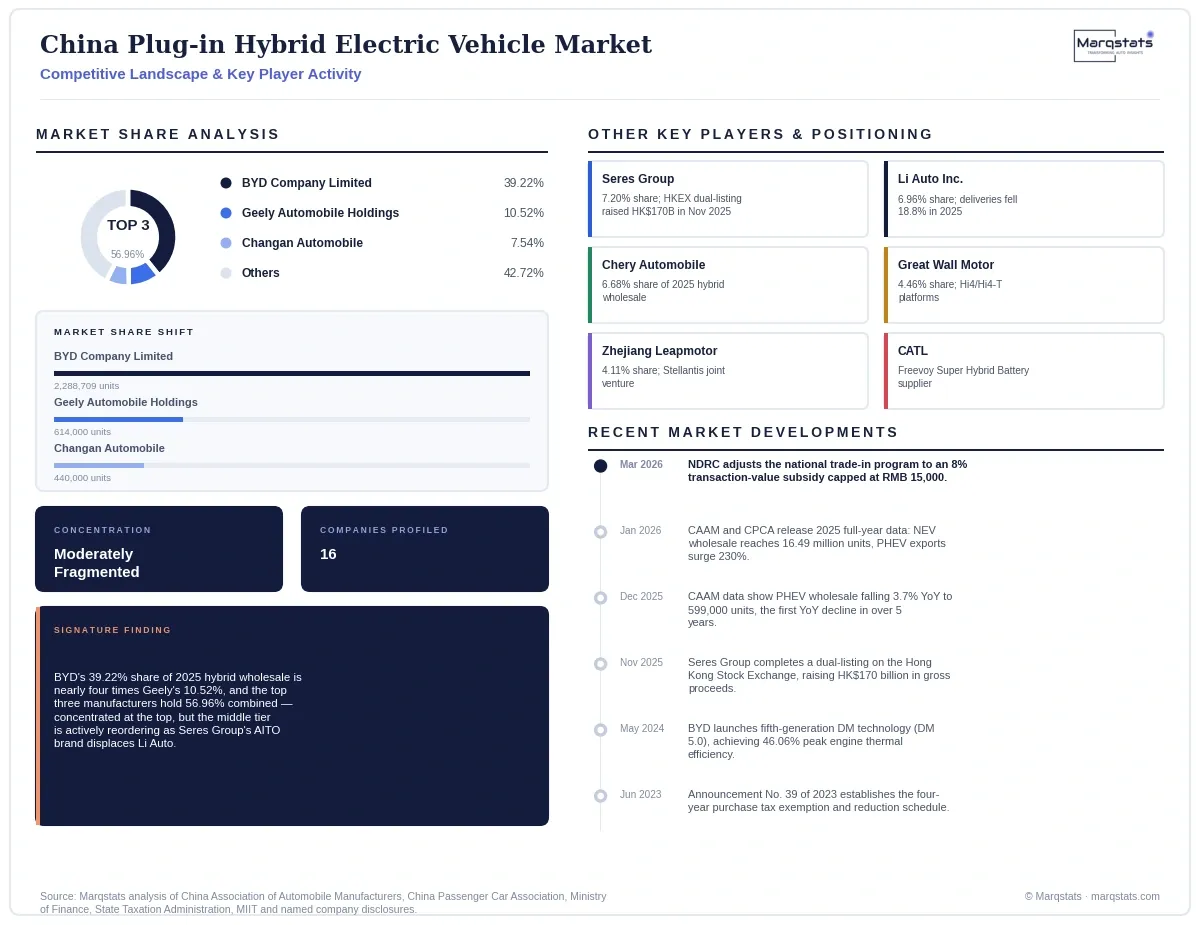
China's PHEV market is moderately concentrated: BYD Company Limited alone holds 39.22% of 2025 hybrid wholesale, and the top three manufacturers — BYD, Changan Automobile Co., Ltd. at 7.54%, and Seres Group Co., Ltd. at 7.20% — hold a combined 56.96%. The remaining share is distributed across Geely Automobile Holdings Limited (10.52%), Li Auto Inc. (6.96%), Chery Automobile Co., Ltd. (6.68%), Great Wall Motor Company Limited (4.46%) and Zhejiang Leapmotor Technology Co., Ltd. (4.11%), with no single challenger yet approaching BYD's scale; the ordering has been stable at the top but is actively moving in the middle tier, where Seres Group's AITO brand displaced Li Auto from its prior position through 2025.
Competitors differentiate primarily on powertrain architecture rather than price alone: BYD, Geely, Chery and Great Wall Motor compete on Dedicated Hybrid Transmission thermal efficiency and highway fuel economy, while Li Auto, Seres/AITO, Changan's Deepal brand and Leapmotor compete on serial Extended-Range EV cost efficiency and software-and-cockpit differentiation. Vertical integration is a second axis: BYD manufactures power electronics, inverters, Blade batteries and motor assemblies internally through its FinDreams Powertrain and FinDreams Battery subsidiaries, while EREV competitors such as Li Auto and Seres source range extenders and batteries from named Tier-1 suppliers, trading manufacturing control for capital-light scaling.
Seres Group Co., Ltd. completed a dual-listing on the Main Board of the Hong Kong Stock Exchange (HKEX: 9927) on 5 November 2025, raising HK$170 billion in gross proceeds — the largest initial public offering by a Chinese automaker and the largest global automaker IPO of 2025 — with approximately 70% of proceeds earmarked for research and development. Seres partners with Huawei Technologies Co., Ltd. under the Harmony Intelligent Mobility Alliance to co-develop the AITO brand, a structural relationship distinct from a conventional supplier arrangement. Zhejiang Leapmotor Technology Co., Ltd. operates as a Stellantis N.V. joint venture, and Horse Powertrain Limited — a supplier to multiple DHT manufacturers — is itself a joint venture between Geely and Renault S.A., meaning ownership verification is required before treating any two entities in the supply chain as independent competitors.
Companies Covered
The report profiles 16+ companies with full strategy and financials analysis, including:
Recent Market Activity
Table of Contents
Coverage & Segmentation
Coverage spans China's Plug-in Hybrid Electric Vehicle market on a wholesale-shipment basis, as reported by the China Association of Automobile Manufacturers, across a 2021-2025 historical period and a 2026-2030 forecast period, with 2025 as the base year. The market is sized in both USD billion (at a constant 7.20 RMB/USD rate) and unit volume, covering passenger PHEVs and EREVs under China's New Energy Vehicle regulatory classification. Three segmentation dimensions are quantified: price bracket, body style, and powertrain architecture (Dedicated Hybrid Transmission versus serial Extended-Range EV).
Excluded from scope: conventional hybrid electric vehicles without external plug-in capability, which China classifies as energy-saving internal-combustion vehicles rather than New Energy Vehicles; new energy commercial vehicles, including plug-in light-duty delivery trucks, which form part of the wholesale-retail reconciliation residual but are not separately sized here; and a provincial or regional unit-share breakdown, for which no permitted statutory or trade-association source publishes a series. A separate Marqstats study addresses China's battery-electric vehicle market on a comparable basis.