Market Snapshot
Key Takeaways
Market Overview & Analysis
Report Summary
The Japan electric micro-mobility market covers three distinct but increasingly interconnected segments: (1) electric-assist bicycles (pedal-assist e-bikes with motor support capped at a legal threshold, requiring no license, used for commuting, shopping, childcare, and utility transport); (2) specified small motorized bicycles and electric kickboards (dendo kickboard)—the new regulatory category created July 2023 for devices up to 20 km/h, no license, 16+, with mandatory insurance—including both shared-fleet and privately owned devices; and (3) personal mobility devices (PMDs) including powered wheelchairs, mobility scooters, walking-assistance vehicles (Toyota C+walk S and C+walk T), and intelligent personal EVs (WHILL Model R, Model C Lite, Model F) designed for elderly and mobility-impaired users. Electric unicycles, Segway-type devices, hoverboards, and stand-up scooters exceeding the specified small motorized bicycle limits fall under motorcycle or moped regulations and are addressed separately.
This market is not a single clean category—it is a mature electric-assist bicycle market sitting next to a fast-growing but regulation-heavy shared low-speed mobility market, with an emerging assistive/elderly segment being built by Japanese OEMs and startups. The volume backbone is still pedal-assist bikes, but the strategic questions are about shared e-scooters, category compliance, safety enforcement, and adjacent new formats including WHILL’s three-wheel Unimo concept and Toyota’s Walk Me robotic-leg wheelchair. Japan’s urban congestion, public transport gaps in aging rural communities, and the need for first/last-mile solutions across Japanese cities create structural demand across all three segments.
Market Dynamics
Key Drivers
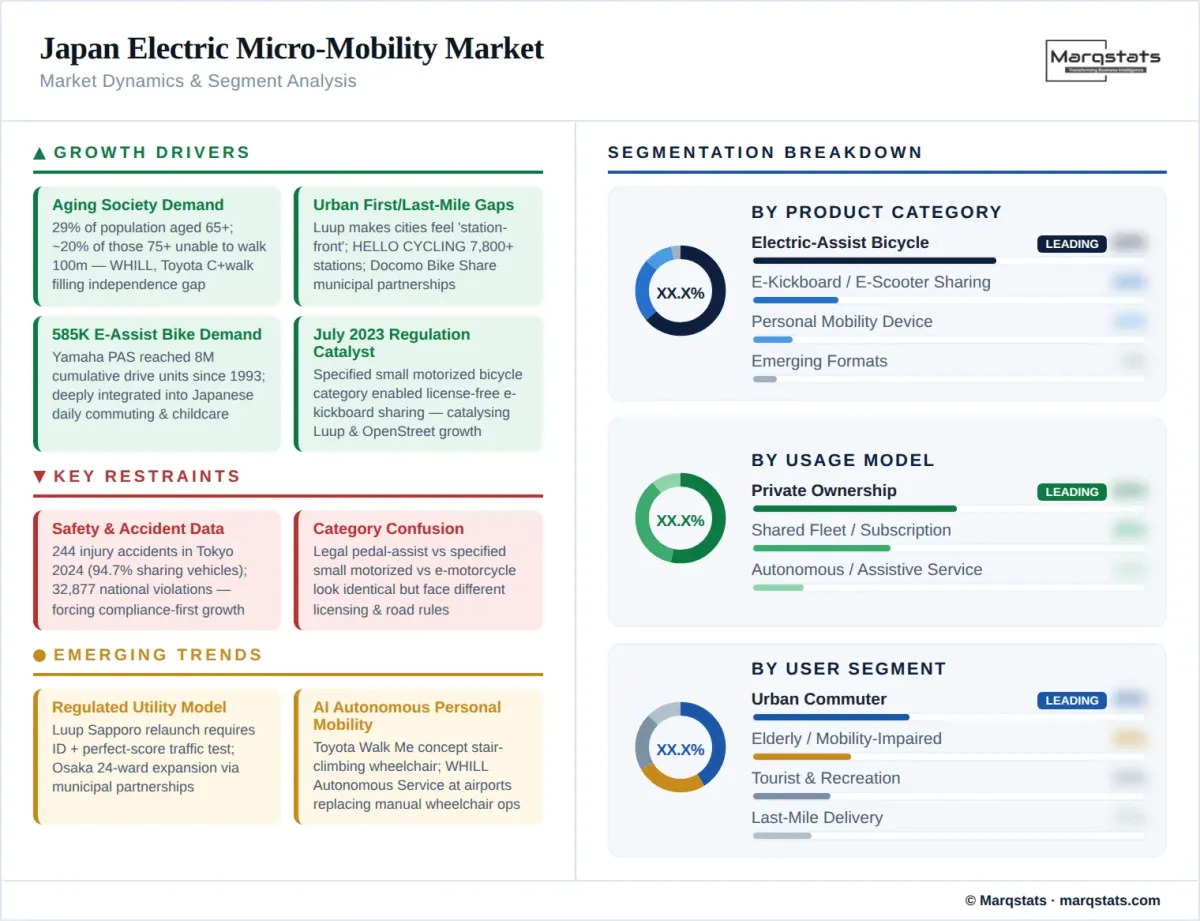
- Japan’s aging society creating structural demand for personal mobility devices: Japan’s population is 29% aged 65+, with approximately 20% of those aged 75+ unable to walk 100 metres without difficulty. As elderly drivers surrender licences, personal mobility devices become essential for maintaining independence and social participation. Toyota’s C+walk S assists people who can walk independently but have difficulty with long distances, operating at 1–6 km/h on sidewalks with obstacle detection. WHILL provides personal mobility products in approximately 30 countries, received METI’s Nippon Startup Excellence Award in 2025, and is launching the Model C Lite (17 kg foldable carbon electric wheelchair) in Spring 2026. The convergence of aging demographics, AI-powered smart navigation, and miniaturised electric propulsion is expanding Japan’s micro-mobility addressable market well beyond traditional e-scooter and e-bike definitions.
- Urban congestion and first/last-mile public transport gaps driving shared micro-mobility: Japanese cities face increasing urban congestion and ageing public transport infrastructure, creating demand for compact, electric first/last-mile solutions. Luup explicitly frames its platform as making the whole city feel like “station-front” territory. HELLO CYCLING positions its 7,800+ station network as transport infrastructure for city riding, commuting, shopping, and tourism. Docomo Bike Share connects its electric-assist share-cycle service to local community and sustainable urban mobility. The compact form factor of electric kickboards and e-bikes allows parking-free, on-demand trips of 1–5 km that complement train and bus networks.
- July 2023 e-scooter regulation creating a legal framework for market formation: The specified small motorized bicycle category—riders 16+, no licence, max 20 km/h, max 190cm × 60cm, automatic transmission, mandatory insurance and number plate, 6 km/h sidewalk mode where permitted—provided the legal clarity that sharing operators needed to scale nationally. Before July 2023, e-scooter sharing existed under limited demonstration permits. The regulation unlocked investment (Luup raised ¥4.4 billion in November 2025), geographic expansion, and OEM product development for the specified small motorized bicycle category.
- Electric-assist bicycle market providing stable demand foundation: 585,074 units in annual domestic demand (JBPI 2025), with Yamaha’s 8 million cumulative PAS drive units demonstrating deep market maturity. Electric-assist bicycles serve Japan’s most practical daily mobility needs—commuting, childcare transport, grocery shopping, suburban connectivity—creating a stable, recurring demand floor that supports component supply chains, battery production, and dealer/repair infrastructure shared with emerging micro-mobility segments.
Key Restraints
- Safety and accident data forcing compliance-first growth model: Tokyo police recorded 244 injury accidents involving specified small motorized bicycles in 2024, with 231 (94.7%) involving sharing vehicles and 46 (18.9%) involving alcohol. The National Police Agency logged 32,877 traffic violations nationally in 2024—approximately 59% for lane/road-classification violations and 27% for signal violations. This safety profile is forcing operators to invest heavily in rider education, rule-testing, geofencing, and public safety messaging. Luup’s Sapporo relaunch in April 2026 requires ID verification and a perfect-score traffic-rule test before e-scooter access—a significant friction increase versus frictionless sign-up models.
- Category confusion between legal pedal-assist, specified small motorized, and electric motorcycle: A legal pedal-assist bicycle, a license-free specified small motorized bicycle, and a pedal-equipped electric motorcycle can look nearly identical but face fundamentally different regulations regarding licensing, insurance, speed limits, and road access. This creates compliance risk for importers, delivery fleets, universities, rental platforms, and operators. The NPA’s 2024 guideline on pedal-equipped electric motorcycles and stand-up vehicles explicitly warns businesses to adopt their own rules because accident realities now justify stronger intervention. Electric unicycle, Segway, and hoverboard devices face motorcycle/moped classification if they exceed the specified small motorized bicycle limits.
- April 2026 bicycle blue-ticket regime increasing compliance burden on e-bike sharing: From April 1, 2026, the blue-ticket system applies to bicycle violations for riders aged 16+. This regulatory change affects the electric-assist bicycle sharing segment—the highest-volume part of the market—by raising enforcement consequences for traffic violations. Luup launched public safety-learning content specifically to prepare operators and riders for this regime change.
- Personal mobility devices facing limited sidewalk and public-road access: WHILL devices and Toyota’s C+walk T initially could not operate on public sidewalks under existing Road Traffic Act provisions, though the C+walk T was updated for sidewalk compliance following the April 2023 Act revision. The C+walk S is classified as a pedestrian device operating at walking speeds. Regulatory uncertainty around where personal mobility devices can operate—indoor facilities, sidewalks, public roads—constrains adoption and creates user confusion about legal usage boundaries.
Key Trends
- Shared micro-mobility evolving from “growth at any cost” to regulated utility model: Luup’s progression illustrates the trend: from rapid port deployment (15,500+ ports) to mandatory ID verification, perfect-score traffic tests (Sapporo), public safety content creation (March 2026 blue-ticket preparation), and expansion tied to municipal partnerships rather than uncontrolled territory growth. Osaka expansion covered all 24 wards plus surrounding cities through coordinated deployment. This regulated-utility model mirrors Japan’s approach to other infrastructure services and differentiates Japan’s micro-mobility trajectory from more permissive Western markets.
- AI-powered smart navigation and autonomous operation entering personal mobility: Toyota unveiled the “Walk Me” concept autonomous wheelchair at JMS 2025 with four robotic foldable legs capable of climbing stairs, transitioning between indoor and outdoor surfaces, and lowering to floor level. WHILL’s Autonomous Service already operates at major Japanese airports, transporting passengers to boarding gates using self-driving personal EVs that replace traditional wheelchair services. These developments signal that personal mobility devices are evolving from simple electric propulsion to AI-governed autonomous navigation, with implications for elderly care, hospital environments, and public facility accessibility.
- Suzuki and Panasonic co-developing new micro-mobility formats: Suzuki announced in 2023 a co-development agreement with Panasonic Cycle Technology to create new mobility products using Panasonic’s small, lightweight e-bike drive unit and lithium-ion battery. This matters because it shows incumbent Japanese industrial players are trying to expand from classic electric-assist bicycles into adjacent micro-mobility formats, potentially including specified small motorized bicycles and light electric scooters. Suzuki also showcased the MOQBA legged mobility concept and MITRA robot undercarriage at JMS 2025.
- Luup’s Unimo three-wheel concept expanding beyond two-wheel form factors: Luup pointed to future expansion beyond e-bikes and e-scooters through its small three-wheel Unimo concept, which could serve elderly users, cargo micro-delivery, and accessibility applications. This signals that sharing operators view the market’s boundary as broader than traditional e-scooter/e-bike rental, potentially converging with the personal mobility device segment.
Market Segmentation
The market’s volume core: approximately 585,074 units in annual domestic demand (JBPI 2025). Yamaha PAS leads with 8 million cumulative drive units since 1993. Panasonic Cycle Technology and Bridgestone provide established domestic alternatives. The segment serves commuting, childcare transport, grocery shopping, and suburban connectivity—deeply integrated into Japanese daily life. Shared electric-assist bicycles (Docomo Bike Share, HELLO CYCLING) extend this category into station-based urban sharing. The April 2026 blue-ticket regime applies to all bicycles including electric-assist, raising enforcement visibility. This is the stable, utility-driven foundation of Japan’s electric micro-mobility market.
The fastest-growing segment, catalysed by the July 2023 specified small motorized bicycle regulation. Luup (15,500+ ports, 5 million downloads, ¥4.4 billion raised November 2025) and OpenStreet/HELLO CYCLING (7,800+ stations, 35,000+ vehicles, 3.1 million users) are the dominant operators. This is primarily a shared-fleet market in Japan; private ownership of specified small motorized bicycles exists but is significantly smaller than the sharing segment. Growth is increasingly tied to compliance infrastructure: ID verification, traffic-rule testing, geofencing, insurance, and municipal partnership agreements. The segment faces regulatory tightening as accident and violation data accumulate.
The emerging segment serving Japan’s aging society. WHILL provides intelligent personal EVs (Model R, Model C Lite, Model F) in approximately 30 countries, with autonomous airport services, JTB tourist rental programmes, and METI recognition. Toyota’s C+walk series (seated C+walk S, standing C+walk T) targets people aged 75+ who have difficulty with long-distance walking, operating at sidewalk speeds with obstacle detection. Japan’s mobility scooter market for elderly care serves a similar but more traditional demographic with four-wheeled electric scooters for daily errands. Powered wheelchairs with AI smart navigation—exemplified by Toyota’s Walk Me concept with autonomous stair-climbing capability—represent the technology frontier for this segment.
Station-based and free-floating sharing services operated by Luup, HELLO CYCLING/OpenStreet, Docomo Bike Share, and regional operators. Revenue models include per-minute pricing, subscription passes, and corporate/municipal contracts. The shared model dominates the electric kickboard/e-scooter category (231 of 244 Tokyo injury accidents in 2024 involved sharing vehicles) and is a significant channel for electric-assist bicycles. Insurance, maintenance, fleet management, and compliance investment are integral to the shared business model in Japan’s regulatory environment.
Dominant for electric-assist bicycles (purchased through bicycle dealers and electronics retailers), growing for personal mobility devices (WHILL sold through healthcare channels, Toyota dealers, and rental/leasing stores), and nascent for private specified small motorized bicycles. Private electric-assist bicycle ownership benefits from Japan’s extensive bicycle parking infrastructure and home charging convenience.
WHILL’s Autonomous Service operates at major Japanese airports (domestic and international terminals), replacing traditional wheelchair services with self-driving personal EVs—reducing staff burden while improving passenger accessibility. JTB’s WHILL rental service targets inbound senior tourists. Luup’s platform functions as urban MaaS, integrating with public transport for first/last-mile connectivity. This segment represents the convergence of micro-mobility hardware with software-defined service platforms.
By Geography
Greater Tokyo Metropolitan Area
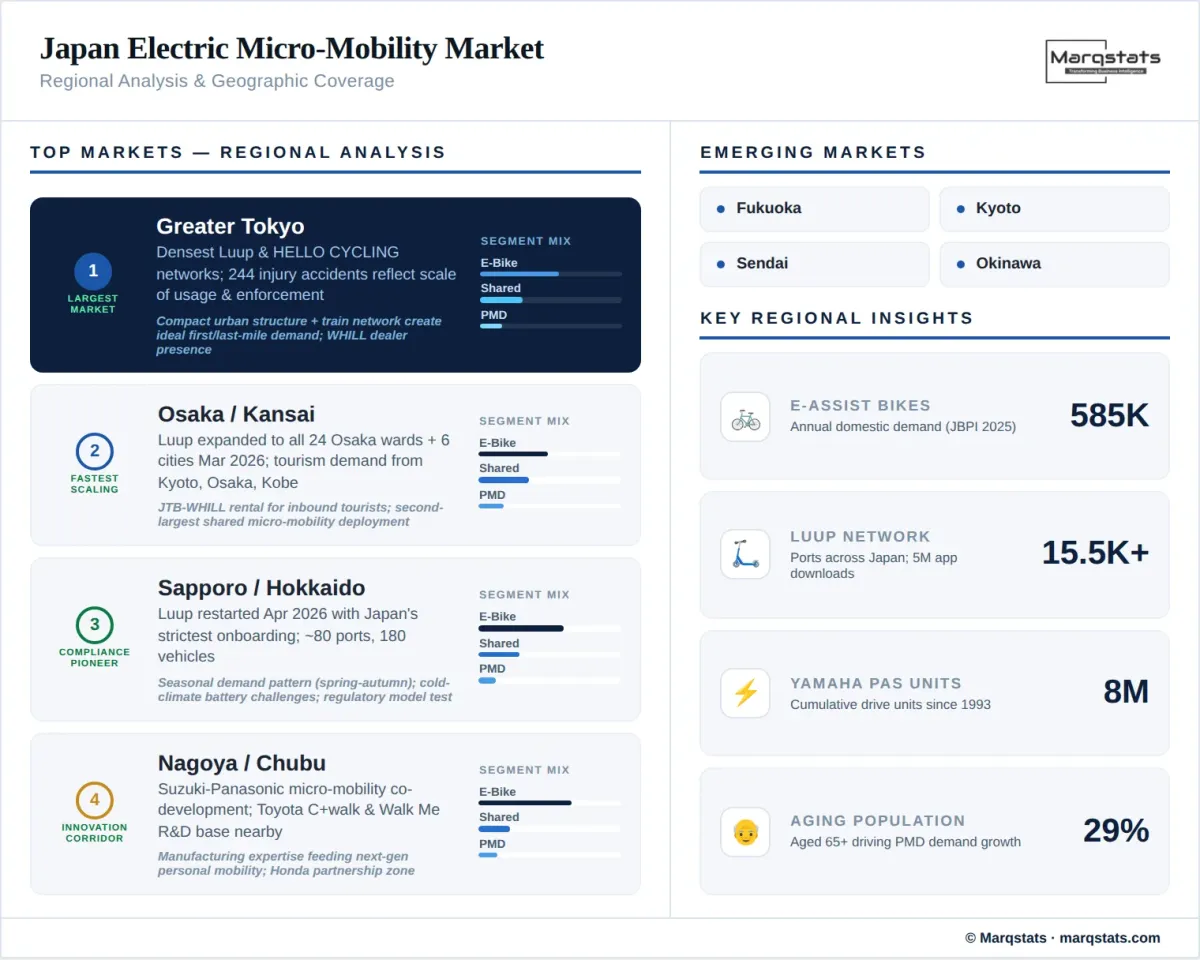
Japan’s largest micro-mobility market across all three segments. Luup and HELLO CYCLING have their densest port/station networks in Tokyo’s 23 wards. Docomo Bike Share operates across multiple Tokyo wards with municipal partnerships. Tokyo police’s 244 injury accident count in 2024 reflects both the scale of usage and the concentration of enforcement attention. Tokyo’s compact urban structure, extensive train network, and high population density create ideal first/last-mile demand. WHILL and Toyota C+walk products are available through Tokyo-area dealers and healthcare channels.
Osaka and Kansai Region
Luup expanded coverage to all 24 wards of Osaka City plus Suita, Moriguchi, Higashi-Osaka, Kadoma, Yao, and Sakai in March 2026, making Osaka its second-largest market. The Kansai region’s tourism demand (Kyoto, Osaka, Kobe) creates micro-mobility rental opportunities for both domestic and international visitors. JTB’s WHILL rental service targets inbound tourists with mobility needs.
Sapporo and Hokkaido
Luup restarted service in Sapporo in April 2026 with approximately 80 ports and 180 vehicles (e-bikes and e-scooters), implementing Japan’s strictest onboarding requirements: ID verification and a perfect-score traffic-rule test before e-scooter access. Cold-climate operation creates seasonal demand patterns, with e-scooter and e-bike usage concentrated in spring through autumn. Battery performance in sub-zero temperatures remains a technical constraint for winter operations.
Regional Cities and Rural Japan
Japan’s aging rural communities represent the primary demand base for personal mobility devices. Toyota’s C+walk S has been deployed in cooperation with local government in Hanawa Town Station, Fukushima Prefecture, as a means to help residents and tourists. Twenty percent of Japanese aged 75+ report difficulty walking 100 metres—a statistic most concentrated in rural prefectures with declining public transport. Electric-assist bicycles serve suburban and semi-rural connectivity where train stations are sparse. However, shared e-scooter services remain predominantly urban due to port density economics.
How Competition Is Evolving
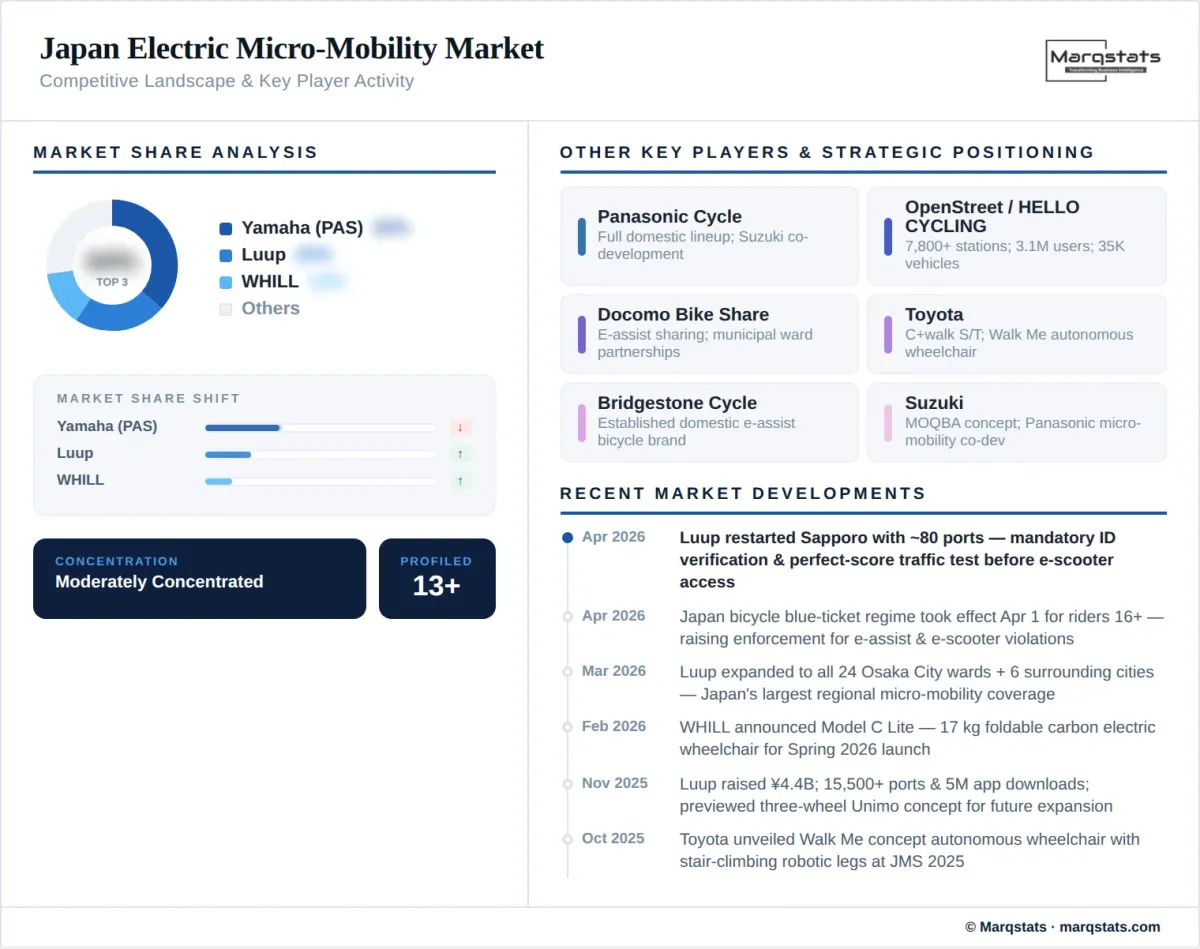
The Japan electric micro-mobility market features distinct competitive dynamics across its three segments. In electric-assist bicycles, established Japanese manufacturers dominate: Yamaha Motor (PAS, 8 million cumulative drive units), Panasonic Cycle Technology (full domestic lineup, co-development with Suzuki for new mobility formats), and Bridgestone Cycle. These incumbents compete on battery range, motor assistance quality, price, and dealer/repair network density in a mature market with incremental innovation cycles.
In shared electric kickboard/e-scooter services, Luup is the clear market leader with 15,500+ ports, 5 million downloads, ¥4.4 billion raised (November 2025), and expansion across Tokyo, Osaka, Sapporo, and additional cities. OpenStreet’s HELLO CYCLING (7,800+ stations, 35,000+ vehicles, 3.1 million users) is the primary competitor, differentiated by spanning both electric-assist bicycles and electric cycles in the specified small motorized bicycle category. Docomo Bike Share occupies a more institutional, municipal-partnership-driven position focused on electric-assist bicycle sharing. Competition in this segment increasingly centres on compliance infrastructure (safety onboarding, geofencing, violation tracking), municipal partnership depth, and port/station density rather than pure fleet size.
In personal mobility devices, WHILL is the most important Japan-headquartered global player, offering products in approximately 30 countries with autonomous airport services, METI recognition, and Tokio Marine insurance alliance. Toyota’s C+walk series (C+walk S seated, C+walk T standing) targets a slightly different use case—walking-assistance for independently mobile but distance-challenged elderly—leveraging Toyota’s massive dealer network. Toyota’s JMS 2025 Walk Me concept (robotic-leg autonomous wheelchair) signals continued R&D investment. Suzuki’s interest in micro-mobility (e EVERY, MOQBA, Panasonic co-development) indicates potential future entry. Traditional mobility scooter manufacturers serve the lower-technology, lower-price segment of elderly personal mobility.
Companies Covered
The report profiles 12+ companies with full strategy and financials analysis, including:
Recent Market Activity
Table of Contents
Coverage & Segmentation
This report provides a comprehensive analysis of the Japan electric micro-mobility market covering the historical period (2021–2025) and forecast period (2026–2030), with 2025 as the base year. The study examines market size in USD and JPY across three segments: electric-assist bicycles (units, revenue), shared electric kickboard/e-scooter services (ports, fleet size, users, revenue), and personal mobility devices (units, revenue). Analysis covers product category, service model (shared, private, MaaS/autonomous), use case (commuting, tourism, elderly mobility, delivery), technology (battery chemistry, motor type, AI navigation), and regional geography. Company profiling covers 12+ players spanning manufacturers, sharing operators, PMD innovators, and component suppliers. Regulatory analysis covers the specified small motorized bicycle framework, bicycle blue-ticket regime, helmet obligations, NPA enforcement data, and Road Traffic Act provisions for personal mobility devices.
Research methodology combines JBPI bicycle production and demand statistics, operator disclosures (Luup, HELLO CYCLING, Docomo Bike Share), OEM annual reports (Yamaha, Panasonic, Toyota, WHILL), NPA accident and violation data, and Japanese automotive/mobility press coverage. Primary research includes interactions with sharing operators, personal mobility device manufacturers, municipal transport planners, and regulatory stakeholders. The Marqstats Japan Electric Kei Car Market and Japan Electric Kei Commercial Vehicle Market reports provide complementary coverage of Japan’s broader electrified mobility ecosystem.