Market Snapshot
Middle bar: base-year value × (1 + CAGR), rounded to two decimals. This is a calculated illustration, not a separately researched annual estimate.
The Europe electric light commercial vehicle market is estimated at USD 8.66 billion in 2025 and is projected to reach USD 25.43 billion by 2030, at a CAGR of 24.04%. Battery-electric van registrations across the European Union, the United Kingdom and the EFTA states reached an estimated 188,099 units in 2025, 10.32% of a van market of 1.82 million. Volumes reach 610,000 by 2030 and battery demand rises from an estimated 12.98 to 50.02 GWh. On the published electrically-chargeable basis the market looks about a sixth larger than that.
Market size and forecast figures are generated using Marqstats' proprietary estimation framework, updated as of August 2026.
That last sentence is the finding this report is built on. Every widely quoted European electric van statistic comes from the industry association's electrically-chargeable category, and the footnote under that category reads, verbatim, that it includes battery-electric and plug-in hybrids. In 2025 the gap between the two was 31,046 vehicles. Plug-in hybrid vans went from 0.3% of new van registrations in 2024 to 1.7% in 2025 across the European Union, Norway and Iceland, a five-fold rise recorded in the statutory carbon dioxide monitoring data. Separately, and on a different population, the United Kingdom's own plug-in hybrid wedge widened from roughly 1,162 to roughly 8,184 vehicles, almost all of it pickups. Growth in 2025 was 67.8% on the electrically-chargeable basis and an estimated 51.7% on a battery-electric basis. Sixteen points of the reported acceleration was not battery-electric at all.
The second correction is to the shape of the curve. European electric van registrations did not grow every year. Electrically-chargeable van registrations fell in 2024, from a restated 105,757 to a restated 96,252 in the European Union, and the official emissions record moves with it: the average carbon dioxide figure for a new van rose that year, from 180.8 to 184.9 grams per kilometre, before falling to a provisional 172.1 in 2025. The two series cover different populations — registrations are counted for the European Union, emissions for the European Union plus Norway and Iceland — so this is co-movement of the expected sign and magnitude rather than a measured causal link. A segment under a binding decarbonisation mandate went backwards in the year immediately before that mandate's first checkpoint. The 2025 rebound is a compliance snap-back off a fallen base, and roughly one point of the electrically-chargeable share gain from 6.1% to 11.2% is not electric growth at all but the total van market contracting 8.8% beneath it. Note that the association restated both 2023 and 2024 between releases; on the as-first-published figures of 108,297 and 96,159 the 2024 decline reads 11.3% rather than 9.0%. This report uses the restated series throughout.
What sits underneath both corrections is a segment that is regulated more leniently than cars, incentivised less than it was two years ago, and bought almost entirely by businesses that price payload. The 2030 target for vans is a 50% cut against 2021 where the car target is 55%, and in December 2025 the European Commission proposed reducing the van figure further, to 40%. On this model's trajectory battery-electric vehicles reach 31.85% of new European van registrations in 2030. Marqstats back-solves the share the target implies at 52.8% under the statutory reduction and 43.4% under the proposed one — a shortfall of 11.6 to 21.0 percentage points. Both requirement figures rest on an assumed 192 grams per kilometre average for a new non-battery-electric van, which is a Marqstats assumption rather than a published figure; at 185 grams the statutory requirement falls to 51.1%. The comparison is also indicative rather than exact, because the model's geography includes the United Kingdom and EFTA while the regulation applies to the European Union alone.
Key Takeaways
Market Overview & Analysis
Report Summary
This report sizes the Europe electric light commercial vehicle market on a battery-electric basis for category N1 vehicles up to 3.5 tonnes gross vehicle weight, registered across the European Union, the United Kingdom and the EFTA states. It is deliberately a narrower definition than the one in general circulation, and the difference is material: on the published electrically-chargeable basis the 2025 market was 219,145 units, and on the basis used here it was an estimated 188,099. The choice is not pedantry. A plug-in hybrid van has a combustion engine, a fuel tank and a tailpipe, and in commercial use with an unmotivated driver it frequently never charges at all. Sizing a battery-electric market with plug-in hybrids inside it produces a number that is wrong in level, wrong in growth rate and wrong in what it implies about charging infrastructure, battery demand and residual values.
The segment is unusual in European road transport for being almost purely a business purchase. Vans are bought by parcel and last-mile operators, utilities, trades, municipal fleets and rental and leasing companies, and they are bought against a payload specification and a cost per kilometre rather than against a list price. That makes the segment more responsive to fiscal treatment, urban access rules and fleet mandates than to purchase grants, which matters a great deal in 2026 because the purchase grants have largely gone. It also makes the segment acutely sensitive to the one thing a battery does to a van, which is take weight out of the load.
The regulatory frame is Regulation (EU) 2019/631, which sets fleet-average carbon dioxide targets for new vans separately from cars and on a weaker trajectory. The immediate context is that the provisional 2025 fleet average sat about 18 grams per kilometre above the fleet-wide reference value — manufacturer targets are mass-adjusted, so that is not a compliance verdict, but it frames the distance — and that the checkpoint was then legislatively softened, and that the 2030 and 2035 targets are themselves now the subject of a Commission proposal to weaken them further. A forecast built on the statutory numbers is a forecast built on figures the Commission has already proposed to move. This report carries both, and models a market that lands short of either.
Market Dynamics
Key Drivers
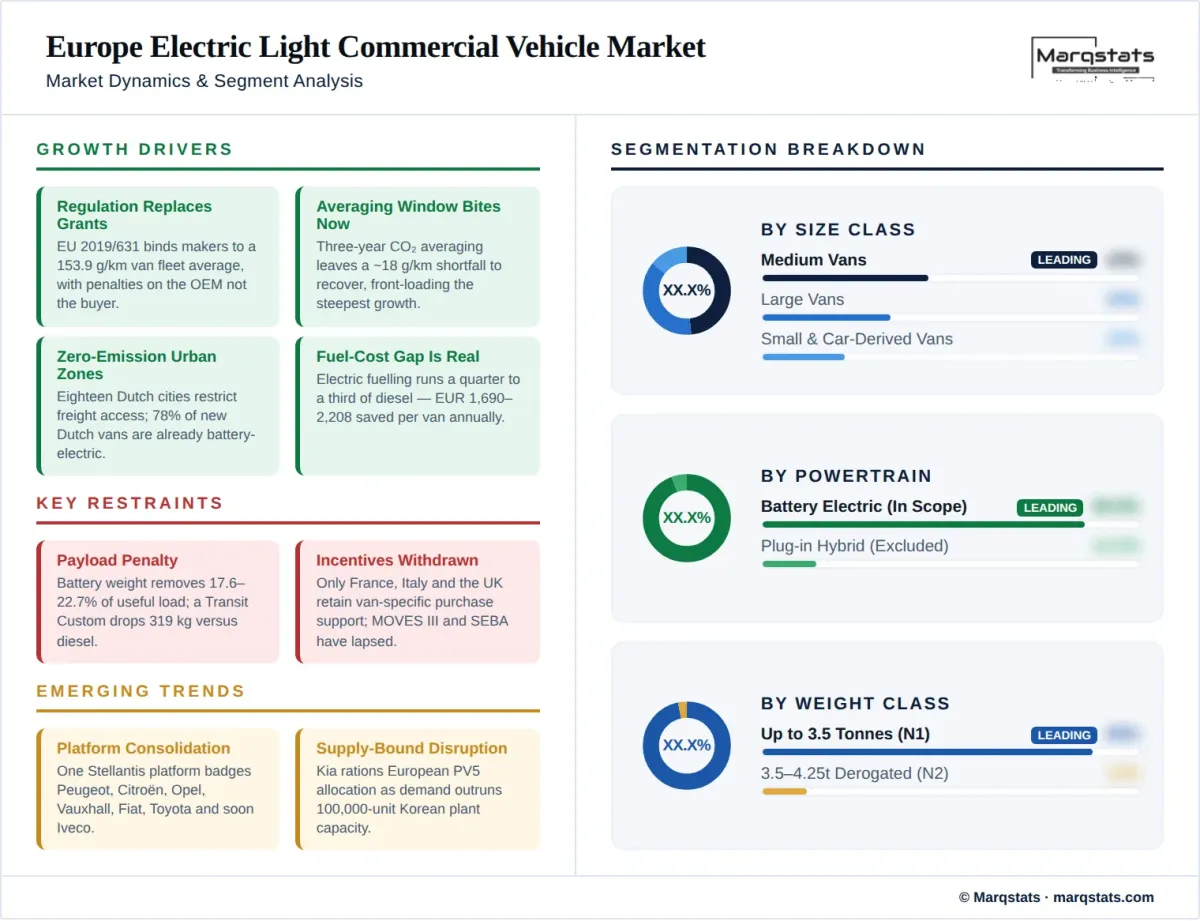
Regulation is now the primary demand instrument, and it binds the manufacturer rather than the buyer. Regulation (EU) 2019/631 sets a fleet-average target of 153.9 grams per kilometre for vans from 2025 and a 50% reduction against 2021 from 2030, enforced by an excess-emissions premium levied on the manufacturer. With purchase grants withdrawn across most of the continent, the pull on volume in 2026 and 2027 comes from manufacturers needing electric mix to average down a fleet, not from operators being paid to buy.
The 2025 to 2027 averaging window concentrates pressure inside the forecast period. Regulation (EU) 2025/1214, in force 9 July 2025, replaced a single 2025 test with a three-year average across 2025, 2026 and 2027. Because the provisional 2025 outturn of 172.1 grams per kilometre sits roughly 18 grams above the reference value, the shortfall has to be recovered in the two years that follow. This is the single clearest reason to expect the steepest growth rate of the forecast in 2026 and 2027 rather than at the end of the decade. Absolute annual additions still rise throughout, because the base compounds.
Urban access rules are becoming a hard constraint on diesel vans in the countries that matter most for share. The Netherlands launched a coordinated national zero-emission zone framework for freight in January 2025 across eighteen cities including Amsterdam, Rotterdam and Utrecht, with Euro 5 vans admitted only to January 2027 and Euro 6 to January 2028. More than 95% of vehicles entering those zones already comply, and by mid-2025 78% of new vans registered in the Netherlands were battery-electric.
The fuel-cost gap is large and it is the operator's actual argument. Using official European electricity and diesel prices, an electric medium van costs roughly a quarter to a third of a diesel van to fuel per kilometre, a saving Marqstats derives at EUR 1,690 to 2,208 a year at 20,000 kilometres and EUR 6,760 to 8,832 over a four-year cycle. These are illustrative unit economics rather than a total-cost model — the diesel consumption figure is a 2023 catalogue number and the electricity price is a commercial average rather than a small-trade tariff.
Small-van pricing has moved sharply, and it moved from outside Europe. The Kia PV5 is listed at EUR 30,000 excluding value-added tax, which one review placed explicitly below a diesel medium van. That is a cross-class comparison and it is generous to the diesel; no current-vintage diesel small-van price is obtainable, so the small-class premium cannot be quantified either, and the honest statement is that a small electric van now undercuts a medium diesel one. In the medium class a premium persists but its size is equally unquantifiable, because the only diesel list prices obtainable for the relevant nameplates date from 2023.
Key Restraints
The battery takes roughly a fifth of the payload, and payload is what a van is for. A Ford Transit Custom carries 1,407 kilograms as a diesel and 1,088 kilograms as an electric — 319 kilograms less, a 22.7% reduction. A Renault Master L2H2 goes from 1,971 to 1,625 kilograms, down 346 kilograms or 17.6%. Both figures are Marqstats derivations from trade-press specification tables rather than from the manufacturers directly, and payload bases differ on whether the driver is included — a 75-kilogram difference that is 21% to 24% of the entire penalty, and one of the two sources does not state its basis.
Purchase support has been withdrawn across most of Europe. Germany's 2026 scheme of roughly EUR 3 billion is restricted to private households with taxable income at or below EUR 80,000 and excludes vans; Spain's MOVES III ended on 31 December 2025 and its replacement Plan Auto+ was still not formally approved at the end of January 2026; the Netherlands closed its SEBA van subsidy permanently on 31 December 2024. Germany's de facto van incentive is now a depreciation rule rather than a grant.
Fleet intentions are running far below the mandated trajectory. A European fleet survey published on 20 August 2026 found fleets expecting only 14% electric vans within three years. In the United Kingdom, battery-electric van uptake ran at 10.6% year-to-date against a 2026 mandate level of 24% — less than half — even in a month, July 2026, when the battery-electric share hit a record 14.7%.
Residual values for used electric vans are close to unmeasured, which makes leasing expensive. The one hard European figure obtainable is an average used electric van price of GBP 9,971 at 34 months and 19,675 miles in January and February 2026, up 33% year on year on 74% higher volumes — improving, but from a base so low that the same auction operator moved just 188 electric vans in nine months of 2023. A leasing company that cannot price a residual prices risk into the monthly rate instead.
Key Trends
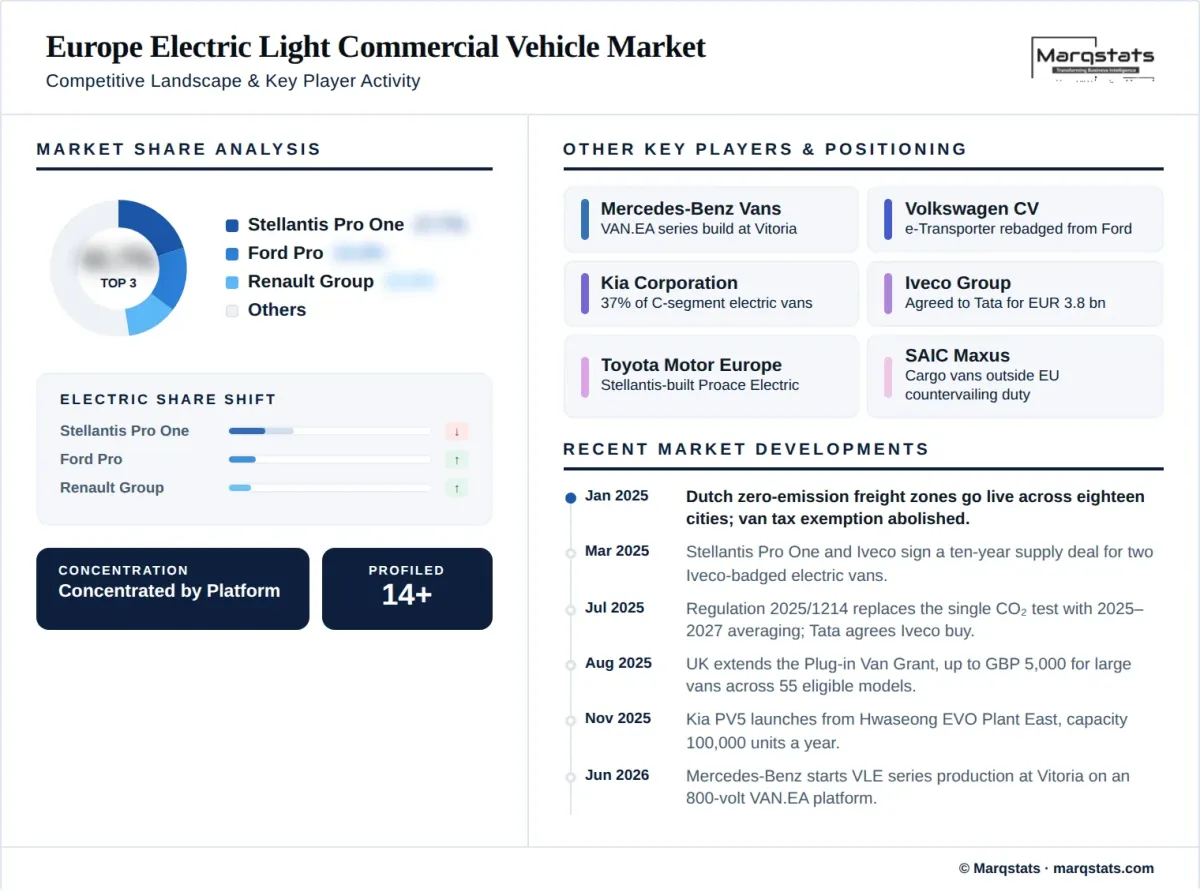
The market is consolidating at platform level while appearing to fragment at brand level. Stellantis Pro One's mid-size and large electric van platforms underpin Peugeot, Citroën, Opel, Vauxhall, Fiat Professional, Toyota and, from mid-2026 under a ten-year supply agreement signed on 14 March 2025, Iveco — a commercialisation not independently confirmed as at August 2026. Counted by badge the segment looks like a dozen competitors; counted by platform it is considerably more concentrated. Any share figure in this segment should state which basis it uses.
The incumbent leader is losing the electric half of its own franchise. Stellantis Pro One held 28.7% of European light commercial vehicles in the first quarter of 2026 and 28.7% again in the first half, against 28.5% in the first half of 2024 — first, and essentially unchanged. Its battery-electric light commercial vehicle share in the first quarter of 2026 was 17.7%, against 31.9% in the first half of 2024; the group did not publish a battery-electric percentage with its first-half 2026 release. Total share held; electric share fell roughly fourteen points in under two years. Note that the group reported the earlier figures on a thirty-country basis and the first-half 2026 figure on a twenty-nine-country basis, without remarking on the change.
Supply, not demand, is the binding constraint on the fastest-growing product. Kia completed its Hwaseong EVO Plant East in South Korea on 14 November 2025 with capacity of 100,000 PV5 units a year, and by June 2026 was rationing European allocation because demand had outrun it. That is the only genuine supply constraint identified in this segment, and it sits with an importer rather than a European manufacturer.
The European supply base consolidated defensively while that happened. Iveco outsourced its electric light van range to a rival and was then itself agreed for acquisition by Tata Motors for EUR 3.8 billion on 31 July 2025; the Flexis joint venture lost two of its three founding partners; and Mercedes-Benz began series production of its VAN.EA platform at Vitoria in Spain on 12 June 2026 with the investment amount undisclosed.
Market Segmentation
The whole of the market as this report defines it, and an estimated 188,099 units across the European Union, United Kingdom and EFTA in 2025 against a published electrically-chargeable 219,145. Battery-electric vans reached 10.3% of new van registrations across the European Union, Norway and Iceland on the statutory monitoring basis in 2025, up from 5.6% in 2024. The model carries this to 31.85% of the European van market by 2030.
Outside this report's scope but inside every headline drawn from the association's data, and growing much faster in relative terms than battery-electric. Plug-in hybrid vans went from 0.3% of new van registrations across the European Union, Norway and Iceland in 2024 to 1.7% in 2025. In the United Kingdom the wedge between the association's electrically-chargeable figure and the national body's battery-electric figure widened from roughly 1,162 units in 2024 to roughly 8,184 in 2025 — about 2.6% of the entire United Kingdom light commercial vehicle market, overwhelmingly plug-in hybrid pickups.
Not counted as electric in the European van statistics at all. The association's footnote places fuel-cell vehicles in an 'others' category alongside compressed natural gas, liquefied petroleum gas and ethanol, a bucket that totalled 13,596 units and 0.9% of the European Union van market in 2025 and is dominated by gas fuels rather than hydrogen. No standalone European fuel-cell van registration count exists from permitted sources.
The statutory and statistical definition of a van in Europe, the scope of Regulation (EU) 2019/631, and the scope of this report. Everything in the association's van series sits here, and this is the band in which the payload penalty bites hardest, because a battery of roughly 43 to 88 kilowatt-hours consumes a fifth of the useful load without any compensating weight allowance.
The compensating instrument, and a statistical blind spot. In member states that have taken up the optional Article 6(4)(c) derogation, and subject to its training and use conditions, a category-B licence holder may drive an alternatively fuelled vehicle in this band. The United Kingdom removed its five-hour training requirement for zero-emission goods vehicles in this band from 10 June 2025. The arithmetic is exact on at least one nameplate: a Ford E-Transit L2H2 carries 1,008 kilograms at 3.5 tonnes and 1,758 kilograms at 4.25 — a gain of 750 kilograms, precisely the gross-weight uplift. On the derogated band the electric van out-carries the diesel. But the vehicle is type-approved N2, so it is excluded from the association's van series and from Regulation (EU) 2019/631, meaning it earns its manufacturer no carbon dioxide credit at all. The United Kingdom's national series explicitly includes it; the European series does not.
The class where pricing has moved most. The Kia PV5 at EUR 30,000 excluding value-added tax and the Ford E-Transit Courier at GBP 24,500 excluding value-added tax anchor this band. It is also the class the newest entrant has taken outright: the PV5 held 37% of all C-segment electric vans in Europe in the first half of 2026.
The volume heart of the European van market and of this model's assumed mix. The Ford E-Transit Custom at GBP 38,630 excluding value-added tax, 71 kilowatt-hours and 1,088 kilograms of payload is representative, and its Volkswagen e-Transporter sibling is the same vehicle under another badge. A price premium against diesel persists in this class but cannot be quantified from current-vintage sources.
Where the payload penalty is most commercially painful and where the 4.25-tonne derogation is most used. The Ford E-Transit at GBP 44,545 excluding value-added tax offers 15.1 cubic metres and, at a 3.5-tonne gross weight, 1,008 to 1,035 kilograms of payload — the widely quoted 1,423-kilogram figure is a 3.9-tonne variant and is outside this report's scope; the Renault Master E-Tech and the Mercedes-Benz eSprinter compete directly. This class also carries most of the segment's cold-chain and utility work.
By Geography
United Kingdom
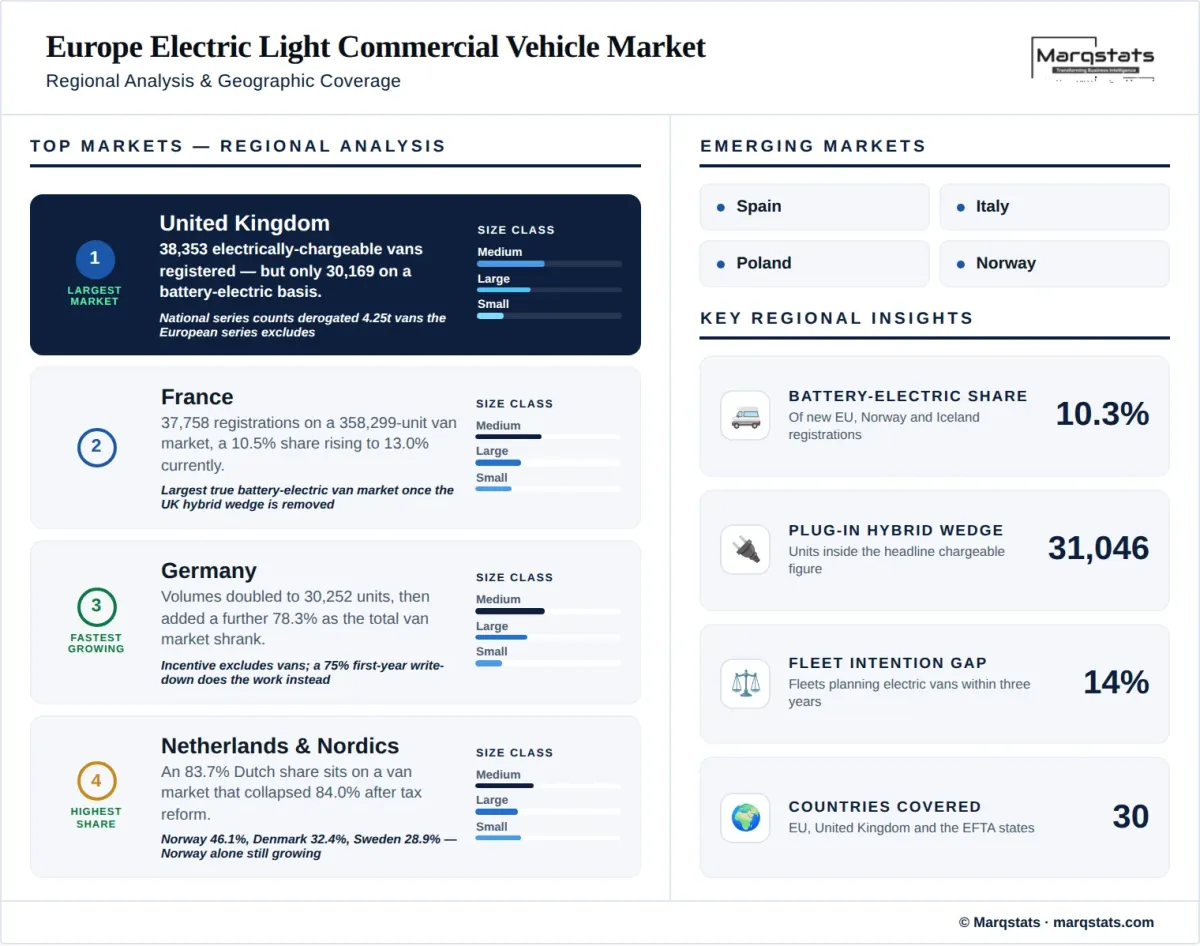
Europe's largest electric van market on the association's basis at 38,353 electrically-chargeable units in 2025, and not the largest on a battery-electric basis, where the national body records 30,169. The ranking flips purely on definition. United Kingdom uptake ran at 10.6% year-to-date in 2026 against a mandate level of 24%, though July 2026 delivered a record 14.7% monthly share on registrations up 22.0%. The national series also includes 3.5 to 4.25-tonne electric vans that the European series excludes, so the two are not like-for-like and the divergence widens as derogated models proliferate.
France
France recorded 37,758 electrically-chargeable van registrations in 2025 on a total van market of 358,299, a 10.5% share, rising to 13.0% in the first half of 2026. No battery-electric-only French figure is published, but French plug-in hybrid van volume is negligible, so once the United Kingdom's roughly 8,184-unit plug-in hybrid wedge is removed France is the largest battery-electric van market in Europe. France retains restructured van-specific purchase support, one of only three European countries that do, and it is the home market of both Renault and the Stellantis large-van plant at Hordain.
Germany
The sharpest 2026 mover and the clearest illustration of subsidy dependence. German electrically-chargeable van registrations doubled from 14,999 in 2024 to 30,252 in 2025, a 101.7% rise, then rose a further 78.3% in the first half of 2026 to 18,021 on a total van market down 4.6%. The 2024 collapse that this rebounds from was attributed by the environment agency to subsidy cancellation. Germany's 2026 incentive excludes vans entirely; its operative instrument is instead a depreciation rule allowing a 75% write-down in the year of acquisition for vehicles acquired between 1 July 2025 and 31 December 2027.
Netherlands and the Nordics
The highest shares in Europe and the most misleading. The Netherlands shows an 83.7% electrically-chargeable van share in 2025 — but on a van market that collapsed 84.0%, from 130,204 units to 20,782, because the entrepreneurs' registration-tax exemption was abolished on 1 January 2025 and pulled an enormous volume of diesel demand into 2024. The share is real; reading it as a demand-side triumph is not. Norway at 46.1%, Denmark at 32.4% and Sweden at 28.9% follow, with Norway's van market growing rather than contracting.
Southern and Central Europe
The laggards, and where the 2030 gap will be decided. Italy managed 5.5% in 2025 and the same in the first half of 2026 despite electrically-chargeable volumes rising 140.0%; Poland reached 4.0% and 4.5%; Spain rose 142.5% to 17,426 units and 9.4%, then hit an incentive vacuum when MOVES III lapsed at the end of 2025 with its replacement unapproved. These are large van markets — Italy 188,373 units, Spain 185,559, Poland 70,156 — and a fleet-average target cannot be met without them.
How Competition Is Evolving
No permitted source publishes a manufacturer or brand league table for European electric vans. The industry association breaks vans down by country, by powertrain and by vehicle segment, and by nothing else; it produces manufacturer tables for passenger cars but not for vans. Any ranked table of electric van makers with units and shares in circulation has therefore been either purchased from a commercial dataset or constructed. This report does not build one, and readers should treat any that they encounter with the same caution.
What the published record does support is a clear reading of the leader's position. Stellantis Pro One held 28.7% of European light commercial vehicles in the first quarter of 2026 and 28.7% in the first half, against 28.5% in the first half of 2024 — first by a distance, and essentially unchanged. Its battery-electric light commercial vehicle share in the first quarter of 2026 was 17.7%, having been 31.9% in the first half of 2024; no battery-electric percentage accompanied the first-half 2026 release. The group holds nearly three in ten vans overall but fewer than two in ten electric vans, and it lost roughly fourteen points of electric share in under two years while its total share barely moved. The two share bases are not identical — the earlier figures cover thirty countries and the 2026 half-year figure twenty-nine — and the group did not flag the change. A second published figure sharpens this: Stellantis holds 48.5% of the European C segment overall, while the Kia PV5 alone holds 37% of the electric C segment. Those two facts are only compatible if the group's C-segment strength is overwhelmingly diesel. They come from different sources and different denominators, so they are consistent rather than directly comparable — but the direction is unambiguous.
Concentration also depends entirely on whether the unit of analysis is the badge or the platform. Stellantis Pro One's mid-size and large electric platforms are sold as Peugeot, Citroën, Opel, Vauxhall, Fiat Professional and Toyota, and, under a ten-year supply agreement signed on 14 March 2025 covering vehicles built at Atessa, Gliwice and Hordain, as Iveco from mid-2026 — though that commercialisation is not independently confirmed as at August 2026. The Volkswagen e-Transporter is a Ford Transit Custom under another badge. Counted by brand the market looks fragmented; counted by platform it is not. Meanwhile the supply base consolidated defensively — Iveco outsourced its electric light van range to a competitor and was then agreed for acquisition by Tata Motors for EUR 3.8 billion on 31 July 2025, and the Flexis joint venture lost two of its three founding partners — while a Korean entrant took the fastest-growing segment with a vehicle built in Korea and imported under a free trade agreement.
Companies Covered
Companies covered in the report include:
Recent Market Activity
Table of Contents
Coverage & Segmentation
This study covers category N1 light commercial vehicles up to 3.5 tonnes gross vehicle weight, battery-electric only, newly registered across the European Union, the United Kingdom and the EFTA states of Norway, Switzerland and Iceland. Plug-in hybrid and fuel-cell vans are measured and reported but are outside the sized market. Vehicles of 3.5 to 4.25 tonnes registered under the category-B licence derogation are type-approved N2 and are outside scope, with the important exception that the United Kingdom's national registration series includes them, which is disclosed wherever United Kingdom figures appear. Heavy commercial vehicles above 3.5 tonnes, buses and coaches are covered by separate Marqstats reports.
Market value is measured at manufacturer list price excluding value-added tax, in euro, and converted to United States dollars at annual average exchange rates for historical years and assumed rates thereafter, with both series reported because they diverge by 0.67 percentage points across the forecast: 24.04% in dollars against 23.37% in euro. No permitted source publishes a European electric light commercial vehicle average selling price, a volume mix by size class, or transaction as opposed to list prices. The average selling price used here is therefore a model output built from three Marqstats class bands and a Marqstats volume mix assumption, not a researched figure, and it is labelled as such throughout the accompanying database. Only the small-van band rests on a sourced euro price. The medium and large bands are set at EUR 45,000 and EUR 52,000, below the EUR 46,356 and EUR 53,454 that the representative United Kingdom list prices imply at an assumed rate of 1.20 euro to the pound, because those nameplates sit at the premium end of their classes; no sourced exchange rate for the period was obtainable. The base year is 2025, the historical period 2021 to 2025 and the forecast period 2026 to 2030.