Market Snapshot
Key Takeaways
Market Overview & Analysis
Report Summary
The electric ATV and UTV market comprises battery-powered all-terrain vehicles and utility-terrain vehicles engineered for off-road operation across recreation, agriculture, utility, and defense applications. All-terrain vehicles are single-rider, straddle-seat machines with handlebar steering and low-pressure tires. Utility-terrain vehicles use side-by-side seating, a steering wheel, a roll cage, and a cargo bed. Both classes replace gasoline or diesel powertrains with lithium-ion battery packs, electric motors, and motor-control units.
Electric off-road vehicles now match or exceed gasoline equivalents on torque delivery, low-end response, and towing capacity. The Can-Am Outlander Electric delivers 47 horsepower and 53 pound-feet of torque, with towing capacity near 1,830 pounds and a range close to 50 miles. The Polaris RANGER XP Kinetic anchors the utility side-by-side segment with high torque and depot-friendly charging. Falling cell costs and lower running expenses narrow the purchase premium against comparable combustion models.
The market reached an estimated 120 thousand units in 2025 and is forecast to approach 283 thousand units by 2030. Battery systems represent a substantial share of vehicle value, near 42% of powertrain content, owing to the cost of cells, modules, and management electronics. Lithium-ion chemistry holds the foremost battery share, near 58%, owing to higher energy density and longer cycle life. Pricing carries a premium over comparable gasoline units; however, reduced maintenance and zero fuel cost lower total cost of ownership across fleet duty cycles.
Demand is increasing owing to silent running for hunting and wildlife work, lower maintenance for fleet operators, and zero emissions in enclosed or environmentally sensitive sites. Agriculture and utility fleets form the core early-adopter base, owing to depot-based operation and overnight grid charging. Recreational and sports use sustains volume across North America and Europe, whereas agricultural mechanization anchors growth across Asia-Pacific. Defense procurement adds demand for low-signature platforms.
Charging architecture centers on Level 2 alternating-current hardware, with several models recovering 20% to 80% of capacity within roughly 50 minutes. Depot and overnight home charging suit fleet and residential use, whereas off-grid charging remains limited. Battery technology favors lithium-ion nickel and iron-phosphate chemistries. Permanent-magnet motors gain share, owing to high power density and compact packaging. Onboard direct-current power export, near 500 watts on some models, supports tools and equipment in the field. Single-motor configurations hold the foremost powertrain share, while dual-motor systems grow across performance models.
Market Dynamics
Market is driven by emission policy, cost-of-ownership economics, and the operational value of quiet, low-maintenance off-road vehicles. Adoption is restrained by upfront price, range limits, and charging access outside depot fleets. Several structural trends, including modular battery platforms and higher-voltage architectures, shape the forecast period.
Key Drivers
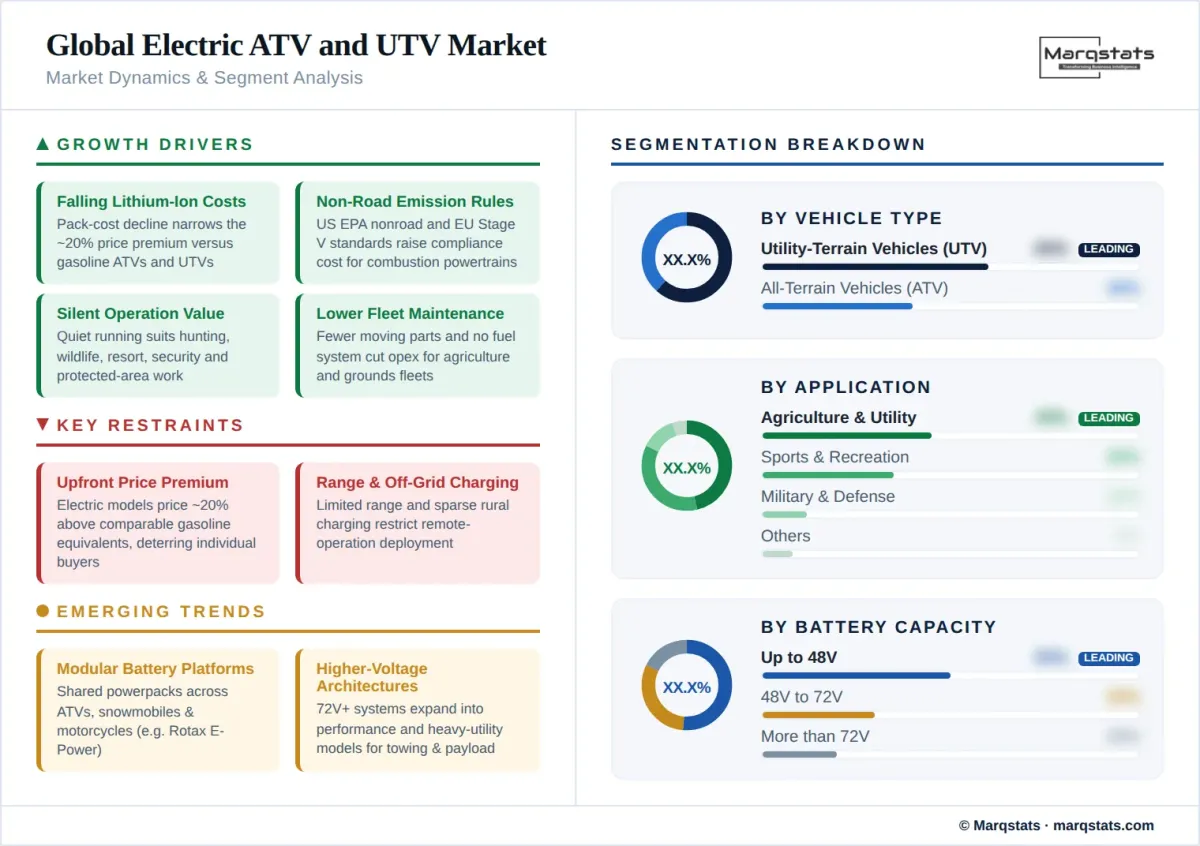
- Falling lithium-ion pack costs improve total cost of ownership, narrowing the price premium against gasoline ATVs and UTVs and accelerating fleet conversion.
- Tightening non-road engine emission requirements, including federal nonroad engine standards and regional low-emission mandates, raise compliance costs for combustion powertrains and favor electric alternatives.
- Silent operation supports hunting, wildlife management, security patrol, and resort use, where engine noise constrains conventional vehicles.
- Lower maintenance, owing to fewer moving parts and no fuel system, reduces operating expense for agriculture and grounds-maintenance fleets.
- Established powersports manufacturers expanded electric model availability through 2025, improving dealer coverage, financing, and after-sales support.
- Instant torque and selectable drive modes improve low-speed control on rough terrain, supporting work and trail applications.
Key Restraints
- Upfront purchase prices exceed comparable gasoline models, with electric premiums near 20%, constraining adoption among price-sensitive individual buyers.
- Limited range and recharge time restrict use in remote operations far from grid access, where gasoline refueling remains faster.
- Battery raw-material price volatility, owing to concentrated lithium and nickel supply, introduces cost uncertainty for manufacturers.
- Sparse off-grid charging in rural and trail environments slows deployment outside depot-based fleet use.
Key Trends
- Modular battery platforms shared across motorcycles, snowmobiles, and ATVs lower development cost and improve manufacturing scale, as seen in shared Rotax E-Power hardware.
- Higher-voltage architectures above 72V expand into performance and heavy-utility models, supporting greater towing and payload.
- Telematics, remote diagnostics, and selectable drive modes increasingly feature as standard, supporting fleet management and uptime.
- Electric-native startups and Chinese powersports manufacturers enter Western markets, broadening price points and intensifying competition.
Market Segmentation
The market segments by vehicle type into all-terrain vehicles and utility-terrain vehicles. Utility-terrain vehicles hold the larger revenue share, owing to higher unit prices and strong work demand. All-terrain vehicles sustain large unit volume across recreation. Electric adoption advances faster in the utility-terrain class, owing to depot charging and fleet duty cycles, while all-terrain electrification follows as cell costs decline.
All-terrain vehicles account for a substantial share of unit volume, owing to affordability and recreational demand. Single-rider quads dominate entry-level and youth-adjacent recreation. Electric ATVs priced near gasoline equivalents, such as models starting close to USD 12,999, broaden appeal among farmers, ranchers, and hunters seeking quiet operation. The class benefits from lower component count and simpler maintenance. Youth models adopt speed limiting and passcode-protected start, supporting controlled introduction for younger riders. Established safety standards govern stability, braking, and rider training across major markets.
Utility-terrain vehicles, also termed side-by-sides, command the largest revenue share, owing to higher price points and strong agriculture and utility demand. Multi-passenger cabins, cargo beds, and towing capacity suit work applications. The side-by-side segment records the fastest growth within the vehicle-type dimension. Depot-based duty cycles align with overnight charging, supporting fleet adoption.
Premium electric side-by-sides match combustion equivalents on payload and towing, while adding onboard power export for field tools. The Polaris RANGER XP Kinetic and the Deere Gator GX target light-duty commercial and rural work, owing to predictable routes and grid access at base. Higher unit prices and richer feature content raise average selling values, reinforcing the revenue lead of this class. Fleet buyers prioritize uptime, serviceability, and total operating cost, where reduced maintenance and zero fuel expense strengthen the electric case.
The market segments by application into agriculture and utility, sports and recreation, military and defense, and others. Agriculture and utility anchors electric adoption, while recreation sustains volume and defense adds high-value demand.
Agriculture and utility applications form the core demand base for electric models, owing to depot-based operation, predictable duty cycles, and grid access for overnight charging. Quiet running and zero emissions suit livestock, orchard, vineyard, and enclosed-facility work. The segment accounted for the foremost share of electric off-road deployment. Lower running costs improve fleet economics across high-utilization sites. Onboard power export supports field tools, while reduced vibration improves operator comfort across long shifts. Towing and payload capacity match combustion equivalents in current models.
Sports and recreation sustains large volume across North America and Europe. Trail riding, hunting, and adventure tourism drive purchases. Silent operation appeals to hunters and wildlife operators, expanding electric adoption within this application. Premium performance side-by-sides extend the segment toward enthusiast buyers.
Resort operators, guided tour providers, and managed trail networks adopt electric models to meet noise limits in protected and residential areas. Instant torque and selectable drive modes improve low-speed control on technical terrain, supporting both novice and experienced riders. Recreational demand remains concentrated in mature powersports markets, where dealer density and financing support purchase. Battery range suits day-use riding patterns, with overnight home charging covering typical recreational duty cycles.
Military and defense records strong forecast growth, owing to the tactical advantage of low acoustic and thermal signature. Electric off-road platforms support reconnaissance, perimeter patrol, and logistics across forward areas. Onboard power export supports field equipment and communications. Procurement favors rugged, serviceable platforms with predictable range.
Defense agencies evaluate electric off-road vehicles for silent-watch operation, where engine noise and exhaust heat compromise concealment. Exportable power supports sensors, communications, and charging of dismounted equipment in the field. Procurement programs emphasize durability, field repairability, and battery thermal management across extreme operating conditions. Higher unit values and specialized requirements position defense as a high-margin application, although volumes remain smaller than agriculture and recreation.
The market segments by battery capacity into up to 48V, 48V to 72V, and more than 72V classes. Entry-level classes hold volume, while higher-voltage classes support performance and heavy-utility demand.
The up to 48V class holds a large revenue share, near 50%, owing to entry-level pricing and suitability for light-duty recreation and utility tasks. These models serve individual buyers and grounds-maintenance fleets. Lower battery content reduces purchase price and supports broad accessibility. The class suits short-duty, low-speed operation across golf-style utility vehicles, youth recreation, and property maintenance, where range demands stay modest.
The 48V to 72V class balances performance and cost, supporting mid-range utility and recreation models. The class scales well across multi-passenger side-by-sides and mixed-duty fleets. Improving cell density extends range within this voltage band. The Deere Gator GX, fitted with a 51.2V lithium-ion system, and the Massimo utility UTV, fitted with a 72V system, illustrate the class. Moreover, this band serves the broadest range of work and recreation duty cycles, supporting its growth across fleet procurement.
The above-72V class supports performance and heavy-utility models, owing to higher power and towing demand. Premium side-by-sides and defense platforms adopt these architectures. The class records strong growth as manufacturers target work duty cycles and higher payload. Higher voltage improves efficiency at high power, reduces current draw, and supports faster charging. Performance models such as the Can-Am Outlander Electric adopt elevated-voltage systems to deliver high torque and towing capacity.
By Geography
North America
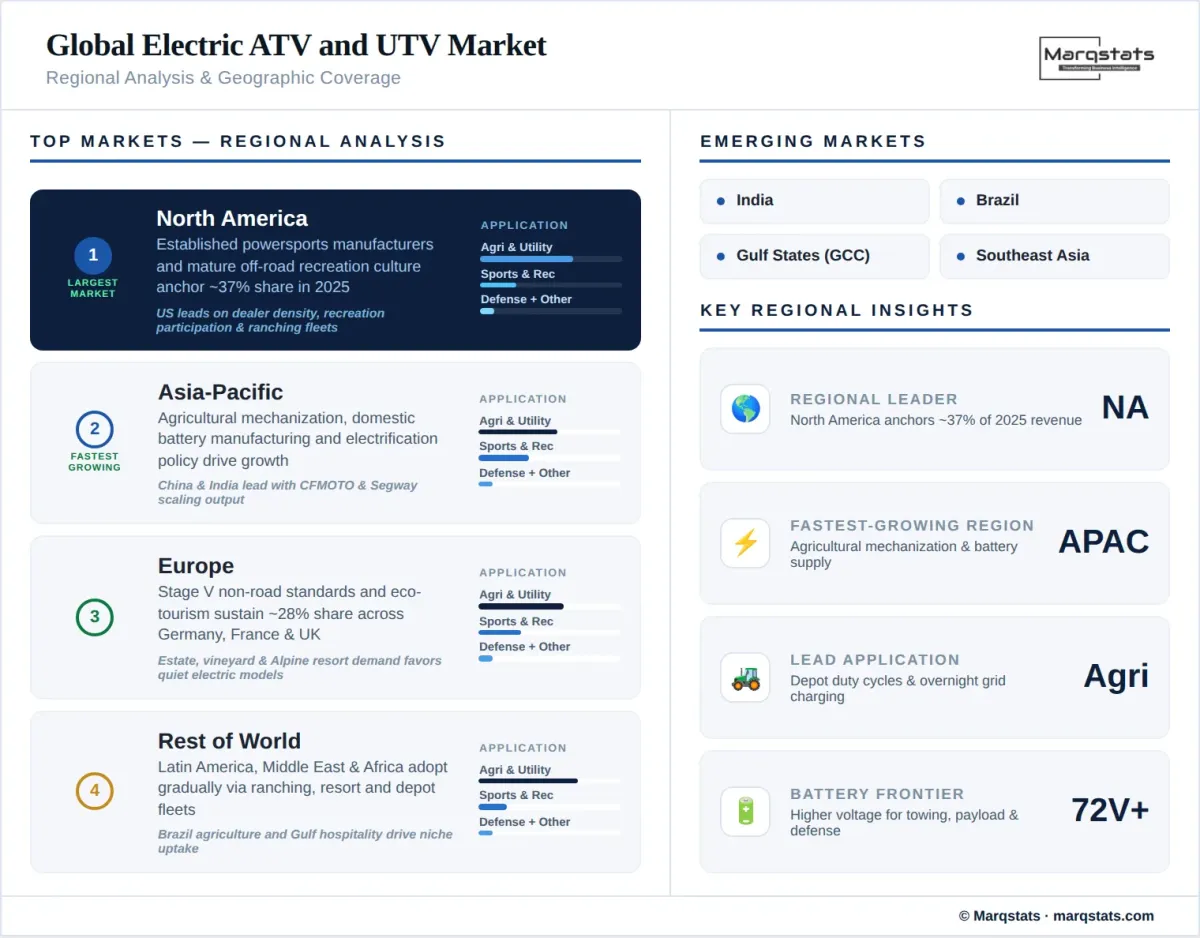
North America holds the largest revenue share, near 37% in 2025, supported by established powersports manufacturers, a mature off-road recreation culture, and large agriculture and ranching fleets across the United States and Canada. The United States contributes the foremost national share, owing to high recreation participation and strong dealer density. Tightening non-road engine requirements and California zero-emission fleet rules reinforce fleet electrification. Shared off-highway manufacturing capacity with the region’s electric construction equipment segment concentrates engineering and dealer support, owing to overlapping original-equipment manufacturers.
Europe
Europe represents the second-largest regional market, near 28% share in 2025, supported by stringent non-road emission standards and sustainability-focused policy. Germany, France, and the United Kingdom promote electrified mobility across recreation and utility. Stage V non-road emission ceilings raise after-treatment costs for combustion engines above 19 kW, favoring electric alternatives. Eco-tourism, estate management, vineyard work, and grounds-maintenance demand sustain growth. Higher fuel costs strengthen the running-cost case for electric fleets. Nordic and Alpine resorts adopt quiet electric models for trail and slope-side operation, owing to noise restrictions in protected areas.
Asia-Pacific
Asia-Pacific records the fastest regional growth, owing to agricultural mechanization, domestic battery manufacturing capacity, and supportive electrification policy. China anchors regional development through extensive electric vehicle policy and large domestic powersports production. Domestic manufacturers, including CFMOTO and Segway Powersports, scale electric side-by-side output for export and local demand. India contributes growth across agriculture and utility, supported by farm mechanization and rural electrification. Japan and Australia add demand across recreation, agriculture, and defense. Local manufacturing lowers price points and broadens access across price-sensitive buyers.
Rest of World
Rest of World, spanning Latin America, the Middle East, and Africa, contributes a smaller share. Agricultural and ranching demand in Brazil and resort use across the Middle East support gradual adoption. Trade arrangements that lower component tariffs ease market entry in parts of South America. Limited charging access constrains deployment outside depot fleets. Gulf hospitality and estate operators adopt quiet electric models for grounds work, while South American agriculture drives utility demand. Sparse rural grid infrastructure and higher import costs slow broader uptake across the region.
How Competition Is Evolving
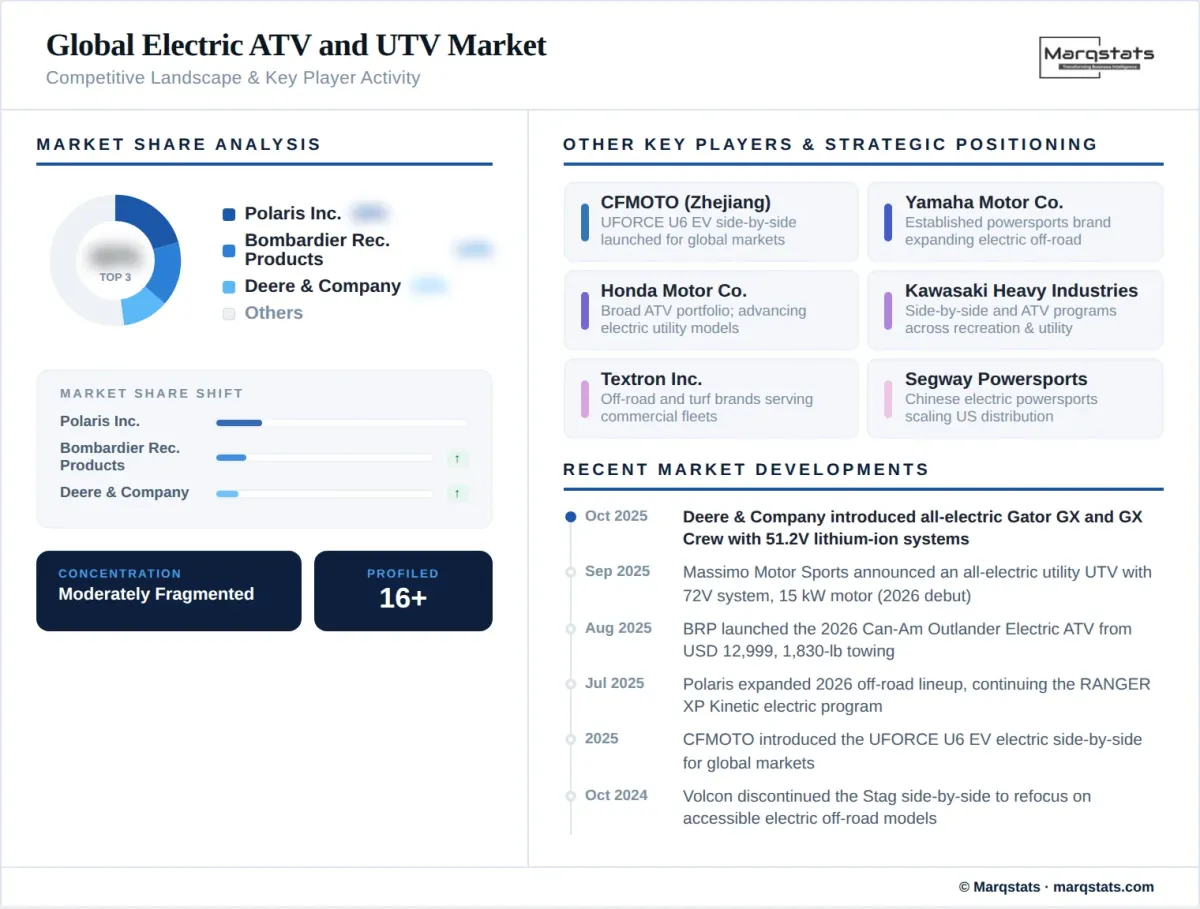
The electric ATV and UTV market is moderately fragmented. Established powersports manufacturers hold strong positions, owing to brand recognition, dealer networks, and after-sales infrastructure. Electric-native startups and Chinese manufacturers add competition across price points. No single manufacturer dominates global electric off-road volume. Competition spans value entry-level models and premium performance side-by-sides.
Manufacturers compete through modular electric platforms, towing and payload performance, and quiet-operation features. Bombardier Recreational Products shares its Rotax E-Power powerpack across motorcycles, snowmobiles, and the Can-Am Outlander Electric, spreading development cost. Polaris fields the RANGER XP Kinetic in the premium utility segment. Deere & Company addresses light-duty commercial and rural work with the all-electric Gator GX and GX Crew. CFMOTO introduced the UFORCE U6 EV side-by-side for global markets.
Geographic expansion and product diversification define competitive activity. Chinese manufacturers expanded United States distribution through 2025, broadening price competition. Partnerships with battery and powertrain suppliers improve range and reduce maintenance. Massimo Motor Sports announced an all-electric utility UTV for 2026 debut. Several startups, including Volcon, refocused model ranges toward accessible price points to align with demand.
Pricing strategy, dealer coverage, financing, and accessory ecosystems shape purchase decisions. Quiet operation, towing capacity, and fast charging serve as primary differentiators. Manufacturers position electric models against gasoline equivalents on performance parity rather than emissions alone, supporting adoption among work and recreation buyers.
Several manufacturers pursue broad electric powersports portfolios that span multiple vehicle categories. Bombardier Recreational Products fields electric motorcycles, four electric snowmobiles, a kart racing powerpack, and the Outlander Electric ATV, supported by shared Rotax E-Power hardware. Polaris developed the RANGER XP Kinetic as a premium electric utility platform, although high early pricing constrained volume. Component suppliers contribute battery management, motor, and controller technology, supporting original-equipment manufacturers across the value chain. Partnerships between vehicle makers and powertrain specialists target longer range and lower maintenance.
Companies Covered
The report profiles 16++ companies with full strategy and financials analysis, including:
Recent Market Activity
Table of Contents
Coverage & Segmentation
This report analyzes the global electric ATV and UTV market across the 2021–2025 historical period and the 2026–2030 forecast period, with 2025 as the base year. Coverage spans market size by value and volume, segmentation by vehicle type, application, and battery capacity, regional and country-level analysis, competitive positioning, and recent developments. The study examines demand drivers, restraints, pricing dynamics, and regulatory influence across major regions.
Primary research included 40+ interviews with manufacturers, fleet operators, dealers, and component suppliers. Secondary research drew from government emission databases, environmental regulatory agencies, industry association data, company filings, customs and registration records, and trade publications. Market estimates were built bottom-up and validated against top-down references for internal consistency.