Market Snapshot
Middle bar: base-year value × (1 + CAGR), rounded to two decimals. This is a calculated illustration, not a separately researched annual estimate.
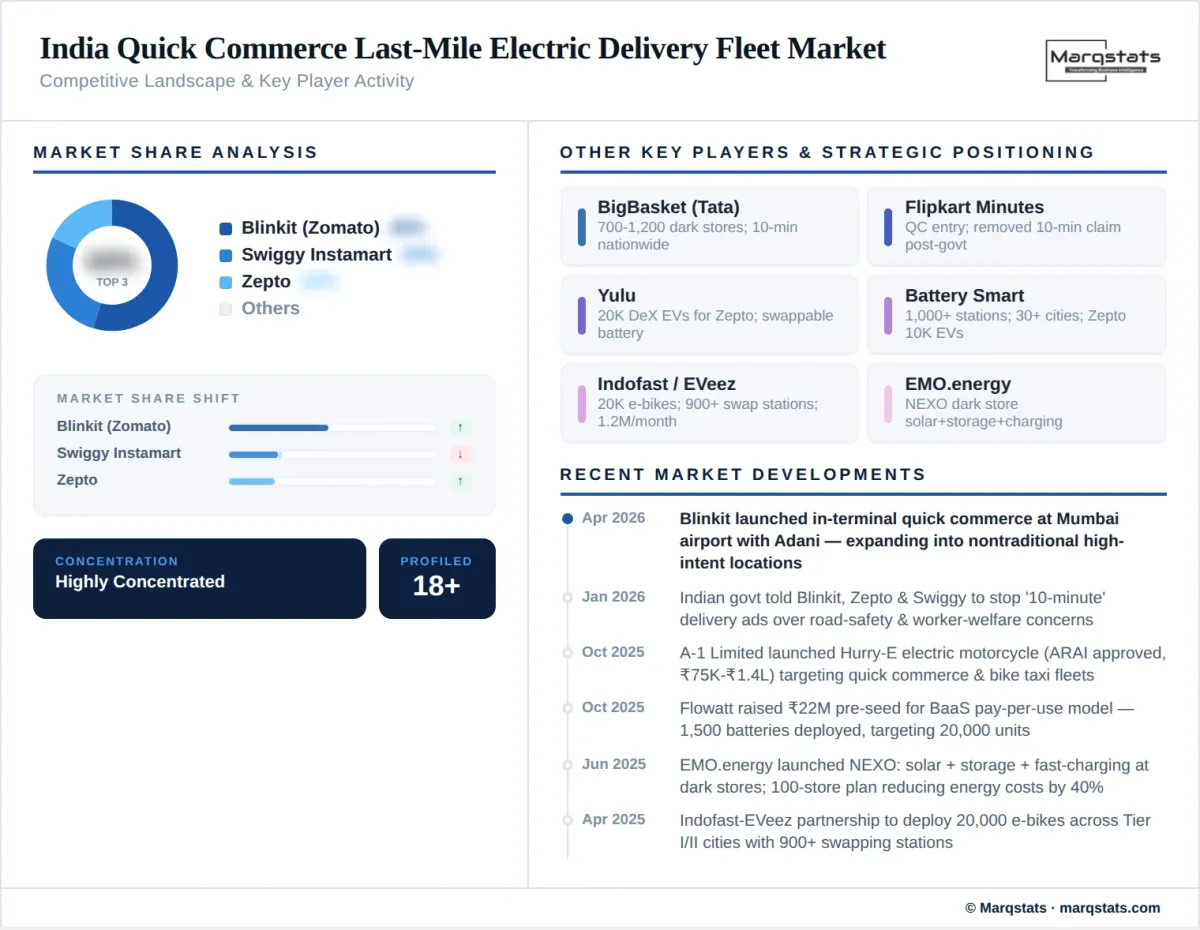
India’s quick commerce delivery fleet market is one of the fastest-scaling urban logistics systems in the world. The quick-commerce sector was valued at approximately ₹64,000 crore in FY25 and is projected to reach roughly ₹2 lakh crore by FY28, growing at approximately 40% annually to 2030. Quick commerce captured over two-thirds of all e-grocery orders in 2024 and about one-tenth of total e-retail spending. Blinkit led with 48% market share in 2025, versus 24% for Swiggy Instamart and 22% for Zepto. The top platforms together handle approximately 4.3–4.8 million orders per day, creating one of the most intensive hyperlocal delivery networks globally. The India quick commerce and last-mile electric delivery fleet market size was valued at approximately USD 1.87 billion in 2025 and is projected to reach USD 6.42 billion by 2030, expanding at a CAGR of 28.02% during the forecast period (2026–2030).
Electrification is no longer marginal—it is becoming a competitive differentiator. Blinkit had 15,000+ active EV-based quick-commerce delivery partners in March 2025. Zomato and Blinkit together had 51,000+ EV-based delivery partners covering 150 million clean kilometres in FY25. Swiggy committed to a 100% low-carbon delivery fleet by 2030, with EV delivery partners growing 7x in FY25 and EVs contributing 10–12% of its fleet covering approximately 10 million km per month. Swiggy’s delivery partner network grew 32% year-over-year to 6.9 lakh by October 2025. The India e-commerce last-mile delivery vehicle mix is dominated by electric two-wheelers and three-wheelers, with battery swapping and BaaS models from Yulu, Battery Smart, and Zypp Electric solving the 15–20 hour daily charging challenge that quick commerce riders face.
The operating model is a dark-store-density and fleet-productivity race. Blinkit operated approximately 1,007 warehouses in March 2025. Swiggy Instamart expanded from 609 dark stores (44 cities, September 2024) to 705 stores (84 cities, February 2025) and then to 1,021 stores by its FY25 AGM—more than doubling—with 4 million sq ft of footprint. Zepto had 900+ stores. BigBasket planned to grow from 700 to 1,000–1,200 dark stores by end-2025. Dark store EV charging co-location is emerging as a critical infrastructure layer, with EMO.energy launching NEXO—integrating solar, battery storage, and fast-charging at dark stores—planned for deployment at 100 dark stores across 2 major cities. The Marqstats India EV battery swap market report and India electric two-wheeler battery market report provide complementary coverage of the swapping ecosystem and 2W battery architecture underpinning delivery fleet electrification.
Key Takeaways
Market Overview & Analysis
Report Summary
The India quick commerce and last-mile electric delivery fleet market covers the hyperlocal delivery fleet layer serving quick-commerce platforms (Blinkit, Swiggy Instamart, Zepto, BigBasket, Flipkart Minutes) and broader e-commerce last-mile operations (Amazon India, Flipkart). The scope includes delivery riders and vehicles (electric 2W and 3W), dark-store dispatch networks and micro-fulfilment operations, EV access models (purchase, rental, Fleet-as-a-Service), battery swapping and BaaS infrastructure serving delivery riders, dark store EV charging co-location, fleet management software and algorithmic dispatch, and the labour/regulatory framework governing gig delivery workers. The market is best understood as a logistics operating system for urban top-up shopping: dense dark stores, large gig-rider networks, rising EV penetration, platform-led asset orchestration, and tightening regulatory oversight.
Quick commerce is an unusually good fit for electric vehicles because of short routes, dense urban loops, and repeated depot/dark-store exposure. The average quick-commerce delivery radius is 2–4 km from dark store to customer, creating ideal conditions for low-speed and high-speed electric two-wheelers that need only brief charging or battery-swap intervals between delivery runs. India had 7.7 million gig and platform workers in 2020–21, projected to rise to 23.5 million by 2029–30. Quick commerce is one of the most visible urban gig segments, making it a focal point for both EV enablement and labour regulation.
Market Dynamics
Key Drivers
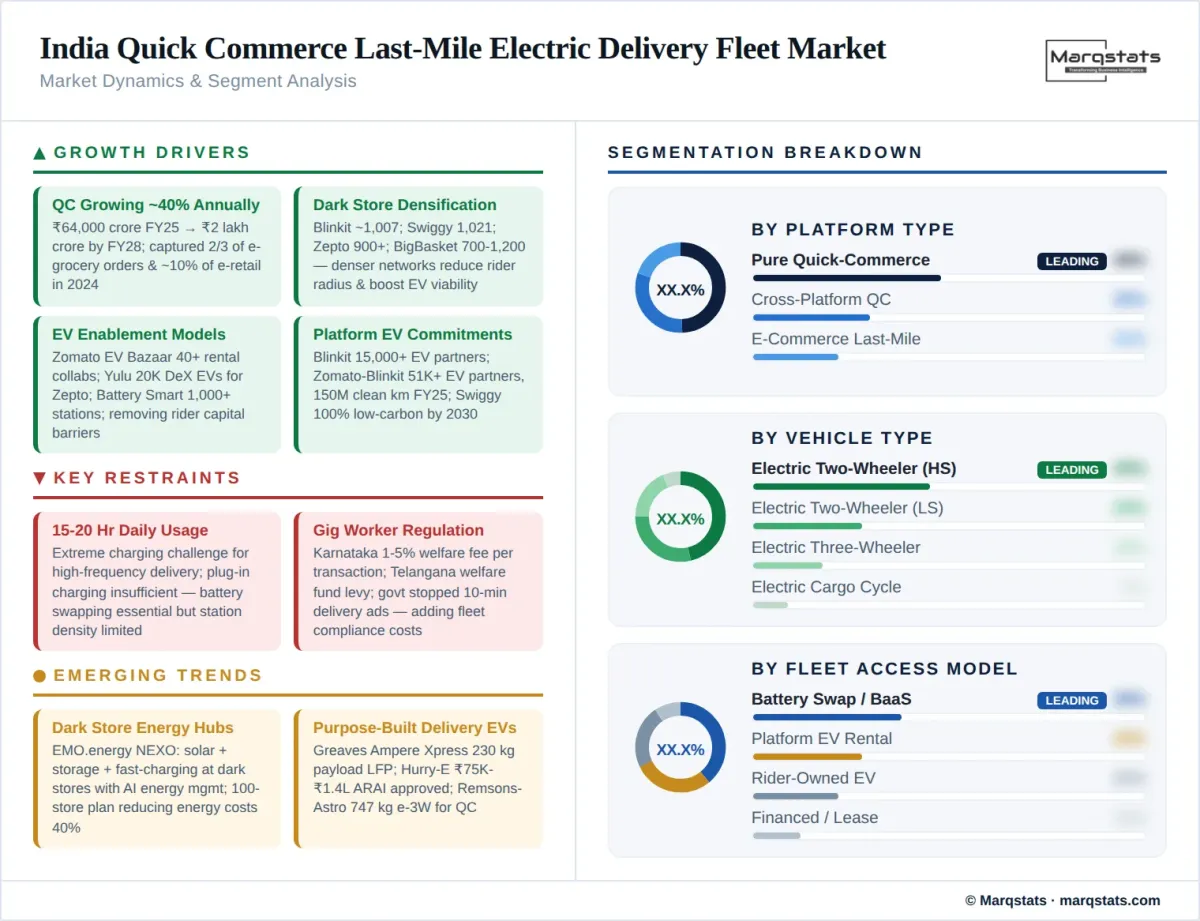
- Quick commerce growing ~40% annually, capturing two-thirds of e-grocery orders: The sector reached ~₹64,000 crore in FY25, projected to ~₹2 lakh crore by FY28. Quick commerce accounted for about one-tenth of total e-retail spending in 2024. India’s quick-commerce sector was valued at approximately USD 11.5 billion. Blinkit’s order value surpassed Zomato food delivery in the June 2025 quarter—showing quick commerce has become the core growth engine for major listed platforms.
- Dark-store densification reducing rider radius and improving fleet productivity: Blinkit: ~1,007 warehouses (March 2025). Swiggy Instamart: 609 → 705 → 1,021 dark stores (September 2024 → February 2025 → FY25 AGM), 4 million sq ft footprint. Zepto: 900+ stores. BigBasket: 700 growing to 1,000–1,200 by end-2025. A denser dark-store network reduces rider travel radius, improves pick-pack speed, and raises deliveries per rider-hour—directly increasing fleet utilisation and EV viability.
- EV enablement models removing rider capital barriers: Platforms are not forcing riders to buy EVs—they are building access through rentals, battery swapping, and financing. Zomato/Blinkit EV Bazaar: “Rent an EV” through 40+ collaborations. Swiggy: ~50 EV ecosystem vendors, 70+ EV models across low-speed and high-speed. Zepto: Yulu deploying 20,000 DeX EVs; Battery Smart providing 1,000+ swapping stations across 30+ cities. Indofast Energy/EVeez: 20,000 electric bikes across Tier I/II cities for quick commerce, e-commerce, and food delivery. Flowatt: BaaS pay-per-use model with IoT-enabled batteries for commercial EV fleets.
- Category expansion lifting rider utilisation and basket value: Zepto now offers 45,000+ products. BigBasket launching nationwide 10-minute food delivery by March 2026. Blinkit launched in-terminal quick commerce at Mumbai airport with Adani (April 2026). Quick commerce is moving beyond emergency grocery into electronics, beauty, food, and impulse categories—supporting better rider productivity per trip.
- PM E-DRIVE and charging infrastructure policy creating supportive backdrop: PM E-DRIVE includes ₹2,000 crore for EV charging infrastructure through March 2028. India’s 2024 Ministry of Power guidelines for charging and battery swapping support fleet electrification. While not quick-commerce-specific, these policies lower the cost of EV infrastructure that delivery fleets directly use. Greaves Cotton’s Ampere Xpress concept (Auto Expo 2025) is purpose-designed for quick commerce with 230 kg payload and LFP battery technology.
Key Restraints
- Quick commerce rider 15–20 hour daily usage creating extreme charging challenge: High-frequency delivery operations mean riders need vehicles available nearly continuously. Conventional plug-in charging cannot meet this demand profile. Battery swapping (Yulu, Battery Smart, Indofast, SUN Mobility) is the primary solution, but swapping station density is still limited outside top-tier cities. Flowatt’s BaaS model with IoT-enabled tracking addresses battery health management during intensive commercial use.
- Labour and safety regulation raising per-transaction fleet costs: January 2026: government told Blinkit, Zepto, Swiggy to stop advertising “10-minute” delivery over road-safety and worker-welfare concerns. Karnataka 2025 law: welfare fee of 1–5% of payout per gig transaction. Telangana 2026 framework: welfare fund levy plus social security architecture. These add compliance costs to already thin unit economics. India’s gig workforce is projected at 23.5 million by 2029–30.
- Fleet economics still heavily shaped by discounts and rapid network buildout: Retail distributors asked India’s competition regulator to investigate Blinkit, Zepto, and Swiggy over alleged deep discounting and predatory pricing. Quick-commerce unit economics are still being proven—platforms balance growth-stage discounting against path to profitability. Swiggy showed sequential loss improvement on Instamart strength in January 2026.
Key Trends
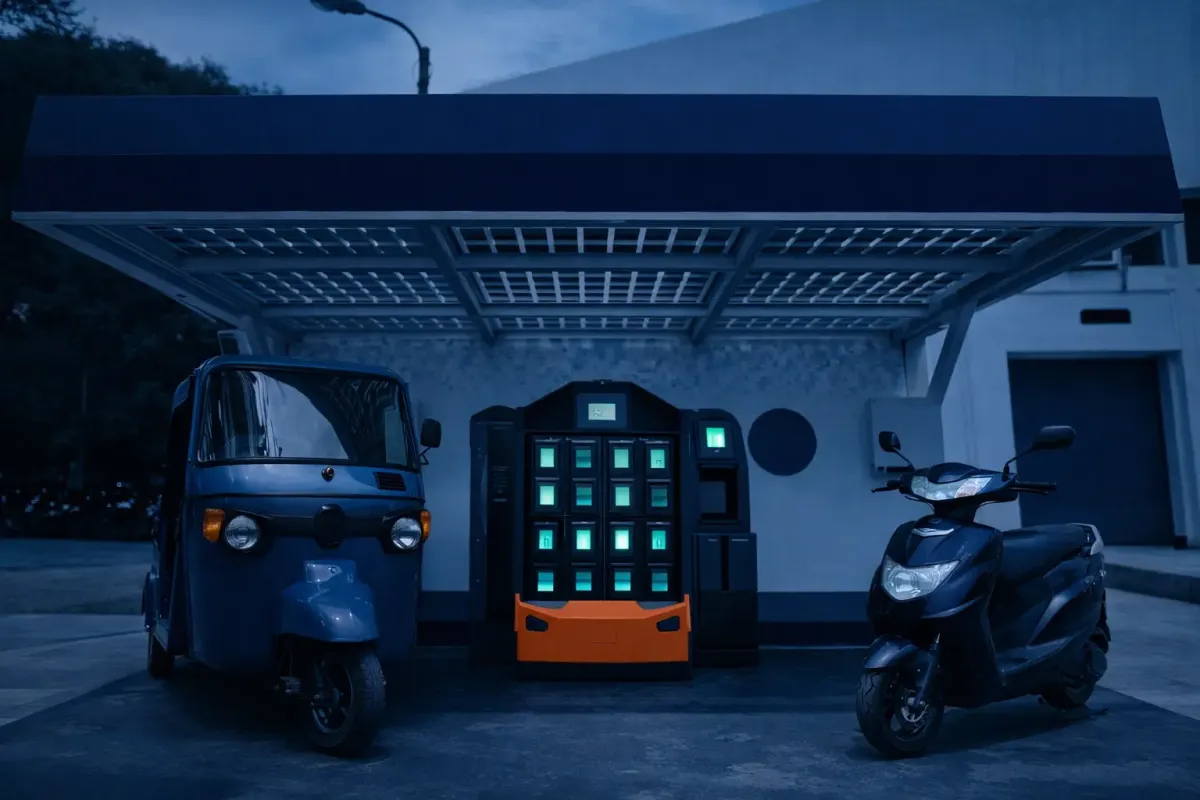
- Dark store EV charging co-location as integrated energy infrastructure: EMO.energy launched NEXO (June 2025): a vertically integrated energy ecosystem for dark stores integrating solar power, battery energy storage, and fast-charging stations, managed through AI-enabled health and energy management. Planned for 100 dark stores across 2 cities, reducing energy costs by up to 40%. This transforms dark stores from pure fulfilment nodes into energy hubs that directly support fleet charging.
- Purpose-built delivery EVs entering the market for quick commerce: Greaves Cotton’s Ampere Xpress (Auto Expo 2025): designed specifically for quick-commerce delivery with 230 kg payload capacity and safe LFP battery technology. A-1 Limited’s Hurry-E electric motorcycle (ARAI approved, ₹75,000–₹1,40,000) targets mass and fleet buyers including quick commerce. Remsons/Astro Motors acquired for electric three-wheelers targeting last-mile delivery and quick commerce. The vehicle ecosystem is becoming purpose-designed for commercial delivery rather than adapted from consumer models.
- Zomato/Blinkit profitability trajectory validating fleet investment: Blinkit’s quick-commerce order value surpassed Zomato food delivery in June 2025. Swiggy Instamart was about two-thirds the GOV of food delivery by Q4 FY25 with sequential loss improvement. Zepto was valued at USD 7 billion (October 2025) with ~USD 900 million net cash reserves and confidential IPO filing. These financial trajectories validate continued fleet investment and EV adoption.
- Platforms softening public speed claims while maintaining operational speed: After January 2026 government intervention, platforms removed overt “10-minute” language, but underlying operating models have not changed. Flipkart also removed its explicit “10-minute” claim. The market is moving toward less aggressive public messaging with the same fast-fulfilment backbone—meaning fleet intensity and EV demand continue unaffected.
Market Segmentation
Blinkit (Eternal/Zomato): 48% market share, ~1,007 warehouses, 15,000+ EV quick-commerce partners, EV Bazaar with 40+ rental collaborations, Mumbai airport launch with Adani. Zepto: 22% share, 900+ stores, 45,000+ products, USD 7 billion valuation, Yulu 20,000 DeX EVs, Battery Smart 1,000+ stations. These platforms are quick-commerce-native and their entire fleet model is optimised for hyperlocal delivery from dark stores.
Swiggy Instamart: 24% share, 1,021 dark stores (FY25 AGM), 100% low-carbon fleet target by 2030, 10–12% EV fleet share, 6.9 lakh delivery partners across platform, ~50 EV ecosystem vendors. Swiggy’s advantage is platform breadth—food, quick commerce, and broader demand aggregation support rider utilisation across use cases. BigBasket (Tata Group): 700 dark stores growing to 1,000–1,200, nationwide 10-minute food delivery by March 2026.
Flipkart Minutes entered quick commerce, removed “10-minute” claim after government intervention. Amazon India operates extensive last-mile delivery fleets with growing EV adoption. These platforms bring massive existing logistics networks and capital to the quick-commerce fleet market, broadening competitive intensity.
The dominant delivery vehicle format. Swiggy offers 70+ EV models across low-speed and high-speed formats via ecosystem partners. A-1 Limited’s Hurry-E targets quick commerce and bike taxi at ₹75,000–₹1,40,000. Greaves Ampere Xpress designed for quick-commerce delivery with 230 kg payload. Yulu DeX EVs deployed for Zepto. Indofast Energy/EVeez deploying 20,000 electric bikes for quick commerce across Tier I/II cities. Electric 2Ws dominate because of low cost, narrow urban manoeuvrability, and compatibility with battery swapping.
Growing segment for larger-basket and cargo delivery. Remsons/Astro Motors e-3W (747 kg payload, 131 km range, 10.2 kWh battery) targets last-mile delivery and quick commerce. Greaves Xargo high-speed e-3W (300 kg payload, 100+ km range, 5 kWh LFP). PM E-DRIVE supports commercial-use e-3Ws. 3Ws serve both quick-commerce cargo runs and broader e-commerce last-mile delivery requiring larger cargo volume.
The fastest-growing access model. Battery Smart: 1,000+ swapping stations, 30+ cities, partnership with Zepto for 10,000 new EVs. Yulu: 20,000 DeX EVs for Zepto partners. Indofast Energy: 900+ stations, 22+ cities, 1.2 million swaps/month, partnering with EVeez for 20,000 bikes. Flowatt: BaaS pay-per-use with IoT tracking, 1,500 batteries deployed, targeting 20,000 units. SUN Mobility: IndianOil JV targeting 10,000+ stations. BaaS solves the quick-commerce rider’s core problem: 15–20 hour daily usage requiring near-continuous vehicle availability.
Zomato/Blinkit EV Bazaar: “Rent an EV” through 40+ collaborations. Swiggy: ~50 EV ecosystem vendors. Platform-orchestrated rental removes capital barriers for gig riders who cannot afford EV purchase. This model is asset-light at platform level but creates captive fleet relationships with vehicle providers.
Declining as a share of new EV adoption among delivery riders due to capital constraints, but still significant in the installed base. Low-cost models like Hurry-E (₹75,000–₹1,40,000) target mass buyers including quick-commerce riders. PM E-DRIVE subsidies for commercial-use e-2W and e-3W support this channel.
By Geography
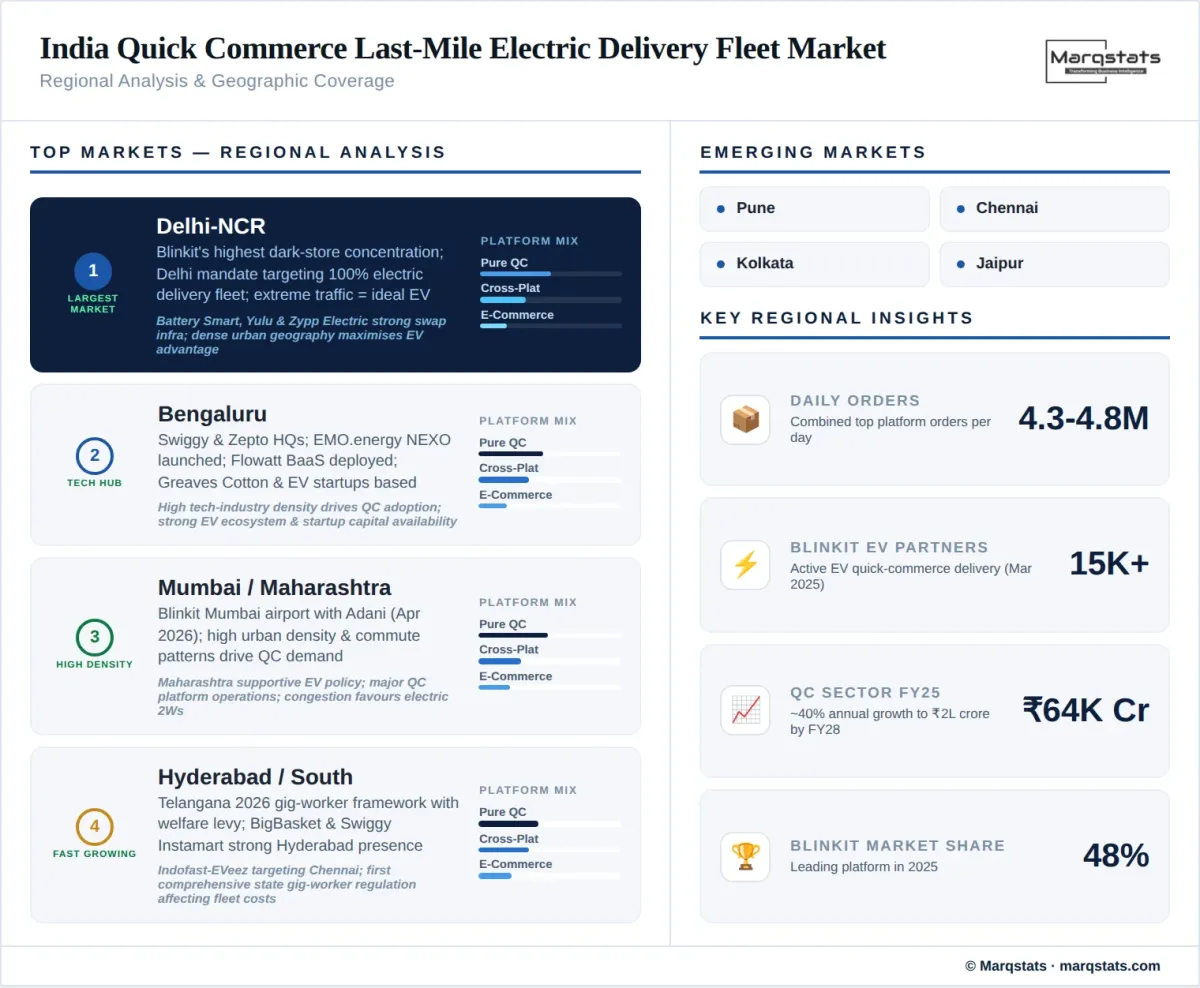
Delhi-NCR (Including Gurgaon)
The largest quick-commerce market by order density. Blinkit’s highest dark-store concentration. Delhi mandate targeting 100% electric delivery fleet creates regulatory pull. Dense urban geography and extreme traffic congestion make electric 2Ws and battery swapping ideal. Battery Smart, Yulu, and Zypp Electric all have strong Delhi-NCR swapping infrastructure.
Bengaluru
Second-largest market and headquarters of Swiggy and Zepto. High tech-industry density drives quick-commerce adoption. EMO.energy launched NEXO dark-store energy platform from Bengaluru. Flowatt is Bengaluru-based, deploying BaaS for commercial EV fleets. Greaves Cotton and multiple EV startups are based in the city.
Mumbai / Maharashtra
Third-largest market. Blinkit launched in-terminal quick-commerce at Mumbai airport with Adani (April 2026). High urban density and commute patterns drive quick-commerce demand. Maharashtra has supportive EV policy and charging infrastructure programmes.
Hyderabad / Telangana
Fast-growing market. Telangana’s 2026 gig-worker framework imposes welfare fund levy and social security for delivery riders—the first comprehensive state-level framework affecting quick-commerce fleet costs. BigBasket and Swiggy Instamart have strong Hyderabad presence.
Chennai / Tamil Nadu
Growing quick-commerce market. Indofast Energy/EVeez targeting Chennai as a priority deployment city for 20,000 electric bikes. A-1 Limited’s Hurry-E manufactured in Ahmedabad but targeting Chennai and South India markets. Tamil Nadu has growing e-2W manufacturing ecosystem.
Tier I and Tier II City Expansion
Quick commerce expanding beyond top 6 cities. Swiggy Instamart expanded from 44 to 84 cities (September 2024 to February 2025). Indofast Energy/EVeez targeting Pune, Jaipur, Lucknow, and Vijayawada alongside Tier I cities. BigBasket and Flipkart Minutes are driving geographic expansion. Tier II presents lower dark-store density but growing demand.
How Competition Is Evolving
Three competitive layers define this market. Quick-commerce platform operators control demand, dispatch, and rider relationships: Blinkit (Eternal/Zomato: 48% share, ~1,007 warehouses, 15,000+ EV quick-commerce partners, EV Bazaar 40+ collaborations, Mumbai airport launch), Swiggy Instamart (24% share, 1,021 dark stores, 100% low-carbon by 2030, 10–12% EV fleet, ~50 EV ecosystem vendors, 6.9 lakh total delivery partners), Zepto (22% share, 900+ stores, 45,000+ products, USD 7B valuation, Yulu/Battery Smart partnerships, confidential IPO filing), BigBasket (Tata Group: 700–1,200 dark stores, nationwide 10-minute food delivery by March 2026), and Flipkart Minutes (removed 10-minute claim after government intervention, but actively competing).
EV access and battery-swapping infrastructure providers solve the rider charging challenge: Yulu (20,000 DeX EVs for Zepto), Battery Smart (1,000+ stations, 30+ cities, Zepto partnership for 10,000 EVs), Indofast Energy/EVeez (20,000 electric bikes across Tier I/II cities, 900+ stations, 1.2M swaps/month), Flowatt (BaaS pay-per-use with IoT, 1,500 batteries deployed, targeting 20,000), SUN Mobility/IndianOil (10,000+ station target), and Zypp Electric (prominent delivery fleet EV provider). EMO.energy’s NEXO provides dark-store-integrated solar + storage + charging infrastructure.
Vehicle OEMs are increasingly designing purpose-built delivery EVs: Greaves Cotton (Ampere Xpress for quick commerce, 230 kg payload, LFP; Xargo e-3W, 300 kg payload), A-1 Limited/Hurry-E (ARAI approved, ₹75K–₹1.4L, quick commerce + bike taxi), Remsons/Astro Motors (e-3W, 747 kg payload, 131 km range, quick commerce targeting), and the broader India e-2W OEM ecosystem supplying the 70+ models available through Swiggy’s platform.
Companies Covered
Companies covered in the report include:
Recent Market Activity
Table of Contents
Coverage & Segmentation
This report provides a comprehensive analysis of the India quick commerce and last-mile electric delivery fleet market covering the historical period (2021–2025) and forecast period (2026–2030), with 2025 as the base year. The study examines market size in USD across platform type (pure quick-commerce, cross-platform, e-commerce last-mile), vehicle type (electric 2W low-speed, electric 2W high-speed, electric 3W), EV access model (battery swapping/BaaS, rental/FaaS, rider-owned), and geography covering 10 city/state clusters. Company profiling covers 18+ players across quick-commerce platforms, EV/swapping providers, energy infrastructure, and delivery vehicle OEMs. Policy analysis covers PM E-DRIVE, Ministry of Power charging guidelines, Karnataka gig-worker law, Telangana framework, and Delhi EV mandate.
Research methodology combines bottom-up modelling from platform-disclosed dark-store counts (Blinkit ~1,007, Swiggy 1,021, Zepto 900+, BigBasket 700–1,200), delivery partner disclosures (Swiggy 6.9 lakh, Blinkit 15,000+ EV QC), EV access programme data (Yulu 20,000, Battery Smart 1,000+ stations, Indofast 20,000 bikes), dark-store-level order throughput estimates (4.3–4.8 million orders/day), and EV penetration rates (Swiggy 10–12%, Zomato/Blinkit 51,000+ EV partners). Primary research encompasses 40+ interactions with quick-commerce logistics directors, delivery fleet managers, EV rental and swapping operators, dark-store operations teams, battery technology providers, and gig-worker policy specialists across Delhi-NCR, Bengaluru, Mumbai, Hyderabad, and Chennai.