Market Snapshot
Middle bar: base-year value × (1 + CAGR), rounded to two decimals. This is a calculated illustration, not a separately researched annual estimate.
The India sodium-ion electric two-wheeler battery market size is estimated at USD 1.87 million in 2025 and is projected to reach USD 256.44 million by 2030, growing at a CAGR of 167.56% over 2026 – 2030. Sodium-ion packs go from about 1,800 electric two-wheelers in 2025, 0.15% of high-speed E2W sales, to 560,000 in 2030, 14.55% of sales, and deployed capacity rises from about 5.4 MWh to 1.79 GWh.
Marqstats defines the market as the value of sodium-ion traction battery packs, including cells, battery management system and enclosure, fitted to new electric two-wheelers sold in India. In rupee terms, the market grows from INR 16.27 crore in 2025 to INR 2,231.04 crore in 2030. Values are converted at INR 87.00 per US dollar. In 2025 sodium-ion packs were at the pilot stage, used mainly by start-ups and delivery fleets, while lithium iron phosphate (LFP) and nickel manganese cobalt (NMC) packs powered more than 92% of new electric two-wheelers.
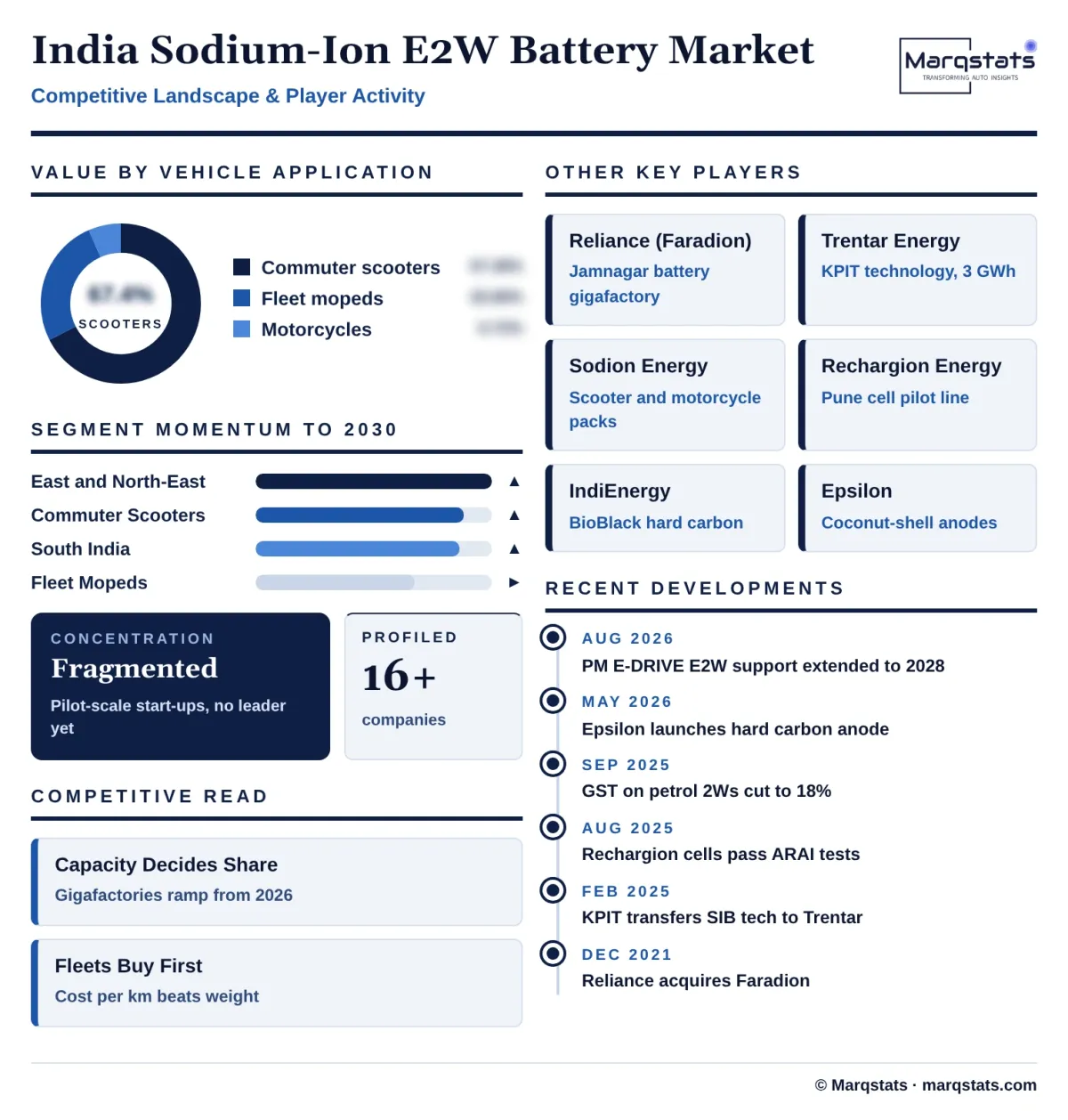
Commuter scooters account for an estimated 67.38% of 2025 value, delivery and fleet mopeds for 25.89% and electric motorcycles for 6.72%. North India holds an estimated 36.36% of 2025 value. The study segments the market by vehicle application and region and excludes lithium-ion packs, low-speed e-cycles, three-wheelers, replacement packs and stationary storage.
Key Takeaways
Market Overview & Analysis
Report Summary
Marqstats sizes the India sodium-ion electric two-wheeler battery market as the value of sodium-ion traction battery packs fitted to new high-speed electric scooters, mopeds and motorcycles sold in India, at pack price including cells, battery management system, wiring and enclosure. Lithium-ion packs, low-speed e-cycles below the registration threshold, electric three-wheelers, aftermarket replacement packs and stationary energy storage are excluded. In 2025 the market was worth an estimated USD 1.87 million from about 1,800 vehicles.
India's electric two-wheeler market provides the base. About 1.28 million electric two-wheelers were registered in calendar 2025, of which Marqstats counts about 1,233,600 high-speed models, and Marqstats expects 3.85 million high-speed E2W sales in 2030, a 25.56% annual growth rate. Battery demand from electric two-wheelers grows from about 3.70 GWh in 2025 to 12.32 GWh in 2030. Sodium-ion's share of this demand rises from 0.15% to 14.55% of units.
Sodium-ion batteries work like lithium-ion batteries but use sodium, which is abundant and widely available in India, instead of lithium, which India must import. The cells use layered oxide, polyanion or Prussian blue cathodes and hard carbon anodes, and can use aluminium foil instead of copper on both electrodes. This lowers material cost and allows cells to be stored and shipped fully discharged, without fire risk.
The trade-off is energy density. Commercial sodium-ion cells store about 120 to 160 Wh per kg, compared with 160 to 200 Wh per kg for LFP and more for NMC. That makes sodium-ion packs heavier and larger for the same range. In return, sodium-ion cells charge fast, work well in cold and hot weather and last for thousands of cycles, which suits high-use delivery fleets and budget commuter scooters with modest range needs.
India's industrial policy supports the shift. The INR 18,100 crore Production Linked Incentive scheme for Advanced Chemistry Cells is chemistry-neutral, so sodium-ion cell plants can qualify. Domestic companies are developing hard carbon anode materials from coconut shells and farm waste, and start-ups such as Sodion Energy, Rechargion Energy and IndiEnergy are building packs, cells and materials. As Reliance New Energy and Trentar begin volume production, Marqstats expects sodium-ion to become a second mainstream chemistry for Indian two-wheelers alongside LFP.
Battery chemistry choices in Indian two-wheelers have changed quickly. In 2022 and 2023 most packs used NMC cells, but battery fires in 2022 and the tighter AIS-156 rules that followed pushed OEMs towards LFP, which accounted for more than 80% of E2W packs by 2025. Sodium-ion is the next step in this shift: it keeps the safety advantages that drove the move to LFP while removing lithium from the supply chain. The speed of the earlier NMC-to-LFP transition shows how quickly Indian OEMs can change chemistry once cost and safety favour a new option.
The market also matters for supply security. More than 92% of new Indian electric two-wheelers in 2025 used lithium-ion chemistries dependent on imported cells and refined materials. A domestic sodium-ion supply chain reduces exposure to lithium price swings and export restrictions, which is why OEMs, cell makers and policymakers all have reasons to support it.
India Sodium-Ion Electric Two-Wheeler Battery Market Size and Forecast
The India sodium-ion electric two-wheeler battery market grows from USD 1.87 million in 2025 to USD 256.44 million in 2030, a CAGR of 167.56%. In rupees, the market grows from INR 16.27 crore to INR 2,231.04 crore. Sodium-ion vehicle volumes grow from about 1,800 to 560,000, and deployed capacity from about 5.4 MWh to 1.79 GWh, a 219.22% annual rate.
Growth builds year by year. Marqstats estimates INR 106.66 crore in 2026 with about 14,000 vehicles and 0.90% penetration, INR 319.80 crore in 2027 with 48,750 vehicles and 2.50% penetration, INR 714.22 crore in 2028 with 134,750 vehicles and 5.50% penetration, and INR 1,347.51 crore in 2029 with 294,500 vehicles and 9.50% penetration, before reaching INR 2,231.04 crore in 2030.
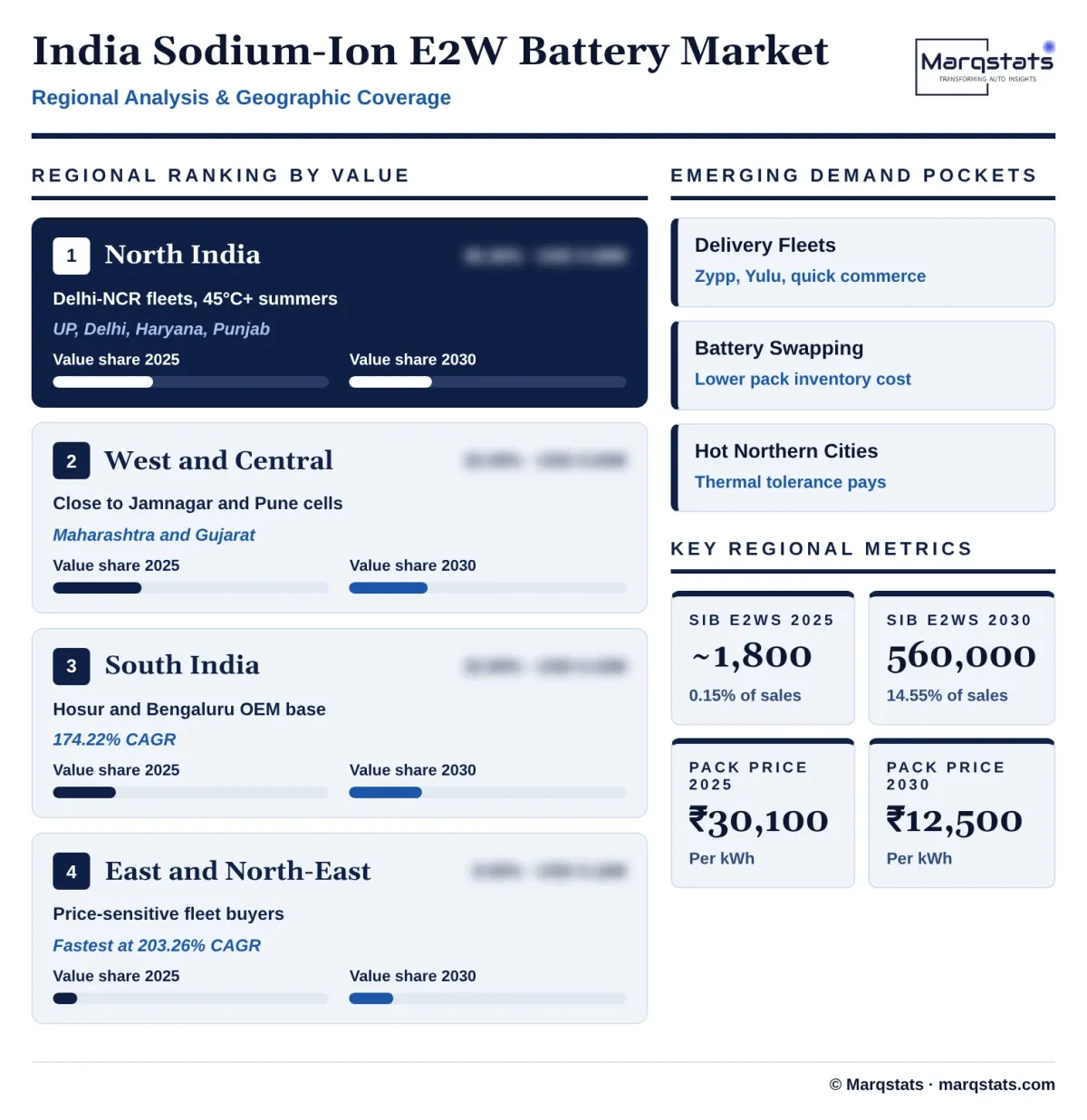
Pack prices fall sharply. In the 2025 pilot phase, sodium-ion packs sold for about INR 30,100 per kWh because cells were made in small volumes, scrap rates were high and hard carbon was costly. Marqstats expects pack prices to fall by about 16% a year to about INR 12,500 per kWh in 2030 as Reliance New Energy, Trentar and other cell makers reach gigawatt-hour scale, yields improve and domestic hard carbon supply grows. Ex-factory cell prices fall from about INR 7,900 to 9,600 per kWh in 2025 to about INR 3,300 to 4,150 per kWh by 2030.
Average pack size rises slightly, from about 3.0 kWh to about 3.2 kWh, as commuter scooters with larger packs take a greater share of sodium-ion volumes. The average pack value falls from about INR 90,400 per vehicle in the pilot phase to about INR 39,800 in 2030, bringing sodium-ion packs within the price range of mass-market scooters.
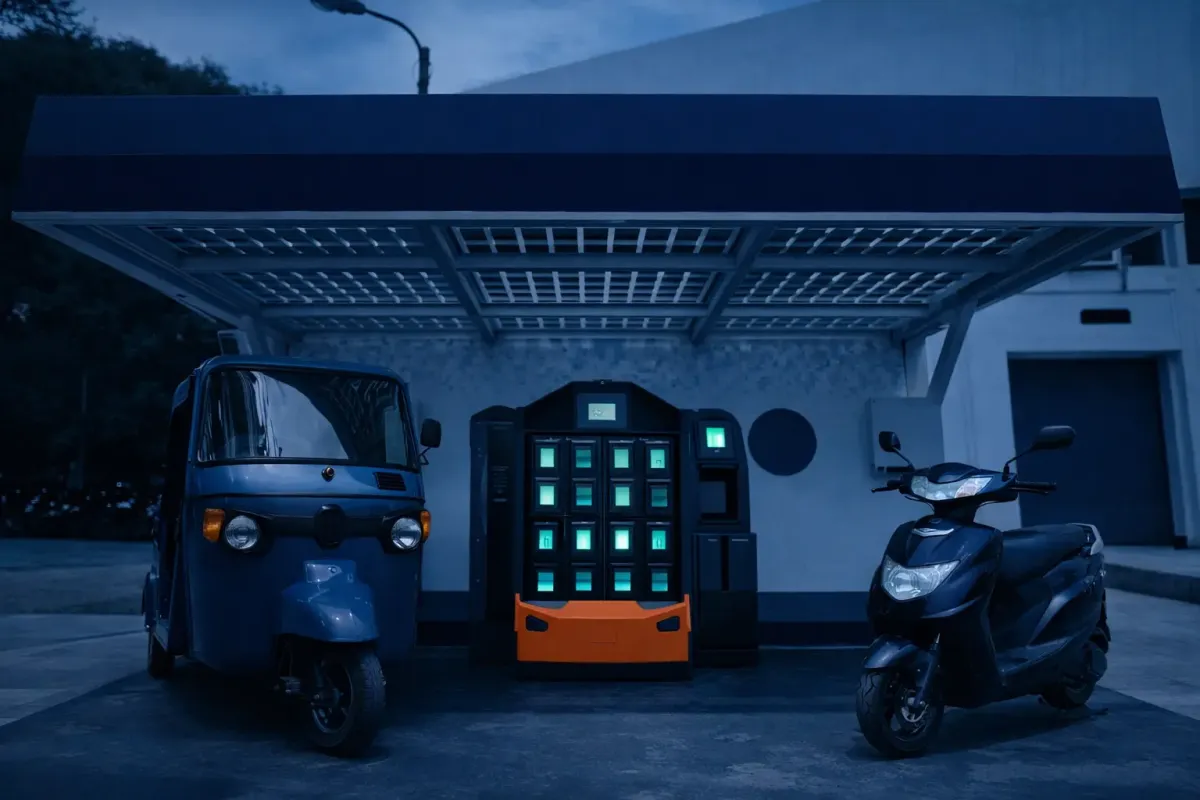
Battery-as-a-service models could speed adoption further. Under battery subscription and swapping schemes, the operator owns the pack and the rider pays per kilometre or per swap. Operators care about pack cost, cycle life and safety rather than weight, so they are natural early buyers of sodium-ion packs. Marqstats expects swapping and subscription fleets to account for a growing share of sodium-ion volumes in delivery mopeds and entry-level scooters from 2027.
Total cost of ownership supports adoption. Marqstats estimates the five-year, 60,000 km cost of owning a sodium-ion scooter falls from about INR 41,800 in 2025 to about INR 28,900 in 2030, against about INR 39,500 for an LFP scooter and about INR 1.55 lakh for a petrol scooter. Long cycle life means a fleet vehicle can complete 60,000 km without replacing its pack.
Market Dynamics
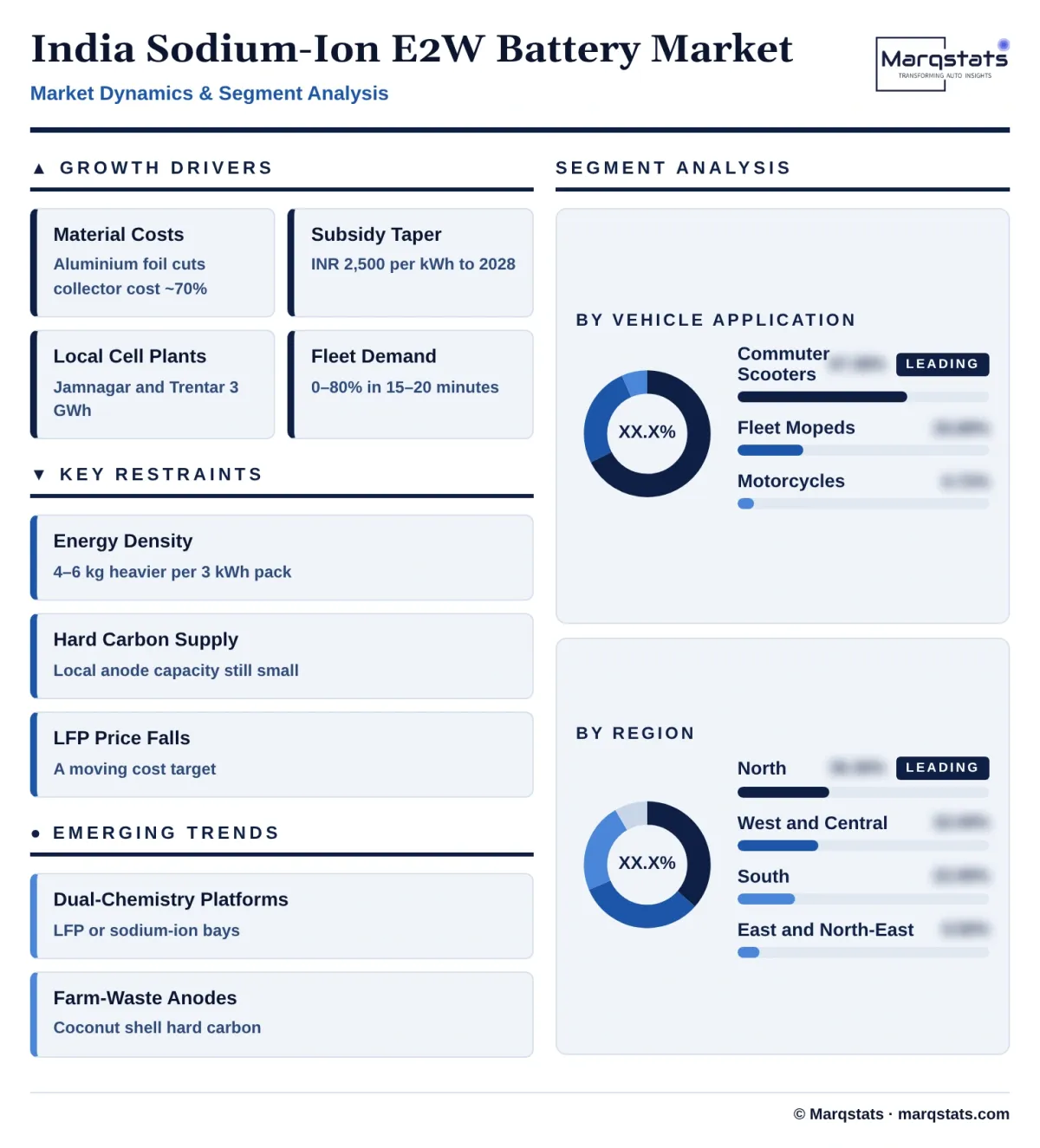
Key Drivers
Five forces are opening Indian electric two-wheelers to sodium-ion packs.
- Lower material costs make sodium-ion attractive. Battery-grade sodium carbonate costs a small fraction of lithium carbonate, and replacing copper foil with aluminium foil on the anode cuts current collector costs by about 70%. Once production reaches scale, Marqstats expects sodium-ion packs to cost 25% to 35% less than equivalent LFP packs.
- Falling subsidies force OEMs to cut costs. PM E-DRIVE support per electric two-wheeler halved between FY 2024-25 and FY 2025-26 and support now runs only to March 2028. The GST cut on petrol two-wheelers in September 2025 also narrowed the price gap with electric models. OEMs are looking for cheaper batteries to keep prices competitive.
- Domestic manufacturing support reduces import dependence. India has no commercial lithium, nickel or cobalt production and imports most cells. The chemistry-neutral PLI scheme for Advanced Chemistry Cells, Reliance New Energy's Jamnagar gigafactory and Trentar's planned 3 GWh plant using KPIT technology create a domestic source of sodium-ion cells.
- Safety rules favour stable chemistries. AIS-156 Phase 2, in force since March 2023, requires thermal propagation tests, smart battery management and IPX7 sealing for two-wheeler packs. Sodium-ion cells generate less heat and gas during failures than nickel-rich lithium cells, making it easier and cheaper to pass these tests.
- Delivery fleets need fast charging and long life. Delivery riders in Indian cities cover 80 to 100 km a day. Sodium-ion packs that charge from 0% to 80% in 15 to 20 minutes and last thousands of cycles reduce downtime and avoid mid-life pack replacement, which matters to fleet operators such as Zypp Electric and Yulu and to battery-swapping networks.
Key Restraints
Four constraints keep sodium-ion a small share of Indian E2W packs for now.
- Lower energy density limits use in scooters and motorcycles. A sodium-ion pack of the same capacity is 20% to 30% larger and 4 to 6 kg heavier than an LFP pack. Step-through scooters have little space under the floor and seat, so OEMs must redesign frames and suspension, and performance motorcycles will continue to use lithium-ion.
- Hard carbon supply is still small. Anode-grade hard carbon is made by a few specialist producers, and Indian makers such as Epsilon Advanced Materials, IndiEnergy and TACC are still scaling up. Until domestic supply reaches gigawatt-hour scale, imported materials can raise costs and reduce the advantage over LFP.
- LFP keeps getting cheaper. Chinese LFP cell prices have fallen sharply because of large-scale production, setting a moving target for sodium-ion. If LFP prices continue to fall faster than sodium-ion manufacturing costs, OEMs have less reason to switch.
- Production scale-up takes time. Sodium-ion cell manufacturing in India is at pilot scale in 2025 and 2026. Delays in commissioning gigafactories, low early yields or slow certification of new cells would delay the cost reductions that drive adoption.
Key Trends
Four shifts are shaping how sodium-ion packs reach Indian two-wheelers.
- OEMs are designing for two chemistries. Two-wheeler makers are developing frames and battery bays that can hold either LFP or sodium-ion packs, allowing them to switch chemistry with commodity prices and to offer sodium-ion versions of entry-level and fleet models.
- Hard carbon is being made from farm waste. Indian companies are producing anode material from coconut shells and crop residues at lower temperatures than graphite processing, cutting cost and carbon footprint and creating a local material supply chain.
- Fleets and battery swapping lead adoption. Delivery fleets and battery-swapping operators value lower pack cost and long cycle life more than weight, so they adopt sodium-ion first. Swapping networks are testing stations that can handle both lithium-ion and sodium-ion packs.
- Technology licensing speeds commercialisation. KPIT's transfer of its sodium-ion technology to Trentar Energy and Reliance's use of Faradion technology show that Indian companies are licensing and acquiring proven chemistries rather than starting from scratch, shortening the time to volume production.
Strategic Implications
- For two-wheeler OEMs, flexible platforms reduce risk. Designing battery bays and electronics that work with both LFP and sodium-ion packs lets OEMs use sodium-ion in fleet and entry-level models now and extend it to commuter scooters as energy density improves.
- For cell makers, certification and materials come first. Securing AIS-156 and IS 16893 certification, local hard carbon supply and PLI eligibility will decide which cell makers win the first large supply contracts with OEMs and fleet operators.
- For fleet operators and swapping networks, sodium-ion lowers cost per kilometre. Lower pack prices, fast charging and long cycle life cut fleet operating costs and reduce the number of spare packs needed, especially in hot cities with high daily use.
- For investors, the window is 2026 to 2028. The period when domestic gigafactories ramp up and pack prices fall below LFP is when market share will be won, and companies that secure capacity, materials and OEM contracts early will benefit most.
- For battery-swapping operators, mixed fleets need planning. Running sodium-ion and lithium-ion packs side by side requires chargers and battery management software that handle different voltage curves, and clear rules on which vehicles can take which packs. Operators that solve this early can cut pack inventory costs and offer cheaper subscriptions.
- For policymakers, chemistry-neutral support is working. Keeping PLI and safety rules open to new chemistries, and supporting domestic hard carbon and cathode production, reduces dependence on imported lithium and helps keep electric two-wheelers affordable as subsidies end.
Market Segmentation
Commuter and high-speed electric scooters with 2.5 to 3.5 kWh packs, such as the TVS iQube, Bajaj Chetak and Ather Rizta, made up 88.6% of 2025 high-speed E2W sales. Sodium-ion packs were fitted to about 1,093 of them in 2025, 0.10% of the segment, worth an estimated USD 1.26 million, or 67.38% of the market. By 2030 sodium-ion reaches 13.00% of commuter scooters, about 422,500 vehicles, and USD 211.99 million, or 82.67% of the market, a 178.73% CAGR, as cell energy density improves enough to fit a 3.0 kWh pack without losing storage space.
Delivery and utility mopeds with 1.5 to 2.5 kWh packs used by fleets and battery-swapping operators account for about 630 sodium-ion vehicles in 2025, 0.70% of the segment, worth an estimated USD 0.48 million, or 25.89% of the market. Sodium-ion reaches 35.00% of the segment by 2030, about 112,000 vehicles and USD 35.12 million, a 135.97% CAGR. The value share falls to 13.70% because these packs are smaller and commuter volumes grow faster, but this is the segment where sodium-ion's advantages matter most.
Electric motorcycles with 3.5 to 5.0 kWh packs, such as the Revolt RV series, Oben Rorr and Raptee models, made up 11.4% of 2025 E2W sales but only about 77 sodium-ion vehicles, worth USD 0.13 million, or 6.72% of the market. Sodium-ion reaches only 5.00% of the segment by 2030, about 14,000 vehicles and USD 9.33 million, a 135.06% CAGR, because riders need the higher energy density of LFP and NMC packs for range and handling.
By Geography
North India
North India, covering Uttar Pradesh, Delhi-NCR, Haryana, Punjab and Rajasthan, is the largest market, with an estimated 36.36% of 2025 value, USD 0.68 million, from about 650 vehicles, rising to USD 76.93 million and 30.00% of the market by 2030, a 157.46% CAGR. The region accounts for 28.6% of high-speed E2W sales, has dense delivery fleets in Delhi-NCR, and faces both freezing winters and summer temperatures above 45°C, conditions where sodium-ion's temperature tolerance is valuable.
West and Central India
West and Central India, covering Maharashtra, Gujarat, Madhya Pradesh and Goa, accounts for an estimated 32.09% of 2025 value, USD 0.60 million, from about 580 vehicles, rising to USD 71.80 million and 28.00% of the market by 2030, a 160.37% CAGR. The region accounts for 27.4% of E2W sales and is close to sodium-ion cell and material production, including Reliance New Energy's Jamnagar complex, Rechargion Energy in Pune and TACC in Madhya Pradesh.
South India
South India, covering Tamil Nadu, Karnataka, Telangana, Kerala and Andhra Pradesh, accounts for an estimated 22.99% of 2025 value, USD 0.43 million, from about 420 vehicles, rising to USD 66.67 million and 26.00% of the market by 2030, a 174.22% CAGR. The region accounts for 25.3% of E2W sales and hosts major E2W plants in Hosur and Bengaluru, battery-swapping networks and Sodion Energy's operations in Hyderabad and Coimbatore.
East and North-East India
East and North-East India, covering West Bengal, Bihar, Odisha, Assam and neighbouring states, accounts for an estimated 8.56% of 2025 value, USD 0.16 million, from about 150 vehicles, but is the fastest-growing region, reaching USD 41.04 million and 16.00% of the market by 2030, a 203.26% CAGR. The region accounts for 18.7% of E2W sales, buyers are highly price-sensitive and cargo and delivery fleets are electrifying quickly, all of which favour cheaper sodium-ion packs.
How Competition Is Evolving
The India sodium-ion electric two-wheeler battery market is fragmented and at an early stage. In 2025 supply came from start-ups building packs and cells at pilot scale, including Sodion Energy in Hyderabad, Rechargion Energy in Pune and IndiEnergy in Roorkee and Bengaluru, often using imported cells or materials. No single supplier dominates.
Large companies are building volume capacity. Reliance New Energy, which owns UK sodium-ion developer Faradion, is building a battery gigafactory in Jamnagar, Gujarat, and KPIT Technologies transferred its sodium-ion technology to Trentar Energy Solutions, which plans a 3 GWh plant. These players are expected to supply most sodium-ion cells by 2030.
Material suppliers are a second competitive layer. Epsilon Advanced Materials, IndiEnergy and TACC are developing hard carbon anodes from domestic sources, which will reduce costs and import dependence. Chinese sodium-ion leaders such as CATL, BYD and HiNa Battery could also supply cells if domestic production is slow.
Competition between chemistries matters as much as competition between companies. LFP suppliers, including large Chinese cell makers and Indian cell makers such as Ola Electric, Exide Energy and Amara Raja, continue to cut prices and improve energy density. Sodium-ion suppliers must therefore compete on total cost per kilometre, safety and supply security rather than on energy density alone, and position their packs where these advantages matter most.
Two-wheeler OEMs and fleet operators will decide the winners. OEMs such as TVS Motor, Bajaj Auto, Ather Energy and Hero MotoCorp, and fleet operators such as Zypp Electric and Yulu, will choose suppliers based on cost, certification, reliability and supply security. Cell makers that sign long-term supply agreements with these buyers early will gain the largest share.
Companies Covered
Companies covered in the report include:
Recent Market Activity
Table of Contents
Coverage & Segmentation
The study covers the India sodium-ion electric two-wheeler battery market, with 2025 as the base year, 2021 – 2025 as the historical period and 2026 – 2030 as the forecast period. Values are in US dollars, converted from Indian rupees at INR 87.00 per US dollar. The market is defined as the value of sodium-ion traction packs, including cells, battery management system and enclosure, fitted to new high-speed electric scooters, mopeds and motorcycles sold in India. It is segmented by vehicle application and region.
Lithium-ion packs, low-speed e-cycles, electric three-wheelers, replacement packs and stationary storage are excluded. Sodium-ion volumes, pack prices, segment and regional splits are Marqstats estimates built on VAHAN registration data, PM E-DRIVE notifications, company announcements and cell and material cost benchmarks.