Market Snapshot
Middle bar: base-year value × (1 + CAGR), rounded to two decimals. This is a calculated illustration, not a separately researched annual estimate.
Cargo vans are the centre of the US zero-emission truck market, not a niche. By the end of 2024, approximately 46,677 zero-emission cargo van deployments accounted for roughly 89% of the total 52,722 zero-emission truck base in the United States. Nearly 26,000 Class 2B/3 commercial vehicles were sold between 2017 and 2023, primarily battery-electric cargo vans used in urban and last-mile delivery. Amazon has rolled out more than 30,000 Rivian delivery vans across the US and installed over 50,000 chargers at more than 250 delivery stations—making it the largest private EV charging operator in the country. Ford Pro reported 3,756 E-Transit sales in Q1 2025 alone (up 29.9% year-over-year). The United States electric last-mile delivery van market size was valued at approximately USD 4.87 billion in 2025 and is projected to reach USD 14.23 billion by 2030, expanding at a CAGR of 23.92% during the forecast period (2026–2030).
The operating profile fits electrification unusually well. Local and regional return-to-base applications account for 49% of vehicles and 45% of energy consumption in the medium/heavy-duty sector, characterised by predictable routes and daily returns to base. Battery-electric cargo vans in local delivery operate equivalently to ICE vehicles for typical daily loads and ranges, and high-speed en-route charging is not needed in most cases because slower depot charging during downtime is sufficient. The average daily range for US commercial vans is 74 miles—well within the 150–275 mile range capability of current electric delivery vans. Battery-electric trucks deliver at least double the fuel efficiency of diesel equivalents and maintenance savings of 40–50 cents per mile. Class 2B/3 freight vehicles are competitive with diesel on a total-cost-of-driving basis when incentives are considered, and can approach TCO parity even without tax credits despite purchase prices 15–45% higher than ICE counterparts.
However, the market is becoming more selective. The 45W commercial clean vehicle credit (up to USD 7,500 for vans under 14,000 lbs) is no longer available for vehicles acquired after September 30, 2025. Charger support under 30C remains through June 2026. GM cancelled BrightDrop production in October 2025 citing slow commercial EV demand, and Canoo filed Chapter 7 bankruptcy in January 2025. The market is rewarding large, service-capable OEMs and well-capitalised fleet ecosystems while poorly supported vehicle programmes are falling out. The Marqstats US commercial EV charging infrastructure market report and US fleet depot charging infrastructure market report provide complementary coverage of the depot charging layer that underpins delivery van electrification.
Key Takeaways
Market Overview & Analysis
Report Summary
The United States electric last-mile delivery van market covers battery-electric cargo vans, step vans, and light/medium commercial vehicles (Class 1–6) serving parcel delivery, e-commerce fulfilment, grocery delivery, field service, and urban logistics fleets. The scope includes purpose-built electric vans (Rivian EDV, BrightDrop Zevo), electrified versions of established commercial platforms (Ford E-Transit, Ram ProMaster EV, Mercedes eSprinter), medium-duty electric chassis and stripped chassis (Harbinger, Peterbilt 536EV/537EV), micro-commercial delivery vehicles (Honda Fastport eQuad), and the depot charging infrastructure serving these fleets. Autonomous and robotic delivery concepts (Tesla Robovan) are referenced as pipeline developments. The market covers both anchor-fleet deployments (Amazon, FedEx, DHL, UPS) and open-market fleet sales, including delivery service providers (DSPs), independent operators, and municipal fleets.
This is a fleet productivity market built around route density, depot charging, uptime, and total cost of ownership—not a consumer EV market. Battery-electric cargo vans in local delivery perform equivalently to ICE vehicles for typical daily routes and loads. Local return-to-base applications account for 49% of MD/HD vehicles and 45% of energy consumption. The average daily range for US commercial vans is 74 miles, making the 150–275 mile range capability of current electric vans more than sufficient for daily operations. US retail e-commerce sales reached USD 1.234 trillion in 2025 (up 5.4% from 2024), accounting for 16.4% of total retail sales and reaching 18.3% in Q4 2025—continuously pressuring parcel carriers and DSPs to expand urban and suburban van operations.
Market Dynamics
Key Drivers
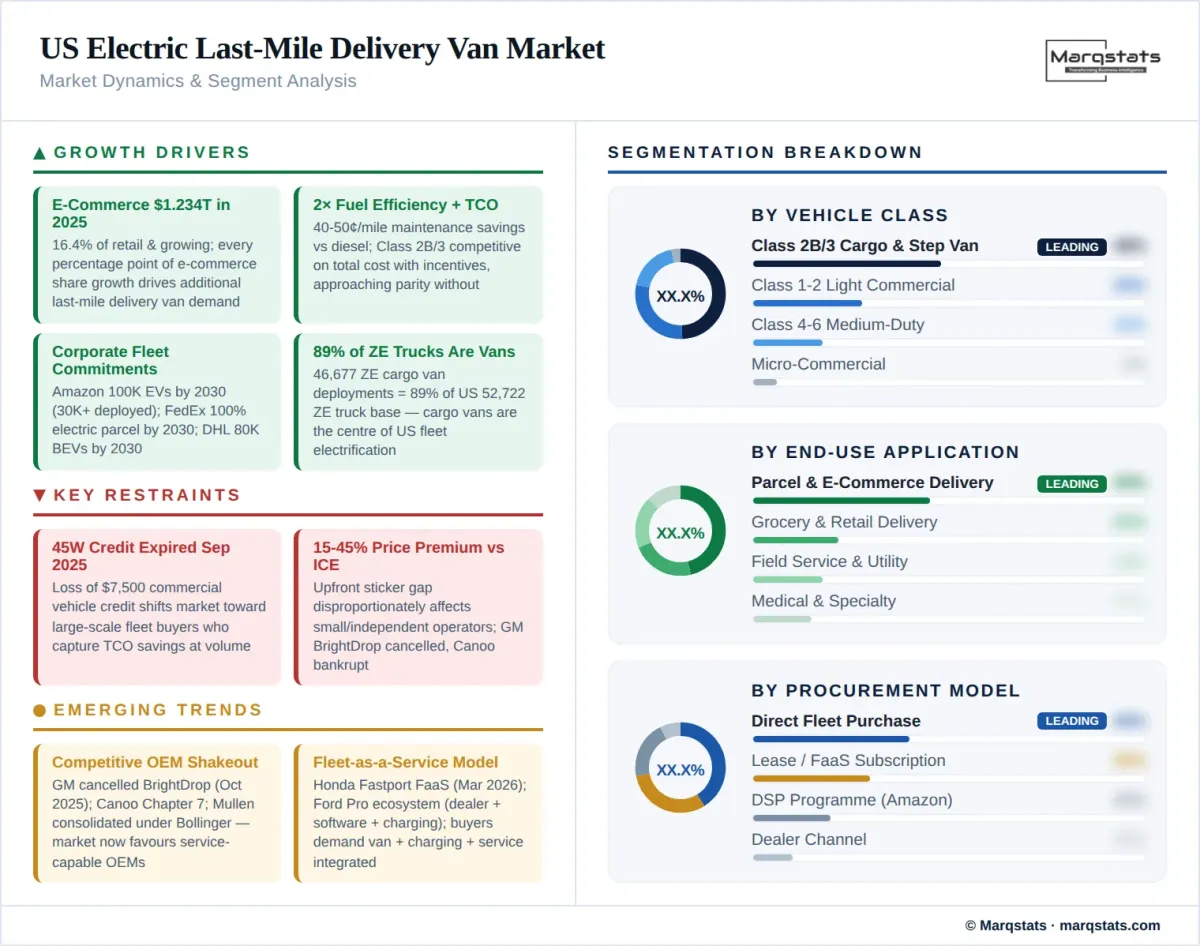
- E-commerce reaching USD 1.234 trillion in 2025 (16.4% of retail) driving parcel volume: US retail e-commerce grew 5.4% from 2024, reaching 18.3% of total sales in Q4 2025. This keeps sustained pressure on parcel carriers, DSPs, and local-delivery fleets to expand urban and suburban van operations. Every percentage point of e-commerce share growth translates to additional last-mile delivery van demand.
- TCO advantage: 2x fuel efficiency, 40–50¢/mile maintenance savings, competitive cost per package: Battery-electric trucks deliver at least double the fuel efficiency of diesel equivalents. Maintenance savings of 40–50 cents per mile versus diesel. Class 2B/3 vehicles are competitive on total-cost-of-driving with incentives, approaching parity without. Electric delivery van TCO and cost per package for last-mile operations are the primary fleet procurement drivers—especially for high-density urban routes where stop-start regenerative braking maximises EV efficiency.
- Corporate fleet decarbonisation commitments creating locked-in demand: Amazon targets at least 100,000 electric delivery vehicles by 2030 (30,000+ already deployed). FedEx committed to 50% electric parcel delivery purchases by 2025, 100% by 2030, full fleet conversion by 2040. DHL plans 80,000 BEVs by 2030 for last-mile delivery (45 Mercedes eSprinters launched in US October 2025). Harbinger raised USD 160 million Series C co-led by FedEx, with FedEx ordering 53 Class 5/6 EVs (November 2025).
- Rivian opening commercial van sales beyond Amazon to all US fleets (February 2025): After the Amazon exclusivity period ended, Rivian announced open-market availability for its electric delivery van. This transforms Rivian from a single-customer programme into a broader fleet supplier, creating competition for Ford E-Transit and Ram ProMaster EV. Rivian’s 30,000+ operational units provide credibility that few competitors can match.
- 150–275 mile range covering 74-mile average daily van distance with wide margin: Ford E-Transit: up to 159 miles. Ram ProMaster EV: up to 164 miles. Mercedes eSprinter: exceeds 240 miles in DHL operations. Rivian EDV: 150+ miles. Harbinger: configurable 140–200+ miles. Peterbilt 536EV/537EV: up to 280 miles. This range-to-duty-cycle ratio means electric delivery vans do not need en-route fast charging for most daily operations.
Key Restraints
- 45W commercial vehicle credit expiry (September 2025) removing USD 7,500 incentive: The loss of the 45W credit makes the business case harder, especially for smaller fleets comparing EV vans against heavily discounted ICE vans. Charger support under 30C remains through June 2026, but vehicle-purchase incentives have materially worsened. This shifts the market further toward large-scale fleet buyers who can capture TCO savings at volume.
- Purchase prices 15–45% higher than ICE counterparts despite TCO advantage: While TCO is competitive or approaching parity, the upfront sticker price gap remains substantial. This disproportionately affects small and independent delivery operators without access to fleet financing, leasing, or Fleet-as-a-Service models. GM’s BrightDrop cancellation and Canoo’s bankruptcy show that even OEMs struggle when buyer timing and service support do not align.
- Depot charging infrastructure as a gating requirement: Amazon’s 50,000+ chargers at 250+ stations demonstrate the scale of charging infrastructure needed for large-fleet deployment. Smaller operators without depot control or charging capital face a structural barrier. XCharge and Gateway Fleets deployed battery-microgrid depot charging in Riverside, CA for medium-duty fleets and FedEx operators (June 2025)—showing how third-party depot solutions can serve non-captive fleets.
Key Trends
- Competitive shakeout reshaping the OEM landscape: GM cancelled BrightDrop production (October 2025) after delivering only 746 vehicles in H1 2024. Canoo filed Chapter 7 (January 2025). Mullen consolidated under Bollinger Innovations (July 2025), eliminating 155 positions and cutting USD 35 million in annual costs. Target piloted 50 BrightDrop vans in Dallas (October 2025) with Circuit EV Solutions—one of the last BrightDrop deployments before cancellation. The market now favours service-capable OEMs with dealer networks and financial stability.
- Fleet-as-a-Service and solution selling replacing standalone van sales: Honda launched Fastport, a B2B Fleet-as-a-Service platform for last-mile delivery using the all-electric eQuad with swappable batteries and bike-lane-width design for dense urban environments (March 2026). Harbinger’s stripped chassis model enables body builders to create custom configurations. Ford Pro’s ecosystem (dealer service, software, charging, financing, upfit) is the template: product alone is not enough. Fleet buyers demand van + charging + software + service as an integrated system.
- Medium-duty Class 5–6 electric vans expanding the addressable market: Harbinger raised USD 160 million (FedEx, Capricorn, THOR Industries) and received FedEx order for 53 Class 5/6 EVs (November 2025). Peterbilt launched 536EV and 537EV medium-duty models with up to 280-mile range and PACCAR ePowertrain (December 2025). GreenPower selected New Mexico for US HQ and advanced EV manufacturing (January 2026), offering Class 4 all-electric commercial vehicles. These entries push electrification beyond Class 2B/3 cargo vans into the heavier delivery and distribution segment.
- Mobile and battery-microgrid depot charging solving infrastructure gaps: Pioneer Power expanded e-Boost Mobile deployments for one of the world’s largest e-commerce fleets during peak season, with plans for multiple metro-market expansions in 2026. XCharge/Gateway Fleets deployed GridLink battery-microgrid charging in Riverside, CA for FedEx operators—using 430 kWh stored energy to charge during day and avoid peak demand charges.
Market Segmentation
The highest-volume segment. Ford E-Transit dominates open-market sales (3,756 in Q1 2025, up 29.9% YoY) with up to 159-mile range and the most extensive US dealer/service network. Mercedes eSprinter entered US fleet operations with DHL (45 vans, October 2025)—exceeding 240 miles consistently. Honda Fastport eQuad (March 2026) represents the micro-commercial tier: all-electric quadricycle with swappable batteries for bike-lane last-mile delivery. This class serves parcel delivery, e-commerce, grocery, and field service.
The core of US electric delivery van deployment. Rivian EDV: 30,000+ deployed with Amazon, now open to all US fleets. Ram ProMaster EV: up to 164 miles, cargo and step-van configurations, orders opened 2025. GM BrightDrop Zevo: 272-mile range, production cancelled October 2025 after slow demand. Bollinger Innovations (formerly Mullen/Bollinger): Class 1, 3, and 4 consolidated under unified brand (July 2025). This class accounts for the majority of the 46,677 zero-emission cargo van deployments.
The fastest-growing class. Harbinger: USD 160M raised, FedEx 53-unit order, configurable 140–200+ mile range, PHEV chassis option (March 2026 partnership with Frazer for mobile healthcare). Peterbilt 536EV/537EV: up to 280 miles, PACCAR ePowertrain, LFP batteries, 350 kW DC charging (December 2025). GreenPower: New Mexico HQ with Class 4 commercial vehicles (January 2026). This class addresses delivery operations requiring larger cargo capacity and heavier payloads than Class 2B/3 vans.
The dominant demand driver. Amazon (30,000+ Rivian vans, 100,000 target by 2030). FedEx (50% electric purchases by 2025, 100% by 2030, Harbinger 53-unit order). DHL (80,000 BEV target by 2030, 45 eSprinters launched US October 2025). UPS (Electreon wireless depot charging at Detroit). Target piloted 50 BrightDrop vans in Dallas with Circuit EV Solutions and Frontdoor Collective (October 2025). These fleets have the route density, depot control, and capital to justify dedicated EV infrastructure.
The most price-sensitive segment and the one most affected by 45W credit expiry. DSPs operate on thin margins and often do not own depots. Rivian’s open-market launch (February 2025) targets this segment. Ford E-Transit’s dealer network provides accessible service. XCharge/Gateway Fleets’ battery-microgrid depot (Riverside, CA) serves independent FedEx operators. Pioneer Power’s mobile e-Boost units support e-commerce fleets without permanent infrastructure.
Growing segment requiring refrigerated electric van configurations. GreenPower offers refrigerated truck options in its Class 4 lineup. Mercedes eSprinter is suited to inner-city logistics including grocery. This segment values the quiet operation and zero tailpipe emissions of electric vans for residential delivery windows.
By Geography
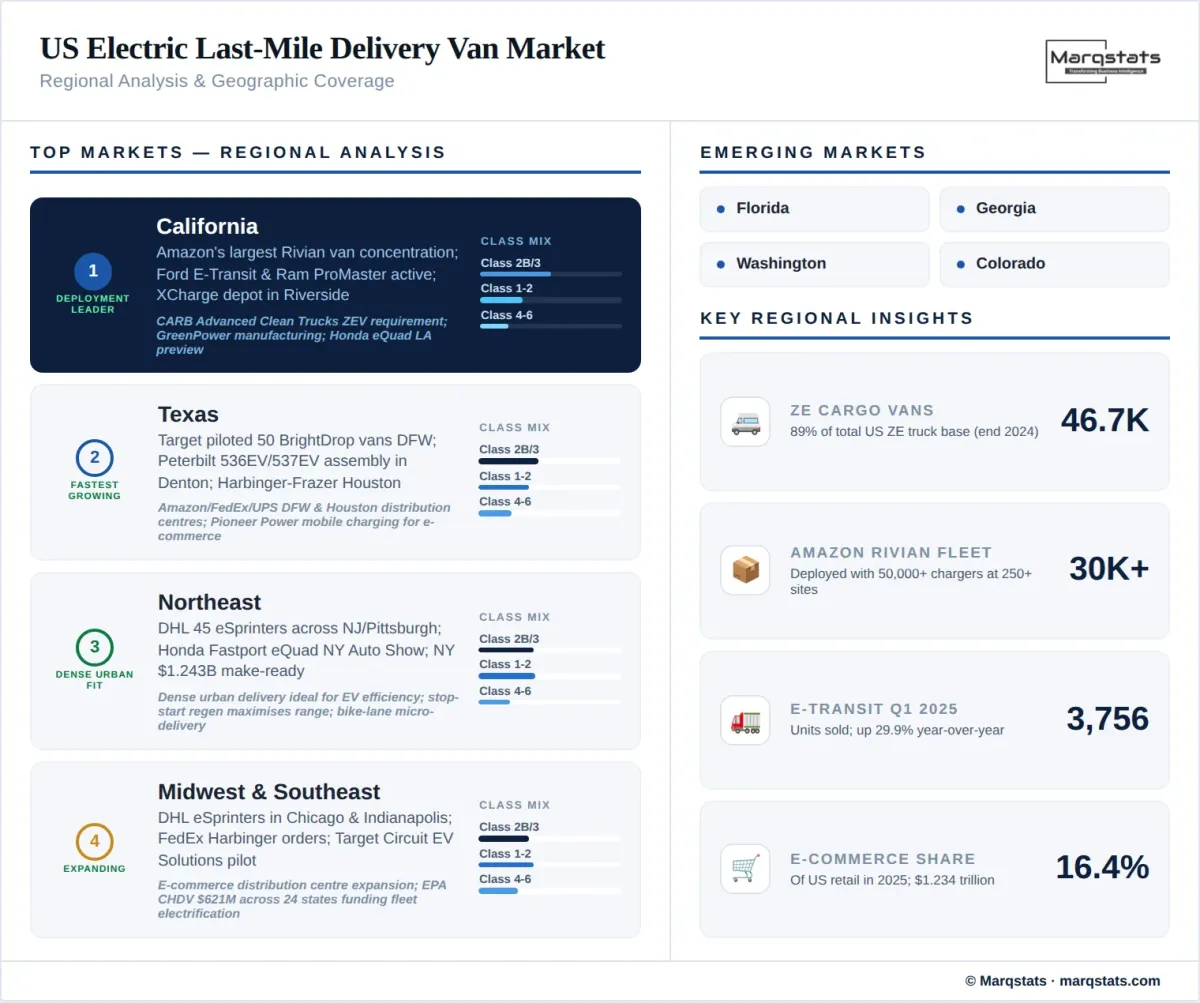
California
The US leader by deployment volume and infrastructure. Amazon’s largest Rivian van concentrations. Ford E-Transit and Ram ProMaster EV active sales. Greenlane’s corridors serve delivery fleets alongside heavy-duty trucks. XCharge/Gateway Fleets deployed battery-microgrid depot in Riverside for FedEx operators. GreenPower manufactures in southern California (moving HQ to New Mexico). Honda Fastport eQuad previewed at LA Auto Show. Voltu Motor Class 3 trucks in Riverside pilot. CARB Advanced Clean Trucks rule maintains manufacturer ZEV sales requirements.
Texas
Second-largest and fastest-growing delivery van market. Target piloted 50 BrightDrop vans in Dallas-Fort Worth (October 2025). Peterbilt’s main assembly plant in Denton, Texas produces new 536EV/537EV. Harbinger’s Frazer PHEV partnership is Texas-based (Frazer in Houston). Amazon, FedEx, UPS distribution centres drive delivery fleet demand. Pioneer Power expanded mobile charging for e-commerce fleets.
New York / Northeast
Dense urban delivery creates ideal electric van conditions. DHL deployed 45 Mercedes eSprinters across Chicago, Indianapolis, Pittsburgh, and New Jersey markets (October 2025). Honda Fastport eQuad showcased at 2026 New York Auto Show for bike-lane last-mile delivery. NY Joint Utilities EV Make-Ready (USD 1.243B) supports fleet charging infrastructure.
Southeast and Midwest
DHL eSprinter deployments in Elizabeth and Moonachie, NJ plus Chicago and Indianapolis. Amazon delivery stations across all major metros. Pioneer Power mobile charging for holiday-peak e-commerce operations. Michigan’s Electreon wireless depot charging at UPS Detroit for commercial delivery. Harbinger’s Bollinger consolidated commercial operations in Oak Park, Michigan.
Mountain West and Pacific Northwest
Amazon Pacific Northwest distribution. GreenPower establishing New Mexico HQ (135,000 sq ft, 340 jobs, USD 5M LEDA award). Pioneer Power e-Boost Mobile deployed with Washington State Department of Natural Resources for electric utility vehicles in remote areas.
How Competition Is Evolving
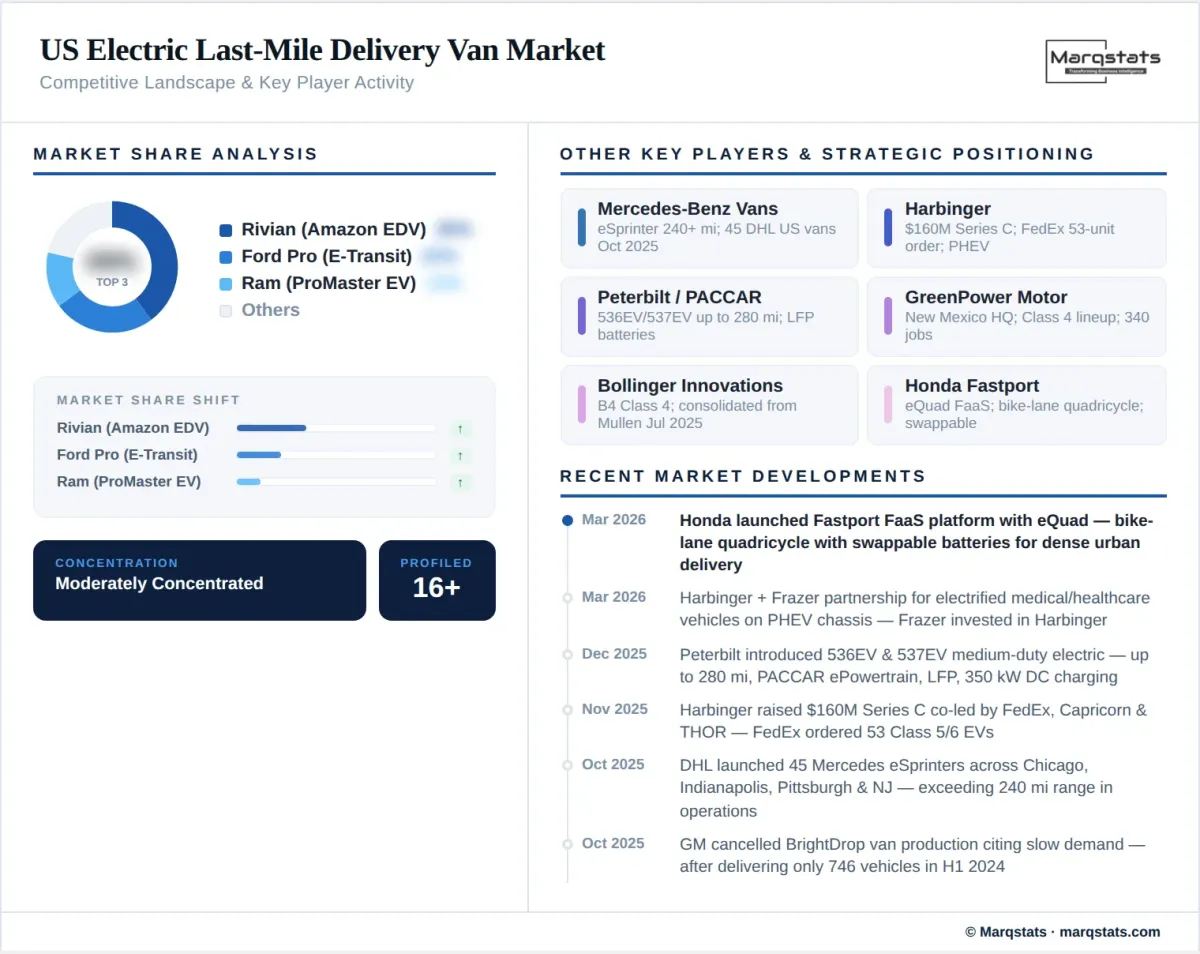
The competitive landscape has four groups. Established OEMs with dealer networks lead open-market sales: Ford Pro (E-Transit: 3,756 Q1 2025 sales, up 29.9% YoY, up to 159 miles, dealer/service/software/financing ecosystem), Ram/Stellantis (ProMaster EV: up to 164 miles, cargo van and step-van configurations), and Mercedes-Benz Vans (eSprinter: exceeds 240 miles in DHL operations, 45 US vans launched October 2025).
Purpose-built EV manufacturers serve anchor fleets and expanding open-market channels: Rivian (EDV: 30,000+ deployed with Amazon, 50,000+ chargers, now open to all US fleets), Harbinger (USD 160M Series C, FedEx/Capricorn/THOR, 53 FedEx Class 5/6 order, PHEV option), Peterbilt/PACCAR (536EV/537EV medium-duty, up to 280 miles, LFP batteries), GreenPower (New Mexico HQ, Class 4 commercial lineup), Bollinger Innovations (formerly Mullen/Bollinger: B4 Class 4 truck, consolidated July 2025), and Cenntro (Logistar 210, 260 orders H1 2025).
Market exits and cautionary examples demonstrate competitive intensity: GM BrightDrop (cancelled October 2025 after 746 deliveries in H1 2024; Target Dallas 50-van pilot was among last deployments), Canoo (Chapter 7 bankruptcy January 2025), and the broader pattern of startup shakeout. Micro-commercial and emerging platforms extend the market: Honda Fastport (eQuad for bike-lane delivery with FaaS platform, swappable batteries, March 2026).
Companies Covered
Companies covered in the report include:
Recent Market Activity
Table of Contents
Coverage & Segmentation
This report provides a comprehensive analysis of the United States electric last-mile delivery van market covering the historical period (2021–2025) and forecast period (2026–2030), with 2025 as the base year. The study examines market size in USD and volume across vehicle class (Class 1–2, Class 2B/3, Class 4–6), end-user fleet type (e-commerce/parcel, DSP/independent, grocery/temperature-controlled, field service, municipal), powertrain (BEV, PHEV/range-extended), and geography covering 10 state/metro clusters. Company profiling covers 20+ players across OEMs, purpose-built manufacturers, anchor fleet operators, and depot charging providers. Policy analysis covers 45W expiry, 30C charger credit, CARB Advanced Clean Trucks, and corporate decarbonisation commitments.
Research methodology combines bottom-up modelling from zero-emission cargo van deployment counts (46,677 by end-2024, ~89% of ZE truck base), OEM sales disclosures (Ford 3,756 Q1 2025, Rivian 30,000+ Amazon), fleet operator commitment tracking (Amazon 100K by 2030, FedEx 100% by 2030, DHL 80,000 by 2030), e-commerce growth rates (USD 1.234T, 16.4% retail share), and TCO modelling (2x fuel efficiency, 40–50¢/mile maintenance savings). Primary research encompasses 40+ interactions with fleet procurement directors, delivery van OEMs, body builders, depot charging operators, DSPs, and logistics technology companies across all major US metro markets.