Market Snapshot
Key Takeaways
Market Overview & Analysis
Report Summary
This analysis sizes the global automotive digital twin synthesis software market, encompassing platforms that synthesize high-fidelity virtual representations of automotive hardware, internal software stacks, physical environments, and fleet telematics, spanning synthetic scenario and sensor generation, multiphysics co-simulation synthesis, and runtime operational twins. The market is built from reconciled primary financial disclosures from major public and private engineering software providers, segregating automotive-specific revenue from broader multi-industry portfolios. The market is sized in USD across a 2020-2024 historical period and a 2025-2029 forecast period, with 2024 as the base year.
The global automotive digital twin synthesis software market grew from USD 3,145.20 million in 2020 to USD 5,704.57 million in 2024, a 16.05% compound annual growth rate, and is projected to reach USD 11,684.99 million by 2029, a 15.42% compound annual growth rate. This growth reflects the shift of digital twin synthesis from an internal engineering efficiency initiative into a statutory mandate required for vehicle type-approval, since national and supranational regulators have acknowledged that verifying Level 3 and Level 4 driving automation requires billions of operating kilometers, a threshold mathematically impossible to clear solely through physical on-road testing.
The base-case 2029 forecast of USD 11,684.99 million assumes the steady, orderly implementation of existing regulatory mandates including UNECE Regulation No. 157 and EU General Safety Regulation 2, without structural disruption, as automakers gradually transition on-premises HPC workloads toward hybrid cloud infrastructure while maintaining software capital expenditures at approximately 15% to 16% of total vehicle R&D budgets. The binding upside condition, reaching USD 13,552.40 million at an 18.90% CAGR, is whether the European Commission, the US NHTSA, and UNECE's WP.29 formally codify the statutory substitution of physical crash tests with digital twin simulation by December 2026; the binding downside condition, reaching only USD 9,320.15 million at a 10.32% CAGR, is whether a series of high-profile autonomous driving safety failures linked to simulation fidelity gaps before year-end 2026 precipitates regulatory suspension of virtual toolchain credibility certifications.
Market Dynamics
Key Drivers
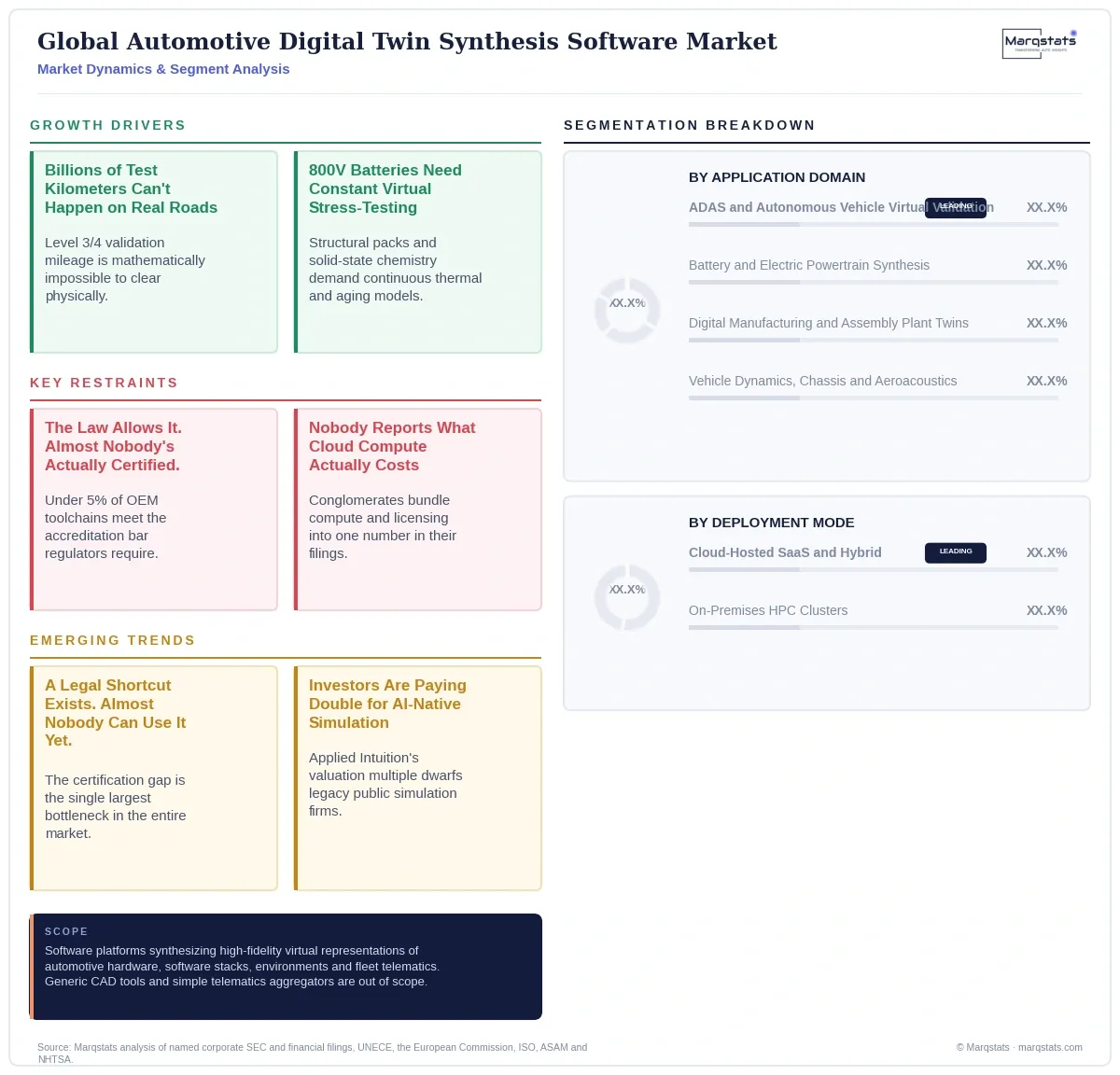
- UN Regulation No. 157 Annex 4 formalizes virtual testing as a legally binding pillar of type-approval for Automated Lane Keeping Systems, requiring automakers to document the pedigree of their virtual toolchain and calibrate mathematical sub-models against empirical proving ground test runs, a credibility framework UN Regulation No. 171 on Driver Control Assistance Systems replicated when it entered into force in September 2024.
- The architectural migration to 800V high-voltage electric vehicle powertrains, structural battery packs, and next-generation solid-state chemistry requires continuous digital twin modeling of multidimensional heat rejection, mechanical crush resistance, and electrochemical aging, sustaining 16.10% compound annual growth in battery and powertrain synthesis software through 2029.
- Cloud-hosted Software-as-a-Service and hybrid architectures generated USD 3,000.60 million (52.60% share) in 2024, expanding at a 19.80% compound annual growth rate, since running continuous Monte Carlo simulation suites across millions of edge-case scenarios requires elastic computing capacity that far exceeds the economic scale of private corporate data centers.
- Automotive original equipment manufacturers, generating USD 3,696.56 million (64.80% share) in 2024, are actively consolidating engineering workflows into unified digital twin platforms to eliminate data fragmentation across disparate design groups, exemplified by BMW Group's commitment to migrate 17,000 global engineering seats to Dassault Systèmes' 3DEXPERIENCE platform.
- Chinese electric vehicle manufacturers including BYD Company Limited and Geely Automobile Holdings have compressed vehicle development lifecycles to 18 to 24 months by relying extensively on digital twin synthesis software to replace sequential physical prototype iterations, establishing Asia-Pacific as the fastest-compounding region at an 18.10% compound annual growth rate through 2029.
Key Restraints
- Fewer than 5.00% of global OEM simulation toolchains have achieved accredited statutory certification from recognized technical services despite UNECE R157 Annex 4 and EU Regulation 2022/1426 permitting virtual simulation as direct proof for type-approval, since technical services require empirical mathematical proof that simulated physical environments, camera sensor transfer functions, and radar clutter models match real-world behavior within tight statistical tolerance bounds.
- Major multi-industry software conglomerates including Siemens, Dassault Systèmes and Synopsys do not disaggregate direct cloud compute consumption from base software licensing revenues in regulatory filings, since enterprise software contracts are routinely sold as consolidated enterprise license agreements blending on-premises solver seats with hybrid cloud compute burst capacity, obscuring precise tracking of the commercial transition toward pure SaaS billing.
- No standardized, audited accounting series tracks the physical prototype fabrication savings digital twin synthesis is marketed to deliver, since automotive capital expenditure reporting does not isolate prototype displacement savings as a distinct line item against capitalized research and development spending, obscuring the precise empirical return on investment realized from digital twin deployments.
- No unified public repository publishes sensor transfer function error metrics under adverse environmental conditions, leaving engineering departments without standardized open datasets establishing mathematical correlation bounds between synthetic radar backscatter or LiDAR beam divergence and real-world sensor degradation under severe weather, a gap that creates validation friction during type-approval credibility audits.
Key Trends
- The gap between regulatory permission and industrial certification reality represents a genuine structural bottleneck rather than a routine compliance lag: fewer than 5.00% of global OEM simulation toolchains have achieved the accredited statutory certification that UNECE R157 Annex 4 and EU Regulation 2022/1426 require before virtual simulation can legally substitute for physical testing, meaning the regulatory pathway exists in principle for a market that has barely begun to operationalize it in practice.
- The dramatic valuation multiple premium capital markets assign to cloud-native synthetic AI pure-plays over legacy on-premises simulation conglomerates, Applied Intuition's 24.12 times forward revenue against Ansys' 13.78 times and Altair's 15.92 times trailing revenue, demonstrates that investors view generative physical AI and neural simulation architecture as a structurally more valuable capability than traditional finite-element solvers, independent of current revenue scale.
- The consolidation of computer-aided engineering around two landmark 2024-2025 megadeals, Synopsys' acquisition of Ansys and Siemens' acquisition of Altair, both independently verified through Synopsys' own SEC financial filings, indicates that surviving as a standalone mid-scale simulation vendor is becoming increasingly difficult, favoring either integrated silicon-to-vehicle conglomerates or specialized, capital-backed pure-plays over generalist independents.
- China's compression of vehicle development lifecycles to 18 to 24 months through extensive digital twin reliance, roughly half the traditional 48-month Western engineering cycle, demonstrates that simulation-first development is not merely a cost optimization tool but a genuine competitive speed advantage that is reshaping global automotive product development timelines.
- The market's own disclosed data gaps, the absence of standalone cloud compute revenue disclosure, unaudited prototype displacement savings tracking, and missing public sensor transfer function error repositories, indicate that even sophisticated market participants currently lack the standardized empirical infrastructure needed to fully validate digital twin synthesis software's promised return on investment.
Strategic Implications
For an emerging entrant seeking to deploy capital, building general-purpose mechanical or fluid finite-element solvers requires hundreds of millions of dollars in foundational development while offering limited differentiation against consolidated incumbents; capital should instead target unresolved technological bottlenecks including generative physical AI scenario synthesis, neural radiance field sensor rendering pipelines, and automated credibility compliance suites mapped directly to ISO/PAS 8800 and UNECE R157 mandates, while adopting open ASAM protocols and API-first microservices that integrate into existing OEM continuous integration pipelines.
For an established software incumbent, defending market share requires re-architecting legacy, desktop-bound simulation solvers into elastic, multi-tenant cloud microservices, since the Ansys and Altair acquisitions demonstrate that survival depends on delivering an unbroken digital thread spanning semiconductor electronic design automation down to physical crashworthiness; incumbents must acquire or partner with physical AI specialists to prevent agile pure-play vendors from capturing high-margin ADAS and autonomous vehicle simulation budgets.
For a Tier-1 automotive supplier, digital twin synthesis software represents a risk-mitigation tool against fixed-price development contracts; suppliers must transition internal engineering assets into self-contained Functional Mock-up Units that can be delivered to OEM customers for virtual integration prior to hardware tooling, since suppliers providing verified, high-fidelity digital twins alongside physical hardware components will secure preferred integration status in next-generation software-defined vehicle platforms.
Outlook
Base case: USD 11,684.99 million by 2029 (15.42% five-year value CAGR). This trajectory assumes the steady, orderly implementation of existing regulatory mandates including UNECE Regulation No. 157 and EU General Safety Regulation 2, without structural disruption, as automakers gradually transition on-premises HPC workloads toward hybrid cloud infrastructure while newly merged entities Synopsys-Ansys and Siemens-Altair execute standard product integration roadmaps and cloud-native SaaS reaches 57.50% of market spend.
Upside case: USD 13,552.40 million by 2029 (18.90% five-year value CAGR). The specific trigger is the European Commission, the US NHTSA, and UNECE's World Forum for Harmonization of Vehicle Regulations formally codifying the statutory substitution of physical crash tests with digital twin simulation by December 2026, under which certified high-fidelity virtual crash simulations would replace at least 50% of destructive barrier tests required for Euro NCAP and FMVSS type-approvals, driving cloud-native SaaS adoption to 66.00% of market spend.
Downside case: USD 9,320.15 million by 2029 (10.32% five-year value CAGR). The specific trigger is a series of high-profile autonomous driving safety failures linked directly to simulation fidelity gaps before year-end 2026, precipitating regulatory suspension of virtual toolchain credibility certifications if technical services determine synthetic sensor engines fundamentally fail to model edge-case optical aberrations and radar multi-path reflections accurately, compelling OEMs to freeze multi-year cloud simulation commitments and restrict cloud-native SaaS to just 46.00% of market spend.
Market Segmentation
ADAS and autonomous vehicle virtual validation is the largest and fastest-compounding segment, generating USD 1,950.96 million (34.20% share) in 2024 and expanding at an 18.25% compound annual growth rate to reach USD 4,510.41 million by 2029, compelled by the volume of test mileage mandated by SOTIF (ISO 21448) and AI safety frameworks (ISO/PAS 8800) that cannot be validated on physical roads within commercial product timelines.
Battery and electric powertrain synthesis accounted for USD 1,620.10 million (28.40% share) in 2024, projected to expand at a 16.10% compound annual growth rate to USD 3,417.89 million by 2029, as the architectural migration to structural battery packs, cell-to-body designs, and solid-state chemistry requires continuous digital twin modeling of heat rejection, mechanical crush resistance, and electrochemical aging.
Digital manufacturing and assembly plant twins generated USD 1,169.44 million (20.50% share) in 2024, growing at a 13.80% compound annual growth rate to USD 2,231.83 million in 2029, exemplified by Mercedes-Benz Group AG's enterprise deployment of NVIDIA Omniverse Enterprise to synthesize assembly tooling ergonomics and coordinate autonomous mobile robots prior to physical line commissioning.
Vehicle dynamics, chassis and aeroacoustics modeling captured USD 964.07 million (16.90% share) in 2024, compounding at a 10.45% growth rate to reach USD 1,524.86 million by 2029, focused on virtual suspension kinematics, cabin acoustic isolation, and aerodynamic drag reduction integrated with real-time driver-in-the-loop simulation rigs.
Cloud-hosted Software-as-a-Service and hybrid architectures generated USD 3,000.60 million (52.60% share) in 2024, expanding at a 19.80% compound annual growth rate through 2029, since running continuous Monte Carlo simulation suites across millions of edge-case scenarios requires elastic computing capacity exceeding the economic scale of private corporate data centers.
On-premises high-performance computing clusters accounted for USD 2,703.97 million (47.40% share) in 2024, expanding at a lower 9.75% compound annual growth rate, remaining defended by corporate data residency restrictions, intellectual property security mandates regarding pre-release vehicle styling surfaces, and existing investments in private server clusters.
Automotive original equipment manufacturers represent the dominant end-user cohort, generating USD 3,696.56 million (64.80% share) in 2024 and expanding at a 16.15% compound annual growth rate through 2029, actively consolidating engineering workflows into unified digital twin platforms to eliminate data fragmentation across disparate design groups.
Tier-1 automotive systems suppliers account for USD 2,008.01 million (35.20% share) in 2024, expanding at a 13.95% compound annual growth rate, deploying synthesis toolchains to validate standalone subsystem integration, such as electronic braking modules and radar radome housings, before physical handoff to the vehicle manufacturer.
By Geography
Europe
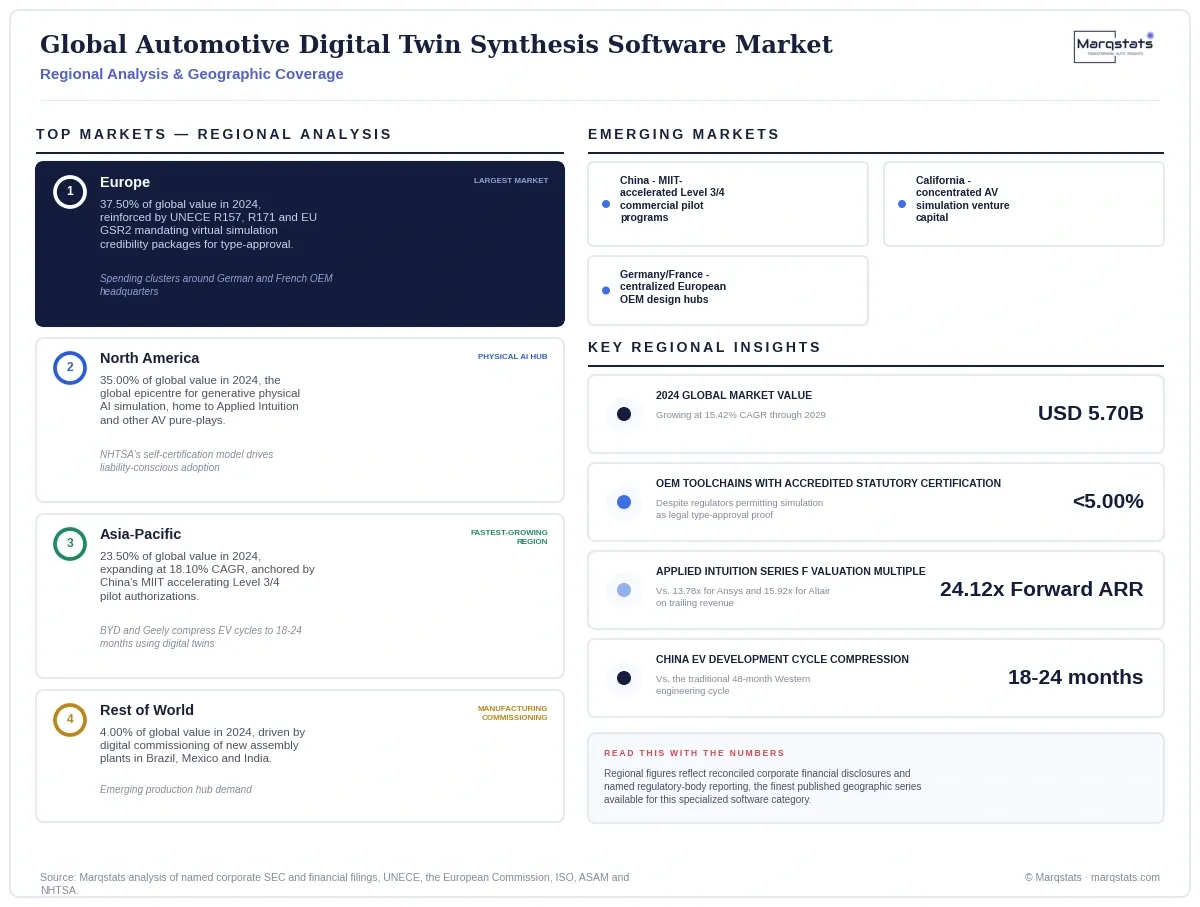
Europe leads the global market at USD 2,139.21 million (37.50% share) in 2024, expanding at a 14.20% compound annual growth rate, reinforced by stringent supranational vehicle safety legislation under UNECE Regulation No. 157, Regulation No. 171, and the EU General Safety Regulation 2, with enterprise software spending clustering around the Germany and France headquarters of BMW Group, Mercedes-Benz Group AG, Volkswagen AG and Renault Group.
North America
North America represents the second-largest market at USD 1,996.60 million (35.00% share) in 2024, projected to expand at a 15.65% compound annual growth rate, serving as the global epicentre for generative physical AI simulation and housing major autonomous vehicle developers including Applied Intuition, while NHTSA's Standing General Order on Crash Reporting pushes automakers toward virtual simulation to minimize product liability exposure under a self-certification regulatory model.
Asia-Pacific
Asia-Pacific is the fastest-compounding region at USD 1,340.57 million (23.50% share) in 2024, expanding at an 18.10% compound annual growth rate to reach USD 3,080.49 million by 2029, anchored by China's Ministry of Industry and Information Technology accelerating commercial Level 3 and Level 4 pilot authorizations while Chinese EV manufacturers compress development lifecycles to 18-24 months using extensive digital twin reliance.
Rest of World
The Rest of World market captures USD 228.19 million (4.00% share) in 2024, compounding at an 11.20% growth rate, driven by the digital commissioning of localized manufacturing assembly plants across emerging production hubs in Brazil, Mexico and India.
How Competition Is Evolving
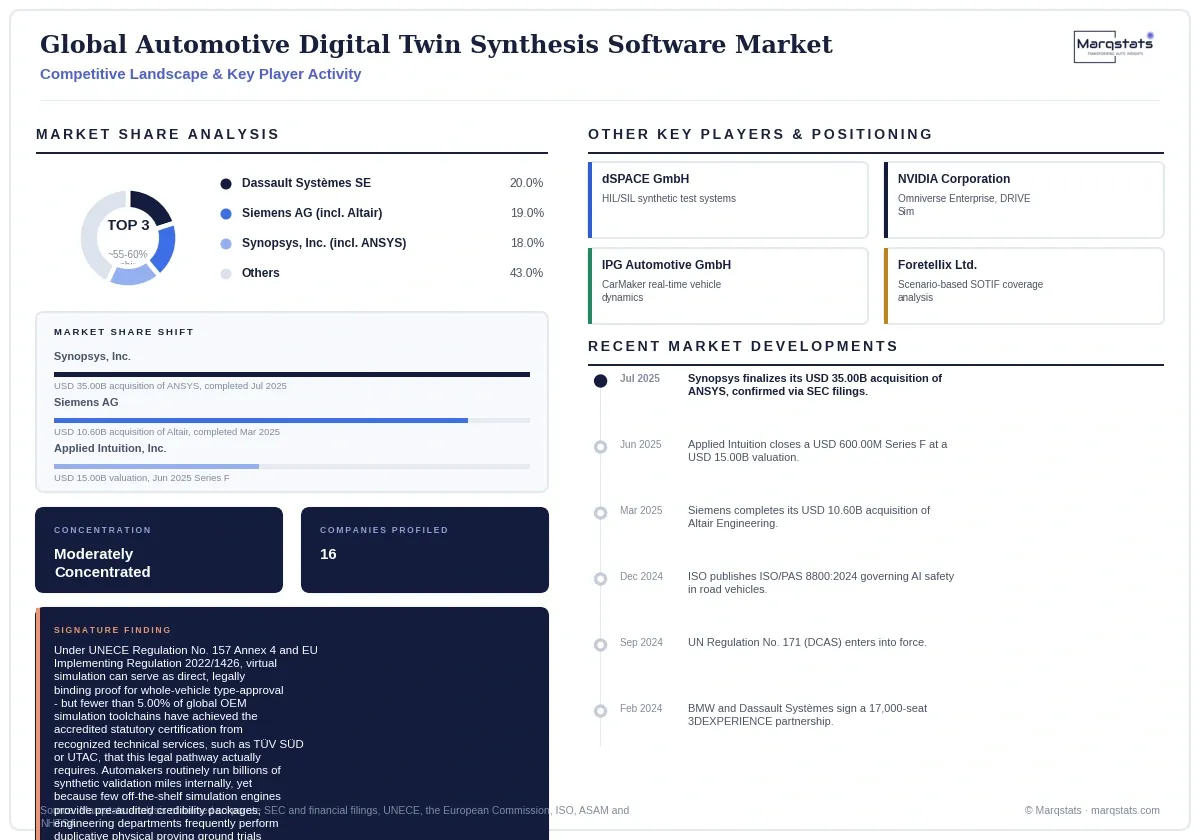
The automotive digital twin synthesis software market is moderately concentrated following its 2024-2025 consolidation wave: Dassault Systèmes SE, Siemens AG (now incorporating Altair Engineering), and Synopsys, Inc. (now incorporating ANSYS) together anchor an estimated 55% to 60% combined share of enterprise engineering software revenue, while pure-play specialists including Applied Intuition, dSPACE and Foretellix compete for high-margin ADAS and autonomous vehicle simulation budgets without the broader multiphysics portfolio the conglomerates offer.
Firms compete differently by tier: multi-domain conglomerates compete on delivering an unbroken digital thread spanning semiconductor electronic design automation down to physical crashworthiness, exemplified by the newly combined Synopsys-Ansys and Siemens-Altair portfolios, while pure-play specialists including Applied Intuition compete on generative physical AI and neural simulation capability that commands a valuation premium of 8.20 to 10.34 multiple turns over established public simulation leaders.
The most significant recent competitive-landscape development is the completion of two landmark megadeals: Synopsys' USD 35.00 billion acquisition of ANSYS, announced 16 January 2024 and completed 17 July 2025, and Siemens' USD 10.60 billion acquisition of Altair Engineering, announced 30 October 2024 and completed 26 March 2025, both independently confirmed through Synopsys' own SEC financial filings, together establishing integrated silicon-to-vehicle simulation stacks that redefine competitive scale in the industry.
Companies Covered
The report profiles 16+ companies with full strategy and financials analysis, including:
Recent Market Activity
Table of Contents
Coverage & Segmentation
Coverage spans the global automotive digital twin synthesis software market, encompassing software platforms that synthesize high-fidelity virtual representations of automotive hardware, internal software stacks, physical environments, and fleet telematics, spanning synthetic scenario and sensor generation, multiphysics co-simulation synthesis, and runtime operational twins. The market is sized in USD across a 2020-2024 historical period and a 2025-2029 forecast period, with 2024 as the base year. Three segmentation dimensions are quantified: application domain, deployment mode, and end-user category.
Excluded from scope: generic static computer-aided design authoring environments, isolated finite-element meshing utilities, and rudimentary post-sale vehicle telematics aggregators lacking closed-loop predictive modeling. Non-automotive revenue from diversified multi-industry software conglomerates is excluded through disclosed segment reconciliation. A separate Marqstats study addresses the global automotive data management market on a comparable basis.