Market Snapshot
Middle bar: base-year value × (1 + CAGR), rounded to two decimals. This is a calculated illustration, not a separately researched annual estimate.
The global autonomous truck transfer hub market size is estimated at USD 312.40 million in 2025 and is projected to reach USD 2,725.60 million by 2030, growing at a CAGR of 54.22% over 2026 – 2030. The number of operational transfer hubs grows from 94 to 685, a 48.77% annual rate, as driverless linehaul trucking expands across the US Sun Belt and Chinese expressways.
Marqstats defines an autonomous truck transfer hub as a terminal near a highway interchange where trailers move between local human-driven trucks and long-haul Level 4 autonomous trucks. The market covers terminal construction and automation spending, including automated gates, inspection gantries, autonomous yard trucks, charging and fuelling and terminal software, and recurring throughput services such as gate fees, yard moves, inspection certification and minor repairs. Autonomous tractors, local drayage fleets and roadside smart-highway systems are excluded.
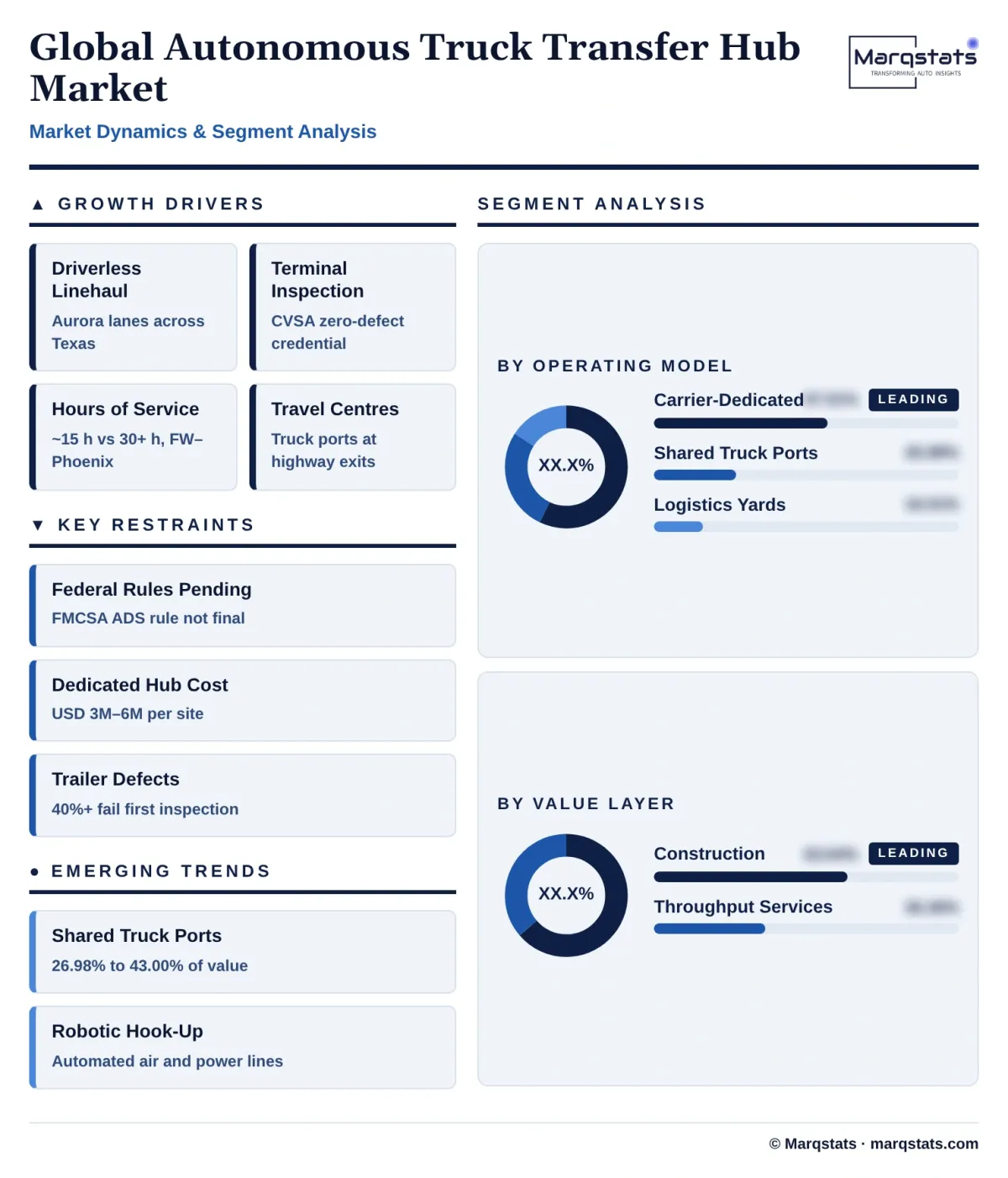
Carrier-dedicated hubs account for an estimated 57.01% of 2025 value, shared multi-tenant truck ports for 26.98% and hubs integrated into logistics companies' yards for 16.01%. North America accounts for 53.01% of 2025 value and China and Asia-Pacific for 36.01%. The study segments the market by operating model, value layer, facility size and region.
Key Takeaways
Market Overview & Analysis
Report Summary
Marqstats sizes the autonomous truck transfer hub market as spending on terminals where freight trailers are exchanged between local human-driven trucks and long-haul Level 4 autonomous trucks. It includes capital spending on site development, automated gates with number plate and trailer recognition, drive-through inspection gantries, sensor calibration bays, autonomous yard trucks, charging and fuelling, and terminal software, plus recurring services such as gate access, yard moves, inspection certification, sensor cleaning and minor repairs. In 2025 the market was worth an estimated USD 312.40 million across 94 hubs.
Transfer hubs separate the easy part of trucking from the hard part. Autonomous trucks perform well on highways with separated lanes and predictable traffic, but city streets, uncontrolled junctions and customer loading docks remain difficult. Hubs next to interstate on-ramps let driverless trucks stay on highways while local drivers handle the first and last miles.
The market sits within a much larger freight economy. Global road freight spending exceeds USD 4 trillion a year, and Level 4 highway autonomous trucking, including vehicles, software and freight billing, was worth about USD 1.5 billion to 1.7 billion in 2025. Transfer hubs are the infrastructure that allows this autonomous linehaul to operate.
A typical hub workflow begins when a local driver drops a trailer at an automated gate. An autonomous yard truck connects the air and electrical lines robotically, moves the trailer through an inspection gantry that checks tyres, brakes, air lines and lights, and sends defective trailers to a repair bay. Approved trailers receive an electronic inspection credential, and an autonomous tractor hooks the trailer, runs self-checks and leaves for the highway once the remote operations centre clears it.
Energy supply is becoming part of the hub. Diesel autonomous trucks refuel at the hub, while battery-electric trucks, common in China and growing elsewhere, need megawatt charging or battery swapping. Hubs that offer both fuels and power, with on-site storage to manage grid limits, will be able to serve mixed fleets as electric heavy trucks spread.
Marqstats expects the number of hubs to reach 146 in 2026, 228 in 2027, 345 in 2028, 495 in 2029 and 685 in 2030. Growth depends on federal rules for driverless trucks, wider acceptance of enhanced inspections across US states, travel centre investment in shared truck ports and the expansion of Chinese expressway freight networks.
Global Autonomous Truck Transfer Hub Market Size and Forecast
The global autonomous truck transfer hub market grows from USD 312.40 million in 2025 to USD 2,725.60 million in 2030, a CAGR of 54.22%. Hub numbers grow from 94 to 685, a 48.77% annual rate. Value grows faster than hub numbers because each hub handles more trailers and earns more service revenue as autonomous fleets grow.
The market grew from USD 24.80 million in 2021, with eight hubs, to USD 58.90 million in 2022, USD 118.50 million in 2023 and USD 192.30 million in 2024, as test yards turned into commercial terminals. Marqstats estimates USD 495.80 million in 2026, USD 782.10 million in 2027, USD 1,215.50 million in 2028 and USD 1,840.20 million in 2029.
Revenue shifts from construction to services. Capital spending on construction and automation was USD 198.80 million, or 63.64% of the market, in 2025, rising to USD 1,199.30 million by 2030, a 43.25% CAGR. Recurring throughput services grow much faster, at 68.13% a year, from USD 113.60 million to USD 1,526.30 million, overtaking capital spending in 2029 and reaching 56.00% of the market in 2030.
Hub costs vary by type. A carrier-dedicated hub costs about USD 3 million to 6 million to build, while shared truck ports at existing travel centres spread costs across several fleets. Tier-1 gateway hubs of 15 to 30 acres operate around the clock with multi-lane inspection gantries, maintenance garages and staging for more than 200 trailers; tier-2 relay sites of 3 to 10 acres use automated gates and basic drop-and-hook pads.
Service revenue per trailer builds steadily. Each trailer transfer can generate fees for gate entry, yard moves, inspection certification, sensor cleaning and repairs to defects found at inspection. As autonomous fleets grow, the number of transfers per hub rises, and shared truck ports serving several fleets spread fixed costs over more trailers, which is why service revenue grows faster than construction spending.
Driverless trucks gain the most from fast hubs. Human drivers are limited to 11 hours of driving in a 14-hour window, restricting a single-driver truck to about 500 to 600 miles a day. A driverless truck can run the roughly 1,000-mile Fort Worth to Phoenix route in about 15 hours instead of 30 or more, but only if terminal stops are short.
Market Dynamics
Key Drivers
Five forces are driving investment in hubs where driverless trucks swap trailers.
- Driverless linehaul trucking is commercial. Aurora runs driverless freight between Dallas, Houston, Fort Worth, El Paso, Phoenix and Laredo, Kodiak runs driverless trucks for Atlas Energy in the Permian Basin, and Inceptio reports more than one billion commercial autonomous kilometres in China. Each new lane needs terminals at both ends.
- Inspection rules require terminal checks. The CVSA Enhanced CMV Inspection Program moves safety inspections from the roadside to the terminal and links results to PrePass and Drivewyze for weigh station bypass. Hubs with certified technicians or automated gantries are needed to issue these credentials.
- Driver shortages and hours-of-service limits favour automation. Long-haul driver shortages persist in the United States, and driverless trucks can run nearly round the clock. Hubs let carriers combine autonomous long-haul runs with local drivers who go home every night.
- State and national rules support driverless freight. Texas allows driverless commercial trucks on public roads, the FMCSA is preparing rules for automated commercial vehicles, Germany's Autonomous Driving Act allows supervised Level 4 operation, and China has opened expressway corridors for intelligent freight vehicles.
- Travel centres see a new business. Pilot and other travel centre operators can turn parking land at highway exits into truck ports earning gate, inspection and energy fees, replacing some of the fuel and driver service revenue that will decline as trucking automates.
Key Restraints
Four constraints shape how quickly transfer hub networks can grow.
- Federal rules are not final. Until the FMCSA completes rules for automated commercial vehicles, operators face uncertainty about remote monitoring, maintenance records and terminal handoff requirements, and some states restrict driverless trucks.
- Dedicated hubs tie up capital. Building private hubs at USD 3 million to 6 million each diverts money from software and vehicle development and risks low use if autonomous volumes grow slowly.
- Labour and community concerns can slow approvals. Driver unions oppose driverless trucks in several states, and local residents may object to large 24-hour terminals near highway exits. Developers must address noise, traffic and jobs concerns when seeking permits for new hubs.
- Customer trailers are often in poor condition. Many trailers supplied by shippers fail zero-defect inspections, causing delays and repair costs at the hub. Operators must manage repairs quickly to keep trucks moving.
- Europe and other regions face fragmented rules. Cross-border approvals, shorter haul distances and cabotage rules limit the case for transfer hubs in Europe outside port corridors, slowing growth there.
Key Trends
Four shifts are changing how autonomous freight terminals are built and run.
- Shared truck ports are replacing private terminals. Autonomous developers are partnering with travel centre operators such as Pilot to use shared hubs on a pay-per-use basis, reducing their capital needs and speeding expansion to new lanes.
- Robots connect trailers. Autonomous yard trucks from Outrider use robotic arms guided by cameras to connect trailer air hoses and electrical cables, removing the need for workers to step between vehicles and allowing fully automated yard moves.
- Inspection is going digital. Drive-through gantries use laser profilometers, thermal cameras, acoustic sensors and camera arrays to check tyres, brakes, air leaks and lights in seconds, and send electronic credentials to enforcement systems.
- Remote operations centres are linked to hubs. Driverless trucks are cleared for departure by remote operations staff who monitor vehicle health and route conditions, and many gateway hubs host these centres alongside maintenance and calibration facilities, making the hub the operational base for each corridor.
- Chinese hubs combine freight and energy. Chinese transfer hubs often include battery swap stations for electric heavy trucks and automated container handling, linking factories, inland dry ports and seaports, with companies such as Westwell and DeepWay supplying autonomous electric tractors.
Strategic Implications
- For ports and inland terminals, transfer capability is a competitive feature. Ports and dry ports that add autonomous handoff areas, digital inspection and charging can attract carriers using driverless trucks on port-to-inland corridors.
- For autonomous truck developers, asset-light access speeds growth. Using shared truck ports and logistics companies' yards on a pay-per-use basis frees capital for technology and lets developers open new lanes faster.
- For carriers and logistics companies, local drayage near hubs becomes valuable. As long-haul margins come under pressure from autonomous capacity, carriers can focus on first- and last-mile work within about 50 miles of major hubs, and automated yards help trailers pass inspections.
- For travel centre operators and real estate developers, highway-exit land gains value. Converting parking areas into truck ports with charging, automated gates, inspection bays and yard trucks creates recurring revenue as trucking automates.
- For yard automation suppliers, standard interfaces open the market. Systems that work with any carrier's trucks and trailers, including robotic line connections and inspection gantries, can be sold to hubs, distribution centres and ports.
- For shippers, trailer quality matters more than before. Trailers that fail inspection at transfer hubs delay freight and incur repair fees, so shippers and trailer pool operators will need better maintenance programmes to benefit from autonomous linehaul.
- For regulators, terminal inspection standards are central. Recognising enhanced terminal inspections across all states and harmonising electronic credentials would let driverless trucks operate on long interstate routes and reduce roadside enforcement burdens.
Market Segmentation
Hubs built or leased for a single autonomous developer or carrier, such as Aurora's terminals in Dallas, Houston and Phoenix and Torc's hub at AllianceTexas, account for 57.01% of 2025 value, USD 178.10 million. They grow at 42.20% a year to USD 1,035.70 million by 2030, while their share falls to 38.00% as shared hubs expand. They offer full control over sensor calibration, dispatch and security but cost USD 3 million to 6 million each.
Multi-tenant truck ports at or near travel centres, which share gates, fuelling and charging, yard trucks and inspection across several fleets, account for 26.98% of 2025 value, USD 84.30 million. They grow fastest, at 69.29% a year, to USD 1,172.00 million and 43.00% of the market by 2030, becoming the largest model.
Transfer capabilities built into high-volume logistics and distribution campuses, linking cross-docking with autonomous linehaul, account for 16.01% of 2025 value, USD 50.00 million, rising to USD 517.90 million and 19.00% of the market by 2030, a 59.61% CAGR. Yard operators such as YMX Logistics are automating with partners such as Outrider.
Capital spending on site works, automated gates, inspection gantries, autonomous yard trucks, charging and terminal software accounts for 63.64% of 2025 value, USD 198.80 million, rising to USD 1,199.30 million by 2030, a 43.25% CAGR, while its share falls to 44.00%.
Recurring fees for gate access, yard moves, inspection certification, sensor cleaning and minor repairs account for 36.36% of 2025 value, USD 113.60 million, and grow at 68.13% a year to USD 1,526.30 million and 56.00% of the market by 2030 as trailer volumes rise.
Large gateway hubs of 15 to 30 acres at major freight interchanges such as Dallas-Fort Worth, Houston, Phoenix, Atlanta and Zhengzhou account for 73.02% of 2025 value, USD 228.10 million, rising to USD 1,771.60 million by 2030, a 50.68% CAGR, while their share falls to 65.00%.
Smaller relay sites of 3 to 10 acres at secondary nodes along long-distance lanes account for 26.98% of 2025 value, USD 84.30 million, and grow faster, at 62.46% a year, to USD 954.00 million and 35.00% of the market by 2030 as networks extend to more lanes.
By Geography
North America
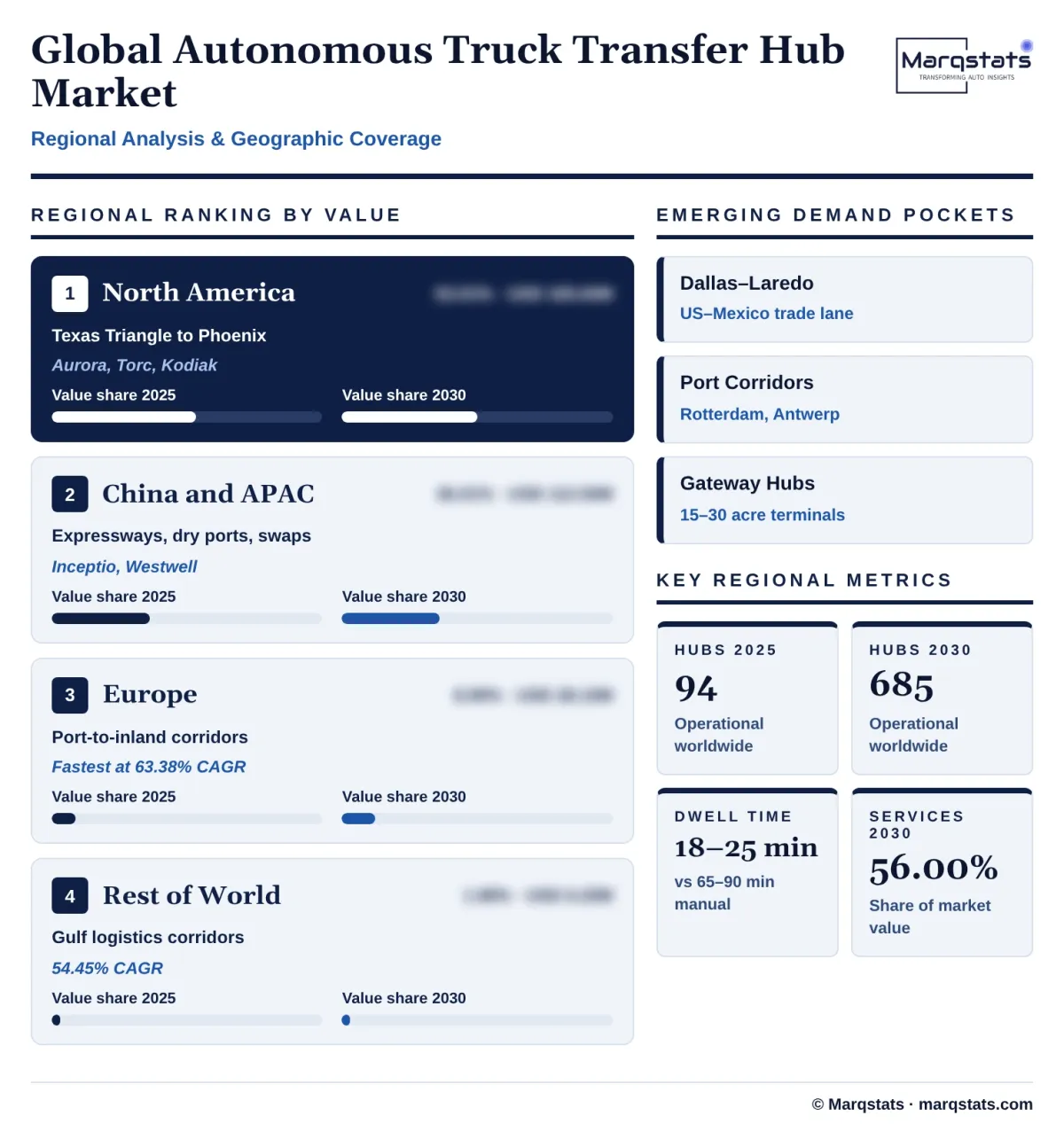
North America is the largest market, with an estimated 53.01% of 2025 value, USD 165.60 million, rising to USD 1,362.80 million by 2030, a 52.43% CAGR, while its share falls to 50.00%. Driverless freight is concentrated in the Texas Triangle and westward to Phoenix, with Aurora terminals in Dallas, Houston and Phoenix, Torc's hub at AllianceTexas in Fort Worth and Kodiak's truckport with Pilot near Atlanta. Texas law, CVSA enhanced inspections and the forthcoming FMCSA rules shape hub design.
China and Asia-Pacific
China and Asia-Pacific account for an estimated 36.01% of 2025 value, USD 112.50 million, rising to USD 981.20 million and 36.00% of the market by 2030, a 54.21% CAGR. Inceptio operates autonomous freight across most of China's main expressways, and Chinese hubs often combine battery swapping for electric heavy trucks with automated container handling linking factories, dry ports and seaports. Westwell runs driverless electric tractors at Hutchison Ports in Hong Kong.
Europe
Europe accounts for an estimated 8.99% of 2025 value, USD 28.10 million, and grows fastest, at 63.38% a year, to USD 327.10 million and 12.00% of the market by 2030. Hubs focus on port and inland corridors connecting Rotterdam, Antwerp and German industrial centres. Fernride operates remotely supervised terminal tractors at HHLA TK Estonia, and Germany's Autonomous Driving Act supports supervised Level 4 freight pilots.
Rest of World
The Middle East and other regions account for an estimated 1.98% of 2025 value, USD 6.20 million, rising to USD 54.50 million and 2.00% of the market by 2030, a 54.45% CAGR. Saudi Arabia and the UAE are testing autonomous trucks on logistics corridors linked to ports and industrial zones, which will need transfer facilities as operations scale.
How Competition Is Evolving
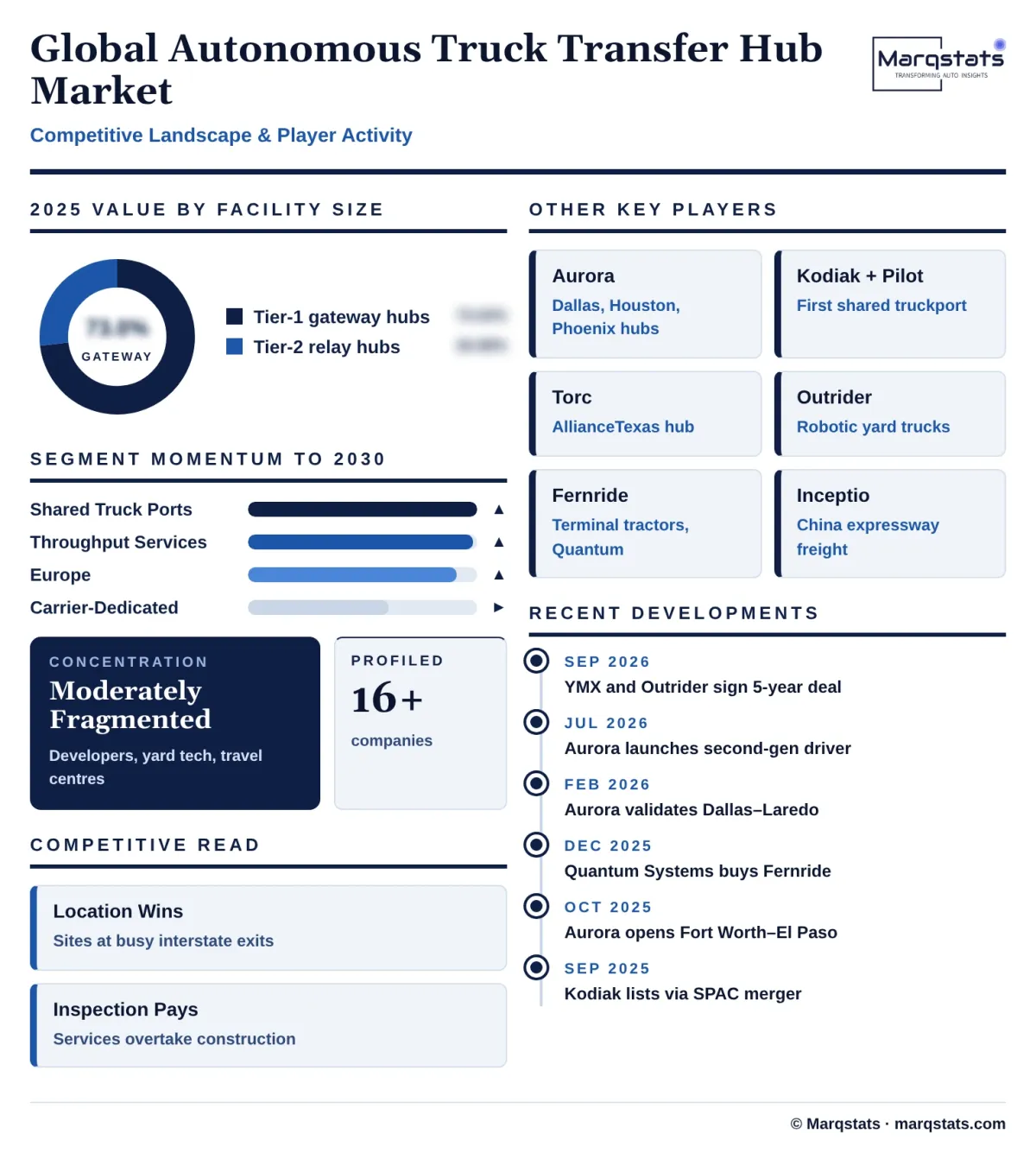
The autonomous truck transfer hub market is moderately fragmented across four groups. Autonomous truck developers such as Aurora, Kodiak, Torc and Inceptio build and operate their own terminals. Yard automation suppliers such as Outrider, Fernride and Westwell provide autonomous yard trucks and terminal software. Travel centre operators such as Pilot co-develop shared truck ports. Logistics yard operators such as YMX Logistics integrate transfer capabilities into distribution campuses.
Developers lead today but are moving to asset-light models. Aurora operates the largest US terminal network, while Kodiak's partnership with Pilot shows how developers can use shared sites. Torc consolidated its testing and operations at AllianceTexas in Fort Worth ahead of its planned 2027 driverless launch.
Inspection technology suppliers form another competitive layer. PrePass and Drivewyze connect terminal inspection results to state enforcement systems, and suppliers of tyre, brake and lighting scanners compete to provide the gantries that issue credentials. Interoperability with these networks is essential for any hub operator.
Yard automation is consolidating. Quantum Systems acquired Fernride in December 2025, and Outrider raised funding and signed a five-year partnership with YMX Logistics in September 2026. Suppliers that offer robotic trailer connections, autonomous yard trucks and yard software as an integrated system will gain share as hubs automate.
Competition will be decided by location, throughput and neutrality. Owners of sites near busy interstate exits, operators that move trailers through inspection fastest, and platforms open to all autonomous fleets will capture the growing service revenue.
Companies Covered
Companies covered in the report include:
Recent Market Activity
Table of Contents
Coverage & Segmentation
The study covers the global autonomous truck transfer hub market, with 2025 as the base year, 2021 – 2025 as the historical period and 2026 – 2030 as the forecast period. Values are in US dollars. The market covers construction and automation spending at terminals where trailers move between local and autonomous long-haul trucks, and recurring throughput services such as gate, yard, inspection and repair fees. It is segmented by operating model, value layer, facility size and region.
Autonomous tractors, local drayage fleets, roadside smart-highway systems and general freight revenue are excluded. Hub counts, spending per hub, segment and regional splits are Marqstats estimates built on developer and operator disclosures, terminal cost benchmarks, inspection programme data and freight lane deployment records.