Market Snapshot
Key Takeaways
Market Overview & Analysis
Report Summary
The GCC autonomous vehicle testing and homologation market covers the paid services that establish whether an autonomous or intelligent connected vehicle may legally operate in the Gulf and whether it continues to satisfy the conditions of that authorisation. Four activities constitute it: homologation and type approval for vehicles and systems entering the region, test programme services for autonomous vehicles operating under permit, simulation and digital twin validation, and the cybersecurity, functional safety and software validation that autonomous systems require and conventional approval never did.
Demand is created by regulation and by programme cadence, not by vehicle purchase, and that distinction matters more here than in any adjacent market. A single vehicle platform entering a Gulf market generates a homologation programme regardless of how many units eventually sell, and an autonomous fleet generates recurring validation work every time its software materially changes. Revenue therefore tracks the number of programmes and tests per model rather than unit volumes, which makes this market largely independent of the vehicle demand cycles that govern the sectors it serves.
Customer concentration is the market's defining commercial characteristic. Regulators, vehicle manufacturers, autonomous developers and large fleet operators account for essentially all spending, and in several Gulf states a single transport authority is simultaneously the largest customer, the approval authority and the owner of the principal testing platform. A provider entering this market is selling to a very small number of buyers, most of whom also set the rules, which shapes pricing power and contract structure more than technical capability does.
Vehicles and Programmes Under Active Test and Validation
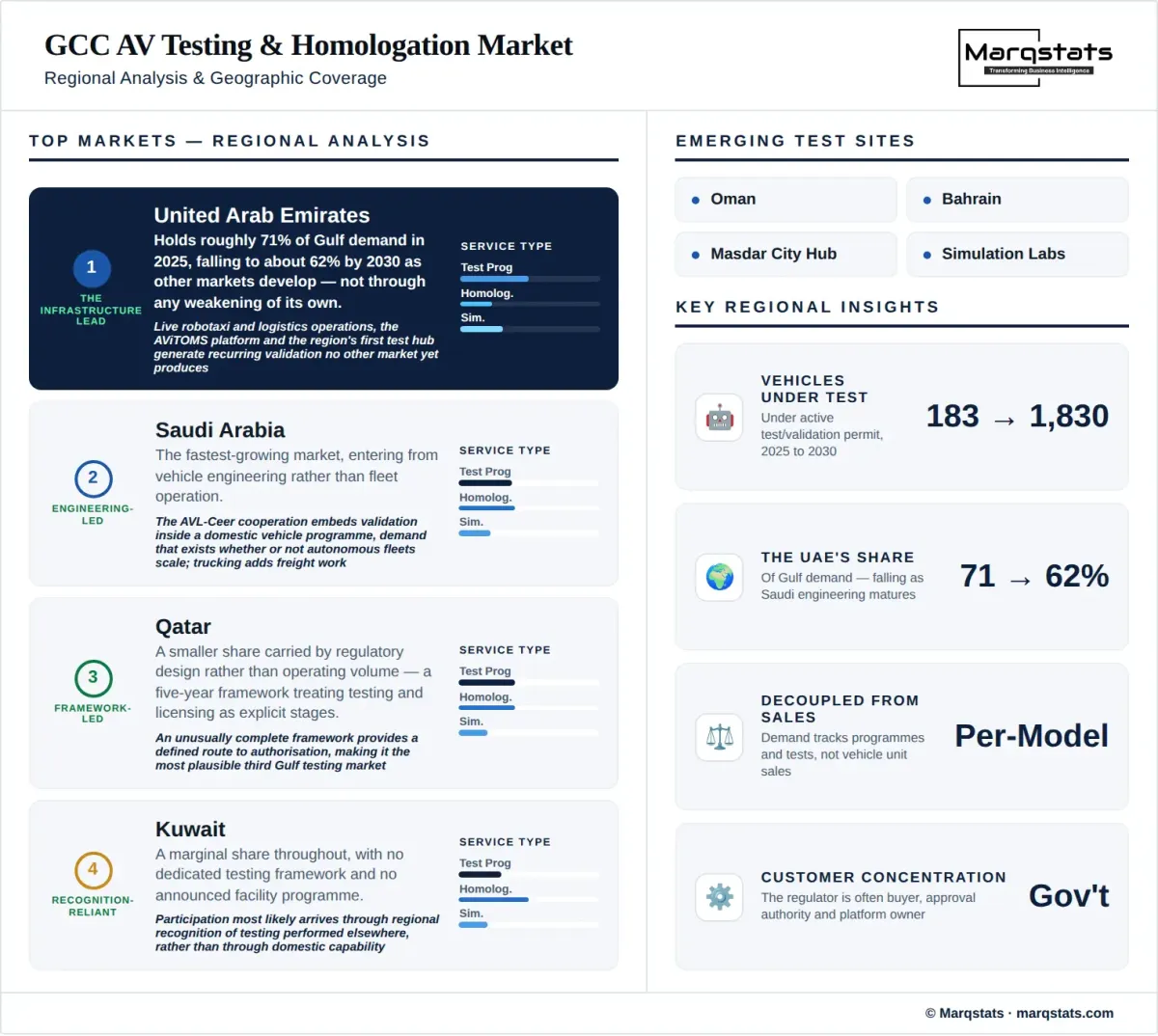
Vehicles under active test and validation permit across the six Gulf states rise from 183 in 2025 to 1,830 by 2030, a 58.49% compound annual growth rate, with an indicative 2031 count near 2,300. The measure covers autonomous vehicles operating under trial rather than commercial authorisation, connected vehicle model programmes in local adaptation and type approval, and vehicles in structured evaluation within domestic manufacturer development cycles.
The country balance shifts materially across the period. The United Arab Emirates accounts for approximately 135 of the 183 vehicles in 2025 and about 1,180 of the 1,830 in 2030, a share falling from roughly three quarters to under two thirds. Saudi Arabia supplies most of the remainder and grows fastest, drawing on both the national autonomous trucking programme and the validation requirements of domestic vehicle manufacturing. Qatar contributes a small but formalised share under a strategy that treats testing and licensing as explicit regulatory stages.
Blended validation spend per vehicle under test falls from approximately USD 113,000 to USD 87,000, a 5.02% annual decline, which is why service value compounds at 50.53% against 58.49% growth in the test population. The figure blends three pools that behave differently: per-vehicle test programme services, per-model homologation and adaptation work that does not scale with fleet size, and facility and simulation services whose cost spreads across every programme using them. Requirements deepen across the forecast while unit costs fall, and the second effect is the larger once dedicated facilities reach operation.
Estimates are working figures rather than reported revenue. No public revenue series exists for autonomous vehicle testing in the Gulf, no participant reports it as a segment, and the market is assembled from test programmes, model and platform launches, local industrialisation commitments and the observable shift from pilots toward certified commercial operation. Confidence is low. The United Arab Emirates component is the best evidenced; the Saudi and Qatari components rest on announced capability rather than operating history.
Market Dynamics
Key Drivers
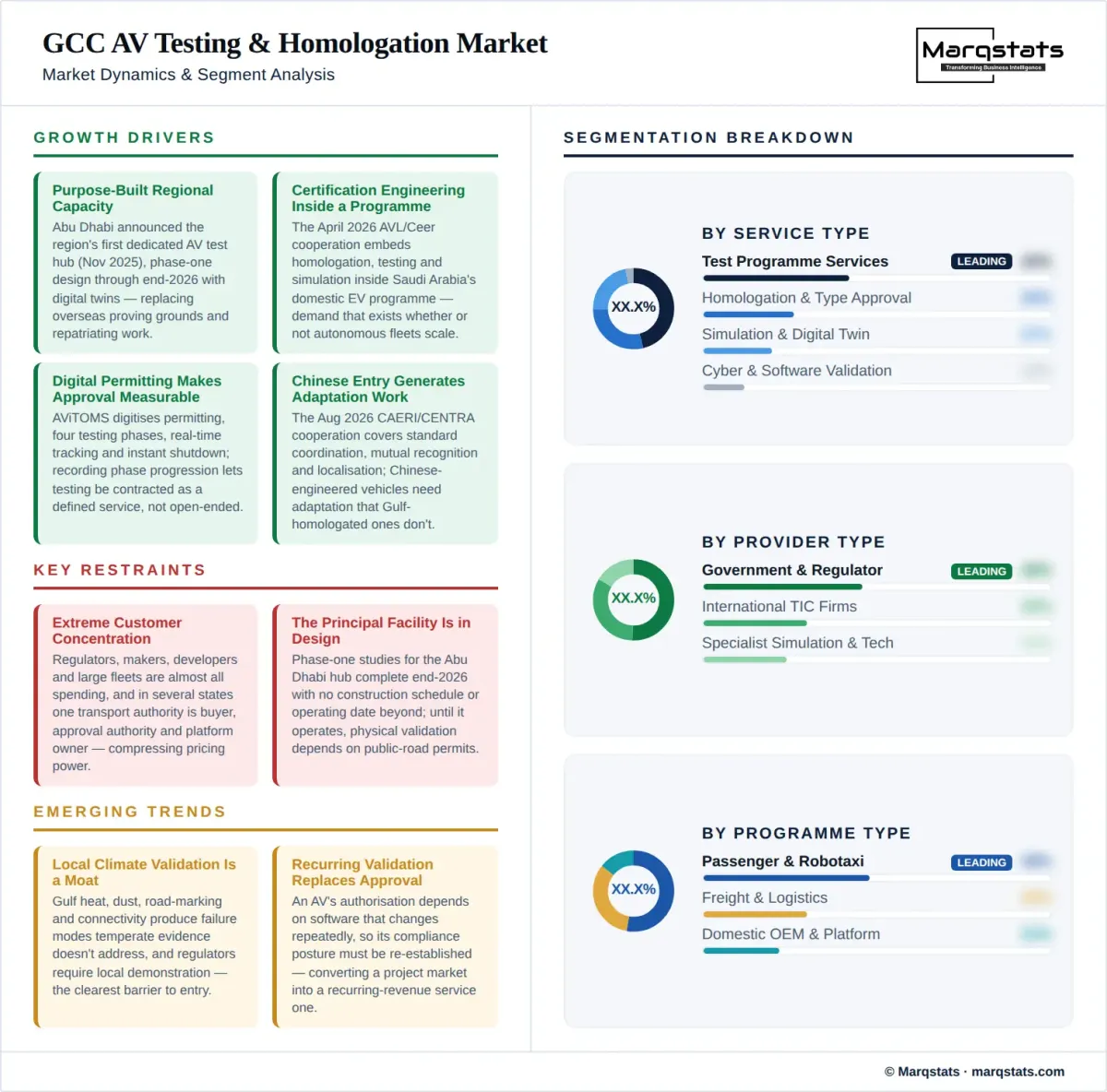
- Purpose-built regional testing capacity entering development. Abu Dhabi announced the region's first dedicated autonomous vehicle test hub in November 2025, intended for testing, validation and certification of autonomous technologies, with phase-one design work planned through the end of 2026 and the facility expected to recreate multiple operating environments using digital twins and sensing infrastructure. Domestic capacity for structured accreditation replaces reliance on overseas proving grounds and repatriates work currently performed abroad.
- Certification-oriented engineering embedding inside national vehicle programmes. The April 2026 AVL and Ceer cooperation covers advanced vehicle development, high-voltage integration, homologation support, testing and validation, and simulation across the development cycle. Validation demand generated by a domestic manufacturer exists whether or not autonomous fleets scale, which diversifies the market away from dependence on a single technology pathway.
- Digital permitting platforms converting approval into a measurable process. AViTOMS digitises registration, applications, permitting, four structured testing phases, real-time tracking, incident monitoring and instant shutdown capability. A platform that records phase progression makes validation evidence auditable and repeatable, which is what allows testing to be contracted as a defined service rather than performed as an open-ended engineering exercise.
- Chinese platform entry generating mutual-recognition and adaptation work. The August 2026 cooperation between the China Automotive Engineering Research Institute and CENTRA Mobility covers intelligent connected vehicles, testing equipment, system development and testing facility construction, alongside technical-standard coordination, mutual recognition, localisation adaptation and market-access support. Vehicles engineered to Chinese standards entering markets that recognise European and Gulf conformity routes require adaptation work that vehicles already homologated to those routes do not.
- Testing established as a prerequisite to regulatory scale-up. The staged path agreed between Dubai's transport authority and Baidu began with 50 Apollo Go vehicles carrying around 40 sensors each for data collection and operational trials ahead of commercial service, with scope to scale toward 1,000 units over three years subject to operating efficiency and service quality standards. Where fleet expansion is conditional on demonstrated performance, validation becomes a recurring cost of growth rather than a one-time entry cost.
Key Restraints
- Extreme customer concentration with the buyer frequently also the regulator. Regulators, manufacturers, autonomous developers and large fleet operators account for almost all spending, and in several Gulf states one transport authority is simultaneously the largest customer, the approval authority and the platform owner. That structure compresses pricing power for independent providers and makes contract award dependent on institutional relationships rather than on competitive tender.
- The principal facility still in design. Phase-one studies and design for the Abu Dhabi test hub complete at the end of 2026, with no announced construction schedule, capital figure or operating date beyond that milestone. Until it operates, physical validation depends on public-road permits and facilities designed for other purposes, which caps how much of the addressable work can be performed inside the region.
- No published pricing benchmark anywhere in the region. Testing and certification revenue is not separately disclosed by any operator, regulator or listed provider in the Gulf. Buyers cannot benchmark, providers cannot anchor proposals, and procurement cycles lengthen accordingly. The opacity also allows facility announcements to be read as demand evidence when they measure capability instead.
- Validation capability retained inside developer organisations. Autonomous developers arrive with their own validation stacks and accumulated global test data, and prefer to satisfy local requirements using in-house evidence wherever regulators permit. Independent providers capture the regulatory interface and local adaptation work but not the core engineering validation, which caps realised revenue per programme below its theoretical level.
Key Trends
- Local climate validation emerging as a defensible commercial position. Gulf heat, dust, road marking conventions and connectivity conditions produce failure modes that temperate-climate test evidence does not address, and regulators increasingly require local demonstration rather than accepting imported files. That requirement protects regional providers from remote competition more effectively than any accreditation advantage, and it is the clearest barrier to entry in the market.
- A regional gateway forming for Gulf-bound platforms. The Abu Dhabi hub can serve as a testing gateway for Chinese intelligent connected and autonomous platforms entering the wider Gulf if mutual-recognition mechanisms develop, converting a national facility into regional infrastructure. The CAERI and CENTRA cooperation names mutual recognition explicitly, which indicates the mechanism is being built rather than merely hoped for.
- Validation scope widening beyond the vehicle. Cybersecurity, software update management, functional safety, high-voltage system safety and data governance now sit inside autonomous vehicle approval alongside mechanical and performance testing. Each is a separate discipline with its own specialists, and the widening scope favours providers able to assemble multi-disciplinary teams over those holding a single laboratory accreditation.
- Recurring validation replacing one-time approval. An autonomous vehicle's authorisation depends on software that changes materially and repeatedly, so its compliance posture must be re-established rather than certified once. That shift converts a project market into a service market with recurring revenue, and it is the structural change that makes this sector investable rather than merely necessary.
Market Segmentation
Test programme services are the largest service type throughout, covering permit application support, safety-case preparation, sensor and system validation, supervised road testing, distance accumulation and the evidence packaging that phase progression requires. The segment scales with vehicles under permit and is where providers build the regulator relationships that determine access to later work. It is also the most exposed to substitution by developers using in-house validation.
Homologation and type approval covers conformity assessment for vehicles and components entering Gulf markets, including model-level approvals and the adaptation of files prepared to other standards. It is the most established of the four activities, with international certification firms already present, and the one that benefits most directly from mutual-recognition arrangements between Chinese and Gulf conformity regimes. Demand follows model launch cadence rather than fleet size.
Simulation and digital twin services grow fastest across the forecast, driven by the Abu Dhabi hub's design commitment to digital twin capability and by the economics of substituting virtual distance for physical distance. Scenario libraries reflecting Gulf road layouts, traffic behaviour, roundabout density, marking conventions and heat conditions are the differentiating asset, since generic scenario sets do not represent the operating domains regulators actually assess.
Cybersecurity, functional safety and software validation covers assessment against international cybersecurity guidance, software update management, functional safety analysis and high-voltage system safety. The segment is small in 2025 and expands steadily as continuous supervision requirements accumulate. Its distinguishing characteristic is recurrence: unlike a mechanical approval, these postures must be re-established after material software change.
Public-road testing under permit accounts for most validation activity through the forecast, because it is the environment in which Gulf authorities currently grant authorisation and because phase progression is evidenced by real-world distance. Its share declines gradually as dedicated facilities and simulation absorb work not requiring public exposure, but it remains the environment where authorisation is ultimately conferred.
Dedicated facility testing is negligible in 2025 and becomes material from 2028, following the Abu Dhabi test hub's transition from design into operation. A controlled environment recreating multiple operating conditions allows repeatable scenario execution and edge-case testing that cannot be scheduled on public roads, and it is the segment that determines whether Gulf validation work is performed regionally or continues to travel abroad.
Laboratory and simulation covers component testing, hardware-in-the-loop validation, sensor characterisation, high-voltage bench work and scenario execution performed without a vehicle on a road. The environment carries the lowest marginal cost per test and the highest scalability, and its expansion is the principal reason blended validation spend per vehicle declines across the forecast.
Autonomous passenger and robotaxi programmes generate the largest share of test-vehicle volume, reflecting the concentration of permitted Gulf activity around passenger mobility. Programme intensity is high because these vehicles operate among the public and progress through structured supervision phases before unmanned authorisation, with each phase requiring separate evidence and each service-area extension constituting a new operational domain.
Autonomous freight and logistics programmes grow fastest across the forecast as Gulf commercial vehicle autonomy moves from pilots toward corridor operation. Validation requirements differ from passenger programmes in vehicle mass, braking distance, load dynamics and the industrial environments involved, and corridor-based authorisation means each route extension generates its own validation exercise.
Domestic manufacturer and platform development programmes are the newest category and the one least dependent on autonomy, covering full-vehicle validation, high-voltage integration and homologation support for regionally developed vehicles. The AVL and Ceer cooperation is the defining example, and the segment's significance is that it generates validation demand whether or not autonomous deployment meets its targets.
Government and regulator-operated capacity holds the largest share, an unusual structure explained by the sequence in which the market formed: platforms, permit systems and test facility programmes were established by transport authorities before a commercial testing industry existed. A commercial provider works through that infrastructure rather than around it, and access to it is granted rather than purchased.
International engineering and certification firms hold established positions in conventional homologation and conformity assessment across the Gulf and are the natural incumbents for imported model programmes. Their position in autonomous validation is stronger where vehicle engineering is involved, as the AVL and Ceer arrangement demonstrates, and weaker where operating-domain and regulatory-interface knowledge accumulated locally is decisive.
Specialist simulation and technology providers grow fastest across the forecast, spanning digital twin and scenario developers, sensing and monitoring integrators and the joint ventures forming around standards recognition. The segment is where entrants can establish a position without the accreditation base or the regulatory mandate the other two provider types already hold, and where local scenario libraries create durable differentiation.
By Geography
United Arab Emirates
The United Arab Emirates holds roughly 71% of Gulf demand in 2025, falling to about 62% by 2030 as other markets develop rather than through any weakening of its own position. Abu Dhabi operates the AViTOMS platform and is developing the region's first dedicated autonomous vehicle test hub with phase-one design due by the end of 2026. Dubai's transport authority has run phased road mapping and test fleets ahead of commercial driverless launch, and live robotaxi and logistics operations generate recurring validation work that no other Gulf market yet produces.
Saudi Arabia
Saudi Arabia is the fastest-growing market and enters from vehicle engineering rather than from fleet operation. The April 2026 AVL and Ceer cooperation embeds homologation support, testing, validation and simulation inside the Kingdom's domestic electric vehicle programme, while Transport General Authority business-model technical evaluation sits alongside national conformity requirements for autonomous operation. The national autonomous trucking programme adds freight validation demand on top of that industrial base.
Qatar
Qatar holds a smaller share carried by regulatory design rather than operating volume. Its autonomous vehicle strategy treats development, testing, licensing and operation as explicit regulatory stages across a five-year framework, which is unusually complete for a market with limited current activity. The framework provides a defined route to authorisation and makes Qatar the most plausible third Gulf testing market.
Kuwait
Kuwait holds a marginal share throughout, with no dedicated autonomous vehicle testing framework and no announced facility programme. Conformity assessment for imported vehicles continues under regional standards arrangements, and participation in autonomous validation is most likely to arrive through regional recognition of testing performed elsewhere rather than through domestic capability.
Oman and Bahrain
Oman and Bahrain together hold a negligible share across the forecast. Neither has announced an autonomous vehicle testing framework or facility, and both are most likely to rely on conformity assessment performed in larger neighbouring markets. Their position depends more on whether Gulf mutual recognition develops than on any domestic investment decision.
How Competition Is Evolving
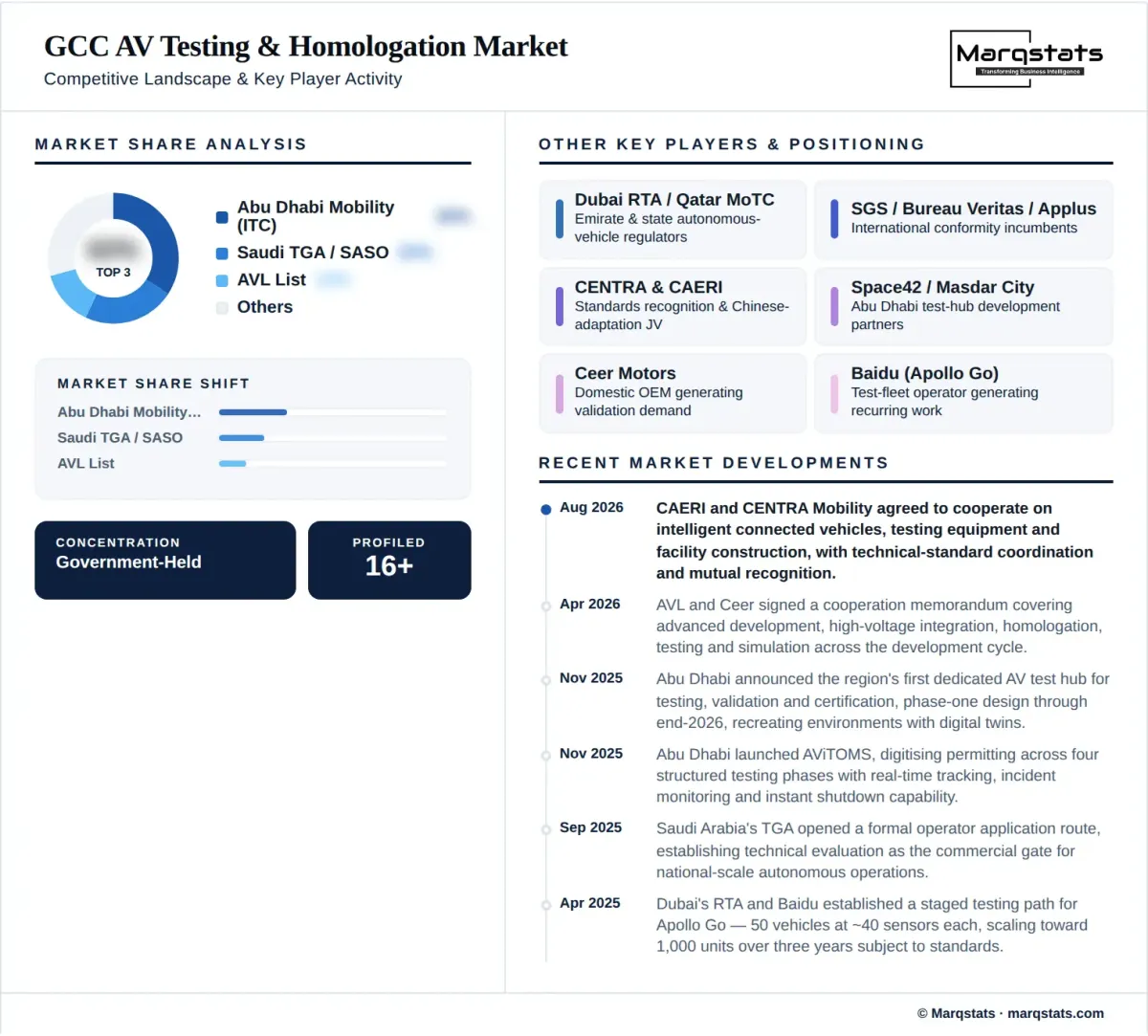
The market is fragmented among commercial providers and concentrated in the institutions above them, which is the structure to understand before assessing any competitive position. Transport authorities in Abu Dhabi, Dubai and Riyadh own the permit systems, the monitoring platforms and the approval decisions, and the principal physical facility in development is a government programme with strategic partners rather than a private investment. Commercial participants operate around that structure: international engineering and certification firms hold conventional homologation and vehicle development work, and specialist technology providers supply simulation, sensing and assessment capability.
Competitive position is therefore determined by inclusion in institutional programmes rather than by accreditation breadth or price. The Abu Dhabi test hub ecosystem draws together a transport authority, a space and technology group, a sustainable urban development and a listed mobility operator, and membership of that consortium is worth more than any laboratory certification an outside entrant could obtain. The CENTRA Mobility arrangement with the China Automotive Engineering Research Institute performs the same function on standards recognition, and the AVL and Ceer cooperation does so on vehicle engineering.
Two structural openings exist for participants without institutional relationships. Local scenario libraries and climate-specific validation capability are genuinely differentiating and cannot be replicated from outside the region, because they encode Gulf heat, dust, road marking and connectivity conditions that imported test evidence does not address. Cybersecurity, functional safety and software validation are new enough that no incumbent holds an established Gulf position, and they carry the recurrence that makes revenue predictable. Both are more accessible than competing for physical testing capacity that is still being built.
Companies Covered
The report profiles 16+ companies with full strategy and financials analysis, including:
Recent Market Activity
Table of Contents
Coverage & Segmentation
The study covers the six Gulf Cooperation Council states with country-level detail for the United Arab Emirates, Saudi Arabia, Qatar, Kuwait, and Oman and Bahrain combined. It measures the annual value of testing, validation, homologation and certification services delivered for autonomous and intelligent connected vehicles, in United States dollars, with vehicles under active test and validation permit carried as the secondary unit. The base year is 2025, the historical period covers 2024 to 2025, and the forecast period runs from 2026 to 2030 with an indicative 2031 endpoint.
Three exclusions define the boundary. Periodic roadworthiness inspection of the in-use vehicle parc is excluded: registration renewal testing across the Gulf is a separate, far larger and structurally different market driven by parc size and renewal cycles rather than by technology approval. Driver training and driver testing are excluded, since they assess people rather than vehicles. Autonomous fleet operating costs and the vehicles themselves are excluded and belong to the fleet operations and vehicle markets respectively.
The Emirati component of this market is the same activity measured in the United Arab Emirates intelligent connected vehicle testing study, at national rather than regional scale. That national figure of USD 14.60 million in 2025 rising to USD 99.40 million by 2030, on 135 vehicles rising to 1,180, sits inside the Gulf figures reported here, so the national and regional measures describe one activity at two geographic scales rather than two markets that combine.