Market Snapshot
Key Takeaways
Market Overview & Analysis
Report Summary
Thailand's driver assistance market is a tax outcome before it is a safety outcome or a consumer one, and that single characteristic makes it behave unlike any comparable market. Fitment is not tracking willingness to pay, it is tracking a threshold written into the excise code, and the threshold is high enough that the decision is made for the manufacturer rather than by it.
The measure is the value of advanced driver assistance systems fitted to vehicles produced in Thailand, priced at system level, meaning sensors, controllers and the software integration that turns them into a functioning feature. That figure includes semiconductor and electronic content that is counted separately at component level on its own page, and the two are never added, because one is a subset of the other measured at a different level of the stack. Autonomous driving is carried as a named dimension covering testing and proving-ground activity rather than deployment.
The analysis is written for sensor and system suppliers sizing a market whose demand curve is a regulation, vehicle manufacturers deciding which four of six systems to fit and at what specification, safety regulators and rating bodies assessing whether a tax threshold delivers the outcome a safety standard would, and investors pricing an autonomy story that Thailand does not yet have.
Thailand ADAS Market Size and Forecast
Equipped vehicle production is estimated at 416,000 units in 2025, 690,000 in 2026 and 1,190,000 by 2030, an increase of 774,000 units a year, taking market value through USD 345.00 million in 2026. Market value moves from USD 216.32 million to USD 541.45 million on a system value per equipped vehicle falling from about USD 520 to USD 455, or THB 16,900 to THB 14,788 at a disclosed constant THB 32.5 per USD.
Two growth rates apply and the gap between them is the whole regulatory story. The five-year value rate connecting 2025 and 2030 is 20.14%; the four-year rate connecting 2026 and 2030 is 11.93%. The 8.21-point gap is a single step: equipped output rises 65.87% in 2026 as the excise condition takes effect on 1 January, after which the market grows on the remaining unequipped production rather than on a rule change.
Value compounds behind volume at 20.14% against 23.39%, a 3.25-point inversion, and the mechanism is sensor hardware deflation rather than mix. Units compound at 14.60% across the narrower window against a 11.93% value rate on the same period, which is the same effect measured twice.
Penetration is the series that makes the forecast assessable. Fitment rises from 28.69% of the 1,450,000 vehicles produced in 2025 to 47.26% of 1,460,000 in 2026 and 78.29% of 1,520,000 by 2030, so the terminal assumes roughly four in five vehicles built in Thailand carry a qualifying system set, against fewer than three in ten before the rule.
A sizing range is published rather than a point. The 2030 figure sits within a band of 900,000 to 1,330,000 equipped units and USD 409.50 million to USD 605.15 million, corresponding to rates of 13.61% and 22.84%, and the spread turns on how far the fitment logic extends into the pickup and commercial classes that face a lower threshold.
The Tax Gap Is Four Times the Hardware Cost
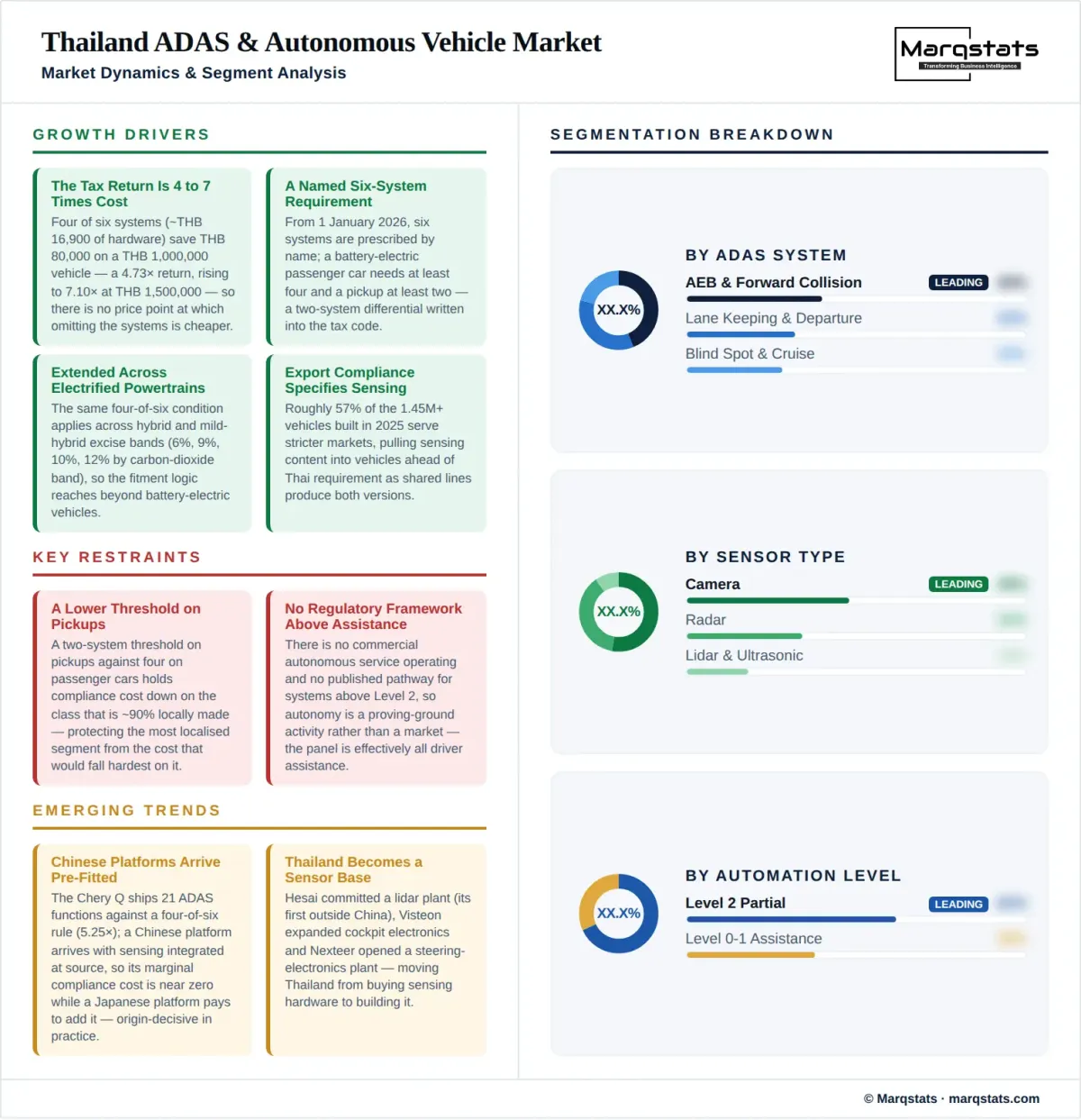
The reason Thai fitment moves faster than Thai consumer demand is a number a manufacturer can compute in one line. A battery-electric passenger car with at least four of the six prescribed systems pays 2% excise; without them it pays 10%, so the gap is 8 percentage points of the vehicle price.
Set that against what the systems cost and the decision stops being a decision. Four systems built from a forward camera, a radar unit and a shared controller represent roughly USD 520, or THB 16,900, of system-level content, against an excise saving of THB 80,000 on a THB 1,000,000 vehicle, which is a return of 4.73 times.
The return improves with price rather than deteriorating. At THB 1,500,000 the saving is THB 120,000 against the same hardware, a return of 7.10 times, and even at THB 800,000 it is 3.79 times, so there is no price point in the Thai market at which omitting the systems is the cheaper choice.
That is why a mandate framed as an incentive behaves like a requirement. The excise structure does not oblige a manufacturer to fit driver assistance, it simply makes not fitting it more expensive than fitting it by a factor of four to seven, which produces near-universal compliance without a safety regulation ever being written.
The practical consequence for a supplier is that the demand curve has a date rather than a slope. Fitment rises 18.57 percentage points in 2026 because the rule takes effect on 1 January 2026, and a sensor supplier that treated this as a gradual adoption curve would have missed a 65.87% single-year increase in equipped output.
Six Systems, Named, and Two Different Thresholds
Thailand prescribes the systems by name rather than by capability, which is unusual and commercially helpful. The six are advanced emergency braking, forward collision warning, lane keeping assistance, lane departure warning, blind spot detection and adaptive cruise control.
The thresholds differ by vehicle class and the difference is two systems. A battery-electric passenger car with ten seats or fewer must carry at least four of the six to reach the 2% rate, while a battery-electric pickup truck must carry at least two, with 10% applying in both cases if the threshold is missed.
That differential lands on the segment with the deepest local content and the thinnest margins. Pickups and eco-cars are built with approximately 90% domestically produced parts, and a two-system threshold rather than four keeps the compliance cost on that segment at roughly half, which protects a locally made vehicle class from a cost that would fall hardest on it.
The named-system approach also decides the sensor mix rather than leaving it open. Four of the six functions can be delivered from a forward camera and a single radar, which is why the Thai fitment pattern concentrates on that configuration rather than on the multi-radar arrays a capability-based rule would encourage.
The same condition applies across the electrified powertrains rather than to battery-electric vehicles alone. The revised hybrid excise package carries the same requirement for at least four of the six systems alongside carbon dioxide bands of 6% for hybrids at or below 100 grams per kilometre and 9% above that to 120, with mild hybrids at 10% and 12% on the same bands.
ADAS Is 41.43% of the Electronic Content It Sits Inside
This page and the Thai automotive electronics analysis measure the same vehicles at different levels of the stack, and the relationship between them needs stating rather than leaving to inference. Driver assistance at about USD 520 per equipped vehicle is 41.43% of the USD 1,255 of total semiconductor and electronic content in an average vehicle built in Thailand in 2025.
The two figures are a subset relationship and not an addition. The USD 520 of system-level driver assistance value contains sensors, a controller and integration whose semiconductor and electronic components are already inside the USD 1,255, so summing them would count the same chips twice and overstate vehicle electronic content by roughly two fifths.
The distinction is not academic for a supplier deciding where to compete. A semiconductor company sells into the USD 1,255; a systems integrator sells the USD 520 as a function with a validated performance claim attached, and the second captures the integration margin that the excise threshold makes non-optional.
Driver assistance is also the fastest-growing part of that content and the reason the wider figure moves. Total electronic content per vehicle rises from USD 1,255 to USD 1,789 across the forecast, and a driver assistance system spreading from 28.69% to 78.29% of production is a substantial share of that increase.
A THB 4xx,000 Car Ships 21 ADAS Functions Against a 4-of-6 Rule
The threshold requires four of six systems, and the market is not meeting it so much as overshooting it. The Chery Q, expected at THB 4xx,000 to 5xx,000, carries 21 ADAS functions with a 360-degree camera and six airbags, which is 5.25 times the regulatory requirement on one of the cheapest vehicles in the launch calendar. Domestic sales reached 406,162 units in January to July 2026, up 15.4%, of which 125,411 were passenger battery electric vehicles against passenger battery electric production of only 47,452 within 834,595 vehicles built, so 62.16% of battery electric demand is imported and arrives with its sensing content already fitted. Cumulative battery electric registrations reached 387,000 units by August 2026.
The price ladder shows the same pattern at every level. The MG URBAN launched on 17 June 2026 at THB 529,900 with Level 2 driver assistance and automated parking including smartphone-controlled remote parking; NIO firefly launched on 24 March 2026 from THB 799,000 with more than 30 active safety and driver assistance features standard; XPeng's L03 launched on 18 August 2026 from THB 899,000, using a Front-View Integrated Machine on the two lower variants and two TURING artificial intelligence chips on the Long Range Ultra, which sits in the THB 1,200,000 band.
That asymmetry is a competitive effect the excise rule creates without intending it. A Chinese platform arrives in Thailand with the sensing content already integrated at source, so the marginal cost of clearing four of six is close to zero; a Japanese platform designed around a different specification pays for the content it has to add. The rule is powertrain-neutral and origin-neutral on its face, and origin-decisive in practice, which is why XPeng has delivered more than 10,000 vehicles in Thailand across two years on hardware it did not have to add.
Thailand Is Becoming a Sensor Manufacturing Base, Not Just a Fitment Market
The most consequential ADAS investment announced in Thailand in 2026 was not a vehicle programme. Hesai Technology committed over THB 1.5 billion on 23 January 2026 to a lidar plant, the company's first outside China, which moves Thailand from buying sensing hardware to building it and changes what the domestic value chain can capture from every equipped vehicle.
Supporting electronics capacity expanded alongside it. Visteon announced on 25 June 2026 an expansion of its cockpit electronics site by 2,988 square metres to 4,700 square metres with future capacity near 2 million units a year; Nexteer opened a 5,000 square metre column electric power steering plant in Rayong on 30 March 2026 with registered capital of THB 108 million; and Analog Devices has invested over THB 30 billion in Thailand with more than 1,200 employees across sectors including automotive chips.
The national ambition behind that is explicit and long-dated. Thailand's semiconductor strategy targets over THB 2.5 trillion of investment and more than 230,000 skilled workers by 2050, and approved electrified mobility investment already reaches THB 137 billion across 198 projects including THB 12.5 billion for drive motors, battery management and energy control across 49 projects, against over THB 180 billion of electric vehicle related applications since 2017.
Autonomy Is a Proving Ground, Not a Market
The autonomous half of this title is a research and testing activity in Thailand rather than a revenue line, and saying so plainly is more useful than sizing something that does not exist. There is no commercial autonomous ride-hailing service operating in Thailand, unlike the one running elsewhere in Southeast Asia.
National activity is concentrated on facilities rather than fleets. Connected and autonomous vehicle proving-ground work led by the national science and higher education apparatus is the substance of Thai autonomy activity, which is infrastructure for validation rather than deployment.
The gap between assistance and autonomy is also a regulatory one and Thailand has not crossed it. The excise structure recognises six named assistance functions and stops there, with no framework equivalent to a Level 3 target date of the kind a neighbouring market has set, so there is no regulatory pathway for a system that takes responsibility from the driver.
For an investor the honest reading is that Thailand is an assistance market with an autonomy option rather than an autonomy market. Level 2 partial automation is where the 1,190,000 equipped vehicles forecast for 2030 will sit, and anything above it requires a regulatory change that has not been proposed.
Market Dynamics
Key Drivers
- An excise gap of 8 percentage points, delivering a return of 4.73 times on roughly THB 16,900 of hardware for a THB 1,000,000 vehicle and 7.10 times at THB 1,500,000.
- A named six-system requirement effective 1 January 2026, with four systems required on battery-electric passenger cars and two on battery-electric pickups.
- The same four-of-six condition extended across hybrid and mild hybrid excise bands of 6%, 9%, 10% and 12% by carbon dioxide band.
- Export compliance on roughly 57% of more than 1.45 million vehicles produced in 2025, specifying sensing content ahead of Thai requirement.
- Regional intelligent vehicle rating frameworks moving driver assistance from a scoring bonus toward a requirement for top safety ratings.
Key Restraints
- A two-system threshold on pickups against four on passenger cars, holding compliance cost down on the class that is approximately 90% locally made.
- No regulatory framework above assistance, with no commercial autonomous service operating and no published pathway for systems above Level 2.
- Sensor hardware deflation taking system value per equipped vehicle from about USD 520 to USD 455 while unit demand grows faster.
- A flat production base of 1,450,000 vehicles rising to 1,520,000, which caps equipped volume once penetration approaches 78.29%.
Key Trends
- Penetration rising 18.57 percentage points in 2026 alone, a 65.87% single-year increase in equipped output driven by a rule with a date rather than a curve.
- Camera and single-radar configurations dominating because four of the six named functions can be delivered from that pairing.
- Driver assistance at 41.43% of the USD 1,255 of total vehicle electronic content and rising as content per vehicle moves toward USD 1,789.
- Value compounding 3.25 points behind volume, so supplier revenue grows more slowly than the installed base of systems.
Market Segmentation
The first of the six prescribed systems and effectively universal among qualifying vehicles, since a passenger car needs four of six and this function is the one a forward camera and radar deliver most directly. It is fitted across the 416,000 equipped vehicles produced in 2025.
The second of the six prescribed systems and the lowest marginal cost among them, because it shares the forward camera and radar that emergency braking already requires, which makes it the default second selection toward the four-system threshold on a vehicle facing an 8-point excise gap.
Two of the six prescribed systems counted separately by the excise structure, both delivered from the same forward camera, which is why selecting them is the cheapest route from two systems to four on a THB 1,000,000 vehicle carrying an 8-point excise gap.
The 1 system of the 6 requiring dedicated rear corner radar rather than sharing the forward sensor set, and therefore the most expensive to add, typically selected only where a manufacturer specifies beyond the 4-system minimum that the 2% excise rate requires.
The sixth prescribed system and the one most visible to the buyer, delivered from the same forward radar as emergency braking and concentrated in the electrified and premium production that made up much of the 28.69% penetration recorded in 2025.
The core sensor in every qualifying configuration, supporting four of the six named functions on its own, and the reason system value per equipped vehicle sits near USD 520 rather than at the multi-sensor levels a capability-based rule would require.
The second sensor in the standard Thai configuration, required for 2 of the 6 prescribed functions in emergency braking and adaptive cruise control, with rear corner units added only where blind spot detection is specified beyond the four-system threshold.
Parking and low-speed sensing, outside the six prescribed systems and therefore outside the excise calculation, fitted on commercial judgement across a production base of 1,450,000 vehicles rather than on regulatory logic.
Present in Thailand through supplier entry rather than through volume fitment, since none of the six prescribed functions requires it, and relevant to the autonomy activity that remains a proving-ground exercise rather than to the 1,190,000 equipped vehicles forecast for 2030.
Warning and single-axis intervention functions, the baseline that the four-of-six threshold lifts vehicles out of, and the level most of the 71.31% of 2025 production without a qualifying system set occupied.
Combined lateral and longitudinal control, where a four-system configuration lands in practice and where effectively all of the 1,190,000 equipped vehicles forecast for 2030 will sit.
Conditional automation and beyond, absent from Thai production and from Thai regulation, with no published pathway equivalent to the 2030 Level 3 target a neighbouring market has set.
The category facing the four-of-six threshold and the 8-point excise gap, covering the 550,456 passenger vehicles of 2025 production and carrying the highest fitment rate and the highest system value per vehicle.
The category facing a two-of-six threshold, covering most of the 899,544 pickups and commercial vehicles produced in 2025, and the segment whose lower requirement holds its compliance cost at roughly half that of a passenger car.
Heavier classes outside the current excise thresholds entirely, fitted where export specification requires it rather than where Thai tax rewards it, and the category where the next extension of a rule that today reaches 4 of 6 systems on passenger cars would land.
Roughly 57% of more than 1.45 million units produced in 2025, specified to destination-market safety rules and rating regimes rather than to the Thai threshold, and the share whose fitment would survive withdrawal of the excise condition.
The balance against domestic sales of 621,166 vehicles in 2025, where the 8-point excise gap is the binding driver and where the 18.57-point penetration jump in 2026 is concentrated.
By Geography
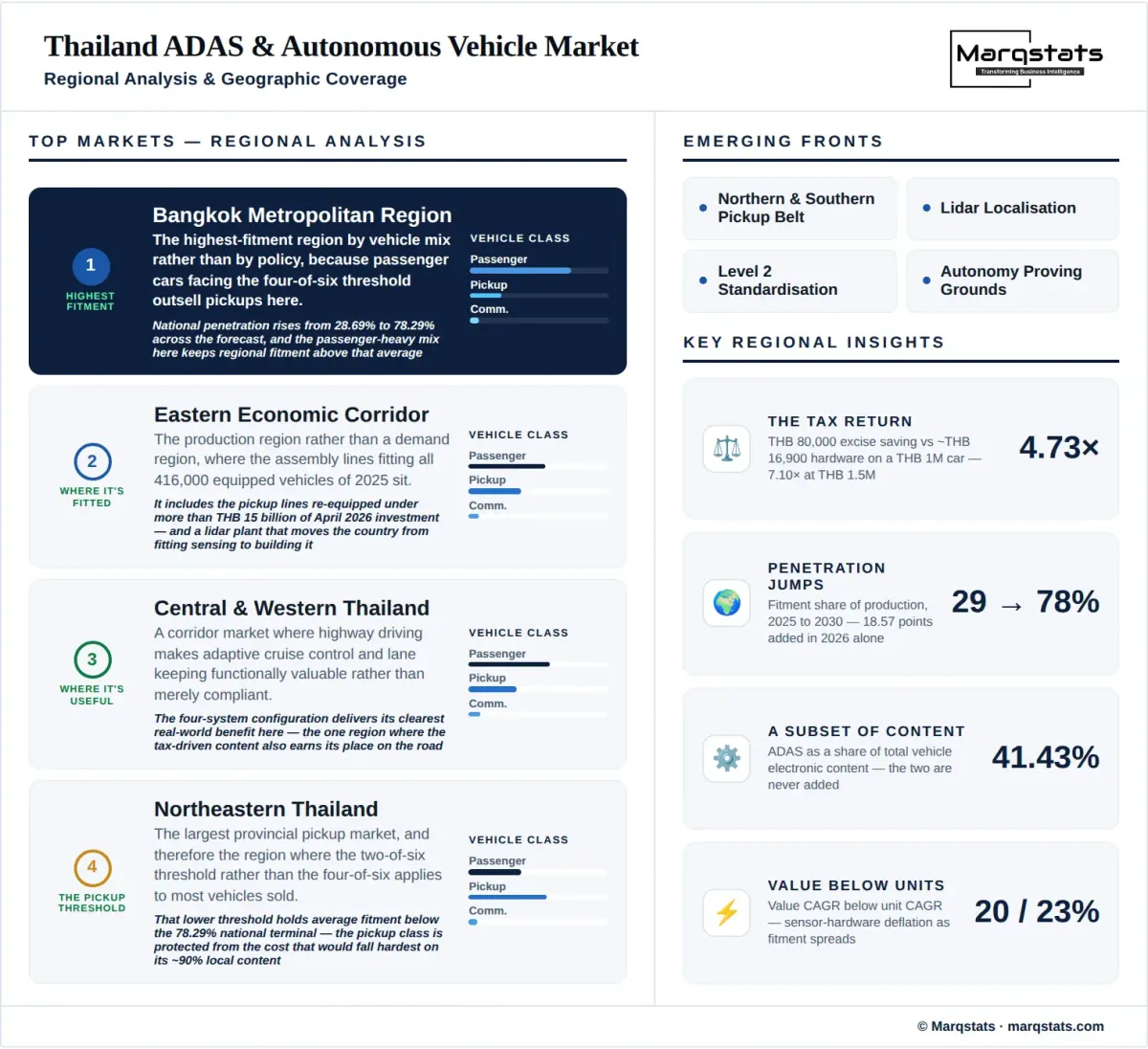
Bangkok Metropolitan Region
The highest fitment region by vehicle mix rather than by policy, because passenger cars facing the four-of-six threshold outsell pickups here, against a national penetration rising from 28.69% to 78.29% across the forecast.
Eastern Economic Corridor
The production region rather than a demand region, where the assembly lines fitting all 416,000 equipped vehicles of 2025 sit, including the pickup lines re-equipped under more than THB 15 billion of investment approved in April 2026.
Central and Western Thailand
A corridor market where highway driving makes adaptive cruise control and lane keeping functionally valuable rather than merely compliant, and where the four-system configuration delivers its clearest real-world benefit.
Northeastern Thailand
The largest provincial pickup market, and therefore the region where the two-of-six threshold rather than the four-of-six applies to most vehicles sold, holding average fitment below the 78.29% national terminal.
Northern and Southern Thailand
Mixed provincial markets where pickups dominate the vehicle mix and the lower threshold applies, and where fitment tracks export-specified production inherited from shared lines rather than domestic tax logic.
How Competition Is Evolving
The competitive structure here is set by a rule rather than by a product, which compresses differentiation in an unusual way. Six functions are named, four are required, and a camera with a single radar delivers them, so the specification a manufacturer buys is close to identical across the market and the contest is on cost and validation rather than on capability.
The established Tier-1 sensing suppliers hold the position that follows from that. Companies able to deliver a validated four-function package at a system price near USD 520 win volume, and the ones selling capability above the threshold are selling into the minority of production specified for export markets rather than for the Thai tax band.
Chinese suppliers and manufacturers are entering with higher specification at the same price point. A lidar supplier establishing a Thai position in a market where none of the six prescribed functions requires lidar is positioning for export specification and for a regulatory change that has not yet been proposed.
Vehicle manufacturers are making the selection decision rather than the buyer, which changes who the supplier sells to. With an 8-point excise gap worth THB 80,000 against THB 16,900 of hardware, the four-system package is specified centrally at platform level and is not a trim option, so a supplier wins a platform or wins nothing.
For an entrant the decisive judgement is whether to build for the threshold or beyond it. The threshold market is 1,190,000 equipped vehicles by 2030 at a falling system value, while the beyond-threshold market is the roughly 57% of output specified for stricter destinations, and those are different products sold to the same customer.
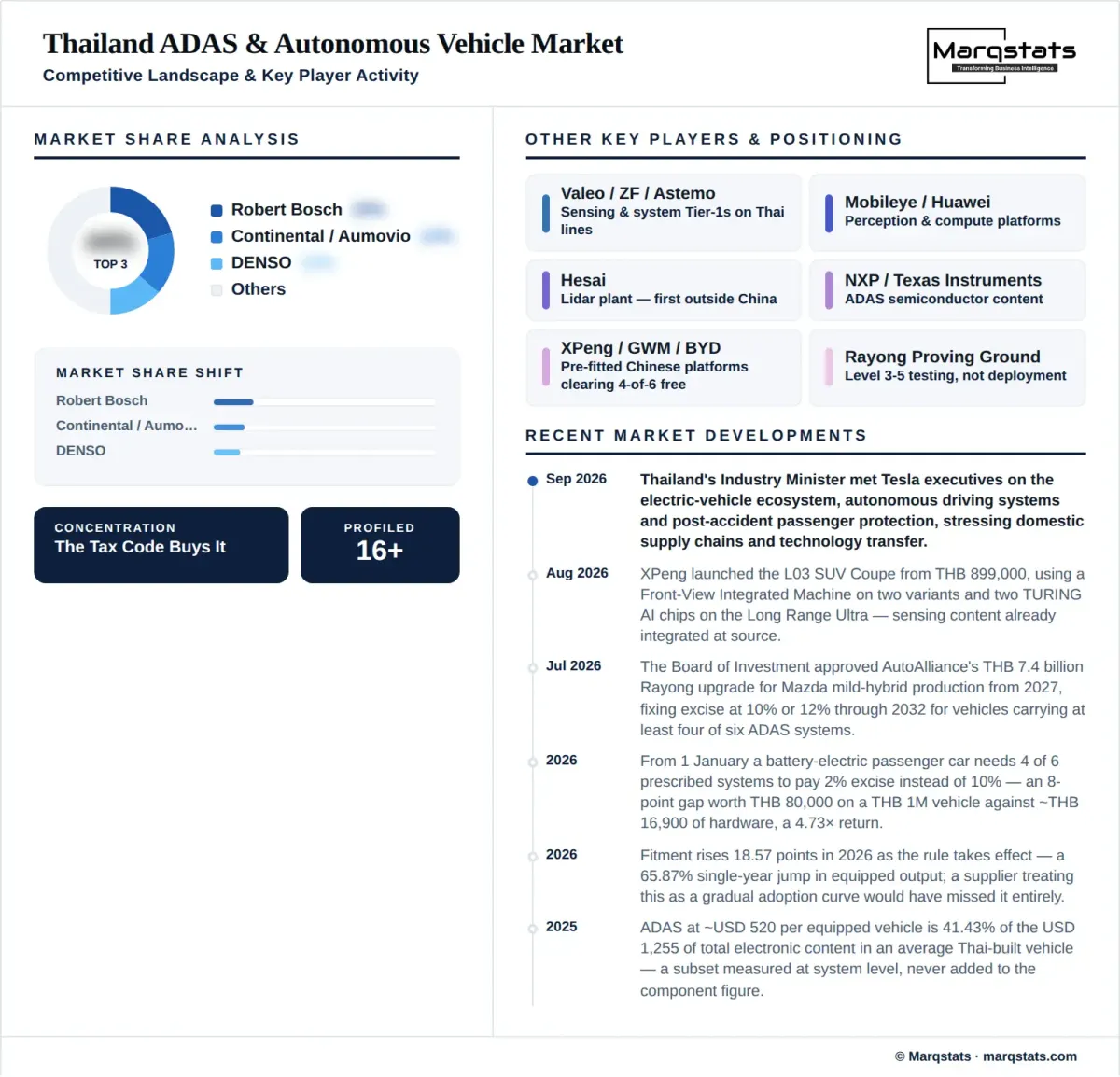
Companies Covered
The report profiles 15+ companies with full strategy and financials analysis, including:
Recent Market Activity
Table of Contents
Coverage & Segmentation
This analysis measures the value of advanced driver assistance systems fitted to vehicles produced in Thailand from 2021 to 2030, with 2025 as the base year and 2026 to 2030 as the forecast period, priced at system level covering sensors, controllers and the integration that turns them into a functioning feature. The figure includes semiconductor and electronic components that are counted separately at component level on the Thai automotive electronics analysis, and the two are never added, because one is a subset of the other measured at a different level of the stack. Autonomous driving is carried as a named dimension covering testing and proving-ground activity rather than deployment, because no commercial autonomous service operates in Thailand. Aftermarket driver assistance retrofits are excluded. Market value is expressed in USD on a disclosed system value per equipped vehicle falling from about USD 520 to USD 455 at a constant THB 32.5 per USD.
Coverage spans five prescribed systems, four sensor types, three automation levels, three vehicle categories and two destinations, with five regional clusters analysed on vehicle mix and road environment rather than on population. Equipped vehicle production is carried as the volume series at 416,000 units in 2025 and fitment penetration as a derived series at 28.69%, and both are published alongside the value panel because a market driven by a threshold moves in penetration rather than in price. Fifteen entities are profiled across sensing Tier-1 suppliers, semiconductor suppliers, technology entrants and vehicle manufacturers specifying at platform level.