Market Snapshot
Middle bar: base-year value × (1 + CAGR), rounded to two decimals. This is a calculated illustration, not a separately researched annual estimate.
Market Size (2025, Base Year): USD 17.92 Billion (RMB 128.70 Billion)
Estimated Value (2026): USD 22.27 Billion
Forecast Value (2030): USD 53.27 Billion
CAGR: 24.35% | Forecast Period: 2026 – 2030
Growth — Absolute: USD 35.35 Billion
Cockpit Domain Controller Adoption: 61.0% (2025) to 96.0% (2030)
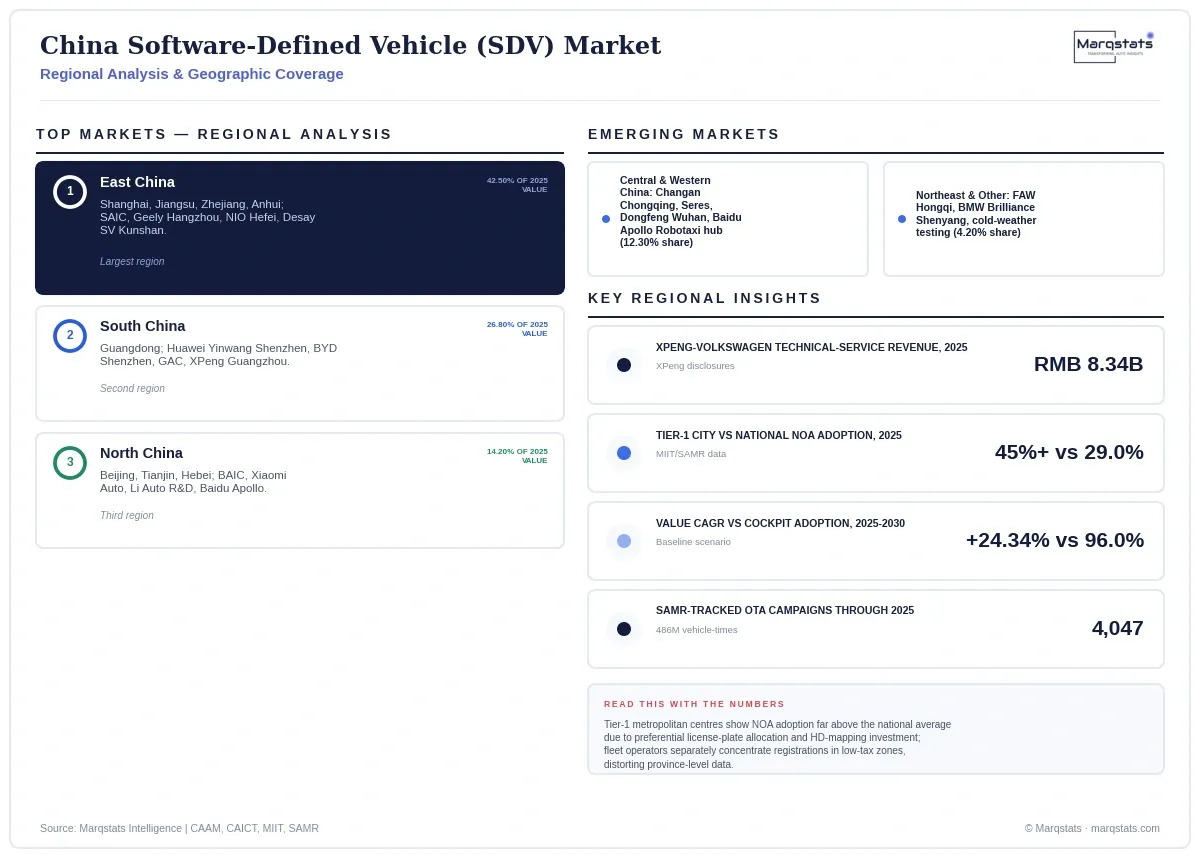
Largest Market: East China (42.50% of 2025 value)
Fastest Growing Segment: Connected Cloud & Fleet OTA (32.78% CAGR, 2025-2030)
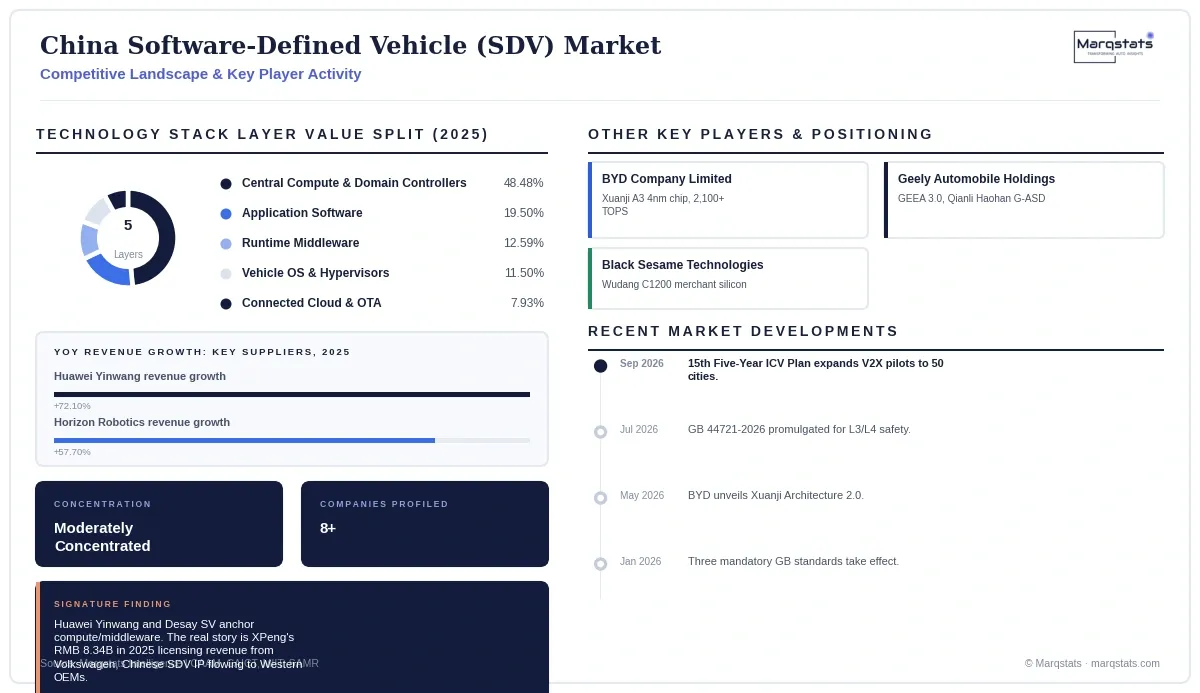
Dominant Layer: Central Compute & Domain Controllers (48.48% of 2025 value)
Market Concentration: Moderately Concentrated (Huawei Yinwang, Desay SV, BYD Lead)
Base Year: 2025 | Historical Period: 2021 – 2025 | Forecast Period: 2026 – 2030
Units Considered: Value (USD Billion)
Segments Covered: 3 | Regions Covered: 5 | Companies Profiled: 8
Report Pages: 165 | Deliverables: PDF, Excel, PPT
Key Takeaways
Market Overview & Analysis
Report Summary
China's software-defined vehicle market is the largest and fastest-institutionalizing in this vertical: a genuine domestic silicon-to-software supply chain has matured to the point where a Chinese EV maker now licenses its own architecture to a Western legacy automaker, not the other way around.
The analysis measures the value of central compute and domain controllers, vehicle operating systems and hypervisors, runtime middleware, application software, and connected cloud/fleet OTA infrastructure inside vehicles sold in China: USD 17.92 billion (RMB 128.70 billion) in 2025, growing to USD 53.27 billion by 2030.
The headline sizing chain traces to a specialized Chinese industry research report, cross-referenced against CAAM and CAICT data; this is disclosed prominently below and in the accompanying verification log.
The analysis is written for four readers: a global OEM evaluating technology-licensing partnerships with Chinese architecture exporters, a semiconductor vendor tracking domestic fabrication node scaling, a regulator or compliance officer preparing for GB 44721-2026, and an investor tracking three scenarios anchored to liability law and semiconductor triggers, each with a distinct, dated milestone.
China's combination of the world's largest EV production base, a maturing domestic silicon industry, and a regulatory apparatus moving from voluntary guidance to binding national standards makes it the structural bellwether for how SDV architecture matures at true mass-market scale, well beyond the premium-vehicle pilots seen elsewhere.
A Technology-Licensing Deal That Runs Backward From Expectation
For a decade, the assumed direction of automotive technology transfer ran from established Western and Japanese manufacturers toward Chinese partners. XPeng's 2025 financials show that assumption is no longer reliable.
XPeng generated RMB 8.34 billion in 2025 technical-service revenue, up 65.59% year-over-year, at a gross margin exceeding 75%, by licensing its China Electronic Architecture and full-stack software platform to Volkswagen Group. This happened alongside XPeng shipping over 200,000 units of its own in-house 5-nanometre, 750-TOPS Turing AI system-on-chip by the first quarter of 2026. The company isn't just building competitive vehicles; it is exporting the underlying electrical-electronic architecture and software stack to one of the industry's largest legacy manufacturers, at software-industry margins rather than automotive hardware margins. For any global OEM still treating Chinese SDV suppliers purely as cost-competitive component sources, XPeng-Volkswagen is a live demonstration that the technology flow has already started running in the other direction.
A Supplier Whose Biggest Customer Is Also Its Biggest Shareholder
Huawei's automotive software unit has built extraordinary growth on a customer relationship close enough to raise real concentration questions.
Shenzhen Yinwang Intelligent Technology, the corporatized form of Huawei's Intelligent Automotive Solution business, generated RMB 45.02 billion in fiscal 2025 revenue, up 72.10% year-over-year. Seres Group holds a 10% equity stake in Yinwang, paying RMB 11.5 billion for it, and Seres's own corporate filings show RMB 22.34 billion in related-party procurement from Yinwang in 2025, roughly 49.6% of Yinwang's entire annual revenue. Avatr Technology holds an equivalent equity stake. This structure, where an anchor customer is simultaneously a minority owner, aligns incentives in the short term, but it also means Yinwang's reported growth rate is partly a function of how much its own part-owner chooses to buy from it, a dynamic worth watching closely as Yinwang's supply base broadens to BAIC, Changan, Chery and JAC.
Why an OTA Update Became China's Default Recall Mechanism
Regulators usually treat over-the-air software updates as a convenience feature to be governed. China's own enforcement data shows it has quietly become something closer to the primary safety-recall infrastructure itself.
SAMR documented 4,047 distinct OTA update campaigns covering 486 million vehicle-times through 2025, establishing remote software updates as the dominant mechanism for executing safety recalls in China. That scale is precisely why the regulatory framework built around it is so specific: Category 1 updates touching core driving dynamics, steering calibration or braking response require prospective MIIT safety testing and formal approval before customer distribution, while Category 2 infotainment and HMI updates require only a 48-hour administrative filing after deployment. The directive explicitly outlaws using OTA updates to covertly remediate latent safety defects without a formal public recall filing, a rule that only makes sense in a market where OTA has become common enough to be a plausible way to quietly patch around a real safety problem.
Two Paths to the Same Single-Chip Future
BYD and Black Sesame are both racing toward single-chip, cross-domain compute architecture, but from opposite ends of the supply chain.
BYD is pursuing full vertical integration: its May 2026 Xuanji Architecture 2.0 runs on a proprietary 4-nanometre Xuanji A3 chip the company designed itself, delivering over 2,100 TOPS of combined throughput across three chips, backed by RMB 63.40 billion in 2025 R&D spend, 7.89% of total revenue. Black Sesame is pursuing the same single-chip cockpit-driving integration from the opposite direction, as an independent silicon vendor: its Wudang C1200 series targets exactly the same architectural consolidation BYD is building in-house, but sells it to any automaker willing to buy rather than keeping it proprietary. Both companies are betting the market converges on single-chip central compute; they simply disagree about whether an automaker should own that chip design itself or purchase it from a specialized vendor, and the answer likely differs by how much capital and chip-design talent a given OEM can actually deploy.
A Sensitivity Number That Explains Where the Real Money Sits
China's SDV model names, with unusual precision, exactly which single assumption moves its 2030 valuation more than any other.
Software represented 35.0% to 45.0% of a completed smart cockpit solution's bill of materials in 2025, projected to expand to 45.0% to 55.0% by 2030. Sensitivity testing quantifies the stakes: a 1.0 percentage-point shift in software content value across China's projected 2030 fleet of 39.4 million passenger car sales alters the standalone automotive software market valuation by RMB 3.94 billion (USD 548.7 million). That single number is the clearest possible demonstration that software content share, not silicon shipment volume or vehicle unit sales, is the variable actually driving this market's long-run value, exactly the kind of margin shift XPeng's Volkswagen licensing deal is already capturing directly.
Two Regulatory Tracks Moving at Genuinely Different Speeds
China's SDV regulatory apparatus isn't advancing uniformly. Cybersecurity and OTA governance moved from proposal to binding enforcement in under eighteen months. Automated-driving liability law has moved far more slowly, and that gap is itself the single largest variable separating the three forward scenarios covered here.
GB 44495-2024, GB 44496-2024 and GB 44497-2024 were issued in August 2024 and took full mandatory effect by January 2026, a genuinely fast regulatory cycle for national cybersecurity, OTA management and automated-driving data-recorder standards. Automated-driving liability, by contrast, still depends on an amendment to the Road Traffic Safety Law that has not yet passed the Standing Committee of the National People's Congress. Until that amendment clarifies whether liability transfers to the automaker when an automated system is active, commercial Level 3 deployment stays constrained to narrow, geographically bounded pilots like Changan's Chongqing corridor and BAIC's Beijing expressways, regardless of how far the underlying compute and cybersecurity technology has already matured.
A Registration Gap That Measures Real Adoption, Not Just Sales
China's headline NOA penetration figure hides a genuinely large gap between what's happening in a handful of cities and what's happening everywhere else.
Tier-1 metropolitan centres, Shanghai, Beijing, Shenzhen and Guangzhou, recorded Level 2+ NOA adoption exceeding 45% in new passenger car sales in 2025, against a nationwide average of 29.0%. That gap isn't simply about wealthier buyers in bigger cities choosing more equipped vehicles; it reflects preferential local license-plate allocation for high-end NEVs carrying advanced ADAS suites, combined with municipal investment in HD urban road mapping and 5G-V2X roadside infrastructure that these systems actually need to function well. A supplier or software vendor sizing near-term opportunity by the national 29.0% average alone would badly undercount how concentrated real, working NOA deployment already is in exactly the cities where the supporting infrastructure has been built out first.
Market Dynamics
Key Drivers
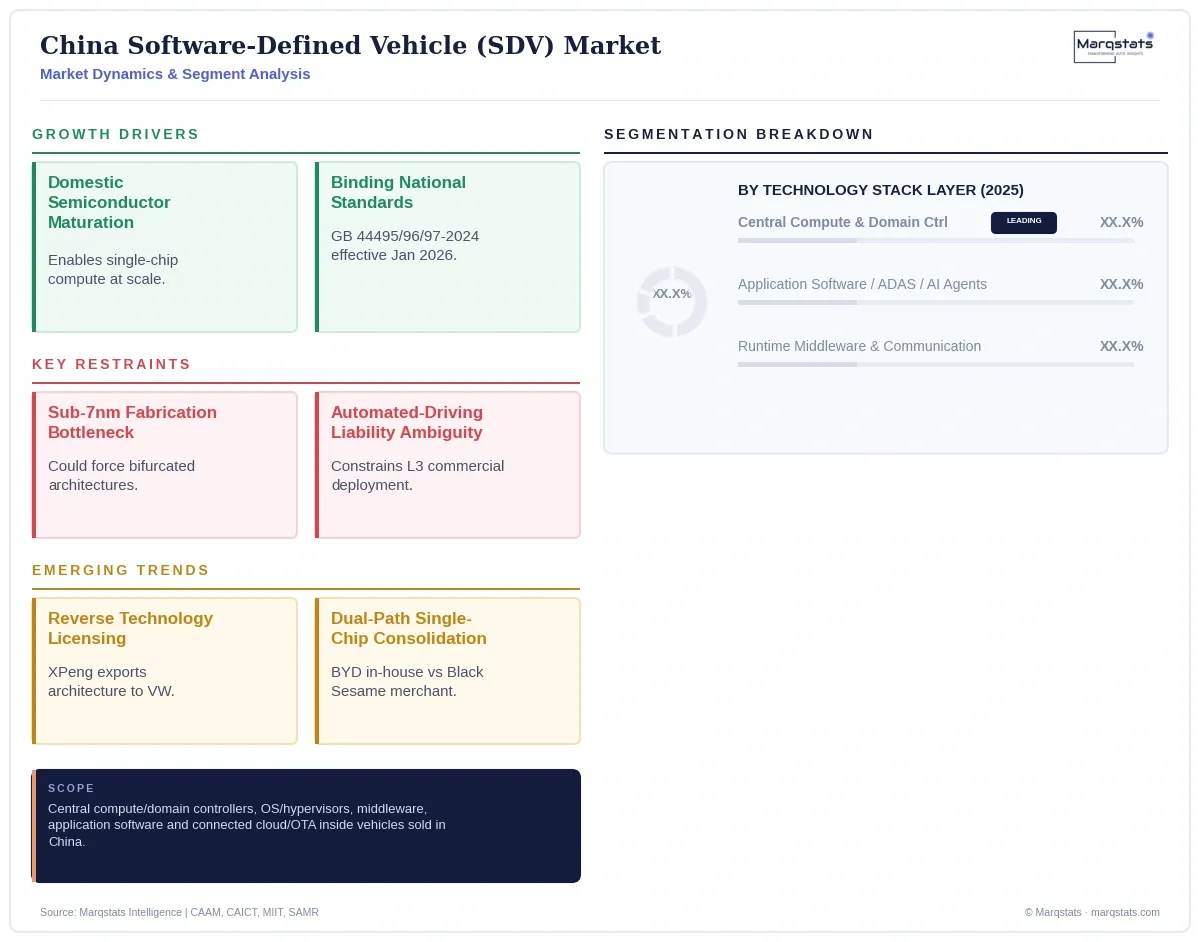
- A maturing domestic semiconductor supply chain is enabling single-chip centralized compute architectures at increasing scale, reducing dependence on foreign advanced-node fabrication with each successive production year.
- Binding national standards (GB 44495/44496/44497-2024, GB 44721-2026) are converting voluntary technical guidance into mandatory compliance floors, accelerating centralized architecture adoption across all new type-approved models on a fixed enforcement timeline.
- Technology-licensing revenue, exemplified by XPeng's Volkswagen partnership, is emerging as a genuine alternative monetization model at software-industry gross margins, well above what vehicle hardware sales alone typically generate.
- Rising software content share of total solution BOM, from 35-45% in 2025 toward 45-55% by 2030, means value capture is shifting toward algorithms and application software faster than toward silicon, the single variable this market's own sensitivity model treats as most consequential.
- Expansion of Vehicle-Road-Cloud infrastructure from 20 to 50 pilot metropolitan zones under the 15th Five-Year Plan is offloading compute requirements to roadside infrastructure, supporting broader Level 2+/NOA rollout.
Key Restraints
- Persistent sub-7nm fabrication bottlenecks would force automakers to maintain bifurcated computing architectures, relying on foreign supply chains for flagship automated-driving silicon, the Downside scenario's core structural constraint.
- Unresolved automated-driving liability under China's Road Traffic Safety Law could keep automakers restricted to monitored Level 2+ systems rather than accelerating Level 3 commercial deployment beyond today's narrow geographic pilots.
- Ongoing domestic vehicle price competition is suppressing Tier-1 software engineering budgets industry-wide, slowing proprietary operating system development at smaller suppliers unable to match the R&D scale of BYD or Geely.
- Customer-concentration risk at suppliers like Yinwang, where an anchor customer is also a minority equity holder, could distort reported growth rates relative to genuinely diversified commercial demand.
Key Trends
- Reverse technology licensing, Chinese architecture exported to Western OEMs, is emerging as a credible alternative monetization path alongside direct vehicle sales, as XPeng's Volkswagen deal already demonstrates.
- Single-chip cross-domain compute consolidation is advancing via both vertically integrated in-house silicon (BYD) and independent merchant silicon vendors (Black Sesame) simultaneously.
- OTA software updates have become the default safety-recall mechanism, with regulatory frameworks now explicitly governing update categorization and disclosure timing across the full national vehicle fleet.
- Multi-modal in-cabin AI foundation models running on vehicular neural processing units are enabling context-aware natural-language cockpit interfaces as a new differentiation layer.
Strategic Implications
- Global OEMs should evaluate Chinese SDV architecture licensing partnerships as a genuine strategic option, not merely a cost play, given XPeng's demonstrated ability to generate software-industry gross margins from technology exports to a legacy Western manufacturer, a template other Chinese architecture exporters may well follow.
- Domestic silicon vendors should pursue merchant-silicon strategies alongside vertically integrated OEM programmes, since the market is supporting both models simultaneously rather than converging on a single winner, as BYD and Black Sesame both demonstrate.
- Compliance and engineering teams should build Category 1/Category 2 OTA update classification directly into release pipelines ahead of full GB 44721-2026 enforcement, rather than treating regulatory filing as a post-development afterthought that risks delaying deployment.
- Investors should track Road Traffic Safety Law amendment progress and domestic sub-7nm fabrication yield milestones, the two named triggers separating the Downside, Baseline and Accelerated scenarios, and should note that the headline sizing chain here traces to a specialized Chinese industry research report Marqstats could not independently verify, disclosed in the evidence section rather than presented as an audited figure.
Outlook
Three scenarios are tested, each anchored to a distinct combination of automated-driving liability law reform and domestic semiconductor fabrication scaling, rather than differing growth-rate assumptions applied to the same story.
Under the Baseline scenario, GB 44721-2026 takes effect on schedule (1 July 2027), enabling regulated Level 3 operations across 50 pilot metropolitan regions, while domestic foundries stabilize mature 16-28nm output and flagship sub-7nm silicon continues relying on overseas packaging channels. Value reaches USD 53.27 billion (RMB 382.50 billion), a 24.35% CAGR, with combined NOA penetration reaching 75.0% and commercial Level 3 penetration at 14.5%.
Under the Accelerated scenario, the Standing Committee passes an amended Road Traffic Safety Law before December 2027 codifying insurable manufacturer liability for automated driving, and domestic foundries deliver commercial sub-7nm multi-core SoCs enabling single-chip architectures at scale. Value reaches USD 63.06 billion (RMB 452.80 billion), a 28.61% CAGR, with Level 3/4 penetration reaching 28.5%.
Under the Downside scenario, severe external trade restrictions freeze domestic high-performance compute production at 14nm thresholds, and GB 44721-2026 enforcement without clear tort indemnification drives prohibitive Level 3 insurance costs. Value reaches only USD 43.93 billion (RMB 315.40 billion), a 19.64% CAGR, with Level 3 penetration constrained to 6.2% in closed commercial logistics fleets.
Market Segmentation
RMB 62.40 billion (48.48% share) in 2025, moving to RMB 156.80 billion (41.00% share) by 2030, a 20.24% CAGR.
RMB 14.80 billion (11.50% share) in 2025, moving to RMB 47.80 billion (12.50% share) by 2030, a 26.43% CAGR.
RMB 16.20 billion (12.59% share) in 2025, moving to RMB 49.70 billion (13.00% share) by 2030, a 25.13% CAGR.
RMB 25.10 billion (19.50% share) in 2025, moving to RMB 86.10 billion (22.51% share) by 2030, a 27.97% CAGR.
RMB 10.20 billion (7.93% share) in 2025, moving to RMB 42.10 billion (11.00% share) by 2030, a 32.78% CAGR.
RMB 68.00 billion (52.84% share) in 2025, moving to RMB 225.68 billion (59.00% share) by 2030.
RMB 44.00 billion (34.19% share) in 2025, moving to RMB 126.22 billion (33.00% share) by 2030.
RMB 16.70 billion (12.97% share) in 2025, moving to RMB 30.60 billion (8.00% share) by 2030.
RMB 118.40 billion (92.00% share) in 2025, moving to RMB 348.08 billion (91.00% share) by 2030.
RMB 10.30 billion (8.00% share) in 2025, moving to RMB 34.42 billion (9.00% share) by 2030.
By Geography
East China (Shanghai/Jiangsu/Zhejiang/Anhui)
RMB 54.70 billion (42.50% share) of national SDV value in 2025.
South China (Guangdong)
RMB 34.49 billion (26.80% share) of national SDV value in 2025.
North China (Beijing/Tianjin/Hebei)
RMB 18.28 billion (14.20% share) of national SDV value in 2025.
Central & Western China
RMB 15.83 billion (12.30% share) of national SDV value in 2025.
Northeast & Other
RMB 5.40 billion (4.20% share) of national SDV value in 2025.
Registration Concentration
Tier-1 metropolitan centres (Shanghai, Beijing, Shenzhen, Guangzhou) recorded Level 2+ NOA adoption exceeding 45% in new passenger car sales in 2025, against a nationwide average of 29%, reflecting preferential local license-plate allocation for high-end NEVs and municipal HD-mapping/5G-V2X investment; fleet leasing entities separately concentrate formal registrations in low-tax municipal zones, distorting registration-based data relative to actual on-road operational fleets.
How Competition Is Evolving
China's SDV ecosystem is characterized by the restructuring of the traditional Tier-1 supply hierarchy into open-equity platform suppliers, joint ventures, and in-house OEM verticalization, with automakers trading off proprietary architectural control against the development speed of specialized platform suppliers.
Shenzhen Yinwang Intelligent Technology (Huawei's corporatized Intelligent Automotive Solution unit) generated RMB 45.02 billion in fiscal 2025 revenue (+72.10% YoY); Seres Group and Avatr Technology each hold 10% equity stakes, with Seres's RMB 22.34 billion in related-party procurement representing nearly half of Yinwang's total revenue. Huizhou Desay SV posted RMB 32.56 billion revenue (+17.88% YoY) with its Smart Cockpit division at RMB 20.59 billion (63.23% of revenue), filing for a Hong Kong dual listing in April 2026.
Horizon Robotics posted RMB 3.76 billion 2025 revenue (+57.70% YoY, 64.5% gross margin), shipping over 4.0 million automotive-grade chips; its CARIZON joint venture with Volkswagen's CARIAD achieved operational volume in 2025. Black Sesame Technologies generated RMB 822.3 million (+73.4% YoY), with autonomous driving products at 83.5% of revenue, and acquired EzAI in early 2026.
ThunderSoft delivered RMB 7.78 billion consolidated revenue (+44.45% YoY), with its AquaOS platform and Kanzi UI framework running across 50 million active vehicles globally. BYD generated RMB 803.96 billion revenue (+3.46% YoY) on 4.602 million vehicle sales, sustaining RMB 63.40 billion R&D spend (7.89% of revenue). Geely delivered RMB 345.20 billion revenue (+25.0% YoY) on 3.025 million vehicle sales (+39% YoY).
XPeng achieved volume production of its in-house Turing AI SoC (5nm, 750 TOPS) with over 200,000 shipments by Q1 2026, and generated RMB 8.34 billion in 2025 technical-service revenue (+65.59% YoY) at over 75% gross margin by licensing its China Electronic Architecture to Volkswagen Group.
Companies Covered
Companies covered in the report include:
Recent Market Activity
Table of Contents
Coverage & Segmentation
The analysis measures central compute and domain controllers, vehicle operating systems and hypervisors, runtime middleware, application software, and connected cloud/fleet OTA infrastructure inside vehicles sold in China, for a 2025 base year and a 2026 to 2030 forecast, in United States dollars and Chinese yuan at a benchmark rate of RMB 7.1819 per USD. Peripheral electronic components (CMOS image sensors, LiDAR transceivers, 5G telematics control units, RMB 41.20 billion in 2025) are excluded.
The analysis covers three segmentation dimensions, technology stack layer, vehicle propulsion and vehicle category, a five-macro-region split, and eight profiled entities. See the verification log for full sourcing detail, including the pack's core-sizing source note.