Market Snapshot
Middle bar: base-year value × (1 + CAGR), rounded to two decimals. This is a calculated illustration, not a separately researched annual estimate.
The Saudi Arabia autonomous truck market size is estimated at USD 3.84 million in 2025 and is projected to reach USD 241.50 million by 2030, expanding at a 128.94% CAGR across the 2026 – 2030 forecast period. The market covers Level 3 and Level 4 autonomous heavy and medium commercial freight vehicles deployed in logistics corridors, ports, mining and controlled industrial applications, valued at the vehicle and autonomy-system spend in each year. The deployed fleet grows from 12 vehicles in 2025 to 2,200 by 2030, a 183.56% unit CAGR. Level 2 driver-assistance trucks are excluded.
Market size and forecast figures are generated using Marqstats' proprietary estimation framework, updated as of September 2026.
This is a deployment market rather than a vehicle sales segment, and reading it as the latter produces the wrong conclusion. No official annual series exists for autonomous truck sales in Saudi Arabia, no national registration category separates them, and the 2025 base of 12 vehicles is a count of known pilot-equivalent deployments rather than a published statistic. The commercial question is not how many trucks were sold but how many are operating under an approved regime, on which routes, and under whose permit. The absolute fleet count accompanies every growth rate throughout, since a percentage computed from a base of twelve conveys little on its own.
What makes Saudi Arabia the most consequential autonomous freight market outside China and the United States is that the demand anchor is a national programme rather than an accumulation of private pilots. HUMAIN, the Public Investment Fund's artificial intelligence company, and Applied Intuition announced a national-scale autonomous trucking programme in 2026 targeting the deployment of thousands of autonomous trucks across key logistics corridors by 2030, with Applied Intuition supplying a Level 4-capable self-driving system and vehicle operating system. Deployment on public roads was guided to within twelve months of that announcement, initially with safety drivers on board. That single programme, rather than aggregate fleet demand, sets the 2030 trajectory.
Key Takeaways
Market Overview & Analysis
Report Summary
The Saudi Arabia autonomous truck market comprises Level 3 and Level 4 autonomous heavy and medium commercial freight vehicles deployed for operation within the Kingdom, across logistics corridors, ports, mining sites and controlled industrial environments. The market is measured as annual spend on autonomous trucks entering service, comprising the vehicle platform and the autonomous driving system supplied with it, and is corroborated by the deployed fleet count. On that basis the market stood at USD 3.84 million and 12 deployed vehicles in 2025. Trucks equipped only with Level 2 driver assistance are excluded, however capable, because a supervised assistance system is a component sale into the conventional truck market rather than an autonomous vehicle deployment.
Fleet size and market value describe the same market from two directions, and both are carried in every table. The deployed fleet is the physical measure of adoption, and at twelve vehicles in 2025 it is the sharper reality check on scale. Annual spend is the commercial measure, capturing what that deployment is worth to vehicle manufacturers, autonomy providers and their suppliers, at a magnitude that can be compared and reconciled against adjacent segments.
Three measurement boundaries shape the figures, and none can be resolved from public data. First, Saudi Arabia publishes no annual autonomous vehicle registration series, so the 2025 base is constructed from known and announced deployments rather than counted from a register. Second, the deployed fleet is a stock measure while market size is a flow measure, so the two move on different curves: the 2030 figure of USD 241.50 million reflects the 1,150 vehicles entering service that year rather than the value of all 2,200 vehicles then operating. Third, the boundary between a pilot, a supervised commercial deployment and a fully driverless operation is not consistently disclosed by operators; a vehicle counts as deployed once it is operating on a defined route under an approved regime, whether or not a safety driver is present.
The forecast is calibrated to a programme rather than extrapolated from a trend, which is the only defensible approach when the base is twelve vehicles. The announced national target of thousands of autonomous trucks by 2030 sets the upper reference, against a modelled 2,200 vehicles in operation by 2030 at the conservative end of that range, on the reasoning that regulatory approvals, insurance frameworks, remote supervision capacity and depot readiness will pace deployment more tightly than vehicle supply. The resulting path is deliberately non-linear, with the steepest proportional gains in 2027 and 2028 as the first commercial corridors open and the largest absolute additions in 2029 and 2030 as approved routes multiply.
Market Dynamics
Key Drivers
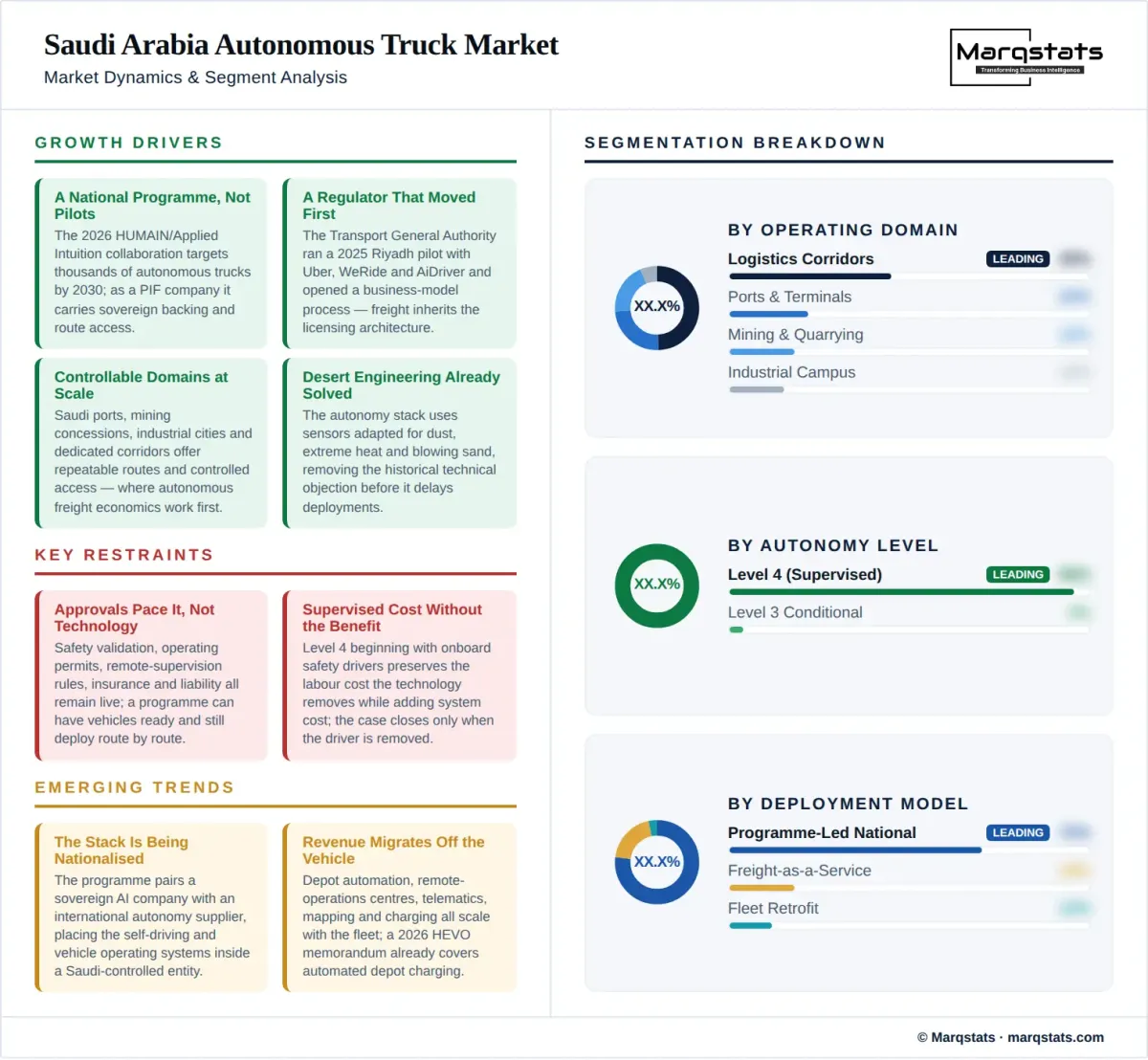
- A national programme rather than dispersed private pilots. The HUMAIN and Applied Intuition collaboration announced in 2026 targets thousands of autonomous trucks across key logistics corridors by 2030, connecting ports, industrial cities and distribution centres. Because HUMAIN is a Public Investment Fund company, the programme carries sovereign backing, coordinated route access and a procurement pathway that no privately funded pilot in the region can match.
- A regulator that moved first on passenger autonomy and built a reusable pathway. The Transport General Authority launched an initial autonomous vehicle operating phase in Riyadh in 2025 with Uber, WeRide and AiDriver, reported as a twelve-month pilot across seven locations and thirteen pick-up and drop-off points including King Khalid International Airport, and separately opened applications for companies to join the autonomous vehicle business model subject to technical evaluation. Freight deployment inherits that licensing architecture rather than waiting for one to be written.
- Controllable operating domains at commercial scale. Saudi ports, mining concessions, industrial cities and dedicated logistics corridors offer repeatable routes, controlled access, private roadway segments and high asset utilisation. These are the conditions under which autonomous freight economics work first anywhere in the world, and the Kingdom has an unusual concentration of them relative to its total road network.
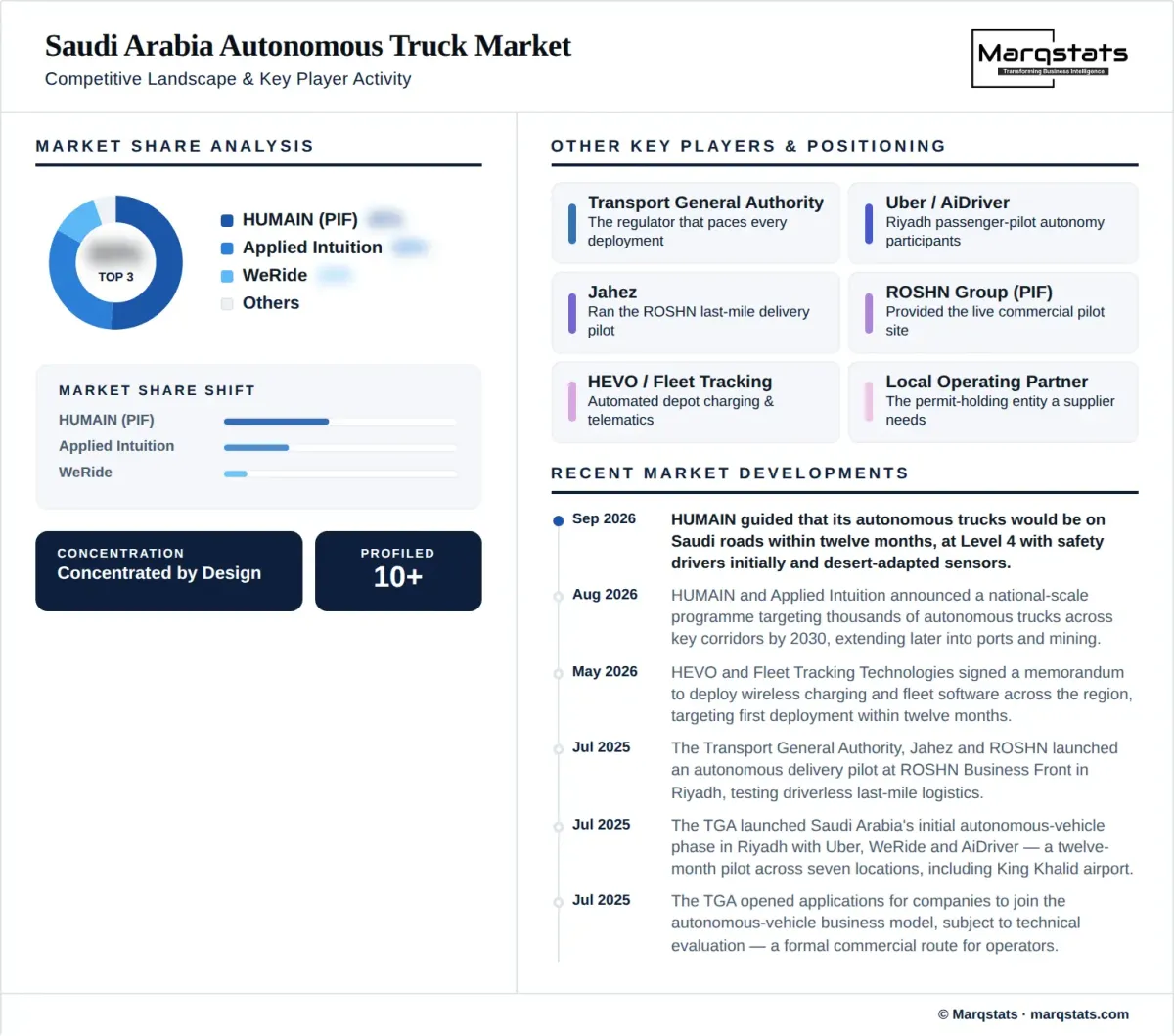
- Proven regulator-supervised commercial logistics experimentation. The Transport General Authority, Jahez and ROSHN launched an autonomous delivery pilot at ROSHN Business Front in Riyadh in 2025, testing driverless last-mile logistics in a live commercial environment. The value of that pilot to heavy freight is not the vehicles but the operating data, incident protocols and regulator familiarity it generates before truck-scale deployment.
- Environmental engineering already addressed rather than deferred. The autonomy stack being deployed uses sensors adapted for dust, extreme heat, blowing sand and remote highway operation. In a market where these conditions have historically been the technical objection to autonomous freight, a supplier that has engineered for them removes a barrier that would otherwise delay every subsequent deployment.
Key Restraints
- Approvals rather than technology pace the rollout. Safety validation, operating permits, remote supervision requirements, insurance and liability allocation, cybersecurity and roadworthiness certification all remain live regulatory requirements. A programme can have vehicles ready and still deploy slowly if permit scope expands route by route, which is the pattern observed in every comparable market and the principal reason the conservative end of the announced target is the more probable outcome.
- No published baseline to measure against. Saudi Arabia has no autonomous vehicle registration category, no published deployment register and no official annual series, so operators, insurers and investors cannot observe the market they are entering. Every available figure is constructed rather than counted, and a business case built on one inherits that confidence level rather than the certainty a registration series would provide.
- Supervised operation carries most of the cost without most of the benefit. Level 4 deployment beginning with onboard safety drivers preserves the labour cost the technology is meant to remove while adding vehicle, system and remote-supervision cost. The economic case only closes when the safety driver is removed, and the timing of that transition is a regulatory decision rather than a commercial one.
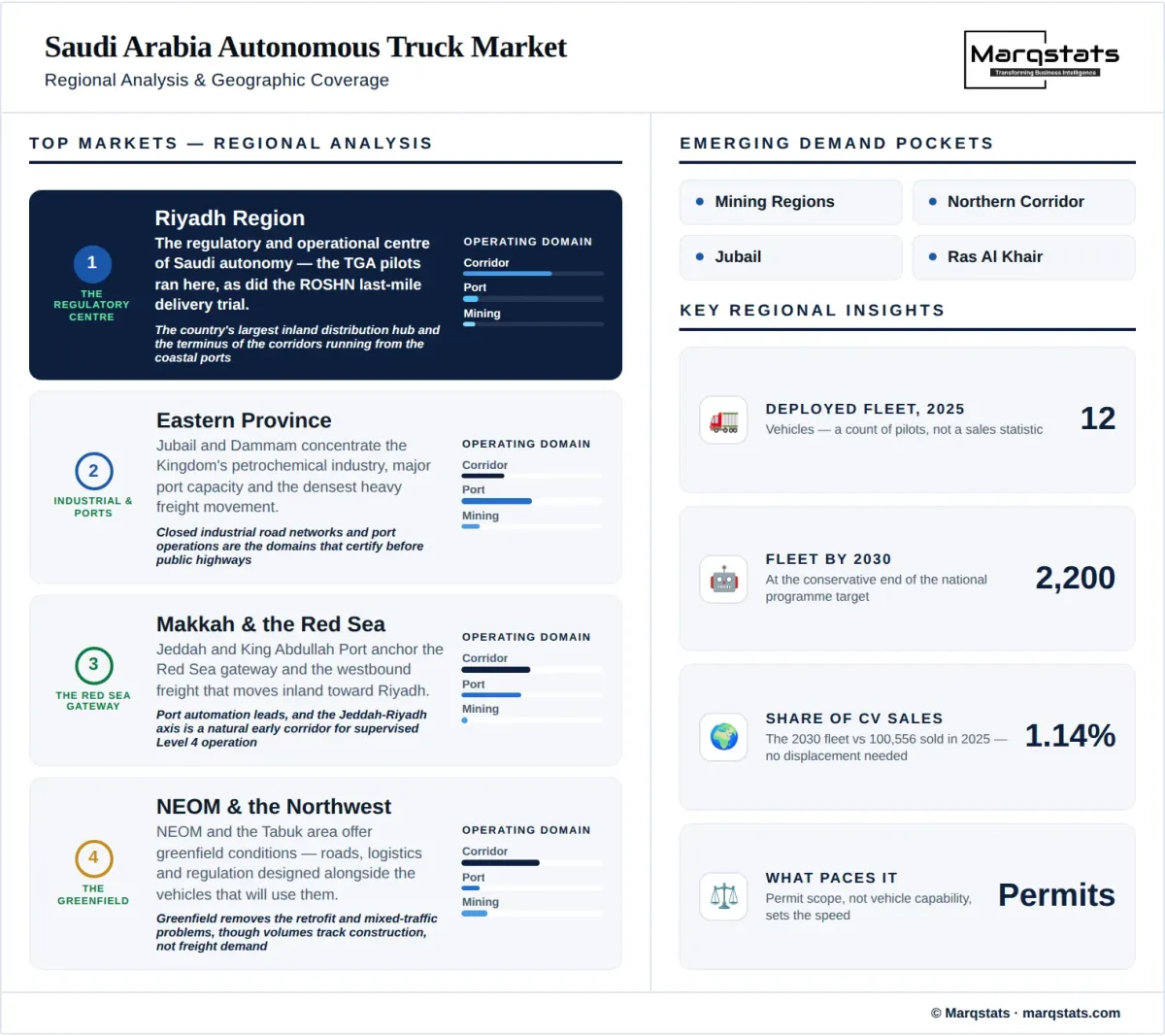
- The fleet is a rounding error against conventional demand. Saudi Arabia sold 100,556 commercial vehicles in 2025 against a deployed autonomous fleet of twelve. Even the 2030 forecast of 1,150 in-year additions is 1.14% of that single year's conventional commercial vehicle volume, which means the segment has no purchasing scale with which to influence vehicle specification, parts supply or service networks for most of the period.
Key Trends
- The technology stack is being nationalised rather than imported piecemeal. The structure of the announced programme pairs a sovereign artificial intelligence company with an international autonomy software supplier, placing the self-driving system and vehicle operating system inside a Saudi-controlled entity. That model is materially different from buying autonomous trucks from a foreign manufacturer and has implications for where value accrues over the decade.
- The revenue pool is migrating from the vehicle to everything around it. Depot automation, remote operations centres, telematics integration, high-definition mapping, charging or refuelling and specialised maintenance all scale with the fleet, and several are already visible: a 2026 memorandum between HEVO and Fleet Tracking Technologies covers automated depot charging, telematics integration and workflows explicitly designed for logistics fleets and autonomous vehicle platforms. This report excludes that pool from market size and treats it as the larger adjacent opportunity.
- Vehicle and system cost is falling faster than in conventional trucking. The blended vehicle-plus-autonomy-system price is modelled to decline 8.08% annually from USD 320,000 to USD 210,000 across the forecast period, driven by sensor cost reduction, compute consolidation and the shift from bespoke integration to a productised self-driving system. That decline is why revenue grows more slowly than the fleet.
- Last-mile autonomy is proving the regulatory model that heavy freight will use. The sequence observed in the Kingdom runs from passenger pilots to supervised delivery robots to freight, with each stage generating the operating evidence the regulator needs for the next. Operators planning heavy deployment should read last-mile permit conditions as a leading indicator of the terms they will eventually receive.
Market Segmentation
Level 4 systems are the basis of the national programme and account for effectively all of the modelled deployment. The self-driving system and vehicle operating system being supplied are Level 4-capable, meaning the vehicle can execute the full driving task within a defined operational design domain without human fallback. Deployment begins with safety drivers on board, which is a regulatory and assurance measure rather than a technical limitation, and the transition to unsupervised operation within approved domains is the single largest value inflection in this market.
Level 3 conditional automation occupies a small and probably transitional position in Saudi freight. It requires a human ready to take over on request, which preserves the driver cost while adding system cost, and it creates a liability handover moment that is difficult to certify for heavy vehicles at highway speed. Where it appears, it is generally a stepping stone within a fleet that intends to reach Level 4 rather than an end-state procurement decision.
Level 2 advanced driver-assistance systems are explicitly outside this market definition. Adaptive cruise control, lane keeping, automatic emergency braking and platooning aids are increasingly standard on conventional heavy trucks sold in the Kingdom, and counting those vehicles would convert this market into a share of total commercial vehicle sales and destroy its analytical meaning. Any figure claiming a Saudi autonomous truck market in the tens of thousands of units is measuring driver assistance, not autonomy.
Long-haul corridors connecting ports, industrial cities and distribution centres are the stated focus of the national programme and the largest addressable domain by vehicle count. Corridor operation offers long repeatable routes, high daily utilisation and a limited number of merge and interchange points to certify. It is also where the driver-cost saving is largest, because corridor haulage is the application with the highest annual kilometres per vehicle.
Port and terminal operation is expected to convert earlier than open highway because the operating domain is enclosed, speeds are low, routes are fixed and the site operator controls access. Terminal tractor and yard-shuttle applications require a narrower certification scope than public-road operation and can proceed under site rules rather than national road regulation, which is why they typically appear first in every market that electrifies or automates freight.
Mining haulage is the domain with the longest global track record of autonomous heavy vehicle operation, on private roads outside public traffic regulation entirely. Saudi Arabia's mining expansion under its industrial diversification programme creates the site conditions where autonomous haulage economics are proven elsewhere: fixed haul routes, continuous operation, controlled access and a labour cost that scales directly with fleet hours. Future phases of the national programme are expected to extend autonomy into mining and other industrial applications.
Industrial cities, economic zones and closed campuses form an intermediate domain between the port and the public highway, with private internal road networks, defined perimeters and single-operator control. They allow a fleet to accumulate operating hours and incident data under conditions the regulator can supervise without opening public-road exposure, which makes them the natural proving ground between pilot and corridor deployment.
Last-mile autonomous delivery is a distinct vehicle class from heavy freight and is not counted in this market size, but it is the domain that has generated the Kingdom's live commercial operating evidence. The 2025 pilot at ROSHN Business Front in Riyadh, run with the Transport General Authority and Jahez, tested driverless last-mile logistics in a working commercial environment and produced exactly the regulator-facing operating data that heavy freight deployment depends on.
Heavy tractors above sixteen tonnes are the core of the addressable fleet and the class the national corridor programme is built around. They carry the highest annual utilisation, the largest driver cost per vehicle and the longest routes, which together produce the strongest autonomy business case. They also carry the highest certification burden, because a fully laden combination at highway speed is the most demanding validation case in road freight.
Medium rigid trucks serve regional distribution and industrial-zone movement and represent a smaller share of deployed units. Their routes are shorter and their utilisation lower, so the payback on an autonomy system is weaker per vehicle, but their operating domains are frequently simpler and they can be certified for a narrower envelope. This class is likely to grow as system cost falls through the forecast period.
Purpose-built platforms designed without a cab and without provision for a human driver are the endpoint of the technology but are not expected to represent meaningful Saudi volume within this forecast period. They are excluded from certification pathways that assume a supervising driver can be present, which currently describes the Kingdom's operating regime, and they are commercially viable only where a fleet is confident of unsupervised approval for the vehicle's whole life.
The self-driving system comprises the sensor suite, compute hardware and the perception, planning and control software, and it is the component with the steepest cost curve and the greatest technical differentiation. In the Saudi programme it is supplied together with a vehicle operating system, which places the software layer that governs the whole vehicle inside the same commercial relationship. Sensor specification here is regionally specific: the stack deployed is adapted for dust, extreme heat and blowing sand rather than transferred unchanged from temperate testing.
The base truck represents the larger share of unit cost today but the smaller share of value creation, and its share of the total falls across the forecast period as autonomy system prices decline more slowly than integration costs. Platform choice is generally conventional, since the operating model in this phase requires a cab, a safety driver position and the ability to revert to manual operation.
Remote supervision is a regulatory requirement as much as an operational one, and the capacity to monitor and if necessary intervene in a deployed fleet scales with vehicle count rather than with route length. It is excluded from this market size because it is a recurring service rather than a vehicle sale, but it is the component most likely to constrain how quickly a fleet can grow once safety drivers begin to be removed.
High-definition mapping, network connectivity along approved routes and automated depot infrastructure form the enabling layer. Their commercial significance is already visible: a 2026 memorandum between HEVO and Fleet Tracking Technologies targets a first commercial deployment within twelve months covering automated depot charging, telematics integration and workflows built specifically for logistics fleets and autonomous vehicle platforms across Saudi Arabia and the wider region.
The dominant model in Saudi Arabia is a sovereign-backed programme pairing a national artificial intelligence company with an international autonomy supplier, deploying at corridor scale under a coordinated plan. This concentrates the market: procurement decisions, route selection and regulatory engagement run through a small number of entities rather than through hundreds of independent fleet buyers, which makes the market highly concentrated by construction.
Retrofitting autonomy systems onto existing fleet vehicles allows an operator to convert selected routes without replacing capital, and is attractive where the fleet is young and the route set is narrow. It is a smaller share of deployment in the Kingdom because the leading programme is integrating at the vehicle and operating-system level rather than adding a system to a finished truck.
Service models in which a technology operator carries the vehicle asset and sells capacity by load or kilometre transfer both the capital and the regulatory burden away from the shipper. This model is likely to grow as approvals mature, because it lets conventional logistics customers access autonomous capacity without acquiring permits, remote operations capability or specialised maintenance.
Diesel remains the default powertrain for autonomous heavy trucks in Saudi Arabia through the forecast period. Corridor operation demands range and refuelling speed that battery-electric heavy vehicles do not yet deliver in the Kingdom's conditions, and combining an unproven powertrain with an unproven driving system multiplies the certification burden on a single deployment.
Battery-electric autonomous trucks pair naturally in closed domains where routes are short, depots are fixed and charging can be automated, which is precisely the environment the depot-charging and telematics work now under way is designed to serve. Ports, industrial campuses and short shuttle routes are where the two technologies converge first; corridor haulage is where they converge last.
By Geography
Riyadh Region
Riyadh is the regulatory and operational centre of Saudi autonomy. The Transport General Authority's initial autonomous vehicle operating phase ran in the capital with Uber, WeRide and AiDriver across seven reported locations and thirteen pick-up and drop-off points including King Khalid International Airport, and the ROSHN Business Front autonomous delivery pilot with Jahez ran there as well. For freight, Riyadh's significance is as the country's largest inland distribution hub and the terminus of the corridors that run from the coastal ports.
Eastern Province
The Eastern Province combines the Kingdom's petrochemical and industrial concentration at Jubail and Dammam with major port capacity and the densest heavy freight movement in the country. Its industrial cities offer closed and semi-closed road networks under single-operator control, which is the domain where autonomous freight certification is most tractable, and its port and terminal operations are the applications most likely to convert before public-highway corridors.
Makkah Province and the Red Sea Corridor
Jeddah and King Abdullah Port anchor the Kingdom's Red Sea gateway and generate the westbound freight that moves inland toward Riyadh and Makkah. Port and terminal automation is the leading application here, and the Jeddah-to-Riyadh axis is among the highest-volume repeatable long-haul routes in the country, which makes it a natural early corridor candidate for supervised Level 4 operation.
NEOM and the Northwest
NEOM and the wider Tabuk development area represent greenfield conditions that no established market offers: road networks, logistics infrastructure and regulatory arrangements designed alongside the vehicles that will use them. Greenfield deployment removes the retrofit and mixed-traffic problems that constrain autonomy elsewhere, though volumes remain tied to construction and commissioning schedules rather than to freight demand.
Mining Regions and the Northern Corridor
The Kingdom's mining expansion creates haulage conditions where autonomous operation is already commercially proven internationally: private haul roads outside public traffic regulation, fixed routes, continuous shift operation and direct labour-cost exposure. Future phases of the national programme are expected to extend autonomy into mining and other industrial applications, and this domain may deliver operating hours faster than public-road corridors even though it will not deliver the headline vehicle counts.
How Competition Is Evolving
The Saudi Arabia autonomous truck market is highly concentrated, and it is concentrated by design rather than by consolidation. A single announced national programme pairing HUMAIN, a Public Investment Fund artificial intelligence company, with Applied Intuition as the autonomy software supplier accounts for the great majority of committed deployment volume through the forecast period. There is no field of competing fleet buyers making independent procurement decisions, and no manufacturer share to measure in the way a conventional truck market would be measured. A market-share table for this segment would describe programme allocation rather than competitive outcome, and no meaningful one can yet be constructed.
The participant set divides into four roles that rarely overlap. Autonomy technology suppliers provide the self-driving system, vehicle operating system and the validation toolchain, and this is where international capability enters the market. Programme and deployment entities hold the sovereign mandate, the capital and the route access. The regulator sets and paces the operating envelope, and in a market where approvals rather than technology determine deployment speed, it exercises more influence over near-term volume than any commercial participant. Enabling suppliers provide depot charging, telematics, mapping and remote operations, and their agreements are frequently the earliest public evidence that a deployment is real.
Competitive advantage in this phase accrues to whoever holds the operating permit and the route, not to whoever has the best vehicle. The Transport General Authority's application process for participation in the autonomous vehicle business model, subject to technical evaluation, is the gate every commercial participant passes through, and a supplier arriving with proven technology but no compliant local operating entity has no route to revenue. For an international supplier the practical implication is that partnership with a Saudi fleet operator or a licensed local operating entity is a prerequisite rather than a growth option, and that the window to establish it is before national-scale fleet tenders rather than after.
Ten organisations are profiled rather than the twelve to eighteen a mature market would support, because only these are evidenced as actual participants in Saudi autonomous freight. Conventional truck manufacturers active in the Kingdom operate in a different market and are excluded on that basis.
Companies Covered
Companies covered in the report include:
Recent Market Activity
Table of Contents
Coverage & Segmentation
This report covers Level 3 and Level 4 autonomous heavy and medium commercial freight vehicles deployed for operation in Saudi Arabia, with 2025 as the base year and 2026–2030 as the forecast period. Market size is reported as annual spend on autonomous trucks entering service in US dollars, comprising the vehicle platform and the autonomous driving system supplied with it, and is corroborated throughout by the deployed fleet count. Note that the value figures are in millions rather than billions: this is a market of USD 3.84 million in the base year. Segmentation covers autonomy level, operating domain, vehicle class, component, deployment model and powertrain, with regional analysis for the Riyadh region, the Eastern Province, Makkah Province and the Red Sea corridor, NEOM and the Northwest, and the mining regions.
Four boundaries define the market perimeter. First, Level 2 driver-assistance trucks fall outside it however capable, since including them would convert the market into a share of conventional commercial vehicle sales. Second, the deployed fleet is a stock measure and market size is a flow measure: the 2030 value reflects the 1,150 vehicles entering service that year rather than the 2,200 then operating. Third, recurring revenue from remote supervision, telematics, mapping, depot automation and specialised maintenance is excluded from market size and treated as an adjacent pool, even though it is likely to exceed vehicle spend over the vehicle's life. Fourth, no official Saudi autonomous vehicle registration series exists, so the base and every forecast year are Marqstats working estimates constructed from announced programmes, regulator disclosures and operator statements, not counted from a register.
The forecast is calibrated to the announced national programme rather than extrapolated from historical growth, because a twelve-vehicle base supports no trend. The stated national target of thousands of autonomous trucks by 2030 forms the upper reference, against a modelled 2,200 vehicles in operation by that year at the conservative end of the range, on the judgement that permit scope, insurance frameworks, remote supervision capacity and depot readiness will pace deployment more tightly than vehicle availability. The fleet path carries the forecast and the revenue CAGR follows from it: a growth rate computed from a base of twelve vehicles is arithmetically correct but carries little meaning alone, so absolute unit counts accompany every rate throughout.