Market Snapshot
Key Takeaways
Market Overview & Analysis
Report Summary
The generative AI in automotive market comprises spending by vehicle manufacturers, suppliers and autonomous driving developers on generative artificial intelligence across the full automotive value chain, covering design and engineering, autonomous driving simulation and synthetic data generation, in-cabin conversational assistants, manufacturing optimisation, and marketing and customer experience applications. This study segments the market by application, deployment model, technology type, end user, vehicle class and region, with a 2025 base year, historical coverage from 2021 to 2025, and forecasts to 2030.
Two scopes are reported throughout because the difference between them is the principal source of confusion in this market. The broad scope covers all automotive generative artificial intelligence spending and reached USD 3.40 billion in 2025. The narrow scope covers in-vehicle assistants and autonomous driving simulation only, and reached USD 0.62 billion. Published figures for 2024 ranged from roughly USD 0.51 billion to roughly USD 4.1 billion, and this model brackets that range precisely at USD 0.34 billion narrow and USD 2.05 billion broad.
Application weighting runs counter to public perception. Design and engineering accounts for about 46% of broad-scope spend, manufacturing optimisation about 21%, marketing and customer experience about 15%, autonomous driving simulation about 14% and in-cabin assistants about 4%. Cockpit assistants attract the most attention because they are the only visible application, yet they are the smallest by spend, since licensing and inference costs per vehicle are low relative to enterprise engineering software.
A physical anchor exists for the in-vehicle segment and this report uses it. Vehicles shipping generative artificial intelligence cabin assistants are countable from announced model programmes and platform integrations, reaching approximately 3.20 million units in 2025 against global light vehicle production near 90 million. That measure is more reliable than revenue for tracking adoption, because licensing terms are undisclosed while vehicle programmes are public.
Market Dynamics
Key Drivers
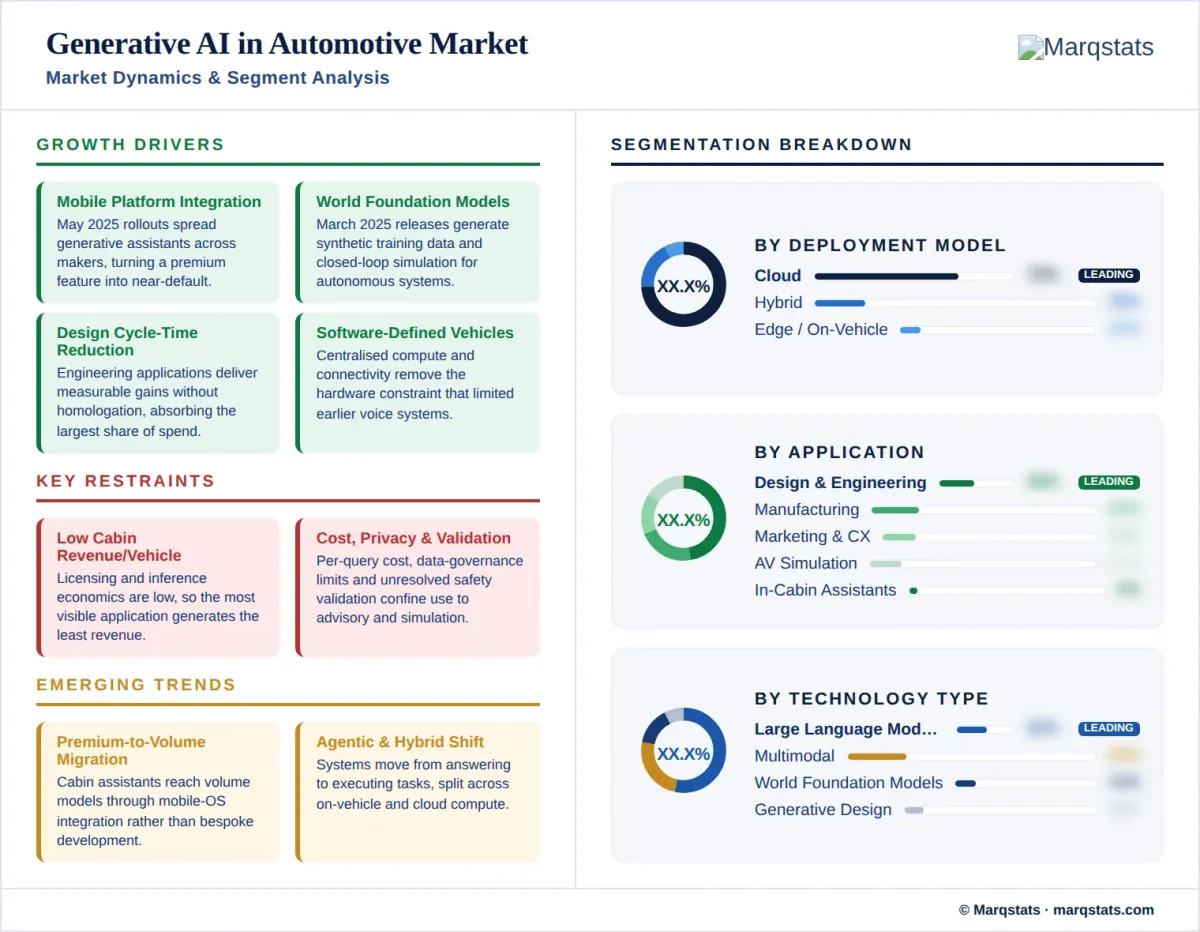
- Mobile platform integrations announced in May 2025 began rolling out generative assistants across vehicles from several manufacturers, converting a premium feature into near-default equipment.
- World foundation models released in March 2025 generate synthetic training data and closed-loop simulation for autonomous systems, addressing the scenario coverage problem physical testing cannot solve.
- Design and engineering applications deliver measurable cycle-time reduction without vehicle homologation requirements, which is why they absorb the largest share of spend.
- Software-defined vehicle architectures provide the in-vehicle compute and connectivity that cabin assistants require, removing the hardware constraint that limited earlier voice systems.
- Autonomous driving developers face rising validation requirements that synthetic scenario generation addresses at a fraction of physical testing cost.
Key Restraints
- Cabin assistant licensing and inference economics per vehicle are low, so visible deployment generates far less revenue than its prominence suggests.
- Inference cost at vehicle scale remains a live constraint, with cloud-dependent assistants incurring per-query costs across the vehicle lifetime.
- Data governance and privacy requirements limit what in-vehicle assistants may process and where, particularly across European jurisdictions.
- Validation of generative outputs in safety-relevant applications is unresolved, which confines current deployment to advisory and simulation rather than control functions.
Key Trends
- Cabin assistants are migrating from premium halo models toward volume platforms through mobile operating system integration rather than bespoke manufacturer development.
- World foundation models trained on very large curated video datasets are becoming the standard approach to autonomous driving synthetic data.
- Agentic in-cabin systems that execute tasks rather than answer questions are emerging from conversational assistants.
- Deployment is shifting toward hybrid architectures, running latency-sensitive functions on vehicle compute and complex reasoning in the cloud.
Market Segmentation
Design and engineering is the largest application at about 46% of broad-scope spend in 2025, covering generative design, simulation, requirements engineering and code generation across vehicle development. Adoption has been fastest here because outputs are reviewed by engineers before use, so validation concerns that constrain safety-relevant applications do not apply. Manufacturing optimisation accounts for about 21%, spanning production scheduling, quality inspection, predictive maintenance and process documentation.
In-cabin conversational assistants account for about 4% of 2025 spend despite being the most visible application, because licensing and inference cost per vehicle is low relative to enterprise software. The segment grows fastest in vehicle terms as platform integrations reach volume models. Marketing and customer experience accounts for about 15%, covering personalised configurators, content generation, dealer sales support and aftersales communication.
Cloud deployment dominates spend across all applications, since design, engineering, manufacturing and marketing workloads run in enterprise environments with no latency constraint. In-vehicle assistants have also been predominantly cloud-dependent, routing queries to hosted foundation models, which delivers capability without requiring vehicle compute but incurs per-query inference cost across the vehicle lifetime and depends on connectivity.
Edge deployment running models on vehicle compute grows fastest, driven by latency requirements, connectivity gaps and inference cost. Hybrid architectures are becoming the practical standard, executing wake-word handling, simple queries and safety-relevant functions locally while routing complex reasoning to the cloud. That split is one of the principal reasons manufacturers are specifying substantially more in-vehicle compute capability than voice systems previously required.
Large language models underpin conversational assistants, engineering documentation, code generation and marketing content, and account for the largest share of deployed technology. Multimodal models processing vision alongside language grow fastest, supporting cabin monitoring, external scene description and manufacturing quality inspection where the input is inherently visual rather than textual.
World foundation models generate synthetic driving scenarios and closed-loop simulation environments for autonomous system development. A major release in March 2025 introduced prediction, transfer and reasoning capabilities for autonomous vehicle synthetic data, with a subsequent version trained on approximately 200 million curated video clips, and it has been adopted or evaluated by several ride-hailing and autonomous driving developers. Generative design applies optimisation to component geometry under manufacturing constraints.
Vehicle manufacturers account for the largest share of spend, deploying generative artificial intelligence across design, manufacturing, cabin experience and customer-facing functions simultaneously. Their spend is concentrated in engineering and manufacturing rather than in the cabin applications that attract public attention. Premium manufacturers have led cabin deployment because they carry the compute platforms and connectivity packages required, and because feature differentiation supports the associated cost.
Tier-one suppliers deploy generative artificial intelligence in component design, software development and manufacturing, and increasingly supply cabin assistant capability as an integrated offering to manufacturers. Autonomous driving developers are the most intensive users relative to their size, since synthetic data generation and closed-loop simulation are central to validation. Dealers and aftermarket operators represent a smaller and growing segment, applying generative tools to sales support, service scheduling and diagnostics.
Premium and luxury vehicles account for the majority of in-cabin generative assistant deployment in 2025. These programmes carry the compute platforms, connectivity packages and software architectures that hosted assistants require, and manufacturers have used the capability as a differentiator on flagship models. A German premium manufacturer launched its cockpit assistant first on a new compact model built on its own vehicle operating system, with a United States launch before the end of 2025.
Mid-market vehicles account for a small share of 2025 cabin deployment and the overwhelming majority of forecast growth, because mobile platform integration delivers generative assistants without bespoke manufacturer development. Announced integrations already span vehicles from American, French and Japanese manufacturers. Commercial vehicles adopt more slowly in the cabin while using generative artificial intelligence more heavily in fleet management, routing and maintenance scheduling.
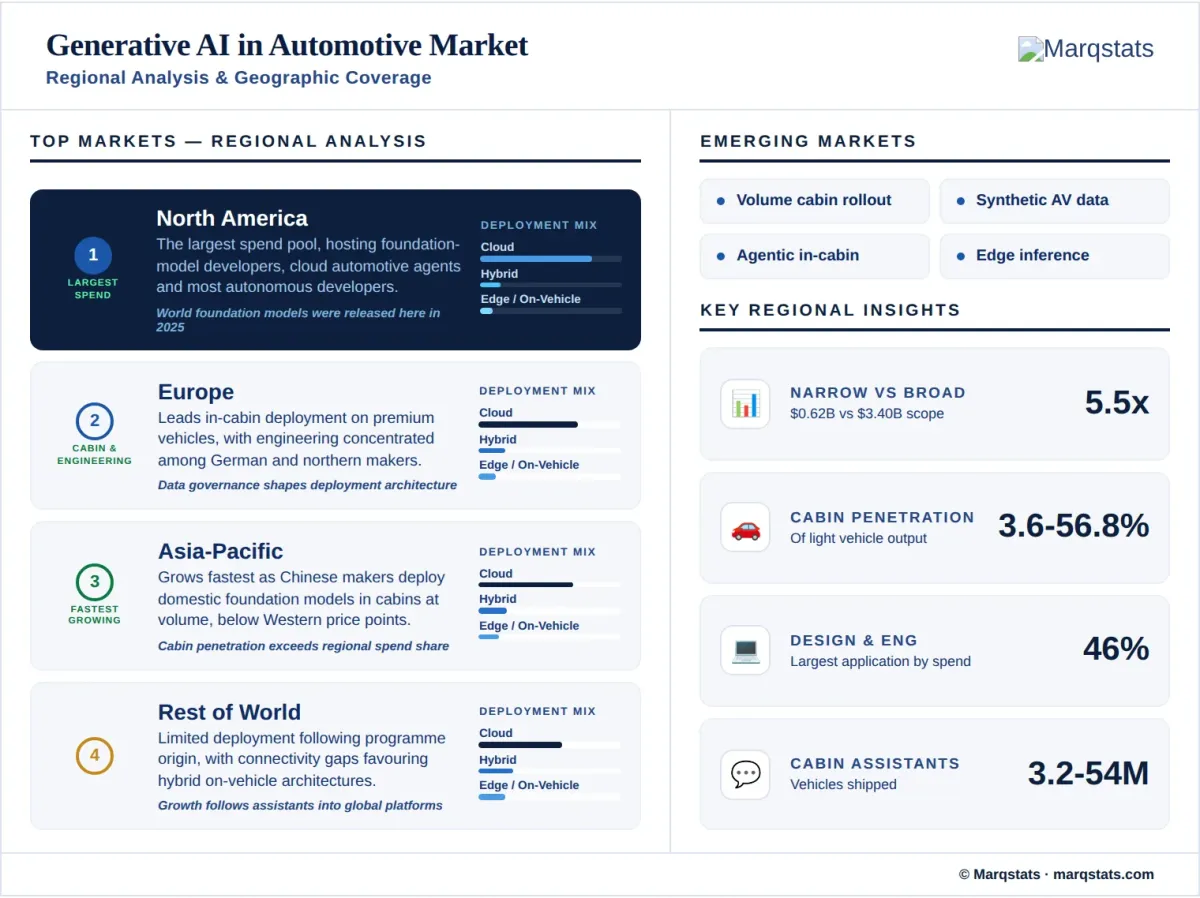
North America accounts for the largest share of spend, hosting the foundation model developers, the cloud platforms delivering automotive artificial intelligence agents, and the majority of autonomous driving developers whose simulation workloads are the most compute-intensive application. Europe follows, with premium manufacturers ahead on cabin assistant deployment and with engineering applications concentrated among German and Northern European manufacturers and suppliers, constrained somewhat by data governance requirements.
Asia-Pacific grows fastest, driven by Chinese manufacturers deploying domestically developed foundation models in cabin assistants at volume and by regional cloud providers supplying automotive artificial intelligence services. Chinese vehicles have integrated generative assistants at price points well below Western equivalents, which is one reason regional cabin penetration exceeds spend share. Rest of World deployment is limited, following vehicle programme origin rather than assembly location.
By Geography
North America
North America accounts for the largest share of generative artificial intelligence spend in automotive, reflecting the concentration of foundation model developers, cloud platform providers and autonomous driving developers. World foundation models for autonomous vehicle synthetic data generation and closed-loop simulation were released here in March 2025 and adopted by ride-hailing and autonomous driving companies. Mobile platform integration announced in May 2025 is rolling out across vehicles from American manufacturers alongside international programmes.
Europe
Europe leads in-cabin generative assistant deployment on premium vehicles. A German manufacturer announced in January 2025 that its cockpit assistant would use a cloud provider's automotive artificial intelligence agent built on foundation and platform services drawing on a mapping database of approximately 250 million places, launching first on a new compact model with a United States launch before end-2025 and a public demonstration in October 2025. Engineering applications are concentrated among German and Northern European manufacturers, with data governance requirements shaping deployment architecture.
Asia-Pacific
Asia-Pacific grows fastest in both spend and cabin deployment. Chinese manufacturers have integrated generative assistants using domestically developed foundation models across mainstream price points, achieving penetration well above the regional spend share because per-vehicle licensing costs are substantially lower than Western equivalents. Japanese and Korean manufacturers have moved more cautiously in the cabin while applying generative tools extensively in engineering and manufacturing. Regional cloud providers supply the underlying services.
Rest of World
Rest of World deployment is limited and follows vehicle programme origin rather than assembly location, since cabin assistant capability is specified during vehicle development in the manufacturer's home market. Connectivity coverage constrains cloud-dependent assistants in several markets, which favours hybrid architectures running core functions on vehicle compute. Growth is expected to follow the migration of generative assistants into volume vehicle platforms sold globally.
How Competition Is Evolving
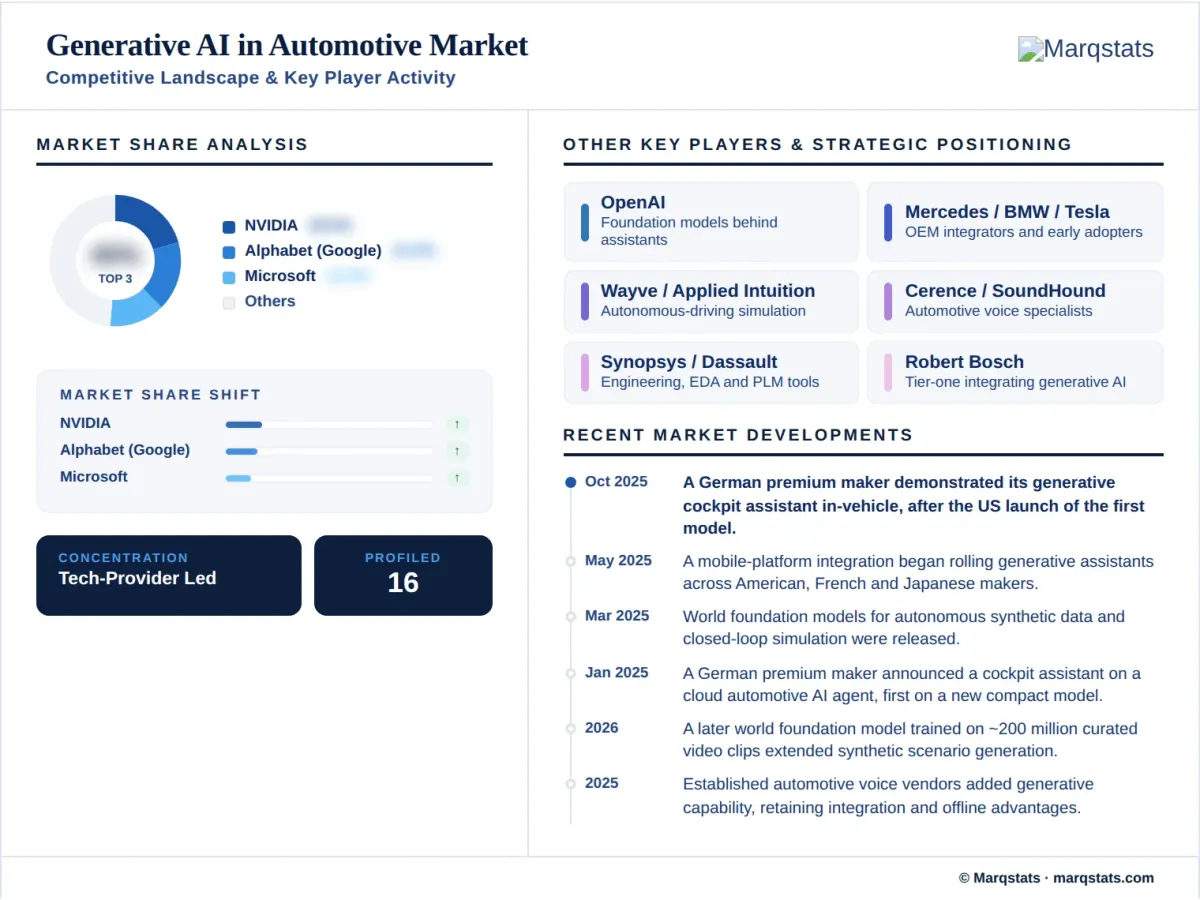
The generative AI in automotive market is contested by technology providers rather than by automotive incumbents, and the commercial positions of greatest value sit outside the traditional automotive supply chain. Foundation model developers, cloud platform providers and specialised simulation software vendors supply the capability, while vehicle manufacturers integrate and brand it. That structure inverts the conventional automotive relationship in which manufacturers specify and suppliers deliver.
Cabin assistant competition has consolidated quickly around a small number of foundation models delivered through cloud platforms. A German premium manufacturer announced integration of a major cloud provider's automotive artificial intelligence agent in January 2025, having previously added a separate hosted conversational model for general-knowledge queries. The same cloud provider's mobile platform integration announced in May 2025 delivers comparable capability across manufacturers without bespoke development, which compresses the differentiation available to any single manufacturer.
Autonomous driving simulation is the most technically defensible position. World foundation models released in March 2025 provide prediction, transfer and reasoning capabilities for synthetic data generation and closed-loop simulation, with a later version trained on approximately 200 million curated video clips, and adopters include ride-hailing operators and autonomous driving developers. The scale of training data and compute required creates a barrier that specialised simulation vendors and manufacturers cannot readily replicate.
Voice and cockpit specialists occupy a narrowing position between foundation model providers and manufacturers. Established automotive voice vendors have added generative capability to existing products, retaining advantage in automotive integration, wake-word performance and offline operation. That advantage compresses as mobile platform integrations mature, and the durable position for these vendors is in orchestration and safety-relevant filtering rather than in the underlying language capability.
Companies Covered
The report profiles 16+ companies with full strategy and financials analysis, including:
Recent Market Activity
Table of Contents
Coverage & Segmentation
This report provides a comprehensive assessment of the generative AI in automotive market across a 2025 base year, historical data from 2021 to 2025, and forecasts spanning 2026 to 2030. Two scopes are reported throughout: the broad scope covering all automotive generative artificial intelligence spending, and the narrow scope covering in-vehicle assistants and autonomous driving simulation only. Vehicles shipping generative cabin assistants are reported as a physical volume metric alongside spending.
The scope covers adoption drivers, restraints and structural trends, with particular focus on resolving the definitional divergence between narrow and broad scopes, the counter-intuitive dominance of design and engineering applications, the migration of cabin assistants from premium to volume vehicles, and the technical position of world foundation models in autonomous simulation. Vehicle electrification context is available in the Brazil Electric Vehicle Market report. An extended forecast to 2035 is available under customization, alongside application-level spend analysis on request.