Market Snapshot
Middle bar: base-year value × (1 + CAGR), rounded to two decimals. This is a calculated illustration, not a separately researched annual estimate.
Market Size (2025, Base Year): USD 2,662.20 Million (Installed Retail)
Estimated Value (2026): USD 2,715.12 Million
Forecast Value (2030): USD 2,898.72 Million
CAGR: 1.72% | Forecast Period: 2026 – 2030
Growth — Absolute: USD 236.52 Million
Physical Volume: 249,000 Tonnes (2025) to 227,200 Tonnes (2030), Volume CAGR -1.82%
Largest Segment Region: National (No Regional Split Published)
Fastest Growing: Ultra-Low-Viscosity Oils (24.00% to 34.97% of passenger car oil)
Dominant Segment: Passenger Car Motor Oil (60.78% of 2025 volume)
Market Concentration: Moderately Concentrated (Top Five About 65%)
Base Year: 2025 | Historical Period: 2021 – 2025 | Forecast Period: 2026 – 2030
Units Considered: Value (USD Million) and Volume (Tonnes)
Segments Covered: 4 | Regions Covered: 1 | Companies Profiled: 14
Report Pages: 170 | Deliverables: PDF, Excel, PPT
Key Takeaways
Market Overview & Analysis
Report Summary
France's lubricants aftermarket sells fewer litres every year and earns slightly more from them. Fleets are ageing, cars are driven less, and electric cars are arriving, while workshops bill more per visit for oils that have to match increasingly specific manufacturer approvals.
The analysis measures the installed retail value of oils and fluids used to service on-road vehicles after factory delivery: USD 2,662.20 million in 2025, including workshop markups and VAT. It excludes OEM first-fill and non-automotive lubricants. Wholesale ex-blender value, USD 1,344.60 million, is shown separately, and the two layers grow at different rates.
The analysis is written for four readers: a blender deciding whether to invest in the approvals that gate Stellantis service fill, a workshop group facing fewer visits and a wider range of specifications to stock, a distributor pricing bag-in-box and modular storage, and an investor tracking a contracting market with a rising ticket.
One Engine Family Is Setting the Approvals That Gate Service Fill
Most oil markets are shaped by fuel-economy rules. In France one specification is shaped by an engine repair.
Stellantis' 1.2L PureTech petrol and 1.5L BlueHDi diesel engines run their timing belts in oil. The research reports that the belt's rubber degraded and shed particles, which clogged oil-pump strainers and led to loss of oil pressure and engine failures. Stellantis mandated a specification, FPW9.55535/03 in SAE 5W-30, which replaced older PSA specifications across millions of vehicles in the French parc. The independent body Verification of Lubricant Specifications investigated aftermarket claims and ruled that claims against Version 1 lapsed on 30 June 2026, so blenders must re-homologate to Version 2 or 3. In April 2026 Infineum secured Stellantis approval for its P6895 additive, opening a route for independent blenders, and Fuchs and Eurorepar already sell compliant oils.
A Larger Fleet, Fewer Litres
The fleet and the oil volume are moving in opposite directions.
The passenger car fleet grew 0.86% in 2025 to 42.5 million vehicles, yet aftermarket oil volume fell 2.60%, from 255,200 to 249,000 tonnes. Two forces explain it. Average annual distance fell to 11,600 km, 0.90% lower than a year earlier and 7.30% below 2019. And modern downsized three-cylinder petrol engines hold 3.2 to 3.8 litres, against 4.5 to 5.5 for older four-cylinder diesels. Electric cars, 1.49 million of them, add to the fleet without adding crankcase oil. Diesel cars, 46.10% of the parc, keep demand alive, and dedicated diesel oils rose 5.80% in 2025 as older diesels moved to independent workshops.
Workshops Bill More From Fewer Visits
Workshop economics explain why value keeps rising as volume falls.
The 2025 Mobilians-Solware barometer of 1,164 repair facilities found weekly workshop entries fell 2.20% to 40.8, but the average invoice rose 2.70% to EUR 402.60. Parts billing slipped 0.50% to EUR 464.0 million while labour billing rose 2.60% to EUR 210.8 million, taking mechanical workshop revenue to EUR 679.5 million. Repairers are doing more technical work per visit and charging more for specified synthetic fluids, which is why installed value grows 1.72% a year while volume declines.
A Circular Levy That Fell While Collection Rose
France's used-oil scheme is mature, and its cost is dropping.
The eco-organism Cyclevia, mandated for 2022 to 2027, collected 240,000 gross tonnes of waste oil in 2024, a 58.0% collection rate, and regenerated over 90% of it into base oil. The eco-contribution fell from EUR 89 to EUR 67 per tonne on 1 January 2025. Blenders using certified re-refined base oil get a 20% to 30% abatement, the European Ecolabel gets a full exemption, and hazardous-classified oils pay a 40% surcharge. A biodegradability modulation began on 1 January 2026 and affects declarations from 2027. Re-refined base oil is 13.00% of demand and is projected to reach 18.00%.
What the Evidence Does and Does Not Show
The official statistics anchor the market, but not every layer reconciles.
The fleet table does not reproduce the delivery total, the text and the table disagree on the size of gasoline and mixed passenger oil (140,165 against 134,140 tonnes), brand shares sum to 99.9%, and installed value by channel exists for 2025 only. The fleet and powertrain figures are cited to a Wikipedia page and are not independently verified, and the wet-belt story rests on one trade-press source. None of this changes the direction of the market, but it limits how precisely the figures should be read.
Thinner Oils, Smaller Sumps, Longer Intervals
Viscosity migration is reducing the litres in every service and raising the price of each.
SAE 5W-30 leads passenger car oil at 45.00%, or 68,100 tonnes, but is projected to fall to 38.36% by 2030. Ultra-low-viscosity 0W-20 and 0W-16 grow from 24.00%, or 36,320 tonnes, to 34.97%, driven by European fleet carbon dioxide targets and by turbocharged direct injection engines that suffer low-speed pre-ignition. SAE 5W-40 falls from 18.00% to 12.98%, and 10W-40 and mineral multigrades, confined to vehicles more than 15 years old, hold about 13%. Petrol and diesel engines also differ: diesel cars are drained every 20,000 to 30,000 km, petrol cars every 15,000 to 20,000 km, so each diesel service uses fewer litres per kilometre despite the larger sump.
Heavy-Duty Oil Holds Up Because Trucks Are Getting Older
Freight is the steadiest part of the market.
New truck registrations fell 19.10% in early 2025 under high interest rates, rising acquisition costs and carrier insolvencies, and the average heavy vehicle reached 9.4 years. Hauliers responded with preventive maintenance to stretch asset lives, which supported a 3.60% rise in commercial diesel engine oil to 49,870 tonnes in 2024 and held volume steady through 2025. Heavy-duty oil is 46,470 tonnes, 18.66% of the aftermarket, and falls only 1.77% a year to 42,500 tonnes by 2030, close to the market average. Transit and heavy freight cannot switch to electric power as easily as private cars.
Why Independents Keep Gaining From Dealers
The channel shift follows the age of the car.
Franchised dealers hold vehicles during the first four years, under dedicated supply agreements such as Renault with Castrol and Stellantis with TotalEnergies and Mopar, then lose them. Independent repairers, Eurorepar and Motrio networks and parts groups such as Autodistribution and Groupauto take vehicles older than four years and hold 43.00% of volume, or 107,070 tonnes, rising to 45.00% by 2030. Fast-fit chains such as Norauto, Feu Vert, Midas and Speedy hold 19.00% with fixed-price oil changes. Retail and online DIY is down to 10.00%, held back by engine-bay encapsulation, diagnostic resets and specification complexity.
A Change of Owner for the Biggest Independent Brand Names
Two ownership events in one month altered the supply side.
In November 2025 BP began formal discussions about selling Castrol, a business valued at about USD 8 billion, which holds 9.80% of French volume and a factory-fill and aftermarket agreement with Renault. In the same month ExxonMobil closed the sale of Esso SAF's Gravenchon refinery, with its Group I and specialty base oil units, to North Atlantic, which now supplies the Mobil brands at 7.20% share. The research does not say who the Castrol buyer might be, and no outcome is confirmed.
Market Dynamics
Key Drivers
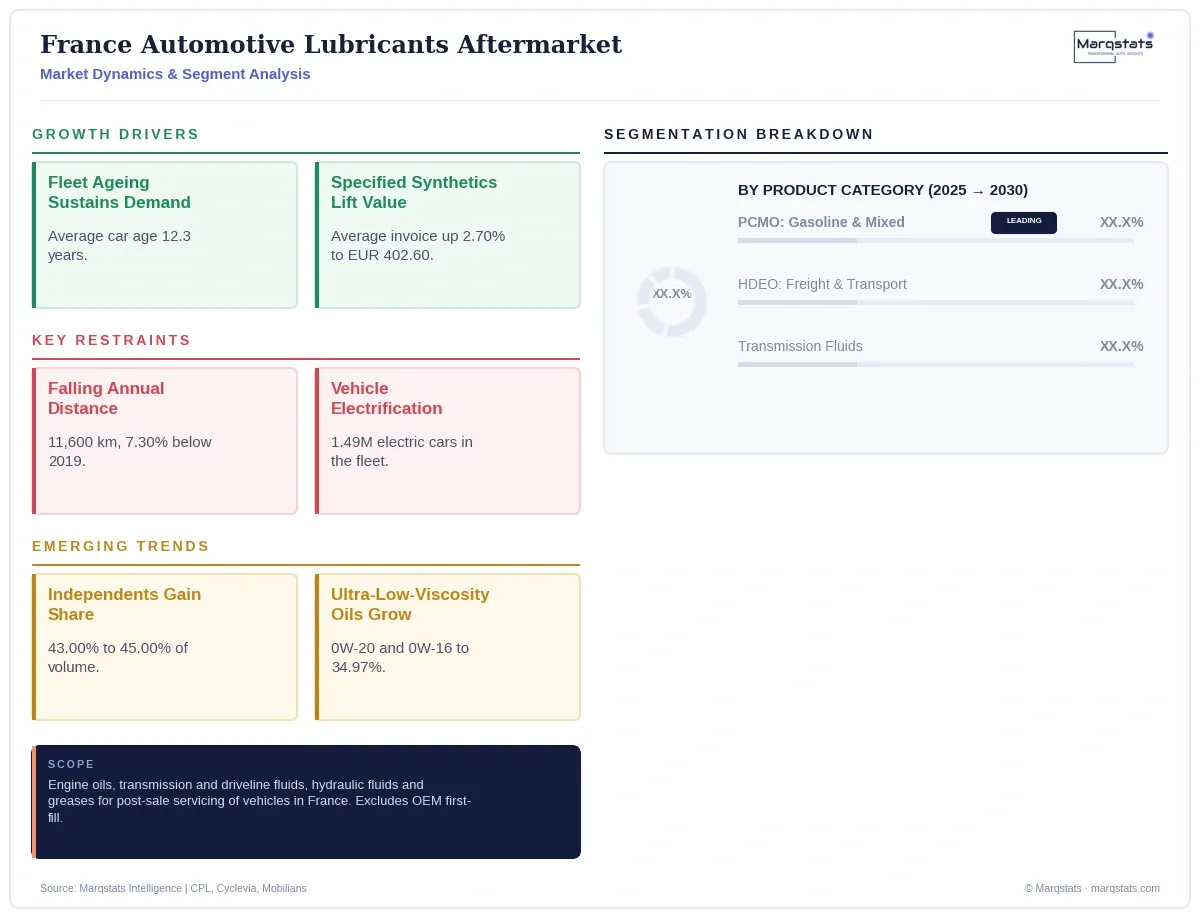
- Fleet ageing, 12.3 years on average and over 14 in rural departments, keeps demand for top-up and specialist oils and moves vehicles from dealerships to independent workshops.
- Diesel remains 46.10% of the passenger car fleet, and dedicated diesel oils grew 5.80% in 2025 as older diesels entered independent and DIY channels.
- Rising unit prices from 0W-20, 0W-16 and specification-specific oils lift value per litre, supporting a 2.70% higher average workshop invoice.
- Heavy-duty demand is stable: ageing trucks, 9.4 years on average, and a 19.10% drop in new truck registrations in early 2025 pushed hauliers toward preventive maintenance.
- Extended producer responsibility keeps used-oil costs predictable, at EUR 67 per tonne, and rewards re-refined content.
Key Restraints
- Workshop entries fell 2.20% to 40.8 a week in 2025, so each garage services fewer vehicles even as the fleet ages, which lowers the number of oil changes sold per workshop.
- Average annual distance fell to 11,600 km, 7.30% below 2019, which cuts oil changes.
- Electrification: 1.49 million battery electric cars run without crankcase oil, and the Downside Scenario reaches 14.20% of the fleet by 2030.
- Smaller sumps in modern downsized engines, 3.2 to 3.8 litres, and drain intervals of 15,000 to 30,000 km reduce litres per service.
- Low-emission zones across 42 urban areas by 2027 would restrict older diesel and petrol vehicles and speed scrappage without replacement.
Key Trends
- Independent repairers gain share, from 43.00% to 45.00% of volume, while franchised dealers fall from 28.00% to 26.00%.
- Ultra-low-viscosity 0W-20 and 0W-16 rise from 24.00% to 34.97% of passenger car oil while SAE 5W-30 falls from 45.00% to 38.36%.
- Circular products enter the mainstream: Renault and Castrol launched a co-branded re-refined oil in December 2025, Motul's NGEN line uses up to 65% regenerated base stock, and TotalEnergies packs in 50% recycled plastic.
- Workshops are adopting modular oil bars and 20-litre bag-in-box systems to hold many specifications without cutting into working capital.
Strategic Implications
- Workshop owners should plan storage for at least four active grades, 5W-30, 0W-20, 5W-40 and a low-SAPS diesel oil, and use bag-in-box or modular oil bars to avoid holding drums of slow-moving specifications.
- Blenders should secure OEM homologations, notably FPW9.55535/03 Version 2 or 3 using the Infineum P6895 route, and build low-SAPS Group III lines rather than compete in generic 10W-40 and 5W-30.
- New entrants should target certified fluids for problem platforms, e-fluids for thermal management and e-transmissions, and closed-loop products with re-refined base oil that earn Cyclevia discounts.
- Distributors should align stock with high-turnover OEM specifications and supply modular storage, and workshops should add transmission fluid exchanges and hybrid cooling services.
- Investors should consider reverse logistics for waste oil under the Cyclevia framework and track what follows Cyclevia's 2022 to 2027 mandate and low-emission zone enforcement.
- Fleet operators should plan for ageing-truck maintenance and consider re-refined oils to cut carbon in Scope 3 reporting.
Outlook
The underlying research presents two scenarios tied to named regulatory and fleet triggers. Both sets of endpoints and CAGRs were recomputed; the Base volume CAGR computes to -1.82% and not the -1.81% stated in the source.
Under the Base Scenario, fleet electrification proceeds steadily, battery electric cars reach about 9.50% of the fleet by 2030 and leave over 38 million combustion and hybrid vehicles in service, and the average car age stays between 12.0 and 12.5 years. Cyclevia's eco-contribution stays at EUR 65 to 70 per tonne and re-refined base oil reaches 18.00% of the mix. Volume falls to 227,200 tonnes, a -1.82% CAGR, and installed value rises to USD 2,898.72 million (EUR 2,684 million), a 1.72% CAGR. Wholesale value rises 1.16% a year to USD 1,424.52 million.
Under the Downside Scenario, low-emission zones are fully enforced in all 42 urban areas of over 150,000 residents by 2027, corporate fleet electrification mandates under the Green Industry Law accelerate van electrification, and battery electric cars pass 35% of new sales by 2028 and 14.20% of the fleet by 2030. The average car age falls to 10.8 years. Volume falls to 208,500 tonnes, a -3.49% CAGR, and installed value falls to USD 2,586.60 million (EUR 2,395 million), a -0.57% CAGR.
Market Segmentation
134,140 tonnes (53.87% share) in 2025, moving to 126,500 tonnes (55.68% share) by 2030. The core category; contracts as electrification and lower mileage reduce oil changes.
17,200 tonnes (6.91% share) in 2025, moving to 12,200 tonnes (5.37% share) by 2030. Grew 5.80% in 2025 as older diesels moved to independent and DIY channels, but declines 6.63% a year to 2030.
46,470 tonnes (18.66% share) in 2025, moving to 42,500 tonnes (18.71% share) by 2030. Supported by ageing trucks averaging 9.4 years and preventive maintenance.
39,930 tonnes (16.04% share) in 2025, moving to 36,000 tonnes (15.84% share) by 2030. ATF sales fell 18% in 2025 on inventory rebalancing and longer dealer intervals.
11,260 tonnes (4.52% share) in 2025, moving to 10,000 tonnes (4.40% share) by 2030. The smallest category and the steepest decline, at 2.35% a year.
114,540 tonnes (46.00% share) in 2025, moving to 118,140 tonnes (52.00% share) by 2030. The majority and growing; imported from Spain, the Middle East and Korea.
59,760 tonnes (24.00% share) in 2025, moving to 47,710 tonnes (21.00% share) by 2030. Standard in modern heavy-duty oils; declining.
32,370 tonnes (13.00% share) in 2025, moving to 40,900 tonnes (18.00% share) by 2030. Driven by Cyclevia eco-modulation discounts; collected domestically.
27,390 tonnes (11.00% share) in 2025, moving to 11,360 tonnes (5.00% share) by 2030. Legacy driveline and heavy commercial use; more than halved by 2030.
14,940 tonnes (6.00% share) in 2025, moving to 9,090 tonnes (4.00% share) by 2030. High-performance and EV thermal uses.
107,070 tonnes (43.00% share) in 2025, moving to 102,240 tonnes (45.00% share) by 2030. Autodistribution, Alliance Automotive Group and Eurorepar; EUR 1,085.0 million of installed value in 2025.
69,720 tonnes (28.00% share) in 2025, moving to 59,070 tonnes (26.00% share) by 2030. Stellantis &You, Renault Retail Group and Emil Frey; EUR 764.0 million; keep vehicles for the first four years.
47,310 tonnes (19.00% share) in 2025, moving to 45,440 tonnes (20.00% share) by 2030. Mobivia (Norauto, Midas), Feu Vert and Speedy; EUR 444.0 million; fixed-price oil change packages.
24,900 tonnes (10.00% share) in 2025, moving to 20,450 tonnes (9.00% share) by 2030. E.Leclerc, Carrefour, Autodoc and Oscaro; EUR 172.0 million; mainly top-ups.
By Geography
National Coverage
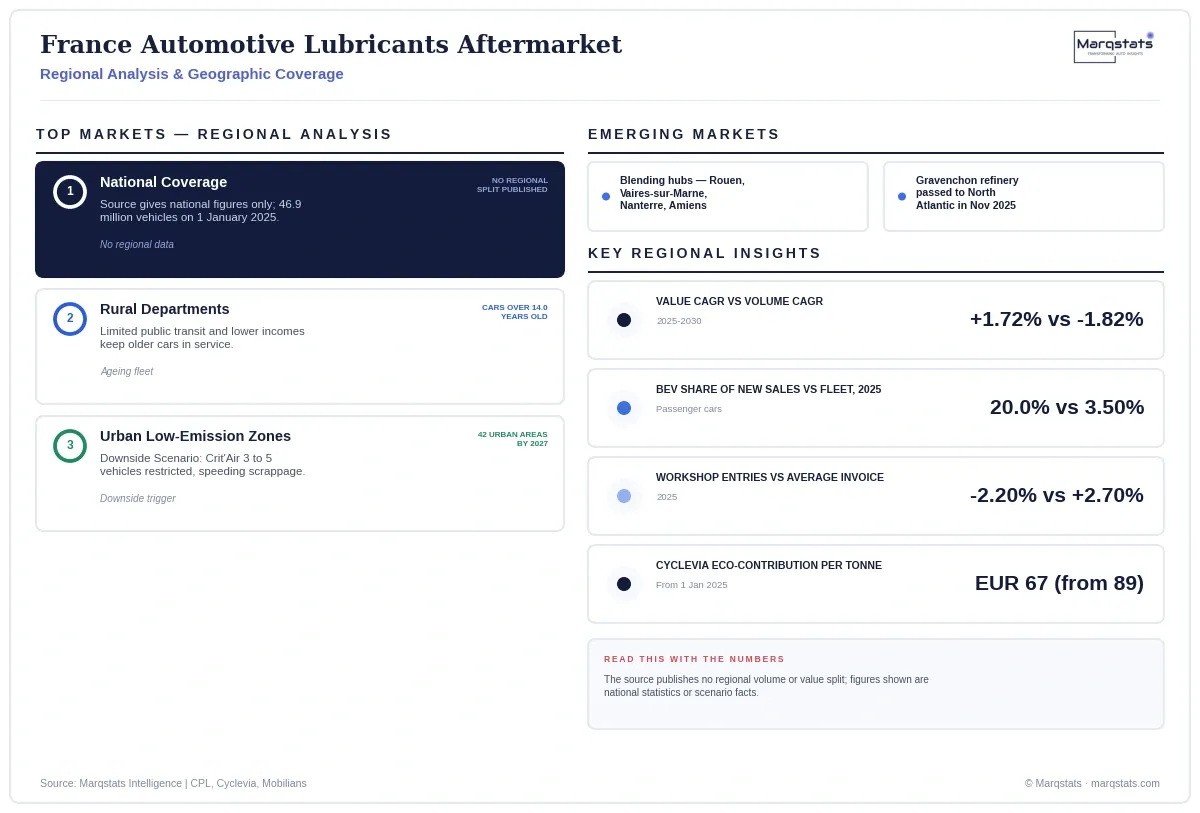
The source does not provide a regional split of volume or value, and none is estimated here. The 2025 fleet census counts 46.9 million vehicles as of 1 January 2025, of which 42.5 million are passenger cars, and reports only two geographic facts: the average passenger car age exceeds 14.0 years in rural departments, and low-emission zones are planned for all 42 urban areas above 150,000 residents by 2027 in the Downside Scenario.
Rural Departments
Rural departments, with limited public transit and lower incomes, run passenger cars averaging more than 14.0 years old against 12.3 nationally, and rely on independent repairers. Older engines burn more oil and stay in service longer.
Urban Low-Emission Zones
Under the Downside Scenario, full enforcement of the ZFE-m low-emission zones in 42 urban areas of more than 150,000 residents by 2027 restricts Crit'Air 3, 4 and 5 vehicles, speeds scrappage and cuts addressable oil volume to 208,500 tonnes by 2030.
Blending and Supply Locations
Blending capacity sits in Rouen (TotalEnergies and Yacco), Vaires-sur-Marne (Motul), Nanterre and Rueil-Malmaison (Fuchs), Amiens (IGOL) and Saumur (Unil Opal). The Gravenchon refinery, with Group I and specialty base oil units, passed to North Atlantic in November 2025.
How Competition Is Evolving
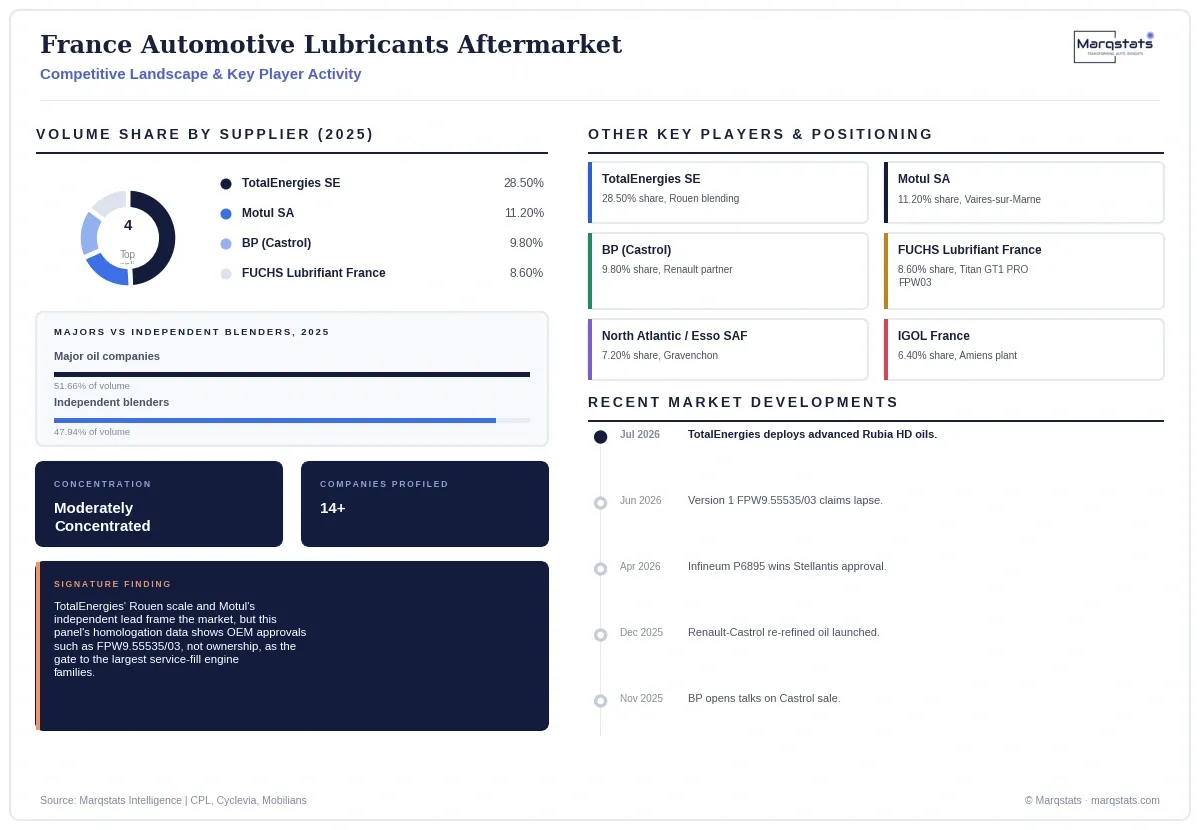
The market splits between integrated energy groups and independent blenders. Majors hold 51.66% of volume, independent blenders 47.94% and toll blenders 0.40%. TotalEnergies leads at 28.50% (Rouen blending), followed by Motul at 11.20%, Castrol at 9.80%, Fuchs at 8.60%, North Atlantic and Esso at 7.20%, IGOL at 6.40%, Shell at 6.10%, Unil Opal at 4.80%, Yacco at 3.50%, Liqui Moly at 3.10% and private labels at 10.70%. The listed shares sum to 99.9%. The top five hold about 65%.
OEM alliances shape access: Renault works with Castrol, and Stellantis with TotalEnergies and Mopar. Independent blenders reach workshops through independent parts groups such as Autodistribution, Alliance Automotive Group and Eurorepar and through fast-fit chains. Motul opened a 45,000 square metre logistics hub in Nangis in June 2026, and Fuchs sells Titan GT1 PRO FPW03 5W-30 for Stellantis engines and the Gear+ transmission fluid exchange system.
Two ownership events are reshaping supply: BP began talks on selling Castrol, valued at about USD 8 billion, in November 2025, and ExxonMobil completed the sale of Esso SAF's Gravenchon refinery and base oil units to North Atlantic in the same month. Approvals, not base oil ownership, decide who can supply the largest service-fill engine families.
Companies Covered
Companies covered in the report include:
Recent Market Activity
Table of Contents
Coverage & Segmentation
The analysis measures passenger car and heavy-duty engine oils, transmission and driveline fluids, hydraulic fluids and greases used to service on-road vehicles after factory delivery in France, for a 2025 base year and a 2026 to 2030 forecast, in United States dollars at 1.080 per euro. The headline value is installed retail, including workshop markups and VAT. OEM first-fill and non-automotive lubricants are excluded.
The analysis covers four segmentation dimensions, product, base stock, channel and passenger car viscosity, and 14 profiled entities. The source gives no regional split. Volumes in each dimension partition exactly to 249,000 tonnes in 2025 and 227,200 tonnes in 2030.