Market Snapshot
Middle bar: base-year value × (1 + CAGR), rounded to two decimals. This is a calculated illustration, not a separately researched annual estimate.
The global automotive AI safety certification market size is estimated at USD 2,350.00 million in 2025 and is projected to reach USD 8,890.00 million by 2030, growing at a CAGR of 30.49% over 2026 – 2030. Growth comes from new rules that make independent checks of AI driving software part of vehicle approval, led by ISO/PAS 8800, UN Regulation No. 171 and the EU AI Act.
Marqstats defines the market as third-party services that assess the safety of artificial intelligence and machine learning software in road vehicle functions. It covers safety audits and process consulting against ISO/PAS 8800, ISO 26262 and ISO 21448, virtual simulation and hardware- and software-in-the-loop testing, type-approval and homologation audits, and continuous in-service monitoring. Vehicles, sensors, chips, base simulation software licences, in-house engineering, roadworthiness inspections and crash testing are excluded.
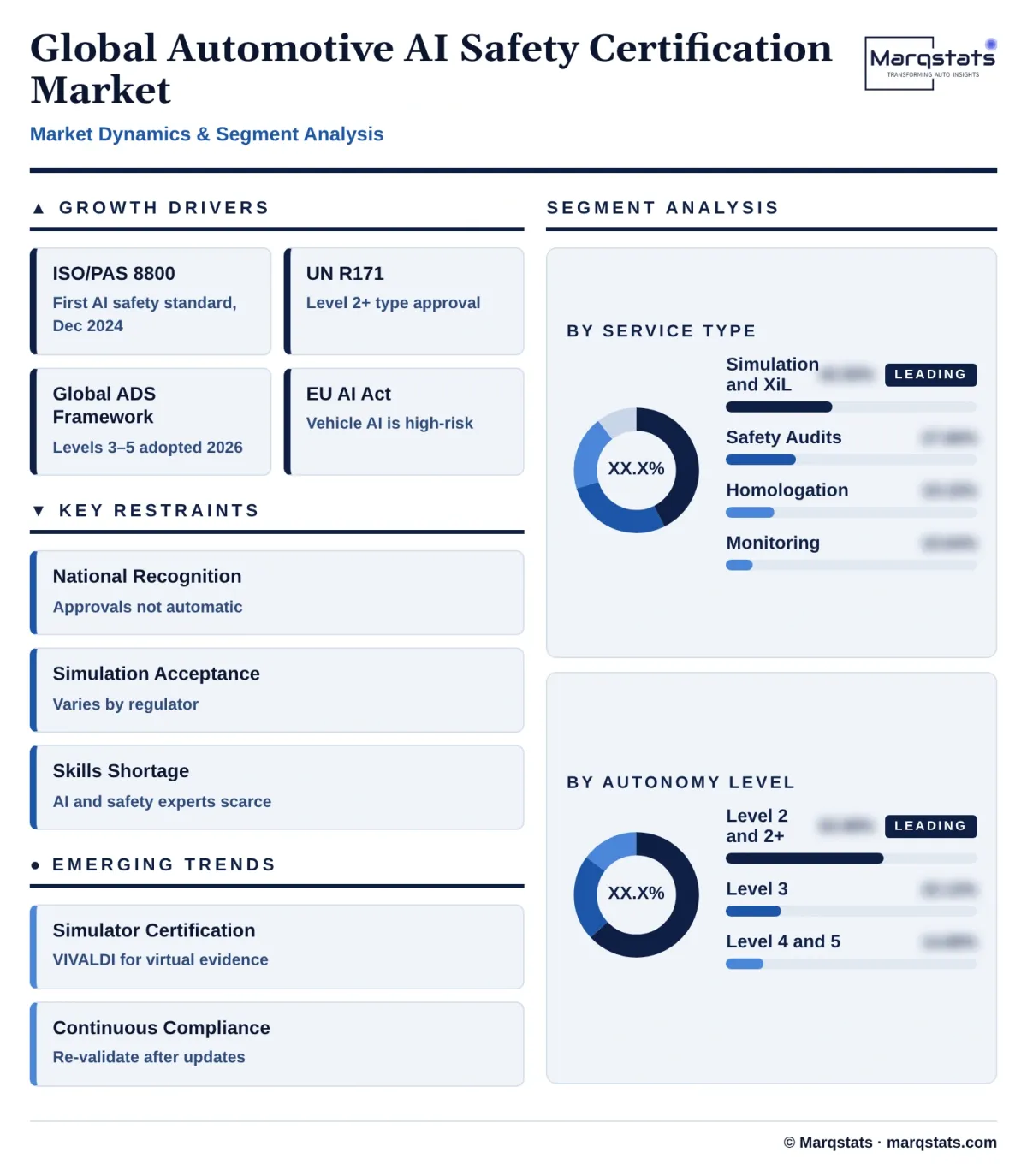
Virtual simulation and in-the-loop testing account for an estimated 42.55% of 2025 value, safety audits for 27.66%, homologation for 19.15% and continuous monitoring for 10.64%. Level 2 and Level 2+ driver assistance systems generate 62.98% of revenue. Europe accounts for 40.00% of 2025 value and Asia-Pacific for 35.00%. The study segments the market by service type, autonomy level, AI application and region.
Key Takeaways
Market Overview & Analysis
Report Summary
Marqstats sizes the automotive AI safety certification market as spending on independent services that assess the safety of AI and machine learning software in vehicles. It includes audits of development processes against ISO/PAS 8800 and related standards, safety of the intended functionality assessments under ISO 21448, simulation and in-the-loop testing, certification of simulation tools, type-approval audits under UN regulations and the EU AI Act, and monitoring of vehicles in use. In 2025 the market was worth an estimated USD 2,350.00 million.
Traditional safety standards were built for predictable software. ISO 26262 addresses hardware faults and coding errors, assuming correct engineering produces predictable behaviour. AI models can behave unsafely without any fault, because of gaps in training data or unusual inputs. ISO/PAS 8800 adds requirements for safety arguments, dataset quality, hazard analysis of AI limitations and monitoring after deployment.
The market sits within a larger testing industry. Automotive testing, inspection and certification is worth about USD 28.6 billion a year, software, electronics and connected vehicle testing about USD 8.5 billion, and driver assistance and automated driving validation about USD 4.8 billion. AI safety assurance is the fastest-growing layer, driven by new regulations.
Marqstats estimates that independent AI safety assurance accounts for about 8.2% of carmaker and supplier spending on driver assistance and automated driving software. A one percentage point change in this ratio shifts the 2025 market by about USD 286.50 million. The most important variable is how far regulators accept simulation results in place of physical tests.
Assurance work follows the AI lifecycle. Certifiers check how training and test data are collected, labelled and balanced, how models are trained and compressed for in-vehicle chips, how hazards from AI limitations are analysed, how the system behaves at the limits of its operating domain, and how performance is monitored and re-approved after updates.
The market grew from USD 780.00 million in 2021 to USD 1,020.00 million in 2022, USD 1,340.00 million in 2023 and USD 1,760.00 million in 2024. Marqstats expects USD 3,120.00 million in 2026, USD 4,100.00 million in 2027, USD 5,350.00 million in 2028 and USD 6,920.00 million in 2029 as new rules for automated driving and AI take effect.
Global Automotive AI Safety Certification Market Size and Forecast
The global automotive AI safety certification market grows from USD 2,350.00 million in 2025 to USD 8,890.00 million in 2030, a CAGR of 30.49%. Annual growth stays near 30% throughout the forecast, from 32.77% in 2026 to 28.47% in 2030, as new rules on driver assistance, automated driving and AI phase in.
Spending shifts from consulting to execution. Safety audits and process consulting grow at 24.57% a year to USD 1,950.00 million, while their share falls from 27.66% to 21.93% as carmakers build internal capabilities. Simulation testing, homologation audits and continuous monitoring grow faster, at about 32% to 33% a year, as compliance moves from preparation to repeated testing and approval.
Simulation reduces costs and time. Marqstats estimates that validating an automated driving system on physical roads alone would cost more than USD 1 billion per programme and take years, while a hybrid approach with about 95% of mileage in simulation cuts physical fleet costs by about 80%. Certifying simulation tools before vehicle testing can shorten development cycles by 40% to 60%.
Revenue models are changing. Traditional homologation was a one-off fee for each vehicle model. AI systems that are updated over the air need re-validation, creating recurring revenue from continuous compliance contracts in which fleet data feed certified simulation tests.
Validation volumes explain the shift. Showing that an automated driving system has a lower fatal crash rate than human drivers would require roughly 5 billion to 11 billion kilometres of driving data under varied conditions, which no physical test fleet can cover. Simulation lets developers test rare and dangerous scenarios repeatedly and identically, with physical testing reserved for checking that simulations match reality.
Company results confirm the scale of the testing industry. DEKRA reported group revenue of EUR 4.4 billion for 2025, TÜV SÜD EUR 3.6 billion, TÜV Rheinland about EUR 3.0 billion and AVL about EUR 2.0 billion, while simulation specialist Applied Intuition reported annual recurring revenue of about USD 830 million.
Market Dynamics
Key Drivers
Five forces are turning AI safety checks into a required step for vehicle approval.
- New standards define AI safety. ISO/PAS 8800:2024 requires safety arguments, dataset checks, hazard analysis and in-service monitoring for AI in vehicles, and carmakers and suppliers seek independent certification to show compliance, as Geely did with SGS-TÜV Saar in 2025.
- Type approval rules now cover advanced driver assistance. UN Regulation No. 171 entered into force in September 2024, with the 01 series in September 2025 covering system-initiated manoeuvres, and further amendments adopted in 2026 extend these to urban roads with incident reporting. Each new approval requires independent audits and tests.
- Automated driving gains a global framework. In 2026 the UN adopted a global regulatory framework for automated driving systems at Levels 3 to 5, adding audit, virtual testing and safety management requirements that technical services must assess.
- The EU AI Act classifies vehicle AI as high-risk. AI safety components in type-approved vehicles must meet high-risk requirements for risk management, data quality, logging and human oversight, assessed through the type-approval process by technical services.
- Carmakers are deploying more AI-driven features. Hands-off highway assistance, urban navigation and Level 3 systems such as Mercedes-Benz DRIVE PILOT, approved for up to 95 km/h in Germany, spread to more models, each needing validation of AI perception and planning.
Key Restraints
Four constraints shape how quickly AI safety certification can scale.
- Approval differs between countries. Although UN regulations are shared, national authorities decide whether to recognise approvals. After the Dutch approval of Tesla FSD Supervised in April 2026, other EU member states could choose to recognise it or carry out their own reviews, adding cost and delay for carmakers launching across Europe.
- Acceptance of simulation evidence varies. Regulators differ in how much simulation they accept in place of physical tests, and repeated physical testing raises costs and slows programmes.
- Skilled assessors are scarce. Certifying AI requires expertise in machine learning, data science, functional safety and regulation, and testing bodies compete with carmakers and technology companies for this talent.
- Documentation burdens are rising. AI safety cases must link datasets, training settings, test results and vehicle-level hazard controls, and regulators expect structured arguments using methods such as Goal Structuring Notation. Smaller suppliers can struggle with the cost of preparing this evidence.
- US carmakers self-certify. In the United States, carmakers certify their own compliance and NHTSA acts after vehicles reach the market, so independent AI certification is voluntary and spending is lower than in Europe.
Key Trends
Four shifts are changing how automotive AI is tested, audited and approved.
- Testing bodies are certifying simulation tools. TÜV SÜD's VIVALDI framework assesses whether simulation platforms produce reliable evidence for approval, and Applied Intuition became one of the first simulation providers to earn it, allowing virtual results to support type approval.
- Physical and virtual testing are converging. Proving ground operators such as Applus+ IDIADA and HORIBA MIRA combine track testing with digital twins, while simulation companies seek accreditation, creating integrated validation services.
- Certification is moving to continuous compliance. Fleet data from vehicles in use feed back into certified simulation tests, letting carmakers re-validate AI models after updates and creating recurring contracts for certifiers.
- Driver monitoring is becoming part of AI certification. EU rules require driver drowsiness and attention monitoring, and UN Regulation No. 171 requires checks that drivers remain engaged, so certifiers validate camera-based AI that tracks eyes and attention as well as driving functions.
- Chinese carmakers seek international certificates. Geely's ISO/PAS 8800 certificate and Lotus Technology's UN Regulation No. 171 certification for the Eletre show Chinese carmakers using international certification to support exports to Europe and other markets.
Strategic Implications
- For carmakers, integrated safety cases are essential. Linking functional safety, intended functionality safety and AI safety work, with traceability from training data to vehicle-level hazards, makes type approval faster and reduces the risk of rejection.
- For carmakers, certifying tools early saves time. Qualifying simulation toolchains with an accredited technical service before vehicle testing lets more evidence be generated virtually and shortens development.
- For insurers and fleet operators, certification evidence supports risk decisions. Independent AI safety certificates and monitoring records help insurers price automated driving risk and help fleet operators choose systems.
- For testing bodies, software skills determine growth. Value is shifting from physical proving grounds to dataset audits, algorithm verification and simulation credibility assessment, and bodies that offer combined UN and EU AI Act packages will win more work.
- For simulation providers, accreditation is a selling point. Certifications such as ISO 26262 tool qualification and VIVALDI turn simulation software into accepted regulatory evidence, embedding it in carmakers' approval processes.
- For suppliers, certified components ease approval. Tier-1 suppliers and software licensors that bring ISO/PAS 8800 certification and certified simulation evidence for their AI components make it easier for carmakers to complete vehicle approval and gain an advantage in sourcing decisions.
- For regulators, mutual recognition reduces cost. Clear rules for recognising approvals across countries and for accepting simulation evidence would cut duplication and speed the safe introduction of new features.
Market Segmentation
Simulation, software-in-the-loop and hardware-in-the-loop testing account for 42.55% of 2025 value, USD 1,000.00 million, rising to USD 4,100.00 million and 46.12% of the market by 2030, a 32.60% CAGR. AVL, dSPACE and Applied Intuition are leading providers, and certified simulation increasingly replaces physical test mileage.
Audits and consulting on ISO/PAS 8800, ISO 26262 and ISO 21448 compliance account for 27.66% of 2025 value, USD 650.00 million, rising to USD 1,950.00 million by 2030, a 24.57% CAGR, while the share falls to 21.93% as carmakers build internal capabilities. SGS-TÜV Saar, TÜV Rheinland and UL Solutions are active providers.
Type-approval audits, prototype evaluations and documentation reviews under UN regulations and the EU AI Act account for 19.15% of 2025 value, USD 450.00 million, rising to USD 1,800.00 million and 20.25% of the market by 2030, a 31.95% CAGR. TÜV SÜD, DEKRA and Applus+ IDIADA are leading technical services.
Monitoring of vehicles in use, drift detection and re-validation after updates account for 10.64% of 2025 value, USD 250.00 million, and grow fastest, at 32.99% a year, to USD 1,040.00 million and 11.70% of the market by 2030, driven by ISO/PAS 8800 and new UN incident reporting requirements.
Driver assistance systems with continuous steering and speed control, approved under UN Regulation No. 171, account for 62.98% of 2025 value, USD 1,480.00 million, rising to USD 4,000.00 million by 2030, a 22.00% CAGR, while the share falls to 45.00%. Hands-off highway assistance and urban navigation on mass-market cars drive volume.
Conditional automation systems such as Mercedes-Benz DRIVE PILOT, approved under UN Regulation No. 157, account for 22.13% of 2025 value, USD 520.00 million, rising to USD 2,670.00 million and 30.03% of the market by 2030, a 38.71% CAGR, as takeover, minimal risk manoeuvre and driver availability checks are validated.
Highly and fully automated systems for robotaxis, shuttles and freight account for 14.89% of 2025 value, USD 350.00 million, and grow fastest, at 44.70% a year, to USD 2,220.00 million and 24.97% of the market by 2030, because removing the driver requires extensive validation for each platform.
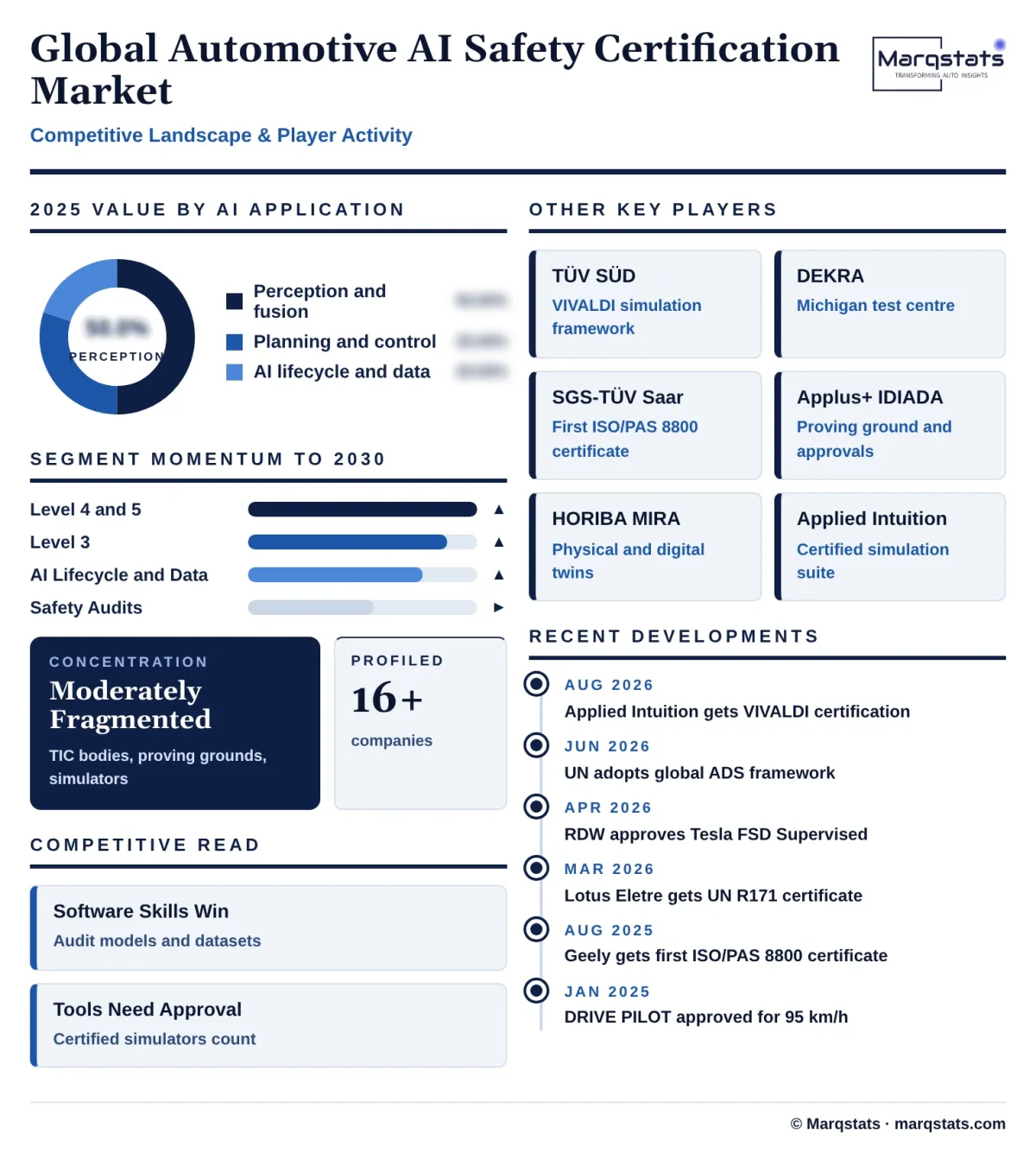
Validation of perception and sensor fusion against weather, lighting, blocked views and unusual objects accounts for 50.00% of 2025 value, USD 1,175.00 million, rising to USD 4,000.00 million by 2030, a 27.76% CAGR, while the share falls to 45.00%.
Verification that planning and control software produces safe paths and fallback manoeuvres accounts for 30.00% of 2025 value, USD 705.00 million, rising to USD 2,845.00 million and 32.00% of the market by 2030, a 32.18% CAGR.
Audits of training datasets, synthetic data, model compression and continuous retraining pipelines account for 20.00% of 2025 value, USD 470.00 million, and grow fastest, at 34.19% a year, to USD 2,045.00 million and 23.00% of the market by 2030.
By Geography
Europe
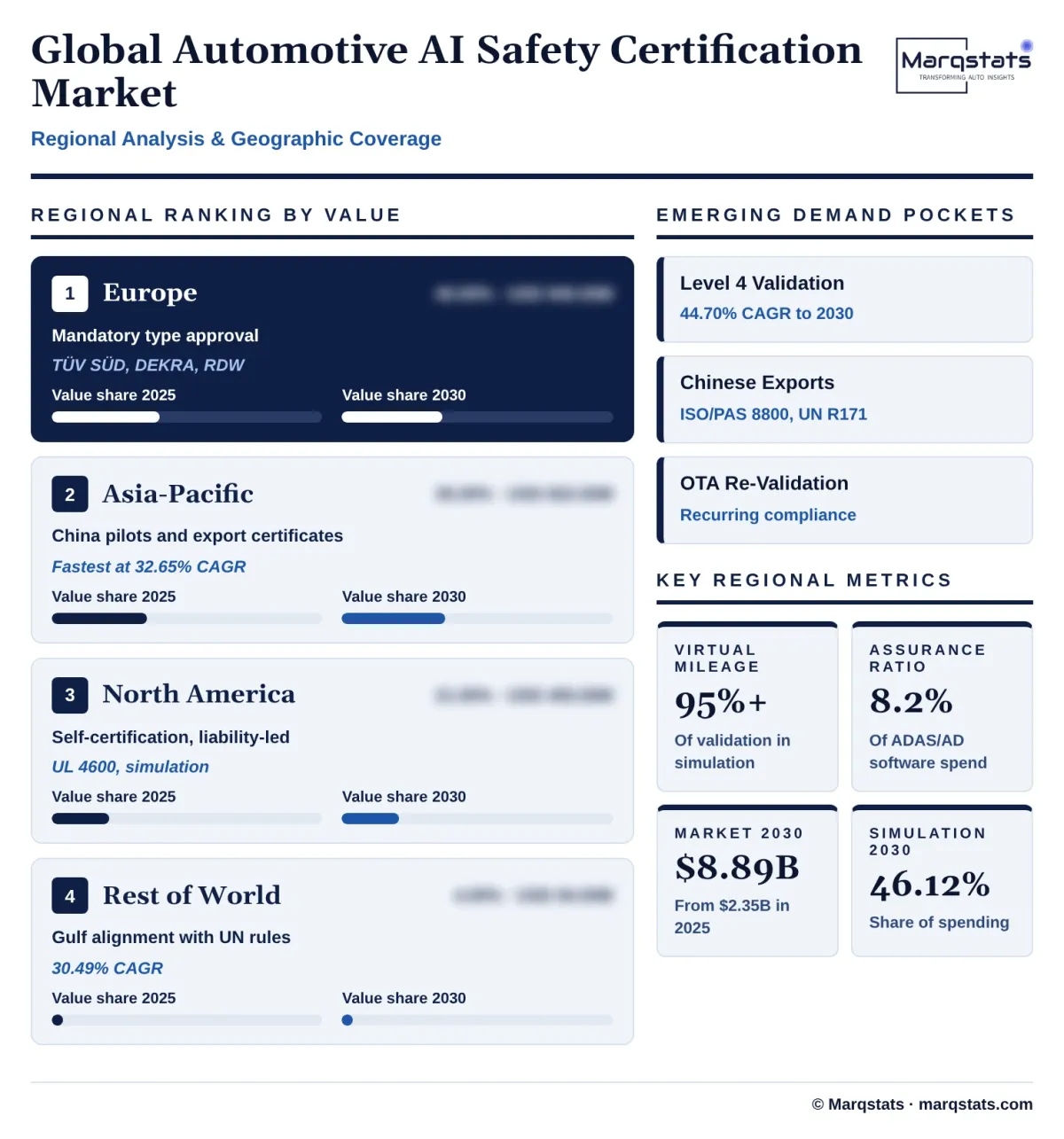
Europe is the largest market, with an estimated 40.00% of 2025 value, USD 940.00 million, rising to USD 3,289.30 million by 2030, a 28.47% CAGR, while its share falls to 37.00%. Carmakers must obtain type approval through designated technical services before sale, with approvals recognised across EU member states. The EU AI Act and UN Regulation No. 171 add AI-specific requirements, and the Dutch RDW's approval of Tesla FSD Supervised in April 2026 made the Netherlands a focus for advanced driver assistance approvals.
Asia-Pacific
Asia-Pacific accounts for an estimated 35.00% of 2025 value, USD 822.50 million, and grows fastest, at 32.65% a year, to USD 3,378.20 million and 38.00% of the market by 2030, overtaking Europe. China's pilot programmes for Level 3 and robotaxi operation, and Chinese carmakers' pursuit of international certification for exports, drive demand. Japan and South Korea align their rules with UN regulations, and India's ARAI is building driver assistance validation laboratories.
North America
North America accounts for an estimated 21.00% of 2025 value, USD 493.50 million, rising to USD 1,866.90 million by 2030, a 30.49% CAGR. Carmakers self-certify against federal safety standards, so spending focuses on simulation toolchains, private proving grounds and voluntary assessments such as UL 4600, used to manage liability and meet state permit requirements. DEKRA opened a Michigan test centre in 2026.
Rest of World
The Middle East, Latin America and other regions account for an estimated 4.00% of 2025 value, USD 94.00 million, rising to USD 355.60 million by 2030, a 30.49% CAGR, as Gulf standards bodies and safety rating programmes align with UN regulations and robotaxi services expand in the UAE and Saudi Arabia.
How Competition Is Evolving
The automotive AI safety certification market is moderately fragmented across three groups. Global testing and certification bodies such as DEKRA, TÜV SÜD, TÜV Rheinland, SGS and UL Solutions provide audits, type approval and certification. Proving ground and engineering specialists such as Applus+ IDIADA and HORIBA MIRA provide physical and combined testing. Simulation and in-the-loop providers such as AVL, dSPACE and Applied Intuition supply the tools and services that generate most validation evidence.
Testing bodies are building software skills. TÜV SÜD developed the VIVALDI framework for simulation credibility, SGS-TÜV Saar issued the first ISO/PAS 8800 certificate, DEKRA offers combined functional safety, cybersecurity and AI services, and TÜV Rheinland provides AI management audits.
Simulation providers are seeking regulatory status. Applied Intuition's VIVALDI certification and ISO 26262 tool qualification allow its simulations to support approval filings, while dSPACE and AVL supply in-the-loop systems widely used by carmakers and suppliers.
Partnerships are reshaping the market. Neither physical testing nor uncertified simulation can provide complete assurance alone, so testing bodies, proving grounds and simulation companies are forming partnerships that combine accredited approval with large-scale virtual testing, as with TÜV SÜD and Applied Intuition and HORIBA MIRA with Tier IV for Level 4 bus validation.
Competition will be decided by accreditation, software depth and global reach. Providers that hold technical service designations in major markets, can audit AI models and datasets, and certify simulation tools will win the largest programmes as rules tighten.
Companies Covered
Companies covered in the report include:
Recent Market Activity
Table of Contents
Coverage & Segmentation
The study covers the global automotive AI safety certification market, with 2025 as the base year, 2021 – 2025 as the historical period and 2026 – 2030 as the forecast period. Values are in US dollars. The market covers third-party safety audits, simulation and in-the-loop testing, homologation and type-approval audits, and continuous monitoring for AI and machine learning software in road vehicles. It is segmented by service type, autonomy level, AI application and region.
Vehicles, sensors, chips, base simulation software licences, in-house engineering, roadworthiness and emissions testing and crash testing are excluded. Segment and regional splits are Marqstats estimates built on testing company results, regulatory timelines, driver assistance and automated driving software spending and assurance intensity benchmarks.