Market Snapshot
Middle bar: base-year value × (1 + CAGR), rounded to two decimals. This is a calculated illustration, not a separately researched annual estimate.
The India software-defined vehicle (SDV) and zonal E/E architecture market was valued at approximately USD 4.5 billion in 2025 and is projected to reach USD 10.2 billion by 2030, expanding at a CAGR of 17.78% over 2026–2030. Growth is attributed to three converging forces: a regulatory compliance clock built on cybersecurity and software-update mandates, the migration of vehicle electrical and electronic architecture from domain to zonal designs, and India's position as a global hub for automotive software engineering. The regulatory framework is set out in draft amendments to the Central Motor Vehicle Rules issued by the Ministry of Road Transport and Highways.
The market is structured across three layers: SDV content fitted in vehicles sold in India, comprising zonal controllers, high-performance computers, over-the-air infrastructure, and software licenses; compliance software for cybersecurity and software-update management; and India-based SDV engineering services delivered by domestic and captive centres. The engineering-services layer is the largest component, reflecting an automotive research-and-development base that draws on around one million research-and-development engineers, per NASSCOM estimates.
Regulation is the near-term catalyst. Draft amendments introduce Rule 125-T for cybersecurity management and Rule 125-U for software-update management, aligning India with United Nations frameworks. AIS-189 applies to new vehicle types from October 2025 and to all types from October 2028, while a full advanced-driver-assistance suite pulls through additional SDV software content from 2026. Software-defined vehicles carry more than 200 million lines of code, and higher automation levels raise that count sharply.
The market is modelled bottom-up across the three layers, with domestic vehicle content ramped on the migration toward zonal architecture, compliance software counted against the regulated vehicle base, and engineering services estimated as the automotive-software share of India's research-and-development export pool. Independent assessments indicate that more than 30% of vehicles produced will carry zonal E/E architecture by 2032, per Automotive Component Manufacturers Association industry data, which anchors the long-run demand curve.
Key Takeaways
Market Overview & Analysis
Report Summary
The India software-defined vehicle and zonal E/E architecture market covers the hardware, software, and engineering services that enable vehicles to be defined and updated through software rather than fixed hardware. Scope spans zonal controllers and high-performance computers, software platforms and middleware including adaptive AUTOSAR, over-the-air and cybersecurity software, and India-based SDV engineering services. The market is anchored on the domain-to-zonal architecture transition and the AIS-189 and AIS-190 compliance framework rather than on generic connectivity, an adjacency to the Marqstats India telematics and fleet safety systems market report.
Zonal architecture consolidates the dozens of distributed electronic control units in a conventional vehicle into a smaller number of zonal controllers linked to central high-performance computers. This reduces wiring-harness length and weight, centralises compute, and enables software features to be added after sale. The transition is the structural driver of hardware content, while the software platform and over-the-air layer convert one-time sales into recurring feature and update revenue. Demand is increasing owing to electrification, advanced-driver-assistance adoption, and consumer preference for connected features.
India occupies a distinctive position. The country hosts a large automotive engineering-services industry, spanning domestic firms and the captive centres of global manufacturers and suppliers, which delivers SDV platform, middleware, and validation work for programmes worldwide. Growth is attributed to the combination of a domestic regulatory mandate, rising vehicle software content, and export demand for India-based automotive software engineering. This three-layer structure differentiates the India market from vehicle-only assessments in other geographies.
Market structure reflects the relative scale of the three layers. Engineering services account for the largest share of value in the base year, as India-based software development serves both domestic and global programmes, while domestic vehicle content and compliance software are smaller today and grow fastest as zonal architecture and the AIS-189 and AIS-190 mandates take effect. The blend shifts over the forecast period toward higher domestic vehicle content, and the reconciled estimate rises from USD 4.5 billion in 2025 toward USD 10.2 billion by 2030 as all three layers expand.
Market Dynamics
The India software-defined vehicle and zonal E/E architecture market is shaped by regulation, architecture migration, and engineering-services demand. Compliance mandates set a near-term floor, the domain-to-zonal transition drives hardware and platform content, and the export engineering base scales with global SDV programmes. The dynamics below separate these drivers from the cost, talent, and integration constraints that govern the pace of adoption.
Key Drivers
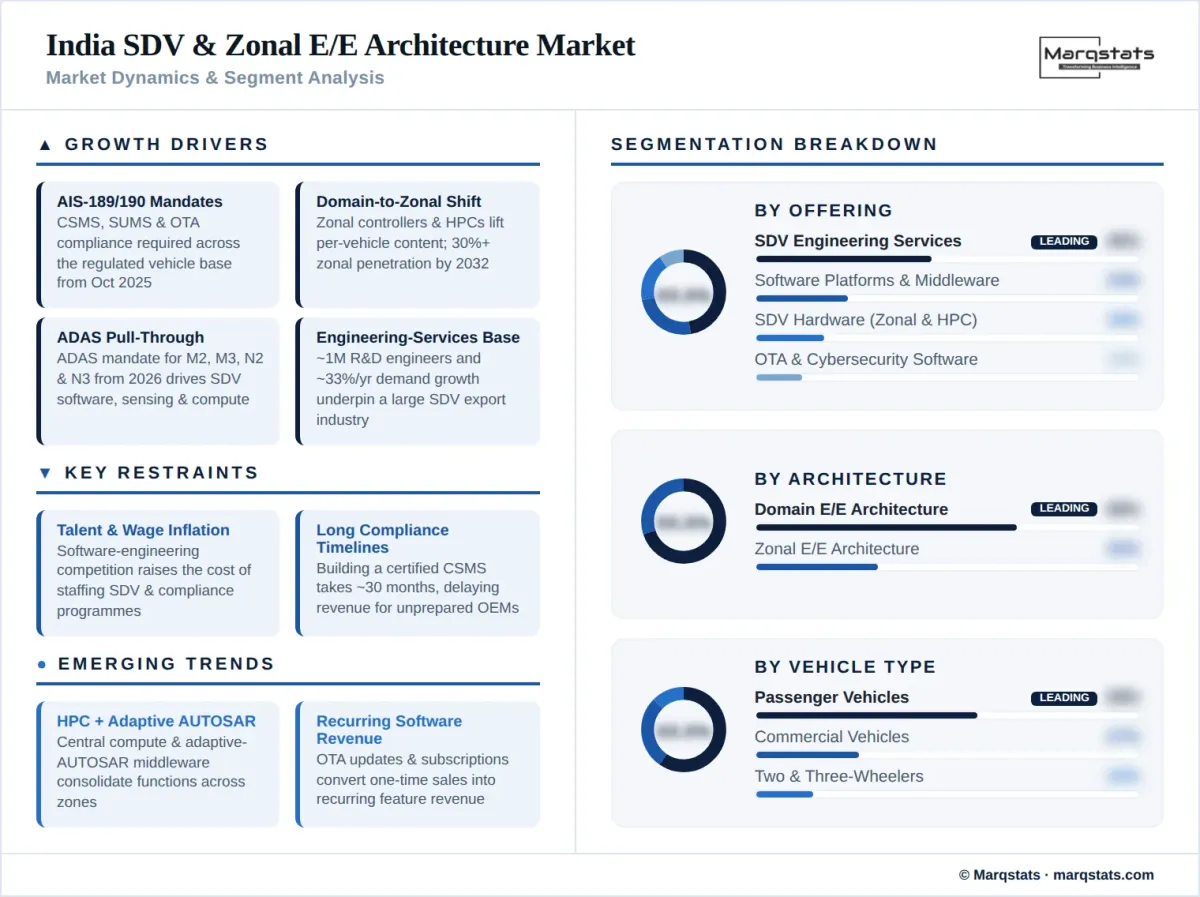
- Cybersecurity and software-update mandates under AIS-189 and AIS-190 create compliance-driven demand for CSMS, SUMS, and over-the-air software across the regulated vehicle base.
- Domain-to-zonal architecture migration raises per-vehicle content for zonal controllers, high-performance computers, and software platforms, with independent assessments indicating over 30% zonal penetration by 2032.
- Advanced-driver-assistance mandates for M2, M3, N2, and N3 vehicles from 2026 pull through SDV software, sensing, and compute content.
- India's engineering-services base, with around one million research-and-development engineers and demand growing near 33% a year, supports a large SDV export industry.
- Consumer preference for connected features and over-the-air updates, which extend vehicle life, raises OEM investment in software-defined platforms.
Key Restraints
- Software-engineering talent competition and wage inflation raise the cost of building and staffing SDV and compliance programmes.
- Long compliance-readiness timelines, as building a certified cybersecurity management system takes on the order of thirty months, delay revenue for unprepared manufacturers.
- Legacy domain architectures and fragmented ECU supply chains slow the transition to zonal designs in mass-market segments.
- Cost sensitivity in entry vehicles limits high-content zonal and compute adoption to premium and electric models in the near term.
Key Trends
- Adoption of central high-performance computers and adaptive AUTOSAR middleware to consolidate functions across zones.
- Shift toward recurring software and feature revenue through over-the-air updates and subscription services.
- Expansion of India captive centres by global manufacturers and suppliers for SDV platform and validation work.
- Convergence of cybersecurity, software-update, and functional-safety engineering into integrated compliance programmes.
Market Segmentation
Offering segmentation separates the hardware, software, and services layers that constitute the market. Engineering services form the largest layer by value, while hardware and software content scale with the architecture transition.
SDV hardware comprises zonal controllers and high-performance computers that consolidate compute and reduce wiring complexity. Content per vehicle rises as domain architectures give way to zonal designs. This layer scales with premium, electric, and advanced-driver-assistance-equipped vehicles. Zonal-controller and compute content is expected to migrate from premium into mid-market platforms as the architecture matures.
Software platforms and middleware, including adaptive AUTOSAR and vehicle operating systems, abstract hardware and enable feature portability. This layer converts vehicles into upgradeable platforms. Demand is increasing owing to the need to manage rising software complexity across zones.
Over-the-air and cybersecurity software address AIS-189 and AIS-190 compliance and enable secure remote updates. This layer is directly tied to the regulatory mandate and to the electronic content of electrified platforms, an adjacency to the Marqstats India electric vehicle components market report. Content grows with the regulated vehicle base and update frequency.
SDV engineering services cover platform development, integration, validation, and compliance work delivered from India for domestic and global programmes. This layer is the largest by value, reflecting India's deep automotive software base. Growth is attributed to export demand and to domestic compliance and platform work. India’s engineering base spans domestic service firms and the captive centres of global manufacturers and suppliers, which together deliver platform, middleware, and validation work at scale.
Architecture segmentation distinguishes established domain designs from the zonal designs that define the SDV transition. Domain architecture remains the base, while zonal architecture is the growth driver.
Domain architecture groups functions into domains such as powertrain, chassis, and infotainment, each with dedicated controllers. It remains the base architecture across mass-market vehicles. The segment declines in share as zonal designs advance, though it persists in cost-sensitive platforms where the economics of full zonal migration are not yet compelling.
Zonal architecture organises electronics by physical location, linking zonal controllers to central compute. It reduces harness length and enables software-defined features. Independent assessments indicate zonal designs will cover more than 30% of produced vehicles by 2032, making this the highest-growth segment.
Vehicle-type segmentation maps SDV content across passenger vehicles, commercial vehicles, and two- and three-wheelers. Passenger and commercial vehicles anchor high-content adoption, while two- and three-wheelers adopt lighter connected platforms.
Passenger vehicles lead SDV content adoption, driven by premium models, electric vehicles, and advanced-driver-assistance features. The segment anchors zonal-architecture and high-performance-compute demand. Consumer preference for connected features reinforces investment.
Commercial vehicles adopt SDV content through the advanced-driver-assistance mandate for M2, M3, N2, and N3 categories and through fleet software services. Growth is attributed to compliance and to fleet-management and safety applications. The segment couples regulated safety content with telematics, and fleet software services add a recurring revenue layer on top of mandated safety hardware.
Two-wheelers and three-wheelers adopt lighter connected and software-update platforms, concentrated in electric models. Content per vehicle is lower than in cars. The segment scales with electrification and connected-feature demand. Electric two- and three-wheelers increasingly adopt over-the-air update capability, extending software-defined features into high-volume urban mobility.
Application segmentation isolates the functions that drive SDV software demand, from safety and connectivity to compliance. Advanced-driver-assistance and cybersecurity applications are the primary regulated growth areas.
Advanced-driver-assistance and functional-safety applications are mandated across commercial-vehicle categories from 2026 and adopted widely in passenger vehicles. These functions drive sensing, compute, and software content. The application is a primary regulated growth area.
Infotainment and connectivity applications deliver the in-vehicle digital experience that consumers increasingly prioritise. This application drives platform and over-the-air demand. It supports recurring feature and subscription revenue. Independent assessments indicate that consumers increasingly weigh the in-vehicle digital experience alongside the vehicle itself, which raises OEM investment in this application.
Body, comfort, and powertrain control applications migrate onto zonal controllers and central compute. Consolidation reduces controller count and wiring. The application scales with zonal-architecture adoption.
Cybersecurity and software-update-management applications address AIS-189 and AIS-190 directly. They require certified management systems, secure over-the-air mechanisms, and long-term version traceability. This application is the clearest compliance-driven growth area.
By Geography
Regional distribution reflects the geography of India's automotive software engineering, concentrated in the southern and western technology hubs, alongside vehicle manufacturing that adopts SDV content. Engineering-services capacity anchors the market's largest layer in a small number of metropolitan clusters.
Southern India
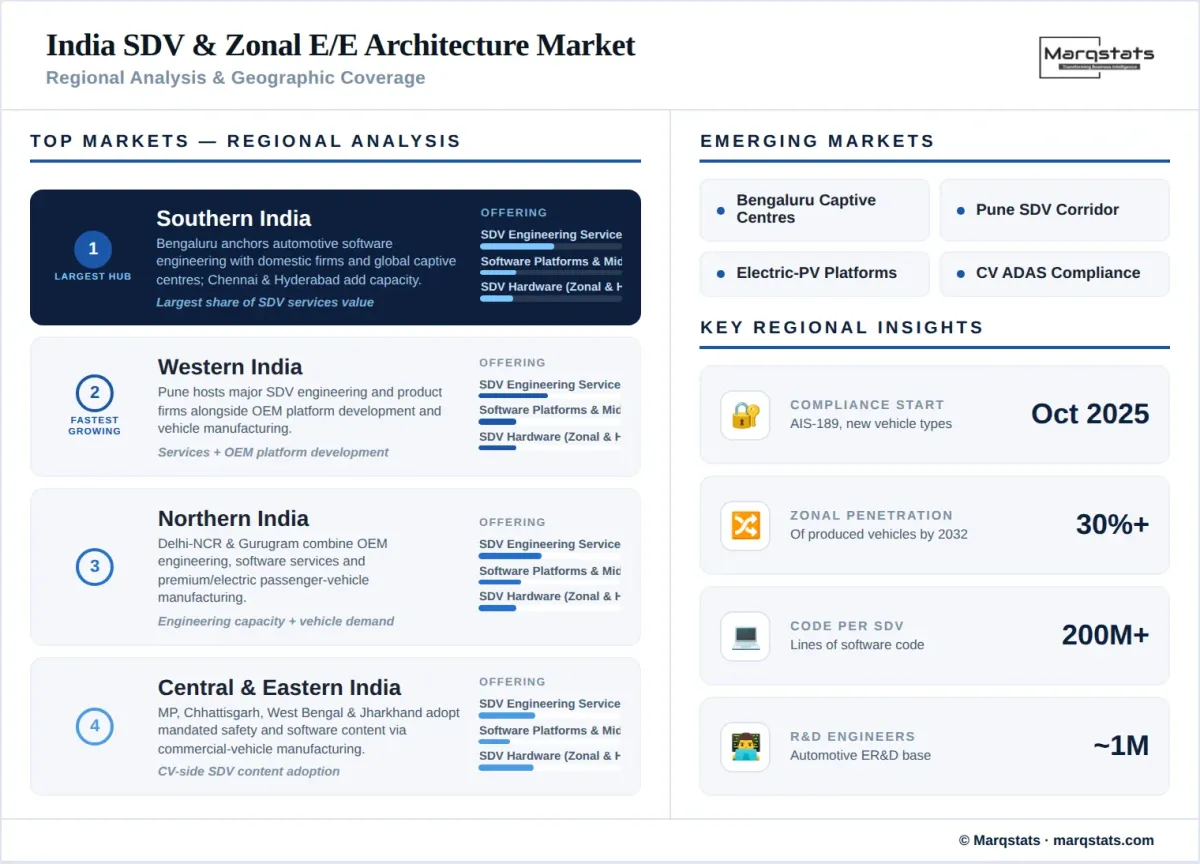
Southern India, anchored by Bengaluru, is the centre of automotive software engineering, hosting domestic firms and the captive centres of global manufacturers and suppliers. Chennai and Hyderabad add automotive and software capacity. Southern India holds the largest share of SDV engineering-services value. The concentration of talent, captive centres, and platform firms reinforces the region’s position as the country’s software-defined-vehicle hub.
Western India
Western India, led by Pune in Maharashtra, hosts major SDV engineering and product firms alongside vehicle manufacturing. The region combines software services with OEM platform development. Western India ranks among the fastest-growing for SDV engineering and content.
Northern India
Northern India, covering Delhi-NCR and Gurugram in Haryana, hosts OEM engineering, software services, and passenger-vehicle manufacturing. The region adopts SDV content through premium and electric models. It contributes both engineering capacity and vehicle-side demand.
Eastern India
Eastern India, including West Bengal and Jharkhand, contributes emerging software-services capacity and commercial-vehicle manufacturing. Growth is attributed to expanding technology clusters and fleet demand. The region supports both services and vehicle-side adoption at a smaller scale.
Central India
Central India, comprising Madhya Pradesh and Chhattisgarh, contributes commercial-vehicle manufacturing that adopts mandated safety and software content. The region's demand is vehicle-side rather than services-led. Central India scales with commercial-vehicle SDV adoption. Manufacturing clusters in the region integrate mandated safety and software-update content into new commercial-vehicle platforms.
How Competition Is Evolving
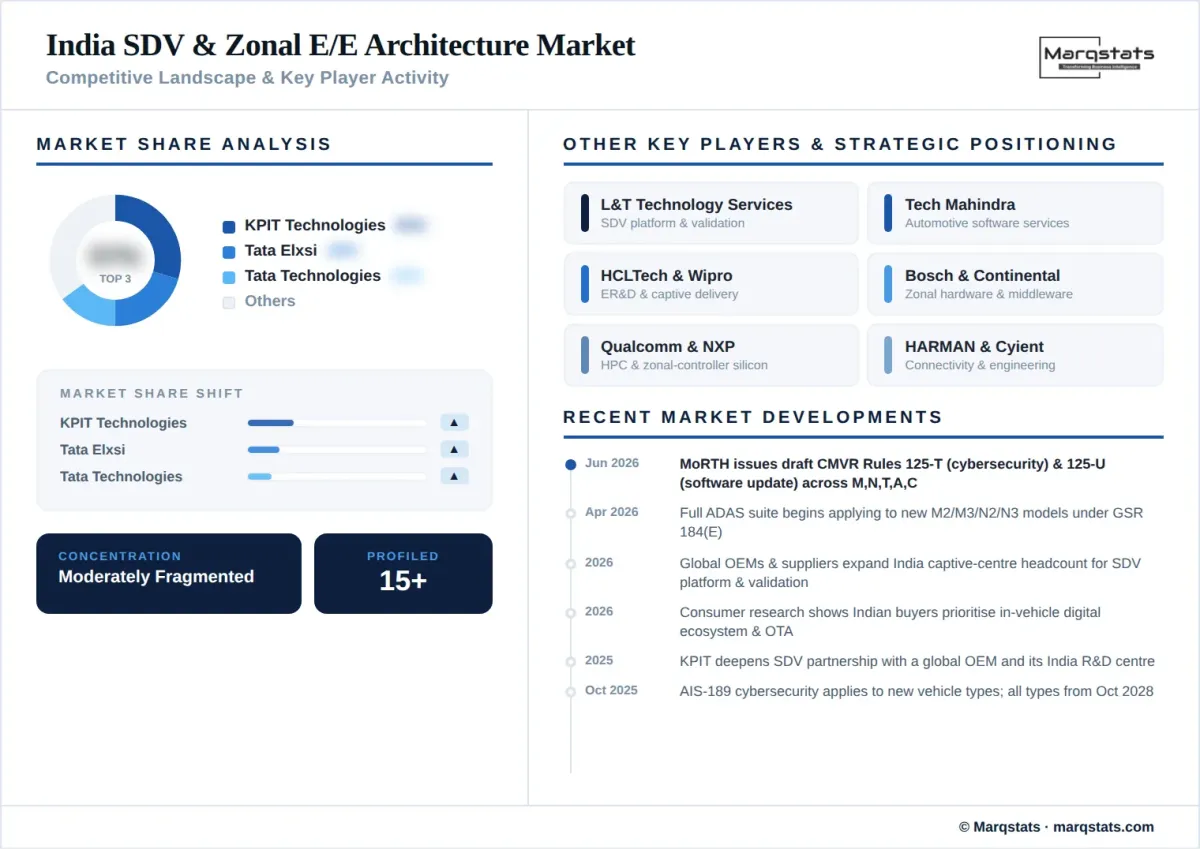
The India software-defined vehicle and zonal E/E architecture market is moderately fragmented, with a small number of large engineering-services firms and a broad base of specialists and captive centres. KPIT Technologies, Tata Elxsi, Tata Technologies, L&T Technology Services, and Tech Mahindra anchor the engineering-services layer, competing on platform depth, programme scale, and OEM relationships. Global suppliers and semiconductor firms provide the hardware and silicon foundation.
Competition centres on SDV platform capability, compliance expertise, and long-term OEM programme wins. KPIT Technologies serves as a strategic software-defined-vehicle partner to global manufacturers and collaborates with a major manufacturer's India research-and-development centre, running software across a large installed base of vehicles. Growth is attributed to multi-year platform and validation engagements and to compliance work generated by the AIS-189 and AIS-190 mandates.
Original-equipment manufacturers shape the structure through in-house software investment and sourcing strategy. Tata Motors, Mahindra, and Maruti Suzuki are building software and connected-vehicle capability, while global captive centres expand India headcount for SDV work. The near-term determinant of position is the ability to deliver compliant, zonal-ready platforms at scale, which favours firms with established automotive software depth and OEM proximity.
Semiconductor and Tier-1 suppliers underpin the hardware layer. Providers of zonal-controller and high-performance-compute silicon, together with adaptive-middleware and cybersecurity specialists, compete on performance, safety certification, and toolchain maturity. The competitive structure rewards integrated capability spanning silicon, platform software, and compliance engineering.
Companies Covered
Companies covered in the report include:
Recent Market Activity
Table of Contents
Coverage & Segmentation
This report provides a comprehensive analysis of the India software-defined vehicle and zonal E/E architecture market for the historical period 2021–2025 and the forecast window 2026–2030, with 2025 as the base year. Coverage spans SDV hardware such as zonal controllers and high-performance computers, software platforms and middleware, over-the-air and cybersecurity software, and India-based SDV engineering services, across passenger vehicles, commercial vehicles, and two- and three-wheelers. The study examines market sizing by value, segment-level forecasts by offering, architecture, vehicle type, and application, regional distribution across Indian zones, competitive positioning, and the regulatory framework that governs compliance.
The market is modelled as three layers: domestic vehicle SDV content, compliance software, and India-based engineering services. Each layer is sized with an explicit method — vehicle content on the zonal-architecture curve, compliance software against the regulated vehicle base, and engineering services as the automotive-software share of the research-and-development export pool. Deliverables include market sizing and forecasts, segment and regional splits, company profiles, and a regulatory-impact assessment. The report is intended for OEM software and strategy teams, engineering-services firms, semiconductor and Tier-1 suppliers, investors, and policy stakeholders.
The forecast provides annual estimates across the 2026–2030 window with sensitivity to three variables: the pace of zonal-architecture adoption, the enforcement timeline for cybersecurity and software-update mandates, and the growth of India-based automotive software engineering. The report connects the regulatory compliance clock, the architecture transition, and the engineering-services base as a single framework, which distinguishes it from global software-defined-vehicle assessments that treat only vehicle content. This framework supports investment decisions across silicon, platform software, and services.